Ghostly moves (From Elena Ferrante’s novel The Story of the Lost Child)

We locked ourselves in her office and sat at the computer, a kind of television with a keyboard, very different from what she had showed me and the children some time before. She pressed the power button, she slid dark rectangles into gray blocks. I waited, bewildered. On the screen luminous tremors appeared. Lila began to type on the keyboard, I was speechless. It was in no way comparable to a typewriter, even an electric one. With her fingertips she caressed gray keys, and the writing appeared silently on the screen, green like newly sprouted grass. What was in her head, attached to who knows what cortex of the brain, seemed to pour out miraculously and fix itself on the void of the screen. It was power that, although passing for act, remained power, an electrochemical stimulus that was instantly transformed into light. It seemed to me like the writing of God as it must have been on Sinai at the time of the Commandments, impalpable and tremendous, but with a concrete effect of purity. Magnificent, I said. I’ll teach you, she said. And she taught me, and dazzling, hypnotic segments began to lengthen, sentences that I said, sentences that she said, our volatile discussions were imprinted on the dark well of the screen like wakes without foam. Lila wrote, I would reconsider. Then with one key she erased, with others she made an entire block of light disappear, and made it reappear higher up or lower down in a second. But right afterward it was Lila who changed her mind, and everything was altered again, in a flash: ghostly moves, what’s here now is no longer here or is there. And no need for pen, pencil, no need to change the paper, put another sheet in the roller. The page is the screen, unique, no trace of a second thought, it always seems the same. And the writing is incorruptible, the lines are all perfectly straight, they emit a sense of cleanliness even now that we are adding the filthy acts of the Solaras to the filthy acts of half of Campania.

From Elena Ferrante’s novel The Story of the Lost Child. English translation by Ann Goldstein.

There’s a lot going on in this passage, in which the heroines of the so-called Neapolitan Novels, Elena and Lila, write an essay together using a personal computer’s word processing program (it’s the first time for Lila; I haven’t done the math here, but I think this episode might happen around 1982 or ’83). From the outset, from the earliest pages of My Brilliant Friend, Ferrante’s heroines have been preoccupied by writing, and in many ways these novels perform their own metatextual self-critiques. Not only does this passage show the experience of writing refreshed by a new technology, it also shows shows that authorship  is a shared, collaborative process, a synthesis (and fracture)—and not the act of a solitary genius. And in its final sentence, the passage points to a willed purity of writing, a stable resistance to the abjection and filth and evil that unceasingly threaten our narrator’s existence.

Self Portrait with Nude — Laura Knight

self-portrait_with_a_nude_by_dame_laura_knight

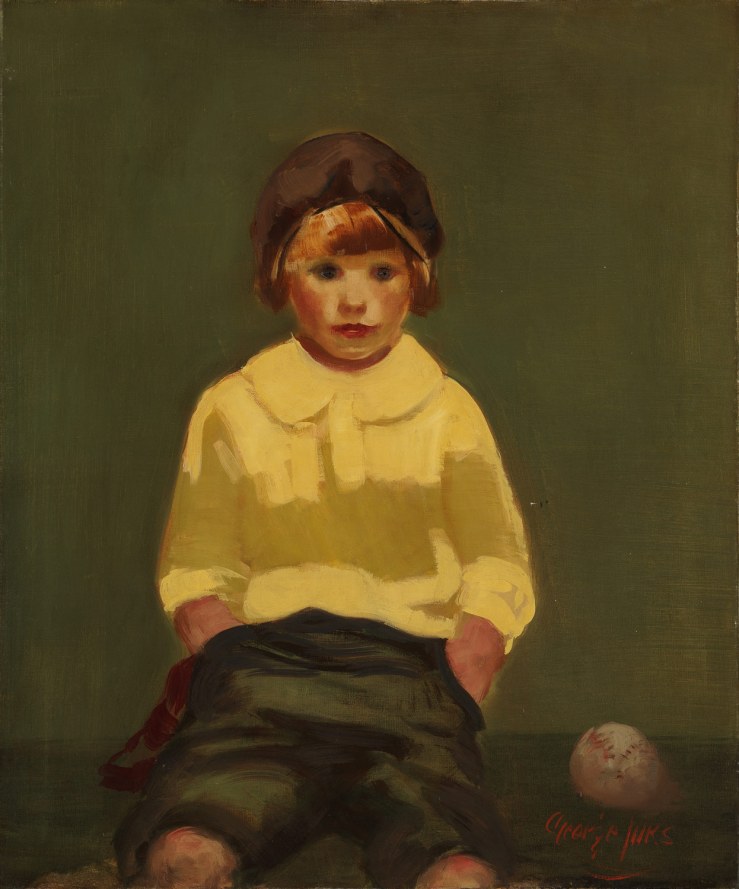
Boy with Baseball — George Luks

hb_54-10-2

Three Books

img_2567

The Sacred and Profane Love Machine by Iris Murdoch. First edition hardback, 1975 by The Book Club (Foyles Group of Book Clubs). Jacket design by Angela Maddigan.

img_2565

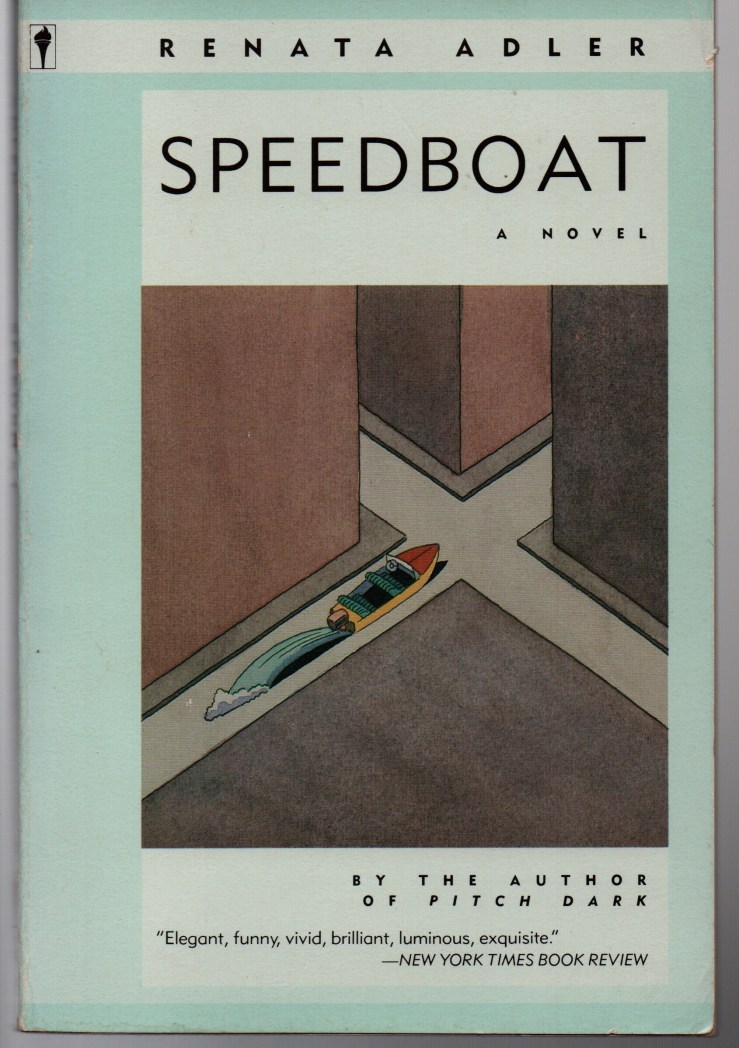
Speedboat by Renata Adler. First Perennial Library edition, 1988. Cover illustration by Steve Guarnaccia.

img_2564

Snow White by Donald Barthelme. Mass market paperback by Atheneum, 1986 (7th printing). Cover illustration by William Steig.

The Shoemaker — Jacob Lawrence

hb_46-73-2

Louis Takes Flight — F. Scott Hess

hess027

The Green Comet — Michael Hutter

tumblr_ncctksbuz21rlaql2o1_1280

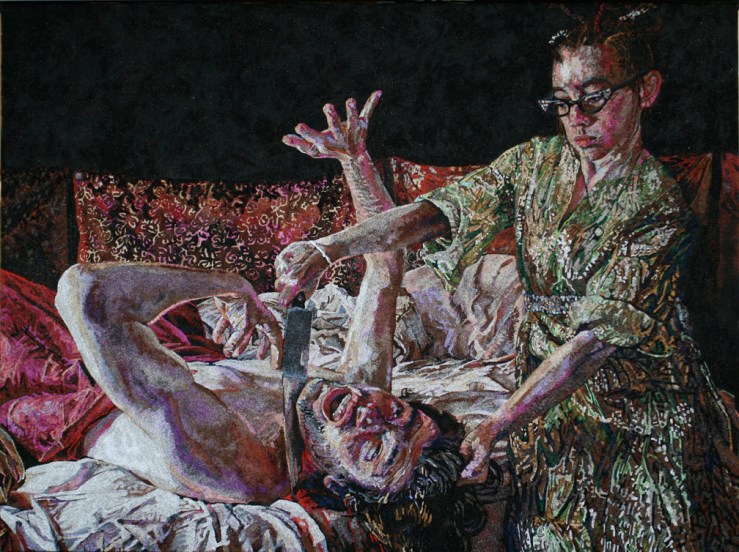
Judith and Holofernes — Jamie Vasta

giuditta

The Temptation of St. Anthony (detail) — Marten de Vos

Screenshot 2016-06-01 at 12.04.21 PM

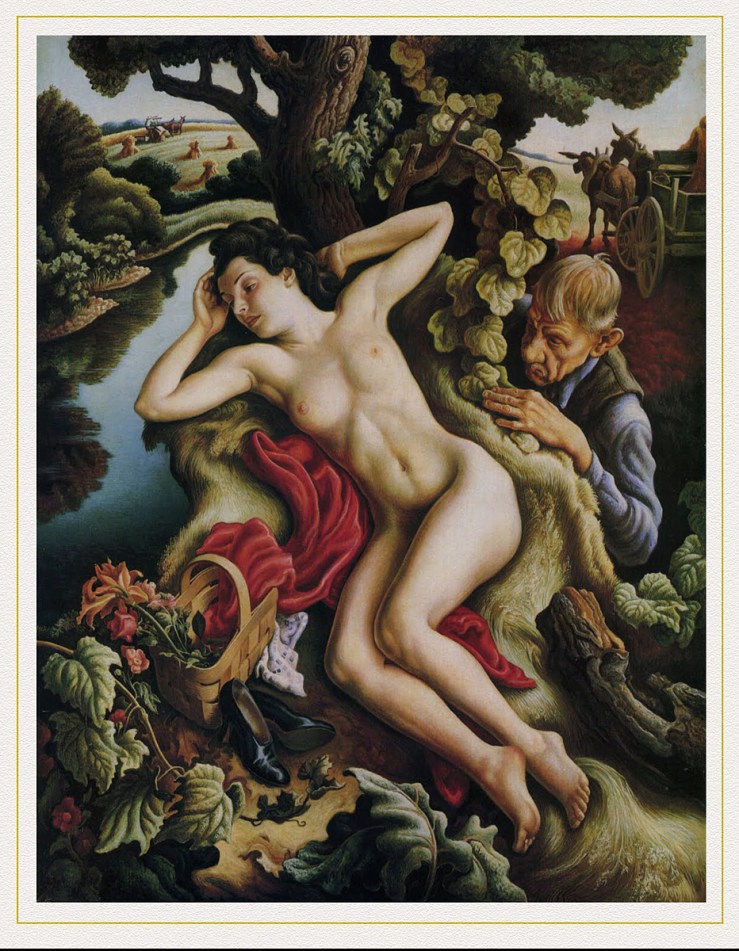
Persephone — Thomas Hart Benton

01_thomas_hart_benton_persephone_1939_100

The Temptation of St. Anthony (detail) — Marten de Vos

Screenshot 2016-06-01 at 12.00.37 PM

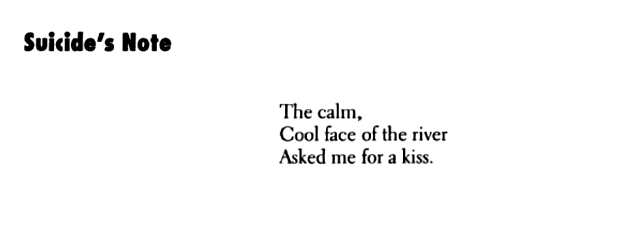
“Suicide’s Note” — Langston Hughes

Screenshot 2016-06-02 at 3

The Judgment of Paris — Dario Ortiz

darc3ado_ortiz_-_el_juicio_de_paris_o_paris_y_las_prepago

The Temptation of St. Anthony (detail) — Marten de Vos

Screenshot 2016-05-31 at 9.00.26 PM

Men will the laws of nature (From Stanley Elkin’s novel The Franchiser)

They drove up to the Broadmoor, a pink Monaco castle at the foot of the Rockies, and he showed her the hotel in a proprietary way, taking her through the nifty Regency public rooms with their beautiful sofas, the striped, silken upholstery like tasteful flags. He showed her huge tiaras of chandelier, soft plush carpets. “Yes,” she said, “carpets were our first floors, our first highways.”

“I didn’t know that.”

“We call the rug in the hall a ‘runner.’ It’s where the runners or messengers waited in the days of kings and emperors.”

“I never made the connection.”

“It’s an insight. Chandeliers must have come in with the development of lens astronomy at the beginning of the seventeenth century. I should think it was an attempt to mimic rather than parody the order of the heavens, to bring the solar system indoors.”

“Really?”

“Well, where, to simple people, would the universe seem to go during the daylight hours, Ben?”

“But chandeliers give light.”

“Not during the daytime. The chandelier is a complex invention—a sculpture of the invisible stars by day, a pragmatic mechanism by night. But a much less daring device finally than carpeting.”

“Why, Patty?”

“Because carpeting—think of Oriental rugs—was always primarily ornamental and decorative. It was a deliberate expression of what ground—our first flooring, remember, and incidentally we have to regard tile, too, as a type of carpeting—ought to be in a perfect world. Order, symmetry, design. And since rugs came in before lens telescopy, how could they know? Oh, carpeting’s much more daring. A leap of will.”

“Of will?”

“Men will the laws of nature.”

From Stanley Elkin’s 1976 novel The Franchiser.


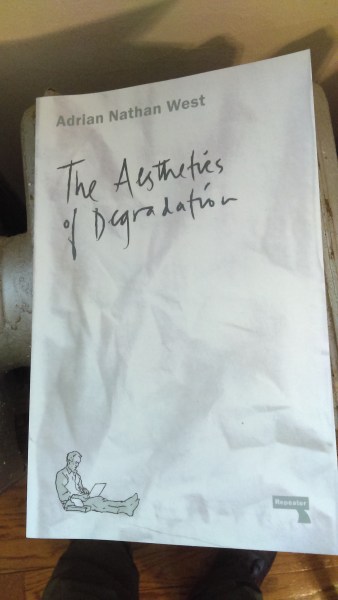
Book Acquired 6.1.16

IMAG0163


Publisher (Repeater Books) sent me this intriguing first novel, The Aesthetics of Degradation, from translator Adrian Nathan West (Franz Werfel, Josef Winkler) the other day. Working on a review of Han Kang’s Human Acts right now (which is good, uh, really good), which will be up here soon (I hope!), but looking forward to this one from Mr. West. From the back:


Pornography keeps getting more extreme. Manufacturers, defenders and consumers of porn rely on a mix of wilful [sic] ignorance and bad faith to avoid serious discussion. When we do talk about violence against women in the porn world, the debate all too often becomes technical, complicated by legalities and outrage.

[…]

Collapsing distinctions between novel, memoir, and essay, this book will not make for light reading. But at its core is an extraordinarily brave and honest concern for the women and men who have been hurt in the name of sexual gratification.

There’s a blurb by Edmund White that I won’t reproduce. Is that important? I don’t know. Trying to be thorough.

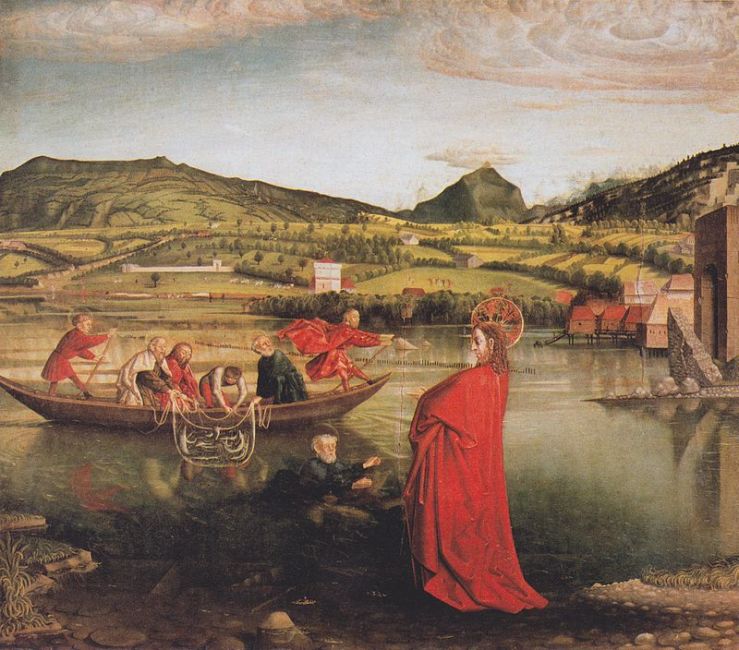
The Miraculous Draft of Fishes — Konrad Witz

800px-konrad_witz_-_fischzug_petri