Set list:
- Intro
- Sense All of Mine
- Oh Yeah
- I Feel Allright
- Mother Sky
- Deadlock
- Bring Me Coffee or Tea
- Don’t Turn the Light On, Leave Me Alone
- Paperhouse
Set list:

[Ed. note: The following citations come from one-star Amazon reviews of Harper Lee’s novel To Kill a Mockingbird. (See also: Thomas Pynchon’s Mason & Dixon, Chinua Achebe’s Things Fall Apart, Mary Shelley’s Frankenstein, Thomas Pynchon’s Gravity’s Rainbow, George Orwell’s 1984, Herman Melville’s Moby-Dick, James Joyce’s Ulysses and David Markson’s Wittgenstein’s Mistress). I’ve preserved the reviewers’ own styles of punctuation and spelling].
the prejudice part was good
A classic american piece of caca
A court case is hardly a thrilling idea.
It mainly compared people to Mockingbirds
it was just like any other book, nothing special.
It uses unutterable words and displeasing language.
I’m not rascist at all, so don’t make that assumption either.
Worst book ever written, a disgrace to American Liturature
Well, at least it was in my own language. Otherwise, it sucked.
I reckon this be anoth’r classic that doesn’t deserve that status.
I don’t like these kinds of books anyway, but I was assigned to read it! Yuk!
Simply put, this is a novel about racism written for people who received their knowledge about racism from this book!
If people would just leave old prejudices to heal themselves, it would all be better, and best of all, this book wouldn’t exist
In 1960 Harper Lee published To Kill A Mockingbird. About thrity years earlier William Faulkner had published the short story Dry September. ITS THE SAME STORY.
Although the author had some good points, I must say that this book sucked a big fat one star. I thought it was horribly thought out and it was considerably a snoozer. I seriously feel asleep readin this
I could write a novel that had notecard characters–even the narrator seemed a little hollow, and Boo Radley was just deus ex machina with a clever, sleepy-southern-town name–and no one would care.
this novel features the archetypal White hero with few flaws, his perfect children, the maid with just the right amount of “colored wisdom,” a black amn who is little more than a dullard, and the evil redneck who actually commited the crime!
It’s an uneven paste-job of short stories and pieces by Harper Lee promoted by her liberal New York publishing friends.
It is a very interesting and great book!!!!! I expecially liked how they talked of people standing up for what is right!! NOT!!!!!!!!!!!!!
I kept hoping that they would get to the point and give me some instructions, but I still don’t know how to kill a mockingbird.
Thanks to all my friends who had to tourchure threw reading this disgrace and supporting me in not likeing the book.
Who really cares about a little girl that goes around the neighborhood doing things like spying on her albino neighbor.
Dissgusting beyond belief. Harper Lee owes an apology to untold numbers of girs, women, and families.
The rednecks are evil, the blacks are victims, and the self-righteous Atticus is too good to be true.
In a just world Harper Lee and her acolytes would be forced to live in the Hell the helped create.
i know slavery was bad and judging blacks and all that is bad but like come on were over it
By the way, DO NOT BUY, because if i find it in your house i won’t think to kindly of you.
All the book consists of is a middle-class family in the south with a few weird neighbors.
Scout and her brother, Jem, grow up while some wierd stuff happens all around them.
the charecters were poorly developed and obviously fake
no excimet in besides when it was in the court spot
I find no point in writing a book about segregation
I don’t see why this book is so fabeulos.
This book is very nasty

SUGAR.
by Gertrude Stein
A violent luck and a whole sample and even then quiet.
Water is squeezing, water is almost squeezing on lard. Water, water is a mountain and it is selected and it is so practical that there is no use in money. A mind under is exact and so it is necessary to have a mouth and eye glasses.
A question of sudden rises and more time than awfulness is so easy and shady. There is precisely that noise.
A peck a small piece not privately overseen, not at all not a slice, not at all crestfallen and open, not at all mounting and chaining and evenly surpassing, all the bidding comes to tea.
A separation is not tightly in worsted and sauce, it is so kept well and sectionally.
Put it in the stew, put it to shame. A little slight shadow and a solid fine furnace.
The teasing is tender and trying and thoughtful.
The line which sets sprinkling to be a remedy is beside the best cold.
A puzzle, a monster puzzle, a heavy choking, a neglected Tuesday.
Wet crossing and a likeness, any likeness, a likeness has blisters, it has that and teeth, it has the staggering blindly and a little green, any little green is ordinary.
One, two and one, two, nine, second and five and that.
A blaze, a search in between, a cow, only any wet place, only this tune.
Cut a gas jet uglier and then pierce pierce in between the next and negligence. Choose the rate to pay and pet pet very much. A collection of all around, a signal poison, a lack of languor and more hurts at ease.
A white bird, a colored mine, a mixed orange, a dog.
Cuddling comes in continuing a change.
A piece of separate outstanding rushing is so blind with open delicacy.
A canoe is orderly. A period is solemn. A cow is accepted.
A nice old chain is widening, it is absent, it is laid by.
For Pynchon, ours is the age of plastics and paranoia, dominated by the System. No one is going to dispute such a conviction; reading the New York Times first thing every morning is sufficient to convince one that not even Pynchon’s imagination can match journalistic irreality. What is more startling about Pynchon is that he has found ways of representing the impulse to defy the System, even though both impulse and its representations always are defeated. In the Zone (which is our cosmos as the Gnostics saw it, the kenoma or Great Emptiness) the force of the System, of They (whom the Gnostics called Archons), is in some sense irresistible, as all overdetermination must be irresistible. Yet there is a Counterforce, hardly distinguished in its efficacy, but it never does (or can) give up. Unfortunately, its hero is the extraordinarily ordinary Tyrone Slothrop, who is a perpetual disaster, and whose ultimate fate, being “scattered” (rather in biblical sense), is accomplished by Pynchon with dismaying literalness. And yet—Slothrop, who has not inspired much affection even in Pynchon’s best critics, remains more Pynchon himself.
From Harold Bloom’s introduction to Bloom’s Critical Modern Views: Thomas Pynchon.

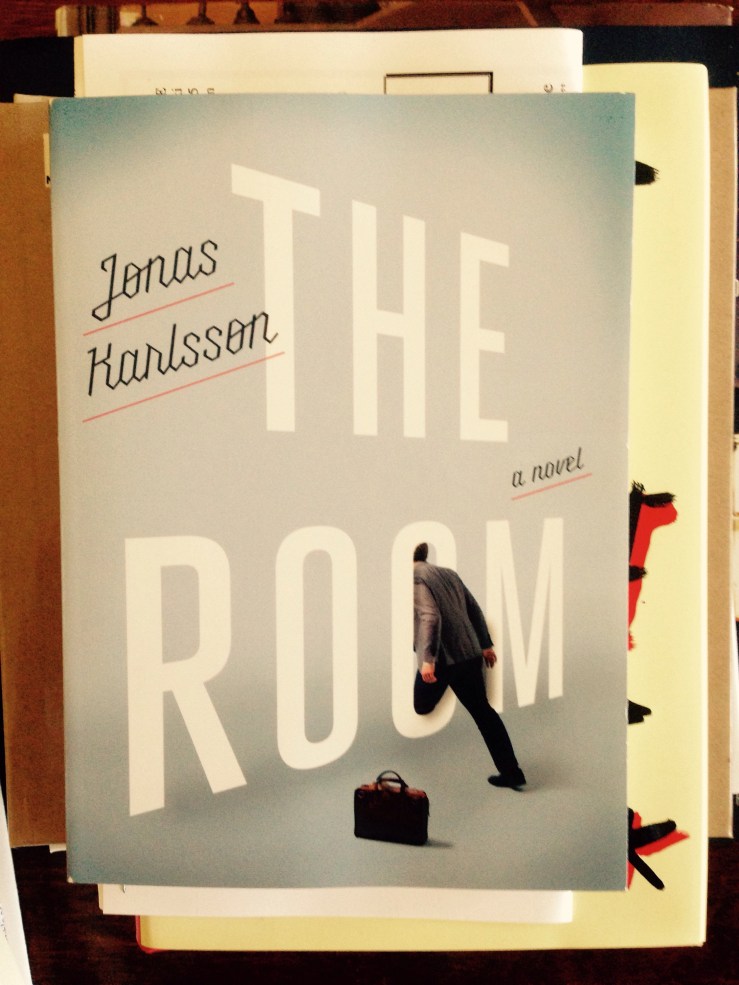
Jonas Karlsson’s novel The Room comes out later this month from Random House. Their blurb:
Funny, clever, surreal, and thought-provoking, this Kafkaesque masterpiece introduces the unforgettable Bjorn, an exceptionally meticulous office worker striving to live life on his own terms.
Bjorn is a compulsive, meticulous bureaucrat who discovers a secret room at the government office where he works–a secret room that no one else in his office will acknowledge. When Bjorn is in his room, what his co-workers see is him standing by the wall and staring off into space looking dazed, relaxed, and decidedly creepy. Bjorn’s bizarre behavior eventually leads his co-workers to try and have him fired, but Bjorn will turn the tables on them with help from his secret room.
Debut author Jonas Karlsson doesn’t leave a word out of place in this brilliant, bizarre, delightful take on how far we will go–in a world ruled by conformity–to live an individual and examined life.

 Biblioklept