Young Man with a Book — Ernest Meissonier

A Summer Night’s Melancholy — Michael Sowa

The birds don’t sing, they screech in pain (Werner Herzog)

I had a fantasy of heaven’s being broken into fleecy fragments | Nathaniel Hawthorne’s Notebook Entry for August 27, 1839

August 27th.–I have been stationed all day at the end of Long Wharf, and I rather think that I had the most eligible situation of anybody in Boston. I was aware that it must be intensely hot in the midst of the city; but there was only a short space of uncomfortable heat in my region, half-way towards the centre of the harbor; and almost all the time there was a pure and delightful breeze, fluttering and palpitating, sometimes shyly kissing my brow, then dying away, and then rushing upon me in livelier sport, so that I was fain to settle my straw hat more tightly upon my head. Late in the afternoon, there was a sunny shower, which came down so like a benediction that it seemed ungrateful to take shelter in the cabin or to put up an umbrella. Then there was a rainbow, or a large segment of one, so exceedingly brilliant and of such long endurance that I almost fancied it was stained into the sky, and would continue there permanently. And there were clouds floating all about,–great clouds and small, of all glorious and lovely hues (save that imperial crimson which was revealed to our united gaze),–so glorious, indeed, and so lovely, that I had a fantasy of heaven’s being broken into fleecy fragments and dispersed through space, with its blest inhabitants dwelling blissfully upon those scattered islands.

From Nathaniel Hawthorne’s American Note-Books.

Lisette’s List (Book Acquired, Some Time in August, 2014)

IMG_3040

Susan Vreeland’s historical novel Lisette’s List is new in hardback from Random House. The Kirkus review is pretty enthusiastic:

Une jolie Parisienne in Provence during the turbulent World War II years comes to understand love and great art to the core of her being.

In a sweeping historical novel set in Vichy, France, Lisette Roux, a 20-year-old bride who longs for “window-shopping, cabaret hopping, gallery gazing,” grudgingly moves out of Paris to the rural south to take care of her new husband André’s aging grandfather in 1937. “How are we going to survive in a town without a gallery?” she asks in dismay. But Pascal is not your ordinary grandpère: An ochre miner–turned–pigment salesman, he befriended young, unappreciated painters and amassed a collection of Cézanne, Pissarro and Picasso paintings. After Pascal dies, the loving couple is cast out of an Edenic existence following the German invasion of France. André enlists to fight the Nazis and meets a tragic end midway through the book. Lisette’s short stay in Provence stretches out more than a decade, prolonged by the war and her determined attempt to find Pascal’s pictures, which André hid for safekeeping before going to war. Lisette’s sensibility deepens as she grows closer to former prisoner of war Maxime Legrand, André’s fellow soldier and best friend. Marc and Bella Chagall, hiding in Provence because they are Jewish, show up for a brief but blazing cameo appearance. Vreeland, who has proven in earlier art-themed best-sellers that she has an exquisite eye for detail, is enormously talented at establishing the important societal role of art, particularly relevant here as the Nazis both steal and burn it. While her prose can get a bit fluffy (“apricot trees blossoming with pinkish-white petals like flakes of the moon”) and the book wraps up a tad too tidily, her deeply researched novel is mesmerizing.

Merveilleux. Vreeland’s passionate writing is as good as a private showing at the Louvre.

The First Class Compartment — Edouard Vuillard

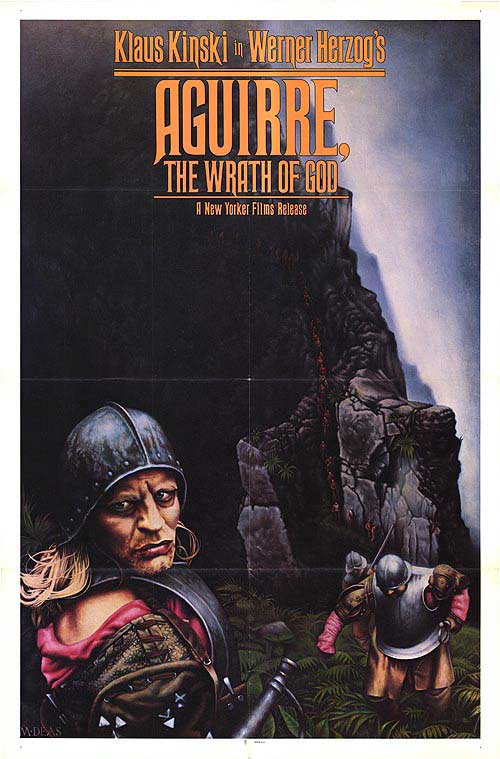
Aguirre, The Wrath of God — Werner Herzog (Full Film)

mpw-32992

Starship Troopers Film Poster — Kilian Eng

The Romantic Tough School of Writing | Doris Lessing’s The Golden Notebook

Toward the end of Doris Lessing’s The Golden Notebook, protagonist Anna Wulf inserts this wonderful parody of a certain kind of midcentury writing (Henry Miller seems like the most obvious target here, although I use the term “target” loosely). The piece ends with Wulf’s “own” voice returning, declaring “If I’ve gone back to pastiche, then it’s time to stop.” And then the notebook stops.

* 19 The Romantic Tough School of Writing

The fellows were out Saturday-nighting true-hearted, the wild-hearted Saturday-night gang of true friends, Buddy, Dave and Mike. Snowing. Snow-cold. The cold of cities in the daddy of cities, New York. But true to us. Buddy, the ape-shouldered, stood apart and stared. He scratched his crotch. Buddy the dreamer, pitch-black-eyed, sombrely staring, he would often masturbate in front of us, unconscious, pure, a curious purity. And now he stood with the snow crumb white on his sad bent shoulders. Dave tackled him low, Dave and Buddy sprawled together in the innocent snow, Buddy winded. Dave drove his fist into Buddy’s belly, oh true love of true friends, mensch playing together under the cold cliffs of Manhattan on a true Saturday night. Buddy passed out cold. ‘I love this son-of-a-bitch,’ Dave said, while Buddy sprawled, lost to us and to the sadness of the city. I, Mike, Mike-the-lone-walker, stood apart, the burden of knowing on me, eighteen-years-old and lonely, watching my true buddies, Dave and Buddy. Buddy came to. Saliva flecked his near-dead lips and flew off into the saliva-white snowbank.

He sat up, gasping, saw Dave there, arms around his kneecaps, staring at him, love in his Bronx-sad eyes. Left side of hairy fist to chin, he hit and Dave now fell flat out, out in the death-cold snow. Laughing Buddy, Buddy sat laughing, waiting in his turn. Man, what a maniac. ‘Whatta you going to do, Buddy?’ I said, Mike the lone-walker but loving his true friends. ‘Ha ha ha, d’you see the expression on his face?’ he said and rolled breathless, holding his crotch. ‘Didja see that?’ Dave gasped, life coming to him, rolled, groaned, sat up. Dave and Buddy fought then, true-fought, laughing with joy, till, laughing, fell apart in the snow. I, Mike, winged-with-words Mike, stood sorrowing with joy. ‘Hey I love this bastard,’ gasped Dave, throwing a punch to Buddy’s midriff and Buddy, forearm stopping it, said: ‘Jeez, I love him.’ But I heard the sweet music of heels on the frost-cold pavement, and I said: ‘Hey, fellas.’ We stood waiting. She came, Rosie, from her dark tenement bedroom, on her sweet-tapping heels. ‘Hey, fellas,’ says Rosie, sweet-smiling. We stood watching. Sad now, watching the proud-fleshed Rosie, swivelling on her true sex down the pavement, twitching her round-ball butt, which jerked a message of hope to our hearts. Then Buddy, our buddy Buddy, moved apart, hesitant, sad-eyed, to our sad eyes: ‘I love her, fellas.’ Two friends were left then. Two-fisted Dave and winged-with words Mike. We stood then, watching our friend Buddy, fated with life, nod and move on after Rosie, his pure heart beating to the tune of her sweet heels. The wings of mystic time beat down on us then, white with snowflakes, time that would whirl us all after our Rosies to death and the frame-house funeral. Tragic and beautiful to see our Buddy move on out into the immemorial dance of fated snow-flakes, the dry rime rhyming on his collar. And the love that went out from us to him then was fantastic, true-volumned, sad-faced and innocent of the purposes of time, but true and in fact serious. We loved him as we turned, two friends left, our adolescent top coats flapping around our pure legs. On then, Dave and I, I-Mike, sad, because the intimation-bird of tragedy had touched our pearly souls, he-Dave and I-Mike, on then, goofy with life. Dave scratched his crotch, slow, owl-scratching pure Dave. ‘Jeez, Mike,’ he said, ‘you’ll write it someday, for us all.’ He stammered, inarticulate, not-winged-with-words, ‘You’ll write it, hey feller? And how our souls were ruined here on the snow-white Manhattan pavement, the capitalist-money-mammon hound-of-hell hot on our heels?’ ‘Gee, Dave, I love you,’ I said then, my boy’s soul twisted with love. I hit him then, square to the jaw-bone, stammering with love-for-the-world, love-for-my-friends, for the Daves and the Mikes and the Buddies. Down he went and I then, Mike, then, cradled him, baby, I-love-you, friendship in the jungle city, friendship of young youth. Pure. And the winds of time were blowing, snow-fated, on our loving pure shoulders.

If I’ve gone back to pastiche, then it’s time to stop.

[The yellow notebook ended here with a double black line.]

Resurrexit — Anselm Kiefer

resurrexit

“A Famous Dancer” — Thomas Bernhard

20140721-162338-59018084.jpg

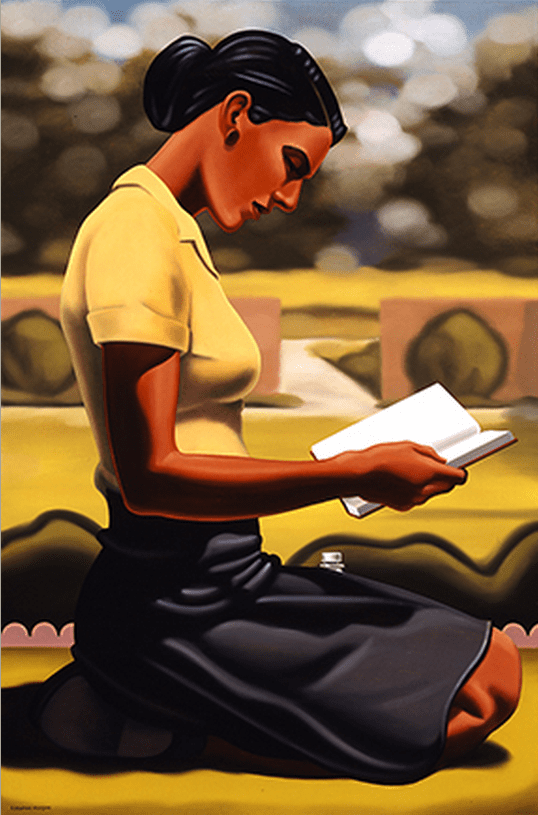
Lucidity — Kenton Nelson

Capture

The Temptation of St. Anthony (Detail) — Hieronymus Bosch

“A Short Novel” | Doris Lessing’s The Golden Notebook

*11 A SHORT NOVEL

Two people together, in any kind of relationship—mother, son; father, daughter; lovers; it doesn’t matter. One of them acutely neurotic. The neurotic hands on his or her state to the other, who takes it over, leaving the sick one well, the well one sick.

From Doris Lessing’s novel The Golden Notebook.

The Beginning of Life — Frantisek Kupka

Bad books are intellectual poison (Schopenhauer)

It is in literature as in life: wherever you turn, you stumble at once upon the incorrigible mob of humanity, swarming in all directions, crowding and soiling everything, like flies in summer. Hence the number, which no man can count, of bad books, those rank weeds of literature, which draw nourishment from the corn and choke it. The time, money and attention of the public, which rightfully belong to good books and their noble aims, they take for themselves: they are written for the mere purpose of making money or procuring places. So they are not only useless; they do positive mischief. Nine-tenths of the whole of our present literature has no other aim than to get a few shillings out of the pockets of the public; and to this end author, publisher and reviewer are in league.

Let me mention a crafty and wicked trick, albeit a profitable and successful one, practised by littérateurs, hack writers, and voluminous authors. In complete disregard of good taste and the true culture of the period, they have succeeded in getting the whole of the world of fashion into leading strings, so that they are all trained to read in time, and all the same thing, viz., the newest books; and that for the purpose of getting food for conversation in the circles in which they move. This is the aim served by bad novels, produced by writers who were once celebrated, as Spindler, Bulwer Lytton, Eugene Sue. What can be more miserable than the lot of a reading public like this, always bound to peruse the latest works of extremely commonplace persons who write for money only, and who are therefore never few in number? and for this advantage they are content to know by name only the works of the few superior minds of all ages and all countries. Literary newspapers, too, are a singularly cunning device for robbing the reading public of the time which, if culture is to be attained, should be devoted to the genuine productions of literature, instead of being occupied by the daily bungling commonplace persons.

Hence, in regard to reading, it is a very important thing to be able to refrain. Skill in doing so consists in not taking into one’s hands any book merely because at the time it happens to be extensively read; such as political or religious pamphlets, novels, poetry, and the like, which make a noise, and may even attain to several editions in the first and last year of their existence. Consider, rather, that the man who writes for fools is always sure of a large audience; be careful to limit your time for reading, and devote it exclusively to the works of those great minds of all times and countries, who o’ertop the rest of humanity, those whom the voice of fame points to as such. These alone really educate and instruct. You can never read bad literature too little, nor good literature too much. Bad books are intellectual poison; they destroy the mind. Because people always read what is new instead of the best of all ages, writers remain in the narrow circle of the ideas which happen to prevail in their time; and so the period sinks deeper and deeper into its own mire

From “On Books and Reading” by Arthur Schopenhauer.