Woman Reading at the Window — Anna Sahlstén

94529534

Watch Two Sisters, Caroline Leaf’s Haunting Animated Short, Etched Directly onto Tinted 70 mm Film

The center of the self is this secret, obsessive, often silly, nearly continuous voice (William H. Gass)

Yet I should like to suggest (despite the undeniable sappiness of it) that the center of the self is this secret, obsessive, often silly, nearly continuous voice – the voice that is the surest sign that we are alive; and that one fundamental function of language is the communication with this self which makes it feasible; that, in fact, without someone speaking, someone hearing, someone overhearing both, no full self can exist; that if society – its families and factories and congresses and schools – has done its work, then every day every one of us is a bit nearer than we were before to being one of the fortunates who have made rich and beautiful the great conversation which constitutes our life.

From William H. Gass’s essay “On Talking to Oneself” (collected in Habitations of the Word).

“The Gambler, the Nun, and the Radio” — Ernest Hemingway

“The Gambler, the Nun, and the Radio”

by

Ernest Hemingway

THEY brought them in around midnight and then, all night long, everyone along the corridor heard the Russian.
‘Where is he shot?’ Mr. Frazer asked the night nurse.

‘In the thigh, I think.’
‘What about the other one?’
‘Oh, he’s going to die, I’m afraid.’
‘Where is he shot?’
‘Twice in the abdomen. They only found one of the bullets.’

They were both beet workers, a Mexican and a Russian, and they were sitting drinking coffee in an all-night restaurant when someone came in the door and started shooting at the Mexican. The Russian crawled under a table and was hit, finally, by a stray shot fired at the Mexican as he lay on the floor with two bullets in his abdomen. That was what the paper said.

The Mexican told the police he had no idea who shot him.
He believed it to be an accident.

‘An accident that he fired eight shots at you and hit you twice, there?’
‘Si, señor,’ said the Mexican, who was named Cayetano Ruiz, ‘An accident that he hit me at all, the cabron,’ he said to the interpreter.
‘What does he say?’ asked the detective sergeant, looking across the bed at the interpreter.
‘He says it was an accident.’
‘Tell him to tell the truth, that he is going to die,’ the detective said.
‘Na,’ said Cayetano. ‘But tell him that I feel very sick and would prefer not to talk so much.’
‘He says that he is telling the truth,’ the interpreter said.
Then, speaking confidently, to the detective, ‘He don’t know who shot him. They shot him in the back.’
‘Yes,’ said the detective. ‘I understand that, but why did the bullets all go in the front?’
‘Maybe he is spinning around,’ said the interpreter.
‘Listen,’ said the detective, shaking his finger almost at Cayetano’s nose, which projected, waxen yellow, from his dead-man’s face in which his eyes were alive as a hawk’s, ‘I don’t give a damn who shot you, but I’ve got to clear this thing up. Don’t you want the man who shot you to be punished? Tell him that,’ he said to the interpreter.
‘He says to tell who shot you.’
‘Mandarlo al carajo,’ said Cayetano, who was very tired.
‘He says he never saw the fellow at all,’ the interpreter said. ‘I tell you straight they shot him in the back.’
‘Ask him who shot the Russian.’
‘Poor Russian,’ said Cayetano. ‘He was on the floor with his head enveloped in his arms. He started to give cries when they shoot him and he is giving cries ever since. Poor Russian.’
‘He says some fellow that he doesn’t know. Maybe the same fellow that shot him.’
‘Listen,’ the detective said. ‘This isn’t Chicago. You’re not a gangster. You don’t have to act like a moving picture. It’s all right to tell who shot you. Anybody would tell who shot them. That’s all right to do. Suppose you don’t tell who he is and he shoots somebody else. Suppose he shoots a woman or a child. You can’t let him get away with that. You tell him,’ he said to Mr. Frazer. ‘I don’t trust that damn interpreter.’
‘I am very reliable,’ the interpreter said. Cayetano looked at Mr. Frazer.
‘Listen, amigo,’ said Mr. Frazer. ‘The policeman says that we are not in Chicago but in Hailey, Montana. You are not a bandit and this has nothing to do with the cinema.’
‘I believe him,’ said Cayetano softly. ‘Ya lo creo.’
‘One can, with honour, denounce one’s assailant. Every one does it here, he says. He says what happens if after shooting you, this man shoots a woman or a child?’
‘I am not married,’ Cayetano said.
‘He says any woman, any child.’
‘The man is not crazy,’ Cayetano said.
‘He says you should denounce him,’ Mr. Frazer finished.
‘Thank you,’ Cayetano said. ‘You are of the great translators. I speak English, but badly. I understand it all right. How did you break your leg?’
‘A fall off a horse.’
‘What bad luck. I am very sorry. Does it hurt much?’
‘Not now. At first, yes.’
‘Listen, amigo,’ Cayetano began, ‘I am very weak. You will pardon me. Also I have much pain; enough pain. It is very possible that I die. Please get this policeman out of here because I am very tired.’ He made as though to roll to one side; then held himself still.
‘I told him everything exactly as you said and he said to tell you, truly, that he doesn’t know who shot him and that he is very weak and wishes you would question him later on,’ Mr. Frazer said.
‘He’ll probably be dead later on.’
‘That’s quite possible.’
‘That’s why I want to question him now.’
‘Somebody shot him in the back, I tell you,’ the interpreter said.
‘Oh, for Chrisake,’ the detective sergeant said, and put his notebook in his pocket.
Outside in the corridor the detective sergeant stood with the interpreter beside Mr. Frazer’s wheeled chair.
‘I suppose you think somebody shot him in the back too?’
‘Yes,’ Frazer said. ‘Somebody shot him in the back. What’s it to you?’
‘Don’t get sore,’ the sergeant said. ‘I wish I could talk spick.’
‘Why don’t you learn?’
‘You don’t have to get sore. I don’t get any fun out of asking that spick question. If I could talk spick it would be different.’
‘You don’t need to talk Spanish,’ the interpreter said. ‘I’m a very reliable interpreter.’
‘Oh, for Chrisake,’ the sergeant said. ‘Well, so long. I’ll come up and see you.’
‘Thanks. I’m always in.’
‘I guess you are all right. That was bad luck all right. Plenty bad luck.’
‘It’s coming along good now since he spliced the bone.’
‘Yes, but it’s a long time. A long, long time.’
‘Don’t let anybody shoot you in the back.’
‘That’s right,’ he said. ‘That’s right. Well, I’m glad you’re not sore.’
‘So long,’ said Mr. Frazer.

Mr. Frazer did not see Cayetano again for a long time, but each morning Sister Cecilia brought news of him. He was so uncomplaining she said and he was very bad now. He had peritonitis and they thought he could not live. Poor Cayetano, she said. He had such beautiful hands and such a fine face and he never complains. The odour, now, was really terrific. He would point toward his nose with one finger and smile and shake his head, she said. He felt badly about the odour. It embarrassed him, Sister Cecilia said. Oh, he was such a fine patient. He always smiled. He wouldn’t go to confession to Father but he promised to say his prayers, and not a Mexican had been to see him since he had been brought in. The Russian was going out at the end of the week. I could never feel anything about the Russian, Sister Cecilia said. Poor fellow, he suffered too. It was a greased bullet and dirty and the wound infected, but he made so much noise and then I always like the bad ones. That Cayetano, he’s a bad one. Oh, he must really be a bad one, a thoroughly bad one, he’s so fine and delicately made and he’s never done any work with his hands. He’s not a beet worker. I know he’s not a beet worker. His hands are as smooth and not a callous on them. I know he’s a bad one of some sort. I’m going down and pray for him now. Poor Cayetano, he’s having a dreadful time and he doesn’t make a sound. What did they have to shoot him for? Oh, that poor Cayetano! I’m going right down and pray for him.
She went right down and prayed for him.

Continue reading ““The Gambler, the Nun, and the Radio” — Ernest Hemingway”

Reading in the Garden — Francine van Hove

fvh

Night March of a Hundred Demons (Detail) — Tosa Mitsuoki

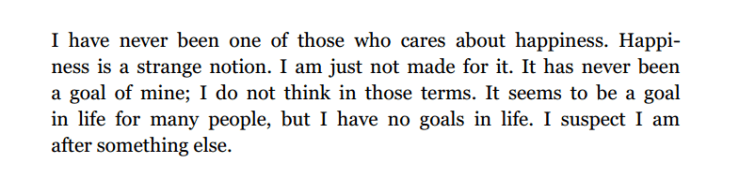
Happiness is a strange notion (Werner Herzog)

wh

Watch Yoji Kuri’s The Midnight Parasites, A Short Film Inspired by Hieronymus Bosch

The Bus — Paul Kirchner

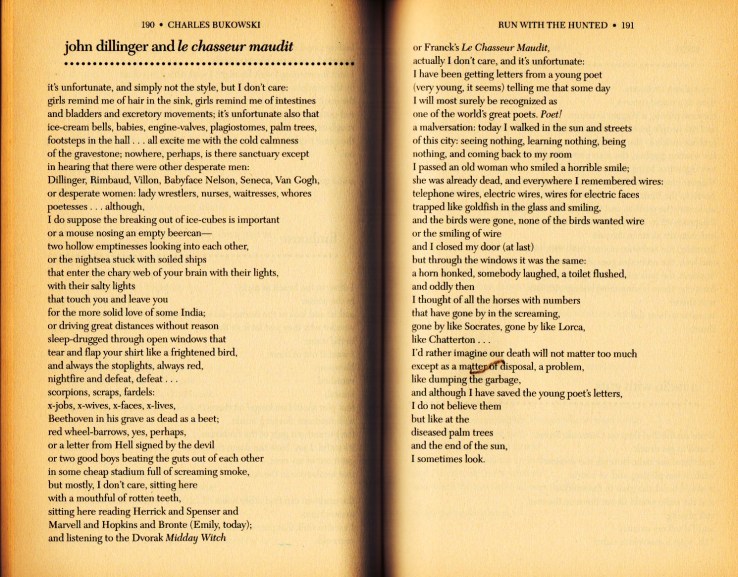
“John Dillinger and Le Chasseur Maudit” — Charles Bukoswki

IMG_3056

Neve, The Moon Is Chilling — Utagawa Kuniyoshi

A Conversation about Ben Lerner’s Novel 10:04 (Part 1)

1004

[Context/editorial note: Ben Lerner’s new novel 10:04 wasn’t on my radar until Ryan Chang, who has been contributing reviews, riffs, citations, and other good stuff to this blog for the some time now, brought it up. He digs it, I don’t—but in fairness, I haven’t finished it yet. I was determined to abandon it, but Ryan’s emails kept me interested enough to continue; our conversation of the past five days is presented below. The book frustrates and rewards; at times I’ve laughed out loud and at other moments I’ve sprained my eyeballs by rolling them. More to come, because this is pretty long—but I think Ryan, who offers the bulk of the analysis here, makes a strong case for Lerner’s book. — ET].   

Edwin Turner: Got an e-galley of the Lerner book. I don’t know if it’s that I’m almost exactly the same age as Lerner/the narrator or what, but I really really hate it so far! He’s very smart and the sentences are often great, but I find myself rolling my eyes at a lot of what he’s doing—it’s probably me not him. The narrative voice strikes me as so thoroughly inauthentic that I want to grab the narrator by the lapels and shout, Quit aping Sebald, quit trying to show how clever you are, and just observe and report! Again, it’s probably me not him.

Ryan Chang: I know what you mean; though it won’t bear any difference to your reading, I can attest personally to the diction & syntax of the narrator and Lerner himself (indeed, he does speak like that). I don’t think it’s an affectation, but I think it’s real “poet-y.” It is a criticism I forgive b/c I see that the tension between authenticity (of time) and inauthenticity (of time; especially exemplified in the Whole Foods/Instant coffee scene — which narrative context of time determines the Real, the Market (or its interpretation of Universal time) or our intuition (something like Whitmanic time, where time is experienced not on a linear, progressive plane but a circular, lateral one?)) is a crucial thread that runs throughout 10:04 and in Lerner’s other work. That said, I know  that in reviews to come of the book he’ll get slammed for that (I think the Kirkus review already did this).

A lot of my friends echo your distaste for Lerner for those exact same reasons, and I totally see why, and I’m kind of annoyed by it too. For me, the success of the book lies in the reclamation of fiction as a communal space from fetish book object/commercial futurity (author advances, agents, contracts, etc. — you already get some of this early on but there is more to come in a beautifully scathing scene of the NYC literary scene) And also, a kind of shiv to the Standard American Novelistic Form that reinforces traditional forms of American identity-making that Gass/Gaddis/Markson et al. have been doing for years and, I think, a poisonous strain of American political sentimentality that keeps most of us “depressed.” I think, too, because I’ve read it twice now, that there is an acknowledgment of his complicity in the very machines he participates in, and an inability, at least on his own, to dismantle those systems. Not sure if we should forgive him for criticizing the bourgeois Food Co-Op while being a member, albeit begrudgingly or tolerate his admission. There’s a lot of celebration of Whitmanic politics in that book, a return to a kind of Whitmanic democratic person is a return to a democratic reading is a return to a “real” democracy shared through the space of the book, of the position of the reader looking at an object and knowing that her “I” is shared amongst several. I’m not sure if you’ve gotten here yet, but he keeps intoning this phrase “bad forms of collectivity” as a better solution than nothing, than “modernist difficulty as resistance to the market.”

The Sebald comparison is apt, esp. with the form & diction & syntax, and I agree with you–Sebald is the master. There’s also something to be said, though, that this kind of fiction-making is badly needed in contemporary American letters on the Big 5 Publishing scene. I mean, I can’t read another fucking book about Brooklyn parents or mid-career Manhattan artist crises without wringing my neck. The kind of book Sebald innovated, too, is able to dismantle received ideas of art/history/writing/identity etc.;  I may be being too generous here, but I think it’s a form that will see continued adoption on this side of the pond.

ET: So your response made me return to the book, Ryan. The line that made me quit was something like, “The place was so quiet I could hear the bartender mixing our artisanal cocktails” or something like that—-I’m still not sure how to read that line as anything but a parody, but I think that the narrator, author, and writer are all sincere in trying to capture or document a particular time/feeling with the phrase. And as I continued reading, I was rewarded by the episode of the older poets/mentors, and their “daughter,” whom the narrator obsessed over—a very fine passage—humorous, reflective, a kind of parodic-but-sincere take on wanting to belong to a particular artistic scene. (What continues to unsettle me is the narrator’s assurance of his own achievement, although I could be wrong).

Continue reading “A Conversation about Ben Lerner’s Novel 10:04 (Part 1)”

The Last Judgment (Detail) — Hieronymus Bosch

Animals Dyeing Fabrics — Utagawa Kuniyoshi

Read James Purdy’s short story “The White Blackbird”

“The White Blackbird”

by

James Purdy

EVEN BEFORE I REACHED my one hundredth birthday, I had made several wills, and yet just before I put down my signature

Delia Mattlock

my hand refused to form the letters. My attorney was in despair. I had outlived everyone and there was only one person to whom I could bequeath much, my young godson, and he was not yet twenty-one.
I am putting all this down more to explain the course of events to myself than to leave this as a document to posterity, for as I say, outside of my godson, Clyde Furness, even my lifelong servants have departed this life.
The reason I could not sign my name then is simply this: piece by piece my family jewels have been disappearing over the last few years, and today as I near my one hundred years all of these precious heirlooms one by one have vanished into thin air.
I blamed myself at first, for even as a young girl I used to misplace articles, to the great sorrow of my mother. My great grandmother’s gold thimble is an example. You would lose your head if it wasn’t tied on, Mother would joke rather sourly. I lost my graduation watch, I lost my diamond engagement ring, and, if I had not taken the vow never to remove it, my wedding ring to Will Mattlock would have also taken flight. I will never remove it and will go to my grave wearing it.
But to return to the jewels. They go back in my family over two hundred years, and yes, piece by piece, as I say, they have been disappearing. Take my emerald necklace — its loss nearly finished me. But what of my diamond earrings, the lavaliere over a century old, my ruby earrings — oh, why mention them? For to mention them is like a stab in the heart.
I could tell no one for fear they would think I had lost my wits, and then they would blame the servants, who were I knew blameless, such perfect, even holy, caretakers of me and mine.
But there came the day when I felt I must at least hint to my godson that my jewels were all by now unaccounted for. I hesitated weeks, months before telling him.
About Clyde now. His Uncle Enos told me many times that it was his heartbroken conviction that Clyde was somewhat retarded. “Spends all his time in the forest,” Enos went on, “failed every grade in school, couldn’t add up a column of figures or do his multiplication tables.”
“Utter rot and nonsense,” I told Enos. “Clyde is bright as a silver dollar. I have taught him all he needs to know, and I never had to teach him twice because he has a splendid memory. In fact, Enos, he is becoming my memory.”
Then of course Enos had to die. Only sixty, went off like a puff of smoke while reading the weekly racing news.
So then there was only Clyde and me. We played cards, chess, and then one day he caught sight of my old Ouija board.
I went over to where he was looking at it. That was when I knew I would tell him — of the jewels vanishing, of course.
Who else was there? Yet Clyde is a boy, I thought, forgetting he was now twenty, for he looked only fourteen to my eyes.
“Put the Ouija board down for a while,” I asked him. “I have something to tell you, Clyde.”
He sat down and looked at me out of his handsome hazel eyes.
I think he already knew what I was to say.
But I got out the words.
“My heirloom jewels, Clyde, have been taken.” My voice sounded far away and more like Uncle Enos’s than mine.
“All, Delia?” Clyde whispered, staring still sideways at the Ouija board.
“All, all. One by one over the past three years they have been slipping away. I have almost wondered sometimes if there are spirits, Clyde.”
He shook his head.
Continue reading “Read James Purdy’s short story “The White Blackbird””

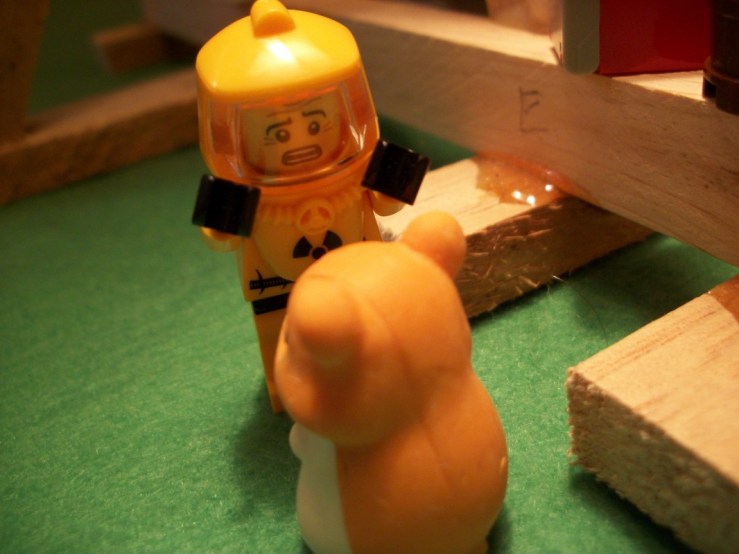
Feral hamsters are not pets. They mean business.

2976326_orig