RIP Harold Ramis

Ramis

RIP Harold Ramis, 1944-2014

GhostbustersBack to SchoolStripes, Groundhog DayMeatballsSCTV—I’m one of the few people that actually really digs Multiplicity. Hell, I even saw Year One in the theater (it was awful, but dude has a lifetime pass that extends now past his lifetime, to be clear). Ramis undoubtedly colored the careers of all the people he worked with—he wrote their lines, made the lines fit into comedies that were smart and dumb and goofy and perceptive all at the same time. RIP.

Big News! — Lyonel Feininger

Nocturne in Black and Gold, the Falling Rocket — James McNeill Whistler

“Sonnet” — Elizabeth Bishop

sonnet

“Sneezing absorbs all the functions of the soul” (Pascal)

Sneezing absorbs all the functions of the soul, as well as work does; but we do not draw therefrom the same conclusions against the greatness of man, because it is against his will. And although we bring it on ourselves, it is nevertheless against our will that we sneeze. It is not in view of the act itself; it is for another end. And thus it is not a proof of the weakness of man, and of his slavery under that action.

It is not disgraceful for man to yield to pain, and it is disgraceful to yield to pleasure. This is not because pain comes to us from without, and we ourselves seek pleasure; for it is possible to seek pain, and yield to it purposely, without this kind of baseness. Whence comes it, then, that reason thinks it honourable to succumb under stress of pain, and disgraceful to yield to the attack of pleasure? It is because pain does not tempt and attract us. It is we ourselves who choose it voluntarily, and will it to prevail over us. So that we are masters of the situation; and in this man yields to himself. But in pleasure it is man who yields to pleasure. Now only mastery and sovereignty bring glory, and only slavery brings shame.

From Pascal’s Pensées.

Emily Dickinson — Tom Gauld

Reviews Page Redesign (And a Reflection on Sexist Reviewing Habits)

So I updated Biblioklept’s Reviews page.

The page had just been a list of the reviews, riffs, and essays published on the blog, with each new entry stacking up in chronological order. For years I’ve known that this unorganized review dump was essentially useless, and I’d been meaning to turn it into an alphabetical index—and I finally did. (I kept the chronolist too, mostly for myself).

Anyway, as I went through this boring, sort-of-arduous process, I couldn’t help but reflect on a few of the habits that manifest under the surface:

The obvious: The reviews on the blog trend very heavily toward male authors. I already knew this, but counting things up makes it plain:

To date, I’ve run reviews of approximately 221 authors (approximate in the sense that I counted only once); of those reviews, only 36 were books by women. That’s about 16%. (This analysis doesn’t even begin to consider the multiple reviews of authors—for example, there are like a ton of reviews of Roberto Bolaño books, but only one review of a Clarice Lispector book). This ratio runs counter to what I’d like to believe are my principles; the number certainly contrasts with the fiction and poetry that I run on the blog (public domain stuff), which trends toward female authors. The number also contrasts with the ratio of male to female authors — roughly 1:1 — that appear on my course syllabuses.

If my tone sounds defensive, it’s because it is. The Read Women 2014 project has helped to highlight sexist reading habits—including my own. Sexism—any kind of prejudicial ism (and every ism is prejudicial) manifests as a blinding structure: Part of the structuring condition of ideological sexism is that the sexist person usually cannot see that he is sexist (he cannot see that he cannot see). I’m not offering this as a defense of my own habits: I’m not saying, Look, I’m aware of my skewed reviewing habits, and my very awareness of my inherent sexism makes me less sexist, absolves, me, etc. (But look at how I rhetorically dance around simply writing, My reviewing habits are sexist; look at how I’m still unable to simply type I’m probably a sexist, let alone I’m sexist, let me hedge, use parentheses, etc.).

Can I turn attention away from myself and onto the aesthetic critic Harold Bloom? In his Paris Review interview, he claimed:

I do not for a moment yield to the notion that any social, racial, ethnic, or “male” interest could determine my aesthetic choices. I have a lifetime of experience, learning, and insight that tells me this.

Bloom’s statement is a perfect example of I cannot see that I cannot see. (Stephen Colbert essentially ridicules this kind of blindness on his satirical show The Colbert Report by repeatedly claiming that he is not racist because he cannot see color).

I think that (I know that) a certain male interest determines my aesthetic interest. At the same time, I understand Bloom’s resistance to the notion that aesthetics are somehow contingent on gender. Could a man have written “A Good Man Is Hard to Find” or To the Lighthouse or Death Comes to the Archbishop or Their Eyes Were Watching God? (A man didn’t). We’d like to believe that the Great Stuff transcends the material world—that part of its timelessness is that it’s not bound to mortal gendered coils. Etc.

What about now? What about Read Women 2014? I’ve been reading more women authors, I think, but I haven’t been reviewing them. I recently reread Flannery O’Connor’s collection Everything That Rises Must Converge, some Gertrude Stein I’d never read before (including Tender Buttons), and some short stories by Eudora Welty and Willa Cather. I’ve read far less contemporary stuff though, although I did review Jessica Hollander’s excellent collection In These Times the Home Is a Tired Place. In general though, I tend to read less contemporaryish fiction now than I used to—I’m reading three books now, and only one is by a living author (Ben Marcus). Of the three books I’m reading now, only one is by a woman (Zelda Fitzgerald). Of the last ten book reviews published on this site, four are of books by women.

Data and numbers are unappealing—especially when they quantify something we (and when I write we you know I mean I) don’t want to acknowledge. We’d (I’d) rather qualify than quantify. Etc.

I suppose it’s the idea of a conscious effort that so repels some of us (me). The notion that I (we?) might have to make an actual intellectual (not aesthetic, perhaps non-intuitive) effort to differentiate our reading. But that’s what it takes, right? An effort. A recognition. A looking.

Two Women Reading — Robert Reid

c978d2c940027122e8968c2201ae166f

An Excerpt From Gerald Murnane’s “Sipping The Essence”

Even drunk on tepid beer we could not talk honestly. Our messages for one another were obliquely worded, or hidden behind childish mimes and antics. At a certain point in the evening Durkin would make a show of examining the tangle of blankets on my bed and finding evidence that a man and a woman had shared it not long before. I would point out what I claimed were signs that a young adult male had recently masturbated there, using a heap of pillows as a surrogate woman and seeing the furthest wrinkles in his blankets as the coastal hills of the Mornington Peninsula. Durkin would then tidy the bedclothes and demonstrate what I ought to do on the bed as soon as I had come to my senses and invited home one of the thousands of girls in Melbourne who were waiting every night by their telephones as anxious to meet a new man as Carolyn had been at Sorrento. Then, if I was drunk enough, I would argue that all those women must have once been to the Gold Coast of Queensland as Carolyn had been and must have learned there too much for a beginner like myself. And if I saw that he was drunk enough I would announce that my last hope was his sixteen-years-old sister. Had he guarded her honour? I would shout at him. Could he keep her from setting out towards the Gold Coast and deliver her to me instead? I would treat her honourably and do no more than read my poems to her until our wedding night and be a fine, boozy brother-in-law to him for the rest of our lives.

When his sister was mentioned he would offer to fight me, and we would grapple on the floor until our buckets of bottles were in danger. Whenever I was on top of him and had him by the throat I boasted that my strength came from my celibate way of life. But whenever he had pinned me to the floor I begged him to procure me his sister or any girl who would give me a strength like his.

Found in the collection Landscape With Landscape.

The Pervert’s Guide to Cinema — Slavoj Žižek (Full Film)

Silent One — Christopher Orr

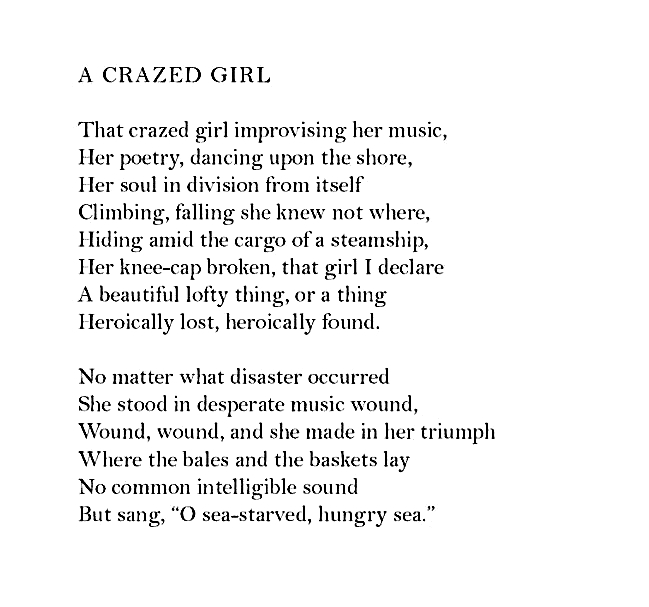
“A Crazed Girl” — William Butler Yeats

wby

Girl in Black — Egon Schiele

“The struggle alone pleases us, not the victory” (Pascal)

The struggle alone pleases us, not the victory. We love to see animals fighting, not the victor infuriated over the vanquished. We would only see the victorious end; and, as soon as it comes, we are satiated. It is the same in play, and the same in the search for truth. In disputes we like to see the clash of opinions, but not at all to contemplate truth when found. To observe it with pleasure, we have to see it emerge out of strife. So in the passions, there is pleasure in seeing the collision of two contraries; but when one acquires the mastery, it becomes only brutality. We never seek things for themselves, but for the search. Likewise in plays, scenes which do not rouse the emotion of fear are worthless, so are extreme and hopeless misery, brutal lust, and extreme cruelty.

From Pascal’s Pensées.

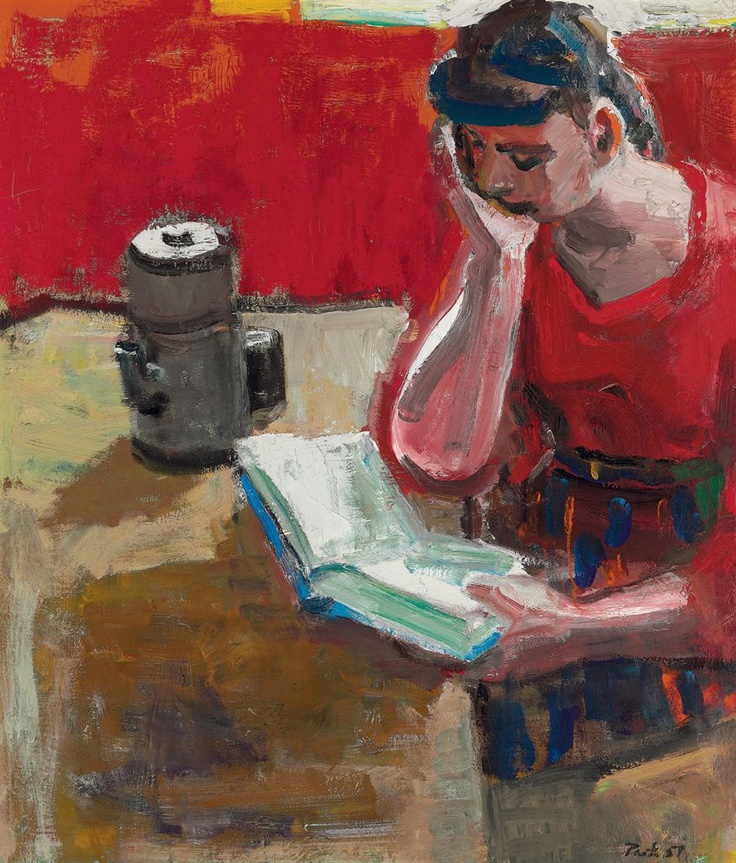
Woman Reading — David Park

1d57a73ac8ce493ac59e37b058b43c71

Star Dust — Glenn Brown

wartist100-3

Lord Gloom (Perry Bible Fellowship)

PBF131-Lord_Gloom