“Rooms” — Gertrude Stein

“Rooms”

by Gertrude Stein

Act so that there is no use in a centre. A wide action is not a width. A preparation is given to the ones preparing. They do not eat who mention silver and sweet. There was an occupation.

A whole centre and a border make hanging a way of dressing. This which is not why there is a voice is the remains of an offering. There was no rental.

So the tune which is there has a little piece to play, and the exercise is all there is of a fast. The tender and true that makes no width to hew is the time that there is question to adopt.

To begin the placing there is no wagon. There is no change lighter. It was done. And then the spreading, that was not accomplishing that needed standing and yet the time was not so difficult as they were not all in place. They had no change. They were not respected. They were that, they did it so much in the matter and this showed that that settlement was not condensed. It was spread there. Any change was in the ends of the centre. A heap was heavy. There was no change.

Burnt and behind and lifting a temporary stone and lifting more than a drawer.

The instance of there being more is an instance of more. The shadow is not shining in the way there is a black line. The truth has come. There is a disturbance. Trusting to a baker’s boy meant that there would be very much exchanging and anyway what is the use of a covering to a door. There is a use, they are double.

If the centre has the place then there is distribution. That is natural. There is a contradiction and naturally returning there comes to be both sides and the centre. That can be seen from the description.

The author of all that is in there behind the door and that is entering in the morning. Explaining darkening and expecting relating is all of a piece. The stove is bigger. It was of a shape that made no audience bigger if the opening is assumed why should there not be kneeling. Any force which is bestowed on a floor shows rubbing. This is so nice and sweet and yet there comes the change, there comes the time to press more air. This does not mean the same as disappearance.

Continue reading ““Rooms” — Gertrude Stein”

Your Favorite Author as a Cute Little Doll

 Debbie Ritter makes and sells charming dolls of writers (and artists and actors and characters).

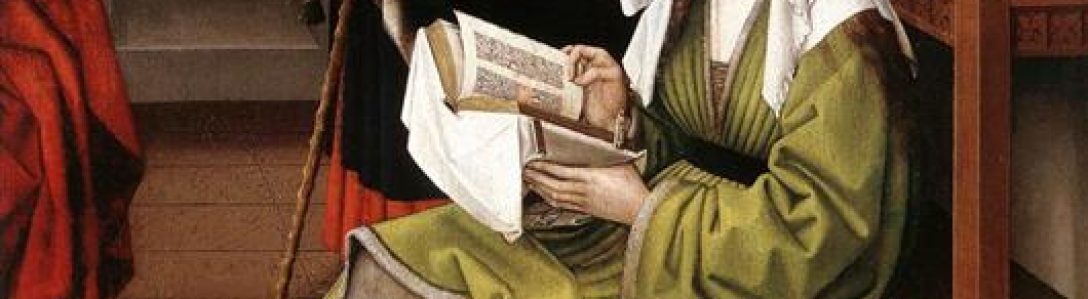
Miraculous Portrait of San Francisco de Paula — Lucas Valdés

Posted in Art

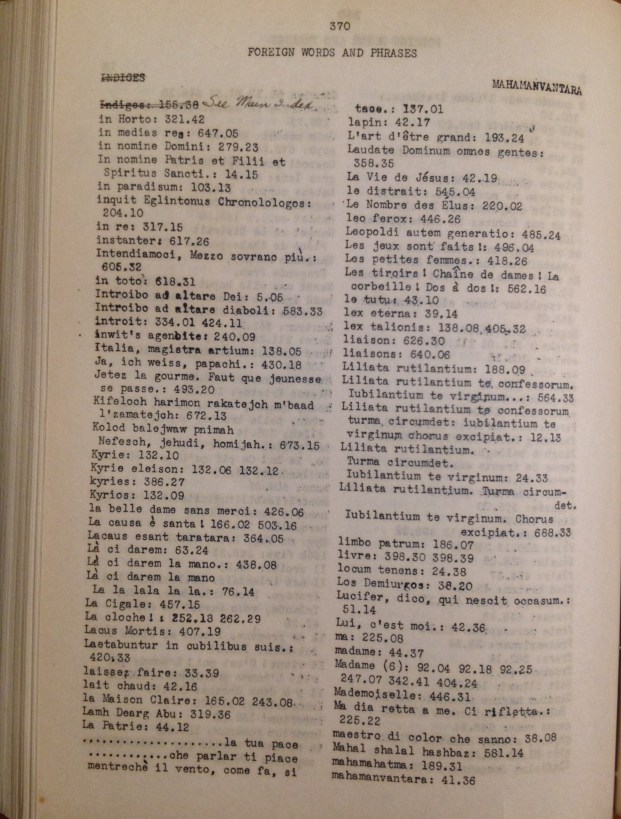
Foreign Words and Phrases (from “Indiges” to “Mahamanvantara”) in James Joyce’s Ulysses

Ulysses_Foreign

From Miles L. Hanley’s Word Index to James Joyce’s Ulysses.


“Mount Sinai” — Franz Kafka

k

I Slept with the Starlight on My Face — Ivan Albright

Hercules on the Crossroad — Jacek Malczewski

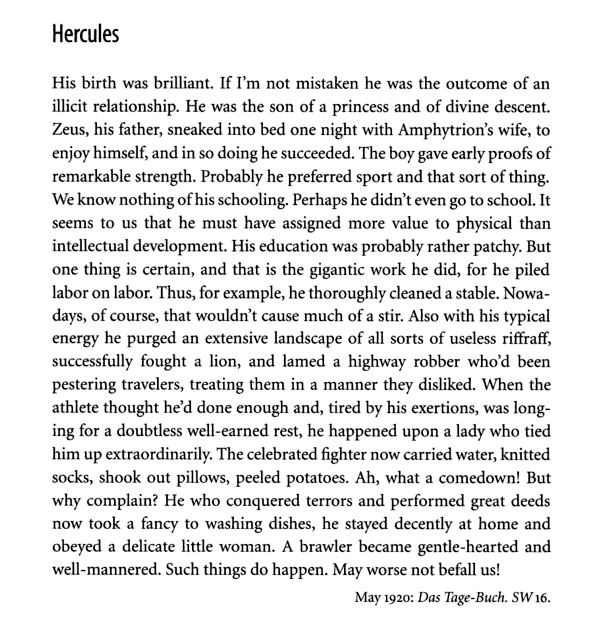
“Hercules” — Robert Walser

herc

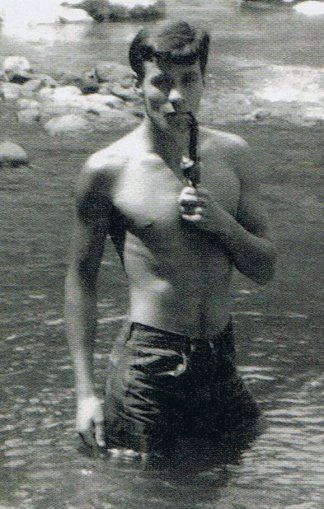
Topless W.G. Sebald

wgs

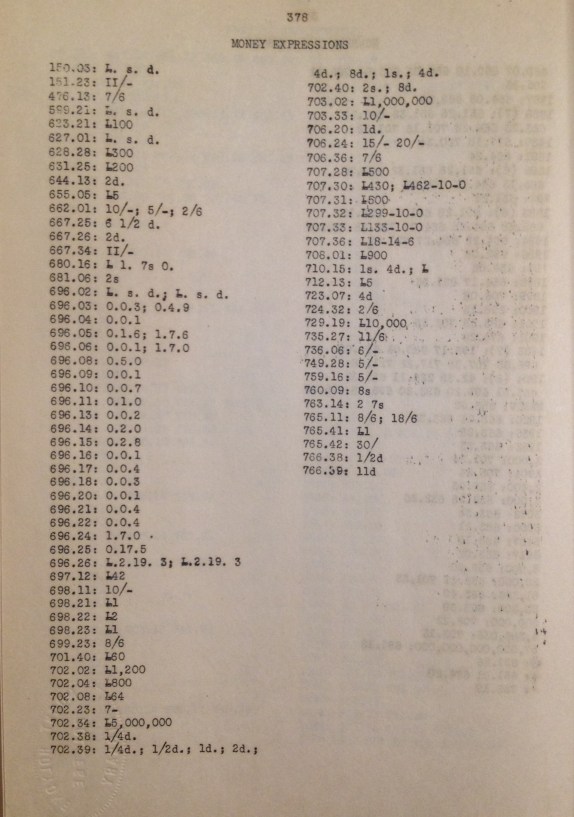
Money Expressions in James Joyce’s Ulysses

Ulysses_Money

From Miles L. Hanley’s Word Index to James Joyce’s Ulysses.


Film Posters by Polish Artist Leszek Żebrowski

(More at Żebrowski’s site)

Children — Balthus

Rich Kyrgyz Hunter with a Falcon — Vasily Vereshchagin

“An Anarchist” — Joseph Conrad

“An Anarchist”

by Joseph Conrad

That year I spent the best two months of the dry season on one of the estates—in fact, on the principal cattle estate—of a famous meat-extract manufacturing company.

B.O.S. Bos. You have seen the three magic letters on the advertisement pages of magazines and newspapers, in the windows of provision merchants, and on calendars for next year you receive by post in the month of November. They scatter pamphlets also, written in a sickly enthusiastic style and in several languages, giving statistics of slaughter and bloodshed enough to make a Turk turn faint. The “art” illustrating that “literature” represents in vivid and shining colours a large and enraged black bull stamping upon a yellow snake writhing in emerald-green grass, with a cobalt-blue sky for a background. It is atrocious and it is an allegory. The snake symbolizes disease, weakness—perhaps mere hunger, which last is the chronic disease of the majority of mankind. Of course everybody knows the B. O. S. Ltd., with its unrivalled products: Vinobos, Jellybos, and the latest unequalled perfection, Tribos, whose nourishment is offered to you not only highly concentrated, but already half digested. Such apparently is the love that Limited Company bears to its fellowmen—even as the love of the father and mother penguin for their hungry fledglings.

Of course the capital of a country must be productively employed. I have nothing to say against the company. But being myself animated by feelings of affection towards my fellow-men, I am saddened by the modern system of advertising. Whatever evidence it offers of enterprise, ingenuity, impudence, and resource in certain individuals, it proves to my mind the wide prevalence of that form of mental degradation which is called gullibility.

In various parts of the civilized and uncivilized world I have had to swallow B. O. S. with more or less benefit to myself, though without great pleasure. Prepared with hot water and abundantly peppered to bring out the taste, this extract is not really unpalatable. But I have never swallowed its advertisements. Perhaps they have not gone far enough. As far as I can remember they make no promise of everlasting youth to the users of B. O. S., nor yet have they claimed the power of raising the dead for their estimable products. Why this austere reserve, I wonder? But I don’t think they would have had me even on these terms. Whatever form of mental degradation I may (being but human) be suffering from, it is not the popular form. I am not gullible.

I have been at some pains to bring out distinctly this statement about myself in view of the story which follows. I have checked the facts as far as possible. I have turned up the files of French newspapers, and I have also talked with the officer who commands the military guard on the Ile Royale, when in the course of my travels I reached Cayenne. I believe the story to be in the main true. It is the sort of story that no man, I think, would ever invent about himself, for it is neither grandiose nor flattering, nor yet funny enough to gratify a perverted vanity. Continue reading ““An Anarchist” — Joseph Conrad”

Two Cheetahs (Anonymous, 15th Century)

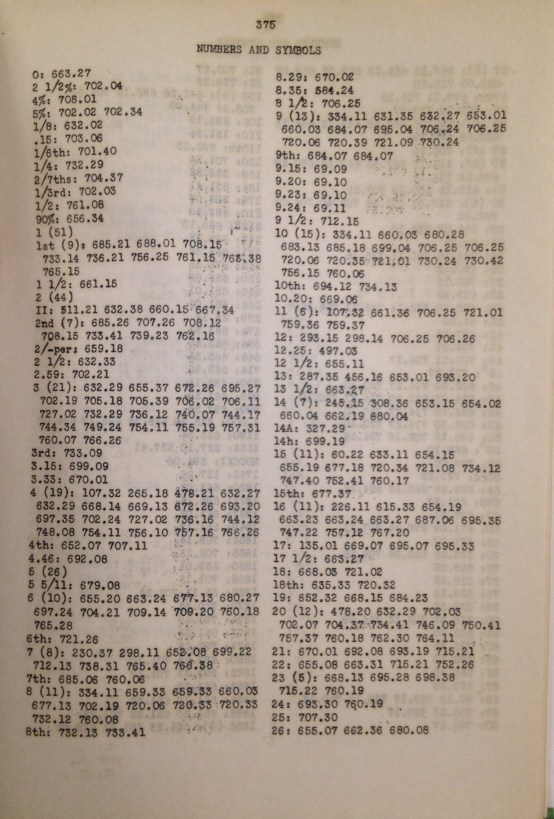
Numbers and Symbols in James Joyce’s Ulysses (“0” through “26”)

Ulysses_Numbers

From Miles L. Hanley’s Word Index to James Joyce’s Ulysses.

Mountain fable (Voltaire)

It is a very old, very universal fable that tells of the mountain which, having frightened all the countryside by its outcry that it was in labor, was hissed by all present when it brought into the world a mere mouse. The people in the pit were not philosophers. Those who hissed should have admired. It was as fine for the mountain to give birth to a mouse, as for the mouse to give birth to a mountain. A rock which produces a rat is a very prodigious thing; and never has the world seen anything approaching this miracle. All the globes of the universe could not call a fly into existence. Where the vulgar laugh, the philosopher admires; and he laughs where the vulgar open their big, stupid eyes in astonishment.

From Philosophical Dictionary.