“Grace” — James Joyce

“Grace” by James Joyce

TWO GENTLEMEN who were in the lavatory at the time tried to lift him up: but he was quite helpless. He lay curled up at the foot of the stairs down which he had fallen. They succeeded in turning him over. His hat had rolled a few yards away and his clothes were smeared with the filth and ooze of the floor on which he had lain, face downwards. His eyes were closed and he breathed with a grunting noise. A thin stream of blood trickled from the corner of his mouth.

These two gentlemen and one of the curates carried him up the stairs and laid him down again on the floor of the bar. In two minutes he was surrounded by a ring of men. The manager of the bar asked everyone who he was and who was with him. No one knew who he was but one of the curates said he had served the gentleman with a small rum.

“Was he by himself?” asked the manager.

“No, sir. There was two gentlemen with him.”

“And where are they?”

No one knew; a voice said:

“Give him air. He’s fainted.”

The ring of onlookers distended and closed again elastically. A dark medal of blood had formed itself near the man’s head on the tessellated floor. The manager, alarmed by the grey pallor of the man’s face, sent for a policeman.

His collar was unfastened and his necktie undone. He opened eyes for an instant, sighed and closed them again. One of gentlemen who had carried him upstairs held a dinged silk hat in his hand. The manager asked repeatedly did no one know who the injured man was or where had his friends gone. The door of the bar opened and an immense constable entered. A crowd which had followed him down the laneway collected outside the door, struggling to look in through the glass panels.

The manager at once began to narrate what he knew. The constable, a young man with thick immobile features, listened. He moved his head slowly to right and left and from the manager to the person on the floor, as if he feared to be the victim of some delusion. Then he drew off his glove, produced a small book from his waist, licked the lead of his pencil and made ready to indite. He asked in a suspicious provincial accent:

“Who is the man? What’s his name and address?”

A young man in a cycling-suit cleared his way through the ring of bystanders. He knelt down promptly beside the injured man and called for water. The constable knelt down also to help. The young man washed the blood from the injured man’s mouth and then called for some brandy. The constable repeated the order in an authoritative voice until a curate came running with the glass. The brandy was forced down the man’s throat. In a few seconds he opened his eyes and looked about him. He looked at the circle of faces and then, understanding, strove to rise to his feet. Continue reading ““Grace” — James Joyce”

Still Life with Silver and Book — Giorgio de Chirico

“There was an Old Man with a beard” (Edward Lear Limerick)

lear

1984 (1954 BBC Sunday-Night Production)

Two Beauties in the Rain — Ohara Koson

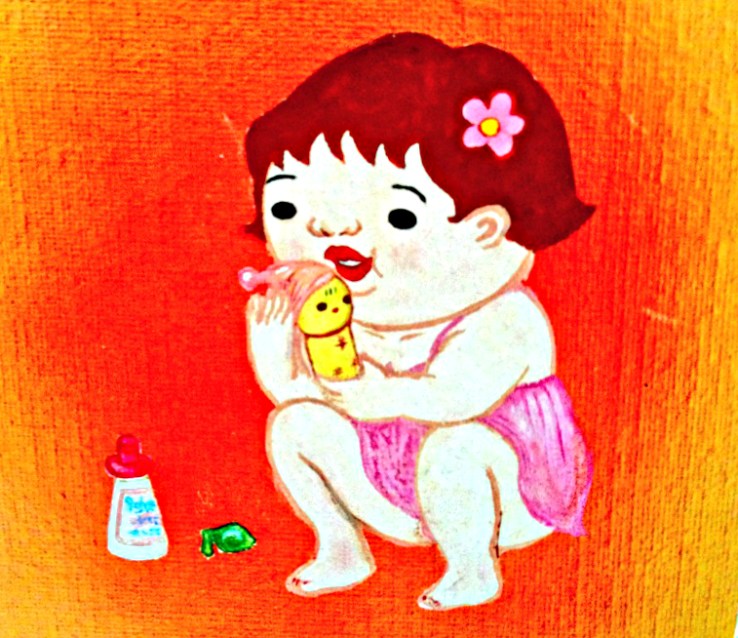
Mimiyo Tomozawa Painting

Mimiyo Tomozawa

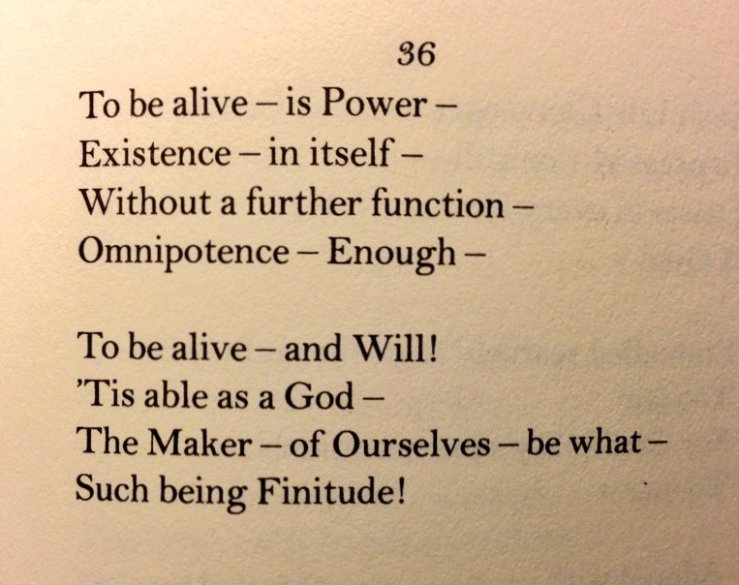
To be alive — is Power — (Emily Dickinson)

20130502-093439

A Constellation of Vital Phenomena (Book Acquired Some Time Last Week)

20130502-112630.jpg

A Constellation of Vital Phenomena by Anthony Marra. Publisher Random House’s blurb:

In his brilliant, haunting novel, Stegner Fellow and Whiting Award winner Anthony Marra transports us to a snow-covered village in Chechnya, where eight-year-old Havaa watches from the woods as Russian soldiers abduct her father in the middle of the night, accusing him of aiding Chechen rebels. Across the road their lifelong neighbor and family friend Akhmed has also been watching, fearing the worst when the soldiers set fire to Havaa’s house. But when he finds her hiding in the forest with a strange blue suitcase, he makes a decision that will forever change their lives. He will seek refuge at the abandoned hospital where the sole remaining doctor, Sonja Rabina, treats the wounded.
For the talented, tough-minded Sonja, the arrival of Akhmed and Havaa is an unwelcome surprise. Weary and overburdened, she has no desire to take on additional risk and responsibility. And she has a deeply personal reason for caution: harboring these refugees could easily jeopardize the return of her missing sister. But over the course of five extraordinary days, Sonja’s world will shift on its axis and reveal the intricate pattern of connections that weave together the pasts of these three unlikely companions and unexpectedly decides their fate. A story of the transcendent power of love in wartime, A Constellation of Vital Phenomenais a work of sweeping breadth, profound compassion, and lasting significance.


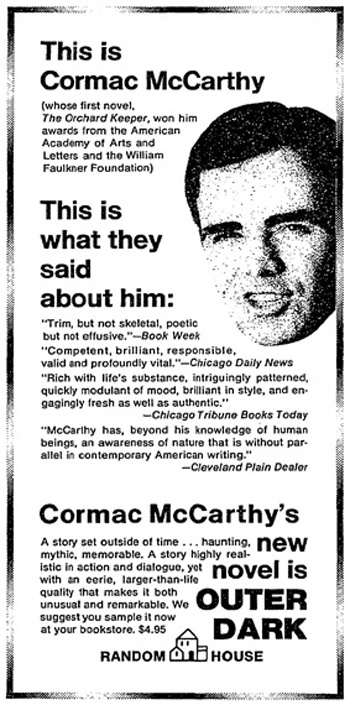
1968 Ad for Cormac McCarthy’s Outer Dark

d05fb40e5ddc4b3a068ca6a01aebc9a3

(Via/more; my review of Outer Dark).

“Life of Ma Parker” — Katherine Mansfield

“Life of Ma Parker” by Katherine Mansfield

When the literary gentleman, whose flat old Ma Parker cleaned every Tuesday, opened the door to her that morning, he asked after her grandson. Ma Parker stood on the doormat inside the dark little hall, and she stretched out her hand to help her gentleman shut the door before she replied. “We buried ‘im yesterday, sir,” she said quietly.

“Oh, dear me! I’m sorry to hear that,” said the literary gentleman in a shocked tone. He was in the middle of his breakfast. He wore a very shabby dressing-gown and carried a crumpled newspaper in one hand. But he felt awkward. He could hardly go back to the warm sitting-room without saying something—something more. Then because these people set such store by funerals he said kindly, “I hope the funeral went off all right.”

“Beg parding, sir?” said old Ma Parker huskily.

Poor old bird! She did look dashed. “I hope the funeral was a—a—success,” said he. Ma Parker gave no answer. She bent her head and hobbled off to the kitchen, clasping the old fish bag that held her cleaning things and an apron and a pair of felt shoes. The literary gentleman raised his eyebrows and went back to his breakfast.

“Overcome, I suppose,” he said aloud, helping himself to the marmalade.

Ma Parker drew the two jetty spears out of her toque and hung it behind the door. She unhooked her worn jacket and hung that up too. Then she tied her apron and sat down to take off her boots. To take off her boots or to put them on was an agony to her, but it had been an agony for years. In fact, she was so accustomed to the pain that her face was drawn and screwed up ready for the twinge before she’d so much as untied the laces. That over, she sat back with a sigh and softly rubbed her knees…

“Gran! Gran!” Her little grandson stood on her lap in his button boots. He’d just come in from playing in the street.

“Look what a state you’ve made your gran’s skirt into—you wicked boy!”

But he put his arms round her neck and rubbed his cheek against hers. Continue reading ““Life of Ma Parker” — Katherine Mansfield”

At the Garden Table — August Macke

Dark Star — John Carpenter (Full Film)

Little Women (The Far Side)

lw

Some content on this page was disabled on June 29, 2021 as a result of a DMCA takedown notice from Andrews McMeel Universal. You can learn more about the DMCA here:

https://wordpress.com/support/copyright-and-the-dmca/

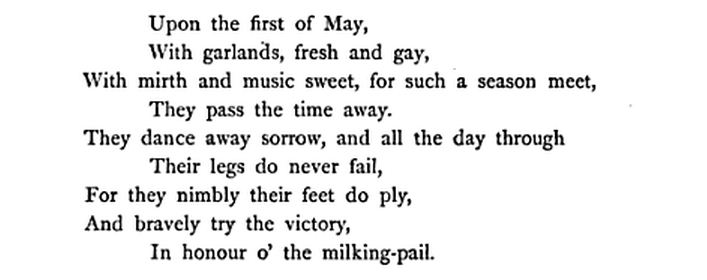
“Upon the first of May” (The Milkmaid)

md

Maypole — Luc Tuymans

Maypole Scene from The Wicker Man

May Day, Central Park — Maurice Prendergast