They support any dogmatic religious system that tends to stupefy and degrade the worshipers | William S. Burroughs


Kim now realizes that they can take over bodies and minds and use them for their purposes. So why do they always take over stupid, bigoted people or people who are retarded or psychotic? Obviously they are looking for dupes and slaves, not for intelligent allies. In fact their precise intention is to destroy human intelligence, to blunt human awareness and to block human beings out of space. What they are launching is an extermination program. And anyone who has sufficient insight to suspect the existence of a they is a prime target.

He listed the objectives and characteristics of the aliens…

1. They support any dogmatic religious system that tends to stupefy and degrade the worshipers. They support the Slave Gods. They want blind obedience, not intelligent assessment. They stand in the way of every increase in awareness. They only conceded a round earth and allowed the development of science to realize the even more stupefying potential of the Industrial Revolution.

2. They support any dogmatic authority. They are the arch-conservatives.

3. They lose no opportunity to invert human values. They are always self-righteous. They have to be right because in human terms they are wrong. Objective assessment drives them to hysterical frenzy.

4. They are parasitic. They live in human minds and bodies.

5. The Industrial Revolution, with its overpopulation and emphasis on quantity rather than quality, has given them a vast reservoir of stupid bigoted uncritical human hosts. The rule of the majority is to their advantage since the majority can always be manipulated.

6. Their most potent tool of manipulation is the word. The inner voice.

7. They will always support any measures that tend to stultify the human host. They will increase the range of arbitrary and dogmatic authority. They will move to make alcohol illegal. They will move to regulate the possession of firearms. They will move to make drugs illegal.

8. They are more at home occupying women than men. Once they have a woman, they have the male she cohabits with. Women must be regarded as the principal reservoir of the alien virus parasite. Women and religious sons of bitches. Above all, religious women.
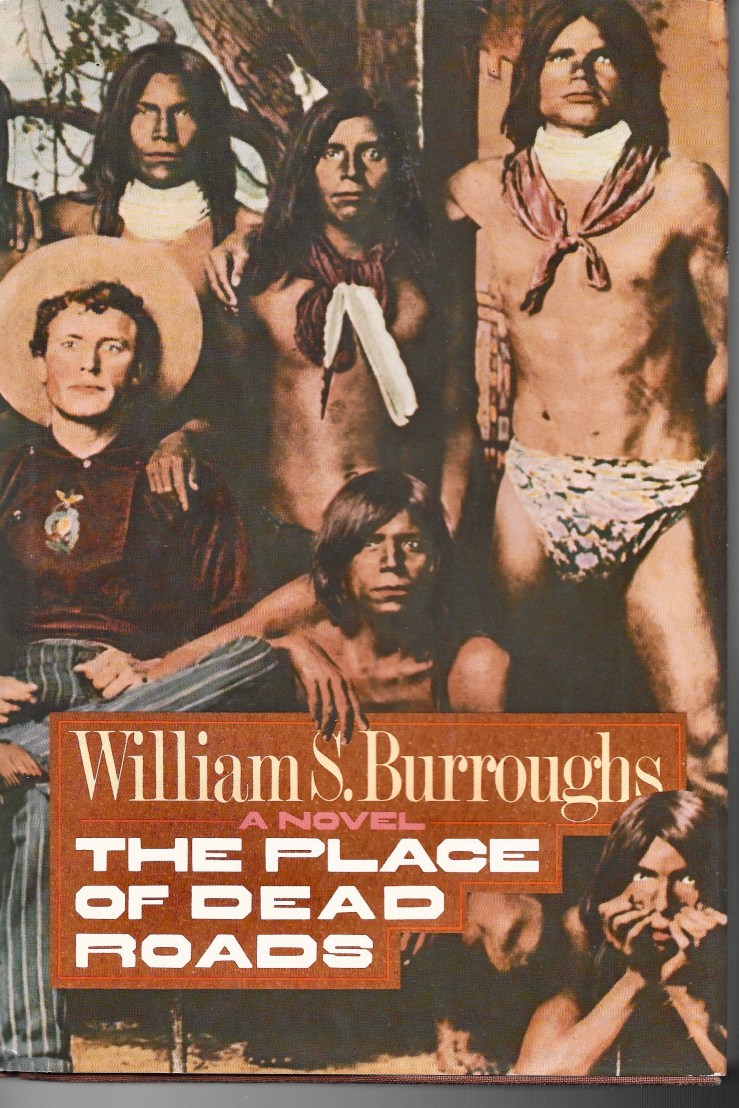
From The Place of Dead Roads by William S. Burroughs.
A hiatus of disinterest | Burroughs meets Beckett (again)

I recall a personal visit to Beckett. John Calder, my publisher and Beckett’s, was the intermediary for a short, not more than half an hour audience. This was in Berlin. Beckett was there directing one of his new plays. Allen Ginsberg, Susan Sontag and myself were there for a reading. Also present in the visiting party were Fred Jordan and Professor Hoellerer, a professor of English literature at Berlin University.

Beckett was polite and articulate. It was, however, apparent to me at least that he had not the slightest interest in any of us, nor the slightest desire to ever see any of us again. We had been warned to take our own liquor as he would proffer none. So we had brought along a bottle of whisky. Beckett accepted a small drink which he sipped throughout the visit. Asking the various participants first what Beckett said, and what the whole conversation was about seems to elicit quite different responses. Nobody seems to remember at all clearly. It was as if we had entered a hiatus of disinterest. I recall that we did talk about my son’s recent liver transplant and the rejection syndrome. I reminded Beckett of our last meeting in Maurice Girodias’ restaurant On this occasion we had argued about the cut-ups, and I had no wish to renew the argument. So it was just ‘yes’, ‘Maurice’s restaurant’. Allen, I believe, asked Beckett if he had ever given a reading of his work. Beckett said ‘No’.

There was some small talk about the apartment placed at his disposal by the Academy: a sparsely furnished duplex overlooking the Tiergarten. I said the zoo was very good, one of the best, with nocturnal creatures in dioramas, like their natural habitat. They even have flying foxes. Beckett nodded, as if willing to take my word for this. I think there was some discussion of Susan Sontag’s cancer. I looked at my watch. Some one asked Allen or Fred for the time. We got up to go. Beckett shook hands politely.

From William S. Burroughs’ essay “Beckett and Proust.” Collected in The Adding Machine. 

There were a number of these antivaccination cults, a self-limiting phenomenon | William S. Burroughs

Kim remembers his first adolescent experiment with biologic warfare. Smallpox was the instrument, the town of Jehovah across the river, his target. Their horrid church absolutely spoiled his sunsets, with its gilded spire sticking up like an unwanted erection, and Kim vowed he would see it leveled.

It was dead easy. The townspeople were antivaccinationists…”polluting the blood of Christ,” they called it. Around the turn of the century there were a number of these antivaccination cults, a self-limiting phenomenon since all the cultists contracted smallpox sooner or later.

So Kim simply jogged the arm of destiny, you might say, by distributing free illustrated Bibles impregnated with smallpox virus to the townspeople of Jehovah. The survivors moved out. Kim bought the land and used the church to test his homemade flamethrower. He found the plan in Boy’s Life…a weed killer, they called it. Well, rotten weeds, you know…

From The Place of Dead Roads by William S. Burroughs.
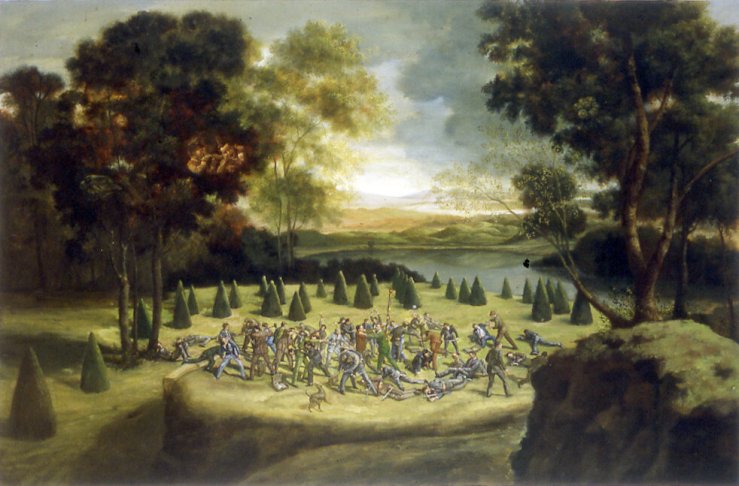
May Day — Julie Heffernan

May Day, 1997 by Julie Heffernan (b. 1956)

Osprey’s Nest — Neil Welliver

Osprey’s Nest, 1980 by Neil Welliver (1929-2005)

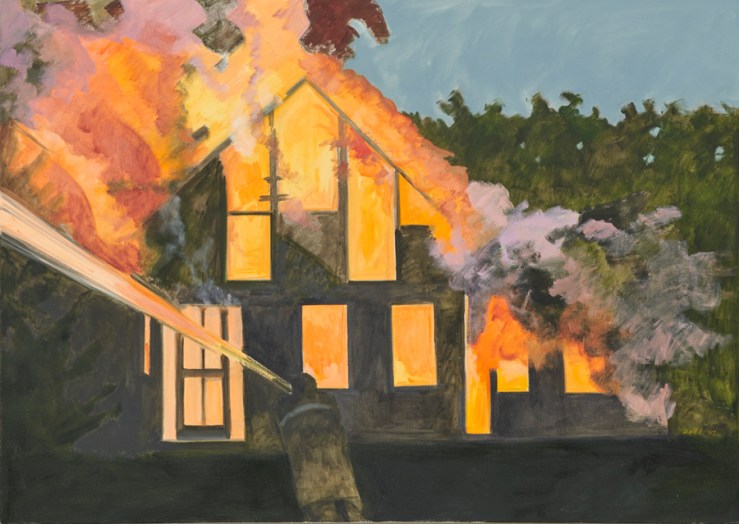
Burning House, Night, with Fireman — Lois Dodd

Burning House, Night, with Fireman, 2007 by Lois Dodd (b. 1927)

Well, Well, Well (Chiffon in Green) — Dominic Chambers

Well, Well, Well (Chiffon in Green), 2020 — Dominic Chambers (b. 1993)


Game planet | William S. Burroughs

This is a game planet. All games are hostile and basically there is only one game, and that game is war. Research into altered states of consciousness — which might result in a viewpoint from which the game itself could be called into question — is inexorably drawn into the game. One of the rules of this game is that there cannot be final victory since that would mean the end of the war game. Every player must believe in final victory and endeavor to attain final victory with all his resources. In consequence all existing technologies are directed towards producing total weapons that could end the game by killing all players. Is there any way out of this impasse of national security at the expense of global insecurity? Certainly a prerequisite for any solution would be for all countries to put all their top secrets right on the table.

From “Mind War,” collected in The Adding Machine. 

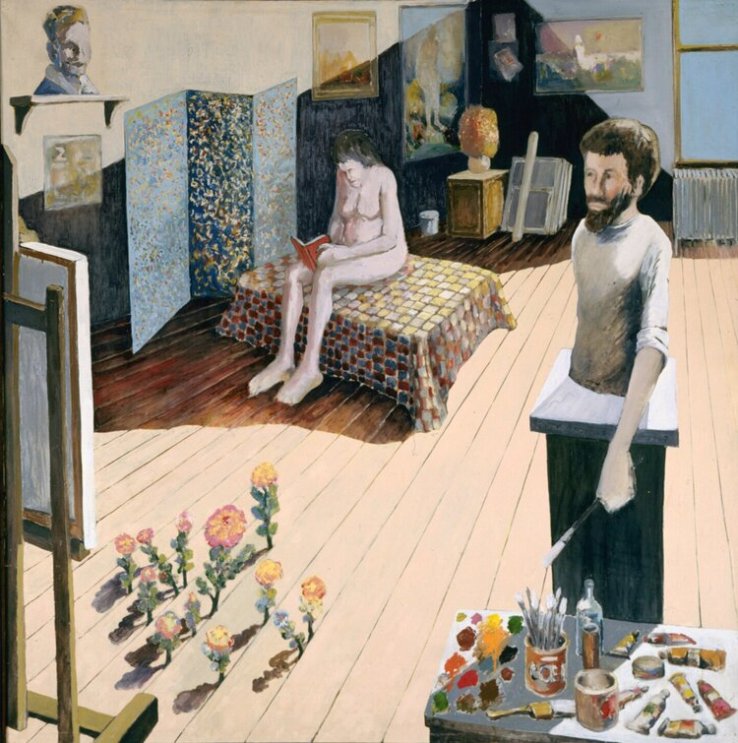
Studio — Benny Andrews

Studio, 1967 by Benny Andrews (1930-2006)

The ecological crisis cannot be resolved by politics | Joy Williams

The ecological crisis cannot be resolved by politics. It cannot be resolved by science or technology. It is a crisis caused by culture and character, and a deep change in personal consciousness is needed. Your fundamental attitudes toward the earth have become twisted. You have made only brutal contact with Nature; you cannot comprehend its grace. You must change. Have few desires and simple pleasures. Honor nonhuman life. Control yourself, become more authentic. Live lightly upon the earth and treat it with respect. Redefine the word progress and dismiss the managers and masters. Grow inwardly and with knowledge become truly wiser. Think differently, behave differently. For this is essentially a moral issue we face, and moral decisions must be made.

From Joy Williams’ essay “Save the Whales, Screw the Shrimp.” Collected in Ill Nature.

Front Yard Things — Peter Uka 

Front Yard Things, 2020 by Peter Uka (b. 1975)

Life Wants to Live — Phil Hale

Life Wants to Live, 2014 by Phil Hale (b. 1963)

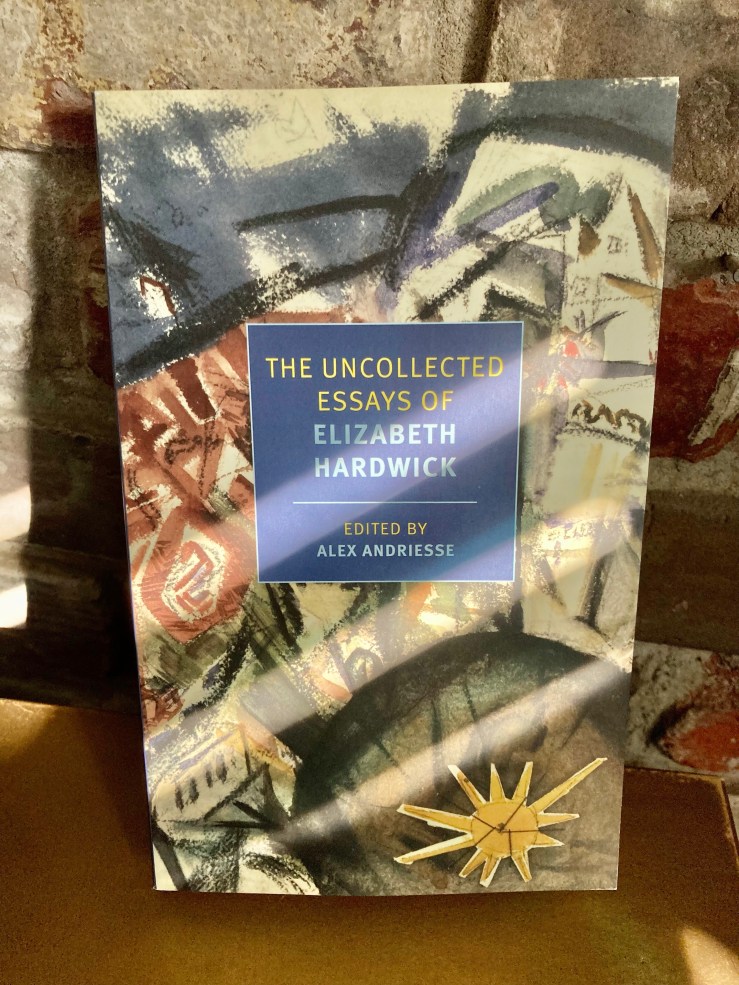
The Uncollected Essays of Elizabeth Hardwick (Book acquired, 25 April 2022)

NYRB has collected the uncollected essays of Elizabeth Hardwick and published it as The Uncollected Essays of Elizabeth Hardwick. Thirty-five essays, out in late May. NYRB’s blurb:

The Uncollected Essays of Elizabeth Hardwick is a companion collection to The Collected Essays, a book that proved a revelation of what, for many, had been an open secret: that Elizabeth Hardwick was one of the great American literary critics, and an extraordinary stylist in her own right. The thirty-five pieces that Alex Andriesse has gathered here—none previously featured in volumes of Hardwick’s work—make it clear that her powers extended far beyond literary criticism, encompassing a vast range of subjects, from New York City to Faye Dunaway, from Wagner’s Parsifal to Leonardo da Vinci’s inventions, and from the pleasures of summertime to grits soufflé. In these often surprising, always well-wrought essays, we see Hardwick’s passion for people and places, her politics, her thoughts on feminism, and her ability, especially from the 1970s on, to write well about seemingly anything.

Carmencita Playing — Antonio López García

Carmencita Playing, 1960, by Antonio López García (b. 1936)

“Noah’s Raven” — W.S. Merwin

“Noah’s Raven”

by

W.S. Merwin


Why should I have returned?
My knowledge would not fit into theirs.
I found untouched the desert of the unknown,
Big enough for my feet. It is my home.
It is always beyond them. The future
Splits the present with the echo of my voice.
Hoarse with fulfillment, I never made promises.

Bisclavret — Walton Ford

Bisclavret, 2022 by Walton Ford (b. 1960)