“An Ecstasy of Truth” — Werner Herzog Distinguishes Fact and Truth

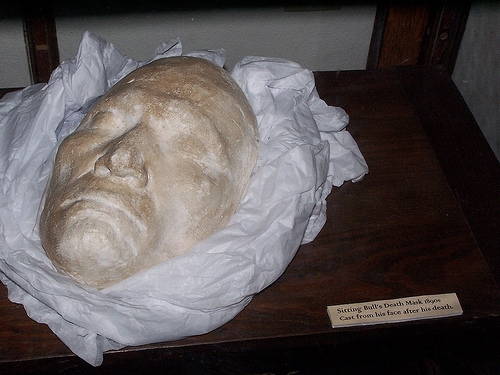
Sitting Bull’s Death Mask

Martin Scorsese on Citizen Kane

“These Go to 11”

Three (Somewhat Literary) Lists for 11 | 11 | 11

Eleven Authors Who Were Also Veterans of War

1. Stendahl (Napoleonic Wars)

2. Ambrose Bierce (Union Army, American Civil War)

3. Erich Maria Remarque (German Army, WWI)

4. George Orwell (Republican Army, Spanish Civil War)

5. Kurt Vonnegut (U.S. Army, WWII)

6. Joseph Heller (U.S. Air Force, WWII)

7. Eveyln Waugh (British Royal Marines, WWII)

8. Norman Mailer (U.S Army, WWII)

9. Gore Vidal (U.S. Army, WWII)

10. Tim O’Brien (U.S. Army, Vietnam War)

11. Anthony Swofford (U.S. Marine Corps, Persian Gulf War)

*          *          *

Eleven Encyclopedic Books, Overstuffed with References, That Compel Compulsive Reading

1. Moby-Dick, Herman Melville

2. Finnegans Wake, James Joyce

3. Expelled from Eden, A WilliamVollmann Reader

4. Species of Spaces and Other Pieces, Georges Perec

5. Wittgenstein’s Mistress, David Markson

6. The Silmarillion, J.R.R. Tolkien

7. Foucault’s Pendulum, Umberto Eco

8. The Rings of Saturn, W.G. Sebald

9. The Recognitions, William Gaddis

10. Between Parentheses, Roberto Bolaño

11.  The Architecture of the Arkansas Ozarks, Donald Harrington

*          *          *

Eleven Excellent Films About Films and Film-making 

1. Hearts of Darkness, Eleanor Coppola, et al

2. Lost in La Mancha, Keith Fulton et al

3. Burden of Dreams, Les Blank

4. Adaptation, Spike Jonze

5. Be Kind Rewind, Michel Gondry

6. The Player, Robert Altman

7. Ed Wood, Tim Burton

8. Stardust Memories, Woody Allen

9. Sullivan’s Travels, Preston Sturges

10. American Movie, Chris Smith

11. Barton Fink, Coen Brothers
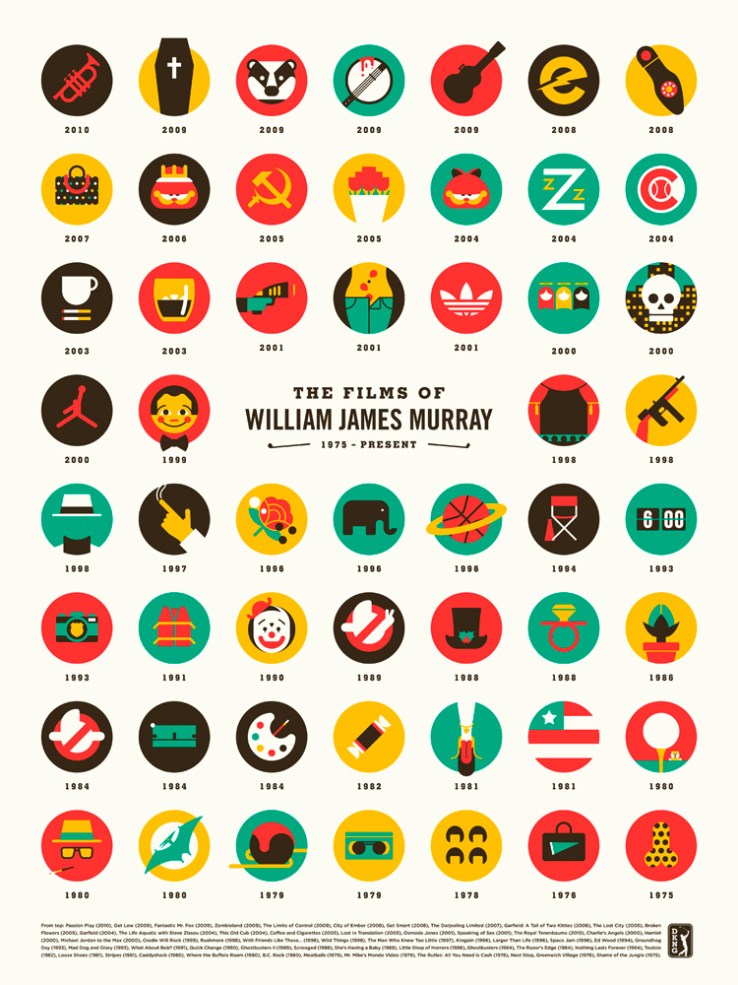
A Graphic Representation of Bill Murray Films

Eleven Excellent Films About Films and Film-making

Eleven Excellent Films About Films and Film-making 

1. Hearts of Darkness, Eleanor Coppola, et al

2. Lost in La Mancha, Keith Fulton et al

3. Burden of Dreams, Les Blank

4. Adaptation, Spike Jonze

5. Be Kind Rewind, Michel Gondry

6. The Player, Robert Altman

7. Ed Wood, Tim Burton

8. Stardust Memories, Woody Allen

9. Sullivan’s Travels, Preston Sturges

10. American Movie, Chris Smith

11. Barton Fink, Coen Brothers
Eleven Encyclopedic Books, Overstuffed with References, That Compel Compulsive Reading

Eleven Encyclopedic Books, Overstuffed with References, That Compel Compulsive Reading

1. Moby-Dick, Herman Melville

2. Finnegans Wake, James Joyce

3. Expelled from Eden, A WilliamVollmann Reader

4. Species of Spaces and Other Pieces, Georges Perec

5. Wittgenstein’s Mistress, David Markson

6. The Silmarillion, J.R.R. Tolkien

7. Foucault’s Pendulum, Umberto Eco

8. The Rings of Saturn, W.G. Sebald

9. The Recognitions, William Gaddis

10. Between Parentheses, Roberto Bolaño

11.  The Architecture of the Arkansas Ozarks, Donald Harrington


“The Discharged Soldier” — William Wordsworth

Drawing of Adrian Jones by Michael Fay

In Section IV of his Prelude, William Wordsworth evokes the most moving encounter with a veteran of war that I have ever read. At first reticent to be anything but a voyeur, the narrator (Wordsworth, in all likelihood), slips “into the shade/ Of a thick hawthorn” to spy on the “meagre man” with a “ghastly” mouth “in military garb” resting on a “mile-stone.” As the poor ex-soldier, “Companionless,” begins to issue “low muttered sounds, as if of pain / Or some uneasy though,” the narrator shakes his “heart’s specious cowardice” and hails the veteran as a human being, asking for his story. It turns out that the guy is slowly—and with great difficulty—returning to his “native home.” Wordsworth takes the veteran to a nearby friend’s house for companionship and rest, before returning to his own home in a contemplative mood. Full text of  “The Discharged Soldier”—

No living thing appeared in earth or air,
And, save the flowing water’s peaceful voice,
Sound there was none–but, lo! an uncouth shape,
Shown by a sudden turning of the road,
So near that, slipping back into the shade
Of a thick hawthorn, I could mark him well, 390
Myself unseen. He was of stature tall,
A span above man’s common measure, tall,
Stiff, lank, and upright; a more meagre man
Was never seen before by night or day.
Long were his arms, pallid his hands; his mouth
Looked ghastly in the moonlight: from behind,
A mile-stone propped him; I could also ken
That he was clothed in military garb,
Though faded, yet entire. Companionless,
No dog attending, by no staff sustained, 400
He stood, and in his very dress appeared
A desolation, a simplicity,
To which the trappings of a gaudy world
Make a strange back-ground. From his lips, ere long,
Issued low muttered sounds, as if of pain
Or some uneasy thought; yet still his form
Kept the same awful steadiness–at his feet
His shadow lay, and moved not. From self-blame
Not wholly free, I watched him thus; at length
Subduing my heart’s specious cowardice, 410
I left the shady nook where I had stood
And hailed him. Slowly from his resting-place
He rose, and with a lean and wasted arm
In measured gesture lifted to his head
Returned my salutation; then resumed
His station as before; and when I asked
His history, the veteran, in reply,
Was neither slow nor eager; but, unmoved,
And with a quiet uncomplaining voice,
A stately air of mild indifference, 420
He told in few plain words a soldier’s tale–
That in the Tropic Islands he had served,
Whence he had landed scarcely three weeks past;
That on his landing he had been dismissed,
And now was travelling towards his native home.
This heard, I said, in pity, “Come with me.”
He stooped, and straightway from the ground took up
An oaken staff by me yet unobserved–
A staff which must have dropped from his slack hand
And lay till now neglected in the grass. 430
Though weak his step and cautious, he appeared
To travel without pain, and I beheld,
With an astonishment but ill suppressed,
His ghostly figure moving at my side;
Nor could I, while we journeyed thus, forbear
To turn from present hardships to the past,
And speak of war, battle, and pestilence,
Sprinkling this talk with questions, better spared,
On what he might himself have seen or felt.
He all the while was in demeanour calm, 440
Concise in answer; solemn and sublime
He might have seemed, but that in all he said
There was a strange half-absence, as of one
Knowing too well the importance of his theme,
But feeling it no longer. Our discourse
Soon ended, and together on we passed
In silence through a wood gloomy and still.
Up-turning, then, along an open field,
We reached a cottage. At the door I knocked,
And earnestly to charitable care 450
Commended him as a poor friendless man,
Belated and by sickness overcome.
Assured that now the traveller would repose
In comfort, I entreated that henceforth
He would not linger in the public ways,
But ask for timely furtherance and help
Such as his state required. At this reproof,
With the same ghastly mildness in his look,
He said, “My trust is in the God of Heaven,
And in the eye of him who passes me!” 460

The cottage door was speedily unbarred,
And now the soldier touched his hat once more
With his lean hand, and in a faltering voice,
Whose tone bespake reviving interests
Till then unfelt, he thanked me; I returned
The farewell blessing of the patient man,
And so we parted. Back I cast a look,
And lingered near the door a little space,
Then sought with quiet heart my distant home.

Eleven Authors Who Were Also Veterans of War

Eleven Authors Who Were Also Veterans of War

1. Stendahl (Napoleonic Wars)

2. Ambrose Bierce (Union Army, American Civil War)

3. Erich Maria Remarque (German Army, WWI)

4. George Orwell (Republican Army, Spanish Civil War)

5. Kurt Vonnegut (U.S. Army, WWII)

6. Joseph Heller (U.S. Air Force, WWII)

7. Eveyln Waugh (British Royal Marines, WWII)

8. Norman Mailer (U.S Army, WWII)

9. Gore Vidal (U.S. Army, WWII)

10. Tim O’Brien (U.S. Army, Vietnam War)

11. Anthony Swofford (U.S. Marine Corps, Persian Gulf War)

“My Books Are Forgeries” — Philip K. Dick

Slate has published an excerpt from the forthcoming collection of letters and other ephemera, The Exegesis of Philip K. Dick (by, uh, PK Dick). An excerpt of that excerpt—

My books are forgeries. Nobody wrote them. The goddam typewriter wrote them; it’s a magic typewriter. Or like John Denver gets his songs: I get them from the air. Like his songs, they—my books—are already there. Whatever that means.

The most ominous element from my books which I am encountering in my actual life is this. In one of my novels, Ubik, certain anomalies occur which prove to the characters that their environment is not real. Those same anomalies are now happening to me. By my own logic in the novel I must conclude that my or perhaps even our collective environment is only a pseudo-environment. In my novel what broke through was the presence of a man who had died. He speaks to them through several intermediary systems and hence must still be alive; it is they, evidently, who are dead. What has been happening to me for over three months is that a man I knew who died has been breaking through in ways so similar to that of Runciter in Ubik that I am beginning to conclude that I and everyone else is either dead and he is alive, or—well, as in the novel, I can’t figure it out. It makes no sense.

Moe Szyslak Defines “Postmodernism” for Homer and the Boys (The Simpsons)

William Gibson: “Bleak House Is the Best Steampunk Landscape That Will Ever Be”

From The Paris Review interviewWilliam Gibson on on Charles Dickens’s Bleak House

INTERVIEWER

The Victorians invented science fiction.

GIBSON

I think the popular perception that we’re a lot like the Victorians is in large part correct. One way is that we’re all constantly in a state of ongoing t­echnoshock, without really being aware of it—it’s just become where we live. The Victorians were the first people to experience that, and I think it made them crazy in new ways. We’re still riding that wave of craziness. We’ve gotten so used to emergent technologies that we get anxious if we haven’t had one in a while.

But if you read the accounts of people who rode steam trains for the first time, for instance, they went a little crazy. They’d traveled fifteen miles an hour, and when they were writing the accounts afterward they struggled to describe that unthinkable speed and what this linear velocity does to a perspective as you’re looking forward. There was even a Victorian medical complaint called “railway spine.”

Emergent technologies were irreversibly altering their landscape. Bleak House is a quintessential Victorian text, but it is also probably the best steam­punk landscape that will ever be. Dickens really nailed it, especially in those proto-Ballardian passages in which everything in nature has been damaged by heavy industry. But there were relatively few voices like Dickens then. Most people thought the progress of industry was all very exciting. Only a few were saying, Hang on, we think the birds are dying.


“I Think I Could Make a Picture Better Than That, But I Haven’t Been Given a Second Chance” — Orson Welles Talks About Making Citizen Kane

Nabokov Shows Off Different Lolita Covers

“Hit Me” — A Scene from Terrence Malick’s Film The Tree of Life

“On the Difficulty of Imagining an Ideal City” — Georges Perec

“On the Difficulty of Imagining an Ideal City,” a poem or essay or something—a text—by Georges Perec. The piece is one of the selections in Perec’s collection of miscellany, Species of Spaces and Other Pieces:

I wouldn’t like to live in America but sometimes I would

I’d love to live on the Boulevard St Germain but sometimes I wouldn’t

I wouldn’t like to live on a coral reef but sometimes I would

I wouldn’t like to live in a dungeon but sometimes I would

I wouldn’t like to live in the East but sometimes I would

I love living in France but sometimes I don’t

I’d love to live in Greenland but not for too long

I’d like to live to a hundred but sometimes I wouldn’t

I wouldn’t like to live in Issoudun but sometimes I would

I wouldn’t like to live on a junk but sometimes I would

I wouldn’t like to live in a ksar but sometimes I would

I’d have loved to go in a lunar module but it’s a bit late

I wouldn’t like to live in a monastery but sometimes I would

I wouldn’t like to live at the Hotel Negresco but sometimes I would

I wouldn’t like to live in the open air but sometimes I would

I love living in Paris but sometimes I don’t

I wouldn’t like to live in Quebec but sometimes I would

I wouldn’t like to live by my own resources but sometimes I would

I wouldn’t like to live in a submarine but sometimes I would

I wouldn’t like to live in a tower but sometimes I would

I wouldn’t like to live with Ursula Andress but sometimes I would

I wouldn’t like to live in a village but sometimes I would

I wouldn’t like to live in a wigwam but sometimes I would

I’d love to live in Xanadu but not for ever

I wouldn’t like to live in the Yonne but sometimes I would

I wouldn’t like us all to live in Zanzibar but sometimes I would