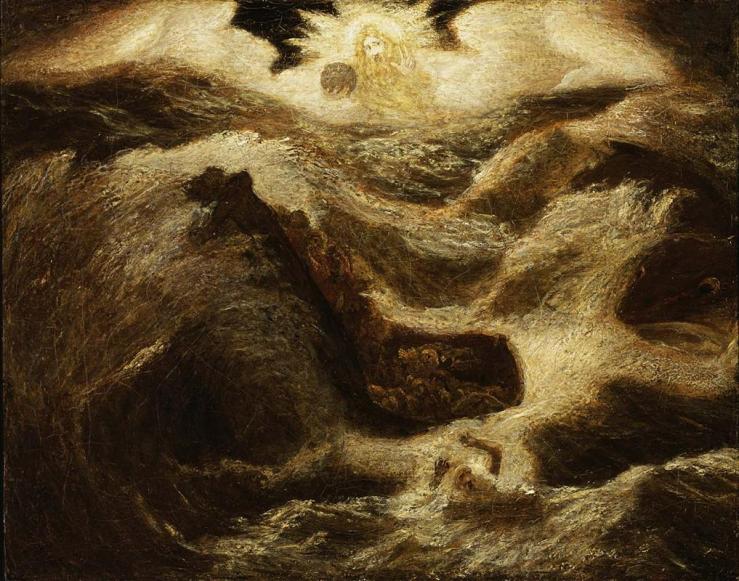
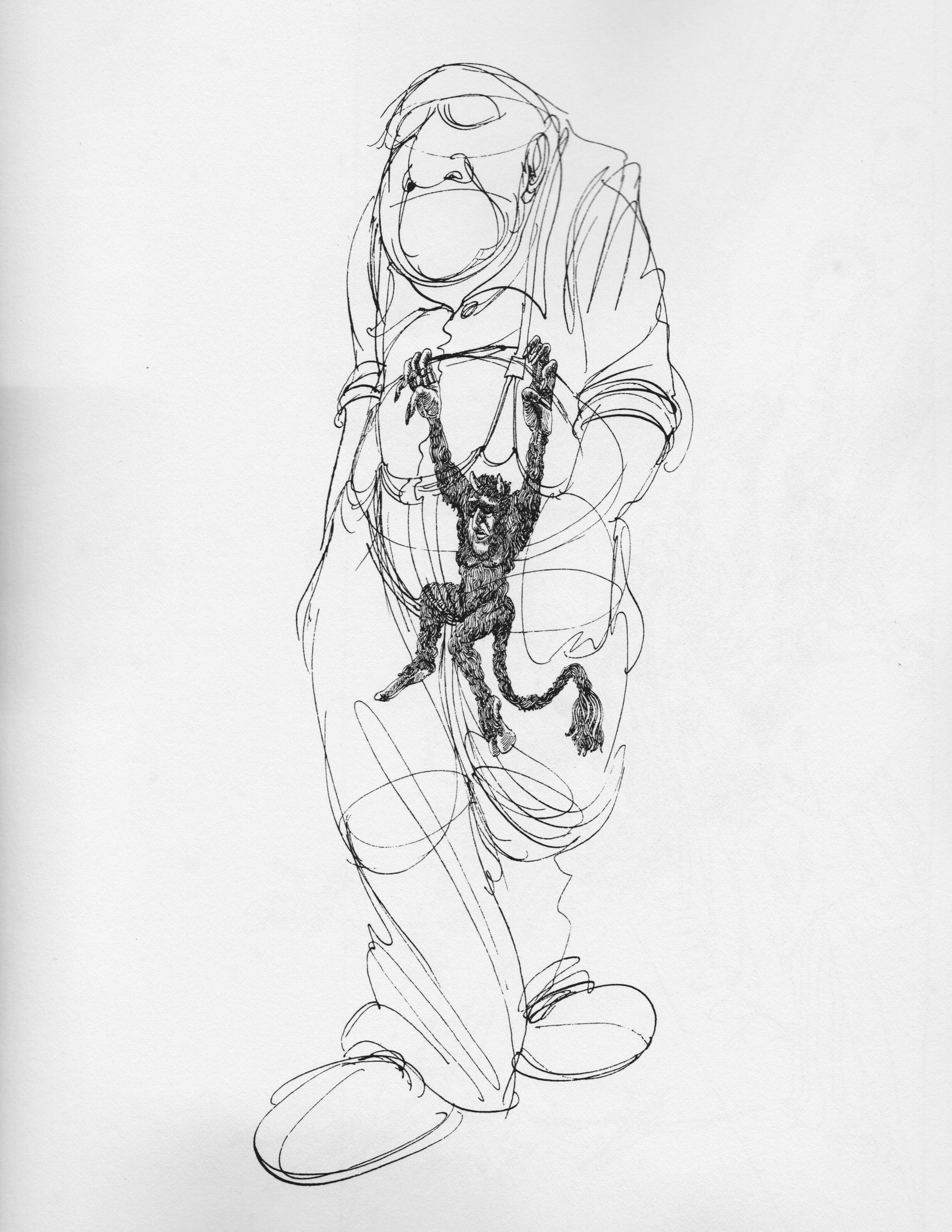
And here is “The Sermon,” Ch. IX of Herman Melville’s great novel Moby-Dick, in which Father Mapple gives us the tale of Jonah—
Father Mapple rose, and in a mild voice of unassuming authority ordered the scattered people to condense. “Starboard gangway, there! side away to larboard—larboard gangway to starboard! Midships! midships!”
There was a low rumbling of heavy sea-boots among the benches, and a still slighter shuffling of women’s shoes, and all was quiet again, and every eye on the preacher.
He paused a little; then kneeling in the pulpit’s bows, folded his large brown hands across his chest, uplifted his closed eyes, and offered a prayer so deeply devout that he seemed kneeling and praying at the bottom of the sea.
This ended, in prolonged solemn tones, like the continual tolling of a bell in a ship that is foundering at sea in a fog—in such tones he commenced reading the following hymn; but changing his manner towards the concluding stanzas, burst forth with a pealing exultation and joy—
     "The ribs and terrors in the whale,
     Arched over me a dismal gloom,
     While all God's sun-lit waves rolled by,
     And lift me deepening down to doom.

     "I saw the opening maw of hell,
     With endless pains and sorrows there;
     Which none but they that feel can tell—
     Oh, I was plunging to despair.

     "In black distress, I called my God,
     When I could scarce believe him mine,
     He bowed his ear to my complaints—
     No more the whale did me confine.

     "With speed he flew to my relief,
     As on a radiant dolphin borne;
     Awful, yet bright, as lightning shone
     The face of my Deliverer God.

     "My song for ever shall record
     That terrible, that joyful hour;
     I give the glory to my God,
     His all the mercy and the power."
Nearly all joined in singing this hymn, which swelled high above the howling of the storm. A brief pause ensued; the preacher slowly turned over the leaves of the Bible, and at last, folding his hand down upon the proper page, said: “Beloved shipmates, clinch the last verse of the first chapter of Jonah—’And God had prepared a great fish to swallow up Jonah.'”
“Shipmates, this book, containing only four chapters—four yarns—is one of the smallest strands in the mighty cable of the Scriptures. Yet what depths of the soul does Jonah’s deep sealine sound! what a pregnant lesson to us is this prophet! What a noble thing is that canticle in the fish’s belly! How billow-like and boisterously grand! We feel the floods surging over us; we sound with him to the kelpy bottom of the waters; sea-weed and all the slime of the sea is about us! But what is this lesson that the book of Jonah teaches? Shipmates, it is a two-stranded lesson; a lesson to us all as sinful men, and a lesson to me as a pilot of the living God. As sinful men, it is a lesson to us all, because it is a story of the sin, hard-heartedness, suddenly awakened fears, the swift punishment, repentance, prayers, and finally the deliverance and joy of Jonah. As with all sinners among men, the sin of this son of Amittai was in his wilful disobedience of the command of God—never mind now what that command was, or how conveyed—which he found a hard command. But all the things that God would have us do are hard for us to do—remember that—and hence, he oftener commands us than endeavors to persuade. And if we obey God, we must disobey ourselves; and it is in this disobeying ourselves, wherein the hardness of obeying God consists. Continue reading “Jonah — Albert Pinkham Ryder”→
I swung by my favorite used bookstore this afternoon; it’s right near the grocery store and I needed to pick up some mint and some ricotta. I was hoping to pick up Elena Ferrante’s novel My Brilliant Friend at the bookstore. I started the audiobook of My Brilliant Friend today, after finishing the audiobook of Adrian Jones Pearson’s novel Cow Country this weekend. (Full review of Cow Country forthcoming but a real quick review: great performance/reading of a very strange book which I enjoyed very much, but which I also suspect will have very limited appeal. Cow cult classic to come). But so anyway, I’m really digging the Ferrante, and decided I wanted to obtain a physical copy to reread passages (and maybe share some on this blog). My store had several copies of four of Ferrante’s novels–but no Friend. While scanning the F section, my eye alighted (alit?) on a strange-looking hardback spine—Warren Fine’s Their Family. I turned it around and the cover…well, I knew I was gonna leave with it. Knopf, 1972—a few years before Gordon Lish was to become editor there, sure, but interesting bona fides I suppose. Fine does not seem to be beloved by anyone on the internet, and his books seem to have failed to go into second printings of any kind. The Fs are near the Es, and I glanced over the works of Mr. Stanley Elkin, who has his own section there, somehow. I finally broke through the second chapter of his novel The Franchiser this weekend (it’s all unattributed dialog, that chapter, sorta like Gaddis’s JR); I’m really digging The Franchiser now that I’ve tuned into the voice. (It also helps to not try reading it exclusively at night after too many bourbons or wines). Again, the spine of the novel looked interesting so I flipped The Dick Gibson Show around and, again, I knew I was gonna leave with it. Henri Michaux’s Miserable MiracleI found in the “Drugs” section—which I was not perusing (because I am no longer 19)—well I guess I was perusing it, but that’s only because it happens to be right next to this particular bookshop’s collection of Black Sparrow Press titles, which I always scan over. Anyway, the Michaux’s Miserable Miracle was turned face out; NYRB titles always deserve a quick scan, and the cover reminded me of a Cy Twombly painting. Flicking through it revealed a strange structure, full of marginal side notes and doodles and diagrams and drawings. And oh, it’s about a mescaline trip, I think. You can actually read it here, but this version is missing all the drawings and sidenotes.
Oh, and so then I forgot to go pick up the ricotta and the mint.
Every evening the young Fisherman went out upon the sea, and threw his nets into the water.
When the wind blew from the land he caught nothing, or but little at best, for it was a bitter and black-winged wind, and rough waves rose up to meet it. But when the wind blew to the shore, the fish came in from the deep, and swam into the meshes of his nets, and he took them to the market-place and sold them.
Every evening he went out upon the sea, and one evening the net was so heavy that hardly could he draw it into the boat. And he laughed, and said to himself, ‘Surely I have caught all the fish that swim, or snared some dull monster that will be a marvel to men, or some thing of horror that the great Queen will desire,’ and putting forth all his strength, he tugged at the coarse ropes till, like lines of blue enamel round a vase of bronze, the long veins rose up on his arms. He tugged at the thin ropes, and nearer and nearer came the circle of flat corks, and the net rose at last to the top of the water.
But no fish at all was in it, nor any monster or thing of horror, but only a little Mermaid lying fast asleep.
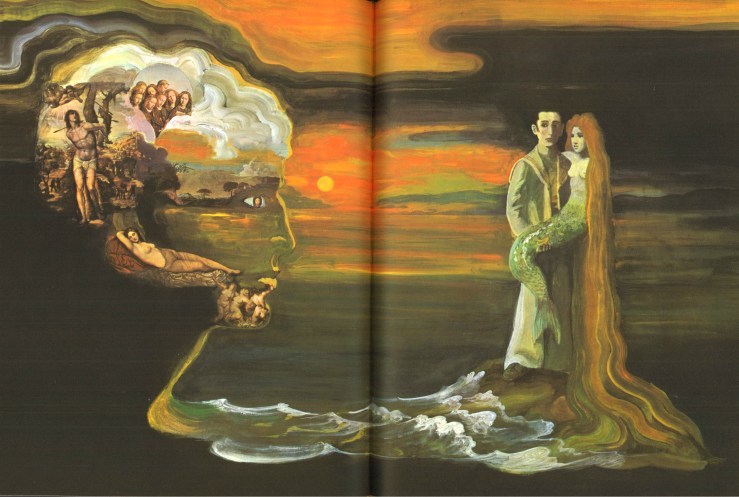
Her hair was as a wet fleece of gold, and each separate hair as a thread of fine gold in a cup of glass. Her body was as white ivory, and her tail was of silver and pearl. Silver and pearl was her tail, and the green weeds of the sea coiled round it; and like sea-shells were her ears, and her lips were like sea-coral. The cold waves dashed over her cold breasts, and the salt glistened upon her eyelids.
So beautiful was she that when the young Fisherman saw her he was filled with wonder, and he put out his hand and drew the net close to him, and leaning over the side he clasped her in his arms. And when he touched her, she gave a cry like a startled sea-gull, and woke, and looked at him in terror with her mauve-amethyst eyes, and struggled that she might escape. But he held her tightly to him, and would not suffer her to depart.
And when she saw that she could in no way escape from him, she began to weep, and said, ‘I pray thee let me go, for I am the only daughter of a King, and my father is aged and alone.’
But the young Fisherman answered, ‘I will not let thee go save thou makest me a promise that whenever I call thee, thou wilt come and sing to me, for the fish delight to listen to the song of the Sea-folk, and so shall my nets be full.’
‘Wilt thou in very truth let me go, if I promise thee this?’ cried the Mermaid.
‘In very truth I will let thee go,’ said the young Fisherman.
So she made him the promise he desired, and sware it by the oath of the Sea-folk. And he loosened his arms from about her, and she sank down into the water, trembling with a strange fear.