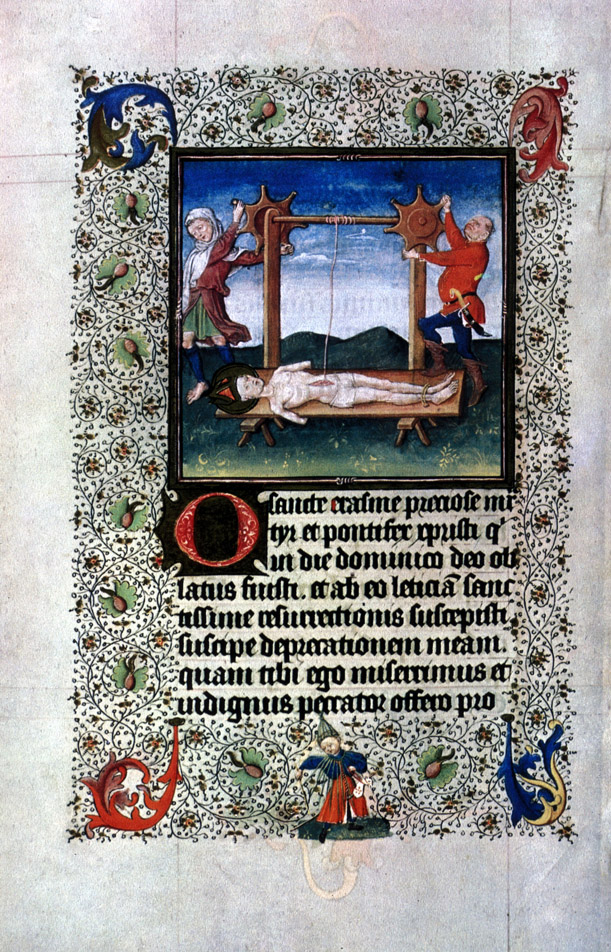
There were images that had nowhere to hang but in his head, images he remembered from books but of which he had no other copy; particularly one, from a strangely beautiful illuminated manuscript called The Hours of Catherine of Cleves, that depicted the martyrdom of Saint Erasmus. The presumptive saint lies on a raised plank, naked except for a loincloth. His abdomen has been opened and his intestines attached to a windlass erected above him. Thereupon, like a length of sausage or a length of rope, his innards are being wound by two figures, one male, one possibly female, each working hard to turn the spokes, their faces, however, averted from the scene. The saint does not appear to have wrists or hands. Eight turns have already been taken. The sky is empty except for a few clouds; the earth is empty except for two hills and some small yellow flowers. Around this painting, framed like a picture, is a delicate thin line made of curlicues and a field of tiny petals stalked by imaginary butterflies. At the bottom a small boy wearing a collar of thin sticks is riding a hobbyhorse.
His curiosity aroused by this calamitous vision, Skizzen sought more bio concerning Saint Erasmus. One source simply said that “although he existed, almost nothing is known about him.” This sentence stayed with Skizzen as stubbornly as the piteous illumination. What a blessed condition Erasmus must have enjoyed! Although he existed, almost nothing was known of him. Although nothing was known of him, as a saint, he existed. He existed, yet he had lived such a saintly life there was nothing of him to be known. Still another authority was not as sanguine. It claimed that the cult of Erasmus spread with such success that twelve hundred years later the martyr was invoked as one of the Fourteen Holy Helpers, whoever they were, and had become patron saint of sailors as well as kids who had colic. What was known, during those hundreds of years, was not known of the saint but of some figure he had thrown about himself as you would a ghostly garment or a costume for the dance. Proudly, Professor Skizzen pasted Erasmus in his memory book. A.d. 300. He was sprayed with tar and set alight. He was jailed, rescued by an angel, disemboweled. On a day in a.d. He died for me.
From William H. Gass’s novel Middle C.














 Biblioklept