Camp Forestia — Peter Doig

“I looked like this horrible Elizabethan courtier” | William Vollmann, Cross-Dresser

14zVOLLMAN4-articleLarge

Mr. Vollmann is 54, heterosexual and married with a daughter in high school. He began cross-dressing seriously about five years ago. Sometimes he transforms himself into a woman as part of a strange vision quest, aided by drugs or alcohol, to mind-meld with a female character in a book he’s writing. Other times it’s just because he likes the “smooth and slippery” feel of women’s lingerie.

From another profile on William T. Vollmann, this time in The New York Times. The profile centers around Vollmann’s latest book, The Book of Dolores.

You may recall Vollmann’s previous adventures in cross-dressing.


The Rose (III) — Cy Twombly

Cy-Twombly_-1928

Antropoides — Frantisek Kupka

Woman Reading in a Garden — Henri Matisse

Hercules Killing the Molionides — Albrecht Durer

A Quarry — Albrecht Durer

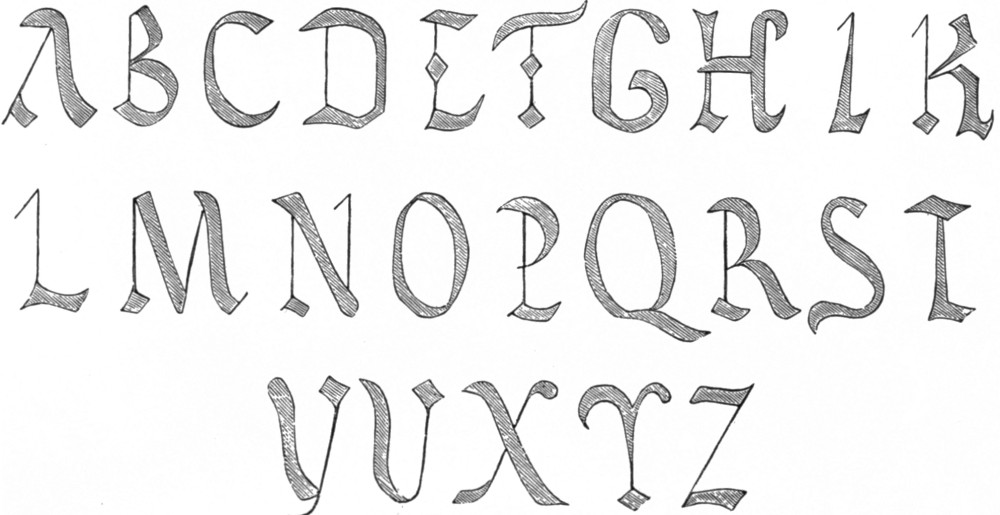
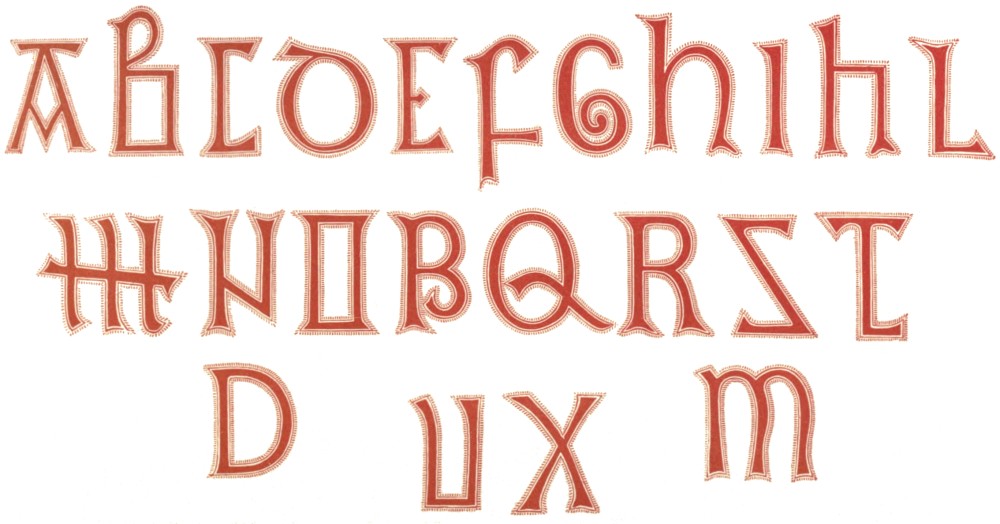
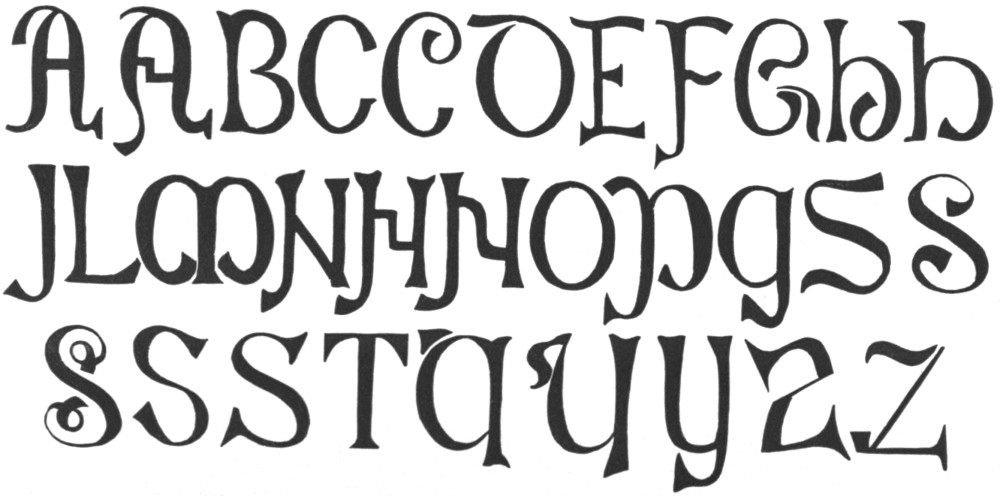
Ornamental Alphabets

8th Century. Vatican

8th Century. British Museum.

8th and 9th Centuries. Anglo-Saxon.

9th Century. From an Anglo-Saxon MS. Battel Abbey.

Continue reading “Ornamental Alphabets”

The Fall of Phaeton — Michelangelo

Nightmare — Nicolai Abildgaard

Loose Company — Dirck van Baburen

Allegory of a Dream — Giorgio Vasari

When the Children Have Gone to Bed — Carl Larsson

Eleven/Twelve/Thirteen

Eleven Heads — Pavel Filonov
Twelve Proverbs — Pieter Bruegel the Elder
Thirteen Rectangles — Wassily Kandinsky


Gross World Product — Ron Cobb

20131112-163332.jpg

Aujourd’hui Rose — Cecily Brown

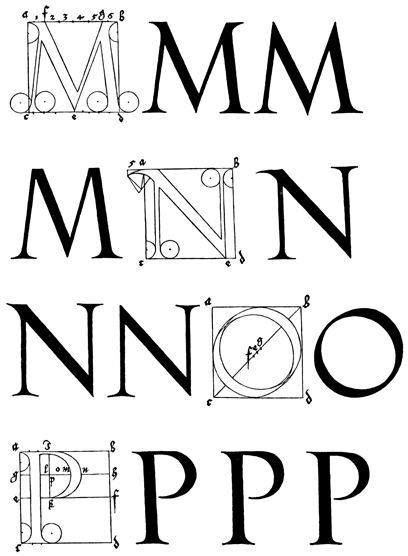
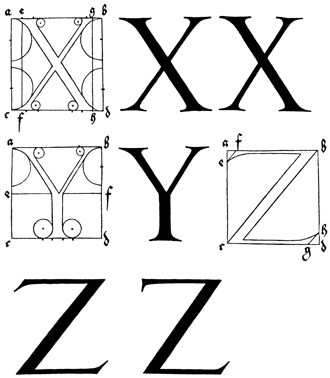
“Directions for the Construction of the Text” — Albrecht Dürer

A to D
E to L
M to P
Q to V
X to Z

“Directions for the Construction of the Text” —  Albrecht Dürer

(From  Of the  Just Shaping of Letters).

THE letters which are usually called “text,” or quadrate, it was formerly customary so to write, although they are now imitated by the new art, as presently I shall show below. Although the alphabet begins with the writing of A, yet shall I (not needlessly) in the first place undertake to draw an I; because almost all the other letters are formed after this letter, although always something has to be added to it or taken away.

First make your I of equal squares, of which three are properly set one over the other; and the top of the top one, and the bottom of the bottom one, divide in two points, that is to say, into three equal parts: then set a square equal to the others in an oblique manner, so that its diagonal be vertical, and its angle on the first point of the top square. In this way, this oblique square shall extend with its angles more to the left than the right. Then produce upwards on either side, after the width of the superposed squares, right lines to meet the sides of the oblique set square. Next do below precisely as you did above, except that you must set the angle of the oblique square on the second point, that is, the one farthest to the right in the bottom of the lowest square; and let fall your lines on either side upon the transposed square: so will I be perfect; only above it draw with a fine pen a tiny in-crescent. Continue reading ““Directions for the Construction of the Text” — Albrecht Dürer”