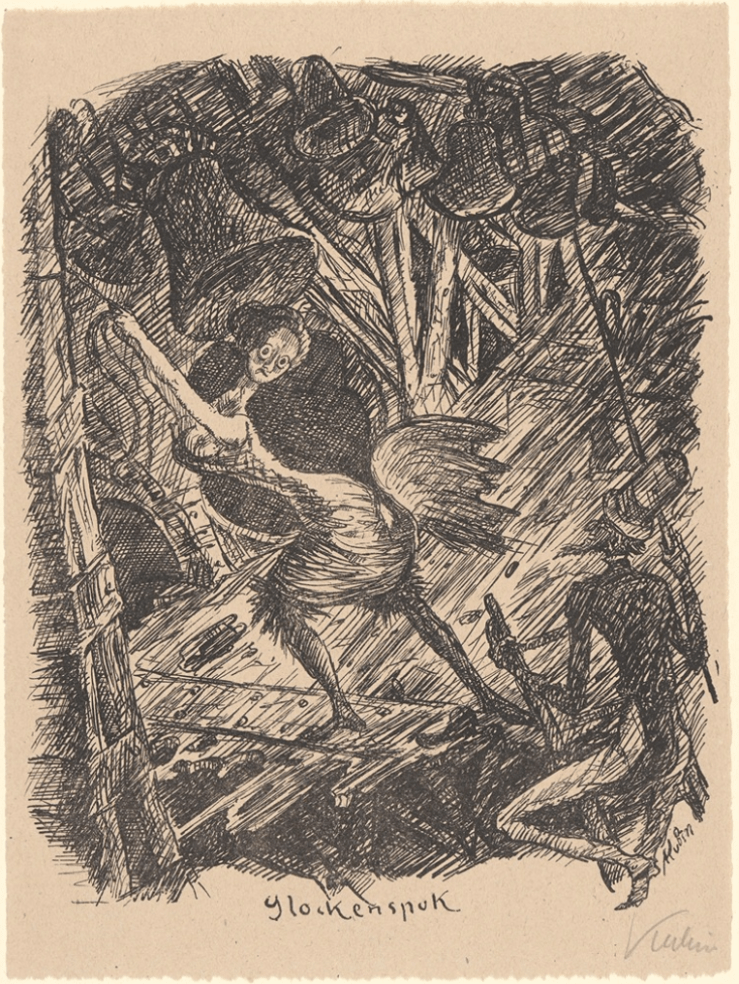
Bell Specter — Alfred Kubin

bell specter

Glockenspuk (Bell Specter) by Alfred Kubin (1877-1959)

The Witch — Francisco Goitia

Screenshot 2018-10-11 at 7.55.22 PM

La Bruja (The Witch), 1916 by Francisco Goitia (1882-1960)

The Head of John the Baptist — Francesco Cairo

the-head-of-st-john-the-baptist

The Head of John the Baptist by Francesco Cairo (1607 – 1665)

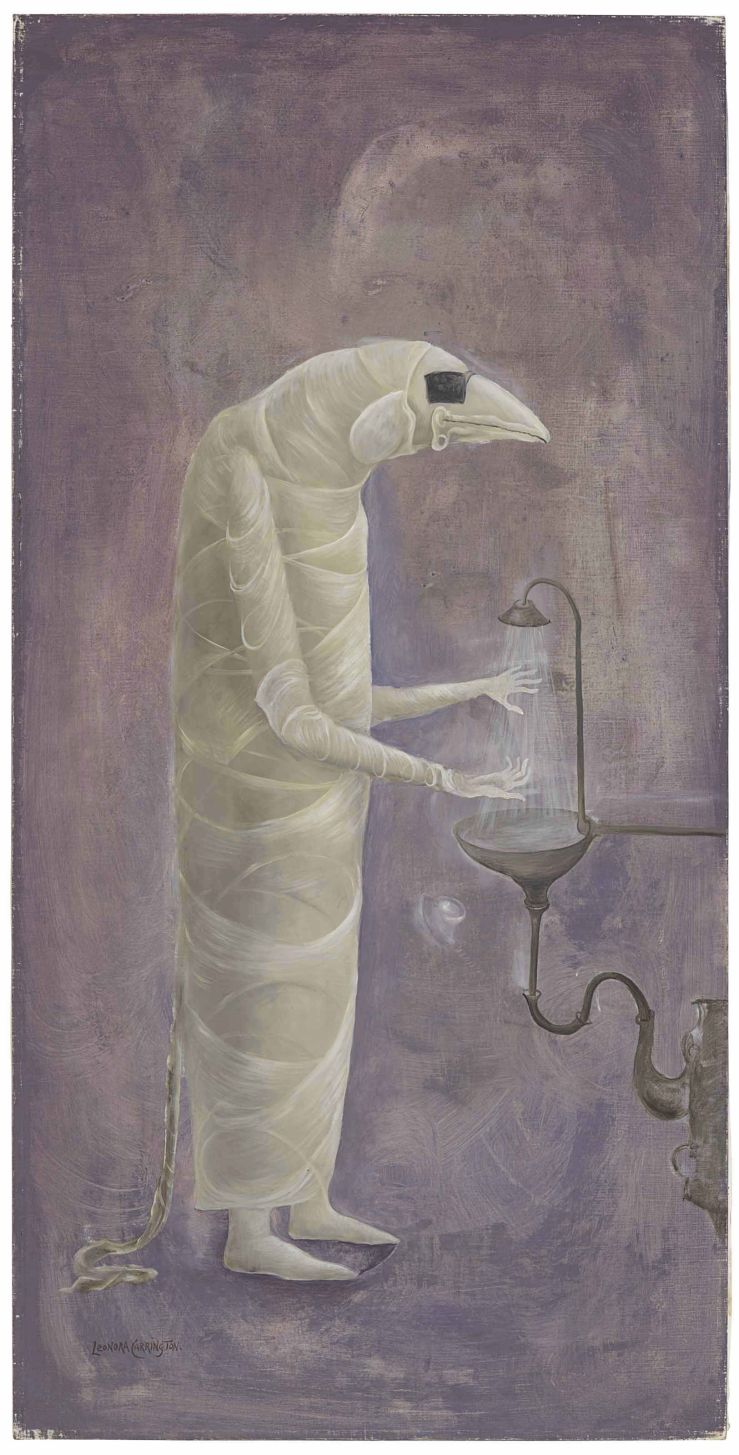
Surgeon — Leonora Carrington

9f3f6d6953acc7db7769ddaaa838a876

Surgeon, 1978 by Leonora Carrington (1917-2011)

Dulle Griet (detail) — David Ryckaert III

Screenshot 2018-10-14 at 5.33.54 PM

Dulle Griet, 1658 by David Ryckaert III (1612-1661)

Zeppelin — Hans Deuss

zeppelin-14x16-w1000

Zeppelin, 2014 by Hans Deuss (1948)

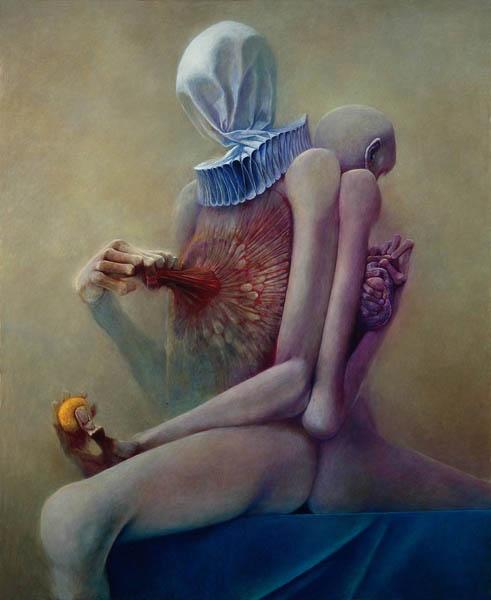
Untitled — Zdzisław Beksiński

untitled-263large

Untitled by Zdzisław Beksiński (1929–2005)

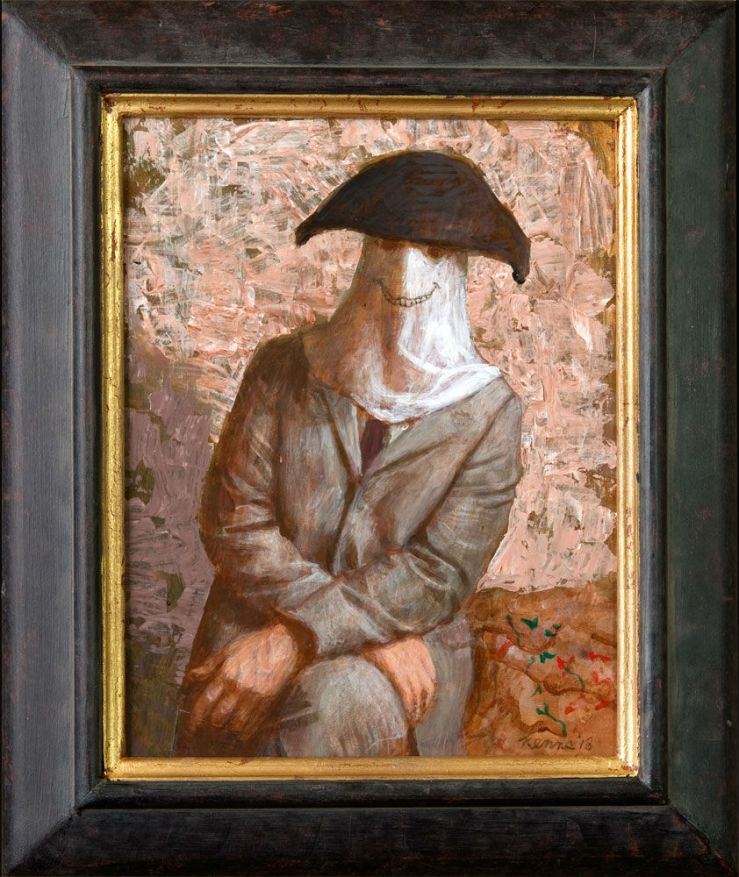
Unknown — Kenne Grégoire

18-onbekende-30x24-acr-pan-w1000

Onbekende (Unknown), 2018 by Kenne Grégoire (b. 1951)

Dulle Griet (detail) — David Ryckaert III

Screenshot 2018-10-14 at 5.34.15 PM

Dulle Griet, 1658 by David Ryckaert III (1612-1661)

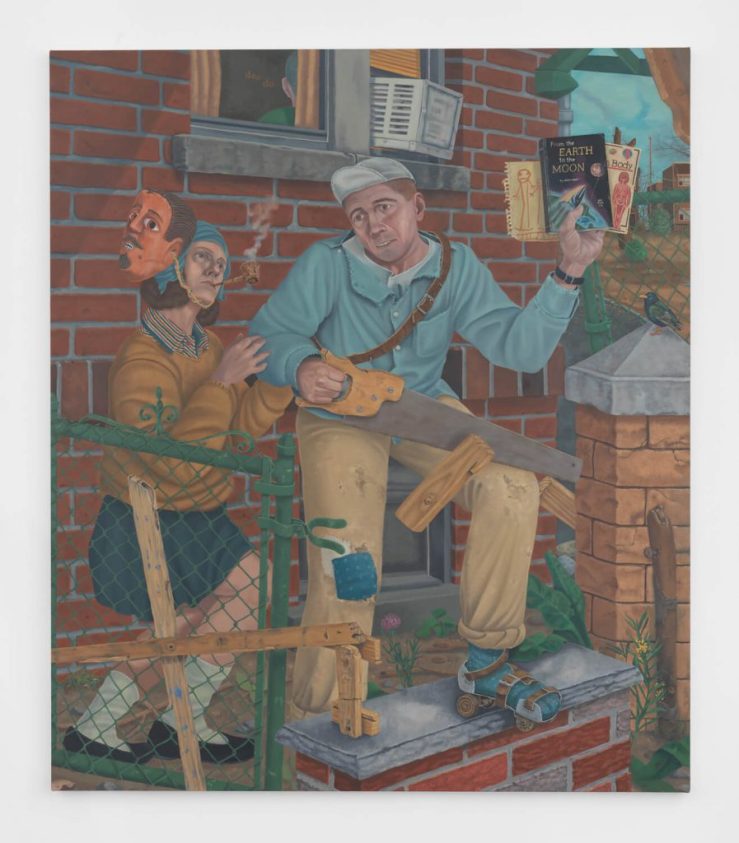
The Messenger — Michael Cline

cline_in7146_themessenger_2017_58x50_1500px-897x1024

The Messenger, 2017 by Michael Cline (b. 1973)

Dulle Griet (detail) — David Ryckaert III

Screenshot 2018-10-14 at 5.34.54 PM

Dulle Griet, 1658 by David Ryckaert III (1612-1661)

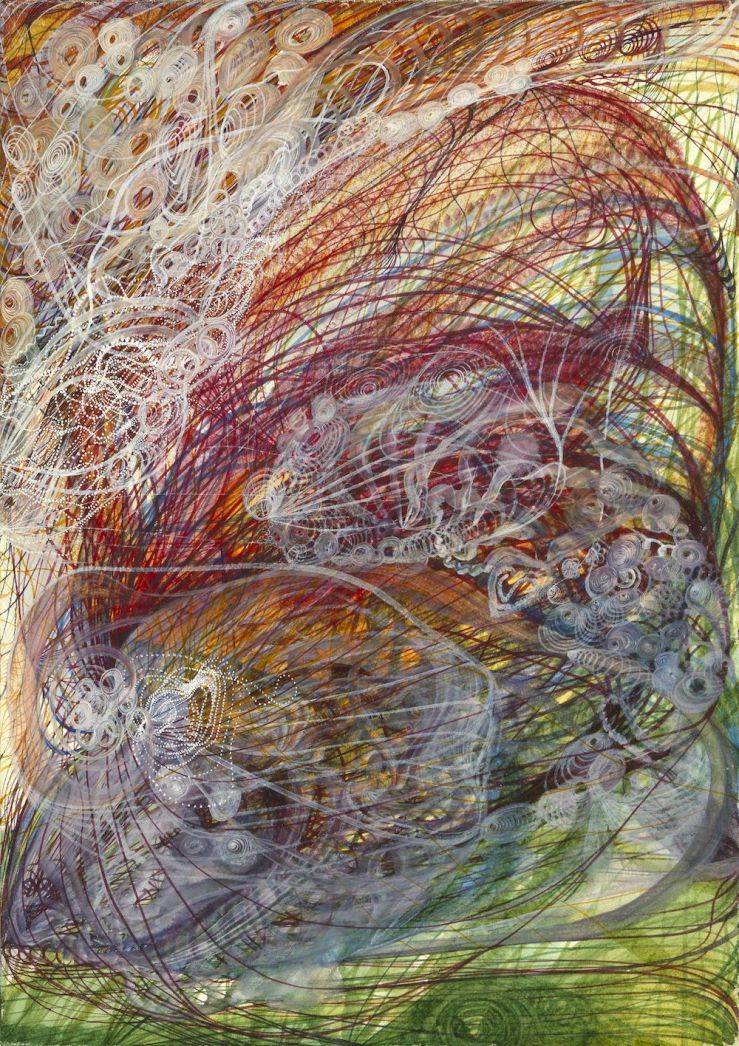
Flower of Catherine Emily Stringer — Georgiana Houghton

8170c8eae38fb9cbd22f8ca3e39b61bb

Flower of Catherine Emily Stringer, 1866 by Georgiana Houghton (1814-1884)

Blog about Jindřich Štyrský’s Dreamverse

img_1161

I have to admit that I had never heard of the Czech artist Jindřich Štyrský (1899-1942) until a review copy of something called Dreamverse arrived at Biblioklept World Headquarters a week or so ago. I was excited when I saw the package though—the book is from Twisted Spoon Press, and their books are always gorgeous and strange and fascinating. Dreamverse is no exception, collecting Štyrský’s paintings, collages, sketches, poems, essays, and prose in a baffling (and yet simultaneously accessible) compendium translated by Jed Slast. Here is Twisted Spoon’s blurb:

Published posthumously in 1970 as Dreams, Štyrský’s dream journal spanning the interwar years comprises prose, sketches, collages, and paintings. The present volume includes the complete series of texts and full-color and halftone images based on Štyrský’s layout for its publication in the 1940s, his sole volume of poetry (also published posthumously), as well as a selection of his most important essays, articles, manifestos, and assorted other texts. This edition presents in English for the first time the broad range of Štyrský’s contribution to the interwar avant-garde and Surrealism.

Dreamverse begins with an (overly academic) introduction by the Czech avant garde artist Karel Teige dated from 1948, which argues that the Štyrský is deeply underappreciated. Teige describes Štyrský’s gradual artistic shift into surrealism, an excursion Štyrský shared with his partner Toyen.

Teige writes like an art historian, fussily constructing a place for a displaced artist. Dreamverse really takes off when we get to Štyrský’s prose. Dreams (1925-1940) comprises about half of the book, and begins with this lucidly surreal self-description:

Work birthed in the wellsprings of hypnagogic mental models, via faithful representations of dream objects and authentic dream records.

Štyrský then offers a brief introduction in which he dedicates the work to “my CHIMERA, my PHANTOM OBJECT.” This particular chimera is a Freudian’s fantasy: Štyrský begins by discussing his prepubescent infatuation with “the image of a woman’s head, exquisite with golden hair” which he sees in a cheap magazine. This image somehow transmogrifies into “the head of Medusa, the whole of it in a pool of blood,” its hair a “cluster of vipers, erect, ready to penetrate the woman through her mouth, nose, and ears.” Štyrský then tells us that this “ghastly horror,” this “alluring horror” haunts his dreams, and he tries to “place the head” on his mother and sister. The head fits his sister: “So I was madly in love with her.” Štyrský then details his sister’s death in strange, alarmingly sensual language. (She died in 1905 when he was a young boy). His muse then, his chimera, foregrounds the dreamverse he creates: we get a mass media image reconverted into a mythological figure, then reconverted again, through creative imagination, into a sister, who is in turn transformed again into a mythic trope of some kind—a figure like Eurydice for Štyrský to play Orpheus to. Štyrský’s dreamverse is a writhing collage of contradictions. Hope and despair, sex and death, the beautiful and the lurid are all collapsed into surrealist expression.

Take, for example, Dream XXXI:a
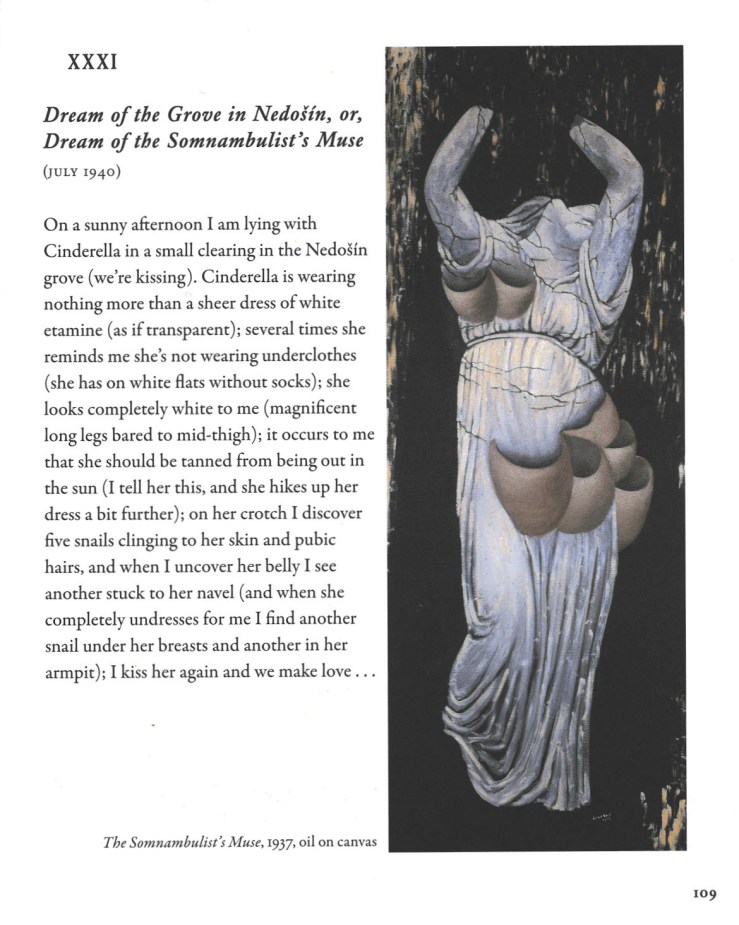
Štyrský’s dream—and its expression—excavates the sexuality suppressed just beneath the surface of our fairy tales. And while sexual abjection is typical in both Dreams (and in many of the poems collected in the Verse section of Dreamverse, sex is not always the dominant motif. Consider Dream VIII:
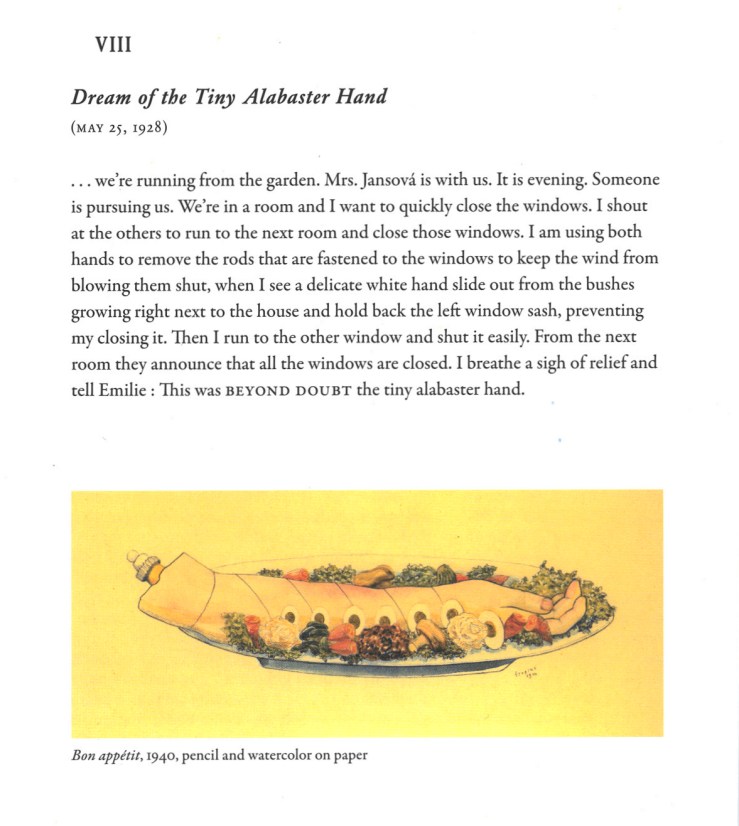
 

c

The vignette is a perfect slice of dread an horror, and the accompanying illustration—humorous and grotesque—is nightmare fuel.

I’ve been reading the Dreams somewhat slowly, a handful at a time, and then dipping deeper in the book, into the Verse, reading the Dreamverse as a sort of push-pull of image and word.

Štyrský’s writing is abject, evocative of a world that decays and regenerates at the same moment. A poem with the title “In the Swamps” of course stands out to me, a Florida boy always on the look out for abject images:

b

Štyrský’s imagery here is wonderful: The “fortune of blackcaps” pops out as an invented form of venery. Are the “blackcaps” actually little warblers—or just a surreal transformation of moorhens, the birds we would expect to find in the swamps? In either case, they are merely prey for “compassionate hunters,” susceptible to the arms of unseen brunettes and hunting dogs. The end of the poem is beautifully abject. The “horde of black swine” rumble in, neatly parallel to the “fortune of blackcaps” in the poems’s first line. These pigs slough through the swamp for “Sodden sacks of gold,” some kind of treasure there in the abject muck. Above it all is a speaker—a poet? Language hovers over the swamp.

Jed Slast deserves much praise for his translation, which seems tonally perfect and consistent over both the Dreams and the Verse sections. I’ll admit I haven’t gotten into any of the Writings at the end, which include lectures, essays, manifestos, and other fragments, but that gives me something to look forward to. So far though, Dreamverse has been an unexpected and strange joy, a dark and often perverse collection that plants its own dreamseeds in its reader.

Supermarket Ghost — Claudio Bravo 

bravo

Supermarket Ghost,1969 by Claudio Bravo (1936 — 2011)

Blog about Blog about 4

img_1220

On 1 Oct. 2018 on this foolish blog I foolishly wrote about my foolishgood intent to blog about something—books, film, art—every day or nearly every day.” I added, ” I’m not sure how it will go,” although I was a little bit sure about how it would go, which was, not great. Like, I knew that I would stumble in writing every day this month, which I have. October has snuck up (or sneaked up) on me like a thief or a serpent or a hobbit or a pick-your-simile—I even somehow missed taking my kid to her dentist appointment yesterday, and will almost surely get a bill from them over that. October sneaked/snuck up on me, and here we are 16 of 31 days in, and I have only managed 10 of these posts (including this one), which is like, 10 of 16, or 62.5%. (10/16 is also today’s date though, so like, uh, so like nothing).

Anyway.

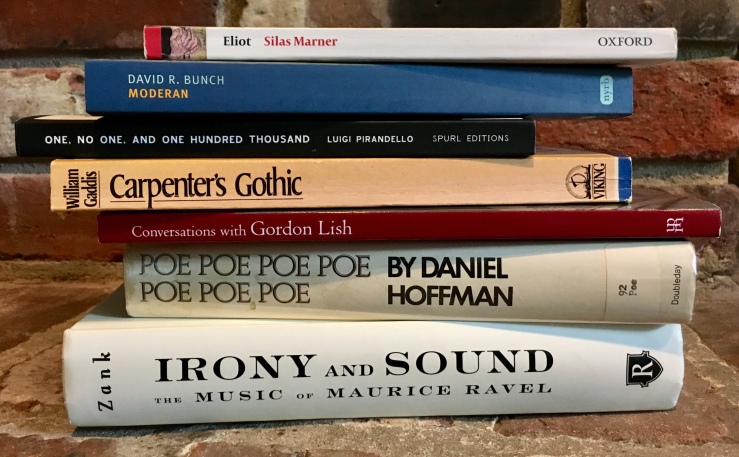
have been reading, and the initial blog I wrote about even included some specific goals, along with this picture, which semi-summarized those goals:

From bottom to top—

did, as I promised I would, return (and not steal) the Ravel book, Irony and Sound, which was frankly over my head.

I have not returned to Hoffman’s Poe book, but I haven’t shelved it.

I’ve been reading the Gordon Lish interviews. Like, the book is good—it’s sort of almost like a book of Lish stories. I blogged about it a bit even.

I’ve absolutely loved reading William Gaddis’s third novel Carpenter’s Gothic. It’s turned out to be a perfect Halloween novel, too. I’ll finish the last of its seven chapters tonight—I would’ve finished last night, but I got sidetracked by some lines that reminded me of Leslie Fiedler’s 1960 analysis of American literature, Love and Death in the American Novel. Gaddis’s book in many ways performs a similar analysis to Fiedler’s—they both trace the weight of American guilt. As if anticipating Gaddis’s postmodern postGothic Gothic novel, Fiedler writes, a quarter century before Carpenter’s Gothic’s publication,

…in the United States, certain special guilts awaited projection in the gothic form. A dream of innocence had sent Europeans across the ocean to build a new society immune to the compounded evil of the past from which no one else in Europe could ever feel himself free. But the slaughter of the Indians, who would not yield their lands to the carriers of utopia, and the abominations of the slave trade, in which the black man, rum, and money were inextricably entwined in a knot of guilt, provided new evidence that evil did not remain with the world that had been left behind—but stayed alive in the human heart, which had come the long way to America only to confront the horrifying image of itself.

(I have stalled out on writing a stupid “Blog about” blog post these past few days because I have been cobbling together notes on something about Fiedler and Gaddis. But, like, really—I need to finish Gaddis’s book first).

No dent in the Pirandello.

I’ll return to David Bunch’s Moderan after finishing Carpenter’s Gothic. Bunch’s work is, so far, a perfectly-pitched pitch black satire of toxic (like nuclearly-toxic) masculinity. Horror-as-comedy, weird and undelightful.

I finished George Eliot’s Silas Marner pretty quickly in October, and enjoyed it. I’m glad I read Middlemarch first though. What Eliot next, reader?

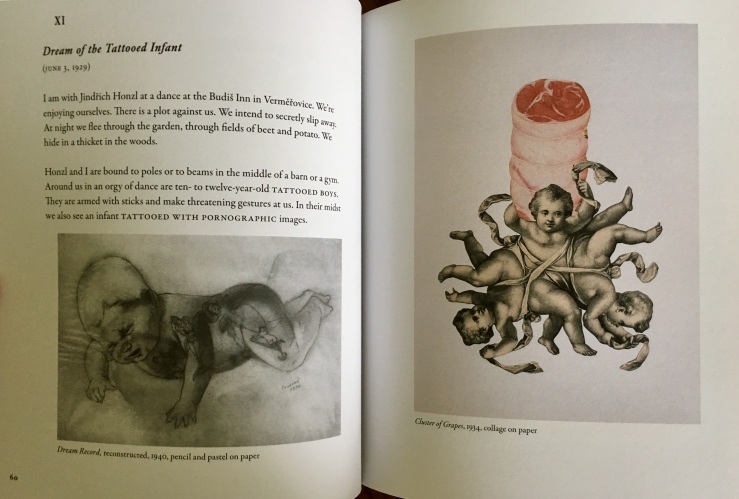
So—what next? The picture at the top is the stack I’ve been stacking and unstacking and restacking. Gaddis and Fiedler feel like the thing I really want to write about—gender roles, Gothic promises, domesticity vs. adventure, the house vs. the frontier, the collapse of self into fragments of language, etc. I’m also loving Dreamverse, a collection of poems, art, and prose by Jindřich Štyrský’ that Twisted Spoon Press has put together.  Its insides look like this, at least in one place—

img_1162

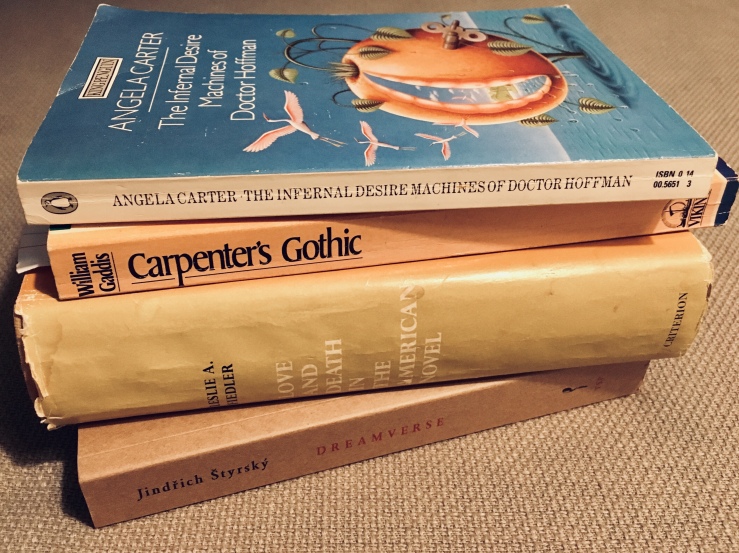
I think the next novel I will read will be Angela Carter’s The Infernal Machines of Doctor Hoffman.

Dulle Griet (detail) — David Ryckaert III

Screenshot 2018-10-14 at 5.35.12 PM

Dulle Griet, 1658 by David Ryckaert III (1612-1661)

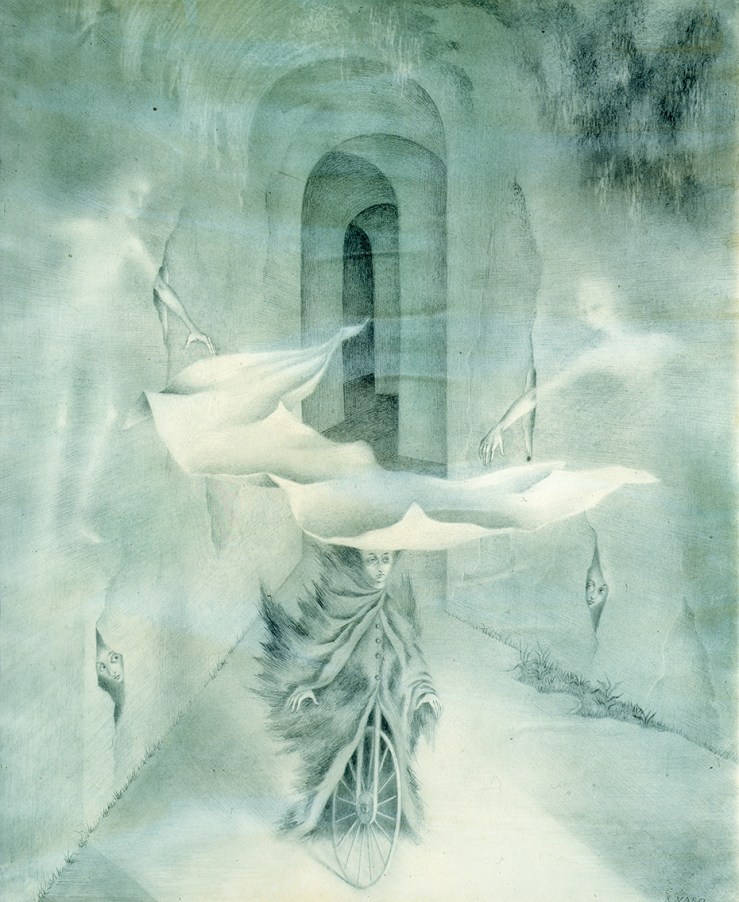
The Street of Hidden Presences — Remedios Varo

cat-164-la-calle-de-las-presencias-ocultas-1956

The Street of Hidden Presences, 1956 by Remedios Varo (1908-1963)