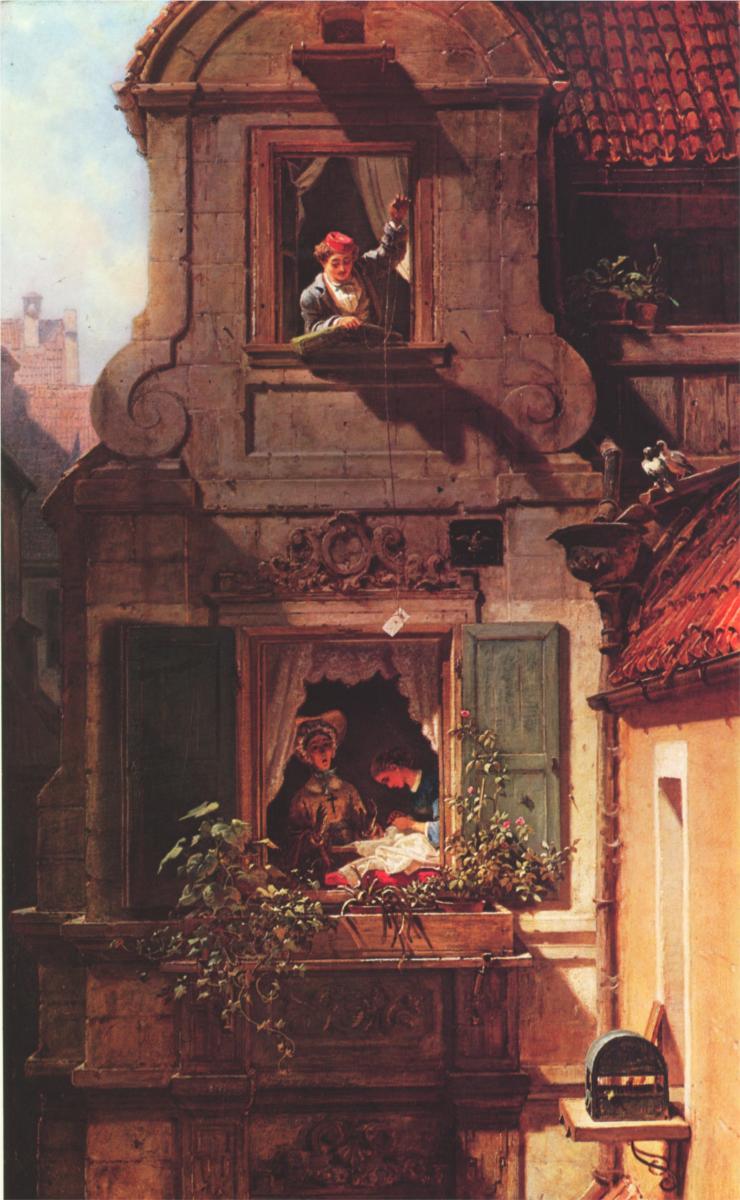
Intercepted Love Letter — Carl Spitzweg

the-intercepted-love-letter.jpg!HD

A Brief Review of David Malouf’s Essay The Happy Life (Book Acquired, Some Time in December 2012)

20130107-201922.jpg

When David Malouf’s little hardback essay The Happy Life showed up late last year to Biblioklept World Headquarters, I’ll admit to grimacing a bit. I judge books by their covers, their appearance, their size, and frankly Malouf’s little book, with its smallish dimensions and hokey subtitle seemed to scream “self-help/gift book.” And oh the emoticon!

But before I do these “Books Acquired” I always take the time to sample the prose a bit. Here’s what happened with Malouf: I kept reading. Malouf snagged me into doing a thought experiment on the first page (“Think of a medieval farmer as he struggled to keep body and soul together”), an exercise that quickly led to citations from Solzhenitsyn, Montaigne, and Sir Henry Wotton—before posing the book’s central questions:

The question that arises is not so much ‘How should we live if we want to be happy?’ but how is it, when the chief sources of human unhappiness, of misery and wretchedness, have largely been removed from our lives—large-scale social injustice, famine, plague and other diseases, the near-certainty of an early death—that happiness still eludes so many of us? What have we succumbed to or failed to do that might have helped us? What is it in us, or in the world we have created, that continues to hold us back?

First World Problems! Seriously though, Malouf seems aware of the simple answer to these questions—it’s impossible and likely dangerous to be happy all the time; what he really seems concerned about are the paradigms and ideologies and systems—government, media, corpocracy, pick your poison—that create impositions of happiness as a kind of ideal. As such, Malouf returns again and again to Jefferson’s “life, liberty, and the pursuit of happiness,” along with Solzhenitsyn’s One Day in the Life of Ivan Denisovich. He ends his long essay with a discussion of Solzhenisyn’s Shukov, “an unlikely example of the happy man.” And through this storytelling, we can find a moment of stabilizing happiness too:

Fiction, with its preference for what is small and might elsewhere seem irrelevant; its facility for smuggling us into another skin and allowing us to live a new life there; its painstaking devotion to what without it might go unnoticed and unseen; its respect for contingency, and the unlikely and odd; its willingness to expose itself to moments of low, almost animal being and make them nobly illuminating, can deliver truths we might not otherwise stumble on.

Shukhov is not happy because he has solved the problem of ‘how to live’ —the live he lives is too provisional, too makeshift for that. Or because, as the classical schools would have put it, he has achieved quite self-containment, self-sufficiency. Quite the opposite.

What he achieves, briefly, intermittently, is moments of self-fulfillment, something different and more accessible, more democratic we might call it, than self-containment. But he achieves it only at moments.

He is happynow—who can know what tomorrow or the day after will do to him? He is happy within limits—and this may be a clue to what makes happiness possible for him, or for any of us.

There’s nothing really radical about this thesis—that we can claim agency to our own happiness by choosing to measure it in small units—but the way that Malouf reaches it is pleasurable to follow and intellectually engaging. I hope that some suckers judge this book by its cover, pick it up in the hopes of buying a map to contentment, and then stick around for Malouf’s journey through literature, philosophy, art, and history. Good stuff.

The Happy Life is new in hardback from Pantheon.


The Love Letter — Alfred Stevens

the-love-letter stevens

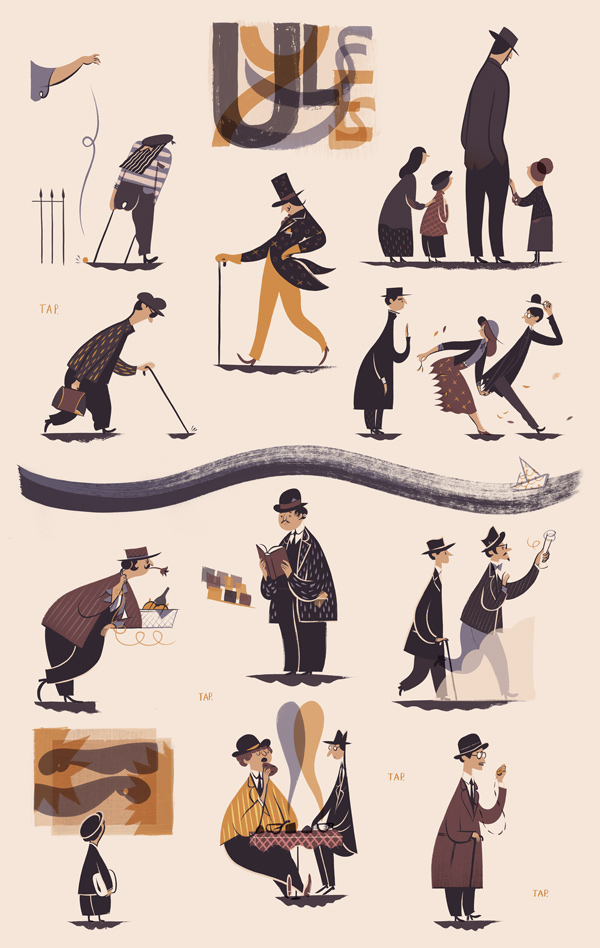
Ulysses — Roman Muradov

ulysses

(Roman Muradov’s wonderful illustration to the Wandering Rocks episode of Joyce’s Ulysses; lots more great stuff at Roman’s site and blog).

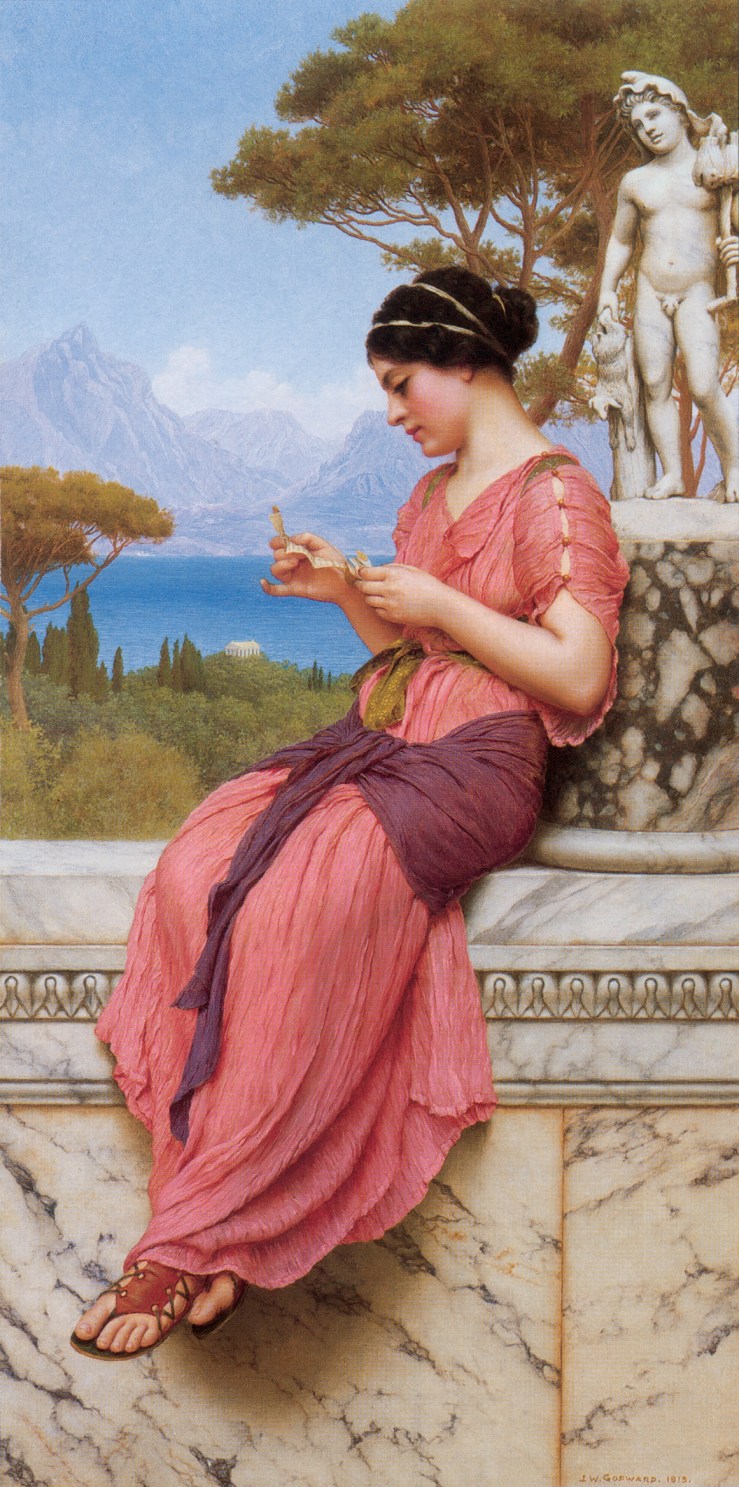
The Love Letter — John William Godward

the-love-letter-1913

The Love Letter — Eugene de Blaas

the-love-letter-1

“Imperfect Resume” — Flann O’Brien

Selection from Flann O’Brien’s novel At Swim-Two-Birds:

The following, imperfect resume or summary as it is, may be taken as a general indication of the scholarly trend of the conversation sustained without apparent effort by the three of them.

It is not generally known, observed Mr. Furriskey, that the coefficient of expansion of all gases is the same. A gas expands to the extent of a hundred and seventy-third part of its own volume in respect of each degree of increased temperature centrigrade. The specific gravity of ice is 0.92, marble 2.70, iron (cast) 7.20 and iron (wrought) 7.79. One mile is equal to 1.6093 kilometres reckoned to the nearest ten-thousandth part of a whole number.

True, Mr. Furriskey, remarked Mr. Paul Shanahan with a quiet smile that revealed a whiteness of the teeth, but a man who confines knowledge to formulae necessary for the resolution of an algebraic or other similar perplexity, the same deserves to be shot with a fusil, or old-fashioned light musket. True knowledge is unpractised or abstract usefulness. Consider this, that salt in solution is an excellent emetic and may be administered with safety to persons who are accustomed to eat poisonous berries or consume cacodyl, an evil-smelling compound of arsenic and methyl. A cold watch-key applied to the neck will relieve nose-bleeding. Banana-skins are invaluable for imparting a gloss to brown shoes.

To say that salt in solution, Lamont objected finely, is a pleasing emetic is a triviality related to inconsequent ephemera – the ever-perishing plasms of the human body. The body is too transient a vessel to warrant other than perfunctory investigation. Only in this regard is it important, that it affords the mind a basis for speculation and conjecture. Let me recommend to you, Mr. Shanahan, the truer spiritual prophylaxis contained in the mathematics of Mr. Furriskey. Ratiocination on the ordered basis of arithmetic is man’s passport to the infinite. God is the root of minus one. He is too great a profundity to be compassed by human cerebration. But Evil is finite and comprehensible and admits of calculation. Minus One, Zero and Plus One are the three insoluble riddles of the Creation.

Mr. Shanahan laughed in a cultured manner.

The riddle of the universe I might solve if I had a mind to, he said, but I prefer the question to the answer. It serves men like us as a bottomless pretext for scholarly dialectic.

Other points not unworthy of mention, mentioned Mr. Furriskey in an absent-minded though refined manner, are the following: the great pyramid at Gizeh is 450 feet high and ranks as one of the seven wonders of the world, the others being the hanging gardens of Babylon, the tomb of Mausolus in Asia Minor, the colossus of Rhodes, the temple of Diana, the statue of Jupiter at Olympia and the Pharos Lighthouse built by Ptolemy the First about three hundred and fifty years B.C. Hydrogen freezes at minus 253 degrees centigrade, equivalent to minus 423 on the Fahrenheit computation.

Everyday or colloquial names for chemical substances, observed Mr. Shanahan, cream of tartar – bitartate of potassium, plaster of Paris – sulphate of calcium, water – oxide of hydrogen. Bells and watches on board ship: first dog – 4 p.m. to 6 p.m., second dog – 6 p.m. to 8 p.m., afternoon-noon to 4 p.m. Paris, son of Priam, King of Troy, carried off the wife of Menelaus, King of Sparta and thus caused the Trojan War.

The name of the wife, said Lamont, was Helen. A camel is unable to swim owing to the curious anatomical distribution of its weight, which would cause its head to be immersed if the animal were placed in deep water. Capacity in electricity is measured by the farad; one microfarad is equal to one millionth of a farad. A carbuncle is a fleshy excrescence resembling the wattles of a turkey-cock. Sphragistics is the study of engraved seals.


Excellent, remarked Mr. Furriskey with that quiet smile which endeared him to everyone who happened to come his way, but do not overlook this, that the velocity of light in vacuo is 186,325 miles per second. The velocity of sound in air is 1,120 feet per second, in tin 8,150 feet per second, in walnut mahogany and heavy timbers 11,000 feet per second approximately; in firwood, 20,000 feet per second. Sine 15 degrees is equal to the root of six minus the root of two, the whole divided by four. Percentages of £1: 1-1/4 per cent, threepence; 5 per cent, one shilling; 12-1/2 percent, a half a crown. Some metric equivalents: one mile equals 1.6093 kilometres; one inch equals 2.54 centimetres; one ounce equals 28.352 grams. The chemical symbol of Calcium is Ca and of Cadmium, Cd. A Trapezoid may be defined as a four-sided figure capable of being transformed into two triangles by the means of a diagonal line.

Some curious facts about the Bible, Mr. Lamont mentioned politely, the longest chapter is Psalm 119 and the briefest, Psalm 117. The Apocrypha contains 14 Books. The first English translation was published in A.D. 1535.

Some notable dates in the history of the world, observed Mr. Shanahan, B.C. 753, foundation of Rome by Romulus, 490 B.C., Battle of Marathon, A.D. 1498, Vasco da Gama sailed around South Africa and reached India, 23 April 1564 Shakespeare was born.

It was then that Mr. Furriskey surprised and indeed, delighted his companions, not to mention our two friends, by a little act which at once demonstrated his resource and his generous urge to spread enlightenment. With the end of his costly malacca cane, he cleared away the dead leaves at his feet and drew the outline of three dials or clock-faces on the fertile soil in this fashion:

0 0 0 9 \ 1 1 9 9 1 8 \ 2 2 8 8 2 o o. o-,._ 7 3 3 \ 7 7 3 6 4 4 `6 6 4 5 5 5

How to read the gas-meter, he announced. Similar dials to these somewhat crudely depicted at my feet may be observed on any gas-meter. To ascertain the consumption of gas, one should procure pencil and paper and write down the figures nearest to the indicator on each dial – thus in the present hypothetical case 963. To this one should add two zeros or noughts, making the number 96,300. This is the answer and represents the consumption of gas in cubic feet. The reading of the electric-meter for the discovery of consumption in Kilowatt-hours is more intricate than the above and would require the help of six dials fox demonstration purposes – more indeed than I have room for in the space I have cleared of withered leaves, even assuming the existing dials could be adapted for the purpose.

Thereafter these three savant or wise men of the East began to talk together in a rapid manner and showered forth pearls of knowledge and erudition, gems without price, invaluable carbuncles of sophistry and scholastic science, thomistic maxims, intricate theorems in plane geometry and lengthy extracts from Kant’s Kritik der reinischen Vernunst. Frequent use was made of words unheard of by illiterates and persons of inferior education exempli gratia saburra or foul granular deposit in the pit of the stomach, tachylyte, a vitreous form of basalt, tapir, a hoofed mammal with the appearance of a swine, capon, castrated cock, triacontahedral, having thirty sides or surfaces and botargo, relish of mullet or tunny roe. The following terms relating to the science of medicine were used with surprising frequency videlicet thyme, exophthalmus, scirrhus, and mycetoma meaning respectively food when acted upon by gastric juices and converted into acid pulp, protrusion of the eye-ball, hard malignant tumour and fungoid disease of hand or foot. Aestho-therapy was touched upon and reference made to the duodenum, that is, the primary part of the small intestine, and the caecum or blind gut. Flowers and plants rarely mentioned in ordinary conversation were accorded their technical or quasi-botanical titles without difficulty or hesitation for instance now fraxinella species of garden dittany, canna plant with decorative blossoms, bifoliate of two leaves (also bifurcate forked), cardamom spice from the germinal capsules of certain East India plants, granadilla passion flower, knapweed hard-stemmed worthless plant, campanulla plant with bell-shaped blossoms, and dittany see fraxinella above. Unusual animals mentioned were the pangolin, chipmuck, echidna, babiroussa and bandicoot, of which a brief descriptive account would be (respectively), scabrous-spined scaly ant-eater, American squirrel aliter wood-rat, Australian toothless animal resembling the hedgehog, Asiatic wild-hog, large Indian insectivorous marsupial resembling the rat.

 

Still Life with Plaster Statuette, a Rose and Two Novels — Vincent van Gogh

still-life-with-plaster-statuette-a-rose-and-two-novels-1887

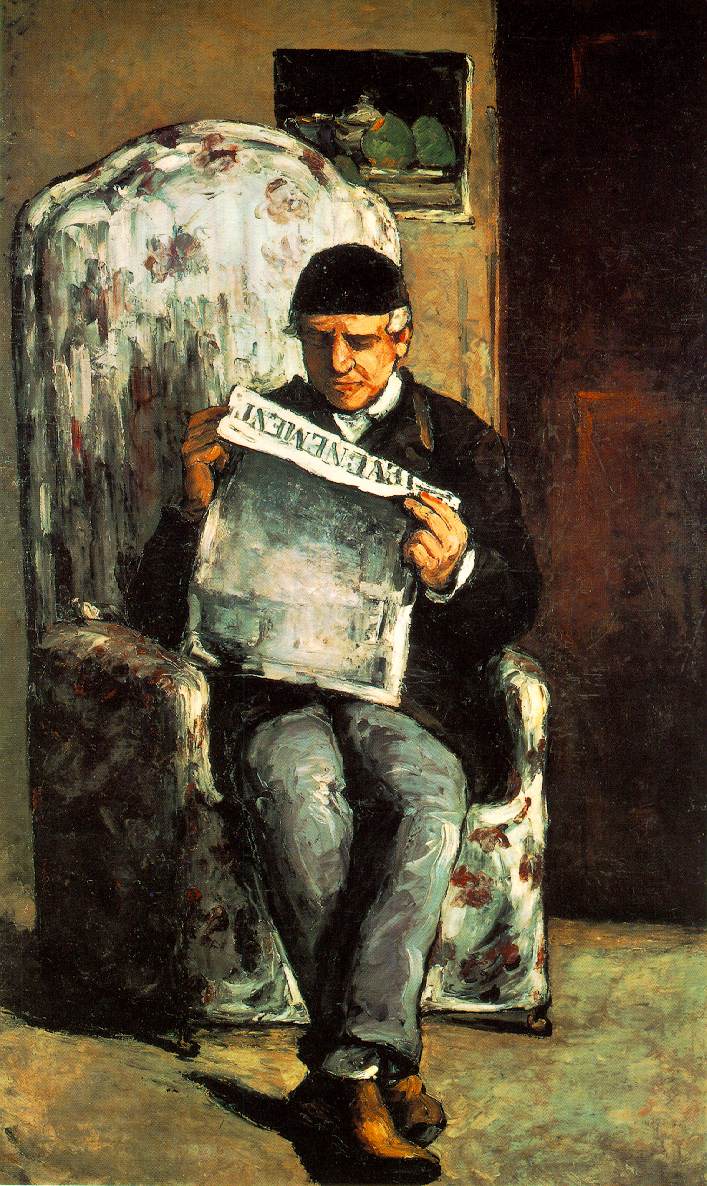
The Artist’s Father Reading His Newspaper — Paul Cézanne

the-artist-s-father-reading-his-newspaper-1866

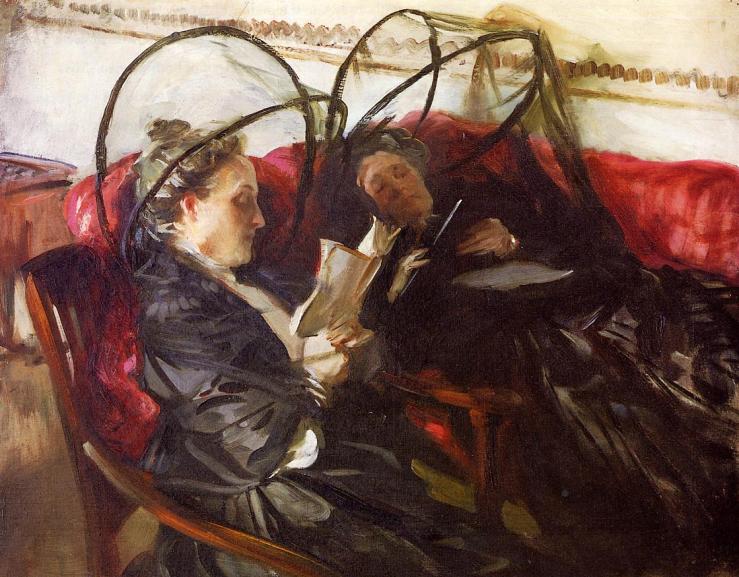
Mosquito Nets — John Singer Sargent

mosquito-nets-1908

The Brown Pot — Gwen John

the-brown-tea-pot

Portrait of Ivan Turgenev — Vasily Perov

The Physician — Gerrit Dou

the-physician-1653-1

Ben Marcus/Victor Segalen/George Saunders (Books Acquired, 2.01.2013)

20130203-165505.jpg

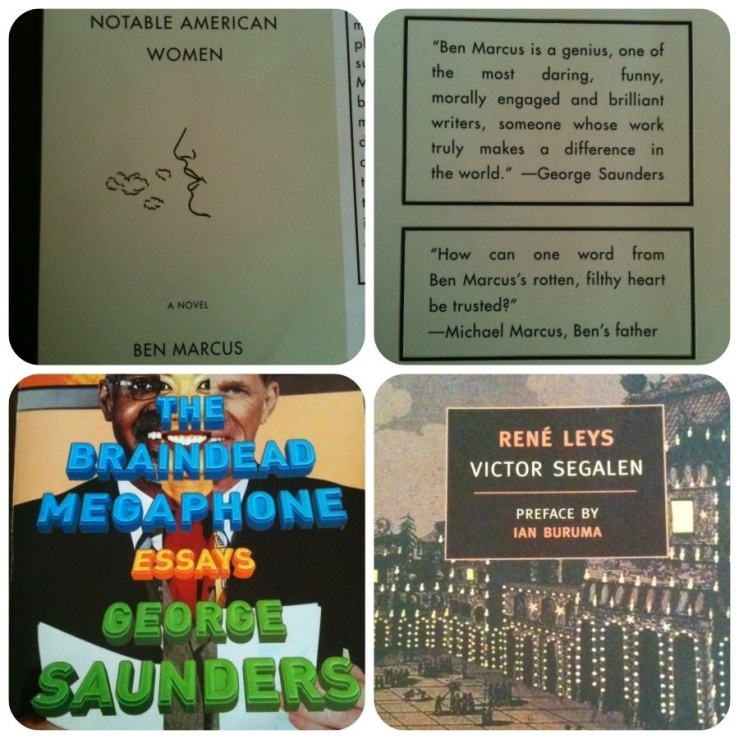
I went to the bookstore on Friday afternoon to drop off some trade-ins and order a few books for my wife and kids for Valentine’s Day. I had no intention of buying anything, but a bit of random browsing led to me leaving with Ben Marcus’s collection Notable American Women (how could I resist that blurb?), a collection of George Saunders essays, and René Leys by Victor Segalen—the NYRB edition stuck out, and then the blurb sold me on this tale of a Westerner trying to access the Forbidden City of imperial China.

I’m reading Ben Marcus’s The Flame Alphabet right now, along with some short stories by Yoko Ogawa, as well as Lars Iyer’s latest, Exodus; I’m pretty sure René Leys is on deck after one of those.


Reading Man — Ferdinand Hodler

reading-man

“In Football Season” — John Updike

“In Football Season” by John Updike

            Do you remember a fragrance girls acquire in autumn? As you walk beside them after school, they tighten their arms about their books bend their heads forward to give a more flattering attention to you words, and in the little intimate area thus formed, carved into the clear; by an implicit crescent, there is a complex fragrance woven of tobacco, powder, lipstick, rinsed hair, and that perhaps imaginary and certainly elusive scent that wool, whether in the lapels of a jacket or the nap of a j sweater, seems to yield when the cloudless fall sky like the blue bell of I a vacuum lifts toward itself the glad exhalations of all things. This fra­grance, so faint and flirtatious on those afternoon walks through the dry leaves, would be banked a thousand-fold on the dark slope of the stadium when, Friday nights, we played football in the city.

“We”—we the school. A suburban school, we rented for some of our home games the stadium of a college in the city of Alton three miles away. My father, a teacher, was active in the Olinger High athletic department, and I, waiting for him beside half-open doors of varnished wood and frosted glass, overheard arguments and felt the wind of the worries that accompanied this bold and at that time unprecedented deci­sion. Later, many of the other county high schools followed our lead; for the decision was vindicated. The stadium each Friday night when we played was filled. Not only students and parents came but spectators unconnected with either school, and the money left over when the sta­dium rent was paid supported our entire athletic program. I remember the smell of the grass crushed by footsteps behind the end zones. The smell was more vivid than that of a meadow, and in the blue electric glare the green vibrated as if excited, like a child, by being allowed up late. I remember my father taking tickets at the far corner of the wall, wedged into a tiny wooden booth that made him seem somewhat magical, like a troll.

And of course I remember the way we, the students, with all of our jealousies and antipathies and deformities, would be—beauty and boob, sexpot and grind—crushed together like flowers pressed to yield to the black sky a concentrated homage, an incense, of cosmetics, cigarette smoke, warmed wool, hot dogs, and the tang, both animal and metallic, of clean hair. In a hoarse olfactory shout, these odors ascended. A dense haze gathered along the ceiling of brightness at the upper limit of the arc lights, whose glare blotted out the stars and made the sky seem romanti­cally void and intimately near, like the death that now and then stooped and plucked one of us out of a crumpled automobile. If we went to the back row and stood on the bench there, we could look over the stone lip of the stadium down into the houses of the city, and feel the cold Novem­ber air like the black presence of the ocean beyond the rail of a ship; and when we left after the game and from the hushed residential streets of this part of the city saw behind us a great vessel steaming with light, the arches of the colonnades blazing like portholes, the stadium seemed a great ship sinking and we the survivors of a celebrated disaster. Continue reading ““In Football Season” — John Updike”

St. Jacob and The Magician — Hieronymous Bosch

st-jacob-and-the-magician