Maurice Sendak’s Erotic Illustrations for Herman Melville’s Pierre (Book Acquired, 5.09.2014)

20140520-162625-59185259.jpg

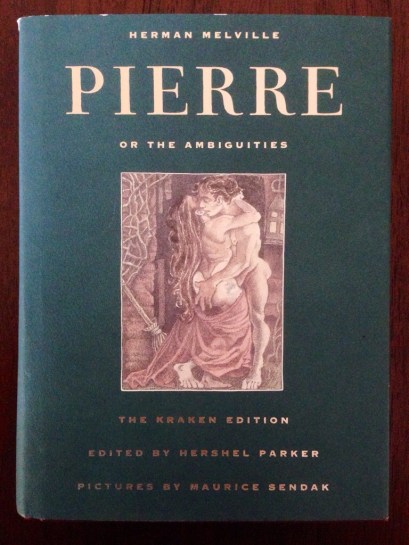
Pierre, Herman Melville’s follow up to Moby-Dick, was, without a doubt, the most challenging, perplexing, befuddling book I read in school. I still don’t get it.

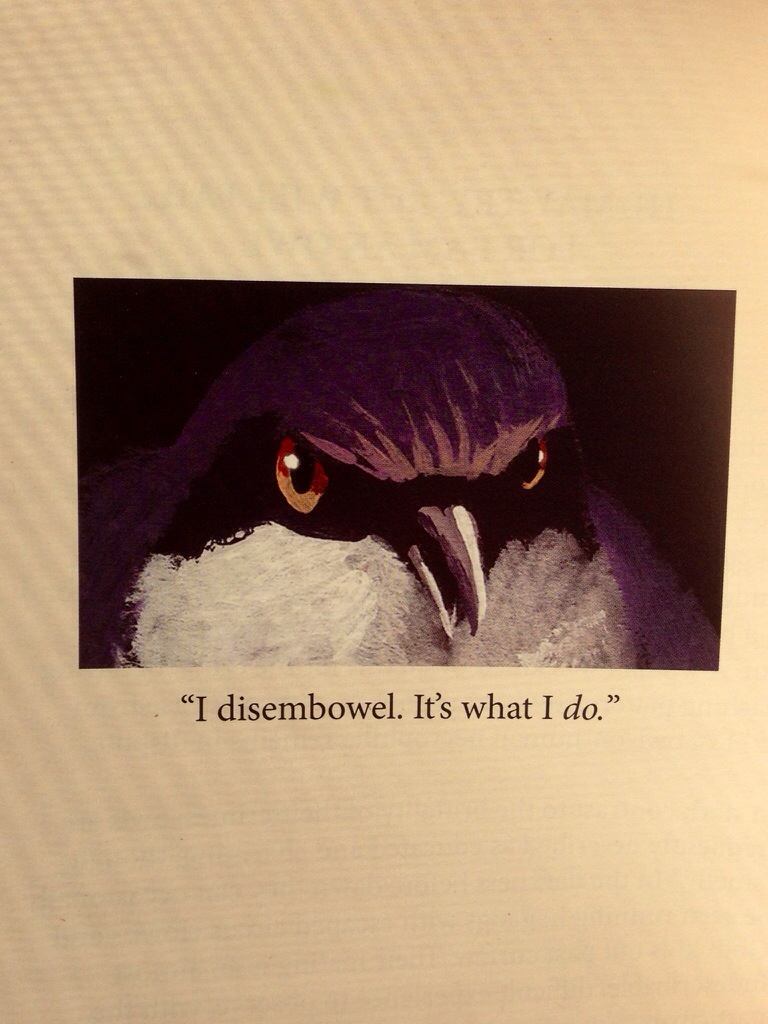
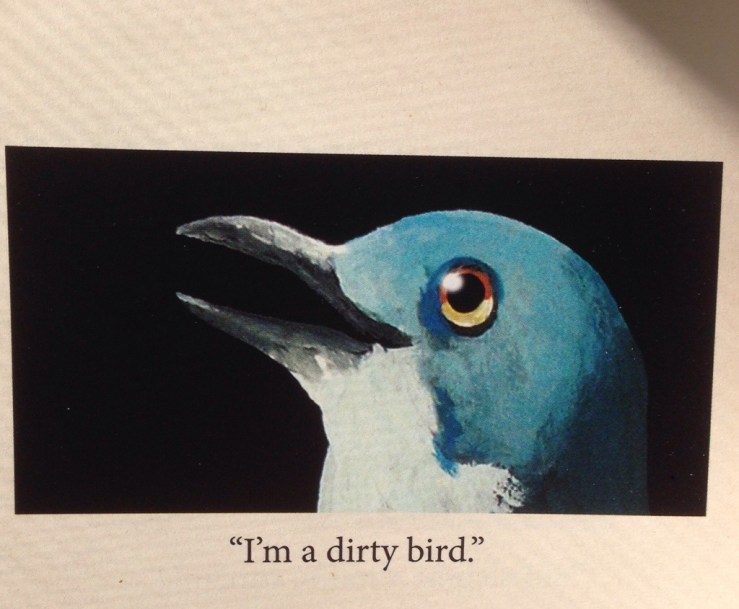
Still, I love Melville, and I love Maurice Sendak, so when I saw this unused copy of the Kraken addition for half-cover price at my favorite local used bookshop, I couldn’t resist.

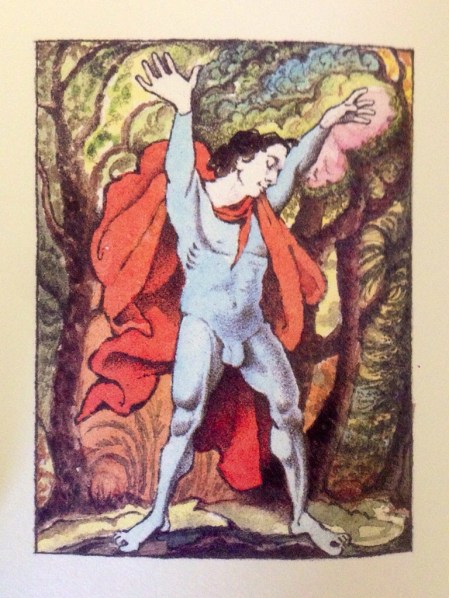
Sendak’s bawdy illustrations recall William Blake to me—great stuff—although I’ll probably read Moby-Dick or The Confidence Man again before I make time for Pierre.

Read more about this edition of Pierre here.

20140520-162627-59187043.jpg

20140520-162630-59190560.jpg Continue reading “Maurice Sendak’s Erotic Illustrations for Herman Melville’s Pierre (Book Acquired, 5.09.2014)”

The Library — Jacob Lawrence

Scrubwoman, Astor Library — John French Sloan

Swallows — Edouard Manet

Six Notes from Nathaniel Hawthorne’s American Note-Books

A letter, written a century or more ago, but which has never yet been unsealed.

A partially insane man to believe himself the Provincial Governor or other great official of Massachusetts. The scene might be the Province House.

A dreadful secret to be communicated to several people of various characters,–grave or gay, and they all to become insane, according to their characters, by the influence of the secret.

Stories to be told of a certain person’s appearance in public, of his having been seen in various situations, and of his making visits in private circles; but finally, on looking for this person, to come upon his old grave and mossy tombstone.

The influence of a peculiar mind, in close communion with another, to drive the latter to insanity.

To look at a beautiful girl, and picture all the lovers, in different situations, whose hearts are centred upon her.

From Nathaniel Hawthorne’s American Note-Books.

Portrait of a Man Writing in His Study — Gustave Caillebotte

“There were many towers, just as in this world there are many perfect books” (William T. Vollmann)

So he lent her books. After all, one of life’s best pleasures is reading a book of perfect beauty; more pleasurable still is rereading that book; most pleasurable of all is lending it to the person one loves: Now she is reading or has just read the scene with the mirrors; she who is so lovely is drinking in that loveliness I’ve drunk.

Amidst the other grey, red, greenish, black and orange volumes of various heights, this white book with the black lettering was perfectly proportioned in every way, neither showy nor insignificant. It was one of his favorite books (we can’t say his favorite since his life wasn’t over yet). He mentioned it, and she was willing to accept it; she was that kind, to read the book which he loved.

At the moment that it actually passed from his hand to hers they were sitting across from each other in one of the three or four restaurants where they usually met; and she, having gazed into his face with her usual richly intelligent seriousness, studied the book she now held with the same air of happy possession which he would have hoped to find had she been looking over his body before making love with him, which she would never, ever do no matter how long they both lived, a fact which made him want to utter a sound much softer and more leaden than any scream; and then, sitting within touching distance of her beautiful hands which he could not touch, he watched her open the book to the title page with its half-calligraphic brush-rendering by an unknown artist of a Buddhist pongmalai garland, probably of jasmine flowers, which was draped across a woman’s naked thigh. This was the most intimate moment that he and she would ever have (unless of course his one percent became a hundred, and she accepted him forever). He would not be at her side when she began to actually read the book; but from their frequent conversations he thought he could keep abreast of where she’d arrived each day. She’d promised to begin it that very night, when she was home with the other man, which meant that she would at least cross the frontier of the half-title page, followed by the dramatic double plant-stalks (connected by a leaf ), of the initial letter E. And now she saw before her those wide white margins and those generous white lines-between-the-lines which encouraged every word to preen itself like the treasure that it truly was.

I should mention that this beautiful volume, which was such a pleasure to hold, began its tale with a dazzling abruptness, as if the reader had just emerged from a dark tunnel into another world, a perfect world whose ground was a hot white plain of salt upon which the words lived their eternal lives.

I need say nothing about the plot, whose involutions (it’s a tale of obsessive love) progressed like the nested terraces on a Buddha-studded tower which narrows perfectly into nothingness. Once I visited a certain wat in Bangkok where although the day was exhaustingly hot and bright I grew enthralled by the sensation of wandering on a high place somewhere in the mist, a plateau exploding with ornately weathered crags. There were many towers, just as in this world there are many perfect books.

From William T. Vollmann’s novel Europe Central.
(This Is Not) David Foster Wallace’s Annotated Copy of Ulysses

fake

I first saw this at the tumblr Book Patrol; they corrected their post fairly quickly.

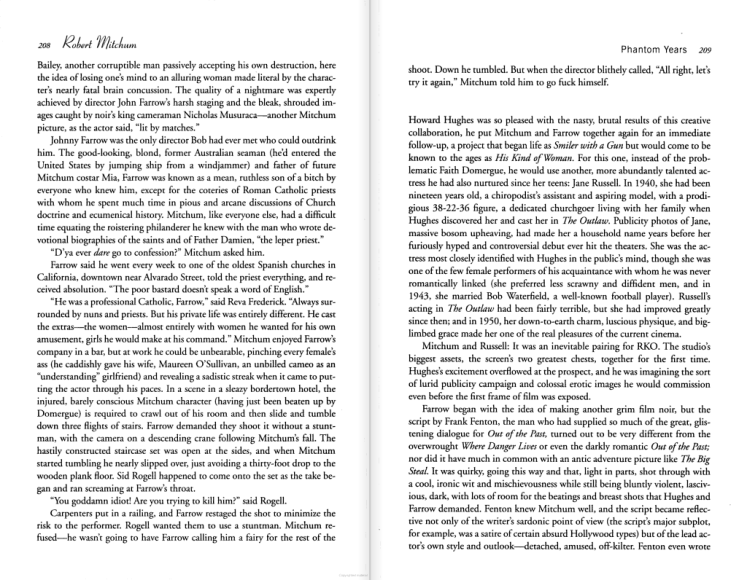
The book, Lee Server’s Baby I Don’t Care, a biography of Robert Mitchum, and its annotations, belong to Tony Shafrazi—

—and—

Enoc Perez took the photo–

The novelist James Boice seems to be the origin of the link between the Mitchum biography to DFW/JJ (clearly a jest):

https://twitter.com/jamesboice/status/467142475459870720

And then somehow the pic got to tumblr.

The University of Texas Libraries does not include Ulysses among its collection of Wallace’s personal books.

Oh, and, here’s a bigger pic of the passage from Server’s book:

phanton


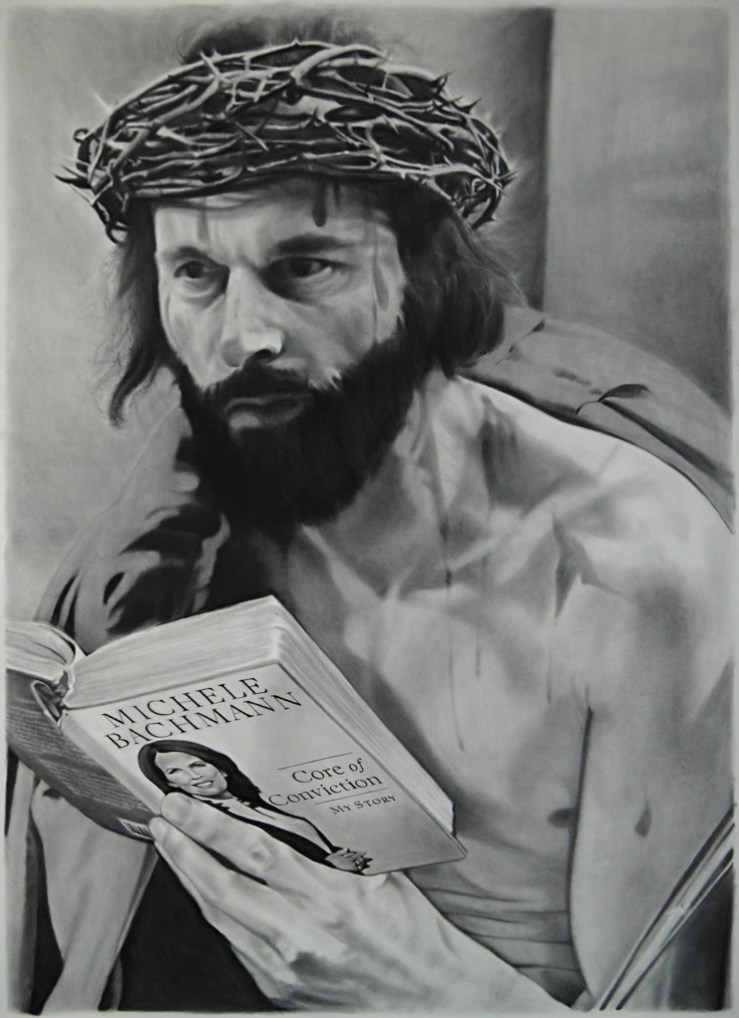
Read #2 — Kenton Nelson

read

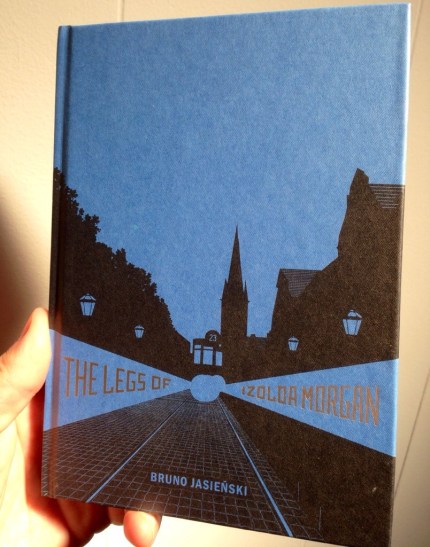
Bruno Jasieński’s The Legs of Izolda Morgan (Book Acquired, 5.01.2014)

20140516-102034.jpg

The recent publication of Bruno Jasieński’s The Legs of Izolda Morgan offers another strong argument that Twisted Spoon Press is publishing some of the most fascinating—and most beautiful—books available today. Clothbound and handsomely printed, Izolda Morgan collects several of Jasieński’s futurist manifestos, an essay, stories, and satires.

20140516-093921.jpg

Publisher’s blurb:

Considered the enfant terrible of the Polish avant-garde, lauded by critics and scorned by the public, Bruno Jasieński suddenly declared the end of Futurism in Poland soon after his short “novel” The Legs of Izolda Morgan appeared in 1923. An extraordinary example of Futurist prose, this fantastic tale cautions against the machine supplanting the human while the human body is disaggregated into fetishized constituent parts. As central to Jasieński’s oeuvre, the text is situated here between two seminal manifestoes and the important essay “Polish Futurism,” which signaled the movement’s end in the context of its confused reception in Poland, the towering influence of Mayakovsky, and what set it apart from the futurisms of Italy and Russia. The condensed story “Keys” displays Jasieński’s turn toward satire to lambaste the hypocrisies pervasive in powerful institutions, and this is further developed in the two longer grotesques from his time in the Soviet Union in the 1930s. Translated into English from the Russian for the first time, these two late stories expose the nefarious absurdity of racial persecution and warmongering and the lengths social and political structures will go to underpin them.


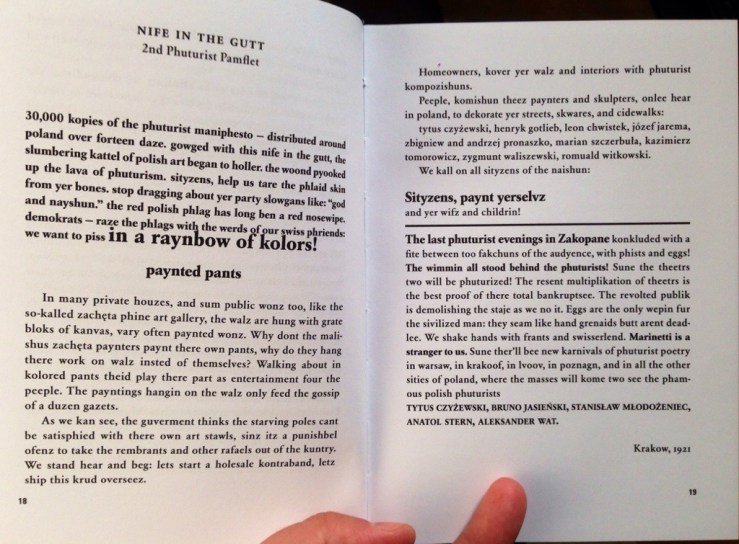
A manifesto:

20140516-102256.jpg

The Awakening — Llyn Foulkes

Mr. and Mrs. Clark and Percy — David Hockney

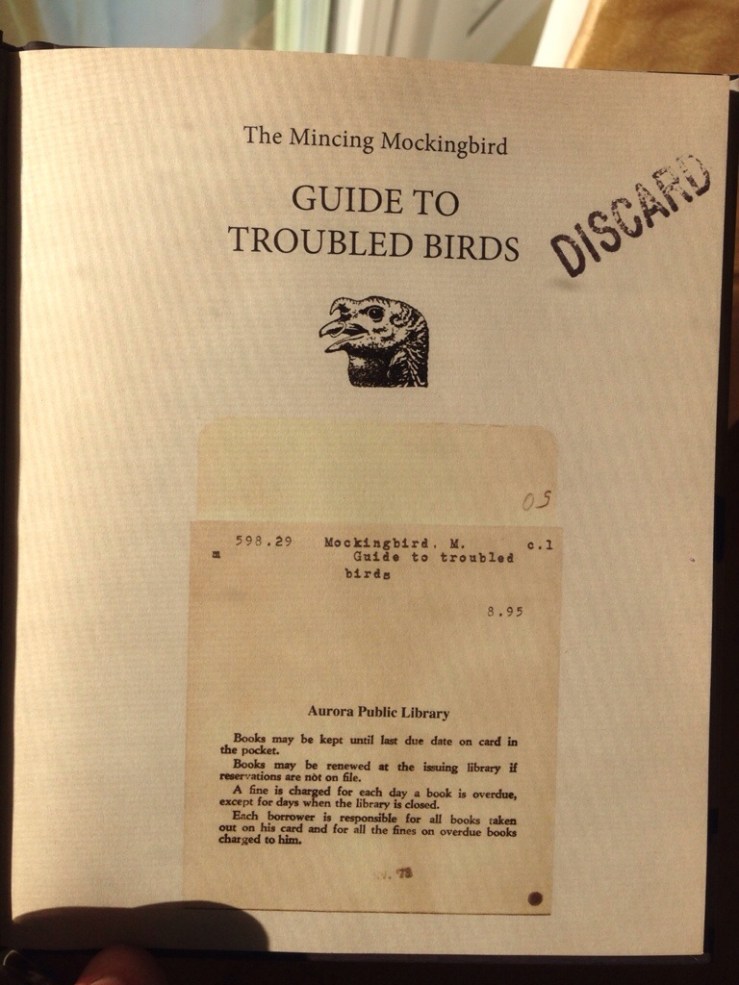
The Mincing Mockingbird Guide to Troubled Birds (Book Acquired, 5.09.2014)

20140514-085207.jpg

The Mincing Mockingbird Guide to Troubled Birds is new from Penguin next month. It’s a handsome little book. Amusing.20140514-085230.jpg

20140514-085238.jpg

20140514-085245.jpg

The Lord Is My Shepherd — Eastman Johnson

Hermit Saints Triptych (Right Panel) — Hieronymus Bosch

To put it aphoristically, a human skeleton is not human (William T. Vollmann)

And now, a note for those of you who consider this a vulgarly supernatural tale: It may well be that ambitious people of any stripe find themselves compelled to schematize the subjects of their solicitude into, say, Jews to be liquidated, or Jews to be saved. There might not be might not be time to learn the name of every Esther or Isaac who falls within Operation Reinhard’s purview. And the further those subjects (I mean objects) get altered in accordance with the purpose, the more problematic it becomes to perceive their irrelevantly human qualities. I quote the testimony of Michal Chilczuk, Polish People’s Army (he’d participated in the liberation of Sachsenhausen): But what I saw were people I call humans, but it was difficult to grasp that they were humans. What did Chilczuk mean by this? To put it aphoristically, a human skeleton is not human. It frightens us because it proves the truth of that gravestone epitaph so common in the age of Holbein: What I once was, so you are. What I am now, so you will be. The gaze of those dark, sharp-edged eye-sockets seems implacable, and the many teeth, which haunted Edgar Allan Poe, snarl much too nakedly, bereft of those festive pink ribbons of flesh we call “lips,” whose convolutions and involutions can express mirth, friendliness, even tenderness. A human skull’s smile is as menacing as a crocodile’s. Since death itself is nothing, the best our minds can do to represent it is through that expressionless face of bone which one day will be ours, and to which we cannot help imparting an expression. Under such circumstances, how can that expression be reassuring?

From William T. Vollmann’s novel Europe Central.

Apotheosis of St. Thomas Aquinas — Francisco de Zurbaran