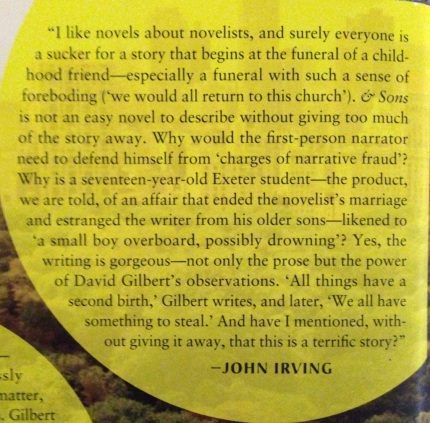
Reclining Woman Reading — Alexandru Ciucurencu

Reclining-Woman-Reading-Alexandru-Ciucurencu

Map Reading — Stanley Spencer

Annuli Reading — Helene Schjerfbeck

Cardinal, Reading a Letter — Jehan Georges Vibert

Coco Reading — Pierre-Auguste Renoir

“—boys to your bellybone and chuck a chum a chance!” — Pynchon Riff + Joyce + Moebius + Chloral Hydrate Party

75883c2d61c7b1ea157f39a036480922

1. Here is a rambling riff if ever I rambled and riffed:

2, First, look, that lovely image—it’s by Jean Giraud, aka Moebius. I came across it a week or two ago and digitally nabbed it.

I love Moebius’s work in general and something about the image reminds me of Thomas Pynchon’s Against the Day, although maybe I’m too immersed in the thick novel to not have much of what I see recall it in some ways.

Something about the airship and the horseman recalls an early passage where Reef Traverse, in the American West, dream-reads the airship adventures of The Chums of Chance into existence. (There are parts of Against the Day that recall to me Cormac McCarthy’s westerns (sometimes—often—called anti-westerns, but come, let’s be adults)…where was I going here? It’s Friday and I’ve consumed the better part (aka “all”) of a bottle of rosé and now I’m circling round some odd notes here—yes—the western/Western thing: Manifest Destiny, etc. — I see it in the Moebius illustration, but of course I bring it with me like a sickness. I move on).

3. ” . . . boys to your bellybone and chuck a chum a chance!” — This is from James Joyce’s Finnegans Wake (85.8). Pointed out to me by Roman Tsivkin, this seems like a most reasonable/splendid source for the namesake of our aeronaut adventurers (who seem rather, uh, absent of late in the final moments of the Bilocations book I’m in right now).

4. Data, perhaps imperfect (again, digitally nabbed)—

In Against the Day:

—Some form of the word invisible appears 173 times—

—The word inconvenience or inconvenient — 84 times—

—The phrase the day — 213 times (usually in a cadence suggestive of the book’s title—some kind of rhythm to it, anyway)—

—The phrase against the day — once (unless you count the chapter (book, really) called “Against the Day,” or the colophon, or what-have-you)—

5. I’m a few sections past this, but a nice passage to end on of a Friday night:

Among students of mathematics here, chloral hydrate was the preferred drug. Sooner or later, whatever the problem being struggled with, having obsessed themselves into nightly insomnia, they would start taking knockout drops to get to sleep—Geheimrat Klein himself was a great advocate of the stuff—and next thing they knew, they were habitués, recognizing one another by the side-effects, notably eruptions of red pimples, known as “the dueling scars of chloralomania.” On Saturday nights in Göttingen, there was always sure to be at least one chloral party, or Mickifest.

It was a peculiar gathering, only intermittently, as you’d say, brisk. People were either talking wildly, often to themselves and without seeming to pause for breath, or lounging draped in pleasurable paralysis across the furniture or, as the evening went along, flat on the floor in deep narcosis.

A Woman Reading — Claude Monet

Seven Entries from Anton Chekhov’s Note-Books

Mankind has conceived history as a series of battles; hitherto it has considered fighting as the main thing in life.

Solomon made a great mistake when he asked for wisdom.

Ordinary hypocrites pretend to be doves; political and literary hypocrites pretend to be eagles. But don’t be disconcerted by their aquiline appearance. They are not eagles, but rats or dogs.

Those who are more stupid and more dirty than we are called the people. The administration classifies the population into taxpayers and non-taxpayers. But neither classification will do; we are all the people and all the best we are doing is the people’s work.

If the Prince of Monaco has a roulette table, surely convicts may play at cards.

Aliosha: “My mind, mother, is weakened by illness and I am now like a child: now I pray to God, now I cry, now I am happy.”

Why did Hamlet trouble about ghosts after death, when life itself is haunted by ghosts so much more terrible?

Notations from Anton Chekhov’s Note-books.


Woman Reading — Henri Matisse

Mufti Reading in His Prayer Stool — Jean-Leon Gerome

Young Girl Reading — Henri Martin

Nine Notes from Nathaniel Hawthorne’s Note-Books

  1. The elephant is not particularly sagacious in the wild state, but becomes so when tamed. The fox directly the contrary, and likewise the wolf.
  2. A modern Jewish adage,–“Let a man clothe himself beneath his ability, his children according to his ability, and his wife above his ability.”
  3. It is said of the eagle, that, in however long a flight, he is never seen to clap his wings to his sides. He seems to govern his movements by the inclination of his wings and tail to the wind, as a ship is propelled by the action of the wind on her sails.
  4. In old country-houses in England, instead of glass for windows, they used wicker, or fine strips of oak disposed checkerwise. Horn was also used. The windows of princes and great noblemen were of crystal; those of Studley Castle, Holinshed says, of beryl. There were seldom chimneys; and they cooked their meats by a fire made against an iron back in the great hall. Houses, often of gentry, were built of a heavy timber frame, filled up with lath and plaster. People slept on rough mats or straw pallets, with a round log for a pillow; seldom better beds than a mattress, with a sack of chaff for a pillow.
  5. In this dismal chamber FAME was won. (Salem, Union Street.)
  6. Those who are very difficult in choosing wives seem as if they would take none of Nature’s ready-made works, but want a woman manufactured particularly to their order.
  7. A council of the passengers in a street: called by somebody to decide upon some points important to him.
  8. Every individual has a place to fill in the world, and is important, in some respects, whether he chooses to be so or not.
  9. Merry, “in merry England,” does not mean mirthful; but is corrupted from an old Teutonic word signifying famous or renowned.

Notations from Nathaniel Hawthorne’s American Note-Books

Tintoretto’s Abduction of the Body of St. Mark / Kid Jesus the Hellraiser (Thomas Pynchon)

One day, strolling in the Piazzetta, Hunter motioned her under the arcade and into the Library, and pointed up at Tintoretto’s Abduction of the Body of St. Mark. She gazed for some time. “Well, if that ain’t the spookiest damned thing,” she whispered at last. “What’s going on?” she gestured nervously into those old Alexandrian shadows, where ghostly witnesses, up far too late, forever fled indoors before an unholy offense.

“It’s as if these Venetian painters saw things we can’t see anymore,” Hunter said. “A world of presences. Phantoms. History kept sweeping through, Napoleon, the Austrians, a hundred forms of bourgeois literalism, leading to its ultimate embodiment, the tourist—how beleaguered they must have felt. But stay in this town awhile, keep your senses open, reject nothing, and now and then you’ll see them.”

A few days later, at the Accademia, as if continuing the thought, he said, “The body, it’s another way to get past the body.”

“To the spirit behind it—” “But not to deny the body—to reimagine it. Even”—nodding over at the Titian on the far wall—“if it’s ‘really’ just different kinds of greased mud smeared on cloth—to reimagine it as light.”

“More perfect.”

“Not necessarily. Sometimes more terrible—mortal, in pain, misshapen, even taken apart, broken down into geometrical surfaces, but each time somehow, when the process is working, gone beyond. . . .”

Beyond her, she guessed. She was trying to keep up, but Hunter didn’t make it easy. One day he told her a story she had actually already heard, as a sort of bedtime story, from Merle, who regarded this as a parable, maybe the first on record, about alchemy. It was from the Infancy Gospel of Thomas, one of many pieces of Scripture that early church politics had kept from being included in the New Testament.

“Jesus was sort of a hellraiser as a kid,” as Merle had told it, “the kind of wayward youth I’m always finding you keepin company with, in fact, not that I’m objecting,” as she had sat up in bed and looked for something to assault him with, “used to go around town pulling these adolescent pranks, making little critters out of clay, bringing them to life, birds that could fly, rabbits that talked, and like that, driving his parents crazy, not to mention most of the local adults, who were always coming by to complain—‘You better tell ’at Jesus to watch it.’ One day he’s out with some friends looking for trouble to get into, and they happen to go by the dyer’s shop, where there’s all these pots with different colors of dye and piles of clothes next to them, all sorted and each pile ready to be dyed a different color, Jesus says, ‘Watch this,’ and grabs up all the clothes in one big bundle, the dyer’s yelling, ‘Hey Jesus, what’d I tell you last time?’ drops what he’s doing and goes chasing after the kid, but Jesus is too fast for him, and before anybody can stop him he runs over to the biggest pot, the one with red dye in it, and dumps all the clothes in, and runs away laughing. The dyer is screaming bloody murder, tearing his beard, thrashing around on the ground, he sees his whole livelihood destroyed, even Jesus’s lowlife friends think this time he’s gone a little too far, but here comes Jesus with his hand up in the air just like in the paintings, calm as anything—‘Settle down, everybody,’ and he starts pulling the clothes out of that pot again, and what do you know, each one comes out just the color it’s supposed to be, not only that but the exact shade of that color, too, no more housewives hollerin ‘hey I wanted lime green not Kelly green, you colorblind or something,’ no this time each item is the perfect color it was meant to be.”

“Not a heck of a lot different,” it had always seemed to Dally, “in fact, from that Pentecost story in Acts of the Apostles, which did get in the Bible, not colors this time but languages, Apostles are meeting in a house in Jerusalem, you’ll recall, Holy Ghost comes down like a mighty wind, tongues of fire and all, the fellas come out and start talking to the crowd outside, who’ve all been jabbering away in different tongues, there’s Romans and Jews, Egyptians and Arabians, Mesopotamians and Cappadocians and folks from east Texas, all expecting to hear just the same old Galilean dialect—but instead this time each one is amazed to hear those Apostles speaking to him in his own language.”

Hunter saw her point. “Yes, well it’s redemption, isn’t it, you expect chaos, you get order instead. Unmet expectations. Miracles.”

Another amazing passage from Thomas Pynchon’s novel Against the Day.


Reading Girl — Henri Matisse

& Sons (Book Acquired, 7.09.2013)

20130709-141542.jpg

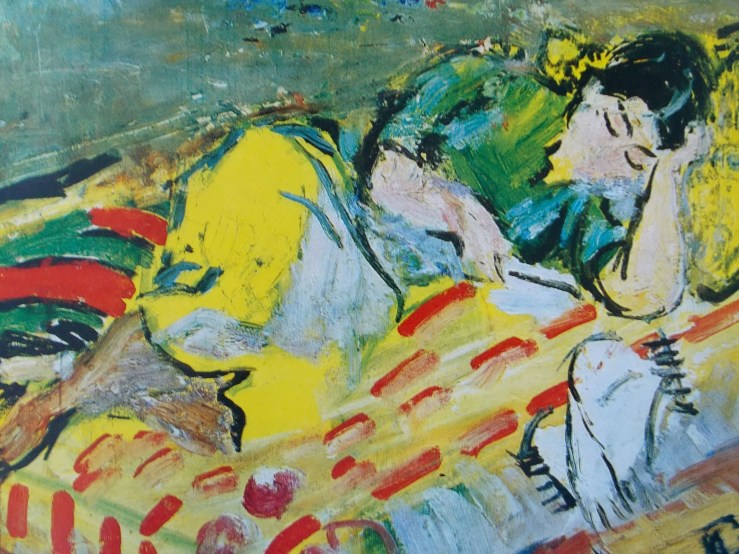
David Gilbert’s & Sons has gotten plenty of advanced praise and been likened to Wonder Boys and The Art of Fielding (which I couldn’t bring myself to waste my time to finish). Here’s John Irving’s blurb:

20130709-141554.jpg

And publisher Random House’s blurb:

The funeral of Charles Henry Topping on Manhattan’s Upper East Side would have been a minor affair (his two-hundred-word obit in The New York Times notwithstanding) but for the presence of one particular mourner: the notoriously reclusive author A. N. Dyer, whose novel Ampersand stands as a classic of American teenage angst. But as Andrew Newbold Dyer delivers the eulogy for his oldest friend, he suffers a breakdown over the life he’s led and the people he’s hurt and the novel that will forever endure as his legacy. He must gather his three sons for the first time in many years—before it’s too late.

So begins a wild, transformative, heartbreaking week, as witnessed by Philip Topping, who, like his late father, finds himself caught up in the swirl of the Dyer family. First there’s son Richard, a struggling screenwriter and father, returning from self-imposed exile in California. In the middle lingers Jamie, settled in Brooklyn after his twenty-year mission of making documentaries about human suffering. And last is Andy, the half brother whose mysterious birth tore the Dyers apart seventeen years ago, now in New York on spring break, determined to lose his virginity before returning to the prestigious New England boarding school that inspired Ampersand. But only when the real purpose of this reunion comes to light do these sons realize just how much is at stake, not only for their father but for themselves and three generations of their family.

In this daring feat of fiction, David Gilbert establishes himself as one of our most original, entertaining, and insightful authors. & Sons is that rarest of treasures: a startlingly imaginative novel about families and how they define us, and the choices we make when faced with our own mortality.


Take Off With Books (Tomi Ungerer Poster)

bookweek

“The study of life not to be neglected for the sake of books” — Samuel Johnson

“The study of life not to be neglected for the sake of books” by Samuel Johnson

 On life, on morals, be thy thoughts employ’d;
Leave to the schools their atoms and their void.

IT is somewhere related by Le Clerc, that a wealthy trader of good understanding, having the common ambition to breed his son a scholar, carried him to an university, resolving to use his own judgment in the choice of a tutor. He had been taught, by whatever intelligence, the nearest way to the heart of an academick, and at his arrival entertained all who came about him with such profusion, that the professors were lured by the smell of his table from their books, and flocked round him with all the cringes of awkward complaisance. This eagerness answered the merchant’s purpose: he glutted them with delicacies, and softened them with caresses, till he prevailed upon one after another to open his bosom, and make a discovery of his competitions, jealousies, and resentments. Having thus learned each man’s character, partly from himself, and partly from his acquaintances, he resolved to find some other education for his son, and went away convinced, that a scholastick life has no other tendency than to vitiate the morals and contract the understanding: nor would he afterwards hear with patience the praises of the ancient authors, being persuaded that scholars of all ages must have been the same, and that Xenophon and Cicero were professors of some former university, and therefore mean and selfish, ignorant and servile, like those whom he had lately visited and forsaken.

Envy, curiosity, and a sense of the imperfection of our present state, incline us to estimate the advantages which are in the possession of others above their real value. Every one must have remarked, what powers and prerogatives the vulgar imagine to be conferred by learning. A man of science is expected to excel the unlettered and unenlightened even on occasions where literature is of no use, and among weak minds, loses part of his reverence, by discovering no superiority in those parts of life, in which all are unavoidably equal; as when a monarch makes a progress to the remoter provinces, the rustics are said sometimes to wonder that they find him of the same size with themselves. Continue reading ““The study of life not to be neglected for the sake of books” — Samuel Johnson”