Would it not be wiser for people to rejoice at all that they now sorrow for, and vice versa? To put on bridal garments at funerals, and mourning at weddings? For their friends to condole with them when they attained riches and honor, as only so much care added?
If in a village it were a custom to hang a funeral garland or other token of death on a house where some one had died, and there to let it remain till a death occurred elsewhere, and then to hang that same garland over the other house, it would have, methinks, a strong effect.
No fountain so small but that Heaven may be imaged in its bosom.
Fame! Some very humble persons in a town may be said to possess it,–as, the penny-post, the town-crier, the constable,–and they are known to everybody; while many richer, more intellectual, worthier persons are unknown by the majority of their fellow-citizens. Something analogous in the world at large.
The ideas of people in general are not raised higher than the roofs of the houses. All their interests extend over the earth’s surface in a layer of that thickness. The meeting-house steeple reaches out of their sphere.
Nobody will use other people’s experience, nor have any of his own till it is too late to use it.
Two lovers to plan the building of a pleasure-house on a certain spot of ground, but various seeming accidents prevent it. Once they find a group of miserable children there; once it is the scene where crime is plotted; at last the dead body of one of the lovers or of a dear friend is found there; and, instead of a pleasure-house, they build a marble tomb. The moral,–that there is no place on earth fit for the site of a pleasure-house, because there is no spot that may not have been saddened by human grief, stained by crime, or hallowed by death. It might be three friends who plan it, instead of two lovers; and the dearest one dies.
Comfort for childless people. A married couple with ten children have been the means of bringing about ten funerals.
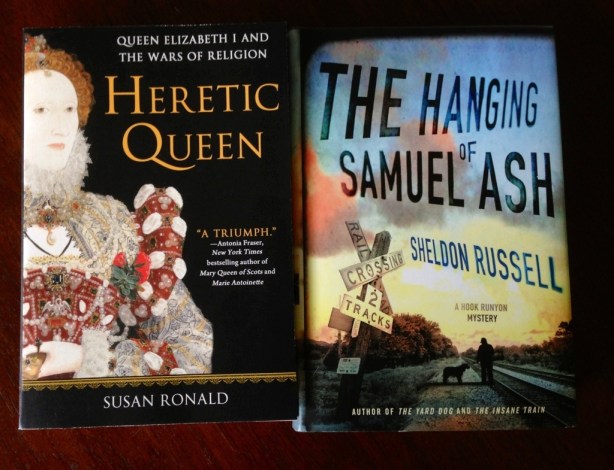
First, Susan Ronald’s Heretic Queen: Publisher St. Martin’s Griffin’s blurb:
Acclaimed biographer Susan Ronald delivers a stunning account of Elizabeth I that focuses on her role in the Wars on Religion—the battle between Protestantism and Catholicisim that tore apart Europe in the 16th Century
Elizabeth’s 1558 coronation procession was met with an extravagant outpouring of love. Only twenty-five years old, the young queen saw herself as their Protestant savior, aiming to provide the nation with new hope, prosperity, and independence from the foreign influence that had plagued her sister Mary’s reign. Given the scars of the Reformation, Elizabeth would need all of the powers of diplomacy and tact she could summon.
Extravagant, witty, and hot-tempered, Elizabeth was the ultimate tyrant. Yet at the outset, in religious matters, she was unfathomably tolerant for her day. “There is only one Christ, Jesus, one faith,” Elizabeth once proclaimed. “All else is a dispute over trifles.” Heretic Queen is the highly personal, untold story of how Queen Elizabeth I secured the future of England as a world power. Susan Ronald paints the queen as a complex character whose apparent indecision was really a political tool that she wielded with great aplomb.
And: The Hanging of Samuel Ash by Sheldon Russell, from Minotaur. Publishers Weekly blurb:
A compelling lead compensates only in part for the relatively weak plot of Russell’s fourth mystery featuring one-armed Santa Fe railroad bull Hook Runyon (after 2012’s Dead Man’s Tunnel), set during WWII against a backdrop of labor unrest. When Runyon checks out a nonworking signal on a remote stretch of track, he discovers a man’s corpse hanging from the signal’s cantilever. The only clue to the dead man’s identity is a Bronze Star inscribed with the name Samuel Ash. Not wanting the war hero to be buried in a pauper’s grave, Runyon takes custody of the body and embarks on a quest to find Ash’s relatives and the truth about his death. A dose of humor lightens the gloom—pickpockets steal Runyon’s wallet and badge while he’s hunting pickpockets—but the mystery itself never picks up much steam. Fans will hope for a return to form next time.
Nanni Balestrini’s novella Sandokan, in English translation from Melville House, tells the story of the rise of the Camorra crime syndicate in the small, poverty-stricken cities around Naples. Balestrini’s unnamed narrator occupies a fascinating insider-outsider perspective: one one hand, he, unlike many of his peers, does not join the gang, or “clan,” as its called–in fact, their behavior repulses him. On the other hand, he’s a native of the small town where Francesco Schiavone (aka Sandokan), Antonio Bardellino, and their henchman rule mercilessly, an eye-witness to the brutality and inhumanity of organized crime. The narrator is a sensitive young man who delineates clearly how the crime cartel was able to achieve such economic prosperity and power in the 70s, 80s, and 90s, detailing the various rackets the clan imposed upon the town, like stealing elections, peddling drugs, and manipulating the agribusiness that is the main source of income for average Neapolitan peasants. The narrator also explores why these small towns fall so easily into the terror of organized crime. The main reason: boredom stemming from little or nothing to do.
Balestrini’s narrator’s description of the Camorra is systematic, detailing the awful history and brutal practices of the syndicate in spare, concrete terms. His explications of the clan’s violence is not so much thrilling as it is ugly, as the narrator always shows how “normal people” (his words) are cheated, killed, or otherwise harmed by the Camorra. The narrator’s tone is often journalistic but never clinical; he always shows what’s at stake for the “normal people,” how they are affected by these crimes. At times the narrator is wryly funny, a tone that results in large part from his observation that the townspeople, the people he grew up around, begin to normalize the violence. It becomes part of their daily lives and affects them so directly that it becomes casual, and the sensitive narrator is one of only a few not to bow to it, ignore it, or take part in it–yet the violence and crime is so overwhelming that to live with it is to live with absurdity. Balestrini employs a punctuation-free rhetorical style in Sandokan that captures the breathless energy and frustration of the narrator. While many readers might balk at the lack of commas, periods, or semi-colons, I found the technique quite liberating. It enhances the immediacy of the narrator’s voice, the rushed sense of importance to his tale. It also promotes sustained readings of the text–I read most of Sandokan in three enthralled sittings.
Sandokan has its cinematic twin in the 2008 film Gomorra, directed by Matteo Garrone. The film, like the book, illustrates the affect that crime has on a range of “normal people,” mostly occupants of a housing project outside of Naples. As in Sandokan, the ordinary citizens find that they have no choice but to choose between sides as an absurd, petty gang war ravages their already decimated landscape. Where Balestrini’s punctuation-free rhetoric allows readers closer access to his narrator’s pathos-driven story, Garrone lets his camera wander freely over the grim landscape without ever imposing any clear narrative structure. It is not until the film’s final third that the five disparate stories he tells coalesce, and even then, it remains unclear who is on whose side. What is clear is that the violence and crime is quickly stealing–and killing–another generation.
In an age where violence is sensationalized and glamorized, particularly in gangster films and TV shows (do I really need to list them?), Sandokan and Gomorra both lay bare the Darwinian cost of crime. In both narratives, the violence is mundane and inescapable, meaningless yet awful, and very, very dark. Neither narrative is didactic in the least–or even hopeful, for that matter–but their is an implicit suggestion that if only there were some alternative to the Camorra–libraries, social clubs, movie houses–there might be another prospect for the young people in this area.
I highly recommend both Sandokan and Gomorra. As an end note, I’d love to see more of Nanni Balestrini’s work come into English translation, perhaps via Antony Shugaar and Melville House, who’ve done a lovely job here.
[Ed. note: Biblioklept published a version of this review in January of 2010]