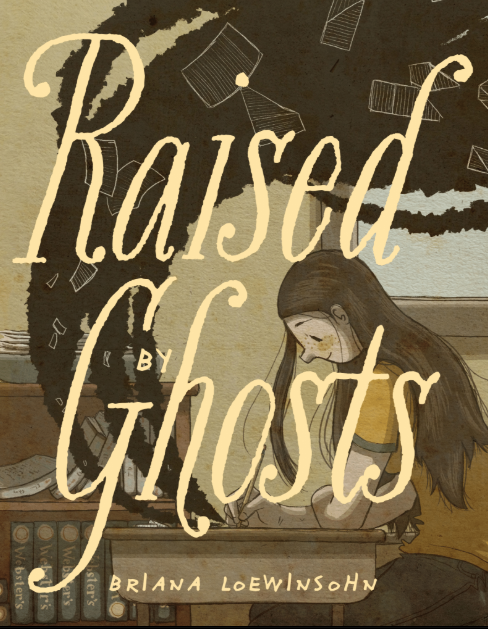
Briana Loewinsohn’s graphic novel Raised by Ghosts turns absence into haunting art

A decade ago I finally tossed out most of the contents of an old shoebox crammed with high-school nostalgia. Notes from ex-girlfriends, summer postcards, flyers from local shows, a handful of choice mixtapes. Some Polaroids. Our stupid band’s stupid lyrics, which we usually forgot or simply abandoned live. There was even a pair of fat shoelaces. The pain of return always hits me hard at such times, and I got dizzy. That box was crammed the scraps of an older life.

The preceding paragraph is an unfair opening to a review of Briana Loewinsohn’s excellent graphic memoir Raised by Ghosts. Reading Raised by Ghosts felt like opening that old shoebox: painful, dizzying, beautiful. Loewinsohn is one of usone of us to borrow a chant from Tod Browning’s Freaks. “Sometimes I feel like I am an alien at this school…But there are other aliens here,” protagonist Briana writes in her diary.
Raised by Ghosts covers Briana’s seven rough years through middle and high school. These are the gay nineties. The narrator, like Loewinsohn herself, is about my age, which makes reading Raised by Ghosts an eerie act of self-recognition. It’s not a conventional memoir—it doesn’t hold your hand or deliver a clean, linear narrative. Instead, it moves like memory does: in flashes, in vignettes, in small sensory moments that coalesce into something greater than the sum of their parts. Everything here feels true. We have here the relics of a teenage moondream, those little ghosts of the past that flicker through memory like frayed photos freed from the rubberbanded bundle in an old Converse box. Briana’s adolescence unfurls as an ebb and flow of loneliness and acceptance among fellow weirdos. She finds her people, but never quite makes the scene; she dances at the live show but finds as much fun in playing cards in the back.
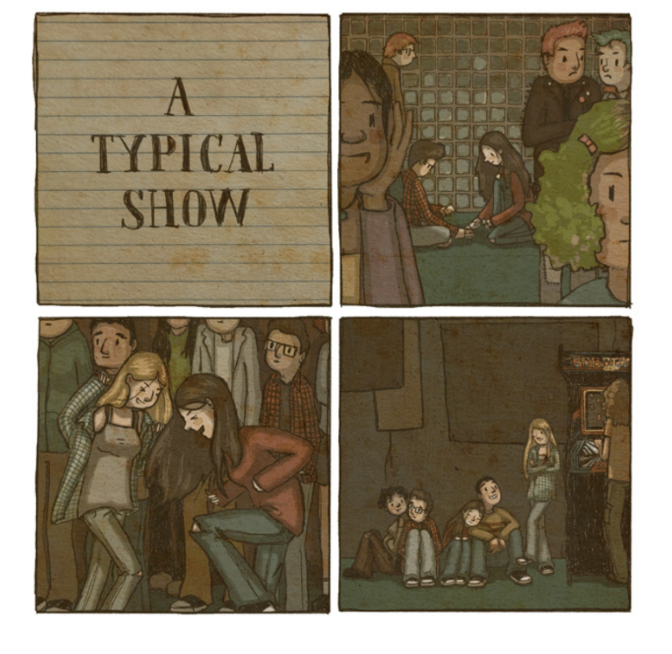
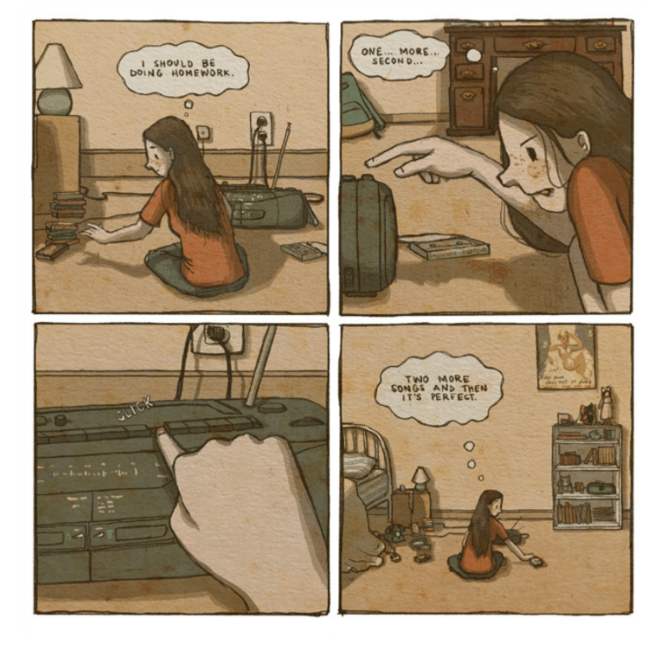
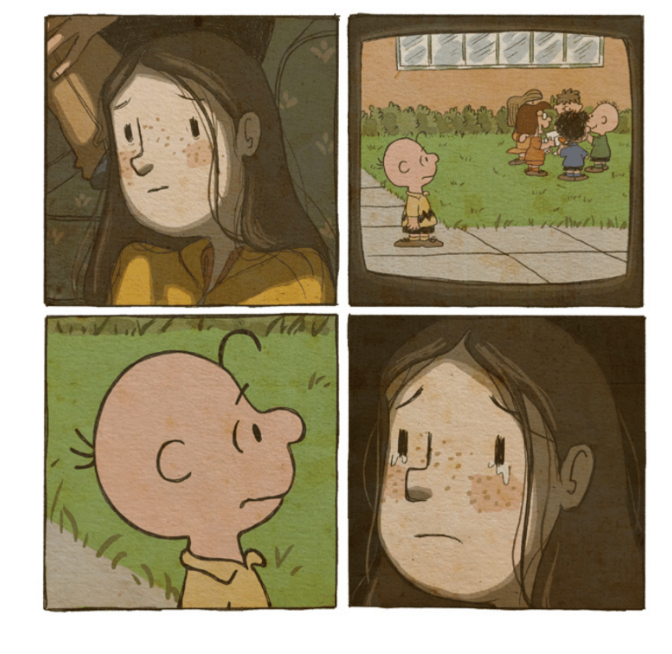
Loewinsohn’s art conveys Raised by Ghosts’ emotional weight. Soft, muted tones in drab olive and rust hues fill square panels that often resemble fading Polaroids. Candids and close-ups capture the messiness of high school. Briana is a sympathetic and endearing character, her sensitivity registering in ways she cannot understand herself, as when she skips out on a living-room VHS double feature. Oliver Stone’s Natural Born Killers would be way too much after the tragedy of You’re a Good Man, Charlie Brown.
Loewinsohn includes full handwritten pages to accompany the traditional comic strips in Raised by Ghosts. These handwritten pages serve as a kind of diary, but often take on subtle visual changes that suggest other media. Often, the handwritten pages mimic the form of the long notes bored Briana composes in class to pass to friends. A passage composed on graph paper praises the note-writing skills of a particular friend; the technique suggests this friend prefers squares to lines. A passage on a brown paper lunch bag reflects on how Briana’s father always takes the time to write her name in detailed, expressive lettering. The variations of handwritten pages enrich the narrative and subtly inform us of Briana’s artistic development.

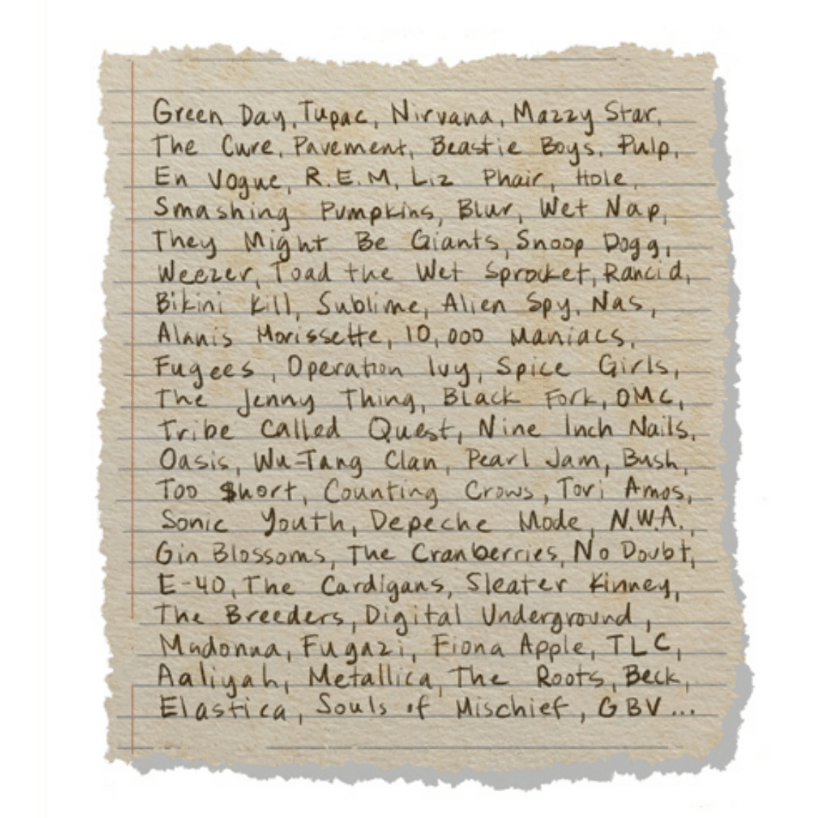
My favorite of the handwritten passages though is simply a list of bands scrawled on lined paper. When I got to that page, about a third of the way into Raised by Ghosts, I was already persuaded by the book–but the page of band names seemed so utterly true, so beautiful and banal. We used to do that, I thought, and: Why did we used to do that? knowing the answer has no good intellectual answer.
But let’s get to the ghosts. Loewinsohn never “shows” us Briana’s parents, yet the picture we get of them is hardly incomplete: a distant, detached mother and a father in arrested development. “I would say I was raised in an AA meeting,” Briana remarks of her mother, noting that it’s often hard for single mothers to find childcare. Of her father’s abode: “My pop’s house is a combination of Indiana Jones’ office, Pee Wee’s playhouse, and an opium den. I am kinda like a roommate here.”
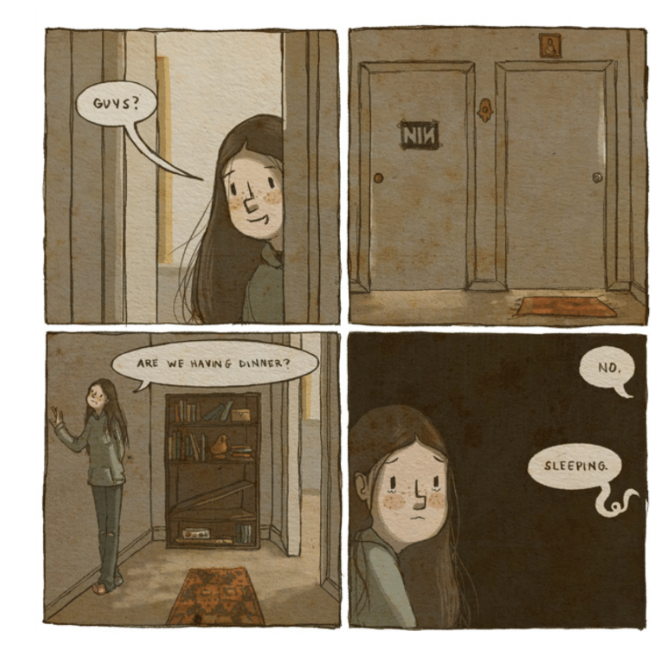
Briana’s parents exist in Raised by Ghosts the way memories of the absent often do—fragmented, elusive, more felt than seen. Loewinsohn never lets them fully materialize, yet their presence, or lack thereof, shapes Briana’s interactions with her world. Neither parent offers Briana guidance. She’s a latchkey kid left to cobble her own sense of belonging among friends, music, and the small rituals of adolescence. In the absence of stability, she builds meaning from mixtapes, handwritten notes, and fleeting moments of connection.

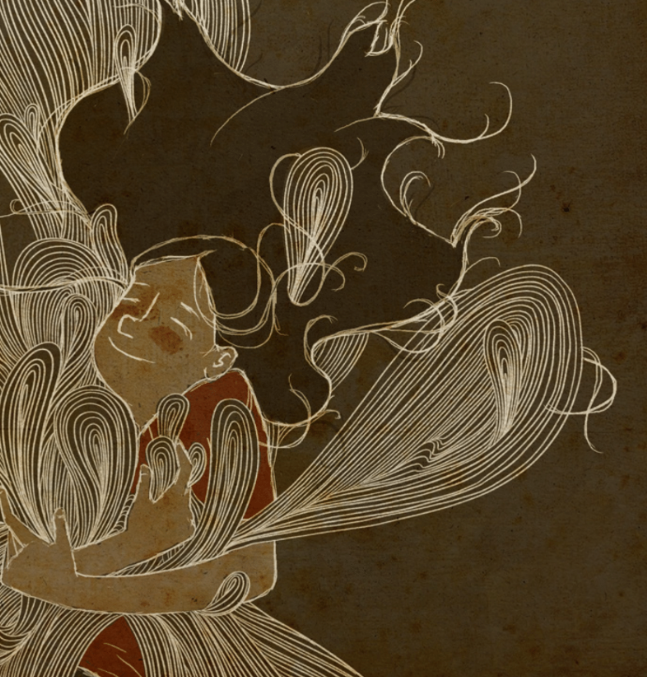
And art. The memoir climaxes in a moment of transformation—an act of self-possession and, ultimately, self-creation. Throughout Raised by Ghosts, Briana moves through a world shaped by absence, by the ghosts of parents who are physically present but emotionally distant. Yet, in the book’s remarkable penultimate sequence, she steps beyond that absence, beyond memory’s hazy grip, into a space that is entirely her own. The panels swirl into a dreamscape of shifting lines—formless and chaotic at first—until Briana gathers them together, lassoing meaning from the void. It is a moment of artistic alchemy, where creation becomes a form of agency, a way to shape her own narrative rather than just mimic one. When she carries those lines from dream to waking life, the transition is profound: she is no longer just a kid collecting relics of meaning from the world around her—she is an artist, making meaning herself.

Publisher Fantagraphics labels Raised by Ghosts as a “young adult graphic novel,” and teenagers will likely identify with Briana’s story—the loneliness, the search for belonging, the quiet acts of self-definition. They may also feel a strange twinge of envy for a world that no longer exists. Being a latchkey kid could be lonely, but it was not without its freedoms. Those of us who were teenage weirdos in the nineties will see in Loewinsohn’s memoir not a young adult novel, but rather a reflective elegy composed by a mature artist in control of her talent. Raised by Ghosts lingers like the echo of an old song in your dim memory — you know the one, right? It’s a memoir about growing up in the margins, about finding meaning in scraps and silence, about turning absence into something tangible. It haunts, in the very best way.
Blog about some recent reading

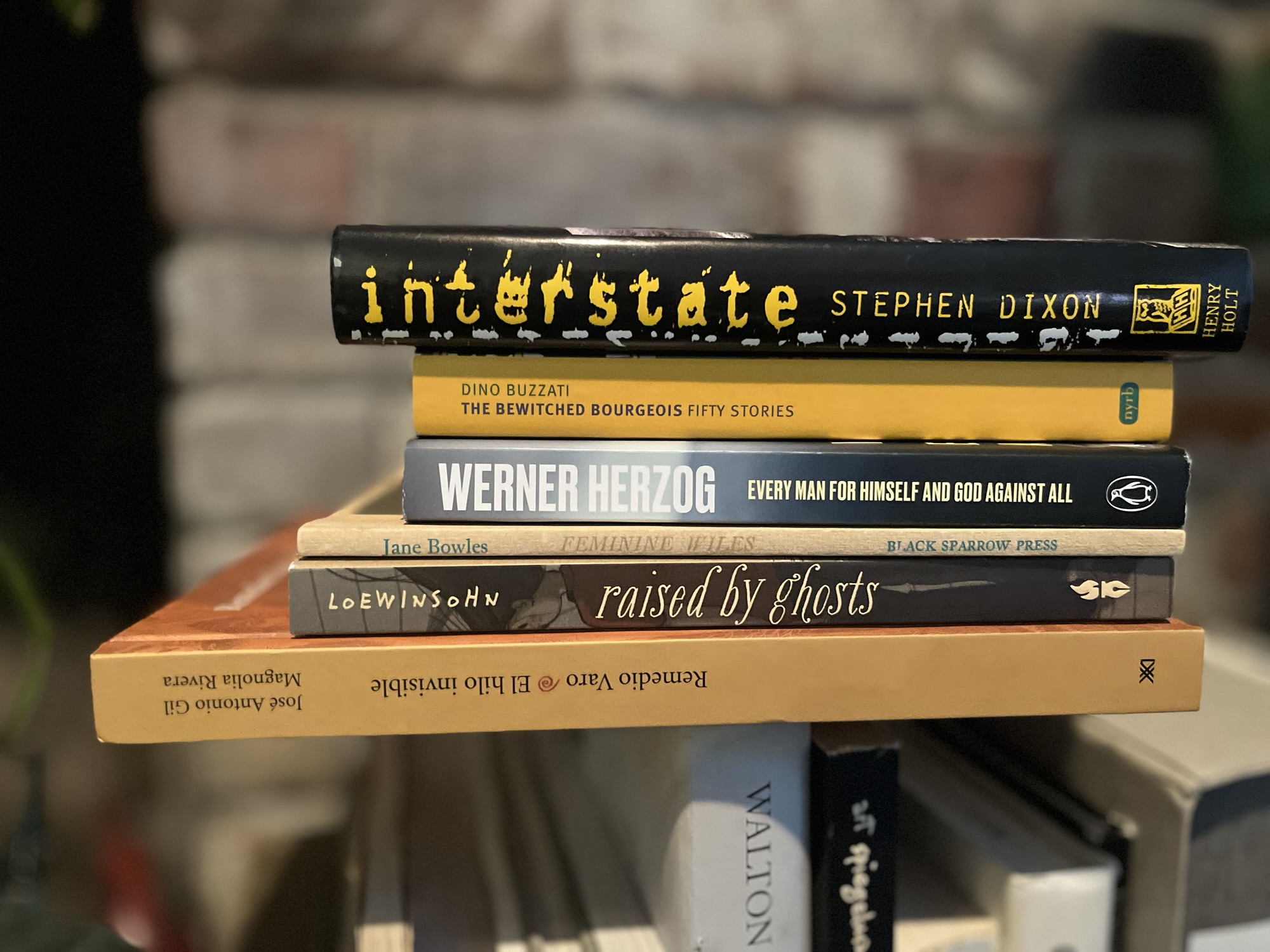
What an interesting few weeks it’s been! Here’s (some of) what I’ve been reading so far this year:

I’m in the middle of Stephen Dixon’s novel Interstate. It is a devastating, ugly, addictive, beautiful novel; I have no idea if it is “good” or not but I love it. I can’t really think of a single person I know (in real life) I could recommend it to. We played cards with some friends and one of them asked about what I was reading, and I said a novel called Interstate by this guy Stephen Dixon, and she asked of course What’s it about? and I said something, Well, this guy’s driving on the interstate with his daughters and two guys in a van pull up along side him and start shooting at them, killing his younger daughter–this happens in like, the first few paragraphs–and then we see how this event destroys his life–but then Dixon repeats the initial scenario like seven more times with different (but all really tragic so far) outcomes–and it’s written in this addictive vocal style that might be really off-putting to many readers, and it also makes really fascinating use of the coordinating conjunction for, which may just be a verbal tic –and it’s also really funny at times? I am not trying to sell this novel to anyone but I love it.

My reading experience of Briana Loewinsohn’s graphic novel Raised by Ghosts was kinda sorta the opposite of Dixon’s Interstate in that after I finished it I immediately pressed it on my wife and then my kids and then texted some of my oldest friends about it (oldest in the previous clause should be understood to modify the friendship, not the actual friend’s years–although we’re all getting older). We’re all getting older, all the time, and Raised by Ghosts provoked an aged nostalgia in me. I’m about half a year older than Loewinsohn and so much of her semi-autobiographical novel resonated with me. She gets everything right about what it was like to be a little bit of a weirdo at school in the nineties. There’s this wonderful passage on how important it was to get a handwritten note from a friend; there’s a page that’s nothing but a notebook page filled with band names; there’s a marvelous scene where our hero loses her shit watching You’re a Good Man, Charlie Brown. I should have a proper review this week or next, but great stuff. (The whole family loved it, by the way.)

I’ve been reading a collection of Dino Buzzati short stories translated by Lawrence Venuti; my technique is to read one of the shorter stories when I feel a bit of dread or anxiety from, like, reading something else. (The collection is called The Bewitched Bourgeois by the way.) I’ve enjoyed reading them, and have especially enjoyed allowing myself to read them at random instead of following the collection’s chronological trajectory. Very Kafka, very Borges, but also very original.

Not in the picture above, but I’ve also been working my way through a digital copy of Vladimir Sorokin’s short story collection Dispatches from the District Committee, in translation by Max Lawton (and illustrated by Gregory Klassen). Great gross stuff.

I picked up a collection of Jane Bowles’ sketches, letters, and other ephemera a few weeks ago–I love her stuff, but really it was that these were contained in the somewhat-rare Black Sparrow Press edition Feminine Wiles. I’m pretty sure all of the stuff here is collected in My Sister’s Hand in Mine, but I’ve enjoyed dipping into this one more. It’s slim, not bulky, but that bulky boy’s around her (My Sister’s) if I need him.

My uncle sent me a copy of Werner Herzog’s 2022 memoir Every Man for Himself and God Against All for Christmas (in translation by Michael Hofmann). I devoured the first few chapters and then a colleague hipped me to the fact that there’s an audiobook of Herzog reading his memoir (available on Spotify and other platforms) — so on my commute I’ve been listening to him read his own memoir, which is just amazing. Like fucking amazing. Hearing him say phrases like “the escapades of Christopher Robin, Winnie-the-Pooh, Piglet, and Eeyore” or that “chipmunks…have something consoling about them” is surreal. There are like fifty insane things that happen in every chapter, and if Dwight Garner of the failing New York Times attested that he didn’t “believe a word” of the memoir, I take the opposite tack. Everything is true, everything is permitted.

Finally, I can’t really say I’ve been “reading” Remedios Varo: El hilo invisible by Jose Antonio Gil and Magnolia Rivera. My grasp of Spanish cannot graspingly grasp too much of the Spanish (although my iPhone’s picture-text-translate thing works fine when I’m really curious), but the book is a lovely visual catalog of not just one of my favorite artist’s works (including many pieces I haven’t seen before), but also documents her visual influences. I picked it up at the Museo de Arte Moderno in Mexico City back in January, still floating on the high of seeing many of Varo’s lovely paintings there that afternoon.