We’re in for some dark ages, kid | Notes on Thomas Pynchon’s Shadow Ticket, Ch. 27-29

Notes on Chapters 1-7 | Glows in the dark.

Notes on Chapters 8-14 | Halloween all the time.

Notes on Chapters 15-18 | Ghostly crawl.

Notes on Chapters 19-20 | The needs of cold capitalist reality and those of adjoining ghost worlds come into rude contact.

Notes on Chapters 21-23 | Phantom gearbox.

Notes on Chapters 24-26 | Idiots get respect out here, they’re believed to be in touch with invisible forces.


Chapter 27 focuses on Hop Wingdale. Out on tour with his band (and maybe on the run, sorta, from Daphne) he meets up with his agent Nigel Trevelyan in Geneva. Hop refuses to play “any of these Nazi joints popping up all over,” but sympathetic Nigel has something kosher for the clarinetist: the “Trans-Trianon 2000 Tour of Hungary Unredeemed,” an anarchic, carnvialesque motorcycle race that will culminate in Fiume (aka Rijeka — a bilocated multilingual, multiethnic city-state). Everyone in Shadow Ticket is headed to Fiume — you too, reader.

Halfway through this short chapter, things take a spooky twist: Nigel dispenses with the tour stuff to move to “the real business at hand…Hop’s ‘booking agent’ turns out to be a” secret agent. He’s so secret that he literally physically morphs “through a smooth frame-by-frame personal transition, gaining a couple inches in height, mustache narrowing to little more than a lip gesture, discreetly tinted indoor specs.” It turns out that “the real business at hand” is the worsening “antisemitism situation.” Hop’s on a mission; the tour is a cover for him to scout “possible escape routes from Central Europe should a sudden exodus become necessary.” Nigel suggests that the “key connection will be to Fiume, also known as Rijeka.” He warns Hop that: “We’re in for some dark ages, kid.”

Nigel has arranged luxury transport for his asset: a “road-Pullman all lit up, size of a railway sleeping car, futuristic as something just rolled off the cover of Amazing Stories.” The notation of a “road-Pullman” threw me at first — Pynchon has evoked something like a sci-fi bus, sure, but I had always identified the term “Pullman” with railroad cars — like the one Hicks journeyed eastward out of Illinois (while chatting with a phantom Pullman porter) back in Ch. 17. Perhaps it’s just slang here?
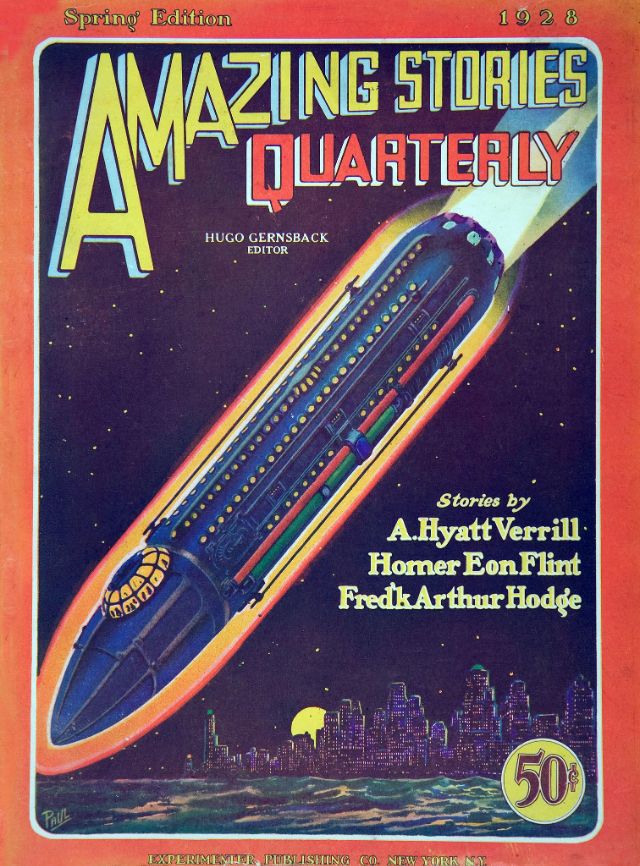
Amazing Stories Quarterly , Spring 1928. Cover by Frank R. Paul.

Chapter 28 begins with homesickness blooming into idealized nostalgia: “Sometimes all Hicks wants is to be back in Milwaukee, restored to normal life, to a country not yet gone Fascist, a place of clarity and safety, still snoozy and safe…” I feel that Hicks!

The chapter then moves through a series of short vignettes that move the plot forward (however obscurely). Terike will be taking off on the Trans-Trianon bike tour; Hicks is worried that Harley-riding Ace Lomax will be there too. Hicks checks in with Egon Praediger, who implicitly offers to pay Hicks to kill Bruno Airhart. Hicks declines, claiming that assassination “draws too much kiddie outlaw attention” — but we get the sense that he’d like to find more meaningful work than just one “high-risk orangutan job after another, always in the service of someone else’s greed or fear.” Hicks also visits journalist Slide Gearheart, who questions whether or not the former strikebreaker might find forgiveness or “redemption via Cheez Princess.” Cynical Slide is dubious, but their exchange recalls psychic Zoltán von Kiss’s riff in Ch. 22 on the redemption of lamps: “even the most hopelessly ill-imagined lamp deserves to belong somewhere, to have been awaited, to enact some return, to stand watch on some table, in some corner, as a place-keeper, a marker, a promise of redemption.”

Chapter 28 then gives over to Daphne, who will finally, “in a turbulence and drift of multiple unlikelihoods” meet up with her estranged father Bruno. She meets him in Night of the World, a multi-floor cabaret whose “circles of depravity…go corkscrewing down…toward ancient depths few have been willing to dare, each with its own bar and dance band and clientele.” The image of the bar and its name recall German philosopher Georg Wilhelm Friedrich Hegel’s notion of “die Nacht der Welt” a reference to human subjectivity as a chaotic, unconscious darkness that lies beneath rational thought. Pynchon has previously referenced Carl Jung in Shadow Ticket, and while I don’t really think of Jung as a follower of Hegel, his concept of “the shadow” seems to resonate with Hegel’s “Nacht der Welt.”

Pynchon’s description of the Night of the World is worth sharing at length: “Each table here has a small circular cathode-ray tube or television screen set flush in the tabletop, throbbing more than flickering with shaggy images of about 100 lines’ resolution…Numbered push-button switches allow you to connect to any other table in the place and watch each other as you chat.” As if to underline the parody here of our twenties’ contemporary screen culture obsession, a strange man — it’s Bruno, spoiler — tells Daphne the screens are, “The future of flirtation…here they call it Gesichtsröhre, or ‘Face-Tube.’ ” 

But the theme here goes beyond the parodic surface. Looking in the screen, “Viewers sometimes do not agree on the nature of the image. Pareidolia is common. You look down into it, like a crystal gazer, and faces loom unbidden.” The language here recalls Hicks gazing into the shoe-fitting fluoroscope back in Ch. 15 and seeing “a face he’s supposed to know but doesn’t, or at least can’t name.” Is this image the shadow — like, the Jungian shadow? The night of the world? Or just Hicks’s paranoid pareidolia cooking up an answer to a corkscrew of images that amount to chaos.

Anyway–the weird stranger is Papa Bruno. Soon there’s another of Pynchon’s original songs and a daddy-daughter dance. Bruno looks much, much younger, and creepily, more virile. How? “These days the Central European backwoods, Bruno explains, are full of ‘scientists,’ elsewhere known as witch doctors, working miracle effects in chemical defiance of time.” All in the service of horny plutocrats, natch.

Daddy and daughter agree on a movie date and go to see Bigger Than Yer Stummick (1931), the latest hit starring child sensation Squeezita Thickly, which is about, well, eating, actually.” The description of Bigger Than Yer Stummick is, for me, a highlight of Shadow Ticket. It’s well-over whatever line of “good taste” some folks might set down (Squeezita Thickly!), over-indulgent, and I love it. Here’s Pynchon the auteur framing a special effects shot:

“A pot of soup, approached from overhead, now smoothly lap-dissolving into a giant swimming pool full of bathing beauties, bordered by palm trees and food pitches, offering an array of snacks from roast turkey drumsticks to deluxe hot dogs smothered in sport peppers and dripping green-blue pickle relish strangely aglow, even though the movie’s supposed to be in black-and-white, and gigantic Italian sandwiches quite a few feet long, and glutton-size ice-cream extravaganzas and oh well that sort of menu…”

I think I’ve pointed out in every single one of these riffs some instance of glow-in-the-dark material, like the “green-blue pickle relish” that manages supernatural radiation here.

The Bigger Than Yer Stummick routine isn’t just goofy fun though. It showcases the zany-sinister paradox that Pynchon is so good at evoking. The film is about eating, and thus, highlights hunger via hunger’s absence. And the film’s audience is hungry: “Back in the States, every showing of this movie, no matter where, has collapsed well before the second reel into civic disorder—screens across the nation presently inscribed with knife scars, fork tracks, spoon indentations as audiences, many of whom haven’t seen a square meal since the start of the Depression.” As the film progresses, it gets darker; first “the music has shifted grimly minor,” and soon folks are shooting at each other, both semi- and fully-automatically, not always in play, plus setting off spherical anarchist-style bombs.” There’s a war on the horizon — “We’re in for some dark ages, kid” — a war that will cannibalize the world. Consider Egon Praediger’s cocaine-inspired reverie back in Ch. 21. He predicts the coming war; although it will entail “a violent collapse of civil order” it will also point to a “horizon with enough edible prey to solve the Meat Question forever…”

One last note on Bigger Than Yer Stummick — the title is a take on the idiom “your eyes are bigger than your stomach,” meaning that you’ve overestimated your hunger or taken on more than you can handle. The missing word is “eyes” and two of the words are in alternate spellings. Perhaps Pynchon is inviting us to see not just a missing “eye” but a missing “I.” Maybe there’s something here with the shadow self, the missing or submerged self, the moral self that would love to transcend the material plain, the stomach of reality — if you weren’t so fucking hungry all the time.

Post-film credits, things get weird between Daphne and pops. The narrator tells us that, “If Daphne has been hoping for something incestuous yet romantic, she’s once again reminded how very little anybody can put past Bruno.” Uh, okay. Bruno wants to euchre her of her cattle/cheese rights; he needs cash as “Some very bad people are after your old Pop, itchin to take down the Al Capone of Cheese. Forces I once had no idea even existed.” We then switch back to Hicks and Slide, with Slide apparently hep to an apparent incest grift on Daphne’s point: Word around is she’s been working her own counter-scheme, luring Bruno deeper into a sordid and forbidden sex affair while hired photo crews secretly record every last shameful detail—” Hicks is shocked. But, like — incest, power, plutocracy. Daphne skips town, possibly hunting Hop.

Ch. 28 snowballs, adding characters, like Heino Zäpfchen, a much sought-after Judenjäger, or Jew-tracker”; the Vladboys, an anti-semitic gang of hooligans “desperate for Nazi approval” who are engaged in streetfighting; and “Zdeněk, who claims to be an authentic Czechoslovakian golem.” Thomas Pynchon is 88 years old. I have no idea how long he’s had this novel percolating, and I’m so thankful to get to read at least one more, and I think it’s a really good novel, but, yeah, there’s a sketchiness to it — a sense that the old master might not have the energy or time to flesh out all of the big ideas. Or, alternately–Shadow Ticket is leaner and meaner than the epics it points towards (Against the Day and Gravity’s Rainbow).

Okay, so I just mentioned Against the Day and Gravity’s Rainbow — parenthetically, sure. But “Zdeněk, who claims to be an authentic Czechoslovakian golem,” provides a clear link to Mason & Dixon. Golems show up in Mason & Dixon, first appearing in Chapter 49, where the narrator refers to “Kitchen-size” ones, not the giants we expect. Cf. Zdeněk being described as a “sort of snub-nose golem.” Then, in chapter 50, there’s an extended riff on the Rabbi of Prague (I wrote about it here). Back in Shadow Ticket, Zdeněk “explains, ever since Judah Loew was Rabbi of Prague, a body of powerful golem lore has been passed down, rabbi to rabbi.”

The (long) chapter ends with a flurry of references: to Imi Lichtenfeld (Hungarian-born inventor of the Israeli martial art krav maga (“’You could think of it as Jew-jitsu,’ sez Zdeněk”); to “a glamorous, indeed sultry, robotka or female robot named Dushka; and to “some business in Transylvania we needed to take care of.”


Chapter 29 is an ultracompressed precis of Central European history in the 1920s, the point of which is the origin of the Trans-Trianon motorcycle ride (that’s not really the point):

“Sometime in the period 1920–25 the first tentative motorcyclists set out on low-horsepower machinery, army dispatch bikes, city-street models. While the ’20s roared in Chicago and American expats whooped it up in Paree, while Dziga Vertov and Mikhail Kaufman went gliding through the city traffic of Petersburg filming a newly tsarless and not yet Stalinized people” —

— “while Berlin still offered unparalleled freedom and refuge to heretics and asylum seekers of all persuasions, this is what was going on in the strange ring of historical debris that had once belonged to the Kingdom of Hungary—bikers in motion, some riding clockwise, some counter-, not a rally, not a race, not a pilgrimage, no timekeepers, no grand prizes, no order of finish, no finish line for that matter, though some, speaking metaphysically, say if there were one it’d be at Fiume. Rijeka, whichever.”

Bilocation, anarchy, telekinesis.

Watch Man with a Movie Camera (dir. Vertov; dir. of photog. Kaufman).
Idiots get respect out here, they’re believed to be in touch with invisible forces | Notes on Thomas Pynchon’s Shadow Ticket, Ch. 24-26

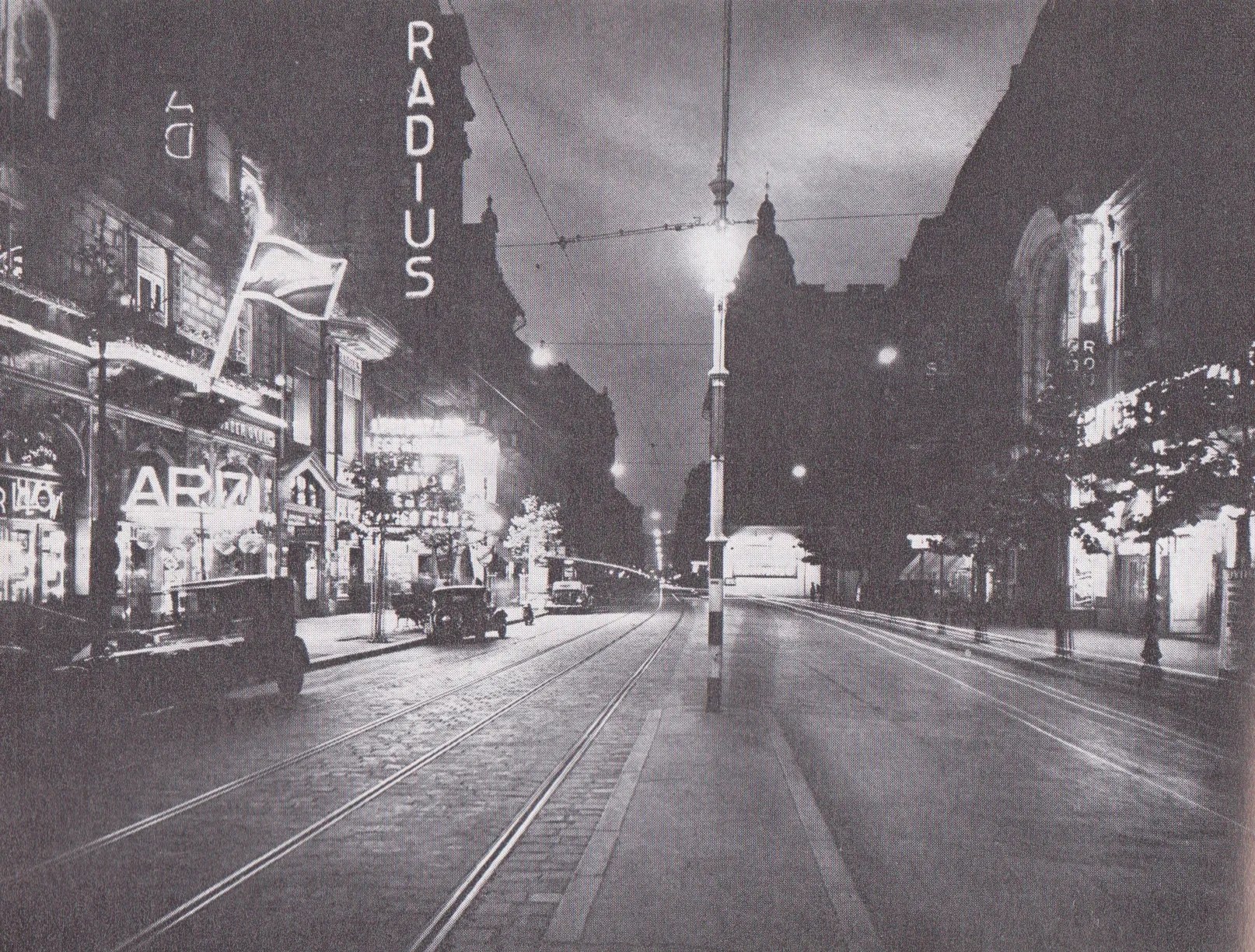
Nagymező Street, the Radius Film Theater (Radius Filmszínház)

Notes on Chapters 1-7 | Glows in the dark.

Notes on Chapters 8-14 | Halloween all the time.

Notes on Chapters 15-18 | Ghostly crawl.

Notes on Chapters 19-20 | The needs of cold capitalist reality and those of adjoining ghost worlds come into rude contact.

Notes on Chapters 21-23 | Phantom gearbox.


Chapter 24: Another fairly long chapter for Shadow Ticket. I’ve been over-summarizing in these notes, and maybe I’ll keep over-summarizing — at this point doing these notes has been my second reading of Shadow Ticket. I would say though, that we’ve reached a point well beyond the novel’s quick change glamour, its bilocative split — or its bait n’ switch, if you feel that way. The novel initially presents as a hardboiled noir send-up in the dark American Heartland only to pivot (or bilocate, to misapporpriate a term from Against the Day) to Central Europe where there’s preparation for a war on (moron). Hero Hicks fades, just a little, in the background; a larger cast steps up.

But Hicks is still the heart of Ch. 24, which begins at Egon Praediger’s office in Budapest, where the ICPC detective is snorting soup spoonfuls of cocaine while ranting about his inability to catch Bruno Airmont. Egon fears he’s wasting his talent “not on an evil genius but on an evil moron, dangerous not for his intellect, what there may be of it, but for the power that his ill-deserved wealth allows him to exert, which his admirers pretend is will, though it never amounts to more than the stubbornness of a child.” Oh man–wonder if that sounds like any evil moron of recent vintage? Egon would rather face off against a worthy villain, a “Dr. Mabuse or Fu Manchu,” references again underlining Shadow Ticket’s lurid pop Goth bona fides.

Hicks then runs into Terike, “just emerging from her latest run-in with the authorities over her motorcycle, a 500 cc Guzzi Sport 15″ — which more on this transport later. On the way to the bike, Hicks finds that he has somehow percolated through Terike, who has performed some kind of metaphysical quick change. He apports, I guess.

1937 Moto Guzzi GTS 500 with matching sidecar

For Terike, the Guzzista “is a metaphysical critter. We know, the way you’d say a cowboy knows, that there’s a fierce living soul here that we have to deal with.” As we should expect now in Ole Central Europe, this bike is spooky, and Terike is a superhero on it: “she can go straight up the sides of walls, pass through walls, ride upside down on the overheads, cross moving water, jump ditches, barricades, urban chasms one rooftop to the next, office-building corridors to native-quarter alleyways quicker than a wink.”

Hicks rides along in the sidecar. (A bit later we’ll see a charming pig, a spirit animal, really, riding sidecar–perhaps there’s a link between Hicks and Pynchon’s other pigmen, like Seaman Bodine or Tyrone Slothrop (or the unfortunate Major Marvy.) Their mission: deliver a batch of experimental vacuum tubes “specially designed for the theremin” to Club Hypotenuse,” a “cheerfully neon-lit” venue featuring a rotating dance floor and “not just one soloist on theremin but a half dozen, each expensively gowned tomato with more or less identical platinum bobs, waving their hands at these units and pulling music out of some deep invisibility, swooping one note to the next, hitting each one with pitch as perfect, Terike assures him, as the instrument’s reigning queen, Clara Rockmore. The joint effect of these six virtuoso cuties all going at once in close harmony is strangely symphonic.”

(Forgive me if I let the quote linger too long, the image is just too lovely.)

At Club Hypotenuse we get a bit of background on Terike, her rejection of her bourgeoisie upbringing, and recent Hungarian political struggles, before meeting yet another character, freelance foreign correspondent Slide Gearheart (he uses the alias “Judge Crater” at the bar. We last heard the name back in Ch. 18, but Crater, icon of the disappearing act, will pop up again). Slide lets Hicks in on a lead he has to cheese heiress Daphne Airmont’s whereabouts; he also gives our P.I. some advice about (not) fitting in to Hungary: “…best stick to English and there’s a chance they’ll take you for an idiot and leave you alone. It might help if you could also pretend now and then to hear voices they don’t. Idiots get respect out here, they’re believed to be in touch with invisible forces.” 

But Slide’s bigger note for Hicks is a soft warning to prepare him for the reality that you can never really go home.


Chapter 25: “Things pick up a day or two later when Slide reports that Daphne has been sighted at the Tropikus nightclub, in Nagymező utca, the Broadway of Budapest.” (This is I suppose the inspiration for the use of the photograph of Nagymező Street used on the cover of the first edition of Shadow Ticket.)

Daphne sings a song and then she and Hicks dance together.

So–I have really neglected Shadow Ticket as a song and dance routine. I think if you’ve read Pynchon you’d expect it; it’s a bit more prevalent here, the singing and dancing, in Shadow Ticket I mean, then in some of the other novels, but it’s certainly what you’d expect. The songs probably deserve their own whole blog or something to deal with (which I will never do); the dancing — well the dancing — I think something I should’ve highlighted much earlier is that Hicks is a really good dancer. Like fucking excellent. He’s a magician who goes into “one of those hoofer’s trances” in the previous chapter while dancing with Terike to the theremin orchestra. That notation — of the trance state — is given for various characters in Shadow Ticket who achieve a kind of short-term perfection outside the physical realm. (It’s the drummer Pancho Caramba (and like, Pynchon, c’mon man, that’s too much, name wise) — it’s the drummer Pancho Caramba in Ch. 25 who goes “into this kind of trance” at his drum kit, enchanting his audience.)

Most of the chapter is the dance and the dance-within-the-dance between Hicks and Daphne. There are Gothic-tinged allusions to their past in Wisconsin–his saving her from the “North Shore Zombie Two-Step” of forced psychiatric hospitalization, incurring a “Chippewa hoodoo” debt as her caretaker in perpetual.

We also start to get Daphne’s backstory with Hop Wingdale, the jazz clarinetist she left home for. She’s followed Hop and his band the Klezmopolitans around Europe, but is worried that the ill-fated lovers “need to relocate before it’s all Storm Trooper chorales and three-note harmony.” Daphne again underlines Shadow Ticket’s departure point — a big ugly change is gonna come. Hop is (rightfully) worried about Papa “Bruno’s invisible hand…” though. Awkwardly enough,” he tells Daphne, “it turns out more of your life than you think is being run on the Q.T. by none other” but her pops.

The phrase “on the Q.T.” — meaning quiet (or “on the quiet tip,” as I thought way back as a teen encountering it) — shows up a few times in Shadow Ticket. It’s phonetically doubled in the word cutie, which shows up more than a few times in Shadow Ticket.


Chapter 26: Another longish section by Shadow Ticket standards, and less breezy than the novel as a whole.

There’s a lot of Daphne-Hicks and Daphne-Hop stuff here — more bilocations, maybe? — in any case, our boy Hicks gets himself more wrapped up than he intended to. After Daphne urges him to help hunt down Hop, who’s kinda sorta left her, he reminds himself of his mantra “No More Matrimonials! Ever!”

By the end of the chapter our American idiot is wondering if “wouldn’t it be a nice turnaround to bring some couple back together again, put the matrimony back in ‘matrimonial’ for a change, instead of divorce lawyers into speedsters and limousines.” Here, I couldn’t help but think of Paul Thomas Anderson’s film revision to Pynchon’s novel Inherent Vice; PTA ties a neater bow on the narrative by letting its lead P.I. Doc Sportello restore the marriage of musician Coy Harlingen.

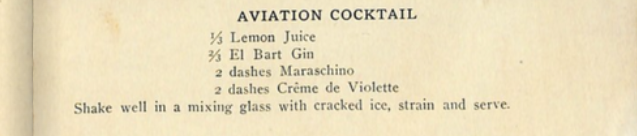
Anyway, we get Daphne and Hop’s origin story: “Talk about meeting cute. You’d think she’d have known better by then. It was in Chicago a few years back, still deep in her teen playgirl phase.” General gunplay shatters Daphne’s double aviation cocktail. She’s smitten with his woodwind serenades.

1917 recipe for aviation cocktail.

This chapter is chocked full of motifs and mottoes we’d expect from Shadow Ticket in particular at this point and Pynchon in general: invisibility, inconvenience, Judge Crater, “Who killed vaudeville?,” etc. It’s also pretty horny, with Hicks and Daphne finally consummating their meet cute from years gone by. Sorry if I’m breezing through.

I’m more interested in a specific exchange.

Carl Jung’s house in Kusnacht, Switzerland: VOCATUS ATQUE NON VOCATUS DEUS ADERIT —  “Called or not called, the god will be there.”

Daphne hips Hicks to something she saw “once, in one of these mental fix-it shops I kept getting sent to, up on the office wall was a motto of Carl Jung—Vocatus atque non vocatus deus aderit. I said what’s this my Latin’s a little rusty, he sez that’s called or not called, the god will come.”

The end of Ch. 23, at least in my guess, seemed to obliquely reference Jung’s Answer to Job, with the narrator suggesting that a trinity can only truly operate as a whole in the form of a stealth quatro — it’s phantom fourth piece balancing out the visible trio in the foreground. The reference to Jung here is not oblique but direct and maybe I will do something more direct with it down the line.

Of course the thing that comes to save Daphne isn’t “the god” but that Big Gorilla Hicks. He notes that, “Your old pals from the rez think it’s spoze to be a critter” who shows up to save the day. In a moment of vulnerability that I take to be sincere, Daphne asks Hicks if he didn’t think that she might actually be insane and should be returned to the hospital and not set free. His reply is a repetition of one of the novel’s several theses: “You were on the run, that was enough.”

Phantom gearbox | Notes on Thomas Pynchon’s Shadow Ticket, Ch. 21-23

Notes on Chapters 1-7 | Glows in the dark.

Notes on Chapters 8-14 | Halloween all the time.

Notes on Chapters 15-18 | Ghostly crawl.

Notes on Chapters 19-20 | The needs of cold capitalist reality and those of adjoining ghost worlds come into rude contact.


Chapter 21:

We move from trans-Atlantic passage to Central Europe pretty quickly. Hicks’s spy handlers Alf and Pip (and like at this point I don’t think he fully realizes Alf and Pip are his handlers on whatever shadow ticket he’s picked up) — Hicks’s spy handlers Alf and Pip leave Hicks on the train while they depart into Belgrade, Kingdom of Serbs, Croats, and Slovenes.

In the Quarrenders’ place emerges Egon Praediger, claiming to be of ICPC — the International Criminal Police Commission (not the Insane Clown Posse Crew), progenitor of Interpol (not the dour 2000s band, but the ICPO). Egon produces “a jarful of cocaine crystals” and grinds up some fat lines — “a routine known around Chicago as ‘hitching up the reindeer,'” the narrator informs us. While ingesting the coke, Egon eventually discloses the shadow ticket Hicks is working: “as you pursue the elusive Miss Airmont, we keep the shadow on you day and night, hoping that Bruno at a moment of diminished attention will make some fateful lunge.” (In another nod to Shadow Ticket’s Gothic motif, the narrator tells us that Egon pronounces the name Bruno Airmont “the way Dracula pronounces the name Van Helsing”).

It turns out that the Al Capone of cheese is the ICPC’s “most sought-after public enemy,” wanted for “criminal activities including murder, tax evasion in a number of countries, [and] Cheese Fraud.” For the terrible crime of counterfeiting cheese, “the International Cheese Syndicate,” or “InChSyn,” want to lock up Bruno. In a cocaine thrall, Egon riffs a bit at the sinister implications behind the scenes: “Cheese Fraud being a metaphor of course, a screen, a front for something more geopolitical, some grand face-off between the cheese-based or colonialist powers, basically northwest Europe, and the vast teeming cheeselessness of Asia.” Egon’s ranting here echoes the academic discussions of cheese back at the Airmont compound in Ch. 13, when discussion turns to breaking into the Asian markets: “How the heck do we create a market for dairy products in Japan short of invading and occupying the country outright? Taking away their tea or sake or whatever it is they drink and forcing them to drink milk like normal human beings?”

(Going back to Ch. 13 to find these lines, I realized that I’d neglected to include a Gothic reference in my riff on that chapter, where cheese is described as “a strange new form of life that was deliberately invented, like Doctor Frankenstein”).

Egon’s coked-up rant culminates in another of Shadow Ticket’s prophetic warnings of the Next Big War to Come. A glistening, entranced Egon declares:

“This is the ball bearing on which everything since 1919 has gone pivoting, this year is when it all begins to come apart. Europe trembles, not only with fear but with desire. Desire for what has almost arrived, deepening over us, a long erotic buildup before the shuddering instant of clarity, a violent collapse of civil order which will spread from a radiant point in or near Vienna, rapidly and without limit in every direction, and so across the continents, trackless forests and unvisited lakes, plaintext suburbs and cryptic native quarters, battlefields historic and potential, prairie drifted over the horizon with enough edible prey to solve the Meat Question forever…”

To repeat a claim I made in my last riff: Shadow Ticket is a bridge novel between two of Pynchon’s masterpieces, Against the Day and Gravity’s Rainbow.

And, to repeat another claim I’ve been making throughout these notes, as Hicks moves eastward, Shadow Ticket’s supernatural elements come closer to the foreground. He’s en route to Budapest, where, according to Egon, there “carouses a psychical Mardi Gras in every shade of the supernatural no matter how lurid.We learn that “Budapest just at the moment is the metropolis and beating heart of asport/apport activities, where objects precious and ordinary, exquisite and kitsch, big and small, have been mysteriously vanishing on the order of dozens per day.” The “asport/apport” motif was first announced back in Ch. 4, via ex-vaudeville psychic Thessalie Wayward. Whereas folks back in Wisconsin were far more skeptical about — or at least reticent to openly speak about — the spooky stuff, Central Europe doesn’t try to deny it.

The chapter ends with Egon giving Hicks a present: a brand new type of pistol called the “Walther PPK.” 


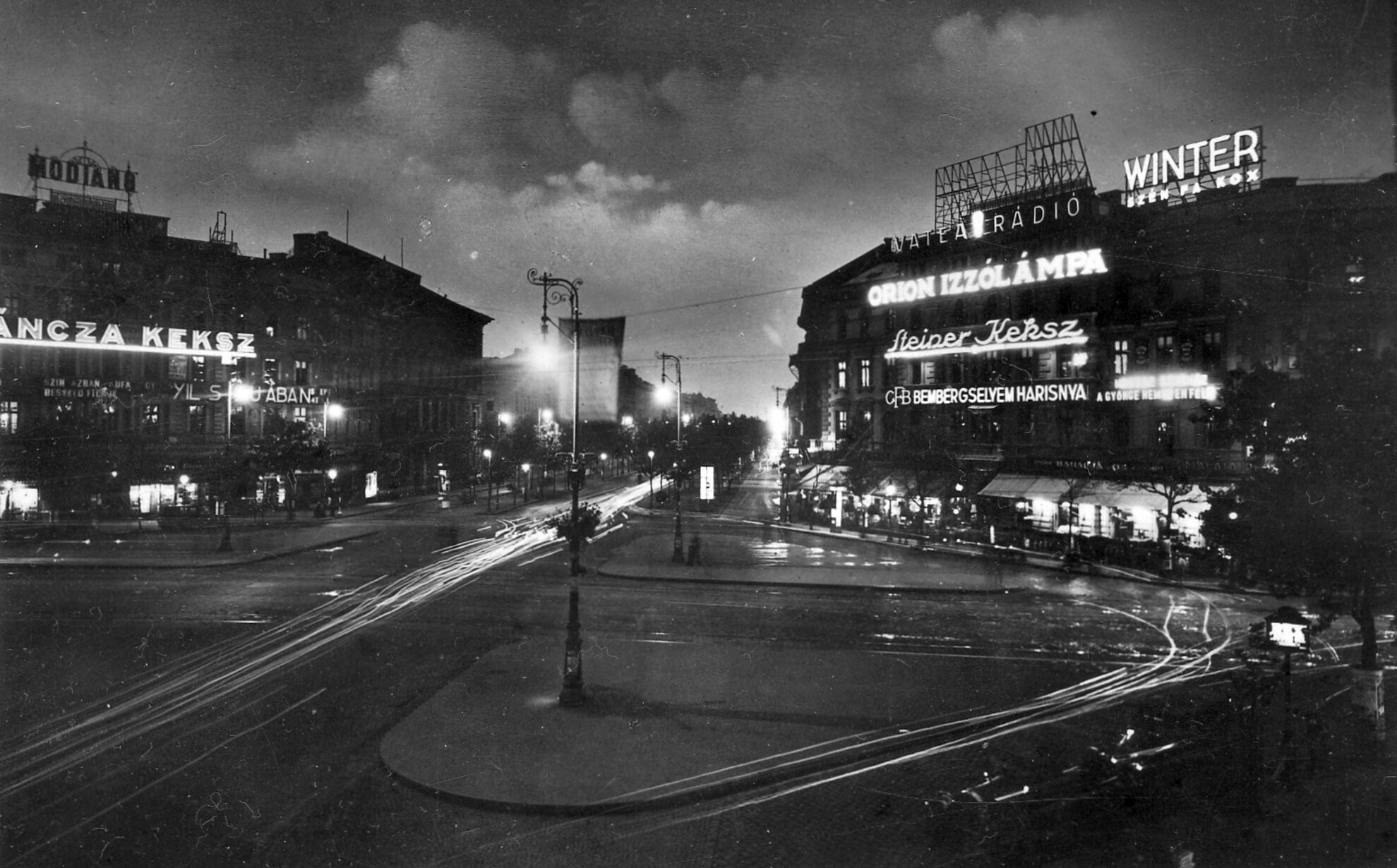
A photograph of the Oktagon, circa 1930

Chapter 22 begins in the Oktogon, a major intersection in Pest. Here, Hicks (and the readers) meet two new characters: Zoltán von Kiss, “once an echt working apportist, lately more of a psychic celebrity detective,” and motorcycle courier Terike who downplays her role as Zoltán’s “Glamorous Assistant.” Hicks is intrigued by Terike, and when she departs with “Szia!” — Hungarian for hello/goodbye, he responds with a “Hope so.” The pun is low hanging fruit but our boy Pynchon loves to eat from that tree.

Zoltán, or “Zoli,” as he prefers to be called has a mission for Hicks. But before getting into that (and a demonstration of his psychic and telekinetic powers), he distinguishes metaphysical Central Europe from concrete America:

“You are a practical people, Americans, everyone is either some kind of inventor or at least a gifted repairman. I myself have grown to rely too much on the passionate mindlessness which creeps over me just as an apport is about to arrive or depart. I am painfully aware of how much more exposure I need to the secular, material world.”

The phrase “passionate mindlessness” recalls Mindless Pleasures — a working title Pynchon used for what would become Gravity’s Rainbow.

mindless-pleasures

But onto that mission: Hicks will assist in the recovery and return of “the crown jewel of tasteless lamps… known in underworld Esperanto as La Lampo Plej Malbongusto.” (Zoli’s ever-inflating description of the lamp’s tastelessness is pure Pynchon.) Again, we get an echo of the Airmont compound back in Ch. 13, where Hicks stumbled into “an excessive number of electric lamps… Some are unusual-looking, to say the least, and few if any in what you’d consider good taste.” 

While the tasteless-lamp bit is, on the surface very goofy, it nevertheless highlights the novel’s concern with what can be seen and what remains unseen; with what casts a shadow, and with what is immaterial. Zolti posits the lamp’s recovery in language that approaches a holy restoration: “even the most hopelessly ill-imagined lamp deserves to belong somewhere, to have been awaited, to enact some return, to stand watch on some table, in some corner, as a place-keeper, a marker, a promise of redemption.” I think the notion here is beautiful answer to a rhetorical question posed in the opening nightmare of Gravity’s Rainbow: “Each has been hearing a voice, one he thought was talking only to him, say,You didn’t really believe you’d be saved. Come, we all know who we are by now. No one was ever going to take the trouble to save you…‘ Pynchon is for the preterite; even the ugliest light-bearer is poised for redemption.

Hicks and Zoli eventually make their way to “a neighborhood of warehouses, corner taverns, cafés and hashish bars, metallic shadows, sounds of mostly invisible train traffic” and into speakeasyish spot “turbulent with kleptos conferring in Esperanto, featuring a lot of words ending in u (‘Volitive mood,’ comments Zoltán, ‘used for yearnings, regrets, if-onlys…’)” (When I was young my mother had a friend who was a member of an Esperanto society. The notion of an invented language fascinated me; I also recognized, even as a child, that it was a doomed project. I love that Pynchon includes a few nods to L. L. Zamenhof’s utopian linguistic project, and highlights the “yearning” behind the invented grammar.) After some funny business by a vaudevillian magic act trio called Drei Im Weggla (secret agents themselves, we’re assured parenthetically) and a nonviolent showdown with “Bruno Airmont’s deputy Ace Lomax,” Hicks fulfills his mission with Zoli.


Chapter 23 sees Hicks reunite with the Quarrenders. Pips has performed a quick change glamour, to Hicks’s admiration. She tells him it’s, All part of the craft, give whoever’s watching something blonde and shiny to fix their attention, then should one need to disappear, simply get rid of it and fade into the mobility.” Like Terike and the other sleight-of-hand artists of Shadow Ticket, Pips understands the value of posing as the “Glamorous Assistant.” Later in this chapter we’ll meet another spy, Vassily Midoff, of whom we’re told “Impressions of what he looks like also vary widely. Not that he’s invisible, exactly, people see him all the time, but they don’t remember that they saw him.”

Alf soon (literally) materializes and complains of an exhausting morning at the “Crossword Suicide Café.” Alf then goes on to detail how “an unemployed waiter named Antal Gyula steps in to what was then known as the Emke Café,” committed suicide, and left a “farewell note in the form of a crossword puzzle he designed himself, whose solution will reveal the reasons he did the deed, along with the names of other people involved.” The puzzle remained unsolved, a “crypto bonanza potentially and yet just as easily somebody’s idea of a practical joke.” The note is zany and sinister, silly and sad, utterly Pynchonian but also, like, totally real.

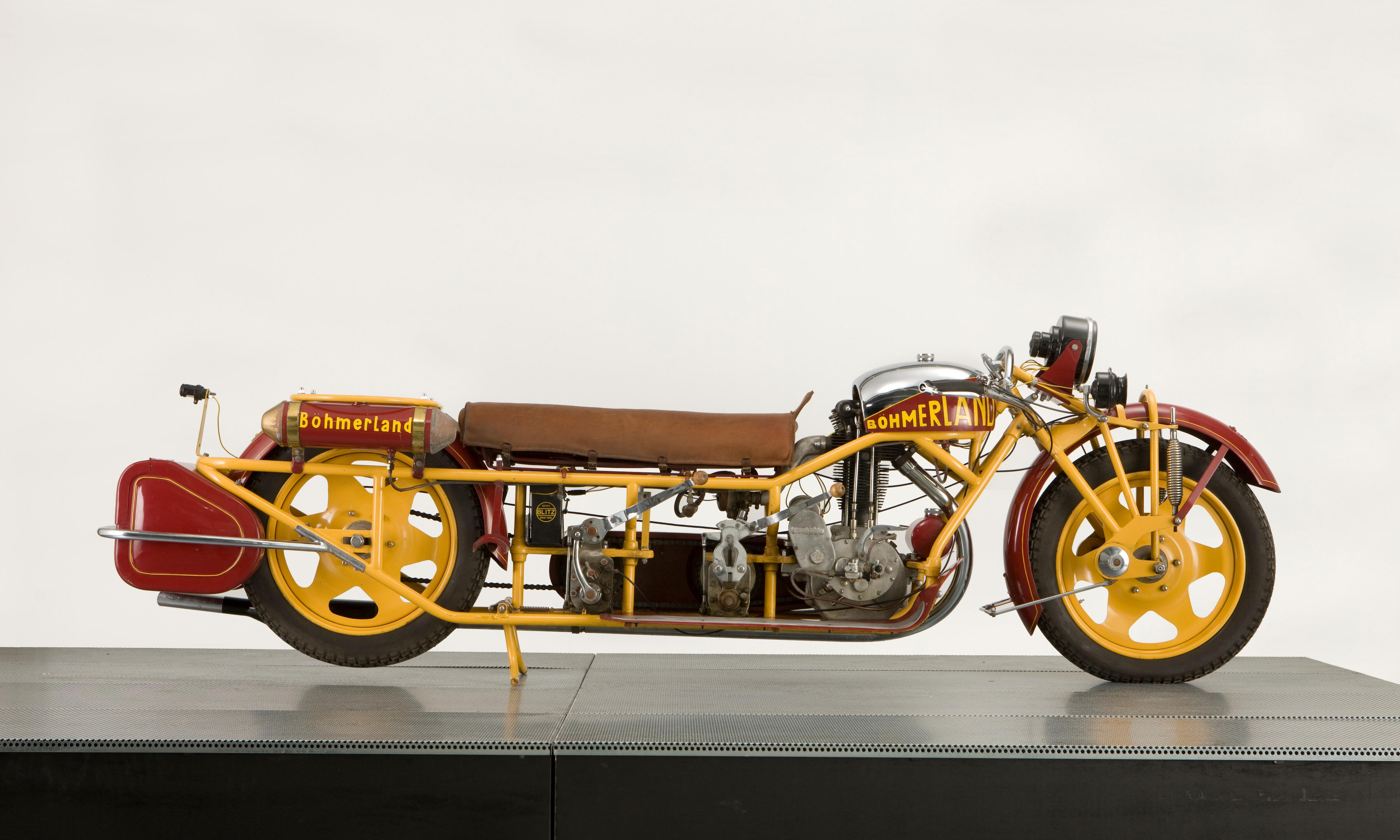
1937 Böhmerland 603cc Langtouren

The chapter ends with the “nightclub apport trio Schnucki, Dieter, and Heinz, seated one behind another on a Böhmerland Long Touring motorcycle, ten and a half foot wheelbase, red and yellow paint job, riding patrol…” The spectacle upsets Vassily Midoff, who senses a fourth “invisible rider” at the motorcycle’s stern. He hits the high road, “spooked…back into invisibility,” the narrator noting that “for a trinity to be effective, and not just a set which happens to contain three members, there must be a fourth element, silent, withheld. A fourth rider, say, working a phantom gearbox…” 

Perhaps the invisible fourth rider alludes to Carl Jung’s Answer to Job, which argues for a unified, reconciled quaternity, and not a trinity; a symbolic totality that acknowledges the shadow (ticket?) suppressed by the idealized triad. In Jung’s schema, the fourth element completes the cycle by restoring what has been excluded, granting wholeness rather than perfection. The phantom rider becomes an embodiment of that hidden completion, an invisible force that trails behind the spectacle of the three visible figures, suggesting that beneath their exuberant surface rides the unacknowledged presence that makes the whole thing work. (Or perhaps threatens to undo it.)

The World Within: C.G. Jung In His Own Words (1990 Documentary with Archival Footage)

“We Are the Origin of Evil” — Carl Jung on Death, Nihilism, and Humanity

See the Trailer for A Dangerous Method: David Cronenberg Does Freud and Jung