David Foster Wallace’s English 102 Syllabus

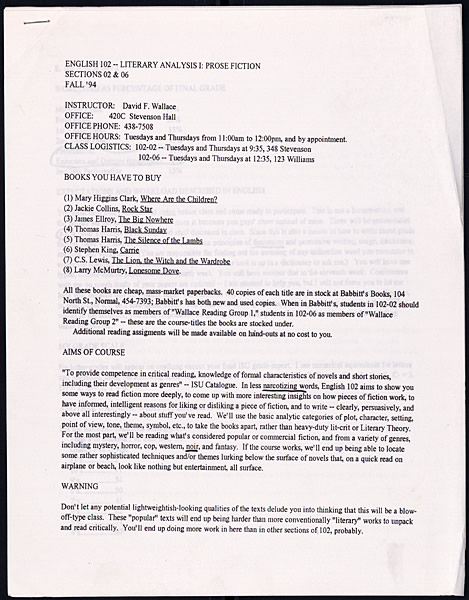
The David Foster Wallace Archive at the Harry Ransom Center showcases some of Wallace’s teaching material, including this syllabus for English 102 (at Illinois State University). Here’s the front page, where you can clearly see that Wallace has selected a reading list comprised almost entirely of airport novels by authors like Thomas Harris, Jackie Collins, and Mary Higgins Clark–

I love his “AIMS OF THE COURSE” section, where he steps outside of the “narcotizing” language of the university catalog to explain why the course will look at “what’s considered popular or commercial fiction.” The “WARNING” is great too.

David Foster Wallace Archive Opens to the Public

The David Foster Wallace Archive at the Henry Ransom Center (UTA) is now open to the public. The center will run a live webcast tonight at 8:00pm EST to celebrate the opening. In addition to his own materials, the collection holds over 300 of Wallace’s books–the majority heavily annotated.

Reminder: David Foster Wallace Archive’s Live Webcast Tomorrow Night

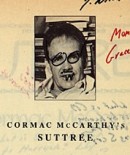
Wallace's edition of McCarthy's "Suttree"

A reminder for interested parties: the David Foster Wallace Archive at the Harry Ransom Center at the University of Texas will début the collection tomorrow night at 8:00pm EST with a live webcast featuring readings of Wallace’s works. You can access the webcast here.

(Ed. note — We got the date wrong the first time. Thanks to @MattBucher for the correction!)

“Just Asking” — David Foster Wallace’s 9/11 Thought Experiment

Here’s David Foster Wallace’s “Just Asking,” from the November, 2007 issue of The Atlantic

Are some things still worth dying for? Is the American idea* one such thing? Are you up for a thought experiment? What if we chose to regard the 2,973 innocents killed in the atrocities of 9/11 not as victims but as democratic martyrs, “sacrifices on the altar of freedom”?* In other words, what if we decided that a certain baseline vulnerability to terrorism is part of the price of the American idea? And, thus, that ours is a generation of Americans called to make great sacrifices in order to preserve our democratic way of life—sacrifices not just of our soldiers and money but of our personal safety and comfort?

In still other words, what if we chose to accept the fact that every few years, despite all reasonable precautions, some hundreds or thousands of us may die in the sort of ghastly terrorist attack that a democratic republic cannot 100-percent protect itself from without subverting the very principles that make it worth protecting?

Is this thought experiment monstrous? Would it be monstrous to refer to the 40,000-plus domestic highway deaths we accept each year because the mobility and autonomy of the car are evidently worth that high price? Is monstrousness why no serious public figure now will speak of the delusory trade-off of liberty for safety that Ben Franklin warned about more than 200 years ago? What exactly has changed between Franklin’s time and ours? Why now can we not have a serious national conversation about sacrifice, the inevitability of sacrifice—either of (a) some portion of safety or (b) some portion of the rights and protections that make the American idea so incalculably precious?

In the absence of such a conversation, can we trust our elected leaders to value and protect the American idea as they act to secure the homeland? What are the effects on the American idea of Guantánamo, Abu Ghraib, Patriot Acts I and II, warrantless surveillance, Executive Order 13233, corporate contractors performing military functions, the Military Commissions Act, NSPD 51, etc., etc.? Assume for a moment that some of these measures really have helped make our persons and property safer—are they worth it? Where and when was the public debate on whether they’re worth it? Was there no such debate because we’re not capable of having or demanding one? Why not? Have we actually become so selfish and scared that we don’t even want to consider whether some things trump safety? What kind of future does that augur?

FOOTNOTES:
1. Given the strict Gramm-Rudmanewque space limit here, let’s just please all agree that we generally know what this term connotes—an open society, consent of the governed, enumerated powers, Federalist 10, pluralism, due process, transparency … the whole democratic roil.

2. (This phrase is Lincoln’s, more or less)


David Foster Wallace Archive Will Open with Live Webcast

The Independent reports that the David Foster Wallace Archive at the Harry Ransom Center at the University of Texas will debut the collection with a live webcast on September 14, 2010 featuring readings of Wallace’s works. You can access the webcast here. (But, like, obviously not until next Tuesday night).

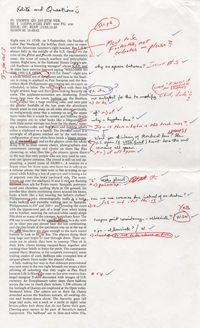
Wallace's annotations of DeLillo's novel Ratner's Star

“How to Be ‘Artsy’ and Mean It” — David Foster Wallace and Mark Branaman

(Via).

Lil Wayne vs DFW

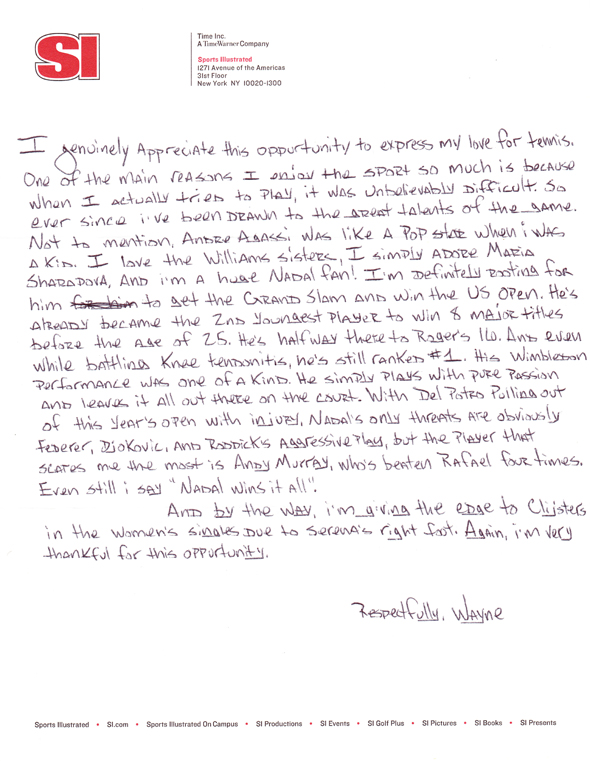
At BlackBook, Adam Wilson pits two literary luminaries against each other on the subject of tennis: Lil’ Wayne vs David Foster Wallace. From Wilson’s piece–

On Understanding Limitations
Lil Wayne: “One of the main reasons I enjoy the sport so much is because when I actually tried to play, it was unbelievably hard.”
David Foster Wallace: “I thus further confess that I arrived in Montreal with some dim unconscious expectation that these professionals—at least the obscure ones, the nonstars—wouldn’t be all that much better than I. I don’t mean to imply that I’m insane: I was ready to concede that age, a nasty ankle injury in 1988, and a penchant for nicotine (and worse) meant that I wouldn’t be able to compete physically with a young unhurt professional, but on TV (while eating junk and smoking), I’d seen pros whacking balls at each other that didn’t look to be moving substantially faster than the balls I’d hit. In other words, I arrived at my first professional tournament with the pathetic deluded pride that attends ignorance. And I have been brought up sharply. I do not play and never have played even the same game as these qualifiers.”

Winner: Wallace. Though Weezy is once again clear and concise, Wallace wins for honesty and breadth of experience.

Lil Wayne on the US Open, Sports Illustrated

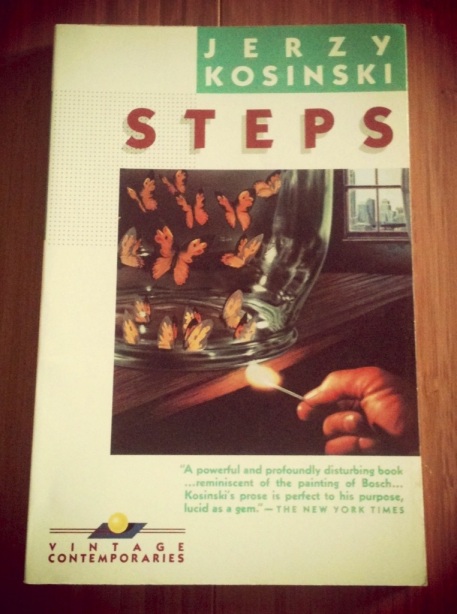
Steps — Jerzy Kosinski

One of the many small vignettes that comprise Jerzy Kosinski’s 1968 book Steps begins with the narrator going to a zoo to see an octopus that is slowly killing itself by consuming its own tentacles. The piece ends with the same narrator discovering that a woman he’s picked up off the street is actually a man. In between, he experiences sexual frustration with a rich married woman. The piece is less than three pages long.

There’s force and vitality and horror in Steps, all compressed into lucid, compact little scenes. In terms of plot, some scenes connect to others, while most don’t. The book is unified by its themes of repression and alienation, its economy of rhythm, and, most especially, the consistent tone of its narrator. In the end, it doesn’t matter if it’s the same man relating all of these strange experiences because the way he relates them links them and enlarges them. At a remove, Steps is probably about a Polish man’s difficulties under the harsh Soviet regime at home played against his experiences as a new immigrant to the United States and its bizarre codes of capitalism. But this summary is pale against the sinister light of Kosinski’s prose. Consider the vignette at the top of the review, which begins with an autophagous octopus and ends with a transvestite. In the world of Steps, these are not wacky or even grotesque details, trotted out for ironic bemusement; no, they’re grim bits of sadness and horror. At the outset of another vignette, a man is pinned down while his girlfriend is gang-raped. In time he begins to resent her, and then to treat her as an object–literally–forcing other objects upon her. The vignette ends at a drunken party with the girlfriend carried away by a half dozen party guests who will likely ravage her. The narrator simply leaves. Another scene illuminates the mind of an architect who designed concentration camps. “Rats have to be removed,” one speaker says to another. “Rats aren’t murdered–we get rid of them; or, to use a better word, they are eliminated; this act of elimination is empty of all meaning. There’s no ritual in it, no symbolism. That’s why in the concentration camps my friend designed, the victim never remained individuals; they became as identical as rats. They existed only to be killed.” In another vignette, a man discovers a woman locked in a metal cage inside a barn. He alerts the authorities, but only after a sinister thought — “It occurred to me that we were alone in the barn and that she was totally defenseless. . . . I thought there was something very tempting in this situation, where one could become completely oneself with another human being.” But the woman in the cage is insane; she can’t acknowledge the absolute identification that the narrator desires. These scenes of violence, control, power, and alienation repeat throughout Steps, all underpinned by the narrator’s extreme wish to connect and communicate with another. Even when he’s asphyxiating butterflies or throwing bottles at an old man, he wishes for some attainment of beauty, some conjunction of human understanding–even if its coded in fear and pain.

In his New York Times review of Steps, Hugh Kenner rightly compared it to Céline and Kafka. It’s not just the isolation and anxiety, but also the concrete prose, the lucidity of narrative, the cohesion of what should be utterly surreal into grim reality. And there’s the humor too–shocking at times, usually mean, proof of humanity, but also at the expense of humanity. David Foster Wallace also compared Steps to Kafka in his semi-famous write-up for Salon, “Five direly underappreciated U.S. novels > 1960.” Here’s Wallace: “Steps gets called a novel but it is really a collection of unbelievably creepy little allegorical tableaux done in a terse elegant voice that’s like nothing else anywhere ever. Only Kafka’s fragments get anywhere close to where Kosinski goes in this book, which is better than everything else he ever did combined.” Where Kosinski goes in this book, of course, is not for everyone. There’s no obvious moral or aesthetic instruction here; no conventional plot; no character arcs to behold–not even character names, for that matter. Even the rewards of Steps are likely to be couched in what we generally regard as negative language: the book is disturbing, upsetting, shocking. But isn’t that why we read? To be moved, to have our patterns disrupted–fried even? Steps goes to places that many will not wish to venture, but that’s their loss. Very highly recommended.

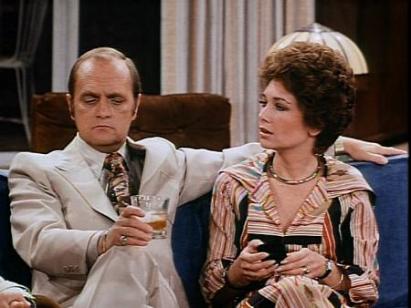
“Hi Bob,” David Foster Wallace’s Drinking Game

In David Foster Wallace’s first novel The Broom of the System, protagonist Lenore Beadsman’s brother and his friends play a drinking game based on The Bob Newhart Show. Here are the rules–

On television was ”The Bob Newhart Show.” In the big social room with LaVache were three boys who all seemed to look precisely alike. . . . ”Lenore, this is Cat, this is Heat, this is the Breather,” LaVache said from his chair in front of the television. . . .

Heat and the Breather were on a spring-sprung sofa, sharing what was obviously a joint. Cat was on the floor, sitting, a bottle of vodka before him, and he clutched it with his bare toes, staring anxiously at the television screen.

”Hi Bob,” Suzanne Pleshette said to Bob Newhart on the screen. . . . La Vache looked up from his clipboard at Lenore. ”We’re playing Hi Bob. You want to play Hi Bob with us?” He spoke sort of slowly. Lenore made a place to sit on the luggage. ”What’s Hi Bob?” The Breather grinned at her from the sofa, where he now held the bottle of vodka. ”Hi Bob is where, when somebody on ‘The Bob Newhart Show’ says ‘Hi Bob,’ you have to take a drink.”

”And but if Bill Dailey says ‘Hi Bob,’ ” said Cat, tending to the joint with a wet finger, ”that is to say, if the character Howard Borden on the show says ‘Hi Bob,’ it’s death, you have to chug the whole bottle.”

”Hi Bob,” said Bill Dailey on the screen.

This text was originally cited in Caryn James’s 1987 review of The Broom of the System in The New York Times. Here’s our review.

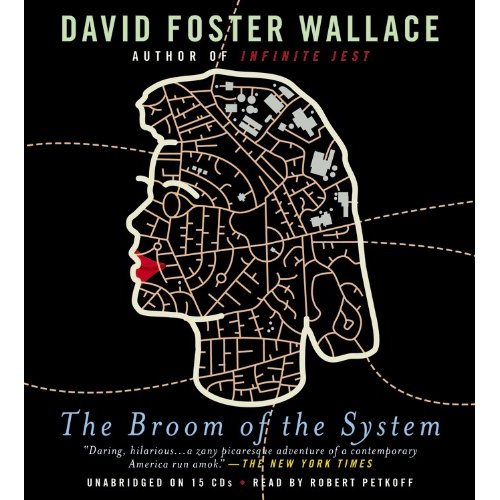
The Broom of the System — David Foster Wallace

David Foster Wallace’s first novel The Broom of the System obsesses over language, words, storytelling and what it might mean to have our lives circumscribed in another person’s narrative. Hatchette Audio’s new audiobook version of Broom highlights the strength of Wallace’s dialogue, a feature of his writing perhaps overlooked, or at least overshadowed, by his complex diction and syntax and his innovative narrative structures. The Broom audiobook features the considerable talents of reader Robert Petkoff, who brings life to its many characters like protagonist Lenore Stonecipher Beadsman, a switchboard operator looking for her grandmother (and namesake) in the weird nooks and crannies of Wallace’s fictional Cleveland. Gramma Lenore (grammar Lenore; lost Lenore) is a former pupil of Wittgenstein, a conceit that allows Wallace to run wild with his own philosophical-linguistic concerns. I first read Broom as an undergrad–this was almost 15 years ago now–and I was pretty soaked in post-structuralist philosophy at the time, at least enough to think I was getting what many of Wallace’s mouthpieces were saying. There’s an obsession with Self and Other and whatever membrane might keep them separate; there’s the paranoia that language dictates our lives; there’s a sense that the postindustrial landscape has led to the need to engender new means of communion. Politicians create the Great Ohio Desert–or G.O.D. (subtle, I know) as a place for spiritual quests; psychiatrists prescribe bizarre ritual theaters for families to produce in front of a recording of a TV audience; a drugged bird develops speech abilities and is mistaken for a miracle. Broom is a dizzying satire of modernity, or more properly, postmodernity (the book was first published in 1987 but set in 1990).

Journeying through the book years later is a new experience, especially in light of how much Wallace and his literary followers have remapped the terrain of fiction. Many of Broom‘s experimental innovations, like the incorporation of TV transcripts, scholarly articles, medical documents, and other “found footage” are so normalized in contemporary fiction as to be almost clichéd in 2010. While these moments are never glaring or gauche in Broom, their inclusion lacks the finesse that Wallace would later demonstrate in Infinite Jest. Similarly, Wallace’s characters in Broom are too cartoonish to connect with. Read aloud, their punning names become a cavalcade of groans:Wang-Dang Lang, Peter Abbott, Candy Mandible, Judith Prietht, Biff Diggerance, and so on, as if Wallace can’t help himself. The Pynchonesque goofiness gets in the way of the reader-writer relationship that Wallace ultimately wants, the Wittgensteinian language game that would allow for identification beyond words. Purposeful bathos is still bathos. Lenore is an engaging character but, as she frequently worries and suspects, she is just that, a character, never transcending the page like Don Gately of Infinite Jest. But it’s cruel and stupid to fault Broom for not being Infinite Jest, especially when Broom is such a rewarding novel. Published when Wallace was just 24, it shows the grand strains of First Novel Syndrome, of a genius trying to push out too many ideas, too many characters, too many philosophical riffs at once. While Infinite Jest is hardly restrained, it shows Wallace’s powerful control over Too Much; it converts Too Much into Not Enough, into Give Me More.

The highlight of Broom is in its storytelling, in its capacity to explode clichés and expose the truth and energy stored within them. Rick Vigorous, Lenore’s would-be beau with literary aspirations, repeatedly shares stories with Lenore (and us, of course). They can be silly and maudlin and mawkish and downright awful, but also inspiring and sad and horrific, all at the same time, and Wallace engineers and comments on these stories (and the other stories that populate the book) in a way that somehow breaks with or goes past the postmodern tradition he’s otherwise relatively beholden to in Broom. And while Wallace’s first novel never achieves the exquisite sadness of Infinite Jest (although it would clearly like to), it does share the same rap-session humor, the same intimate narrative voice that welcomes the reader to laugh, to ponder, to play the game. Recommended.

David Foster Wallace on Education

In Honor of the Confounding Kafka Cache Caper, Listen to Susan Sontag, Paul Auster, David Foster Wallace and Others on Kafka’s Work

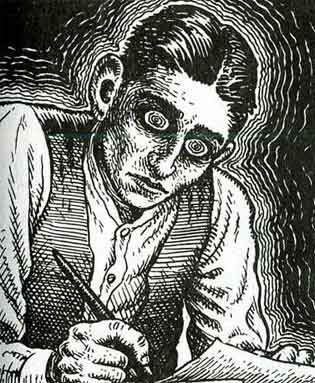
Kafka by R. Crumb

Yesterday, lawyers in Zurich opened four anonymous safety deposit boxes supposedly containing original manuscripts, letters, and drawings by Franz Kafka. The question of who owns the literary cache has turned into something of an international debacle, with lawyers and judges jostling for control.

In appreciation of Kafka (and this whole cosmically-ironic fiasco), we direct you to audio clips of the PEN fellowship’s March 26, 1998 tribute, which featured, among others, E.L. Doctorow, Susan Sontag, Cynthia Ozick, and Paul Auster, reading from their own essays on Kafka, or the Czech’s work. The highlight is David Foster Wallace’s essay “A Series of Remarks on Kafka’s Funniness from Which Not Enough Has Been Removed.”

You can stream the tracks here. True biblioklepts can download them directly from here.

David Foster Wallace on Commercial Literature and the Dread of Reading

Bret Easton Ellis Disses David Foster Wallace

At a in a reading in Hackney, England, two days ago, Bret Easton Ellis dissed the late great David Foster Wallace:

Question: David Foster Wallace – as an American writer, what is your opinion now that he has died?

Answer: Is it too soon? It’s too soon right? Well I don’t rate him. The journalism is pedestrian, the stories scattered and full of that Mid-Western faux-sentimentality and Infinite Jest is unreadable. His life story and his battle with depression however is really quite touching . . .

Via HTMLGIANT, via The Howling Fantods. The discussion at HTMLGIANT’s comment section is pretty great right now (see our own comment thread below for comments detailing HTMLGIANT readers who claim that BEE’s quote is misrepresented/mistranscribed), with a few commentators bringing up an interview in which DFW said the following about BEE:

I think it’s a kind of black cynicism about today’s world that Ellis and certain others depend on for their readership. Look, if the contemporary condition is hopelessly shitty, insipid, materialistic, emotionally retarded, sadomasochistic, and stupid, then I (or any writer) can get away with slapping together stories with characters who are stupid, vapid, emotionally retarded, which is easy, because these sorts of characters require no development. With descriptions that are simply lists of brand-name consumer products. Where stupid people say insipid stuff to each other. If what’s always distinguished bad writing—flat characters, a narrative world that’s cliched and not recognizably human, etc.—is also a description of today’s world, then bad writing becomes an ingenious mimesis of a bad world. If readers simply believe the world is stupid and shallow and mean, then Ellis can write a mean shallow stupid novel that becomes a mordant deadpan commentary on the badness of everything. Look man, we’d probably most of us agree that these are dark times, and stupid ones, but do we need fiction that does nothing but dramatize how dark and stupid everything is? In dark times, the definition of good art would seem to be art that locates and applies CPR to those elements of what’s human and magical that still live and glow despite the times’ darkness. Really good fiction could have as dark a worldview as it wished, but it’d find a way both to depict this world and to illuminate the possibilities for being alive and human in it. You can defend “Psycho” as being a sort of performative digest of late-eighties social problems, but it’s no more than that.

In Brief — Adam Langer, William H. Gass, David Foster Wallace, and Frank Meeink

I have terrible writer’s block. It’s not that I have nothing to say, it’s just that I can’t seem to say it. Or that I write sentences like the previous one and shudder at their awkward clunky artless awfulness. But I’m gonna press through it, write through it, and share a few thoughts on what I’ve read this week–
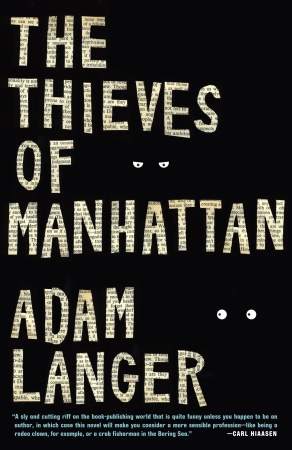
First up: Adam Langer’s new novel, The Thieves of Manhattan, a send-up of the publishing industry that sets its targets directly on the current swath of (faked) memoirs that have done gangbusters for publishers in the past few years. Ian Minot is a broke-assed barista one fuck-up away from an overdue firing, who moves from the Midwest to make it as a writer in the big city. Only he’s not doing so well–in contrast to his gorgeous Romanian girlfriend Anya whose literary star is on the rise. For Minot though, this isn’t the worst–that would be the rampant success of über-poseur Blade Markham, a wanna-be gangsta whose memoir Blade on Blade is a blatant fabrication (albeit a fabrication that no one but savvy schlemiel Minot seems to notice (or, at the least, be bothered by)).  I read the first fifty-odd pages of the Thieves in one sitting–a good sign to be sure. Langer’s Minot’s voice is familiar territory, the boy who loves to mock the literati he would love to be a part of. In one of the signal moves of his patois, the names of famous authors (and characters) regularly replace common nouns–a bed becomes a proust, a full head of hair is a chabon, sex is chinaski and so on. Minot seems to be headed to running his own grift soon with the help of a man he appropriately calls the Confident Man–should be good stuff. Full review forthcoming. The Thieves of Manhattan is available July 13, 2010 from Spiegel & Grau.
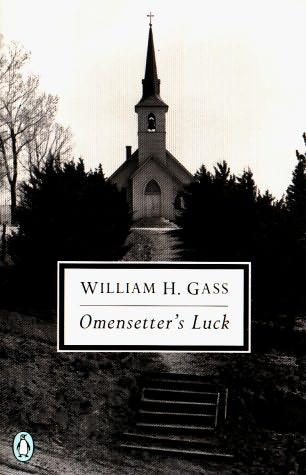
I’ve also been reading William H. Gass’s first novel, Omensetter’s Luck. It’s weird, wonderful, Faulknerish in its loose (but somehow layered and constructed) stream of consciousness. Omensetter’s Luck comprises three sections, each progressively longer; I finished the second one today, and so far the novel seems to dance around a description or accounting of its namesake, Brackett Omensetter who carts his family into the small sleepy town of Gilean, Ohio, and immediately perplexes the townsfolk with his amazing luck. As Frederic Morton put it in his contemporary 1966 New York Times review, “It quickly becomes apparent that as other people have green thumbs, [Omensetter] has a green soul. The cosmos and he live in mysterious congruity.” There’s much to commend and unpack in Gass’s writing here, but the pleasure of his musical rhythm are enough for me now (in my writer’s block, I retreat to aesthetic criticism [shudders]). Besides, do I really have to recommend this novel when David Foster Wallace already did so in his semi-famous list “Five Direly Underappreciated U.S. Novels > 1960”? No, I don’t, that’s right. Here’s Wallace on Omensetter’s Luck: “Gass’ first novel, and his least avant-gardeish, and his best. Basically a religious book. Very sad. Contains the immortal line ‘The body of Our Saviour shat but Our Saviour shat not.’ Bleak but gorgeous, like light through ice.”
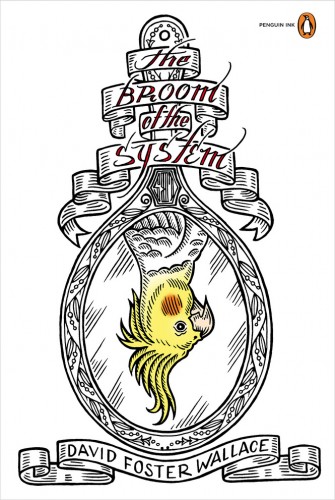
Speaking of Wallace and début novels, Richard Rayner at The Los Angeles Times has reviewed Wallace’s first book The Broom of the System, which is being republished at the end of this month with a cool new cover by tattoo artist Duke Riley. A considered, well-written review, one which prompted me to dig out (okay, bad verb phrase choice; no unearthing involved, my Wallace volumes are neatly aligned together on a shelf in my living room) my copy of Broom. I remember reading a friend’s copy in the burning humidity of a Gainesville summer, in ’98 or ’99, reading the book in long chunks. I tried to read it again after I finishing Infinite Jest but it seemed kinda sorta goofy (albeit purposely, Pynchonesquely goofy). Anyway, Rayner’s review makes a strong case for a re-reading.
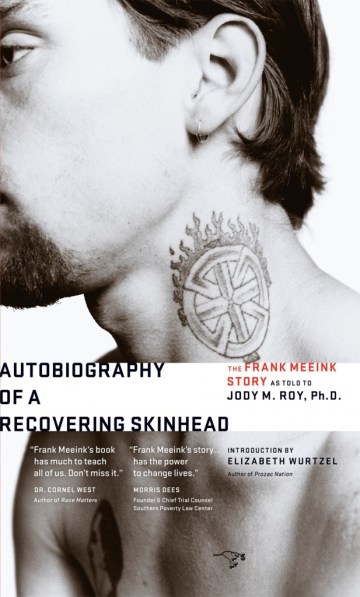
And, speaking of Wallace (again), or at least using him as a crutch–I’ve almost finished Autobiography of a Recovering Skinhead by Frank Meeink (“as told to” Jody M. Roy; they’ve sort of got the whole Malcolm X/Alex Haley thing going on there). So, yeah, why the Wallace segue? How to justify it? Well, reading Meeink’s story, the true story of an abused, battered Philadelphia kid who falls into the American neo-Nazi movement and its attendant violent crime and terrorism, who goes to prison and finds redemption and human connection and a new purpose for the nihilistic void of his life, who falls into alcoholism and drug addiction only to be redeemed again–reading Meeink’s story, even knowing its veracity (demonstrable to a point that would satisfy even Langer’s Ian Minot)–I couldn’t help but read his strong, immediate, gritty, and utterly real voice as something not unlike one of the creations in David Foster Wallace’s Brief Interviews with Hideous Men. It’s not just Meeink’s hideousness, his violence, or the grace that he works toward–all constituents of DFW’s collection–it’s that voice, the realness of the volume, surely the book’s greatest asset. Recovering Skinhead is an engrossing read, fascinating in the same way that an infected wound prompts our attention, our paradoxical compulsion and repulsion, but most of all it’s an exhilarating and exhausting performance of voice, of Meeink’s unrelenting, authentic telling of a tale, a telling that any novelist would thrill to channel. Only Meeink’s voice isn’t a novel creation: it’s real. Autobiography of a Recovering Skinhead is available now from Hawthorne Books.
“The Wasted Land” — A 1996 David Foster Wallace Profile Unearthed

Big kudos to Craig Ferman who tracked down and posted an obscure 1996 Details magazine profile on David Foster Wallace by David Strietfield.  You can read the full profile here. Here are a few (heartbreaking) excerpts:

He doesn’t want Infinite Jest to be seen as autobiography, which it’s not. On the other hand, if Wallace hadn’t been hospitalized in 1988 and put on a suicide watch, he might not have written so accurately about Kate, a character in Infinite Jest who keeps trying to die: “It’s like something horrible is about to happen,” she explains to her doctor, “there’s the feeling that there’s something you have to do right away to stop it but you don’t know what it is you have to do, and then it’s happening, too, the whole horrible time, it’s about to happen and also it’s happening all at the same time.” . . .

Unlike some of his characters, Wallace managed to extricate himself from the downward spiral before the damage became permanent—these days, he won’t even drink beer. Moreover, he got the raw impetus for a new book. By this point, Wallace was living in upstate New York, in an apartment so small that he had to move everything onto the bed when he wanted to write. “It was,” he says, “like spending two years in a submarine.”

Recently he found a Mennonite house of worship, which he finds sympathetic even if the hymns are impossible to sing. “The more I believe in something, and the more I take something other than me seriously, the less bored I am, the less self-hating. I get less scared. When I was going through that hard time a few years ago, I was scared all the time.” It’s not a trip he ever plans to take again.

David Foster Wallace on Book Tour Sex, Blue Velvet, and Bandanas

Flavorwire has compiled a fantastic collection of David Foster Wallace quotes from David Lipsky’s new book, Although Of Course You End Up Becoming Yourself. A few excerpts:

On book tour sex:
“I didn’t get laid on this tour. The thing about fame is interesting, although I would have liked to get laid on the tour and I did not….People come up, they kind of slither up during readings or whatever. But it seems like, what I want is not to have to take any action. I don’t want to have to say, ‘Would you like to come back to the hotel?’ I want them to say, ‘I am coming back to the hotel. Where is your hotel?’ None of ‘em do that….I just can’t stand to look like I’m actively trading on this sexually. Even though of course that’s—I would be happy to do that.”

On Blue Velvet:
“I remember going to see Blue Velvet. . . . It absolutely made me shake. And I went back and saw it again the next day. And there was somethin’ about…it was my first hint that being a surrealist, or being a weird writer, didn’t exempt you from certain responsibilities. But it in fact upped them. . . . David Lynch, Blue Velvet coming out when it did, I think saved me from droppin’ out of school. And saved me maybe even from quittin’ as a writer. ‘Cause I’d always—if I could have made a movie, right at that time? That would have been it. I mean, I vibrated on every frequency.”

On the origin of the trademark bandana:
“I started wearing bandannas in Tucson because it was a hundred degrees all the time. When it’s really hot, I would perspire so much that I would drip on the page. Actually, I started wearing it that year, and then it became a big help in Yaddo in ’87 because I would drip into the typewriter, and I was worried that I would get a shock. And then I discovered that I felt better with them on. And then I dated a woman who…said there were these various chakras, and one of the big ones was what she called the spout hole, at the very top of your cranium. And in a lot of cultures, it was considered better to keep your head covered. And then I began thinking about the phrase, Keeping your head together, you know? …. It’s a security blanket for me. . . . It makes me…feel kind of creepy that people view it as an affectation or trademark or something. It’s more just a foible, it’s the recognition of a weakness, which is that I’m just kind of worried my head’s going to explode.”