David Foster Wallace mp3s

Update: Go to the David Foster Wallace Audio Project for DFW audio needs.

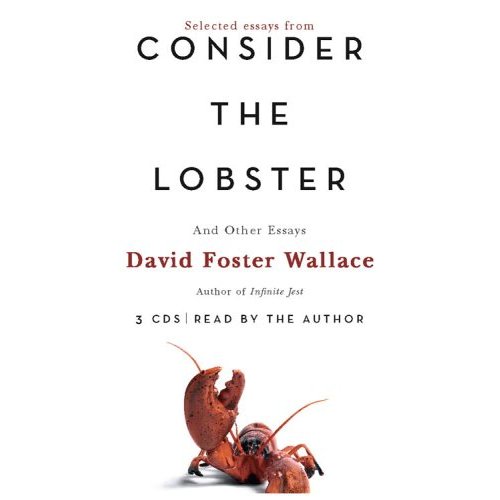
What follows are some of the better recordings I’ve collected over the years of DFW reading his work and being interviewed. Links take you to a site where you can download the mp3s. You can find most of these recordings dispersed over the net, but I thought I’d try to collate it all here. If you like what you hear, get a hold of DFW reading his own work in the audiobook version of Consider the Lobster (his handling of footnotes is pretty cool). Enjoy.

David Foster Wallace reads some unpublished stuff. December 6, 2000, Lannan Foundation. The middle section, beginning around 12:50 is particularly fantastic.

John O’Brien interviews DFW. December 6, 2000, Lannan Foundation.

DFW reads “A Series of Remarks on Kafka’s Funniness from Which Not Enough Has Been Removed.” March, 1998. Part of “Metamorphosis: A New Kafka,” a symposium sponsored by the PEN American Center in New York City. Text here. Republished in Consider the Lobster.

Michael Silverblatt interviews DFW about Consider the Lobster on KCRW’s Bookworm show. March 2, 2006.

Michael Goldfarb’s radio interview with DFW for The Connection. June 25, 2004.

Of course, the March 27, 1997 Charlie Rose interview is pretty well known to DFW fans, but if you haven’t seen it, it’s well worth checking out.

Also, if you feel like parsing through The Howling Fantods collection of audio links, I’m sure some of them are still working.

For DFW

This post will be full of typos and rhetorical slips and just generally bad writing. I’m just gonna write and post and I won’t bother editing. Sorry.

This morning, after BLTs with wife and child I checked my email. My buddy Damon sent me this article from the New York Times. Damon’s subject line, “David Foster Wallace dead at 46 (suicide)” kinda blew my mind. I didn’t get past the first lines of the Times report before tears started coming out of my eyes.

I’ve read all of DFW’s books, and, as corny as it sounds, the majority of them spoke so directly to me, so intimately, that I feel as if I’ve lost someone I knew. I’m sure that this isn’t the case at all, because he’s a writer and I’m his audience. He’s not friends or family. But reading him doesn’t feel that way. I would describe his style as a really, really good friend sitting on the couch with you, telling you stories that were both painfully funny and painfully sad. Infinite Jest provided a world of escape–a world I became addicted to–when I felt lonely in a foreign country I’d moved to. Girl with Curious Hair changed forever the way I thought about writing and reading–it opened me up to a whole new bank of authors and styles. But it’s probably DFW’s essays that hit me most directly.

Anyone who’s read the title essay from A Supposedly Fun Thing I’ll Never Do Again, or “Getting Away from Already Being Pretty Much Away from It All” from that same collection knows just how funny and insightful and analytical Wallace could be–all without any of the caustic meanness a lesser writer might employ. DFW’s essays–and fiction–are always negotiating the razor line between earnest emotion and ironic detachment. He hated the latter but understood it was part of a cultural mode, part of the counter-tradition of post- or meta- fiction that he was continuing and responding to with his own writing. The two essays that probably best exemplify this are a Fun Thing‘s “E Unibus Pluram: Television and U.S. Fiction” (this should be required reading for every thinking person) and “Authority and  American Usage,” DFW’s take on who-decides-what-is-proper-grammar-and-diction (collected in Consider the Lobster). I was re-reading the essay last Thursday and last night, with the intention to finish it today, with the intention to use it as part of something else I had planned to write. It will be impossible to finish it with the same reading schema in mind.

Just last week I listened to DFW reading from some as-yet-unpublished stuff; one section, on an overachieving boy that everyone hates is hilarious. The crowd is sometimes laughing too hard for DFW to maintain his rhythm and he has to slow down. In the interview that follows the reading, DFW seems like a really sweet, honest guy.

I remember distinctly my cousin calling me, well over a decade ago now, to tell me that Kurt Cobain had shot himself. I felt nothing then–it seemed perfectly logical. I was a huge Nirvana fan; they were my first concert and a big musical/cultural determiner in my young life. But his suicide seemed normal, natural even to me. I remember thinking “Of course.” When Hunter S. Thompson committed suicide, it seemed strange to me that he’d taken so long to do it. And when one of my favorite writers of all time, Kurt Vonnegut, passed away last year, I felt sad, but not so sad. So it goes.

This, this devastates me though. How could he hang himself? Why? I feel selfish and sad. Will we get another novel? Is it wrong to feel this way? I’m pretty sure that it’s wrong. I think about his body, hanged, and it makes me sick. I honestly felt close to this person. Unlike DeLillo or Pynchon or Barth, there was no veil or mediation in Wallace’s greatest work, no distance between his voice, or his speakers’ voices and my own burning internal ear. I have no pithy statement or philosophical wax for this piece, I have no way of summing up here. I feel sick.

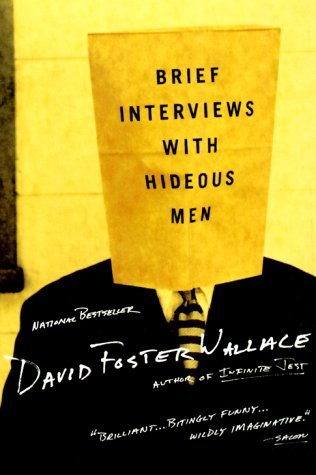
Essential Short Story Collections: Brief Interviews with Hideous Men

brief-interviews-wit_79fe25.jpg

Properly describing David Foster Wallace’s Brief Interviews with Hideous Men involves using all of those words that I hate to see in any book review: “radiates,” “pathos,” “poignancy,” “gut-busting laughs,” “existential crises of identity in the post-modern world,” and so on. Now that I have them out of the way, let me tell you why you should read this book: it will make you laugh, it will make you cry. Out loud. After you read it, you will want to press it on other people, who will say, “Yeah, sure, okay”; only their eyes’ will be slightly-slanted, their mouths just a bit crooked, even their nose will appear askew at your demand. They will hurriedly change the subject–you’ve already foisted so many unwanted books on them, and who even has time to read now?–but you will persevere! “Here,” you’ll say, “Read “A Radically Condensed History of Postindustrial Life”–it’s only two paragraphs! You can read the whole thing in under a minute!”:

When they were introduced, he made a witticism, hoping to be liked. She laughed extremely hard, hoping to be liked. Then each drove home alone, staring straight ahead, with the very same twist to their faces.

The man who’d introduced them didn’t much like either of them, though he acted as if did, anxious as he was to preserve good relations at all times. One never knew, after all, now did one now did one now did one.

And, as they finish reading, you’ll beam at them and nod your head knowingly. They’ll look a little confused, perhaps bored. “It’s like an overture, see? It’s like, about loss, the inability to connect, the masks we wear to hide our hideousnessnesses.” Your victim will nod politely and begin to bring up an interesting thing he saw on the local news concerning pet ownership, but you’ll cut him off before he can get out of this. “Check out the “Brief Interviews with Hideous Men” sections that permeate the book–they’re like little vignettes, interviews where you only get the interviewee’s responses. They’re funny, shocking sad–they’re really good! Also, check out my favorites– “Adult World (I)” and “Adult World (II)”–these stories are about a wife who it turns out doesn’t really know her husband at all. Just read the beginning– ”

For the first three years, the young wife worried that their lovemaking together was somehow hard on his thingie. The rawness and tenderness and spanked pink of the head of his thingie. The slight wince when he’d enter her down there. The vague hot-penny taste of rawness when she took his thingie in her mouth–she seldom took him in her mouth, however; there was something about it that she felt he did not quite like.

“See?” you’ll demand uncaringly of your now-obviously exasperated detainee, “See? Sex! It’s got sex in it! Everyone loves to read about sex, especially weird awkward sex!” Your victim will now stand up, feigning the need to visit the restroom. But you won’t let him go that easily! “There’s another series of running vignettes that unify the book’s structure, making its sum more than just a collection of previously-published stories–check out a selection from one of the “Yet Another Example of the Porousness of Certain Borders” series”–

“Don’t love you no more.”

“Right back at you.”

“Divorce your ass.”

“Suits me.”

“Except now what about the doublewide.”

“I get the truck is all I know.”

“You’re saying I get the doublewide you get the truck.”

“All I’m saying is that truck out there’s mine.”

“Then what about the boy.”

“For the truck you mean?”

Your poor visitor is now literally walking away from you, ignoring the book in your hands, yet still somehow politely smiling–though only with his mouth–his hard eyes show how much he hates you right now. As he retreats to the toilet, your feelings hurt, you comfort yourself by declaring that he doesn’t read anyway; besides, he wouldn’t be able to figure out that “Tri-Stan: I Sold Sissee Nar to Ecko” was a retelling of both the Tristan and Isolde and Narcissus and Echo stories, set in Hollywood; he wouldn’t appreciate the book’s themes of child-abuse, repressed (false?) memories, and lost love. Philistine.

When he comes out of the bathroom you chit-chat a little more and then he’s ready to go. He holds his hand out toward the book. He wants to borrow the book. He wants to take your book. Oh shit. What have you done?

_____________________________________________________________________

Believe it or not, that dude who plays “Jim” from The Office is directing a movie version of Brief Interviews with Hideous Men, scheduled to come out later this year.

You can read the first part of this series here.

Shilling for DFW, Special Babies, Ursula K. LeGuin, Sunshine, and (Moby)Dick Jokes

This month’s issue of Harper’s has some great stuff, including a selection called “The Compliance Branch” from David Foster Wallace’s current work in progress. In the short piece, an unidentified narrator is overcome by a “fierce” infant:

The infant’s face, as I experienced it, was mostly eyes and lower lip, its nose a mere pinch, its forehead milky and domed, its pale red hair wispy, no eyebrows or lashes or even eyelids I could see. I never saw it blink. Its features seemed suggestions only. It had roughly as much face as a whale does. I did not like it at all.

Doesn’t this guy know that all babies are special? Evidence of special babies:

baby-sumo.jpg

You can read DFW’s last piece for Harper’s, “Tense Present,” an essay about grammar and usage and democracy, here. Or, alternately, you could treat yourself to the entirety of Consider the Lobster, where said essay is collected. Or, if you’re spectacularly lazy, hear DFW read unpublished work here and here.

Harper’s also has a great essay by ‘klept fave Ursula K. LeGuin. In “Staying Awake,” LeGuin takes on the relationship between reading, capitalism, literature in art. Good stuff. Bibliophile’s will appreciate LeGuin on the physiognomy of books:

The book itself is a curious artifact, not showy in its technology but complex and extremely efficient: a really neat little device, compact, often very pleasant to look at and handle, that can last decades, even centuries. It doesn’t have to be plugged in, activated, or performed by a machine; all it needs is light, a human eye, and a human mind. It is not one of a kind, and it is not ephemeral. It lasts. It is reliable. If a book told you something when you were fifteen, it will tell it to you again when you are fifty, though you may understand it so differently that it seems you’re reading a whole new book.

If you haven’t read LeGuin, I highly recommend The Left Hand of Darkness, a book that scrutinizes gender roles with more interesting results than, say, Eugenides’s Middlesex or Woolf’s Orlando.

Abrupt transition: Sunshine, the latest movie from director Danny Boyle, the mastermind behind Trainspotting, Millions, and 28 Days Later, is out on DVD. Sunshine, scripted by long-time Boyle collaborator Alex Garland (The Beach, 28 Days Later, 28 Weeks Later), was eaten alive last summer by a host of tertiary blockbuster sequels. I liked Sunshine; in addition to being a shiny, beautiful movie, it also raised some interesting questions about the cost of existence, individual worth, and the merits of self-sacrifice. Although the end unravels a bit, the movie is well worth seeing. Recommended.

Finally, lit nerds and Melville fans such as myself might have a laugh at Teddy Wayne’s take on Ishmael as comedian. Sample joke:

What’s the deal with the biscuits? Do they really expect this to suffice for a six months’ imperialistic voyage for exotic spices? And the servings they give you—is this for, like, a baby sailor? Did I accidentally request the infant meal?

Ishmael’s a hack–get it? Is there anything funnier than whaling humor?

whale.jpg

Alphabet Soup: I

1831s.jpg

I is for Ishmael, narrator of Herman Melville’s Moby-Dick, a story about whaling/wailing. Ishmael’s narrative is an attempt to transform his pain and loss into some kind of meaningful human connection–to try to measure the incomprehensible and to put the ineffable into words. He’s a lovable guy, something of an eccentric in his time, who makes good friends with his strange bedfellow Queequeg. Of course, the whole thing ends in disaster, a disaster that Ishmael alone bears witness to, like one of Job’s servants returning to the master.

Also, I think that the great white whale, Moby Dick, is like a symbol or something.

infinitejest.jpg

I is also for Incandenza, Hal, the would-be tennis prodigy, secret stoner, and eidetically gifted prescriptive grammarian who is–along with Don Gately (somehow unjustly skipped over in installments D and G)–the protagonist of David Foster Wallace’s mammoth novel Infinite Jest. Hal is a sensitive kid, the son of a mad scientist filmmaker/tennis academy founder, who kinda sorta haunts both the novel as well as the Enfield Tennis Academy. Writing this makes me wish for a free month (i.e. no grad school) to re-read IJ, just so that I could take another crack at why Hal comes down with the howling fantods. Plenty of theories here.

Lost: Lost in the Funhouse

It’s been a while since I’ve written about a stolen book (ostensibly, this blog is all about book theft. But we’re easily distracted here). John Barth’s Lost in the Funhouse is one of my favorite short story collections ever and it’s been MIA from my library for a couple of years now. The collection starts with “Frame Tale,” a one-page (front and back) meta-commentary that informs the whole text. “Frame Tale” is essentially a marginal strip which says “Once upon a time…” on one side and “there was a tale that began…” on the other. The accompanying directions (a number of the stories come with directions; some are to be read aloud, some are to be tape recorded and played back, some are to be read aloud along to looped recording) direct the reader to cut out a strip of paper and connect the opposing ends, creating a Möbius strip, a commentary on the infinite and cyclical nature of story-telling (Barth expanded on this theme in the three linked novellas of Chimera).

funhouse-pbk.gif funhouse-hbk.jpg

My favorite story in the collection is “Petition,” a letter from a distraught Siamese twin, but the most lauded tale in LITF is the title story. “Lost in the Funhouse” recounts the adventures of young Ambrose as he navigates a bizarre amusement park funhouse during a family vacation to the beach one summer. The story is shot through with sexual anxiety and familial tension; Ambrose’s confused (and sometimes confusing) narrative loops discursively, unwinding and then condensing as he trips over his own thoughts. David Foster Wallace riffs off of “Lost in the Funhouse” in his long short story “Westward the Course of Empire Goes” (from Girl With Curious Hair). Ambrose, a semi-autobiographical stand-in as Barth’s pubescent alter-ego, appears as a a much older writing teacher in DFW’s novella. Clever, hunh? And to think, some people hate post-modernism! I feel bad for these folks.

I think that this collection paired with DFW’s Girl With Curious Hair (or, even better Brief Interviews With Hideous Men) makes a great introduction to post-modern writing. The major tropes, themes, and devices are explored in these books in short, digestible chunks full of humor and (surprise!) emotion. Highly recommended.

Early 2007

If you come to this blog regularly, chances are you’re killing a few minutes from what may or may not be a dreary day. So sorry if Biblioklept hasn’t been posting regularly enough to satisfy your cubicle boredom. Early 2007 has been very busy around here, what with bathroom renovations (books, even Time-Life books, will not lay new tile or replumb your corroded pipes), a new school year, and a baby on the way. Between philosophical treatises in graduate school, AP essays to grade, and the self-induced Ontology 101 reading list (“Week 4” begins…uhm…later this week?), I’ve had little time to read anything, let alone get anything decent written.

So well and hence, before January is officially over, The Biblioklept will attempt an assessment of 2007 so far. With one-twelfth of the year already gone, where do we stand?

Books: Okay, I still haven’t made it through David Foster Wallace’s Oblivion, which was published waaaaay back in 2004.  Actually, in the interest of full disclosure, I’ve been attempting the same story repeatedly. My mistake is that I start reading right before I go to sleep–and then I go to sleep immediately. At this rate, I will probably finish anything published in 2007 in late 2011.

Magazines: TodayI got the February issue of The Believer. I still haven’t finished the Dec/Jan issue. A sorry state of affairs for someone who claims to love to read.

Movies: Why have you still not gone to see Children of Men? Go see it in the theater while you still have the chance. This weekend, if time permits, Pan’s Labyrinth. Has anyone seen this one yet?

Music: Lots of great stuff has dropped in 2007. Current favorites–Panda Bear’s Person Pitch, Bobby Conn’s King for a Day, Apostle of Hustle’s National Anthem of Nowhere, Menomena’s Friend or Foe. All of these are great listening and deserve more in-depth reviews, possibly at a later time. Also, Deerhoof’s Friend Opportunity dropped legal style.

TV: I must admit that I love the American Idol auditions (after the schadenfreude of watching losers have their illusions painfully revoked in front of millions, the show turns into pure drivel of course). It was also nice to see Jewel join the judges (do you remember when Jewel was like, alternative?)

Politics: My rage-fatigue has mellowed into a nice warm apathy. Does it matter that the Democrats are “in control”?  

Furniture: I regret passing up an ottoman offered by my uncle.

Wine: I still advocate boxed wines, screwtops will be all the rage in 07.

Pets: As of now, our cat is still alive.

David Foster Wallace Talks Tennis on NPR

A couple of weeks ago, loyal reader Damon Noisette left a link to a David Foster Wallace piece on Roger Federer. Click on the player below to listen to a cool interview with DFW about this piece. I know, I know–the interview is a couple of months old–but I’m trying to integrate audio into this website, and this is something of a trial run. Enjoy (or not).

[odeo=http://odeo.com/audio/1757889]

wallace.gif

Dave Eggers on Infinite Jest

ij.jpg

Last week Little Brown published a new edition of David Foster Wallace’s Infinite Jest featuring a new introduction by Dave Eggers. You can read the whole introduction here (thanks to Bob Tomorrowland for sending me the link).

Eggers’ intro weighs in on the current “readability” debate in contemporary fiction. In his 2002 essay “Mr. Difficult,” Jonathan Franzen (author of The Corrections) attacked “difficult fiction,” focusing on writers like William Gaddis and Thomas Pynchon, whom Franzen views as “Status” writers who don’t really care about their audience. Franzen posits that “Contract” writers (like himself) take a more humanist, social approach. In his intro, Eggers avers that DFW’s work denies these classifications; the content of DFW’s work may be complex and weighty and downright philosophical, but DFW’s tone and his humor and his pathos ultimately allow for an accessible, fun read.

This blog has previously come out against Franzen’s argument: biblioklept is a fan of both the difficult and the more accessible–and the work of authors like Eggers and DFW prove that Franzen’s types are empty models. It’s too bad for Franzen that Gravity’s Rainbow and Ulysses require more work on the part of the reader than say, Stephen King or Tom Clancy. The Bible and Shakespeare and Moby-Dick and Gabriel García Márquez also require work from the reader, and no one could make a legitimate argument for removing them from the literary canon. One day, Infinite Jest will take its place in that same canon, alongside the work of Pynchon, John Barth and Don DeLillo–all authors whose work requires some effort on the part of the reader.

Eggers disscusses the effort required to read Infinite Jest, noting that it’s not a book you can simply put down and come back to a few weeks later. From my own IJ reading experience, I know this to be true: I made three attempts before finally getting into it; once I was “into” it, I was addicted, reading well past my bedtime, lugging the large object around on the Tokyo subway, reading snatches during my lunch break. IJ made me laugh loudly, it made me cry a few times; I even found myself so excited that I had to stand up during the climactic fight between Don Gately and the mysterious guys in Hawaiian shirts. When I finished the book, I immediately started re-reading it, sifting through its dense language for added meaning. And one day (month), when I have the time, I plan on reading it in its entirety again.

If you have any interest in this book, read Eggers’ foreward–he does a much better job selling this book than I could. I will say that this book is a favorite of mine, and that if you put the time and effort into it, you won’t be disappointed.

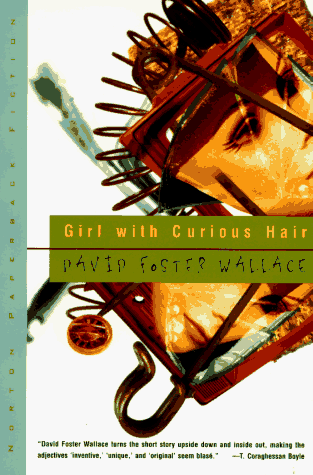
Girl With Curious Hair–David Foster Wallace

dfw.gif

Scott Martin was kind enough to loan me this book. Did he know that it would forever change the way I read? It was the first semester of my freshman year in college, and I was slowly reaching beyond stuff like Henry Miller, Wm Burroughs and Franz Kafka. David Foster Wallace’s short story collection Girl With Curious Hair introduced me to a whole new world of writing. Reading DFW is like having a very witty friend tell you a moving and funny story over a  few beers. He’s hilarious, thought-provoking, and not nearly as hard to read as people seem to think (by the way, simply googling “David Foster Wallace” will yield several vitriolic essays by people who think that DFW is somehow duping his readers. He’s not. These people don’t know a good story when they read one.)

Girl features “real people” like Alex Trebek, David Letterman, and Lyndon Johnson as characters, but constantly destabilizes any realism these figures might lend to the story. The novella included in this collection, Westward the Course of Empire Takes Its Way, alludes directly to John Barth’s Lost in the Funhouse (another book I’ve loaned out and never gotten back). Westward takes a critical but humorous look at how culture is commodified: the plot centers around a reunion for everyone who has ever acted in a McDonald’s commercial. At the reunion, plans are revealed for a series of real-life “Funhouses,” based on the work of “Dr. Ambrose” (Barth’s stand-in in Westward).

Girl with Curious Hair is probably the best starting point for anyone interested in DFW but daunted by 1000 pages of Infinite Jest (IJ is yet another one I loaned out and never got back). Girl‘s stories have a little more ‘pop’ to them than DFW’s latest collection, Oblivion, and Girl tends to be easier to find used than DFW’s other collections, Brief Interviews with Hideous Men (actually a better collection, in my opinion) and A Supposedly Fun Thing I’ll Never Do Again (a collection of hilarious essays and nonfiction).

To sum up: if you still haven’t read DFW go consume this book; when you’re done you’ll be left wondering: “What other good stuff have I been missing out on?”