“Another orange juice, with a little vodka in it this time” (Donald Barthelme)

SNOW WHITE had another glass of healthy orange juice. “From now on I deny myself to them. These delights. I maintain an esthetic distance. No more do I trip girlishly to their bed in the night, or after lunch, or in the misty mid-morning. Not that I ever did. It was always my whim which governed those gregarious encounters summed up so well by Livy in the phrase, vae victis. I congratulate myself on that score at least. And no more will I chop their onions, boil their fettucini, or marinate their flank steak. No more will I trudge about the house pursuing stain. No more will I fold their lingerie in neat bundles and stuff it away in the highboy. I am not even going to speak to them, now, except through third parties, or if I have something special to announce — a new nuance of my mood, a new vagary, a new extravagant caprice. I don’t know what such a policy will win me. I am not even sure I wish to implement it. It seems small and mean-spirited. I have conflicting ideas. But the main theme that runs through my brain is that what is, is insufficient. Where did that sulky notion come from? From the rental library, doubtless. Perhaps the seven men should have left me in the forest. To perish there, when all the roots and berries and rabbits and robins had been exhausted. If I had perished then, I would not be thinking now. It is true that there is a future in which I shall inevitably perish. There is that. Thinking terminates. One shall not always be leaning on one’s elbow in the bed at a quarter to four in the morning, wondering if the Japanese are happier than their piglike Western contemporaries. Another orange juice, with a little vodka in it this time.”

From Donald Barthelme’s novel Snow White.


“The psychology of Snow White: What does she hope for?” (Donald Barthelme)

The psychology of Snow White: What does she hope for? “Someday my prince will come.” By this Snow White means that she lives her own being as incomplete, pending the arrival of one who will “complete” her. That is, she lives her own being as “not-with” (even though she is in some sense “with” the seven men, Bill, Kevin, Clem, Hubert, Henry, Edward and Dan). But the “not-with” is experienced as stronger, more real, at this particular instant in time, than the “being-with.” The incompleteness is an ache capable of subduing all other data presented by consciousness. I don’t go along with those theories of historical necessity, which suggest that her actions are dictated by “forces” outside of the individual. That doesn’t sound reasonable, in this case. Irruption of the magical in the life of Snow White: Snow White knows a singing bone. The singing bone has told her various stories which have left her troubled and confused: of a bear transformed into a king’s son, of an immense treasure at the bottom of a brook, of a crystal casket in which there is a cap that makes the wearer invisible. This must not continue. The behavior of the bone is unacceptable. The bone must be persuaded to confine itself to events and effects susceptible of confirmation by the instrumentarium of the physical sciences. Someone must reason with the bone.

From Donald Barthelme’s novel Snow White.

Wrinkle in the groin (David Barthelme)

Henry walked home with his suit in a plastic bag. He had been washing the buildings. But something was stirring in him, a wrinkle in the groin. He was carrying his bucket too, and his ropes. But the wrinkle in his groin was monstrous. “Now it is necessary to court her, and win her, and put on this clean suit, and cut my various nails, and drink something that will kill the millions of germs in my mouth, and say something flattering, and be witty and bonny, and hale and kinky, and pay her a thousand dollars, all just to ease this wrinkle in the groin. It seems a high price.” Henry let his mind stray to his groin. Then he let his mind stray to her groin. Do girls have groins? The wrinkle was still there. “The remedy of Origen. That is still open to one. That door, at least, has not been shut.”

From Donald Barthelme’s novel Snow White.


Snow White’s Education (Donald Barthelme)

BEAVER COLLEGE is where she got her education. She studied Modern Woman, Her Privileges and Responsibilities: the nature and nurture of women and what they stand for, in evolution and in history, including householding, upbringing, peace-keeping, healing and devotion, and how these contribute to the rehumanizing of today’s world. Then she studied Classical Guitar I, utilizing the methods and techniques of Sor, Tarrega, Segovia, etc. Then she studied English Romantic Poets II: Shelley, Byron, Keats. Then she studied Theoretical Foundations of Psychology: mind, consciousness, unconscious mind, personality, the self, interpersonal relations, psychosexual norms, social games, groups, adjustment, conflict, authority, individuation, integration and mental health. Then she studied Oil Painting I bringing to the first class as instructed Cadmium Yellow Light, Cadmium Yellow Medium, Cadmium Red Light, Alizarin Crimson, Ultramarine Blue, Cobalt Blue, Viridian, Ivory Black, Raw Umber, Yellow Ochre, Burnt Sienna, White. Then she studied Personal Resources I and II: self-evaluation, developing the courage to respond to the environment, opening and using the mind, individual experience, training, the use of time, mature redefinition of goals, action projects. Then she studied Realism and Idealism in the Contemporary Italian Novel: Palazzeschi, Brancati, Bilenchi, Pratolini, Moravia, Pavese, Levi, Silone, Berto, Cassola, Ginzburg, Malaparte, Mapalarte, Calvino, Gadda, Bassani, Landolfi. Then she studied —

From Donald Barthelme’s novel Snow White.

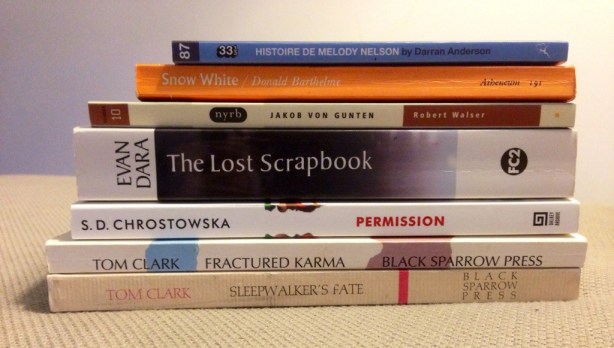
Books I’ve been reading these past few weeks

20131115-165229.jpg

I am reading too many books.

I am hoping to write about a few of these before the month is over, starting with Chrostowska’s Permission (my review is long overdue).

I’m about fifty pages shy of finishing Evan Dara’s The Lost Scrapbook; the book has been a revelation, one of those “How-the-hell-didn’t-I-know-about-this-already-?” deals. I’ll lazily compare it to Gaddis’s J R and DFW’s Infinite Jest.

I fell into rereading Snow White after working through several dozen of Barthelme’s short stories again. He’s probably the best.

Also the best is Tom Clark, whose poetry also falls into that “How-the-hell-didn’t-I-know-about-this-already-?” spectrum.

Quick thought on the beginning of Walser’s Jakob von Gunten: Seems part of a little mini-genre that includes Barthelme’s “Me and Miss Mandible” and Gombrowicz’s Ferdydurke.

Sorry for the lazy blogging. I will try to do better.


“There is a river of girls and women in our streets” (Donald Barthelme)

THERE is a river of girls and women in our streets. There are so many that the cars are forced to use the sidewalks. The women walk in the street proper, the part where, in other cities, trucks and bicycles are found. They stand in windows too unbuckling their shirts, so that we will not be displeased. I admire them for that. We have voted again and again, and I think they like that, that we vote so much. We voted to try the river in the next town. They have a girl-river there they don’t use much. We slipped into the felucca carrying our baggage in long canvas tubes tied, in the middle, with straps. The girls groaned under the additional weight. Then Hubert pushed off and Bill began to beat time for the rowers. We wondered if Snow White would be happy, alone there. But if she wasn’t, we couldn’t do anything about it. Men try to please their mistresses when they, men, are not busy in the countinghouse, or drinking healths, or having the blade of a new dagger chased with gold. In the village we walked around the well where the girls were dipping their trousers. The zippers were rusting. “Ha ha,” the girls said, “we could tear this down in a minute, this well.” It is difficult to defeat that notion, the one the village girls hold, that the boy who trembles by the wall, against the stones, will be Pope someday. He is not even hungry; his family is not even poor.

From Donald Barthelme’s novel Snow White.


“The first thing the baby did wrong” — Donald Barthelme

“The first thing the baby did wrong” by Donald Barthelme

The first thing the baby did wrong was to tear pages out of her books. So we made a rule that each time she tore a page out of a book she had to stay alone in her room for four hours, behind the closed door. She was tearing out about a page a day, in the beginning, and the rule worked fairly well, although the crying and screaming from behind the closed door were unnerving. We reasoned that that was the price you had to pay, or part of the price you had to pay. But then as her grip improved she got to tearing out two pages at a time, which meant eight hours alone in her room, behind the closed door, which just doubled the annoyance for everybody. But she wouldn’t quit doing it. And then as time went on we began getting days when she tore out three or four pages, which put her alone in her room for as much as sixteen hours at a stretch, interfering with normal feeding and worrying my wife. But I felt that if you made a rule you had to stick to it, had to be consistent, otherwise they get the wrong idea. She was about fourteen months old or fifteen months old at that point. Often, of course, she’d go to sleep, after an hour or so of yelling, that was a mercy. Her room was very nice, with a nice wooden rocking horse and practically a hundred dolls and stuffed animals. Lots of things to do in that room if you used your time wisely, puzzles and things. Unfortunately sometimes when we opened the door we’d find that she’d torn more pages out of more books while she was inside, and these pages had to be added to the total, in fairness.

The baby’s name was Born Dancin’. We gave the baby some of our wine, red, whites and blue, and spoke seriously to her. But it didn’t do any good.

I must say she got real clever. You’d come up to her where she was playing on the floor, in those rare times when she was out of her room, and there’d be a book there, open beside her, and you’d inspect it and it would look perfectly all right. And then you’d look closely and you’d find a page that had one little corner torn, could easily pass for ordinary wear-and-tear but I knew what she’d done, she’d torn off this little corner and swallowed it. So that had to count and it did. They will go to any lengths to thwart you. My wife said that maybe we were being too rigid and that the baby was losing weight. But I pointed out to her that the baby had a long life to live and had to live in a world with others, had to live in a world where there were many, many rules, and if you couldn’t learn to play by the rules you were going to be left out in the cold with no character, shunned and ostracized by everyone. The longest we ever kept her in her room consecutive was eighty-eight hours, and that ended when my wife took the door off its hinges with a crowbar even though the baby still owed us twelve hours because she was working off twenty five pages. I put the door back on its hinges and added a big lock, one that opened only if you put a magnetic card in a slot, and I kept the card.

But things didn’t improve. The baby would come out of her room like a bat out of hell and rush to the nearest book, Goodnight Moon or whatever, and begin tearing pages out of it hand over fist. I mean there’d be thirty-four pages of Goodnight Moon on the floor in ten seconds. Plus the covers. I began to get a little worried. When I added up her indebtedness, in terms of hours, I could see that she wasn’t going to get out of her room until 1992, if then. Also, she was looking pretty wan. She hadn’t been to the park in weeks. We had more or less of an ethical crisis on our hands.

I solved it by declaring that it was all right to tear pages out of books, and moreover, that it was all right to have torn pages out of books in the past. That is one of the satisfying things about being a parent-you’ve got a lot of moves, each one good as gold. The baby and I sit happily on the floor, side by side, tearing pages out of books, and sometimes, just for fun, we go out on the street and smash a windshield together.

[Via Jaessamyn’s excellent Barthelme page].

William T. Vollmann, Profiled at Newsweek, Suggests “We’re a culture of prostitutes”

Newsweek has published a profile/interview of William T. Vollmann by Alexander Nazaryan. It’s a vivid, engaging read. The first two paragraphs of the profile:

If William T. Vollmann ever wins the Nobel Prize in Literature – as many speculate he will – he knows exactly what he will do with the $1.1 million pot the Swedes attach to the award. “It will be fun to give some to prostitutes,” he says, sitting on his futon, chuckling, a half-empty bottle of pretty good bourbon between us.

He is neither flippant nor drunk, though more booze awaits us out there in the temperate Sacramento twilight. Vollmann became famous for fiction that treated the sex worker as muse – especially the street stalker of those days in the Tenderloin of San Francisco when AIDS was just coming to haunt the national psyche and the yuppie invasion was a nightmare not yet hatched. His so-called prostitution trilogy – Whores for GloriaButterfly Stories, and The Royal Family – is overflowing with life and empathy, nothing like the backcountry machismo of Raymond Carver or fruitless experimentation of Donald Barthelme, both oh-so-popular with young writers when Vollmann first came on the scene after graduating from Cornell in 1981. He approached the prostitute like an anthropologist, yet did so without condescension, writing in Whores for Gloria, “The unpleasantnesses of her profession are largely caused by the criminal ambiance in which the prostitute must conduct it.”

Read the rest of it.

“The Great Hug” — Donald Barthelme

“The Great Hug” by Donald Barthelme

At the last breakfast after I told her, we had steak and eggs. Bloody Marys. Three pieces of toast. She couldn’t cry she tried. Balloon Man came. He photographed the event. He created the Balloon of the Last Breakfast After I Told Her — a butter- colored balloon. “This is the kind of thing I do so well,” he said. Balloon Man is not modest. No one has ever suggested that. “This balloon is going to be extra-famous and acceptable, a documentation of raw human riches, the plain canvas gravy of the thing. The Pin Lady will never be able to bust this balloon, never, not even if she hugs me for a hundred years.” We were happy to have pleased him, to have contributed to his career.

The Balloon Man won’t sell to kids. Kids will come up to the Balloon Man and say, “Give us a blue balloon, Balloon Man,” and the Balloon Man will say, “Get outa here kids, these balloons are adults-only.” And the kids will say, “C’mon, Balloon Man, give us a red balloon and a green balloon and a white balloon, we got the money.” “Don’t want any kid-money,” the Balloon Man will say, “kid-money is wet and nasty and makes your hands wet and nasty and then you wipe ’em on your pants and your pants get all wet and nasty and you sit down to eat and the chair gets all wet and nasty, let that man in the brown hat draw near, he wants a balloon.” And the kids will say, “Oh please Balloon Man, we want five yellow balloons that never pop, we want to make us a smithereen.” “Ain’t gonna make no smithereen outa my fine yellow balloons,” says the Balloon Man, “your red balloon will pop sooner and your green balloon will pop later but your yellow balloon will never pop no matter how you stomp on it or stick it and besides the Balloon Man don’t sell to kids, it’s against his principles.”

The Balloon Man won’t let you take his picture. He has something to hide. He’s a superheavy Balloon Man, doesn’t want the others to steal his moves. It’s all in the gesture — the precise, reunpremeditated right move. Continue reading ““The Great Hug” — Donald Barthelme”

Read Donald Barthelme’s Story “Me and Miss Mandible”

“Me and Miss Mandible” by Donald Barthelme

13 September

Miss Mandible wants to make love to me but she hesitates because I am officially a child; I am, according to the records, according to the gradebook on her desk, according to the card index in the principal’s office, eleven years old. There is a misconception here, one that I haven’t quite managed to get cleared up yet. I am in fact thirty-five, I’ve been in the Army, I am six feet one, I have hair in the appropriate places, my voice is a baritone, I know very well what to do with Miss Mandible if she ever makes up her mind.

In the meantime we are studying common fractions. I could, of course, answer all the questions, or at least most of them (there are things I don’t remember). But I prefer to sit in this too-small seat with the desktop cramping my thighs and examine the life around me. There are thirty-two in the class, which is launched every morning with the pledge of allegiance to the flag. My own allegiance, at the moment, is divided between Miss Mandible and Sue Ann Brownly, who sits across the aisle from me all day long and is, like Miss Mandible, a fool for love. Of the two I prefer, today, Sue Ann; although between eleven and eleven and a half (she refuses to reveal her exact age) she is clearly a woman, with a woman’s disguised aggression and a woman’s peculiar contradictions. Strangely neither she nor any of the other children seem to see any incongruity in my presence here.

15 September

Happily our geography text, which contains maps of all the principal land-masses of the world, is large enough to conceal my clandestine journal-keeping, accomplished in an ordinary black composition book. Every day I must wait until Geography to put down such thoughts as I may have had during the morning about my situation and my fellows. I have tried writing at other times and it does not work. Either the teacher is walking up and down the aisles (during this period, luckily, she sticks close to the map rack in the front of the room) or Bobby Vanderbilt, who sits behind me, is punching me in the kidneys and wanting to know what I am doing. Vanderbilt, I have found out from certain desultory conversations on the playground, is hung up on sports cars, a veteran consumer of Road & Track. This explains the continual roaring sounds which seem to emanate from his desk; he is reproducing a record album called Sounds of Sebring.

19 September

Only I, at times (only at times), understand that somehow a mistake has been made, that I am in a place where I don’t belong. It may be that Miss Mandible also knows this, at some level, but for reasons not fully understood by me she is going along with the game. When I was first assigned to this room I wanted to protest, the error seemed obvious, the stupidest principal could have seen it; but I have come to believe it was deliberate, that I have been betrayed again.

Now it seems to make little difference. This life-role is as interesting as my former life- role, which was that of a claims adjuster for the Great Northern Insurance Company, a position which compelled me to spend my time amid the debris of our civilization: rumpled fenders, roofless sheds, gutted ware houses, smashed arms and legs. After ten years of this one has a tendency to see the world as a vast junkyard, looking at a man and seeing only his (potentially) mangled parts, entering a house only to trace the path of the inevitable fire. Therefore when I was installed here, although I knew an error had been made, I countenanced it, I was shrewd; I was aware that there might well be some kind of advantage to be gained from what seemed a disaster. The role of The Adjuster teaches one much.  Continue reading “Read Donald Barthelme’s Story “Me and Miss Mandible””

(Not Quite Reviews of) Stuff I Read in September

20130927-141817.jpg

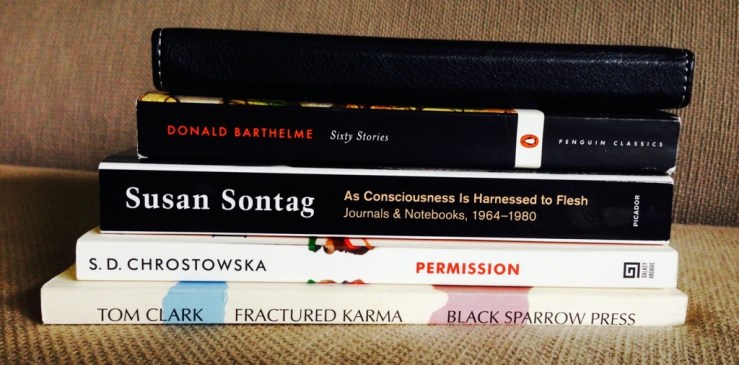
So somehow in September, I neglected to write a single book review—not even a riff!—on this blog. Mea culpa, mea culpa. This oversight (not really an oversight) I mayhap blame on the nascent Fall semester. Or perhaps I should pin it on a certain fatigue after working my way through Pynchon’s mammoth beast Against the Day and Bernhard’s caustic Gargoyles at the end of the summer. But I shouldn’t blame the Thomases. No, I’ve been reading too much at once again. Bad habit.

So, what have I been reading?

Thomas Bernhard’s early novel Frost (on my Kindle, in the dark, often not exactly sober). I posted an excerpt of Ben Marcus’s review of the novel earlier, which I think does a nice job of describing Bernhard’s project. I’m really close to the end, but the novel wears me down—I experienced a similar feeling when I doubled up Correction and The Loser—I should’ve taken a break I think. Still, an excellent, funny read.

Donald Barthelme’s Sixty Stories: I don’t know why anyone wouldn’t own this book. There are a lot of negatives in that sentence; let me reword: Sixty Stories is perfect, a trove, a performance of an author doing stuff that no other author can do. I think I read most of this in college and just sort of went “check” next to it and moved on and I’m certain I didn’t get what he was doing like I do now—just amazing stuff.

I’ve already posted a few excerpts from the latest collection of Susan Sontag’s journals and notebooks, As Consciousness Is Harnessed to Flesh. I like this collection more than the last one—there’s almost a curatorial aspect to Sontag, who is perhaps in her intellectual prime near the end of the journals—or, maybe prime is not the right word; rather, it’s like her mind (which we get to access in some sense via her entries) is so finely attuned (and at times perfectly out of tune) with the intellectual milieu of the day. I’ll be posting a full review sometime in the next two weeks.

S.D. Chrostowska’s novel Permission, new from Dalkey Archive, is lovely stuff—and again, it’ll get its own proper review on here once I can muster the strength. Chrostowska does all sorts of things here that shouldn’t work—cite directly from Blanchot, Derrida, et al—but it does work. The novel is Sebaldian, soaked in history and literature, a book about books, writing about writing. Full review forthcoming. Short review: It’s very very good.

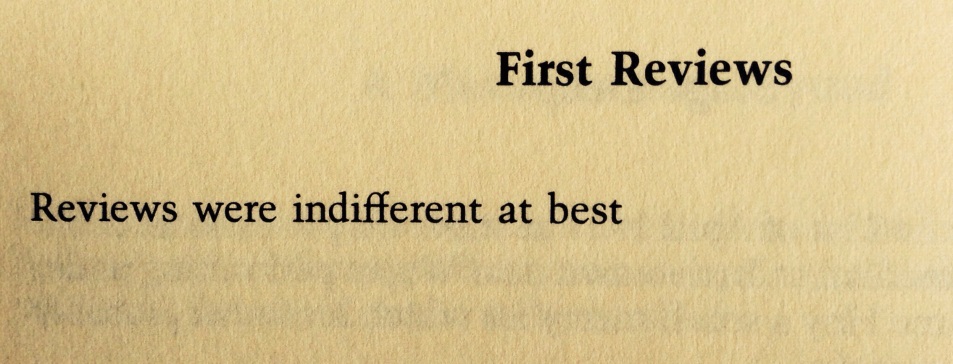
I picked up Tom Clark’s Fractured Karma two weeks ago somewhat randomly. My local bookshop had reorganized some shelves, putting all the Black Sparrow titles together. Fractured Karma must have been on top, because I don’t see how else I would’ve picked up a book with the word “karma” in the title. The book opened to this page:

20130927-141831.jpg

That’s all there is on that page, and something about it—the form, the phrasing—cracked me up. It’s part of a long poem called “He was born blind” about the British comedy actor George Formby. The poem is amazing: I read it there in the store. It reminded me immediately of David Markson’s notecard novels—something about how Clark includes so much reality into his poem. But there’s also this perceptive (if oblique) sense of humor behind it all. I ended up devouring the book, reading the whole thing that weekend. It was one of those holy shit reading moments, frankly. Once I finish typing this I’m going to go pick my kids up and we’re going to go to the bookstore and I’m going to get another Tom Clark book and read it this weekend.

Here’s his poem about The Purple One:

20130927-141838.jpg


“Willie & Wade” — Donald Barthelme

“Willie & Wade” by Donald Barthelme

Well we all had our Willie & Wade records ‘cept this one guy who was called Spare Some Change? ’cause that’s all he ever said and you don’t have no Willie & Wade records if the best you can do is Spare Some Change?

So we all took our Willie & Wade records down to the Willie & Wade Park and played all the great and sad Willie & Wade songs on portable players for the beasts of the city, the jumpy black squirrels and burnt-looking dogs and filthy, sick pigeons.

And I thought probably one day Willie or Wade would show up in person at the Willie & Wade Park to check things out, see who was there and what record this person was playing and what record that person was playing.

And probably Willie (or Wade) would just ease around checking things out, saying “Howdy” to this one and that one, and he’d see the crazy black guy in Army clothes who stands in the Willie & Wade Park and every ten minutes screams like a chicken, and Willie (or Wade) would just say to that guy, “How ya doin’ good buddy?” and smile, ’cause strange things don’t bother Willie, or Wade, one bit.

And I thought I’d probably go up to Willie then, if it was Willie, and tell him ’bout my friend that died, and how I felt about it at the time, and how I feel about it now. And Willie would say, “I know.”

And I would maybe ask him did he remember Galveston, and did he ever when he was a kid play in the old concrete forts along the sea wall with the giant cannon in them that the government didn’t want any more, and he’d say, “Sure I did.” And I’d say, “You ever work the Blue lay in San Antone?” and he’d say, “Sure I have.”

And I’d say, “Willie, don’t them microphones scare you, the ones with the little fuzzy sweaters on them?” And he’d say to me, “They scare me bad, potner, but I don’t let on.”

And then he (one or the other, Willie or Wade) would say, “Take care, good buddy,” and leave the Willie & Wade Park in his black limousine that the driver of had been waiting patiently in all this time, and I would never see him again, but continue to treasure, my life long, his great contributions.

Barthelme’s Influences

INTERVIEWER

Your own influences—whom would you like to cite as your spiritual ancestors?

BARTHELME

They come in assorted pairs. Perelman and Hemingway. Kierkegaard and Sabatini. Kafka and Kleist. Kleist was clearly one of Kafka’s fathers. Rabelais and Zane Grey. The Dostoyevsky of Notes from Underground. A dozen Englishmen. The surrealists, both painters and poets. A great many film people, Buñuel in particular. It’s always a stew, isn’t it? Errol Flynn ought to be in there somewhere, and so should Big Sid Catlett, the drummer.

—From Donald Barthelme’s interview with The Paris Review.

“Concerning the Bodyguard” — Donald Barthelme

“Concerning the Bodyguard” by Donald Bartheleme

Does the bodyguard scream at the woman who irons his shirts? Who has inflicted a brown burn on his yellow shirt purchased expensively from Yves St. Laurent? A great brown burn just over the heart?

Does the bodyguard’s principal make conversation with the bodyguard, as they wait for the light to change, in the dull gray Citroën? With the second bodyguard, who is driving? What is the tone? Does the bodyguard’s principal comment on the brown young women who flock along the boulevard? On the young men? On the traffic? Has the bodyguard ever enjoyed a serious political discussion with his principal?

Is the bodyguard frightened by the initials D.I.T.?

Is the bodyguard frightened by the initials C.N.D.?

Will the bodyguard be relieved, today, in time to see the film he has in mind – Emmanuelle Around the World? If the bodyguard is relieved in time to see Emmanuelle Around the World, will there be a queue for tickets? Will there be students in the queue?

Is the bodyguard frightened by the slogan Remember 17 June? Is the bodyguard frightened by black spray paint, tall letters ghostly at the edges, on this wall, on this wall? At what level of education did the bodyguard leave school?

Is the bodyguard sufficiently well-paid? Is he paid as well as a machinist? As well as a foreman? As well as an army sergeant? As well as a lieutenant? Is the Citroën armored? Is the Mercedes armored? What is the best speed of the Mercedes? Can it equal that of a BMW? A BMW motorcycle? Several BMW motorcycles?

Does the bodyguard gauge the importance of his principal in terms of the number of bodyguards he requires? Should there not be other cars leading and following his principals car, these also filled with bodyguards? Are there sometimes such additional precautions, and does the bodyguard, at these times, feel himself part of an ocean of bodyguards? Is he exalted at these times? Does he wish for even more bodyguards, possibly flanking cars to the right and left and a point car far, far ahead?

After leaving technical school, in what sort of enterprises did the bodyguard engage before accepting his present post? Has he ever been in jail? For what sort of offense? Has the bodyguard acquired a fondness for his principal? Is there mutual respect? Is there mutual contempt? When his principal takes tea, is the bodyguard offered tea? Beer? Who pays?

Can the bodyguard adduce instances of professional success?

Had he a previous client?

Is there a new bodyguard in the group of bodyguards? Why? Continue reading ““Concerning the Bodyguard” — Donald Barthelme”

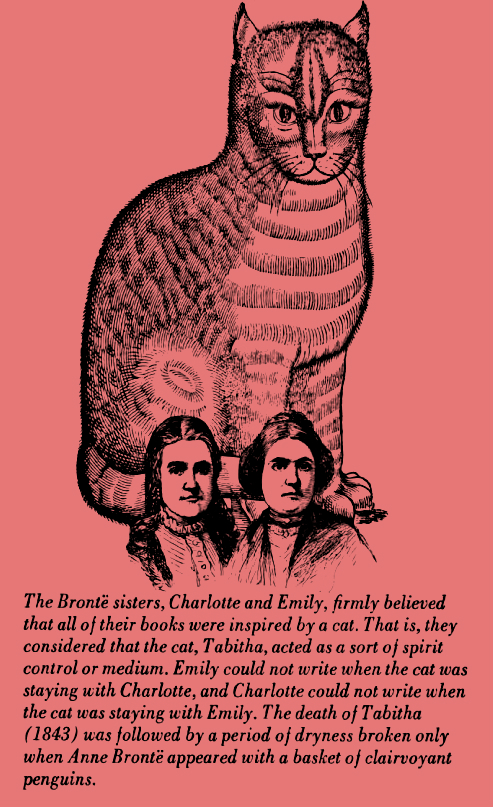
The Brontë Sisters, Inspired by a Cat (Donald Barthelme)

db

(From “Natural History” by Donald Barthelme, published in the August 1971 issue of Harper’s).

“Bliss” (Donald Barthelme)

Bliss: A condition of extreme happiness, euphoria. The nakedness of young women, especially in pairs (that is to say, a plenitude), often produces bliss in the eye of the beholder, male or female. A delight, let us confess the fact, and that is why we are considering all of the different ways in which this delight maybe conceptualized, in the privacy of our studies, or in airport bars where the dry, thin drinks cost too much. There is not enough delight. Doubtless naked young women think the same sort of thoughts, in the privacy of their studies,or other sorts of thoughts obscure to us. Maybe they just sit there, in their studies studying their own beauty, the beauty of a naked thumb, a passionate, interestingly historied wrist …

Read Donald Barthelme’s Story “Robert Kennedy Saved from Drowning”

K at His Desk

He is neither abrupt with nor excessively kind to associates. Or he is both abrupt and kind. The telephone is, for him, a whip, a lash, but also a conduit for soothing words, a sink into which he can hurl gallons of syrup if it comes to that. He reads quickly, scratching brief comments (“Yes,” “No”) in corners of the paper. He slouches in the leather chair, looking about him with a slightly irritated air for new visitors, new difficulties. He spends his time sending and receiving messengers. “I spend my time sending and receiving messengers,” he says. “Some of these messages are important. Others are not.”

Described by Secretaries

A: “Quite frankly I think he forgets a lot of things. But the things he forgets are those which are inessential. I even think he might forget deliberately, to leave his mind free. He has the ability to get rid of unimportant details. And he does.” B: “Once when I was sick, I hadn’t heard from him, and I thought he had forgotten me. You know usually your boss will send flowers or something like that. I was in the hospital, and I was mighty blue. I was in a room with another girl, and her boss hadn’t sent her anything either. Then suddenly the door opened and there he was with the biggest bunch of yellow tulips I’d ever seen in my life. And the other girl’s boss was with him, and he had tulips too. They were standing there with all those tulips, smiling. ”

Behind the Bar

At a crowded party, he wanders behind the bar to make himself a Scotch and water. His hand is on the bottle of Scotch, his glass is waiting. The bartender, a small man in a beige uniform with gilt buttons, politely asks K. to return to the other side, the guests’ side, of the bar. “You let one behind here, they all be behind here,” the bartender says.

Read the rest of Donald Barthelme’s short story “Robert Kennedy Saved from Drowning.”