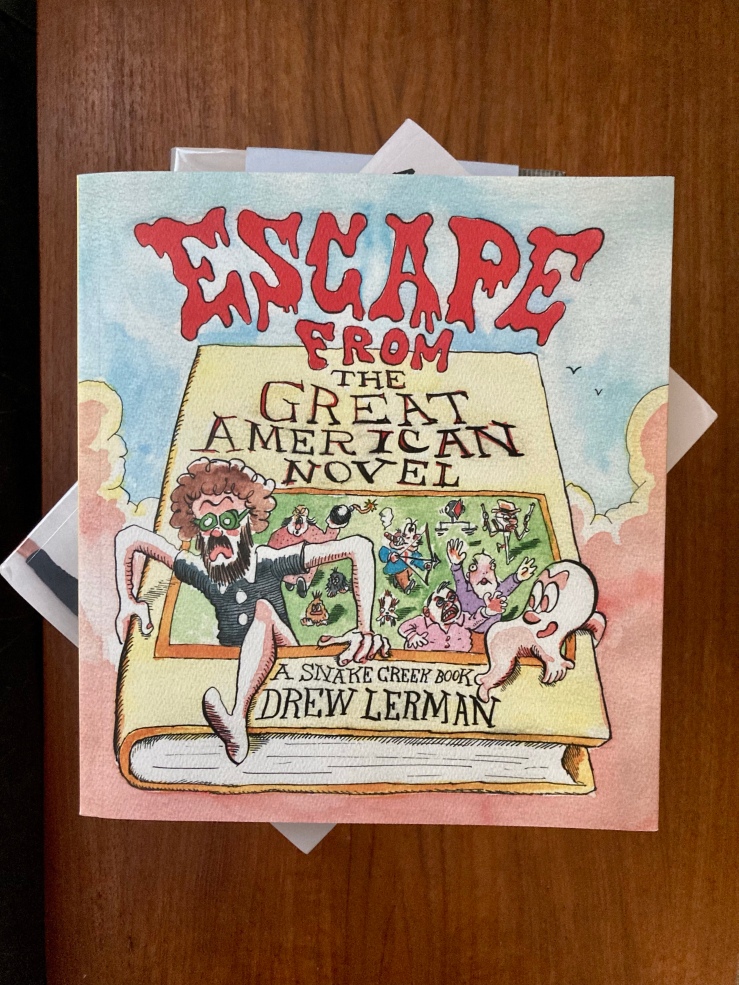
A review of Escape from the Great American Novel, Drew Lerman’s zany satire on art, nature, and capitalism

Drew Lerman’s comic strip Snake Creek takes us into the world of best pals Roy and Dav, weirdos among weirdos in Weirdest Florida. Their adventures and misadventures are both absurdly comic and zanily tragic, calling to mind George Herriman’s Krazy Kat strips and Samuel Beckett’s pessimism, Walt Kelly’s primeval Pogo and Robert Coover’s jivetalk, all rendered in kinetic black ink four-panel doses. I’ve been a big fan of the strip for a few years now, and Lerman’s latest collection Escape from the Great American Novel is his best work to date, a fun, messy, spirited send-up of the relationship between art, nature, and commerce.

Escape from the Great American Novel is a novel in just over 150 strips, spanning the end of August, 2019 through the beginning of August, 2021. If you reflect on those dates for a minute, you might recall that we squeezed in a lot of history there. Many of the (so-called) real-life tensions of that tumultuous time bubble up (and occasionally erupt) in the zany, myth-elastic world of Snake Creek.

Things begin simply enough, with Dav seeking to reclaim his “status as a reader of books.” Our protagonist simply wants to dig in to fine literature, but news of approaching Hurricane Dorian blocks his book time. Lerman is a Miamian (a Floridian like myself), and although the world of Snake Creek reverberates with massive streaks of irreality, it is nevertheless also beholden to real-life forces of nature. Ever the slackers, Dav and Roy are ill-prepared for an impending Cat 5. Lerman lays out a comedic scene that might be familiar to anyone who’s tried to buy batteries and water and plywood at the last minute:
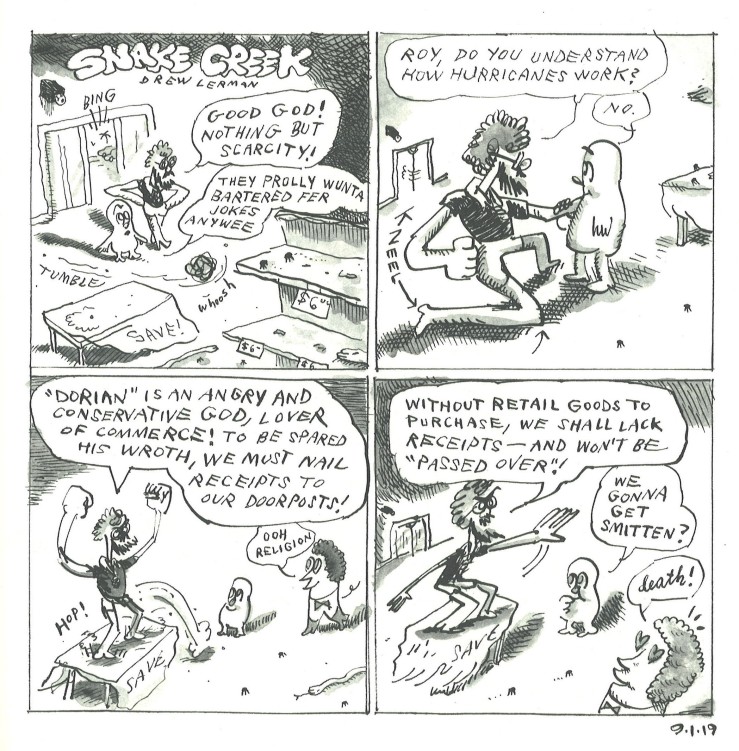
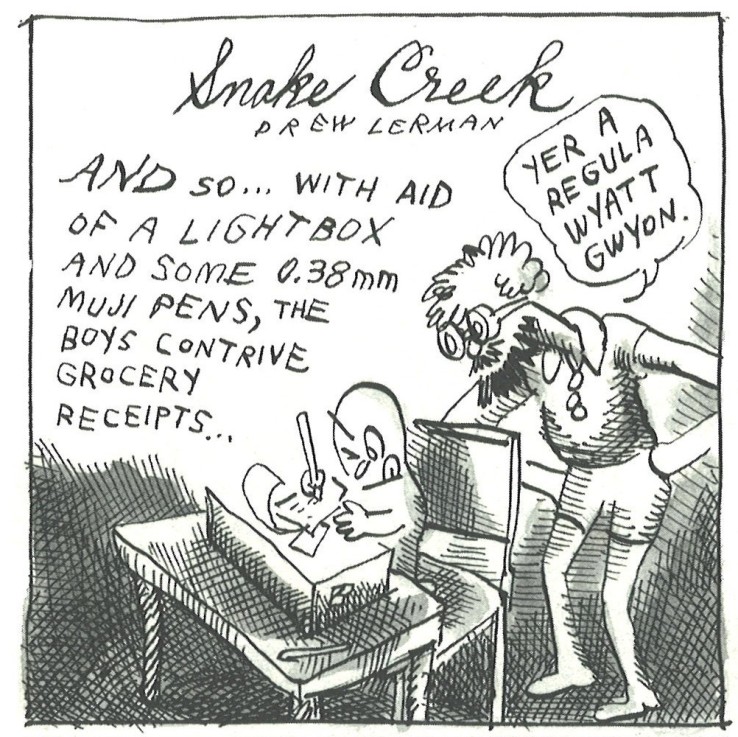
The early Dorian episodes of Escape usher in a critique of capitalism-as-religion, or capitalism-as-philosophy (as opposed to, say, the naked reality of exploitation both of people, animals, and natural resources). Short on capital or material, Dav and Roy concoct a plan to forge receipts, totems of capital that might ward off the angry Nature God Dorian. Lerman sneaks in a reference to the erstwhile hero of William Gaddis’s 1955 novel The Recognitions, the forger Wyatt Gwyon:
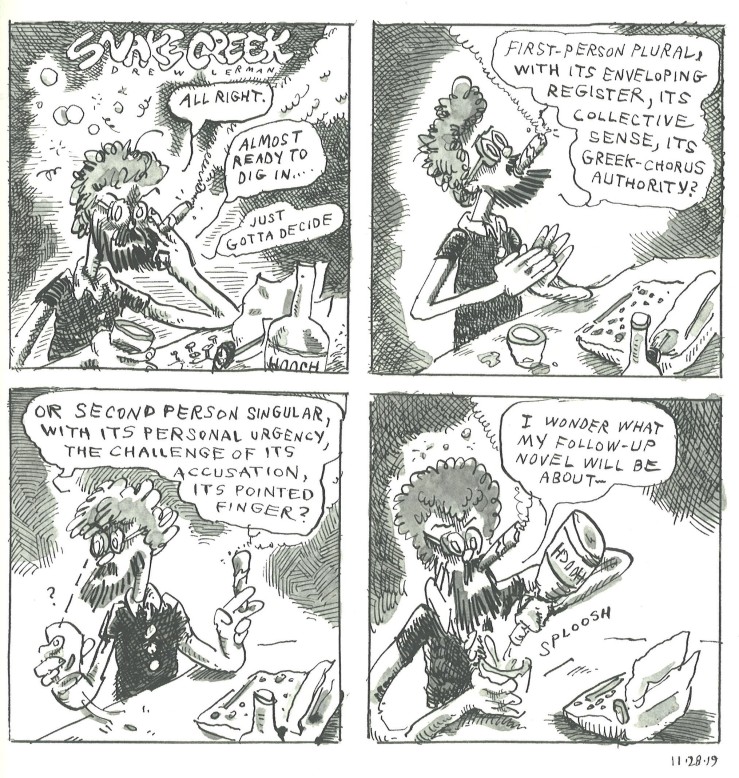
The storm passes, post-hurricane sobriety settles in, and Dav finds himself reflective: Just what is he doing with his life? And, maybe more to the point, what can he do to extend that life into immortality? His solution, immediately ridiculed by friend Roy, is to commit himself to writing The Great American Novel:
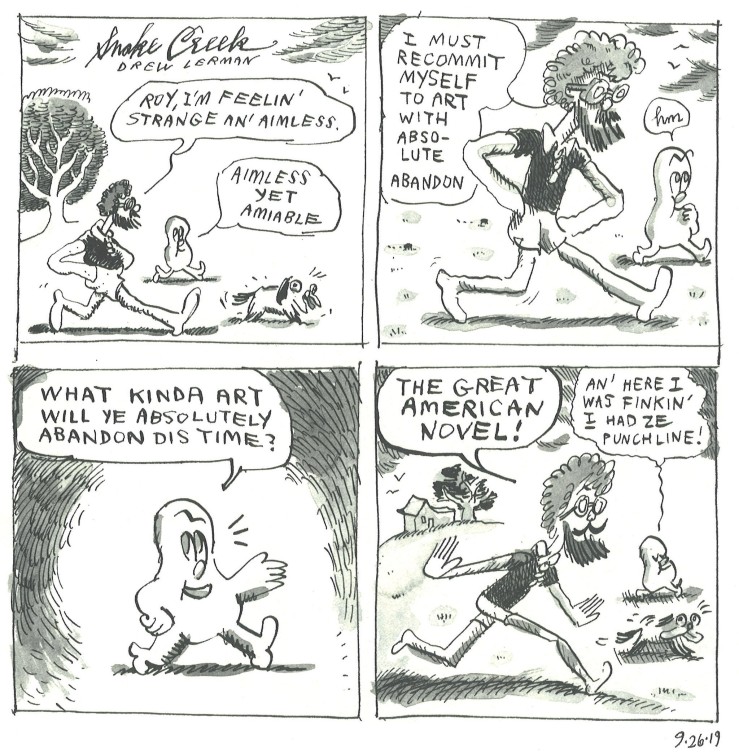
Dav’s quest takes a solipsistic turn. He plays the tortured artist, his ambition a block to his actual progress in writing The Great American Novel. Lerman satirizes the over-inflated but self-defeating ego of the artist who aspires to surpass all the great works came before him. While the pratfalls of a would-be tortured artist is not a particularly fresh subject matter, Lerman brings vitality to his depiction of Dav’s struggle against the anxiety of influence. If we enjoy mocking Dav, it’s because we understand and empathize with him. Who doesn’t want to contend with the greats?
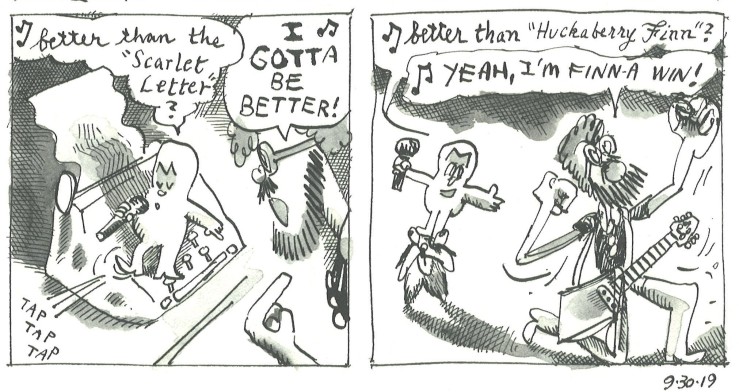
Dav’s quest also takes a turn away from his shenanigans with Roy. The pair’s riffing has always been the heart of Snake Creek, but Lerman keeps his partners apart for much of Escape. Dav’s dive into writing (or preparing to write, or preparing to prepare to write) distract him from Roy time. Initially, Dav chugs out reams of pages in the thrill of early enterprise. His ego swells, inflated by the grandeur of his illusions:
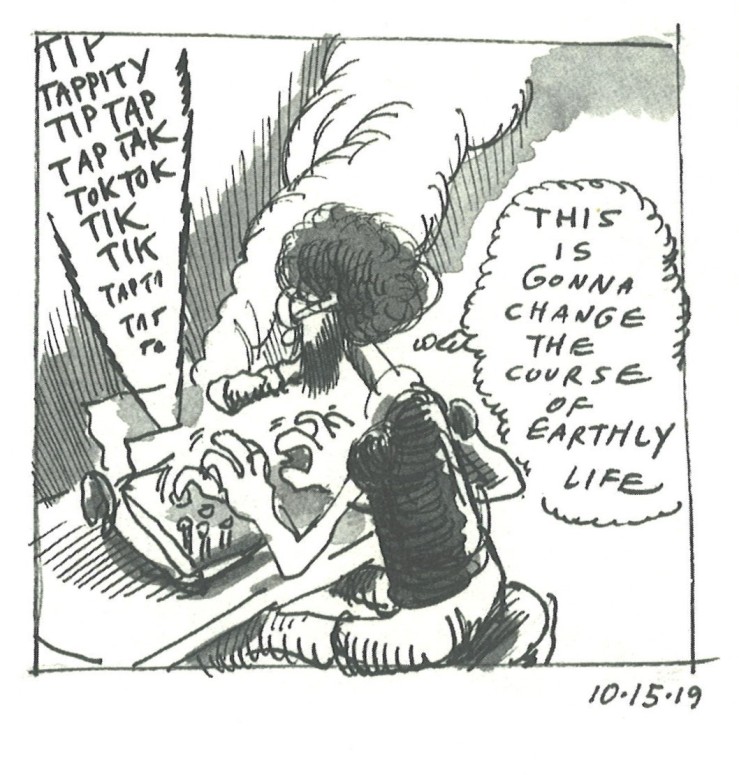
Only a few strips later, we find Dav’s illusions deflated. “S’all trash!” he declares over the mess of his nascent manuscript. Roy tries to help Dav. Snake Creek folk are all riled up over the plans of some “ollie garx” and the people are protesting. Roy rightfully recognizes potential inspiration here. He can bring his pal back to earth. “Sum sorter politicka thing” is happening, and that might be the inspirational grist Dav needs, right? But Dav rejects him: “I do not wish to know about anything that happened on this earth.” It might be hard to change the course of earthly life with that attitude. Instead of heeding Roy’s advice, Dav falls deeper into navel-gazing, imagining his future success, and generally doing anything except writing.
Dav’s dithering with the typewriter leaves Roy loose and “roving.” An amiable fellow, Roy soon takes up with two Russian oligarchs, Lev and Igor. This nefarious pair wishes to drill for oil in Snake Creek, destroying the weird paradise for profit. They plan to use charismatic, naïve Roy as their mouthpiece, a trusted liaison to the Creek community who can convince the locals on board to “drill baby drill.”

Lerman’s satire of these “ollie garx” and their relations with Roy is riddled with great gags. The oligarchs give Roy bald eagle eggs, which he proceeds to fry up to Dav’s dismay. They take him golfing and try to get him into Ayn Rand. They explain their anti-nature views—Mother Earth isn’t a caring mother but a devouring father who must, in oh-so Freudian terms, be eliminated. (Lerman, who always sneaks literary allusions into his strips, can’t resist referencing Faulkner’s As I Lay Dying during this exchange.) In one of my favorite exchanges in Escape, the oligarchs try to explain to Roy why his main talking point to convince the Snake Creek denizens to drill should be the promise of jobs:
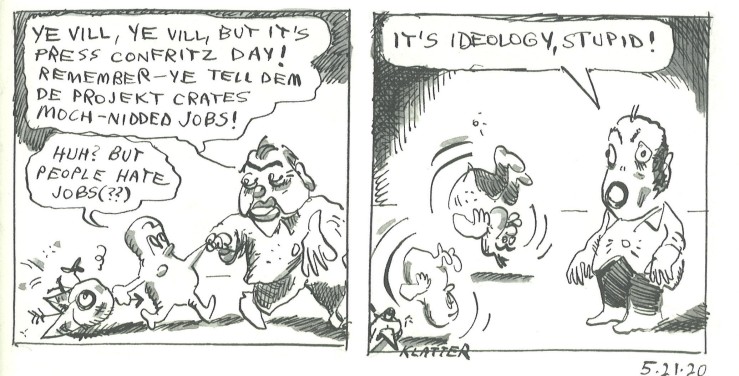
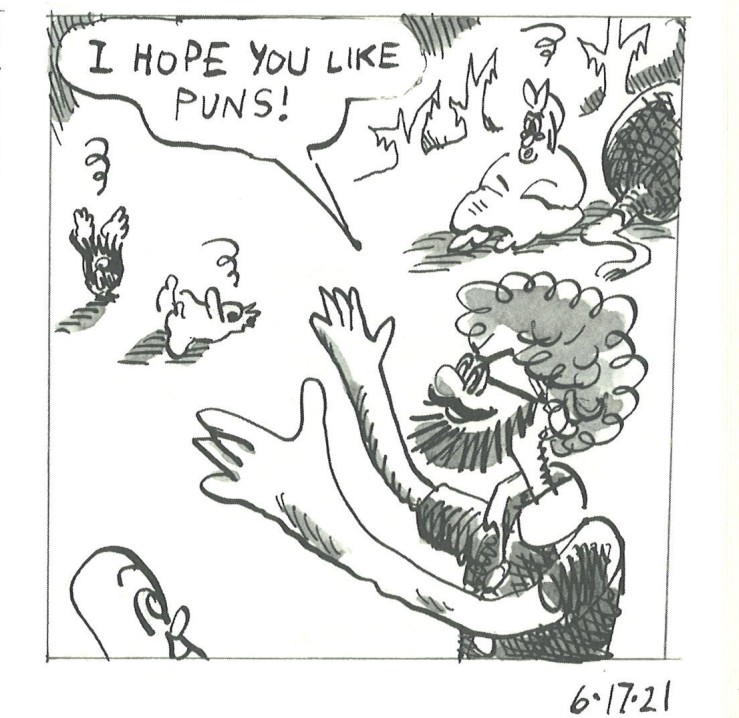
“But people hate jobs” — yes. And it is ideology, but you’re not stupid, reader, although the oligarchs might think you are. Their attempted seduction of sweet Roy plays out against Dav’s egotistical self-seduction into a fantasy of literary greatness in the twin threads of Escape from the Great American Novel. There are meditations on art, immortality, capitalism, and the role of our native environs. There are throwaway jokes on Harold Bloom and arguments over the better English translation of Camus’ L’Etranger. There are drones and fecal preoccupations and a nice ACAB reference; there are anarchist swamp folk and bombs! And there are puns. I hope you like puns.
The strips collected in Escape from the Great American Novel span two years that often felt in “real time” like an eternity. Many of us were separated from friends and family over these months. Lerman’s gambit, intentional or otherwise, is to keep his central characters separated, which adds real tension to a comic novel that otherwise might be a loose collection of funny riffs. As I stated before, Roy and Dav are the heart of Snake Creek, so when Lerman finally reunites them the moment is not just cathartic, it’s literarily metaphysical. For all its sardonic jags, ribald japes, and erudite allusions, Escape from the Great American Novel is in the end a sweet, even heartwarming read (Dav and Roy would find a way to mock this sentiment, I’m sure). I loved it. Highly recommended.

Escape from the Great American Novel is available in print from Radiator Comics.


My entry in The Comics Journal’s “Best Comics of 2021” article

The Comics Journal’s lengthy write up of “The Best Comics of 2021” is up. Here’s my entry:

When I was a kid one of the greatest small joys of my short existence was reading the comics page in the morning newspaper, an experience that seems and quite literally is of another century. I loved Calvin & HobbesBloom County,and The Far Side, but my favorite was Peanuts. While it’s not exactly the same as poring over the morning paper’s comics, I love to see Peanuts on this Day in my Twitter feed. So much has been written on Charles Schulz‘s genius, so I won’t wax more – I’ll just add that Charlie Brown’s strange defeated ever-reemerging optimism still brings me a weird dark hope.

I also continue to really dig Drew Lerman‘s Snake Creek series. Roy and Dav are perfect heroes for the 21st century, a new Vladimir and Estragon wandering through Weirdest Florida. Lerman publishes Snake Creek on Instagram. He collected the first few years of the strip in a volume that is now out of print. I hope he’ll reprint it and put out the latest strips in a paperback at some point soon.

Another artist I followed initially on a social media app (Tumblr) is Yvan Guillo, aka Samplerman. Samplerman’s collages initiate his audience into a new world of pop art surrealism where the Ben-Day dots of twentieth-century pulp transmute into a comic book you read in a dream when you were a kid. I picked up his 2021 book Anatomie Narrative (Ion Edition) and got lost in it again and again. The word narrative in the title asks the audience to understand story in a new way (or to take the title ironically, which I do not). The story here is pure aesthetics.

Another book I loved this year was Paul Kirchner‘s Dope Rider: A Fistful of Delirium (Éditions Tanibis), which collects the Dope Rider revival published in High Times from 2015 to 2020 (Dope Rider‘s initial run was in the ’70s). Great art, great jokes, great goofy fun.

I also spent way too much of the little free time I have going through old issues of The East Village Other. The scans I pulled from JSTOR are difficult to read, but the graphics are really what interests me. Initially I was looking for comix by folks like Bernie Wrightson, Art Spiegelman, Robert Crumb, and Kim Deitch – but I also love all the old ads for weird albums, concerts, films, and books. A digital scan of an old, weird paper with its own weird comix isn’t exactly the same as having the paper in your hand. But it’s better than nothing.

Blog about some recent reading

The last little bit of Spring trickles away here in North Florida, where beautiful days with highs of 82℉ promise to turn into burning sweaty hell in the next week or two. The Spring 2021 semester is behind me, and I’ve found a lot more time to read. So, re: pic, bottom to top:

Paul Kirchner’s latest collection Dope Rider: A Fistful of Delerium is dope goofy gorgeousness. I’ve been taking it a page a day or so and am about to run out of the stash. I hope to have a review of it soon (maybe in The Comics Journal, where I reviewed Kirchner’s last collection, Hieronymus & Bosch).

Paul Kirchner

I also read some comix by Drew Lerman, and wrote about them here.

Drew Lerman

I picked up Rachel Cusk’s much-lauded novel Outline a few weeks ago at a Friends of the Library Sale. It was not for me. The flat, “tell-don’t-show” style didn’t bother me—indeed the prose is very “readable” (whatever that means)—but I found myself rolling my eyes a lot. A lot of smart people like this novel (and the trilogy it initiates), so maybe I fundamentally misread it. And in fairness, the whole contemporary autoficiton thing has left me cold, with the possible exception of Elena Ferrante’s so-called Neopolitan Novels, which I loved.

I read four B.S. Johnson novels in something of a blur. Johnson was an English avant-gardiste writing primarily in the 1960s. I wrote a bit about some of the novels hereChristie Malry’s Own Double-Entry ended up being my favorite, with Albert Angelo a close second. I thought Trawl was extremely tedious. I broke down and ordered a copy of his “novel in a box,” The Unfortunates—maybe I’ll muster the energy for something bigger on Johnson.

I’m a little over half way through Patrick Suskind’s Perfume (trans. by John E. Woods), and I really dig it—it feels like a long time since I’ve read a good ole fashioned historical novel told in the third-person omniscient/free indirect style. Set in France in the mid-1700’sPerfume is the story of Jean-Baptiste Grenouille, a perfume genius, a freak, a murderer. I’d seen Tom Twyker’s film adaptation years ago, but the novel is richer, taking us deeper into Grenouille’s strange mind. Great stuff.

I recently finished Norah Lange’s fragmentary memoir, Notes from Childhood (trans. by Charlotte Whittle). It’s a propulsive and rich read, a loving but unsentimental, magical without a trace of whimsy. I wrote about it a bit here.

New Snake Creek comix from Drew Lerman

I’ve been a fan of Drew Lerman’s strip Snake Creek for a few years now. Reviewing Lerman’s first collection (simply titled Snake Creek) in The Comics Journal, Brian Nicholson wrote that,

Looking at these strips, you’re looking at something that recalls George Herriman, Harvey Kurtzman, Robert Crumb, Daniel Clowes, Matt Groening, but also thinking: What if Stanley Elkin drew a comic strip?

What if Elkin drew a comic strip indeed?

Like Elkin, Lerman plays with a variety of voices and rhythms in his work. There’s a zaniness to the Snake Creek world, but also an almost-melancholy seriousness to it as well. His main characters are Dav and Roy. Roy is something of a would-be tortured artist; Roy his familiar/foil, a spritely interlocutor to bounce ideas off of. Like the swamp-dwellers of Walt Kelly’s seminal strip Pogo, there’s a real affection between the two characters that anchors the surreal plasticity of Lerman’s work in genuine emotion.

I got three Snake Creek comix last week and tried not to read them too quickly on Sunday afternoon. I needed to get the bad taste of a Serious Contemporary Novel out of my brain, and Detective! Double Digest did the trick. There are two stories here: Lerman’s “Cryonic Pain: A Snake Creek Mystery” and on the literal flipside, Pete Faecke’s “The Big Love Triangle” (which has a scuzzy punk noir vibe).

From Pete Faecke’s “The Big Love Triangle.”

Lerman’s detective story is an existentialist affair—a goofing riff on the myth of Sisyphus and the burden of a consciousness constrained by mortality and time. It’s also full of verbal slapstick and surreal shenanigans.

From Drew Lerman’s “Cryonic Pain.”
Back cover of Drew Lerman’s Schtick

Schtick is a mini-comic in full color compromised of five vignettes, each one a riff or routine rooted in vaudevillian humor and composed in an original vernacular. The longest of the pieces, “Herbit and Sheiler,” is an extended play on linguistic misunderstandings—good stuff.

From Drew Lerman’s strip “Levi & Cohn,” Schtick

My favorite of the three comix is the most recent, “Head Trip,” the cover feature for the latest issue of the Miami-based comics journal Spiny Orb Weaver. (The issue also features an essay by comics critic Rob Clough, an autobiographical comic by Chris López, and a lengthy interview with Lerman, conducted by SOW editor Neil Brideau.)

Detail from Drew Lerman’s cover for Spiny Orb Weaver no. 2

“Head Trip” sees Dav and Roy trying to take Snake Creek’s most anguished character, Head on a Stone, on an adventure he can remember. Unable to move or communicate, but nevertheless burdened by consciousness, Head on a Stone is a tragic figure, a “pulsing node of dread,” as Dav puts it. Dav and Roy decide, in their wisely wisdom, to take the large rock seafaring. What follows is an ironic series of tragic-comic-tragic-etc. reversals of fortune (as well as some of Lerman’s most lyrical work to date with his strip). “Head Trip” is as linguistically loose and visually goofy as we might expect from anything set in the Snake Creek universe, and also achieves a level of poignancy we might not expect. Great stuff.

From Drew Lerman’s “Head Trip.”


Drew Lerman’s Snake Creek

2019-10-14_163321

I got a copy of Drew Lerman’s Snake Creek strips a few weeks ago and have been reading a strip a day, or sometimes reading two or four strips a day, or sometimes reading no strips a day.

Snake Creek comprises the first volume of Snake Creek comix created by Lerman between the summers of ’18 and ’19. Lerman made one each day, as far as I can tell, which, like props.

The heroes of Snake Creek are maybe-human Dav (an altar-ego for Lerman?) and maybe walkin-talkin potato/maybe-mutant Roy, who spend their days and nights strolling the beaches, riffing on life, and extemporizing poems and songs. They take up with a dog and one point, and later encounter strange ducks. (I’m sure there’s more—I’ve been trying, like I said, to limit myself to a few strips a day.) It’s all a big anarchic kick.

2019-10-14_163456

Snake Creek has an absurdist and occasionally nihilist bent, flavors I love. Never too bitter, the strip’s sweetness is anchored in the weird friendship betwixt Dav and Roy, who wander and wonder along a Miami Beach that Lerman turns into a kind of desert island running on Prospero’s magic.

2019-10-14_163605

Snake Island’s chords and rhythms resonate with Walt Kelly’s Pogo, another Floridaish strip, as well as George Herriman’s zany strip Krazy Kat. Lerman seems like a willing descendant of Kelly and Herriman, but Snake Island is also wholly contemporary, a comic that begins with a discussion of old G-chats.

I’m really digging the collection, and I hope not to gobble it up too fast.

2019-10-14_163713