
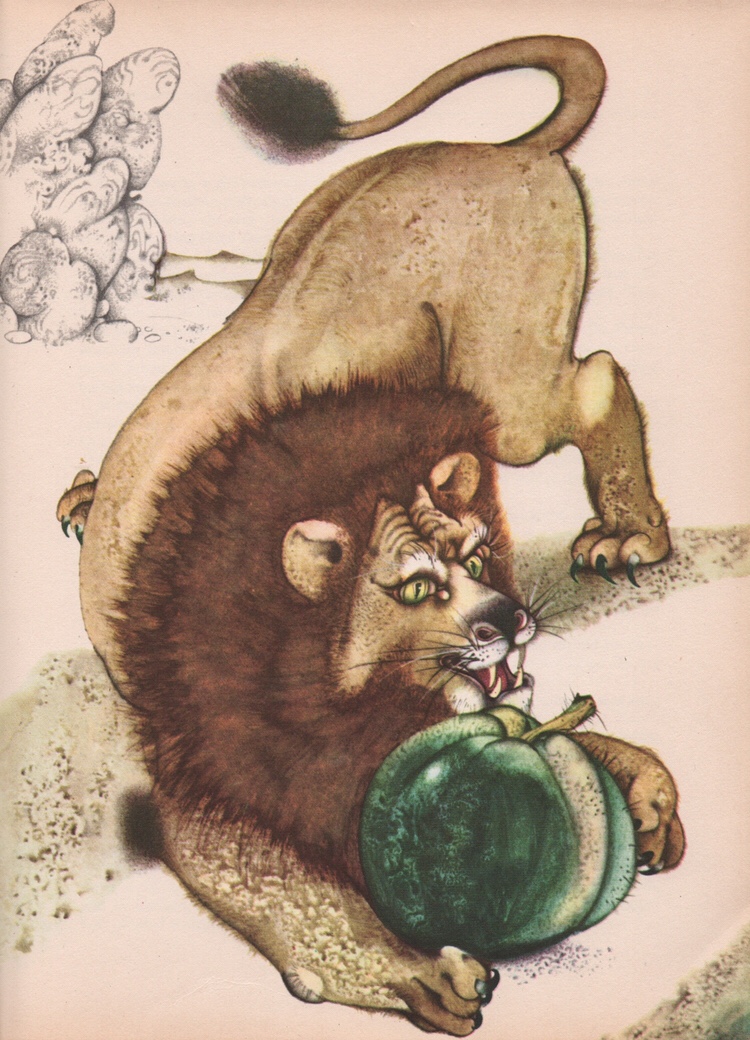
There is a little tale about man’s fate, and this is the way it is put. A man is being pursued by a raging elephant and takes refuge in a tree at the edge of a fearsome abyss. Two mice, one black and one white, are gnawing at the roots of the tree, and at the bottom of the abyss is a dragon with parted jaws. The man looks above and sees a little honey trickling down the tree, and he begins to lick it up and forgets his perilous situ- ation. But the mice gnaw through the tree and the man falls down and the elephant seizes him and hurls him over to the dragon. Now, that elephant is the image of death, which pur- sues men, and the tree is this transitory existence, and the mice are the days and the nights, and the honey is the sweetness of the passing world, and the savor of the passing world diverts mankind. So the days and nights are accomplished and death seizes him and the dragon swallows him down into hell and this is the life of man.
This little tale with its broad and beasty strokes seems to approximate man’s dilemma quite charmingly, with the caveat that it also applies to the ladies (“she” being “he” throughout here, the writer’s woes not limited by gender; like Flannery O’Connor’s Misfit, the writer knows there’s no enjoyment to be had in this life). This is the story, then, pretty much the story, with considerable latitude to be had in describing those mice, those terrifying mice. But it is not for the writer to have any part in providing the honey—the passing world does that. The writer can’t do better than that. What the writer wants to be is the consciousness of the story, he doesn’t want to be part of the distraction; to distract is ignoble, to distract is to admit defeat, to serve a lesser god. The story is not a simple one. It is syncretistic and strange and unhappy, and it all must be told beautifully, even the horrible parts, particularly the horrible parts. The telling of the story can never end, not because the writer doesn’t like the way it must end but because there is no end to the awareness of the story, which the writer has only the dimmest, most fragmentary knowledge of.
From Joy Williams’ essay “Why I Write.” Collected in Ill Nature.
 Biblioklept