Read “Christmas Eve,” a supernatural tale by Nikolai Gogol

“Christmas Eve”

by

Nikolai Gogol

translated by George Tolstoy

as “The Night of Christmas Eve: A Legend of Little Russia”


The last day before Christmas had just closed. A bright winter night had come on, stars had appeared, and the moon rose majestically in the heavens to shine upon good men and the whole of the world, so that they might gaily sing carols and hymns in praise of the nativity of Christ. The frost had grown more severe than during the day; but, to make up for this, everything had become so still that the crisping of the snow under foot might be heard nearly half a verst round. As yet there was not a single group of young peasants to be seen under the windows of the cottages; the moon alone peeped stealthily in at them, as if inviting the maidens, who were decking themselves, to make haste and have a run on the crisp snow. Suddenly, out of the chimney of one of the cottages, volumes of smoke ascended in clouds towards the heavens, and in the midst of those clouds rose, on a besom, a witch.

If at that time the magistrate of Sorochinsk had happened to pass in his carriage, drawn by three horses, his head covered by a lancer cap with sheepskin trimming, and wrapped in his great cloak, covered with blue cloth and lined with black sheepskin, and with his tightly plaited lash, which he uses for making the driver drive faster—if this worthy gentleman had happened to pass at that time, no doubt he would have seen the witch, because there is no witch who could glide away without his seeing her. He knows to a certainty how many sucking pigs each swine brings forth in each cottage, how much linen lies in each box, and what each one has pawned in the brandy-shop out of his clothes or his household furniture. But the magistrate of Sorochinsk happened not to pass; and then, what has he to do with those out of his jurisdiction? he has his own circuit. And the witch by this time had risen so high that she only looked like a little dark spot up above; but wherever that spot went, one star after another disappeared from heaven. In a short time the witch had got a whole sleeveful of them. Some three or four only remained shining. On a sudden, from the opposite side, appeared another spot, which went on growing, spreading, and soon became no longer a spot. A short-sighted man, had he put, not only spectacles, but even the wheels of a britzka on his nose, would never have been able to make out what it was. In front, it was just like a German; a narrow snout, incessantly turning on every side, and smelling about, ended like those of our pigs, in a small, round, flattened end; its legs were so thin, that had the village elder got no better, he would have broken them to pieces in the first squatting-dance. But, as if to make amends for these deficiencies, it might have been taken, viewed from behind, for the provincial advocate, so much was its long pointed tail like the skirt of our dress-coats. And yet, a look at the goat’s beard under its snout, at the small horns sticking out of its head, and at the whole of its figure, which was no whiter than that of a chimney sweeper, would have sufficed to make any one guess that it was neither a German nor a provincial advocate, but the Devil in person, to whom only one night more was left for walking about the world and tempting good men to sin. On the morrow, at the first stroke of the church bell, he was to run, with his tail between his legs, back to his quarters. The devil then, as the devil it was, stole warily to the moon, and stretched out his hand to get hold of it; but at the very same moment he drew it hastily back again, as if he had burnt it, shook his foot, sucked his fingers, ran round on the other side, sprang at the moon once more, and once more drew his hand away. Still, notwithstanding his being baffled, the cunning devil did not desist from his mischievous designs. Dashing desperately forwards, he grasped the moon with both hands, and, making wry faces and blowing hard, he threw it from one hand to the other, like a peasant who has taken a live coal in his hand to light his pipe. At last, he hastily hid it in his pocket, and went on his way as if nothing had happened. At Dikanka, nobody suspected that the devil had stolen the moon. It is true that the village scribe, coming out of the brandy-shop on all fours, saw how the moon, without any apparent reason, danced in the sky, and took his oath of it before the whole village, but the distrustful villagers shook their heads, and even laughed at him. And now, what was the reason that the devil had decided on such an unlawful step? Simply this: he knew very well that the rich CossackChoop was invited to an evening party at the parish clerk’s, where he was to meet the elder, also a relation of the clerk, who was in the archbishop’s chapel, and who wore a blue coat and had a most sonorous basso profondo, the Cossack Sverbygooze, and some other acquaintances; where there would be for supper, not only the kootia, but also a varenookha, as well as corn-brandy, flavoured with saffron, and divers other dainties. He knew that in the mean time Choop’s daughter, the belle of the village, would remain at home; and he knew, moreover, that to this daughter would come the blacksmith, a lad of athletic strength, whom the devil held in greater aversion than even the sermons of Father Kondrat. When the blacksmith had no work on hand, he used to practise painting, and had acquired the reputation of being the best painter in the whole district. Even the Centurion had expressly sent for him to Poltava, for the purpose of painting the wooden palisade round his house. All the tureens out of which the Cossacks of Dikanka ate their borsch, were adorned with the paintings of the blacksmith. He was a man of great piety, and often painted images of the saints; even now, some of them may be seen in the village church; but his masterpiece was a painting on the right side of the church-door; in it he had represented the Apostle Peter, at the Day of Judgment, with the keys in his hand, driving the evil spirit out of hell; the terrified devil, apprehending his ruin, rushed hither and thither, and the sinners, freed from their imprisonment, pursued and thrashed him with scourges, logs of wood, and anything that came to hand. All the time that the blacksmith was busy with this picture, and was painting it on a great board, the devil used all his endeavours to spoil it; he pushed his hand, raised the ashes out of the forge, and spread them over the painting; but, notwithstanding all this, the work was finished, the board was brought to the church, and fixed in the wall of the porch. From that time the devil vowed vengeance on the blacksmith. He had only one night left to roam about the world, but even in that night he sought to play some evil trick upon the blacksmith. For this reason he, had resolved to steal the moon, for he knew that old Choop was lazy above all things, not quick to stir his feet; that the road to the clerk’s was long, and went across back lanes, next to mills, along the churchyard, and over the top of a precipice; and though the varenookha and the saffron brandy might have got the better of Choop’s laziness on a moonlight night, yet, in such darkness, it would be difficult to suppose that anything could prevail on him to get down from his oven and quit his cottage. And the blacksmith, who had long been at variance with Choop, would not on any account, in spite even of his strength, visit his daughter in his presence. Continue reading “Read “Christmas Eve,” a supernatural tale by Nikolai Gogol”

Read “The Girl I Left Behind Me,” a ghost story by Muriel Spark

“The Girl I Left Behind Me”

by

Muriel Spark


It was just gone quarter past six when I left the office.

‘Teedle-um-tum-tum’ — there was the tune again, going round my head. Mr Letter had been whistling it all throughout the day between his noisy telephone calls and his dreamy sessions. Sometimes he whistled ‘Softly, Softly, Turn the Key’, but usually it was ‘The Girl I Left Behind Me’ rendered at a brisk hornpipe tempo.

I stood in the bus queue, tired out, and wondering how long I would endure Mark Letter (Screws & Nails) Ltd. Of course, after my long illness, it was experience. But Mr Letter and his tune, and his sudden moods of bounce, and his sudden lapses into lassitude, his sandy hair and little bad teeth, roused my resentment, especially when his tune barrelled round my head long after I had left the office; it was like taking Mr Letter home.

No one at the bus stop took any notice of me. Well, of course, why should they? I was not acquainted with anyone there, but that evening I felt particularly anonymous among the homegoers. Everyone looked right through me and even, it seemed, walked through me. Late autumn always sets my fancy towards sad ideas. The starlings were crowding in to roost on all the high cornices of the great office buildings. And I located, among the misty unease of my feelings, a very strong conviction that I had left something important behind me or some job incompleted at the office. Perhaps I had left the safe unlocked, or perhaps it was something quite trivial which nagged at me. I had half a mind to turn back, tired as I was, and reassure myself. But my bus came along and I piled in with the rest. Continue reading “Read “The Girl I Left Behind Me,” a ghost story by Muriel Spark”

“Columbus in Chains” — Jamaica Kincaid

“Columbus in Chains”

by

Jamaica Kincaid


Outside, as usual, the sun shone, the trade winds blew; on her way to put some starched clothes on the line, my mother shooed some hens out of her garden; Miss Dewberry baked the buns, some of which my mother would buy for my father and me to eat with our afternoon tea; Miss Henry brought the milk, a glass of which I would drink with my lunch, and another glass of which I would drink with the bun from Miss Dewberry; my mother prepared our lunch; my father noted some perfectly idiotic thing his partner in housebuilding, Mr. Oatie, had done, so that over lunch he and my mother could have a good laugh.

The Anglican church bell struck eleven o’clock—one hour to go before lunch. I was then sitting at my desk in my classroom. We were having a history lesson—the last lesson of the morning. For taking first place over all the other girls, I had been given a prize, a copy of a book called Roman Britain, and I was made prefect of my class. What a mistake the prefect part had been, for I was among the worst-behaved in my class and did not at all believe in setting myself up as a good example, the way a prefect was supposed to do. Now I had to sit in the prefect’s seat—the first seat in the front row, the seat from which I could stand up and survey quite easily my classmates. From where I sat I could see out the window. Sometimes when I looked out, I could see the sexton going over to the minister’s house. The sexton’s daughter, Hilarene, a disgusting model of good behavior and keen attention to scholarship, sat next to me, since she took second place. The minister’s daughter, Ruth, sat in the last row, the row reserved for all the dunce girls. Hilarene, of course, I could not stand. A girl that good would never do for me. I would probably not have cared so much for first place if I could be sure it would not go to her. Ruth I liked, because she was such a dunce and came from England and had yellow hair. When I first met her, I used to walk her home and sing bad songs to her just to see her turn pink, as if I had spilled hot water all over her.

Our books, A History of the West Indies, were open in front of us. Our day had begun with morning prayers, then a geometry lesson, then it was over to the science building for a lesson in “Introductory Physics” (not a subject we cared much for), taught by the most dingy-toothed Mr. Slacks, a teacher from Canada, then precious recess, and now this, our history lesson. Recess had the usual drama: this time, I coaxed Gwen out of her disappointment at not being allowed to join the junior choir. Her father—how many times had I wished he would become a leper and so be banished to a leper colony for the rest of my long and happy life with Gwen—had forbidden it, giving as his reason that she lived too far away from church, where choir rehearsals were conducted, and that it would be dangerous for her, a young girl, to walk home alone at night in the dark. Of course, all the streets had lamplight, but it was useless to point that out to him. Oh, how it would have pleased us to press and rub our knees together as we sat in our pew while pretending to pay close attention to Mr. Simmons, our choirmaster, as he waved his baton up and down and across, and how it would have pleased us even more to walk home together, alone in the “early dusk” (the way Gwen had phrased it, a ready phrase always on her tongue), stopping, if there was a full moon, to lie down in a pasture and expose our bosoms in the moonlight. We had heard that full moonlight would make our breasts grow to a size we would like. Poor Gwen! When I first heard from her that she was one of ten children, right on the spot I told her that I would love only her, since her mother already had so many other people to love.

Our teacher, Miss Edward, paced up and down in front of the class in her usual way. In front of her desk stood a small table, and on it stood the dunce cap. The dunce cap was in the shape of a coronet, with an adjustable opening in the back, so that it could fit any head. It was made of cardboard with a shiny gold paper covering and the word “DUNCE” in shiny red paper on the front. When the sun shone on it, the dunce cap was all aglitter, almost as if you were being tricked into thinking it a desirable thing to wear. As Miss Edward paced up and down, she would pass between us and the dunce cap like an eclipse. Each Friday morning, we were given a small test to see how well we had learned the things taught to us all week. The girl who scored lowest was made to wear the dunce cap all day the following Monday. On many Mondays, Ruth wore it—only, with her short yellow hair, when the dunce cap was sitting on her head she looked like a girl attending a birthday party in The Schoolgirl’s Own Annual.

It was Miss Edward’s way to ask one of us a question the answer to which she was sure the girl would not know and then put the same question to another girl who she was sure would know the answer. The girl who did not answer correctly would then have to repeat the correct answer in the exact words of the other girl. Many times, I had heard my exact words repeated over and over again, and I liked it especially when the girl doing the repeating was one I didn’t care about very much. Pointing a finger at Ruth, Miss Edward asked a question the answer to which was “On the third of November 1493, a Sunday morning, Christopher Columbus discovered Dominica.” Ruth, of course, did not know the answer, as she did not know the answer to many questions about the West Indies. I could hardly blame her. Ruth had come all the way from England. Perhaps she did not want to be in the West Indies at all. Perhaps she wanted to be in England, where no one would remind her constantly of the terrible things her ancestors had done; perhaps she had felt even worse when her father was a missionary in Africa. I could see how Ruth felt from looking at her face. Her ancestors had been the masters, while ours had been the slaves. She had such a lot to be ashamed of, and by being with us every day she was always being reminded. We could look everybody in the eye, for our ancestors had done nothing wrong except just sit somewhere, defenseless. Of course, sometimes, what with our teachers and our books, it was hard for us to tell on which side we really now belonged—with the masters or the slaves—for it was all history, it was all in the past, and everybody behaved differently now; all of us celebrated Queen Victoria’s birthday, even though she had been dead a long time. But we, the descendants of the slaves, knew quite well what had really happened, and I was sure that if the tables had been turned we would have acted differently; I was sure that if our ancestors had gone from Africa to Europe and come upon the people living there, they would have taken a proper interest in the Europeans on first seeing them, and said, “How nice,” and then gone home to tell their friends about it. Continue reading ““Columbus in Chains” — Jamaica Kincaid”

“One of These Days” — Gabriel García Márquez

“One of These Days”

by Gabriel García Márquez

translated by J.S. Bernstein


Monday dawned warm and rainless. Aurelio Escovar, a dentist without a degree, and a very early riser, opened his office at six. He took some false teeth, still mounted in their plaster mold, out of the glass ease and put on the table a fistful of instruments which he arranged in size order, as if they were on display. He wore a collarless striped shirt, closed at the neck with a golden stud, and pants held up by suspenders. He was erect and skinny, with a look that rarely corresponded to the situation, the way deaf people have of looking.

When he had things arranged on the table, he pulled the drill toward the dental chair and sat down to polish the false teeth. He seemed not to be thinking about what he was doing, but worked steadily, pumping the drill with his feet, even when he didn’t need it.

After eight he stopped for a while to look at the sky through the window, and he saw two pensive buzzards who were drying themselves in the sun on the ridgepole of the house next door. He went on working with the idea that before lunch it would rain again. The shrill voice of his eleven-year-old son interrupted his concentration.

“Papá”

“What?”

“The Mayor wants to know if you’ll pull his tooth.”

“Tell him I’m not here.”

He was polishing a gold tooth. He held it at arm’s length, and examined it with his eyes half closed. His son shouted again from the little waiting room.

“He says you are, too, because he can hear you.”

The dentist kept examining the tooth. Only when he had put it on the table with the finished work did he say:

“So much the better.”

He operated the drill again. He took several pieces of a bridge out of a cardboard box where he kept the things he still had to do and began to polish the gold.

“Papá.”

“What?”

He still hadn’t changed his expression.

“He says if you don’t take out his tooth, he’ll shoot you.”

Without hurrying, with an extremely tranquil movement, he stopped pedaling the drill, pushed it away from the chair, and pulled the lower drawer of the table all the way out. There was a revolver. “O.K.,” he said. “Tell him to come and shoot me.”

He rolled the chair over opposite the door, his hand resting on the edge of the drawer. The Mayor appeared at the door. He had shaved the left side of his face, but the other side, swollen and in pain, had a five-day-old beard. The dentist saw many nights of desperation in his dull eyes. He closed the drawer with his fingertips and said softly:

“Sit down.”

“Good morning,” said the Mayor.

“Morning,” said the dentist.

While the instruments were boiling, the Mayor leaned his skull on the headrest of the chair and felt better. His breath was icy. It was a poor office: an old wooden chair, the pedal drill, a glass case with ceramic bottles. Opposite the chair was a window with a shoulder-high cloth curtain. When he felt the dentist approach, the Mayor braced his heels and opened his mouth.

Aurelio Escovar turned his head toward the light. After inspecting the infected tooth, he closed the Mayor’s jaw with a cautious pressure of his fingers.

“It has to be without anesthesia,” he said.

“Why?”

“Because you have an abscess.”

/>   The Mayor looked him in the eye. “All right,” he said, and tried to smile. The dentist did not return the smile. He brought the basin of sterilized instruments to the worktable and took them out of the water with a pair of cold tweezers, still without hurrying. Then he pushed the spittoon with the tip of his shoe, and went to wash his hands in the washbasin. He did all this without looking at the Mayor. But the Mayor didn’t take his eyes off him.

It was a lower wisdom tooth. The dentist spread his feet and grasped the tooth with the hot forceps. The Mayor seized the arms of the chair, braced his feet with all his strength, and felt an icy void in his kidneys, but didn’t make a sound. The dentist moved only his wrist. Without rancor, rather with a bitter tenderness, he said:

“Now you’ll pay for our twenty dead men.”

The Mayor felt the crunch of bones in his jaw, and his eyes filled with tears. But he didn’t breathe until he felt the tooth come out. Then he saw it through his tears. It seemed so foreign to his pain that he failed to understand his torture of the five previous nights.

Bent over the spittoon, sweating, panting, he unbuttoned his tunic and reached for the handkerchief in his pants pocket. The dentist gave him a clean cloth.

“Dry your tears,” he said.

The Mayor did. He was trembling. While the dentist washed his hands, he saw the crumbling ceiling and a dusty spider web with spider’s eggs and dead insects. The dentist returned, drying his hands. “Go to bed,” he said, “and gargle with salt water.” The Mayor stood up, said goodbye with a casual military salute, and walked toward the door, stretching his legs, without buttoning up his tunic.

“Send the bill,” he said.

“To you or the town?”

The Mayor didn’t look at him. He closed the door and said through the screen:

“It’s the same damn thing.”

Mass-market Monday | Eco-Fiction

Eco-Fiction, 1971, ed. John Stadler. Pocket Books (1971). No cover artist or designer credited. 206 pages.

The cover art is by Michael Eagle (you can see his signature in the illustration).

In addition to the names listed on the back cover, this collection also features stories by J.G. Ballard, Frank Herbert, J.F. Powers and more.

The vignette “The Turtle” condenses all of The Grapes of Wrath–and most of Steinbeck’s themes in general–into four paragraphs.


“The Turtle”

by

John Steinbeck

The concrete highway was edged with a mat of tangled, broken, dry grass, and the grass heads were heavy with oat beards to catch on a dog’s coat, and foxtails to tangle in a horse’s fetlocks, and clover burrs to fasten in sheep’s wool; sleeping life waiting to be spread and dispersed, every seed armed with an appliance of dispersal, twisting darts and parachutes for the wind, little spears and balls of tiny thorns, and all waiting for animals or the hem of a woman’s skirt, all passive but armed with appliances of activity, still, but each possessed of the anlage of movement.

The sun lay on the grass and warmed it, and in the shade under the grass the insects moved, ants and ant lions to set traps for them, grasshoppers to jump into the air and flick their yellow wings for a second, sow bugs like little armadillos, plodding restlessly on many tender feet. And over the grass at the roadside a land turtle crawled, turning aside for nothing, dragging his high-domed shell over the grass: His hard legs and yellow-nailed feet threshed slowly through the grass, not really walking, but boosting and dragging his shell along. The barley beards slid off his shell, and the clover burrs fell on him and rolled to the ground. His horny beak was partly opened, and his fierce, humorous eyes, under brows like fingernails, stared straight ahead. He came over the grass leaving a beaten trail behind him, and the hill, which was the highway embankment, reared up ahead of him. For a moment he stopped, his head held high. He blinked and looked up and down. At last he started to climb the embankment. Front clawed feet reached forward but did not touch. The hind feet kicked his shell along, and it scraped on the grass, and on the gravel. As the embankment grew steeper and steeper, the more frantic were the efforts of the land turtle. Pushing hind legs strained and slipped, boosting the shell along, and the horny head protruded as far as the neck could stretch. Little by little the shell slid up the embankment until at last a parapet cut straight across its line of march, the shoulder of the road, a concrete wall four inches high. As though they worked independently the hind legs pushed the shell against the wall. The head upraised and peered over the wall to the broad smooth plain of cement. Now the hands, braced on top of the wall, strained and lifted, and the shell came slowly up and rested its front end on the wall. For a moment the turtle rested. A red ant ran into the shell, into the soft skin inside the shell, and suddenly head and legs snapped in, and the armored tail clampled in sideways. The red ant was crushed between body and legs. And one head of wild oats was clamped into the shell by a front leg. For a long moment the turtle lay still, and then the neck crept out and the old humorous frowning eyes looked about and the legs and tail came out. The back legs went to work, straining like elephant legs, and the shell tipped to an angle so that the front legs could not reach the level cement plain. But higher and higher the hind legs boosted it, until at last the center of balance was reached,  the front tipped down, the front legs scratched at the pavement, ad it was up. But the head of wild oats was held by its stem around the front legs.

Now the going was easy, and all the legs worked, and the shell boosted along, waggling from side to side. A sedan driven by a forty-year-old woman approached, She saw the turtle and swung to the right, off the highway, the wheels screamed and a cloud of dust boiled up. Two wheels lifted for a moment and then settled. The car skidded back onto the road, and went on, but more slowly. The turtle had jerked into its shell, but now it hurried on, for the highway was burning hot.

And now a light truck approached, and as it came near, the driver saw the turtle and swerved to hit it. His front wheel struck the edge of the shell, flipped the turtle like a tiddly-wink, spun it like a coin, and rolled it off the highway. The truck went back to its course along the right side. Lying on its back, the turtle was tight in its shell for a long time. But at last its legs waved in the air, reaching for something to pull it over. Its front foot caught a piece of quartz and little by little the shell pulled over and flopped upright. The wild oat head fell out and three of the spearhead seeds stuck in the ground. And as the turtle crawled on down the embankment, its shell dragged dirt over the seeds. The turtle entered a dust road and jerked itself along, drawing a wavy shallow trench in the dust with its shell. The old humorous eyes looked ahead, and the horny beak opened a little. His yellow toe nails slipped a fraction in the dust.

Mass-Market Monday | Donald Barthelme’s Sadness

Sadness, 1972, Donald Barthelme. Kangaroo Pocket Books (1980). No cover artist or designer credited. 159 pages.

Here is the fifth section of “Departures,” a series of vignettes. It stands alone as its own short story–


My grandfather once fell in love with a dryad—a wood nymph who lives in trees and to whom trees are sacred and who dances around trees clad in fine leaf-green tutu and who carries a great silver-shining axe to whack anybody who does any kind of thing inimical to the well-being and mental health of trees. My grandfather was at that time in the lumber business.

It was during the Great War. He’d got an order for a million board feet of one-by-ten of the very poorest quality, to make barracks out of for the soldiers. The specifications called for the dark red sap to be running off it in buckets and for the warp on it to be like the tops of waves in a distressed sea and for the knotholes in it to be the size of an intelligent man’s head for the cold wind to whistle through and toughen up the (as they were then called) doughboys.

My grandfather headed for East Texas. He had the timber rights to ten thousand acres there, Southern yellow pine of the loblolly family. It was third-growth scrub and slash and shoddy—just the thing for soldiers. Couldn’t be beat. So he and his men set up operations and first crack out of the box they were surrounded by threescore of lovely dryads and hamadryads all clad in fine leaf-green tutus and waving great silver-shining axes.

“Well now,” my grandfather said to the head dryad, “wait a while, wait a while, somebody could get hurt.”

“That is for sure,” says the girl, and she shifts her axe from her left hand to her right hand.

“I thought you dryads were indigenous to oak,” says my grandfather, “this here is pine.”

“Some like the ancient tall-standing many-branched oak,” says the girl, “and some the white-slim birch, and some take what they can get, and you will look mighty funny without any legs on you.”

“Can we negotiate,” says my grandfather, “it’s for the War, and you are the loveliest thing I ever did see, and what is your name?”

“Megwind,” says the girl, “and also Sophie. I am Sophie in the night and Megwind in the day and I make fine whistling axe-music night or day and without legs for walking your life’s journey will be a pitiable one.”

“Well Sophie,” says my grandfather, “let us sit down under this tree here and open a bottle of this fine rotgut here and talk the thing over like reasonable human beings.”

“Do not use my night-name in the light of day,” says the girl, “and I am not a human being and there is nothing to talk over and what type of rotgut is it that you have there?”

“It is Teamster’s Early Grave,” says my grandfather, “and you’ll cover many a mile before you find the beat of it.”

“I will have one cupful,” says the girl, “and my sisters will have each one cupful, and then we will dance around this tree while you still have legs for dancing and then you will go away and your men also.”

“Drink up,” says my grandfather, “and know that of all the women I have interfered with in my time you are the absolute top woman.”

“I am not a woman,” says Megwind, “I am a spirit, although the form of the thing is misleading I will admit.”

“Wait a while,” says my grandfather, “you mean that no type of mutual interference between us of a physical nature is possible?”

“That is a thing I could do,” says the girl, “if I chose.”

“Do you choose?” asks my grandfather, “and have another wallop.”

“That is a thing I will do,” says the girl, and she had another wallop.

“And a kiss,” says my grandfather, “would that be possible do you think?”

“That is a thing I could do,” says the dryad, “you are not the least prepossessing of men and men have been scarce in these parts in these years, the trees being as you see mostly scrub, slash and shoddy.”

“Megwind,” says my grandfather, “you are beautiful.”

“You are taken with my form which I admit is beautiful,” says the girl, “but know that this form you see is not necessary but contingent, sometimes I am a fine brown-speckled egg and sometimes I am an escape of steam from a hole in the ground and sometimes I am an armadillo.”

“That is amazing,” says my grandfather, “a shape-shifter are you.”

“That is a thing I can do,” says Megwind, “if I choose.”

“Tell me,” says my grandfather, “could you change yourself into one million board feet of one-by-ten of the very poorest quality neatly stacked in railroad cars on a siding outside of Fort Riley, Kansas?”

“That is a thing I could do,” says the girl, “but I do not see the beauty of it.”

“The beauty of it,” says my grandfather, “is two cents a board foot.”

“What is the quid pro quo?” asks the girl.

“You mean spirits engage in haggle?” asks my grandfather.

“Nothing from nothing, nothing for nothing, that is a law of life,” says the girl.

“The quid pro quo,” says my grandfather, “is that me and my men will leave this here scrub, slash and shoddy standing. All you have to do is to be made into barracks for the soldiers and after the War you will be torn down and can fly away home.”

“Agreed,” says the dryad, “but what about this interference of a physical nature you mentioned earlier? for the sun is falling down and soon I will be Sophie and human men have been scarce in these parts for ever so damn long.”

“Sophie,” says my grandfather, “you are as lovely as light and let me just fetch another bottle from the truck and I will be at your service.”

This is not really how it went. I am fantasizing. Actually, he just plain cut down the trees.

“The Nose,” an absurd tale by Nikolai Gogol

“The Nose”

by

Nikolai Gogol

translated by Claud Field


I

On the 25th March, 18—, a very strange occurrence took place in St Petersburg. On the Ascension Avenue there lived a barber of the name of Ivan Jakovlevitch. He had lost his family name, and on his sign-board, on which was depicted the head of a gentleman with one cheek soaped, the only inscription to be read was, “Blood-letting done here.”

On this particular morning he awoke pretty early. Becoming aware of the smell of fresh-baked bread, he sat up a little in bed, and saw his wife, who had a special partiality for coffee, in the act of taking some fresh-baked bread out of the oven.

“To-day, Prasskovna Ossipovna,” he said, “I do not want any coffee; I should like a fresh loaf with onions.”

“The blockhead may eat bread only as far as I am concerned,” said his wife to herself; “then I shall have a chance of getting some coffee.” And she threw a loaf on the table.

For the sake of propriety, Ivan Jakovlevitch drew a coat over his shirt, sat down at the table, shook out some salt for himself, prepared two onions, assumed a serious expression, and began to cut the bread. After he had cut the loaf in two halves, he looked, and to his great astonishment saw something whitish sticking in it. He carefully poked round it with his knife, and felt it with his finger.

“Quite firmly fixed!” he murmured in his beard. “What can it be?”

He put in his finger, and drew out—a nose!

Ivan Jakovlevitch at first let his hands fall from sheer astonishment; then he rubbed his eyes and began to feel it. A nose, an actual nose; and, moreover, it seemed to be the nose of an acquaintance! Alarm and terror were depicted in Ivan’s face; but these feelings were slight in comparison with the disgust which took possession of his wife.

“Whose nose have you cut off, you monster?” she screamed, her face red with anger. “You scoundrel! You tippler! I myself will report you to the police! Such a rascal! Many customers have told me that while you were shaving them, you held them so tight by the nose that they could hardly sit still.”

But Ivan Jakovlevitch was more dead than alive; he saw at once that this nose could belong to no other than to Kovaloff, a member of the Municipal Committee whom he shaved every Sunday and Wednesday.

“Stop, Prasskovna Ossipovna! I will wrap it in a piece of cloth and place it in the corner. There it may remain for the present; later on I will take it away.”

“No, not there! Shall I endure an amputated nose in my room? You understand nothing except how to strop a razor. You know nothing of the duties and obligations of a respectable man. You vagabond! You good-for-nothing! Am I to undertake all responsibility for you at the police-office? Ah, you soap-smearer! You blockhead! Take it away where you like, but don’t let it stay under my eyes!”

Ivan Jakovlevitch stood there flabbergasted. He thought and thought, and knew not what he thought.

“The devil knows how that happened!” he said at last, scratching his head behind his ear. “Whether I came home drunk last night or not, I really don’t know; but in all probability this is a quite extraordinary occurrence, for a loaf is something baked and a nose is something different. I don’t understand the matter at all.” And Ivan Jakovlevitch was silent. The thought that the police might find him in unlawful possession of a nose and arrest him, robbed him of all presence of mind. Already he began to have visions of a red collar with silver braid and of a sword—and he trembled all over.

At last he finished dressing himself, and to the accompaniment of the emphatic exhortations of his spouse, he wrapped up the nose in a cloth and issued into the street.

He intended to lose it somewhere—either at somebody’s door, or in a public square, or in a narrow alley; but just then, in order to complete his bad luck, he was met by an acquaintance, who showered inquiries upon him. “Hullo, Ivan Jakovlevitch! Whom are you going to shave so early in the morning?” etc., so that he could find no suitable opportunity to do what he wanted. Later on he did let the nose drop, but a sentry bore down upon him with his halberd, and said, “Look out! You have let something drop!” and Ivan Jakovlevitch was obliged to pick it up and put it in his pocket.

A feeling of despair began to take possession of him; all the more as the streets became more thronged and the merchants began to open their shops. At last he resolved to go to the Isaac Bridge, where perhaps he might succeed in throwing it into the Neva.

But my conscience is a little uneasy that I have not yet given any detailed information about Ivan Jakovlevitch, an estimable man in many ways.

Like every honest Russian tradesman, Ivan Jakovlevitch was a terrible drunkard, and although he shaved other people’s faces every day, his own was always unshaved. His coat (he never wore an overcoat) was quite mottled, i.e. it had been black, but become brownish-yellow; the collar was quite shiny, and instead of the three buttons, only the threads by which they had been fastened were to be seen. Continue reading ““The Nose,” an absurd tale by Nikolai Gogol”

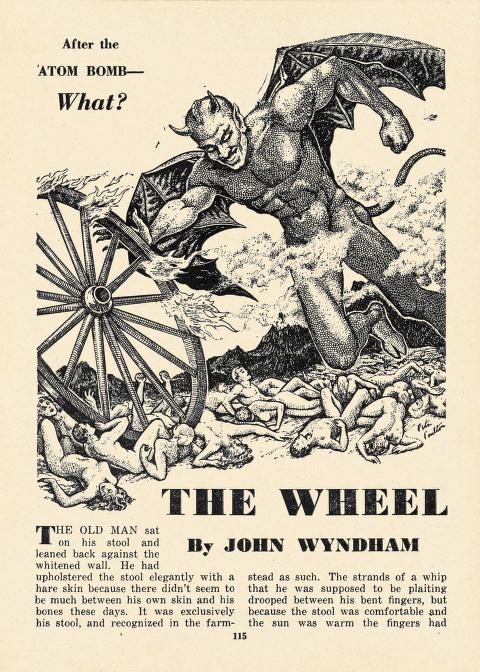
“The Wheel,” a short story by John Wyndham

“The Wheel”

by

John Wyndham


THE OLD MAN sat on his stool and leaned back against the whitened wall. He had upholstered the stool elegantly with a bare skin because there didn’t seem to be much between his own skin and his bones these days. It was exclusively his stool, and recognized in the farmstead as such. The strands of a whip that he was supposed to be plaiting drooped between his bent fingers, but because the stool was comfortable and the sun was warm the fingers had stopped moving, and his head was nodding.

The yard was empty save for a few hens that pecked more inquisitively than hopefully in the dust, but there were sounds that told of others who had not the old man’s leisure for siesta. From round the corner of the house came the occasional plonk of an empty bucket as it hit the water, and its scrape on the side of the well as it came up full. In the shack across the yard a dull pounding went on rhythmically and soporifically.

The old man’s head fell further forward as he drowsed.

Presently, from beyond the rough, enclosing wall there came another sound, slowly approaching. A rumbling and a rattling, with an intermittent squeaking. The old man’s ears were no longer sharp, and for some minutes it failed to disturb him. Then he opened his eyes and, locating the sound, sat staring incredulously toward the gateway.

The sound drew closer, and a boy’s head showed above the wall. He grinned at the old man, an expression of excitement in his eyes. He did not call out, but moved a little faster until he came to the gate. There he turned into the yard, proudly towing behind him a box mounted on four wooden wheels.

The old man got up suddenly from his seat, alarm in every line. He waved both arms at the boy as though he would push him back. The boy stopped. His expression of gleeful pride faded into astonishment. He stared at the old man who was waving him away so urgently. While he still hesitated the old man continued to shoo him off with one hand as he placed the other on his own lips, and started to walk towards him.

Reluctantly and bewilderedly the boy turned, but too late. The pounding in the shed stopped. A middle-aged woman appeared in the doorway. Her mouth was open to call, but the words did not come. Her jaw dropped slackly, her eyes seemed to bulge, then she crossed herself, and screamed….

Continue reading ““The Wheel,” a short story by John Wyndham”

“Presents” — Donald Barthelme

“Presents”

by

Donald Barthelme


In the middle of a forest. Parked there is a handsome 1932 Ford, its left rear door open. Two young women are pausing, about to step into the car. Each has one foot on the running board. Both are naked. They have their arms around each other’s waist in sisterly embrace. The woman on the left is dark, the one on the right fair. Their white, graceful backs are in sharp contrast to the shiny black of the Ford. The woman on the right has turned her head to hear something her companion is saying.


At a dinner party. The eight guests are seated, in shining white plastic shells mounted on steel pedestals, in a luxurious kitchen. They sit around a long table of polished rosewood, at one end of which there is a wicker basket filled with fruit, pineapples, bananas, pears, and at the other a wicker basket containing loaves of burnt-orange bread. The kitchen floor is polished black tile; electric ovens with bronze fronts are set into the polished off-white walls. On thick glass shelves above the diners, handsome pots with herbs, jams, jellies, and tall glass jars with half-a-dozen varieties of raw pasta. Six of the guests, men and women, are conventionally clothed. The two young women (one dark, one fair) are naked, smoking cigarillos. One of them unfolds a large white linen napkin and smoothes it over her companion’s lap.


Ten o’clock in the morning. Marble, more marble, together with walnut paneling, a terrazzo floor, on the left a long (sixty feet) black-topped counter behind which the tellers sit, on the right a beige-carpeted area with three rows (three times three) of bank officers, suited and gowned. At the back, the great vault door open, functionary seated at desk reading a Gothic novel. In the center, long lines of depositors channeled to the tellers by a flattened S-curve of blue velvet ropes. Uniformed guards, etc., the American flag drooping on its standard near the vault. Two young women enter. They are naked except for black masks. One is dark, one fair. They place themselves back-to-back in the center of the banking floor. The guards rush toward them, then rush away again.


A woman seated on a plain wooden chair under a canopy. She is wearing white overalls and has a pleased expression on her face. Watching her, two dogs, German shepherds, at rest. Behind the dogs, with their backs to us, a row of naked women kneeling, sitting on their heels, their buttocks perfect as eggs or O’s — OOOOOOOOOOOOO. In profile to the scene, at the far right, Henry James — his calm, accepting gaze.


Two young women wrapped as gifts. But the gift-wrapping is indistinguishable from ordinary clothing. Or there is a distinction, in that what they are wearing is perhaps a shade newer, brighter, more studied than ordinary clothing, proclaims the specialness of what is wrapped, argues for immediate unwrapping, or if not that, unwrapping at leisure, with wine, cheese, sour cream.


Two young women, naked, tied together by a long red thread. One is dark, one is fair.


Large (eight by ten feet) sheets of white paper on the floor, six or eight of them. The total area covered is perhaps 200 feet square; some of the sheets overlap. A string quartet is playing at one edge of this area, and irregular rows of handsomely-dressed spectators border another. A large bucket of blue paint sits on the paper. Two young women, naked. Each has her hair rolled up in a bun; each has been splashed, breasts, belly, and thighs, with blue paint. One, on her belly, is being dragged across the paper by the other, who is standing, gripping the first woman’s wrists. Their backs are not painted. Or not painted with. The artist is Yves Klein.


Two young men, wrapped as gifts. They have wrapped themselves carefully, tight pants, open-throated shirts, shoes with stacked heels, gold jewelry on right and left wrists, codpieces stuffed with credit cards. They stand, under a Christmas tree big as an office building, the women rush toward them. Or they stand, under a Christmas tree big as an office building, and no women rush toward them. A voice singing inappropriate Easter songs, hallelujahs.


Two young men, artists, naked in a loft on Broome Street, are painting a joint portrait of four young women, fully clothed, who are standing in a row with their backs to the artists, who are sipping coffee from paper cups (the paper cup held in the left hand, the brush or palette knife in the right) and carefully regarding the backs of the women, who from time to time let slip from the sides of their mouths comments (encouraging or disparaging) about the artists, who for their part are not intimidated by these comments which have mostly to do with the weather and future projects but in some cases with the comparative beauty and masculinity (because of course the women have opinions about these matters, expressed in whispers just loud enough to be overheard) of the naked artists, who are mostly worried about the stamina and comfort (four or five hours’ work yet ahead) of the women, who are feeling rather hot and peevish in the white-painted, rather stuffy (although the big windows have been opened) loft of the artists, who are perfectly comfortable themselves, being naked, but do recognize the fact that some discomfort may be engendered by the heavy overcoats worn by the women, who are in truth pulling and tugging irritably upon these gross garments, increasing the nervousness of the artists, who are also concerned about the effect the scene might have upon someone who just blundered into it, such as the four lovers of the women, who are thinking now (by coincidence) of those selfsame lovers, Luke, Matt, John, and Mark, and what they might say if, battered by the heat of the hot sun, they staggered into an air-conditioned art gallery and there beheld a sixteen-by-forty foot painting of four backs, backs that they know intimately even through the layers of clothes, and begin to wonder whether the clothes on those backs had just been painted on (but of course they had been painted on, like everything else on the canvas) but had been really there while the women were posing for the naked artists, who are as character types notoriously . . .


Nowhere — the middle of it, its exact center. Standing there, a telephone booth, green with tarnished aluminum, the word PHONE and the system’s symbol (bell in ring) in medium blue. Inside the telephone booth, two young women, one dark, one fair, facing each other. Their breasts and thighs brush lightly (one holding the receiver to the other’s ear) as they place phone calls to their mothers in California and Maine. In profile to the scene, at far right, Henry James, wearing white overalls.


Henry James, wearing white overalls (Iron Boy brand) is attending a film. On the screen two young women, naked, are playing ping-pong. One makes a swipe with her paddle at a ball the other has placed just over the net and misses, bruising her right leg. The other puts down her paddle and walks around the table (gracefully) to examine the bruise; she places her hands on either side of the raw, ugly mark, then bends to kiss it. Henry James picks up his hat and walks thoughtfully from the theatre. Behind the popcorn machine in the lobby stand two young women, naked, one dark and one fair. Henry James approaches the popcorn stand and purchases, for 35¢, a bag of M & Ms. He opens the bag with his teeth. The women smile at each other.


Two young women wearing web belts to which canteens are attached, nothing more, marching down Broadway again. They are followed by a large crowd, bands, etc.


A plaza or open space. Two young women on their hands and knees. They are separated by a distance of eight feet, both facing in the same direction. Rough wooden boards (one by tens) have been laid across their backs to form a sort of table. On top of the table are piled bags and bags of M & Ms, hundreds of bags some of which have been opened spilling the chocolate out onto the table. A small army of insects, not ants but other chocolate-loving insects, informed of this prime target by scouts, is advancing across the plaza toward the rear of the table. The vanguard (the insects are a half-inch long and, closely inspected, resemble tiny black toothbrushes) reaches the left leg of the young woman on the left side of the table. The boldest members leap upon the leg, a line of insects runs up the leg toward the cleft of the buttocks. The table shudders and collapses.


The world of work. Two young women, one dark, one fair, wearing web belts to which canteens are attached, nothing more. They are sitting side-by-side on high stools (OO OO) before a pair of draughting tables, inking-in pencil drawings. Or, in a lumberyard in Southern Illinois, they are unloading a railroad car containing several hundred thousand board feet of Southern yellow pine. Or, in the composing room of a medium-sized Akron daily, they are passing long pieces of paper through a machine which deposits a thin coating of wax on the back side, and then positioning the type on a page. Or, they are driving two Yellow cabs which are racing side-by-side up Park Avenue with frightened passengers, each driver trying to beat the other to a hole in the traffic in front of them. Or, they are seated at adjacent desks in the beige-carpeted area set apart for officers in a bank (possibly the very same bank they had entered, naked, masked, several days ago), refusing loans. Or, they are standing bent over, hands on knees, peering into the site of an archaeological dig in the Cameroons. Or, they are teaching, in adjacent classrooms, Naked Physics — in the classroom on the left, Naked Physics I, and in the classroom on the right, Naked Physics II. These courses are very popular. Or, they are kneeling, sitting on their heels, before a pair of shoeshine sta
nds, polishing the expensive boots, suave loafers, of their admiring customers. OO OO.


Two women, one dark and one fair, wearing parkas, blue wool watch caps on their heads, inspecting a row of naked satyrs, hairy-legged, split-footed, tailed and tufted, who hang on hooks in a meat locker where the temperature is a constant 18 degrees. The women are tickling the satyrs under the tail, where they are most vulnerable, with their long white (nimble) fingers tipped with long curved scarlet nails. The satyrs squirm and dance under this treatment, hanging from hooks, while other women, seated in red plush armchairs, in the meat locker, applaud, or scold, or hug and kiss, in the meat locker.


Two women, one dark and one fair, wearing parkas, blue wool watch caps on their heads, inspecting a row of naked young men, hairy-legged, many-toed, pale and shivering, who hang on hooks in a meat locker where the temperature is a constant 18 degrees. The women are tickling the young men under the tail, where they are most vulnerable, with their long white (nimble) fingers tipped with long curved scarlet nails. The young men squirm and dance under this treatment, hanging from hooks, while giant eggs, seated in red plush chairs, boil.


Two young women, naked, trundle the giant boiled eggs to market in wheelbarrows. They move through double rows of shouting civilians who applaud the size, whiteness, and exquisite shape of the eggs, and the humor and good cheer of the women. The grandest eggs ever seen in this part of the country, and the most gloriously-powered wheelbarrows! There is no end to the intoxicating noise. The women are sweating, moisture visible on their backs, on their legs and breasts, on their white, beautifully-formed shoulders. Yet they smile, and smile, and smile, their hands on the handles of the wheelbarrows, their sturdy sweating backs bent into the work. Like Henry James writing a novel, they trundle onward, placing one foot in front of the other in sweet, determined, dogged bliss — the achievement of a task.


Bliss: A condition of extreme happiness, euphoria. The nakedness of young women, especially in pairs (that is to say, a plenitude) often produces bliss in the eye of the beholder, male or female. If you have an elbow in your mouth, then you are occupied, for the moment, but your mind often wanders away, toward more bliss, wondering if you should be doing something else, with your arms and legs, so as to provide more static along the surface of the situation, wherein the two (naked) young women lie unfolded before you, waiting for you to fold them up again in new, interesting ways. Oh they are good kids, no doubt about it, and brave and forthright too, and mind their manners and their eggs, and have hope and ambitions, and are supportive and giving as well as chilly and austere — most of all, naked. That is a delight, let us confess the fact, and that is why we are considering all these different ways in which naked young women may be conceptualized, in the privacy of our studies, dealt out like cards from a deck of thin, flexible, six-foot-tall mirrors. Doubtless women do the same sort of thing in regard to us, in the privacy of their studies, or even better things, things we have not yet been able to imagine, or possibly nothing at all — maybe they just sit there, the beauty of a naked thumb, for example, or a passionate, interestingly-historied wrist. What if they don’t care? If this is the case, send them to the elephants, let them sit around all day listening to the elephants cry “Long live King Babar! Long live Queen Celeste!” Few naked young women can take much of this.


Back to business: Two naked young women are walking, with an older man in a white suit, on a plain in British Columbia. The older man has told them that he is Henry James, returned to earth in a special dispensation accorded those whose works, in life, have added to the gaiety of nations. They do not quite believe him, yet he is stately, courteous, beautifully-spoken, full of anecdotes having to do with the upper levels of London society. One of the naked young women reaches across the chest of Henry James to pinch, lightly, the rosy, full breast of the second young woman, who —

Read “Red Rubber Gloves,” a short story by Christine Brooke-Rose

“Red Rubber Gloves”

by

Christine Brooke-Rose


From this position on my high balcony, the semi-detached beyond the garden looks more squat than it ought to in such a prosperous suburb, forming with its Siamese twin a square inverted U that faces me and boxes a wide inverted T of a back-yard, neatly divided by a hedge of roses and hydrangeas. On the left of the hedge there is a bit of lawn. On the right, only a small paved yard. The house on the left seems devoid of life, devoid, that is, of the kind of life liable to catch the eye and stop it in its casual round, mutating its idle curiosity through momentary fascination and hence, inexorably, by the mere process of reiteration, to a mild but fixed obsessiveness. As does the right-hand house.

In the angle of the square U, outside the french windows of the right-hand house, the girl sits on the edge of the red canvas bed in a pale pink bikini, carefully oiling inch after inch of her thin white body. She looks, from up here, totally naked, the pink bikini being so pale, and she sits on the edge of the red canvas bed which is set obliquely in the paved yard to face the morning sun. She has oiled the arms, the shoulders, the chest and the long midriff. Now she is doing the right leg, starting with the foot, the ankle, then the shin, as if to meet her upper oily self half way. She is oiling the right thigh. Inside the thigh. The left foot. If the heat-wave holds out she will perhaps become brown enough to contrast with the pink and so look less totally naked on the red canvas bed. The inside of the left thigh. She lies now framed in the red canvas bed, chin up, eyes closed to face the hot June sun. Round the corner from her naked body, at the square end of the inverted U, the red rubber gloves lie quiet on the kitchen window-sill.

In the morning the large rectangular windows of the house tend to reflect the sun in some at least of their thirty-two small black squares framed in cream-painted wood. And in the afternoon they are quite cast into the shade as the sun moves round to face me on my high balcony, immobilised in convalescence. I cannot therefore see much further than the beginning of the pink wash-basin in the bathroom or, in the kitchen below it, the long and gleaming double-sink unit. And the red rubber gloves, moving swiftly apart and together, vanishing and reappearing, moving apart and down. All the windows of both houses, those of the kitchen and of the bathroom above it, at each end of the square inverted U, and those of each bedroom inside the U above the french windows, are rectangular and divided into four panels, each of eight black squares, two over two over two over two, all in cream-painted frames.

The thin girl has melted away into the sun, the red canvas bed is empty. Continue reading “Read “Red Rubber Gloves,” a short story by Christine Brooke-Rose”

Read “The Pedestrian,” a short story by Ray Bradbury

“The Pedestrian”

by

Ray Bradbury

To enter out into that silence that was the city at eight o’clock of a misty evening in November, to put your feet upon that buckling concrete walk, to step over grassy seams and make your way, hands in pockets, through the silences, that was what Mr Leonard Mead most dearly loved to do. He would stand upon the corner of an intersection and peer down long moonlit avenues of sidewalk in four directions, deciding which way to go, but it really made no difference; he was alone in this world of 2053 A.D., or as good as alone, and with a final decision made, a path selected, he would stride off, sending patterns of frosty air before him like the smoke of a cigar. Continue reading “Read “The Pedestrian,” a short story by Ray Bradbury”

Read “What a Thought,” a short story by Shirley Jackson

“What a Thought”

by

Shirley Jackson


Dinner had been good. Margaret sat with her book on her lap and watched her husband digesting, an operation to which he always gave much time and thought. As she watched he put his cigar down without looking and used his free hand to turn the page of his paper. Margaret found herself thinking with some pride that unlike many men she had heard about, her husband did not fall asleep after a particularly good dinner.

She flipped the pages of her book idly; it was not interesting. She knew that if she asked her husband to take her to a movie, or out for a ride, or to play gin rummy, he would smile at her and agree; he was always willing to do things to please her, still, after ten years of marriage. An odd thought crossed her mind: she would pick up the heavy glass ashtray and smash her husband over the head with it.

“Like to go to a movie?” her husband asked.

“I don’t think so, thanks,” Margaret said. “Why?”

“You look sort of bored,” her husband said.

“Were you watching me?” Margaret asked. “I thought you were reading.”

“Just looked at you for a minute.” He smiled at her, the smile of a man who is still, after ten years of marriage, very fond of his wife.

The idea of smashing the glass ashtray over her husband’s head had never before occurred to Margaret, but now it would not leave her mind. She stirred uneasily in her chair, thinking: what a terrible thought to have, whatever made me think of such a thing? Probably a perverted affectionate gesture, and she laughed. Continue reading “Read “What a Thought,” a short story by Shirley Jackson”

Read “The White People,” a supernatural tale by Arthur Machen

“The White People”

by

Arthur Machen


PROLOGUE

‘Sorcery and sanctity,’ said Ambrose, ‘these are the only realities. Each is an ecstasy, a withdrawal from the common life.’

Cotgrave listened, interested. He had been brought by a friend to this mouldering house in a northern suburb, through an old garden to the room where Ambrose the recluse dozed and dreamed over his books.

‘Yes,’ he went on, ‘magic is justified of her children. There are many, I think, who eat dry crusts and drink water, with a joy infinitely sharper than anything within the experience of the “practical” epicure.’

‘You are speaking of the saints?’

‘Yes, and of the sinners, too. I think you are falling into the very general error of confining the spiritual world to the supremely good; but the supremely wicked, necessarily, have their portion in it. The merely carnal, sensual man can no more be a great sinner than he can be a great saint. Most of us are just indifferent, mixed-up creatures; we muddle through the world without realizing the meaning and the inner sense of things, and, consequently, our wickedness and our goodness are alike second-rate, unimportant.’

‘And you think the great sinner, then, will be an ascetic, as well as the great saint?’

‘Great people of all kinds forsake the imperfect copies and go to the perfect originals. I have no doubt but that many of the very highest among the saints have never done a “good action” (using the words in their ordinary sense). And, on the other hand, there have been those who have sounded the very depths of sin, who all their lives have never done an “ill deed.”‘

He went out of the room for a moment, and Cotgrave, in high delight, turned to his friend and thanked him for the introduction.

‘He’s grand,’ he said. ‘I never saw that kind of lunatic before.’

Ambrose returned with more whisky and helped the two men in a liberal manner. He abused the teetotal sect with ferocity, as he handed the seltzer, and pouring out a glass of water for himself, was about to resume his monologue, when Cotgrave broke in—

‘I can’t stand it, you know,’ he said, ‘your paradoxes are too monstrous. A man may be a great sinner and yet never do anything sinful! Come!’

‘You’re quite wrong,’ said Ambrose. ‘I never make paradoxes; I wish I could. I merely said that a man may have an exquisite taste in Romanée Conti, and yet never have even smelt four ale. That’s all, and it’s more like a truism than a paradox, isn’t it? Your surprise at my remark is due to the fact that you haven’t realized what sin is. Oh, yes, there is a sort of connexion between Sin with the capital letter, and actions which are commonly called sinful: with murder, theft, adultery, and so forth. Much the same connexion that there is between the A, B, C and fine literature. But I believe that the misconception—it is all but universal—arises in great measure from our looking at the matter through social spectacles. We think that a man who does evil to us and to his neighbours must be very evil. So he is, from a social standpoint; but can’t you realize that Evil in its essence is a lonely thing, a passion of the solitary, individual soul? Really, the average murderer, quâ murderer, is not by any means a sinner in the true sense of the word. He is simply a wild beast that we have to get rid of to save our own necks from his knife. I should class him rather with tigers than with sinners.’

‘It seems a little strange.’

‘I think not. The murderer murders not from positive qualities, but from negative ones; he lacks something which non-murderers possess. Evil, of course, is wholly positive—only it is on the wrong side. You may believe me that sin in its proper sense is very rare; it is probable that there have been far fewer sinners than saints. Yes, your standpoint is all very well for practical, social purposes; we are naturally inclined to think that a person who is very disagreeable to us must be a very great sinner! It is very disagreeable to have one’s pocket picked, and we pronounce the thief to be a very great sinner. In truth, he is merely an undeveloped man. He cannot be a saint, of course; but he may be, and often is, an infinitely better creature than thousands who have never broken a single commandment. He is a great nuisance to us, I admit, and we very properly lock him up if we catch him; but between his troublesome and unsocial action and evil—Oh, the connexion is of the weakest.’

It was getting very late. The man who had brought Cotgrave had probably heard all this before, since he assisted with a bland and judicious smile, but Cotgrave began to think that his ‘lunatic’ was turning into a sage.

‘Do you know,’ he said, ‘you interest me immensely? You think, then, that we do not understand the real nature of evil?’ Continue reading “Read “The White People,” a supernatural tale by Arthur Machen”

“Columbus in Chains” — Jamaica Kincaid

“Columbus in Chains”

by

Jamaica Kincaid


Outside, as usual, the sun shone, the trade winds blew; on her way to put some starched clothes on the line, my mother shooed some hens out of her garden; Miss Dewberry baked the buns, some of which my mother would buy for my father and me to eat with our afternoon tea; Miss Henry brought the milk, a glass of which I would drink with my lunch, and another glass of which I would drink with the bun from Miss Dewberry; my mother prepared our lunch; my father noted some perfectly idiotic thing his partner in housebuilding, Mr. Oatie, had done, so that over lunch he and my mother could have a good laugh.

The Anglican church bell struck eleven o’clock—one hour to go before lunch. I was then sitting at my desk in my classroom. We were having a history lesson—the last lesson of the morning. For taking first place over all the other girls, I had been given a prize, a copy of a book called Roman Britain, and I was made prefect of my class. What a mistake the prefect part had been, for I was among the worst-behaved in my class and did not at all believe in setting myself up as a good example, the way a prefect was supposed to do. Now I had to sit in the prefect’s seat—the first seat in the front row, the seat from which I could stand up and survey quite easily my classmates. From where I sat I could see out the window. Sometimes when I looked out, I could see the sexton going over to the minister’s house. The sexton’s daughter, Hilarene, a disgusting model of good behavior and keen attention to scholarship, sat next to me, since she took second place. The minister’s daughter, Ruth, sat in the last row, the row reserved for all the dunce girls. Hilarene, of course, I could not stand. A girl that good would never do for me. I would probably not have cared so much for first place if I could be sure it would not go to her. Ruth I liked, because she was such a dunce and came from England and had yellow hair. When I first met her, I used to walk her home and sing bad songs to her just to see her turn pink, as if I had spilled hot water all over her.

Our books, A History of the West Indies, were open in front of us. Our day had begun with morning prayers, then a geometry lesson, then it was over to the science building for a lesson in “Introductory Physics” (not a subject we cared much for), taught by the most dingy-toothed Mr. Slacks, a teacher from Canada, then precious recess, and now this, our history lesson. Recess had the usual drama: this time, I coaxed Gwen out of her disappointment at not being allowed to join the junior choir. Her father—how many times had I wished he would become a leper and so be banished to a leper colony for the rest of my long and happy life with Gwen—had forbidden it, giving as his reason that she lived too far away from church, where choir rehearsals were conducted, and that it would be dangerous for her, a young girl, to walk home alone at night in the dark. Of course, all the streets had lamplight, but it was useless to point that out to him. Oh, how it would have pleased us to press and rub our knees together as we sat in our pew while pretending to pay close attention to Mr. Simmons, our choirmaster, as he waved his baton up and down and across, and how it would have pleased us even more to walk home together, alone in the “early dusk” (the way Gwen had phrased it, a ready phrase always on her tongue), stopping, if there was a full moon, to lie down in a pasture and expose our bosoms in the moonlight. We had heard that full moonlight would make our breasts grow to a size we would like. Poor Gwen! When I first heard from her that she was one of ten children, right on the spot I told her that I would love only her, since her mother already had so many other people to love.

Our teacher, Miss Edward, paced up and down in front of the class in her usual way. In front of her desk stood a small table, and on it stood the dunce cap. The dunce cap was in the shape of a coronet, with an adjustable opening in the back, so that it could fit any head. It was made of cardboard with a shiny gold paper covering and the word “DUNCE” in shiny red paper on the front. When the sun shone on it, the dunce cap was all aglitter, almost as if you were being tricked into thinking it a desirable thing to wear. As Miss Edward paced up and down, she would pass between us and the dunce cap like an eclipse. Each Friday morning, we were given a small test to see how well we had learned the things taught to us all week. The girl who scored lowest was made to wear the dunce cap all day the following Monday. On many Mondays, Ruth wore it—only, with her short yellow hair, when the dunce cap was sitting on her head she looked like a girl attending a birthday party in The Schoolgirl’s Own Annual.

It was Miss Edward’s way to ask one of us a question the answer to which she was sure the girl would not know and then put the same question to another girl who she was sure would know the answer. The girl who did not answer correctly would then have to repeat the correct answer in the exact words of the other girl. Many times, I had heard my exact words repeated over and over again, and I liked it especially when the girl doing the repeating was one I didn’t care about very much. Pointing a finger at Ruth, Miss Edward asked a question the answer to which was “On the third of November 1493, a Sunday morning, Christopher Columbus discovered Dominica.” Ruth, of course, did not know the answer, as she did not know the answer to many questions about the West Indies. I could hardly blame her. Ruth had come all the way from England. Perhaps she did not want to be in the West Indies at all. Perhaps she wanted to be in England, where no one would remind her constantly of the terrible things her ancestors had done; perhaps she had felt even worse when her father was a missionary in Africa. I could see how Ruth felt from looking at her face. Her ancestors had been the masters, while ours had been the slaves. She had such a lot to be ashamed of, and by being with us every day she was always being reminded. We could look everybody in the eye, for our ancestors had done nothing wrong except just sit somewhere, defenseless. Of course, sometimes, what with our teachers and our books, it was hard for us to tell on which side we really now belonged—with the masters or the slaves—for it was all history, it was all in the past, and everybody behaved differently now; all of us celebrated Queen Victoria’s birthday, even though she had been dead a long time. But we, the descendants of the slaves, knew quite well what had really happened, and I was sure that if the tables had been turned we would have acted differently; I was sure that if our ancestors had gone from Africa to Europe and come upon the people living there, they would have taken a proper interest in the Europeans on first seeing them, and said, “How nice,” and then gone home to tell their friends about it. Continue reading ““Columbus in Chains” — Jamaica Kincaid”

“The Brother” — Robert Coover

“The Brother”

by

Robert Coover


right there right there in the middle of the damn field he says he wants to put that thing together him and his buggy ideas and so me I says “how the hell you gonna get it down to the water?” but he just focuses me out sweepin the blue his eyes rollin like they do when he gets het on some new lunatic notion and he says not to worry none about that just would I help him for God’s sake and because he don’t know how he can get it done in time otherwise and though you’d have to be loonier than him to say yes I says I will of course I always would crazy as my brother is I’ve done little else since I was born and my wife she says “I can’t figure it out I can’t sec why you always have to be babyin that old fool he ain’t never done nothin for you God knows and you got enough to do here fields need plowin it’s a bad enough year already my God and now that red-eyed brother of yours wingin around like a damn cloud and not knowin what in the world he’s doin buildin a damn boat in the country my God what next? you’re a damn fool I tell you” but packs me some sandwiches just the same and some sandwiches for my brother Lord knows his wife don’t have no truck with him no more says he can go starve for all she cares she’s fed up ever since the time he made her sit out on a hillside for three whole days rain and everything because he said she’d see God and she didn’t see nothin and in fact she like to die from hunger nothin but berries and his boys too they ain’t so bright neither but at least they come to help him out with his damn boat so it ain’t just the two of us thank God for that and it ain’t no goddamn fishin boat he wants to put up neither in fact it’s the biggest damn thing I ever heard of and for weeks wees I’m tellin you we ain’t doin nothin but cuttin down pine trees and haulin them out to his field which is really pretty high up a hill and my God that’s work lemme tell you and my wife she sighs and says I am really crazy r-e-a-1-l-y crazy and her four months with a child and tryin to do my work and hers too and still when I come home from haulin timbers around all day she’s got enough left to rub my shoulders and the small of my back and fix a hot meal her long black hair pulled to a knot behind her head and hangin marvelously down her back her eyes gentle but very tired my God and I says to my brother I says “look I got a lotta work to do buddy you’ll have to finish this idiot thing yourself I wanna help you all I can you know that but” and he looks off and he says “it don’t matter none your work” and I says “the hell it don’t how you think me and my wife we’re gonna eat I mean where do you think this food comes from you been puttin away man? you can’t eat this goddamn boat out here ready to rot in that bastard sun” and he just sighs long and says “no it just don’t matter” and he sits him down on a rock kinda tired like and stares off and looks like he might even for God’s sake cry and so I go back to bringin wood up to him and he’s already started on the keel and frame God knows how he ever found out to build a damn boat lost in his fog where he is Lord he was twenty when I was born and the first thing I remember was havin to lead him around so he didn’t get kicked by a damn mule him who couldn’t never do nothin in a normal way just a huge oversize fuzzyface boy so anyway I take to gettin up a few hours earlier ever day to do my farmin my wife apt to lose the baby if she should keep pullin around like she was doin then I go to work on the boat until sundown and on and on the days hot and dry and my wife keepin good food in me or else I’d of dropped sure and no matter what I say to try and get out of it my brother he says “you come and help now the rest don’t matter” and we just keep hammerin away and my God the damn thing is big enough for a hundred people and at least I think at least it’s a place to live and not too bad at that at least it’s good for somethin but my wife she just sighs and says no good will come of it and runs her hands through my hair but she don’t ask me to stop helpin no more because she knows it won’t do no good and she’s kinda turned into herself now these days and gettin herself all ready and still we keep workin on that damn thing that damn boat and the days pass and my brother he says we gotta work harder we ain’t got much time and from time to time he gets a coupla neighbors to come over and give a hand them sucked in by the size and the novelty of the thing makin jokes some but they don’t stay around more than a day or two and they go away shakin their heads and swearin under their breath and disgusted they got weaseled into the thing in the first place and me I only get about half my place planted and sec to my stock as much as I can my wife she takes more care of them than I can but at least we won’t starve we say if we just get some rain and finally we get the damn thing done all finished by God and we cover it in and out with pitch and put a kinda fancy roof on it and I come home on that last day and I ain’t never goin back ain’t never gonna let him talk me into nothin again and I’m all smellin of tar and my wife she cries and cries and I says to her not to worry no more I’ll be home all the time and me I’m cryin a little too though she don’t notice just thinkin how she’s had it so lonely and hard and all and for one whole day I just sleep the whole damn day and the rest of the week I work around the farm and one day I get an idea and I go over to my brother’s place and get some pieces of wood left over and whaddaya know? they are all livin on that damn boat there in the middle of nowhere him and his boys and some women and my brother’s wife she’s there too but she’s madder than hell and carpin at him to get outa that damn boat and come home and he says she’s got just one more day and then he’s gonna drug her on the boat but he don’t say it like a threat or nothin more like a fact a plain fact tomorrow he’s gonna drug her on the boat well I ain’t one to get mixed up in domestic quarrels God knows so I grab up the wood and beat it back to my farm and that evenin I make a little cradle a kinda fancy one with little animal figures cut in it and polished down and after supper I give it to my wife as a surprise and she cries and cries and holds me tight and says don’t never go away again and stay close by her and all and I feel so damn good and warm about it all and glad the boat thing is over and we get out a little wine and we decide the baby’s name is gonna be either Nathaniel or Anna and so we drink an extra cup to Nathaniel’s health and we laugh and we sigh and drink one to Anna and my wife she gently fingers the little animal figures and says they’re beautiful and really they ain’t I ain’t much good at that sorta thing but I know what she means and then she says “where did you get the wood?” and I says “it’s left over from the boat” and she don’t say nothin for a moment and then she says “you been over there again today?” and I says “yes just to get the wood” and she says “what’s he doin now he’s got the boat done?” and I says “funny thing they’re all living in the damn thing all except the old lady she’s over there hollerin at him how he’s gettin senile and where does he think he’s sailin to and how if he ain’t afraid of runnin into a octypuss on the way he oughta get back home and him sayin she’s a nut there ain’t no water and her sayin that’s what she’s been tellin him for six months” and my wife she laughs and it’s the happiest laugh I’ve heard from her in half a year and I laugh and we both have another cup-of wine and my wife she says “so he’s just livin on that big thing all by hisself?” and I says “no he’s got his boys on there and some young women who are maybe wives of the boys or somethin I don’t know I ain’t never seen them before and all kinda damn animals and birds and things I ain’t never seen the likes” and my wife she says “animals? what animals?” and I says “oh all kinds I don’t know a whole damn menagerie all clutterin and stinkin up the boat God what a mess” and my wife laughs again and she’s a little silly with the wine and she says “I bet he ain’t got no pigs” and “oh yes I seen them” I says and we laugh thinkin about pigs rootin around in that big tub and she says “I bet he ain’t got no jackdaws” and I says “yes I seen a couple o£ them too or mostly I heard them you couldn’t hardly hear nothin else” and we laugh again thinkin about them crows and his old lady and the pigs and all and my wife she says “I know what he ain’t got I bet he ain’t got no lice” and we both laugh like crazy and when I can I says “oh yes he does less he’s took a bath” and we both laugh til! we’re cryin and we finish off the wine and my wife says “look now I fyiow what he ain’t got he ain’t got no termites” and I says “you’re right I don’t recollect no termites maybe we oughta make him a present” and my wife she holds me close quiet all of a sudden and says “he’s really movin Nathaniel’s really movin” and she puts my hand down on her round belly and the little fella is kickin up a terrific storm and I says kinda anxious “does it hurt? do you think that—?” and “no” she says “it’s good” she says and so I says with my hand on her belly “here’s to you Nathaniel” and we drain what’s left in the bottom of our cups and the next day we wake up in each other’s arms and it’s rainin and than God we say and since it’s rainin real good we stay inside and do things a round the place and we’re happy because the rain has come just in time and in the evenin things smell green and fresh and delicious and it’s still rainin a little but not too hard so I decide to take a walk and I wander over by my brother’s place thinkin I’ll ask him if he’d like to take on some pet termites to go with his collection and there by God is his wife on the boat and I don’t know if he drug her on or if she just finally come by herself but she ain’t sayin nothin which is damn unusual and the boys they ain’t sayin nothin neither and my brother he ain’t sayin nothin they’re just all standin up there on top and gazin off and I holler up at them “nice rain ain’t it?” and my brother he looks down at me standin there in the rain and still he don’t say nothin but he raises his hand kinda funny like and then puts it back on the rail and I decide not to say nothin about the termites and it’s startin to rain a little harder again so I turn away and go back home and I tell my wife about what happened and my wife she just laughs and says “they’re all crazy he’s finally got them all crazy” and she’s cooked me up a special pastry with £rcsh meat and so we forget about them but by God the next day the rain’s still comin down harder than ever and water’s beginnin to stand around in places and after a week of rain I can see the crops is pretty well ruined and I’m havin trouble keepin my stock fed and my wife she’s cryin and talkin about our bad luck that we might as well of built a damn boat as plant all them crops and still we don’t figure things out I mean it just don’t come to our minds not even when the rain keeps spillin down like a ocean dumped upsidedown and now water is beginnin to stand around in big pools really big ones and water up to the ankles around the house and Icakin in and pretty soon the whole damn house is gettin fulla water and I keep sayin maybe we oughta go use my brother’s boat till this blows over but my wife she says “never” and then she starts in cryin again so finally I says to her I says “we can’t be so proud I’ll go ask him” and so I set out in the storm and I can hardly see where I’m goin and I slip up to my neck in places and finally I get to where the boat is and I holler up and my brother he comes out and he looks down at where I am and he don’t say nothin that bastard he just looks at me and I shout up at him I says “hey is it all right for me and my wife to come over until this thing blows over?” and still he don’t say a damn word he just raises his hand in that same sillyass way and I holler “hey you stupid sonuvabitch I’m soakin wet goddamn it and my house is fulla water and my wife she’s about to have a kid and she’s apt to get sick all wet and cold to the bone and all I’m askin you—” and right then right while I’m still talkin he turns around and he goes back in the boat and I can’t hardly believe it me his brother but he don’t come back out and I push up under the boat and I beat on it with my fists and scream at him and call him ever name I can think up and I shout for his boys and for his wife and for anybody inside and nobody comes out “Gowdamn you” I cry out at the top of my lungs and half sobbin and sick and then feelin too beat out to do anythin more I turn around and head back for home but the rain is thunderin down like mad now and in places I gotta swim and I can’t make it no further and I recollect a hill nearby and I head for it and when I get to it I climb up on top of it and it feels good to be on land again even if it is soggy and greasy and I vomit and retch there awhile and move further up and the next thing I know I’m wakin up the rain still in my face and the water halfway up the hill toward me and I look cut and I can see my brother’s boat is fioatin and I wave at it but I don’t see nobody wave back and then I quick look out towards my own place and all I can see is the top of it and of a sudden I’m scared scared about my wife and I go tearin for the house swimmin most all the way and cryin and shoutin and the rain still comin down like crazy and so now well now I’m back here on the hill again what little there is left of it and I’m figurin maybe I got a day left if the rain keeps comin and it don’t show no signs of stoppin and I can’t see my brother’s boat no more gone just water how how did he know? that bastard and yet I gotta hand it to him it’s not hard to see who’s crazy around here I can’t see my house no more I just left my wife inside where I found her I couldn’t hardly stand to look at her the way she was

Read “Bitterness for Three Sleepwalkers,” a short story by Gabriel García Márquez

“Bitterness for Three Sleepwalkers”

by

Gabriel García Márquez

translated by Gregory Rabassa


Now we had her there, abandoned in a corner of the house. Someone told us, before we brought her things – her clothes which smelled of newly cut wood, her weightless shoes for the mud – that she would be unable to get used to that slow life, with no sweet tastes, no attraction except that harsh, wattled solitude, always pressing on her back. Someone told us – and a lot of time had passed before we remembered it – that she had also had a childhood. Maybe we didn’t believe it then. But now, seeing her sitting in the corner with her frightened eyes and a finger placed on her lips, maybe we accepted the fact that she’d had a childhood once, that once she’d had a touch that was sensitive to the anticipatory coolness of the rain, and that she always carried an unexpected shadow in profile to her body.

All this – and much more – we believed that afternoon when we realized that above her fearsome subworld she was completely human. We found it out suddenly, as if a glass had been broken inside, when she began to give off anguished shouts; she began to call each one of us by name, speaking amidst tears until we sat down beside her; we began to sing and clap hands as if our shouting could put the scattered pieces of glass back together. Only then were we able to believe that at one time she had had a childhood. It was as if her shouts were like a revelation somehow; as if they had a lot of remembered tree and deep river about them. When she got up, she leaned over a little and, still without covering her face with her apron, still without blowing her nose, and still with tears, she told us:

‘I’ll never smile again.’

We went out into the courtyard, the three of us, not talking: maybe we thought we carried common thoughts. Maybe we thought it would be best not to turn on the lights in the house. She wanted to be alone – maybe – sitting in the dark corner, weaving the final braid which seemed to be the only thing that would survive her passage toward the beast.

Outside, in the courtyard, sunk in the deep vapor of the insects, we sat down to think about her. We’d done it so many times before. We might have said that we were doing what we’d been doing every day of our lives.

Yet it was different that night: she’d said that she would never smile again, and we, who knew her so well, were certain that the nightmare had become the truth. Sitting in a triangle, we imagined her there inside, abstract, incapacitated, unable even to hear the innumerable clocks that measured the marked and minute rhythm with which she was changing into dust. ‘If we only had the courage at least to wish for her death,’ we thought in a chorus. But we wanted her like that: ugly and glacial, like a mean contribution to our hidden defects.

We’d been adults since before, since a long time back. She, however, was the oldest in the house. That same night she had been able to be there, sitting with us, feeling the measured throbbing of the stars, surrounded by healthy sons. She would have been the respectable lady of the house if she had been the wife of a solid citizen or the concubine of a punctual man. But she became accustomed to living in only one dimension, like a straight line, perhaps because her vices or her virtues could not be seen in profile. We’d known that for many years now. We weren’t even surprised one morning, after getting up, when we found her face down in the courtyard, biting the earth in a hard, ecstatic way. Then she smiled, looked at us again; she had fallen out of the second-story window onto the hard clay of the courtyard and had remained there, stiff and concrete, face down on the damp clay. But later we learned that the only thing she had kept intact was her fear of distances, a natural fright upon facing space. We lifted her up by the shoulders. She wasn’t as hard as she had seemed to us at first. On the contrary, her organs were loose, detached from her will, like a lukewarm corpse that hadn’t begun to stiffen.

Her eyes were open, her mouth was dirty with that earth that already must have had a taste of sepulchral sediment for her when we turned her face up to the sun, and it was as if we had placed her in front of a mirror. She looked at us all with a dull, sexless expression that gave us – holding her in my arms now – the measure of her absence. Someone told us she was dead; and afterward she remained smiling with that cold and quiet smile that she wore at night when she moved about the house awake. She said she didn’t know how she got to the courtyard. She said that she’d felt quite warm, that she’d been listening to a cricket, penetrating, sharp, which seemed – so she said – about to knock down the wall of her room, and that she had set herself to remembering Sunday’s prayers, with her cheek tight against the cement floor.

We knew, however, that she couldn’t remember any prayer, for we discovered later that she’d lost the notion of time when she said she’d fallen asleep holding up the inside of the wall that the cricket was pushing on from outside and that she was fast asleep when someone, taking her by the shoulders, moved the wall aside and laid her down with her face to the sun.

That night we knew, sitting in the courtyard, that she would never smile again. Perhaps her inexpressive seriousness pained us in anticipation, her dark and willful living in a corner. It pained us deeply, as we were pained the day we saw her sit down in the corner where she was now; and we heard her say that she wasn’t going to wander through the house any more. At first we couldn’t believe her. We’d seen her for months on end going through the rooms at all hours, her head hard and her shoulders drooping, never stopping, never growing tired. At night we would hear her thick body noise moving between two darknesses, and we would lie awake in bed many times hearing her stealthy walking, following her all through the house with our ears. Once she told us that she had seen the cricket inside the mirror glass, sunken, submerged in the solid transparency, and that it had crossed through the glass surface to reach her. We really didn’t know what she was trying to tell us, but we could all see that her clothes were wet, sticking to her body, as if she had just come out of a cistern. Without trying to explain the phenomenon, we decided to do away with the insects in the house: destroy the objects that obsessed her.

We had the walls cleaned; we ordered them to chop down the plants in the courtyard and it was as if we had cleansed the silence of the night of bits of trash. But we no longer heard her walking, nor did we hear her talking about crickets any more, until the day when, after the last meal, she remained looking at us, she sat down on the cement floor, still looking at us, and said: ‘I’m going to stay here, sitting down,’ and we shuddered, because we could see that she had begun to look like something already almost completely like death.

That had been a long time ago and we had even grown used to seeing her there, sitting, her braid always half wound, as if she had become dissolved in her solitude and, even though she was there to be seen, had lost her natural faculty of being present. That’s why we now knew that she would never smile again; because she had said so in the same convinced and certain way in which she had told us once that she would never walk again. It was as if we were certain that she would tell us later: ‘I’ll never see again,’ or maybe ‘I’ll never hear again,’ and we knew that she was sufficiently human to go along willing the elimination of her vital functions and that spontaneously she would go about ending herself, sense by sense, until one day we would find her leaning against the wall, as if she had fallen asleep for the first time in her life. Perhaps there was still a lot of time left for that, but the three of us, sitting in the courtyard, would have liked to hear her sharp and sudden broken-glass weeping that night, at least to give us the illusion that a baby … a girl baby had been born in the house. In order to believe that she had been born renewed.

“The Rest of the Novel” — Stanley Elkin

“The Rest of the Novel”

an essay by

Stanley Elkin

collected in Pieces of Soap


For conveying ideas, novels are among the least functional and most decorative of the blunt instruments. (Could this be a universal truth, some starry, operative mathematical principle? Most stars are decorative too, of course, their function merely to peg the universe in place like studs in upholstery, servicing the elegancies, strumming its physics like a man with a blue guitar, fleshing all the centripetals and centrifugals, stringing the planets like beads, some beautiful pump of placement, arranging night, moving the planetary furniture, and fixing the astronomical data, but less useful, finally, in the sense that a handful more here or a dollop less there could make as much of a never mind as corks or rhythm, less useful, finally, than mail or ice cream.) And if, a few times in a way, novels like Richard Henry Dana’s Two Years Before the Mast or Beecher Stowe’s Uncle Tom’s Cabin or Steinbeck’s Grapes of Wrath come along to legislate, or raise a consciousness or two, or rouse a rabble, to make, I mean, what history or the papers call a difference, why that’s decorative, too, I think, a lip service the system, touching the bases like a superstitious braille, pays art—like, oh, the claims made a few years back for the “We Are the World” folks when it was really the Catholic Relief Services already on site during the Ethiopian famine that did the heavy lifting.

Well it’s not the novelist’s fault. Not that they don’t deserve some of the blame, leaking encouragement like someone paying out line to fish, some of your have-cake-and-eat-its like a little miracle of the loaves. And there are still a few big mouths who stake claims for the ameliorative shamanism of—hark! this is interesting: not the book so much as the writer—the practice of fiction—the loyal, Nutso Art Jerk Groupie, like some devoted cultist, the last Deadhead, say, worrying like holy beads the shoelace on his wrist he thinks is a bracelet making confrontation with an Elvis Presley impersonator.

Isn’t it pretty to think so, though? To take oneself as seriously as one’s readers sometimes do? To believe, if only briefly, and if only by the light off the gloss of the brittlest mood swing, in the justice or even the palpability of one’s cause, to Don Quixote principle, any principle, and raise to the level of purpose what in the final analysis is only what given egos, fashionably or not, fashion or no, frozen in mere season’s hipped au courantness, perceive as beauty. Continue reading ““The Rest of the Novel” — Stanley Elkin”