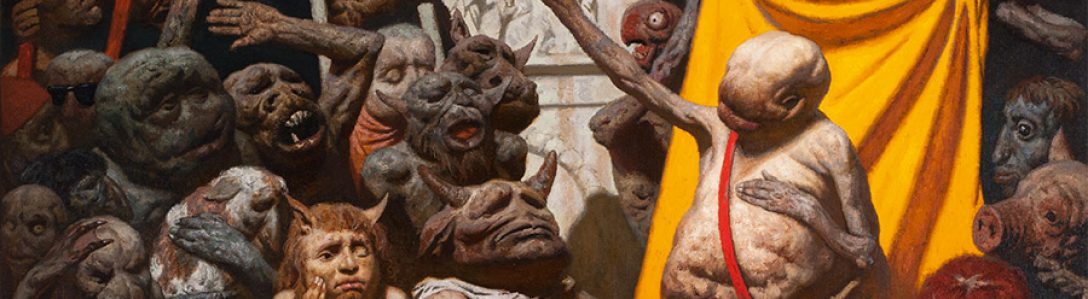
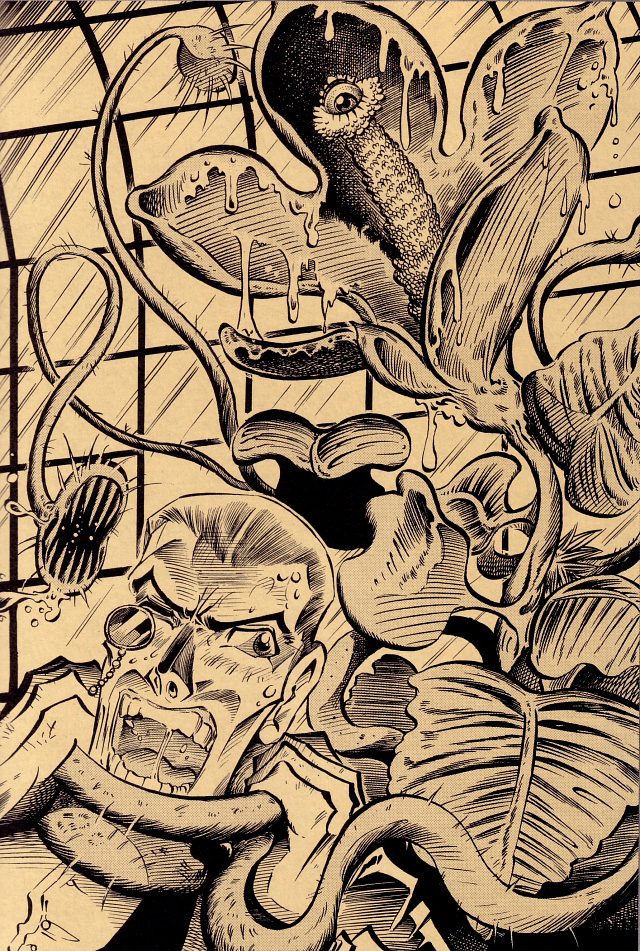
Illustration for “The Flowering of the Strange Orchid,” Tatsuya Morino
“The Flowering of the Strange Orchid”
by
H.G. Wells
The buying of orchids always has in it a certain speculative flavour. You have before you the brown shrivelled lump of tissue, and for the rest you must trust your judgment, or the auctioneer, or your good-luck, as your taste may incline. The plant may be moribund or dead, or it may be just a respectable purchase, fair value for your money, or perhaps – for the thing has happened again and again – there slowly unfolds before the delighted eyes of the happy purchaser, day after day, some new variety, some novel richness, a strange twist of the labellum, or some subtler coloration or unexpected mimicry.
Pride, beauty, and profit blossom together on one delicate green spike, and it may be, even immortality. For the new miracle of Nature may stand in need of a new specific name, and what so convenient as that of its discoverer? “Johnsmithia!” There have been worse names.
It was perhaps the hope of some such happy discovery that made Winter-Wedderburn such a frequent attendant at these sales – that hope, and also, maybe, the fact that he had nothing else of the slightest interest to do in the world. He was a shy, lonely, rather ineffectual man, provided with just enough income to keep off the spur of necessity, and not enough nervous energy to make him seek any exacting employments. He might have collected stamps or coins, or translated Horace, or bound books, or invented new species of diatoms. But, as it happened, he grew orchids, and had one ambitious little hothouse. Continue reading ““The Flowering of the Strange Orchid” — H.G. Wells”→
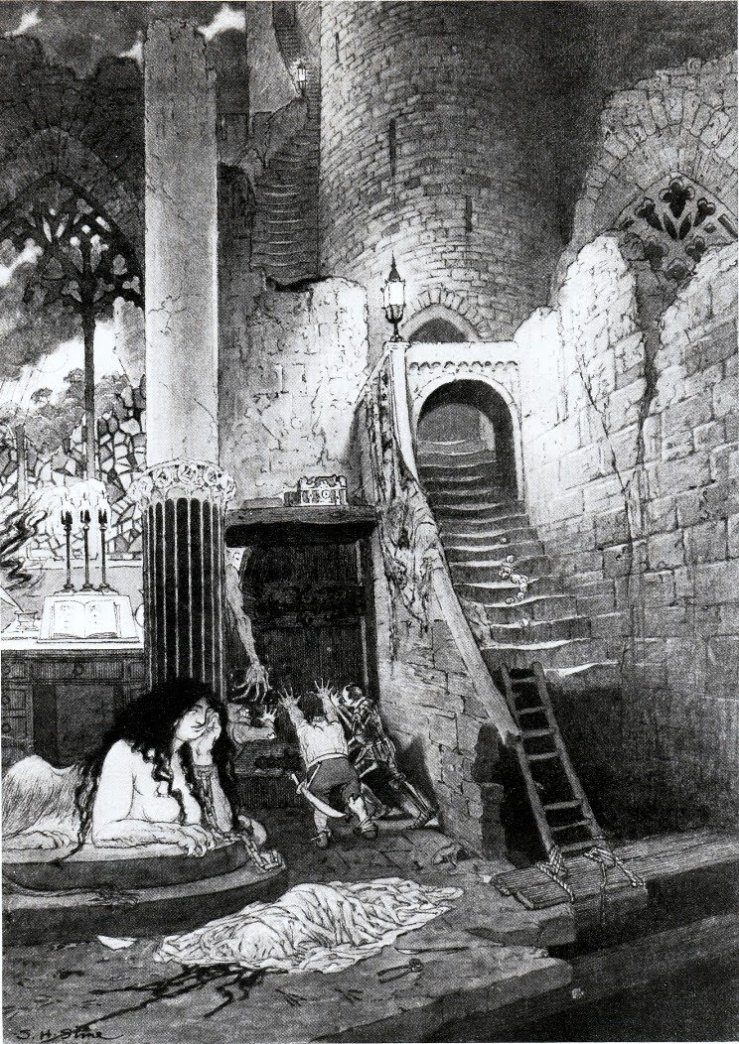
“The House of the Sphinx” illustration by Sidney Sime
“The House of the Sphinx”
by
Lord Dunsany
When I came to the House of the Sphinx it was already dark. They made me eagerly welcome. And I, in spite of the deed, was glad of any shelter from that ominous wood. I saw at once that there had been a deed, although a cloak did all that a cloak may do to conceal it. The mere uneasiness of the welcome made me suspect that cloak.
The Sphinx was moody and silent. I had not come to pry into the secrets of Eternity nor to investigate the Sphinx’s private life, and so had little to say and few questions to ask; but to whatever I did say she remained morosely indifferent. It was clear that either she suspected me of being in search of the secrets of one of her gods, or of being boldly inquisitive about her traffic with Time, or else she was darkly absorbed with brooding upon the deed.
I saw soon enough that there was another than me to welcome; I saw it from the hurried way that they glanced from the door to the deed and back to the door again. And it was clear that the welcome was to be a bolted door. But such bolts, and such a door! Rust and decay and fungus had been there far too long, and it was not a barrier any longer that would keep out even a determined wolf. And it seemed to be something worse than a wolf that they feared.
A little later on I gathered from what they said that some imperious and ghastly thing was looking for the Sphinx, and that something that had happened had made its arrival certain. It appeared that they had slapped the Sphinx to vex her out of her apathy in order that she should pray to one of her gods, whom she had littered in the house of Time; but her moody silence was invincible, and her apathy Oriental, ever since the deed had happened. And when they found that they could not make her pray, there was nothing for them to do but to pay little useless attentions to the rusty lock of the door, and to look at the deed and wonder, and even pretend to hope, and to say that after all it might not bring that destined thing from the forest, which no one named.
It may be said I had chosen a gruesome house, but not if I had described the forest from which I came, and I was in need of any spot wherein I could rest my mind from the thought of it.
I wondered very much what thing would come from the forest on account of the deed; and having seen that forest—as you, gentle reader, have not—I had the advantage of knowing that anything might come. It was useless to ask the Sphinx—she seldom reveals things, like her paramour Time (the gods take after her), and while this mood was on her, rebuff was certain. So I quietly began to oil the lock of the door. And as soon as they saw this simple act I won their confidence. It was not that my work was of any use—it should have been done long before; but they saw that my interest was given for the moment to the thing that they thought vital. They clustered round me then. They asked me what I thought of the door, and whether I had seen better, and whether I had seen worse; and I told them about all the doors I knew, and said that the doors of the baptistry in Florence were better doors, and the doors made by a certain firm of builders in London were worse. And then I asked them what it was that was coming after the Sphinx because of the deed. And at first they would not say, and I stopped oiling the door; and then they said that it was the arch-inquisitor of the forest, who is investigator and avenger of all silverstrian things; and from all that they said about him it seemed to me that this person was quite white, and was a kind of madness that would settle down quite blankly upon a place, a kind of mist in which reason could not live; and it was the fear of this that made them fumble nervously at the lock of that rotten door; but with the Sphinx it was not so much fear as sheer prophecy.
The hope that they tried to hope was well enough in its way, but I did not share it; it was clear that the thing that they feared was the corollary of the deed—one saw that more by the resignation upon the face of the Sphinx than by their sorry anxiety for the door.
The wind soughed, and the great tapers flared, and their obvious fear and the silence of the Sphinx grew more than ever a part of the atmosphere, and bats went restlessly through the gloom of the wind that beat the tapers low.
Then a few things screamed far off, then a little nearer, and something was coming towards us, laughing hideously. I hastily gave a prod to the door that they guarded; my finger sank right into the mouldering wood—there was not a chance of holding it. I had not leisure to observe their fright; I thought of the back-door, for the forest was better than this; only the Sphinx was absolutely calm, her prophecy was made and she seemed to have seen her doom, so that no new thing could perturb her.
But by mouldering rungs of ladders as old as Man, by slippery edges of the dreaded abyss, with an ominous dizziness about my heart and a feeling of horror in the soles of my feet, I clambered from tower to tower till I found the door that I sought; and it opened on to one of the upper branches of a huge and sombre pine, down which I climbed on to the floor of the forest. And I was glad to be back again in the forest from which I had fled.
And the Sphinx in her menaced house—I know not how she fared—whether she gazes for ever, disconsolate, at the deed, remembering only in her smitten mind, at which the little boys now leer, that she once knew well those things at which man stands aghast; or whether in the end she crept away, and clambering horribly from abyss to abyss, came at last to higher things, and is wise and eternal still. For who knows of madness whether it is divine or whether it be of the pit?
Illustration for E.T.A. Hoffmann’s “The Sandman” — Mario Laboccetta
“The Sandman”
by
E.T.A. Hoffmann
English translation by John Oxenford
NATHANIEL TO LOTHAIRE.
Certainly you must all be uneasy that I have not written for so long—so very long. My mother, I am sure, is angry, and Clara will believe that I am passing my time in dissipation, entirely forgetful of the fair angel-image that is so deeply imprinted in my heart and mind. Such, however, is not the case. Daily and hourly I think of you all, and in my sweet dreams the kindly form of my lovely Clara passes before me, and smiles upon me with her bright eyes as she was wont when I appeared among you. Alas, how could I write to you in the distracted mood which has hitherto disturbed my every thought! Something horrible has crossed my path of life. Dark forebodings of a cruel, threatening, fate spread themselves over me like dark clouds, which no friendly sunbeam can penetrate. Now will I tell you what has befallen me. I must do so, that I plainly see—but if I only think of it, it will laugh out of me like mad. Ah, my dear Lothaire, how shall I begin it? How shall I make you in any way sensible that that which occurred to me a few days ago could really have such a fatal effect on my life? If you were here you could see for yourself, but now you will certainly take me for a crazy ghost-seer. In a word, the horrible thing which happened to me, and the painful impression of which I in vain endeavour to escape, is nothing more than this; that some days ago, namely on the 30th of October, at twelve o’clock at noon, a barometer-dealer came into my room and offered me his wares. I bought nothing, and threatened to throw him down stairs, upon which he took himself off of his own accord.
You suspect that only relations of the most peculiar kind, and exerting the greatest influence over my life can give any import to this occurrence, nay, that the person of that unlucky dealer must have a hostile effect upon me. So it is, indeed. I collect myself with all my might, that patiently and quietly I may tell you so much of my early youth as will bring all plainly and clearly in bright images before your active mind. As I am about to begin I fancy that I hear you laughing and Clara saying: “Childish stories indeed!” Laugh at me I beseech you, laugh with all your heart. But, heavens, my hair stands on end, and it seems as if I am asking you to laugh at me, in mad despair, as Franz Moor asked Daniel.But to my story.
Excepting at dinner time I and my brothers and sisters saw my father very little during the day. He was, perhaps, busily engaged at his ordinary occupation. After supper, which, according to the old custom was served up at seven o’clock, we all went with my mother into my father’s work-room, and seated ourselves at the round table. My father smoked tobacco and drank a large glass of beer. Often he told us a number of wonderful stories, and grew so warm over them that his pipe continually went out. I had to light it again, with burning paper, which I thought great sport. Often, too, he would give us picture-books, and sit in his arm-chair silent and thoughtful, puffing out such thick clouds of smoke that we all seemed to be swimming in the clouds. On such evenings as these my mother was very melancholy, and immediately the clock struck nine, she would say: “Now children, to bed—to bed! The Sandman is coming, I can see.” And certainly on all these occasions I heard something with a heavy, slow step go bouncing up the stairs. That I thought must be the Sandman. Once that dull noise and footstep were particularly fearful, and I asked my mother, while she took us away: “Eh, mamma, who is this naughty Sandman, who always drives us away from papa? What does he look like?” “There is no Sandman, dear child,” replied my mother. “When I say the Sandman comes, I only mean that you are sleepy and cannot keep your eyes open,—just as if sand had been sprinkled into them.” This answer of my mother’s did not satisfy me—nay, in my childish mind the thought soon matured itself that she only denied the existence of the Sandman to hinder us from being terrified at him. Certainly I always heard him coming up the stairs. Full of curiosity to hear more of this Sandman, and his particular connection with children, I at last asked the old woman who tended my youngest sister what sort of man he was. “Eh, Natty,” said she, “do you not know that yet? He is a wicked man, who comes to children when they will not go to bed, and throws a handful of sand into their eyes, so that they start out bleeding from their heads. These eyes he puts in a bag and carries them to the half-moon to feed his own children, who sit in the nest up yonder, and have crooked beaks like owls with which they may pick up the eyes of the naughty human children.” Continue reading ““The Sandman” — E.T.A. Hoffmann”→
MISERY is manifold. The wretchedness of earth is multiform. Overreaching the wide horizon as the rainbow, its hues are as various as the hues of that arch—as distinct too, yet as intimately blended. Overreaching the wide horizon as the rainbow! How is it that from beauty I have derived a type of unloveliness?—from the covenant of peace, a simile of sorrow? But as, in ethics, evil is a consequence of good, so, in fact, out of joy is sorrow born. Either the memory of past bliss is the anguish of to-day, or the agonies whichare, have their origin in the ecstasies which might have been.
My baptismal name is Egaeus; that of my family I will not mention. Yet there are no towers in the land more time-honored than my gloomy, gray, hereditary halls. Our line has been called a race of visionaries; and in many striking particulars—in the character of the family mansion—in the frescos of the chief saloon—in the tapestries of the dormitories—in the chiselling of some buttresses in the armory—but more especially in the gallery of antique paintings—in the fashion of the library chamber—and, lastly, in the very peculiar nature of the library’s contents—there is more than sufficient evidence to warrant the belief.
The recollections of my earliest years are connected with that chamber, and with its volumes—of which latter I will say no more. Here died my mother. Herein was I born. But it is mere idleness to say that I had not lived before—that the soul has no previous existence. You deny it?—let us not argue the matter. Convinced myself, I seek not to convince. There is, however, a remembrance of aerial forms—of spiritual and meaning eyes—of sounds, musical yet sad—a remembrance which will not be excluded; a memory like a shadow—vague, variable, indefinite, unsteady; and like a shadow, too, in the impossibility of my getting rid of it while the sunlight of my reason shall exist.
In that chamber was I born. Thus awaking from the long night of what seemed, but was not, nonentity, at once into the very regions of fairy land—into a palace of imagination—into the wild dominions of monastic thought and erudition—it is not singular that I gazed around me with a startled and ardent eye—that I loitered away my boyhood in books, and dissipated my youth in reverie; but it is singular that as years rolled away, and the noon of manhood found me still in the mansion of my fathers—it is wonderful what stagnation there fell upon the springs of my life—wonderful how total an inversion took place in the character of my commonest thought. The realities of the world affected me as visions, and as visions only, while the wild ideas of the land of dreams became, in turn, not the material of my every-day existence, but in very deed that existence utterly and solely in itself.
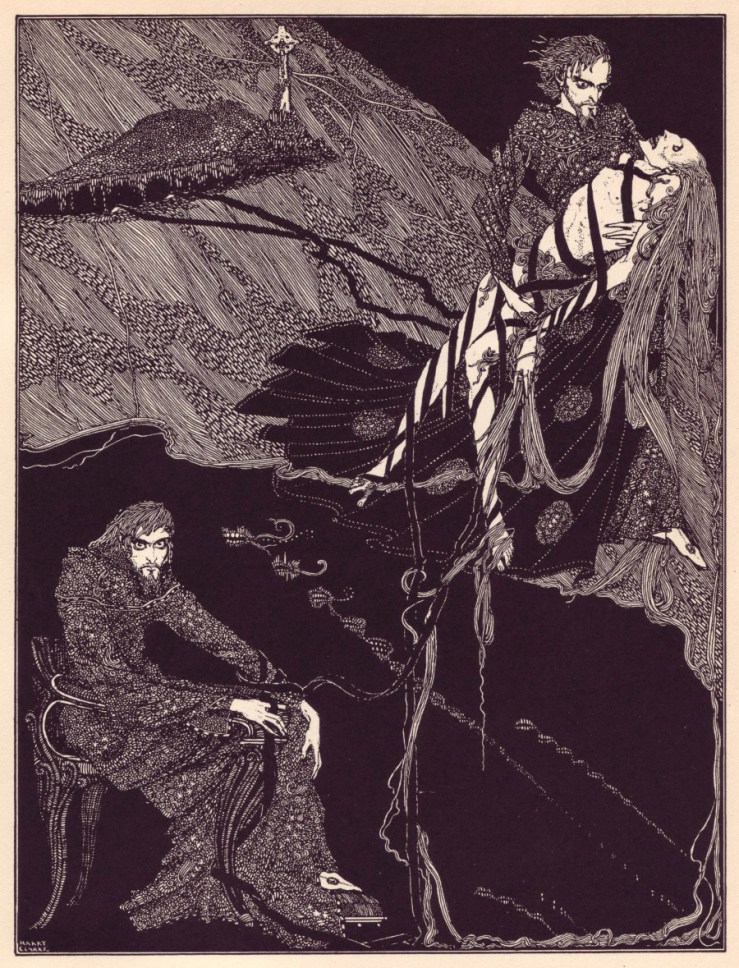
Berenice and I were cousins, and we grew up together in my paternal halls. Yet differently we grew—I, ill of health, and buried in gloom—she, agile, graceful, and overflowing with energy; hers, the ramble on the hill-side—mine the studies of the cloister; I, living within my own heart, and addicted, body and soul, to the most intense and painful meditation—she, roaming carelessly through life, with no thought of the shadows in her path, or the silent flight of the raven-winged hours. Berenice!—I call upon her name—Berenice!—and from the gray ruins of memory a thousand tumultuous recollections are startled at the sound! Ah, vividly is her image before me now, as in the early days of her light-heartedness and joy! Oh, gorgeous yet fantastic beauty! Oh, sylph amid the shrubberies of Arnheim! Oh, Naiad among its fountains! And then—then all is mystery and terror, and a tale which should not be told. Disease—a fatal disease, fell like the simoon upon her frame; and, even while I gazed upon her, the spirit of change swept over her, pervading her mind, her habits, and her character, and, in a manner the most subtle and terrible, disturbing even the identity of her person! Alas! the destroyer came and went!—and the victim—where is she? I knew her not—or knew her no longer as Berenice. Continue reading ““Berenice” — Edgar Allan Poe”→
The town was a little one, worse than a village, and it was inhabited by scarcely any but old people who died with an infrequency that was really annoying. In the hospital and in the prison fortress very few coffins were needed. In fact business was bad. If Yakov Ivanov had been an undertaker in the chief town of the province he would certainly have had a house of his own, and people would have addressed him as Yakov Matveyitch; here in this wretched little town people called him simply Yakov; his nickname in the street was for some reason Bronze, and he lived in a poor way like a humble peasant, in a little old hut in which there was only one room, and in this room he and Marfa, the stove, a double bed, the coffins, his bench, and all their belongings were crowded together.
Yakov made good, solid coffins. For peasants and working people he made them to fit himself, and this was never unsuccessful, for there were none taller and stronger than he, even in the prison, though he was seventy. For gentry and for women he made them to measure, and used an iron foot-rule for the purpose. He was very unwilling to take orders for children’s coffins, and made them straight off without measurements, contemptuously, and when he was paid for the work he always said:
“There is a wild beast in your woods,” said the artist Cunningham, as he was being driven to the station. It was the only remark he had made during the drive, but as Van Cheele had talked incessantly his companion’s silence had not been noticeable.
“A stray fox or two and some resident weasels. Nothing more formidable,” said Van Cheele. The artist said nothing.
“What did you mean about a wild beast?” said Van Cheele later, when they were on the platform.
“Nothing. My imagination. Here is the train,” said Cunningham.
That afternoon Van Cheele went for one of his frequent rambles through his woodland property. He had a stuffed bittern in his study, and knew the names of quite a number of wild flowers, so his aunt had possibly some justification in describing him as a great naturalist. At any rate, he was a great walker. It was his custom to take mental notes of everything he saw during his walks, not so much for the purpose of assisting contemporary science as to provide topics for conversation afterwards. When the bluebells began to show themselves in flower he made a point of informing every one of the fact; the season of the year might have warned his hearers of the likelihood of such an occurrence, but at least they felt that he was being absolutely frank with them.
What Van Cheele saw on this particular afternoon was, however, something far removed from his ordinary range of experience. On a shelf of smooth stone overhanging a deep pool in the hollow of an oak coppice a boy of about sixteen lay asprawl, drying his wet brown limbs luxuriously in the sun. His wet hair, parted by a recent dive, lay close to his head, and his light-brown eyes, so light that there was an almost tigerish gleam in them, were turned towards Van Cheele with a certain lazy watchfulness. It was an unexpected apparition, and Van Cheele found himself engaged in the novel process of thinking before he spoke. Where on earth could this wild-looking boy hail from? The miller’s wife had lost a child some two months ago, supposed to have been swept away by the mill-race, but that had been a mere baby, not a half-grown lad. Continue reading ““Gabriel-Ernest” — Saki”→
THERE was no hope for him this time: it was the third stroke. Night after night I had passed the house (it was vacation time) and studied the lighted square of window: and night after night I had found it lighted in the same way, faintly and evenly. If he was dead, I thought, I would see the reflection of candles on the darkened blind for I knew that two candles must be set at the head of a corpse. He had often said to me: “I am not long for this world,” and I had thought his words idle. Now I knew they were true. Every night as I gazed up at the window I said softly to myself the word paralysis. It had always sounded strangely in my ears, like the word gnomon in the Euclid and the word simony in the Catechism. But now it sounded to me like the name of some maleficent and sinful being. It filled me with fear, and yet I longed to be nearer to it and to look upon its deadly work.
Old Cotter was sitting at the fire, smoking, when I came downstairs to supper. While my aunt was ladling out my stirabout he said, as if returning to some former remark of his:
“No, I wouldn’t say he was exactly… but there was something queer… there was something uncanny about him. I’ll tell you my opinion….”
He began to puff at his pipe, no doubt arranging his opinion in his mind. Tiresome old fool! When we knew him first he used to be rather interesting, talking of faints and worms; but I soon grew tired of him and his endless stories about the distillery.
The woman with the pink velvet poppies twined round the assisted gold of her hair traversed the crowded room at an interesting gait combining a skip with a sidle, and clutched the lean arm of her host.
“”Now I got you!” she said. “Now you can’t get away!”
“Why, hello,” said her host. “Well. How are you?”
“Oh, I’m finely,” she said. “Just simply finely. Listen. I want you to do me the most terrible favor. Will you? Will you please? Pretty please?”
“What is it?” said her host.
“Listen,” she said. “I want to meet Walter Williams. Honestly, I’m just simply crazy about that man. Oh, when he sings! When he sings those spirituals! Well, I said to Burton, ‘It’s a good thing for you Walter Williams is colored,’ I said, ‘or you’d have lots of reason to be jealous.’ I’d really love to meet him. I’d like to tell him I’ve heard him sing. Will you be an angel and introduce me to him?”
“Why, certainly,” said her host. “I thought you’d met him. The party’s for him. Where is he, anyway?”
“He’s over there by the bookcase,” she said. “Let’s wait till those people get through talking to him. Well, I think you’re simply marvelous, giving this perfectly marvelous party for him, and having him meet all these white people, and all. Isn’t he terribly grateful?”
Marshall McKann followed his wife and her friend Mrs. Post down the aisle and up the steps to the stage of the Carnegie Music Hall with an ill-concealed feeling of grievance. Heaven knew he never went to concerts, and to be mounted upon the stage in this fashion, as if he were a “highbrow” from Sewickley, or some unfortunate with a musical wife, was ludicrous. A man went to concerts when he was courting, while he was a junior partner. When he became a person of substance he stopped that sort of nonsense. His wife, too, was a sensible person, the daughter of an old Pittsburgh family as solid and well-rooted as the McKanns. She would never have bothered him about this concert had not the meddlesome Mrs. Post arrived to pay her a visit. Mrs. Post was an old school friend of Mrs. McKann, and because she lived in Cincinnati she was always keeping up with the world and talking about things in which no one else was interested, music among them. She was an aggressive lady, with weighty opinions, and a deep voice like a jovial bassoon. She had arrived only last night, and at dinner she brought it out that she could on no account miss Kitty Ayrshire’s recital; it was, she said, the sort of thing no one could afford to miss.
When McKann went into town in the morning he found that every seat in the music-hall was sold. He telephoned his wife to that effect, and, thinking he had settled the matter, made his reservation on the 11.25 train for New York. He was unable to get a drawing-room because this same Kitty Ayrshire had taken the last one. He had not intended going to New York until the following week, but he preferred to be absent during Mrs. Post’s incumbency.
In the middle of the morning, when he was deep in his correspondence, his wife called him up to say the enterprising Mrs. Post had telephoned some musical friends in Sewickley and had found that two hundred folding-chairs were to be placed on the stage of the concert-hall, behind the piano, and that they would be on sale at noon. Would he please get seats in the front row? McKann asked if they would not excuse him, since he was going over to New York on the late train, would be tired, and would not have time to dress, etc. No, not at all. It would be foolish for two women to trail up to the stage unattended. Mrs. Post’s husband always accompanied her to concerts, and she expected that much attention from her host. He needn’t dress, and he could take a taxi from the concert-hall to the East Liberty station. Continue reading ““A Gold Slipper” by Willa Cather”→
Mr. Bessel was the senior partner in the firm of Bessel, Hart, and Brown, of St. Paul’s Churchyard, and for many years he was well known among those interested in psychical research as a liberal-minded and conscientious investigator. He was an unmarried man, and instead of living in the suburbs, after the fashion of his class, he occupied rooms in the Albany, near Piccadilly. He was particularly interested in the questions of thought transference and of apparitions of the living, and in November, 1896, he commenced a series of experiments in conjunction with Mr. Vincey, of Staple Inn, in order to test the alleged possibility of projecting an apparition of one’s self by force of will through space.
Their experiments were conducted in the following manner: At a prearranged hour Mr. Bessel shut himself in one of his rooms in the Albany and Mr. Vincey in his sitting-room in Staple Inn, and each then fixed his mind as resolutely as possible on the other. Mr. Bessel had acquired the art of self-hypnotism, and, so far as he could, he attempted first to hypnotise himself and then to project himself as a “phantom of the living” across the intervening space of nearly two miles into Mr. Vincey’s apartment. On several evenings this was tried without any satisfactory result, but on the fifth or sixth occasion Mr. Vincey did actually see or imagine he saw an apparition of Mr. Bessel standing in his room. He states that the appearance, although brief, was very vivid and real. He noticed that Mr. Bessel’s face was white and his expression anxious, and, moreover, that his hair was disordered. For a moment Mr. Vincey, in spite of his state of expectation, was too surprised to speak or move, and in that moment it seemed to him as though the figure glanced over its shoulder and incontinently vanished.
It had been arranged that an attempt should be made to photograph any phantasm seen, but Mr. Vincey had not the instant presence of mind to snap the camera that lay ready on the table beside him, and when he did so he was too late. Greatly elated, however, even by this partial success, he made a note of the exact time, and at once took a cab to the Albany to inform Mr. Bessel of this result. Continue reading ““The Stolen Body,” a weird short story by H.G. Wells”→
This thing is the most difficult for a person to understand. Keep trying. Don’t get discouraged. It will seem obvious. But it is extremely difficult to know about it. For it involves time.
We divide time when in reality it is not divisible. It is always immutable. But we need to divide it. And to that end a monstrous thing was created: the clock.
I am not going to speak of clocks. But of one particular clock. I’m showing my cards: I’ll say up front what I have to say and without literature. This report is the anti-literature of the thing.
The clock of which I speak is electronic and has an alarm. The brand is Sveglia, which means “awake.” Awake to what, my God? To time. To the hour. To the instant. This clock is not mine. But I took possession of its infernal tranquil soul.
It is not a wristwatch: Therefore it is freestanding. It is less than an inch tall and stands upon the surface of the table. I would like its actual name to be Sveglia. But the owner of the clock wants its name to be Horácio. No matter. Because the main thing is that it is time.
Please, God, let him telephone me now. Dear God, let him call me now. I won’t ask anything else of You, truly I won’t. It isn’t very much to ask. It would be so little to You, God, such a little, little thing. Only let him telephone now. Please, God. Please, please, please.
If I didn’t think about it, maybe the telephone might ring. Sometimes it does that. If I could think of something else. If I could think of something else. Knobby if I counted five hundred by fives, it might ring by that time. I’ll count slowly. I won’t cheat. And if it rings when I get to three hundred, I won’t stop; I won’t answer it until I get to five hundred. Five, ten, fifteen, twenty, twenty-five, thirty, thirty-five, forty, forty-five, fifty…. Oh, please ring. Please.
This is the last time I’ll look at the clock. I will not look at it again. It’s ten minutes past seven. He said he would telephone at five o’clock. “I’ll call you at five, darling.” I think that’s where he said “darling.” I’m almost sure he said it there. I know he called me “darling” twice, and the other time was when he said good-by. “Good-by, darling.” He was busy, and he can’t say much in the office, but he called me “darling” twice. He couldn’t have minded my calling him up. I know you shouldn’t keep telephoning them–I know they don’t like that. When you do that they know you are thinking about them and wanting them, and that makes them hate you. But I hadn’t talked to him in three days-not in three days. And all I did was ask him how he was; it was just the way anybody might have called him up. He couldn’t have minded that. He couldn’t have thought I was bothering him. “No, of course you’re not,” he said. And he said he’d telephone me. He didn’t have to say that. I didn’t ask him to, truly I didn’t. I’m sure I didn’t. I don’t think he would say he’d telephone me, and then just never do it. Please don’t let him do that, God. Please don’t. Continue reading ““A Telephone Call” — Dorothy Parker”→
So my poem is damned, and immortal fame is not for me! I am nobody forever and ever. Intolerable fate!
Snatching my hat, I dashed down the criticism, and rushed out into Broadway, where enthusiastic throngs were crowding to a circus in a side-street near by, very recently started, and famous for a capital clown.
Presently my old friend Standard rather boisterously accosted me.
“Well met, Helmstone, my boy! Ah! what’s the matter? Haven’t been committing murder? Ain’t flying justice? You look wild!”
“You have seen it then?” said I, of course referring to the criticism.
“Oh yes; I was there at the morning performance. Great clown, I assure you. But here comes Hautboy. Hautboy—Helmstone.”
Without having time or inclination to resent so mortifying a mistake, I was instantly soothed as I gazed on the face of the new acquaintance so unceremoniously introduced. His person was short and full, with a juvenile, animated cast to it. His complexion rurally ruddy; his eye sincere, cheery, and gray. His hair alone betrayed that he was not an overgrown boy. From his hair I set him down as forty or more.
“Come, Standard,” he gleefully cried to my friend, “are you not going to the circus? The clown is inimitable, they say. Come; Mr. Helmstone, too—come both; and circus over, we’ll take a nice stew and punch at Taylor’s.”
The sterling content, good humor, and extraordinary ruddy, sincere expression of this most singular new acquaintance acted upon me like magic. It seemed mere loyalty to human nature to accept an invitation from so unmistakably kind and honest a heart.
During the circus performance I kept my eye more on Hautboy than on the celebrated clown. Hautboy was the sight for me. Such genuine enjoyment as his struck me to the soul with a sense of the reality of the thing called happiness. The jokes of the clown he seemed to roll under his tongue as ripe magnum bonums. Now the foot, now the hand, was employed to attest his grateful applause. At any hit more than ordinary, he turned upon Standard and me to see if his rare pleasure was shared. In a man of forty I saw a boy of twelve; and this too without the slightest abatement of my respect. Because all was so honest and natural, every expression and attitude so graceful with genuine good-nature, that the marvelous juvenility of Hautboy assumed a sort of divine and immortal air, like that of some forever youthful god of Greece. Continue reading “Read Herman Melville’s story “The Fiddler””→
Kramer leaned back. “You can see the situation. How can we deal with a factor like this? The perfect variable.”
“Perfect? Prediction should still be possible. A living thing still acts from necessity, the same as inanimate material. But the cause-effect chain is more subtle; there are more factors to be considered. The difference is quantitative, I think. The reaction of the living organism parallels natural causation, but with greater complexity.”
Gross and Kramer looked up at the board plates, suspended on the wall, still dripping, the images hardening into place. Kramer traced a line with his pencil.
“See that? It’s a pseudopodium. They’re alive, and so far, a weapon we can’t beat. No mechanical system can compete with that, simple or intricate. We’ll have to scrap the Johnson Control and find something else.”
“Meanwhile the war continues as it is. Stalemate. Checkmate. They can’t get to us, and we can’t get through their living minefield.”
Kramer nodded. “It’s a perfect defense, for them. But there still might be one answer.”
“What’s that?”
“Wait a minute.” Kramer turned to his rocket expert, sitting with the charts and files. “The heavy cruiser that returned this week. It didn’t actually touch, did it? It came close but there was no contact.”
“Correct.” The expert nodded. “The mine was twenty miles off. The cruiser was in space-drive, moving directly toward Proxima, line-straight, using the Johnson Control, of course. It had deflected a quarter of an hour earlier for reasons unknown. Later it resumed its course. That was when they got it.”
My kinsman and myself were returning to Calcutta from our Puja trip when we met the man in a train. From his dress and bearing we took him at first for an up-country Mahomedan, but we were puzzled as we heard him talk. He discoursed upon all subjects so confidently that you might think the Disposer of All Things consulted him at all times in all that He did. Hitherto we had been perfectly happy, as we did not know that secret and unheard-of forces were at work, that the Russians had advanced close to us, that the English had deep and secret policies, that confusion among the native chiefs had come to a head. But our newly-acquired friend said with a sly smile: “There happen more things in heaven and earth, Horatio, than are reported in your newspapers.” As we had never stirred out of our homes before, the demeanour of the man struck us dumb with wonder. Be the topic ever so trivial, he would quote science, or comment on the Vedas, or repeat quatrains from some Persian poet; and as we had no pretence to a knowledge of science or the Vedas or Persian, our admiration for him went on increasing, and my kinsman, a theosophist, was firmly convinced that our fellow-passenger must have been supernaturally inspired by some strange “magnetism” or “occult power,” by an “astral body” or something of that kind. He listened to the tritest saying that fell from the lips of our extraordinary companion with devotional rapture, and secretly took down notes of his conversation. I fancy that the extraordinary man saw this, and was a little pleased with it.
When the train reached the junction, we assembled in the waiting room for the connection. It was then 10 P.M., and as the train, we heard, was likely to be very late, owing to something wrong in the lines, I spread my bed on the table and was about to lie down for a comfortable doze, when the extraordinary person deliberately set about spinning the following yarn. Of course, I could get no sleep that night.
When, owing to a disagreement about some questions of administrative policy, I threw up my post at Junagarh, and entered the service of the Nizam of Hydria, they appointed me at once, as a strong young man, collector of cotton duties at Barich.
Barich is a lovely place. The Susta “chatters over stony ways and babbles on the pebbles,” tripping, like a skilful dancing girl, in through the woods below the lonely hills. A flight of 150 steps rises from the river, and above that flight, on the river’s brim and at the foot of the hills, there stands a solitary marble palace. Around it there is no habitation of man—the village and the cotton mart of Barich being far off. Continue reading ““The Hungry Stones” — Rabindranath Tagore”→
I have a poppy field. That is, by the grace of God and the good-nature of editors, I am enabled to place each month divers gold pieces into a clerical gentleman’s hands, and in return for said gold pieces I am each month reinvested with certain proprietary-rights in a poppy field. This field blazes on the rim of the Piedmont Hills. Beneath lies all the world. In the distance, across the silver sweep of bay, San Francisco smokes on her many hills like a second Rome. Not far away, Mount Tamalpais thrusts a rugged shoulder into the sky; and midway between is the Golden Gate, where sea mists love to linger. From the poppy field we often see the shimmering blue of the Pacific beyond, and the busy ships that go for ever out and in.
“We shall have great joy in our poppy field,” said Bess. “Yes,” said I; “how the poor city folk will envy when they come to see us, and how we will make all well again when we send them off with great golden armfuls!”
“But those things will have to come down,” I added, pointing to numerous obtrusive notices (relics of the last tenant) displayed conspicuously along the boundaries, and bearing, each and all, this legend:
“Private Grounds. No Trespassing.”
“Why should we refuse the poor city folk a ramble over our field, because, forsooth, they have not the advantage of our acquaintance?”
“How I abhor such things,” said Bess; “the arrogant symbols of power.”
“They disgrace human nature,” said I.
“They shame the generous landscape,” she said, “and they are abominable.”
My father was, I am sure, intended by nature to be a cheerful, kindly man. Until he was thirty-four years old he worked as a farmhand for a man named Thomas Butterworth whose place lay near the town of Bidwell, Ohio. He had then a horse of his own and on Saturday evenings drove into town to spend a few hours in social intercourse with other farmhands. In town he drank several glasses of beer and stood about in Ben Head’s saloon–crowded on Saturday evenings with visiting farmhands. Songs were sung and glasses thumped on the bar. At ten o’clock father drove home along a lonely country road, made his horse comfortable for the night and himself went to bed, quite happy in his position in life. He had at that time no notion of trying to rise in the world.
It was in the spring of his thirty-fifth year that father married my mother, then a country schoolteacher, and in the following spring I came wriggling and crying into the world. Something happened to the two people. They became ambitious. The American passion for getting up in the world took possession of them.
It may have been that mother was responsible. Being a schoolteacher she had no doubt read books and magazines. She had, I presume, read of how Garfield, Lincoln, and other Americans rose from poverty to fame and greatness and as I lay beside her–in the days of her lying-in–she may have dreamed that I would someday rule men and cities. At any rate she induced father to give up his place as a farmhand, sell his horse and embark on an independent enterprise of his own. She was a tall silent woman with a long nose and troubled grey eyes. For herself she wanted nothing. For father and myself she was incurably ambitious.
The first venture into which the two people went turned out badly. They rented ten acres of poor stony land on Griggs’s Road, eight miles from Bidwell, and launched into chicken raising. I grew into boyhood on the place and got my first impressions of life there. From the beginning they were impressions of disaster and if, in my turn, I am a gloomy man inclined to see the darker side of life, I attribute it to the fact that what should have been for me the happy joyous days of childhood were spent on a chicken farm. Continue reading ““The Egg,” a short story by Sherwood Anderson”→