Read William Faulkner’s short story “Hair”

“Hair”

by

William Faulkner


THIS GIRL, this Susan Reed, was an orphan. She lived with a family named Burchett, that had some more children, two or three more. Some said that Susan was a niece or a cousin or something; others cast the usual aspersions on the character of Burchett and even of Mrs. Burchett: you know.

Women mostly, these were.

She was about five when Hawkshaw first came to town.

It was his first summer behind that chair in Maxey’s barber shop that Mrs Burchett brought Susan in for the first time.

Maxey told me about how him and the other barbers watched Mrs Burchett trying for three days to get Susan (she was a thin little girl then, with big scared eyes and this straight, soft hair not blonde and not brunette) into the shop. And Maxey told how at last it was Hawkshaw that went out into the street and worked with the girl for about fifteen minutes until he got her into the shop and into his chair: him that hadn’t never said more than Yes or No to any man or woman in the town that anybody ever saw. “Be durn if it didn’t look like Hawkshaw had been waiting for her to come along,” Maxey told me.

That was her first haircut. Hawkshaw gave it to her, and her sitting there under the cloth like a little scared rabbit.

But six months after that she was coming to the shop by herself and letting Hawkshaw cut her hair, still looking like a little old rabbit, with her scared face and those big eyes and that hair without any special name showing above the cloth. If Hawkshaw was busy, Maxey said she would come in and sit on the waiting bench close to his chair with her legs sticking straight out in front of her until Hawkshaw got done. Maxey says they considered her Hawkshaw’s client the same as if she had been a Saturday night shaving customer. He says that one time the other barber, Matt Fox, offered to wait on her, Hawkshaw being busy, and that Hawkshaw looked up like a flash. “I’ll be done in a minute,” he says. “I’ll tend to her.” Maxey told me that Hawkshaw had been working for him for almost a year then, but that was the first time he ever heard him speak positive about anything.

That fall the girl started to school. She would pass the barber shop each morning and afternoon. She was still shy, walking fast like little girls do, with that yellow-brown head of hers passing the window level and fast like she was on skates. She was always by herself at first, but pretty soon her head would be one of a clump of other heads, all talking, not looking toward the window at all, and Hawkshaw standing there in the window, looking out. Maxey said him and Matt would not have to look at the clock at all to tell when five minutes to eight and to three o’clock came, because they could tell by Hawkshaw. It was like he would kind of drift up to the window without watching himself do it, and be looking out about the time for the school children to begin to pass. When she would come to the shop for a haircut, Hawkshaw would give her two or three of those peppermints where he would give the other children just one, Maxey told me.

No; it was Matt Fox, the other barber, told me that. He was the one who told me about the doll Hawkshaw gave her on Christmas. I don’t know how he found it out. Hawkshaw never told him. But he knew some way; he knew more about Hawkshaw than Maxey did. He was a married man himself, Matt was. A kind of fat, flabby fellow, with a pasty face and eyes that looked tired or sad something. A funny fellow, and almost as good a barber as Hawkshaw. He never talked much either, and I don’t know how he could have known so much about Hawkshaw when a talking man couldn’t get much out of him. I guess maybe a talking man hasn’t got the time to ever learn much about anything except words.

Anyway, Matt told me about how Hawkshaw gave her a present every Christmas, even after she got to be a big girl. Continue reading “Read William Faulkner’s short story “Hair””

“The Difficulty of Crossing a Field,” a very short tale by Ambrose Bierce

“The Difficulty of Crossing a Field”

by

Ambrose Bierce

from Present at a Hanging and Other Ghost Stories


One morning in July, 1854, a planter named Williamson, living six miles from Selma, Alabama, was sitting with his wife and a child on the veranda of his dwelling.  Immediately in front of the house was a lawn, perhaps fifty yards in extent between the house and public road, or, as it was called, the “pike.”  Beyond this road lay a close-cropped pasture of some ten acres, level and without a tree, rock, or any natural or artificial object on its surface.  At the time there was not even a domestic animal in the field.  In another field, beyond the pasture, a dozen slaves were at work under an overseer.

Throwing away the stump of a cigar, the planter rose, saying: “I forgot to tell Andrew about those horses.”  Andrew was the overseer.

Williamson strolled leisurely down the gravel walk, plucking a flower as he went, passed across the road and into the pasture, pausing a moment as he closed the gate leading into it, to greet a passing neighbor, Armour Wren, who lived on an adjoining plantation.  Mr. Wren was in an open carriage with his son James, a lad of thirteen.  When he had driven some two hundred yards from the point of meeting, Mr. Wren said to his son: “I forgot to tell Mr. Williamson about those horses.”

Mr. Wren had sold to Mr. Williamson some horses, which were to have been sent for that day, but for some reason not now remembered it would be inconvenient to deliver them until the morrow.  The coachman was directed to drive back, and as the vehicle turned Williamson was seen by all three, walking leisurely across the pasture.  At that moment one of the coach horses stumbled and came near falling.  It had no more than fairly recovered itself when James Wren cried: “Why, father, what has become of Mr. Williamson?”

It is not the purpose of this narrative to answer that question.

Mr. Wren’s strange account of the matter, given under oath in the course of legal proceedings relating to the Williamson estate, here follows:

“My son’s exclamation caused me to look toward the spot where I had seen the deceased [sic] an instant before, but he was not there, nor was he anywhere visible.  I cannot say that at the moment I was greatly startled, or realized the gravity of the occurrence, though I thought it singular.  My son, however, was greatly astonished and kept repeating his question in different forms until we arrived at the gate.  My black boy Sam was similarly affected, even in a greater degree, but I reckon more by my son’s manner than by anything he had himself observed.  [This sentence in the testimony was stricken out.]  As we got out of the carriage at the gate of the field, and while Sam was hanging [sic] the team to the fence, Mrs. Williamson, with her child in her arms and followed by several servants, came running down the walk in great excitement, crying: ‘He is gone, he is gone!  O God! what an awful thing!’ and many other such exclamations, which I do not distinctly recollect.  I got from them the impression that they related to something more – than the mere disappearance of her husband, even if that had occurred before her eyes.  Her manner was wild, but not more so, I think, than was natural under the circumstances.  I have no reason to think she had at that time lost her mind.  I have never since seen nor heard of Mr. Williamson.”

This testimony, as might have been expected, was corroborated in almost every particular by the only other eye-witness (if that is a proper term) – the lad James.  Mrs. Williamson had lost her reason and the servants were, of course, not competent to testify.  The boy James Wren had declared at first that he saw the disappearance, but there is nothing of this in his testimony given in court.  None of the field hands working in the field to which Williamson was going had seen him at all, and the most rigorous search of the entire plantation and adjoining country failed to supply a clew.  The most monstrous and grotesque fictions, originating with the blacks, were current in that part of the State for many years, and probably are to this day; but what has been here related is all that is certainly known of the matter.  The courts decided that Williamson was dead, and his estate was distributed according to law.

“Shrove Tuesday,” a tale by Anton Chekhov

“Shrove Tuesday”

by

Anton Chekhov

English translation by

Constance Garnett

from ‘The Cook’s Wedding’ and Other Stories


“PAVEL VASSILITCH!” cries Pelageya Ivanovna, waking her husband. “Pavel Vassilitch! You might go and help Styopa with his lessons, he is sitting crying over his book. He can’t understand something again!”

Pavel Vassilitch gets up, makes the sign of the cross over his mouth as he yawns, and says softly: “In a minute, my love!”

The cat who has been asleep beside him gets up too, straightens out its tail, arches its spine, and half-shuts its eyes. There is stillness. . . . Mice can be heard scurrying behind the wall-paper. Putting on his boots and his dressing-gown, Pavel Vassilitch, crumpled and frowning from sleepiness, comes out of his bedroom into the dining-room; on his entrance another cat, engaged in sniffing a marinade of fish in the window, jumps down to the floor, and hides behind the cupboard.

“Who asked you to sniff that!” he says angrily, covering the fish with a sheet of newspaper. “You are a pig to do that, not a cat. . . .”

From the dining-room there is a door leading into the nursery. There, at a table covered with stains and deep scratches, sits Styopa, a high-school boy in the second class, with a peevish expression of face and tear-stained eyes. With his knees raised almost to his chin, and his hands clasped round them, he is swaying to and fro like a Chinese idol and looking crossly at a sum book. Continue reading ““Shrove Tuesday,” a tale by Anton Chekhov”

Read “Loka,” a short story by Kate Chopin

“Loka”

by

Kate Chopin

from Bayou Folk (1894)


She was a half-breed Indian girl, with hardly a rag to her back. To the ladies of the Band of United Endeavor who questioned her, she said her name was Loka, and she did not know where she belonged, unless it was on Bayou Choctaw.

She had appeared one day at the side door of Frobissaint’s “oyster saloon” in Natchitoches, asking for food. Frobissaint, a practical philanthropist, engaged her on the spot as tumbler-washer.

She was not successful at that; she broke too many tumblers. But, as Frobissaint charged her with the broken glasses, he did not mind, until she began to break them over the heads of his customers. Then he seized her by the wrist and dragged her before the Band of United Endeavor, then in session around the corner. This was considerate on Frobissaint’s part, for he could have dragged her just as well to the police station.

Loka was not beautiful, as she stood in her red calico rags before the scrutinizing band. Her coarse, black, unkempt hair framed a broad, swarthy face without a redeeming feature, except eyes that were not bad; slow in their movements, but frank eyes enough. She was big—boned and clumsy.

She did not know how old she was. The minister’s wife reckoned she might be sixteen. The judge’s wife thought that it made no difference. The doctor’s wife suggested that the girl have a bath and change before she be handled, even in discussion. The motion was not seconded. Loka’s ultimate disposal was an urgent and difficult consideration.

Some one mentioned a reformatory. Every one else objected.

Madame Laballière, the planter’s wife, knew a respectable family of ‘Cadians living some miles below, who, she thought, would give the girl a home, with benefit to all concerned. The ‘Cadian woman was a deserving one, with a large family of small children, who had all her own work to do. The husband cropped in a modest way. Loka would not only be taught to work at the Padues’, but would receive a good moral training beside.

That settled it. Every one agreed with the planter’s wife that it was a chance in a thousand;-and Loka was sent to sit on the steps outside, while the band proceeded to the business next in order.

Loka was afraid of treading upon the little Padues when she first got amongst them,—there were so many of them,—and her feet were like leaden weights, encased in the strong brogans with which the band had equipped her.

Madame Padue, a small, black-eyed, aggressive woman, questioned her in a sharp, direct fashion peculiar to herself.

“How come you don’t talk French, you?” Loka shrugged her shoulders.

“I kin talk English good ‘s anybody; an’ lit’ bit Choctaw, too,” she offered, apologetically.

Ma foi, you kin fo’git yo’ Choctaw. Soona the betta for me. Now if you wil-lin’, an’ ent too lazy an’ sassy, we ‘ll git ‘long somehow. Vrai sauvage ça,” she muttered under her breath, as she turned to initiate Loka into some of her new duties.

She herself was a worker. A good deal more fussy one than her easy-going husband and children thought necessary or agreeable. Loka’s slow ways and heavy motions aggravated her. It was in vain Monsieur Padue expostulated:—

“She’s on’y a chile, rememba, Tontine.”

“She’s vrai sauvage, that’s w’at. It’s got to be work out of her,” was Tontine’s only reply to such remonstrance.

The girl was indeed so deliberate about her tasks that she had to be urged constantly to accomplish the amount of labor that Tontine required of her. Moreover, she carried to her work a stolid indifference that was exasperating. Whether at the wash-tub, scrubbing the floors, weeding the garden, or learning her lessons and catechism with the children on Sundays, it was the same.

It was only when intrusted with the care of little Bibine, the baby, that Loka crept somewhat out of her apathy. She grew very fond of him. No wonder; such a baby as he was! So good, so fat, and complaisant! He had such, a way of clasping Loka’s broad face between his pudgy fists and savagely biting her chin with his hard, toothless gums! Such a way of bouncing in her arms as if he were mounted upon springs! At his antics the girl would laugh a wholesome, ringing laugh that was good to hear. Continue reading “Read “Loka,” a short story by Kate Chopin”

Read Philip K. Dick’s early short story “Piper in the Woods”

“WELL, Corporal Westerburg,” Doctor Henry Harris said gently, “just why do you think you’re a plant?”

As he spoke, Harris glanced down again at the card on his desk. It was from the Base Commander himself, made out in Cox’s heavy scrawl: Doc, this is the lad I told you about. Talk to him and try to find out how he got this delusion. He’s from the new Garrison, the new check-station on Asteroid Y-3, and we don’t want anything to go wrong there. Especially a silly damn thing like this!

Harris pushed the card aside and stared back up at the youth across the desk from him. The young man seemed ill at ease and appeared to be avoiding answering the question Harris had put to him. Harris frowned. Westerburg was a good-looking chap, actually handsome in his Patrol uniform, a shock of blond hair over one eye. He was tall, almost six feet, a fine healthy lad, just two years out of Training, according to the card. Born in Detroit. Had measles when he was nine. Interested in jet engines, tennis, and girls. Twenty-six years old.

“Well, Corporal Westerburg,” Doctor Harris said again. “Why do you think you’re a plant?”

The Corporal looked up shyly. He cleared his throat. “Sir, I am a plant, I don’t just think so. I’ve been a plant for several days, now.”

“I see.” The Doctor nodded. “You mean that you weren’t always a plant?”

“No, sir. I just became a plant recently.”

“And what were you before you became a plant?”

“Well, sir, I was just like the rest of you.”

There was silence. Doctor Harris took up his pen and scratched a few lines, but nothing of importance came. A plant? And such a healthy-looking lad! Harris removed his steel-rimmed glasses and polished them with his handkerchief. He put them on again and leaned back in his chair. “Care for a cigarette, Corporal?”

“No, sir.”

The Doctor lit one himself, resting his arm on the edge of the chair. “Corporal, you must realize that there are very few men who become plants, especially on such short notice. I have to admit you are the first person who has ever told me such a thing.”

“Yes, sir, I realize it’s quite rare.”

“You can understand why I’m interested, then. When you say you’re a plant, you mean you’re not capable of mobility? Or do you mean you’re a vegetable, as opposed to an animal? Or just what?”

The Corporal looked away. “I can’t tell you any more,” he murmured. “I’m sorry, sir.”

“Well, would you mind telling me how you became a plant?”

Corporal Westerburg hesitated. He stared down at the floor, then out the window at the spaceport, then at a fly on the desk. At last he stood up, getting slowly to his feet. “I can’t even tell you that, sir,” he said.

“You can’t? Why not?”

“Because—because I promised not to.”

Read the rest of “Piper in the Woods” by Philip K. Dick at Gutenberg. (And consider donating a buck or five or ten or more while you’re there).

Read Donald Barthelme’s story “Shower of Gold”

Because he needed the money Peterson answered an ad that said “We’ll pay you to be on TV if your opinions are strong enough or your personal experiences have a flavor of unusual.” He called the number and was told to come to Room 1551 in the Graybar Building on Lexington. This he did and after spending twenty minutes with a Miss Arbor who asked him if he had ever been in analysis was okeyed for a program called Who Am I? “What do you have strong opinions about?” Miss Arbor asked. “Art,” Peterson said, “life, money.” “For instance?” “I believe,” Peterson said, “that the learning ability of mice can be lowered or increased by regulating the amount of serotonin in the brain. I believe that schizophrenics have a high incidence of unusual fingerprints, including lines that make almost complete circles. I believe that the dreamer watches his dream in sleep, by moving his eyes.” “That’s very interesting!” Miss Arbor cried. “It’s all in the World Almanac,” Peterson replied.

“I see you’re a sculptor,” Miss Arbor said, “that’s wonderful.” “What is the nature of the program?” Peterson asked. “I’ve never seen it.” “Let me answer your question with another question,” Miss Arbor said. “Mr. Peterson, are you absurd?” Her enormous lips were smeared with a glowing white cream. “I beg your pardon?” “I mean,” Miss Arbor said earnestly, do you encounter your existence as gratuitous? Do you feel de trop? Is there nausea?” “I have enlarged liver,” Peterson offered. “That’s excellent!” Miss Arbor exclaimed. “That’s a very good beginning. Who Am I? tries, Mr. Peterson, to discover what people really are. People today, we feel, are hidden away inside themselves, alienated, desperate, living in anguish, despair and bad faith. Why have we been thrown here, and abandoned? That’s the question we try to answer, Mr. Peterson. Man stands alone in a featureless, anonymous landscape, in fear and trembling and sickness unto death. God is dead. Nothingness everywhere. Dread. Estrangement. Finitude. Who Am I? approaches these problems in a root radical way.” “On television?” “We’re interested in basics, Mr. Peterson. We don’t play around.” “I see,” Peterson said, wondering about the amount of the fee. “What I wanted to know now, Mr. Peterson, is this: are you interested in absurdity?” “Miss Arbor,” he said, “to tell you the truth, I don’t know. I’m not sure I believe in it.” “Oh, Mr. Peterson!” Miss Arbor said, shocked. “Don’t say that! You’ll be …” “Punished?” Peterson suggested. “You may not be interested in absurdity,” she said, “but absurdity is interested in you.” “I have a lot of problems, if that helps,” Peterson said. “Existence is problematic for you,” Miss Arbor said, relieved. “The fee is two hundred dollars.”

Read the rest of Donald Barthelme’s short story “Shower of Gold.”

“‘The Haunted Man’ by Ch_r__s D_i_ck_n_s: A Christmas Story” — Bret Harte

“‘The Haunted Man’

by Ch_r__s D_i_ck_n_s

A Christmas Story”

by

Bret Harte


PART I

THE FIRST PHANTOM

Don’t tell me that it wasn’t a knocker. I had seen it often enough, and I ought to know. So ought the three-o’clock beer, in dirty high-lows, swinging himself over the railing, or executing a demoniacal jig upon the doorstep; so ought the butcher, although butchers as a general thing are scornful of such trifles; so ought the postman, to whom knockers of the most extravagant description were merely human weaknesses, that were to be pitied and used. And so ought for the matter of that, etc., etc., etc.

But then it was such a knocker. A wild, extravagant, and utterly incomprehensible knocker. A knocker so mysterious and suspicious that policeman X 37, first coming upon it, felt inclined to take it instantly in custody, but compromised with his professional instincts by sharply and sternly noting it with an eye that admitted of no nonsense, but confidently expected to detect its secret yet. An ugly knocker; a knocker with a hard human face, that was a type of the harder human face within. A human face that held between its teeth a brazen rod. So hereafter, in the mysterious future should be held, etc., etc. Continue reading ““‘The Haunted Man’ by Ch_r__s D_i_ck_n_s: A Christmas Story” — Bret Harte”

“A Psychological Shipwreck,” a story by Ambrose Bierce

“A Psychological Shipwreck”

by Ambrose Bierce


In the summer of 1874 I was in Liverpool, whither I had gone on business for the mercantile house of Bronson & Jarrett, New York.  I am William Jarrett; my partner was Zenas Bronson.  The firm failed last year, and unable to endure the fall from affluence to poverty he died.

Having finished my business, and feeling the lassitude and exhaustion incident to its dispatch, I felt that a protracted sea voyage would be both agreeable and beneficial, so instead of embarking for my return on one of the many fine passenger steamers I booked for New York on the sailing vessel Morrow, upon which I had shipped a large and valuable invoice of the goods I had bought.  The Morrow was an English ship with, of course, but little accommodation for passengers, of whom there were only myself, a young woman and her servant, who was a middle-aged negress.  I thought it singular that a traveling English girl should be so attended, but she afterward explained to me that the woman had been left with her family by a man and his wife from South Carolina, both of whom had died on the same day at the house of the young lady’s father in Devonshire – a circumstance in itself sufficiently uncommon to remain rather distinctly in my memory, even had it not afterward transpired in conversation with the young lady that the name of the man was William Jarrett, the same as my own.  I knew that a branch of my family had settled in South Carolina, but of them and their history I was ignorant.
Continue reading ““A Psychological Shipwreck,” a story by Ambrose Bierce”

“An Upheaval,” a short story by Anton Chekhov

“An Upheaval”

by

Anton Chekhov

English translation by Constance Garnett


MASHENKA PAVLETSKY, a young girl who had only just finished her studies at a boarding school, returning from a walk to the house of the Kushkins, with whom she was living as a governess, found the household in a terrible turmoil. Mihailo, the porter who opened the door to her, was excited and red as a crab.

Loud voices were heard from upstairs.

“Madame Kushkin is in a fit, most likely, or else she has quarrelled with her husband,” thought Mashenka.

In the hall and in the corridor she met maid-servants. One of them was crying. Then Mashenka saw, running out of her room, the master of the house himself, Nikolay Sergeitch, a little man with a flabby face and a bald head, though he was not old. He was red in the face and twitching all over. He passed the governess without noticing her, and throwing up his arms, exclaimed:

“Oh, how horrible it is! How tactless! How stupid! How barbarous! Abominable!”

Continue reading ““An Upheaval,” a short story by Anton Chekhov”

Read “John Inglefield’s Thanksgiving,” a short story by Nathaniel Hawthorne

“John Inglefield’s Thanksgiving”

by

Nathaniel Hawthorne


On the evening of Thanksgiving day, John Inglefield, the blacksmith, sat in his elbow-chair, among those who had been keeping festival at his board. Being the central figure of the domestic circle, the fire threw its strongest light on his massive and sturdy frame, reddening his rough visage, so that it looked like the head of an iron statue, all aglow, from his own forge, and with its features rudely fashioned on his own anvil. At John Inglefield’s right hand was an empty chair. The other places round the hearth were filled by the members of the family, who all sat quietly, while, with a semblance of fantastic merriment, their shadows danced on the wall behind then. One of the group was John Inglefield’s son, who had been bred at college, and was now a student of theology at Andover. There was also a daughter of sixteen, whom nobody could look at without thinking of a rosebud almost blossomed. The only other person at the fireside was Robert Moore, formerly an apprentice of the blacksmith, but now his journeyman, and who seemed more like an own son of John Inglefield than did the pale and slender student.

Only these four had kept New England’s festival beneath that roof. The vacant chair at John Inglefield’s right hand was in memory of his wife, whom death had snatched from him since the previous Thanksgiving. With a feeling that few would have looked for in his rough nature, the bereaved husband had himself set the chair in its place next his own; and often did his eye glance thitherward, as if he deemed it possible that the cold grave might send back its tenant to the cheerful fireside, at least for that one evening. Thus did he cherish the grief that was dear to him. But there was another grief which he would fain have torn from his heart; or, since that could never be, have buried it too deep for others to behold, or for his own remembrance. Within the past year another member of his household had gone from him, but not to the grave. Yet they kept no vacant chair for her.

While John Inglefield and his family were sitting round the hearth with the shadows dancing behind them on the wall, the outer door was opened, and a light footstep came along the passage. The latch of the inner door was lifted by some familiar hand, and a young girl came in, wearing a cloak and hood, which she took off, and laid on the table beneath the looking-glass. Then, after gazing a moment at the fireside circle, she approached, and took the seat at John Inglefield’s right hand, as if it had been reserved on purpose for her. Continue reading “Read “John Inglefield’s Thanksgiving,” a short story by Nathaniel Hawthorne”

“The Night Before Thanksgiving” — Sarah Orne Jewett

“The Night Before Thanksgiving”

by

Sarah Orne Jewett


I.

There was a sad heart in the low-storied, dark little house that stood humbly by the roadside under some tall elms. Small as her house was, old Mrs. Robb found it too large for herself alone; she only needed the kitchen and a tiny bedroom that led out of it, and there still remained the best room and a bedroom, with the low garret overhead.

There had been a time, after she was left alone, when Mrs. Robb could help those who were poorer than herself. She was strong enough not only to do a woman’s work inside her house, but almost a man’s work outside in her piece of garden ground. At last sickness and age had come hand in hand, those two relentless enemies of the poor, and together they had wasted her strength and substance. She had always been looked up to by her neighbors as being independent, but now she was left, lame-footed and lame-handed, with a debt to carry and her bare land, and the house ill-provisioned to stand the siege of time.

For a while she managed to get on, but at last it began to be whispered about that there was no use for any one so proud; it was easier for the whole town to care for her than for a few neighbors, and Mrs. Robb had better go to the poorhouse before winter, and be done with it. At this terrible suggestion her brave heart seemed to stand still. The people whom she cared for most happened to be poor, and she could no longer go into their households to make herself of use. The very elms overhead seemed to say, “Oh, no!” as they groaned in the late autumn winds, and there was something appealing even to the strange passer-by in the look of the little gray house, with Mrs. Robb’s pale, worried face at the window. Continue reading ““The Night Before Thanksgiving” — Sarah Orne Jewett”

Turkey and Bones and Eating and We Liked It — A Play by Gertrude Stein

Turkey and Bones and Eating and We Liked It

A Play

by

Gertrude Stein


He was very restless. He does not like to stand while he picks flowers. He does not smell flowers. He has a reasonable liking for herbs. He likes their smell. He is not able to see storms. He can see anything running. He has been able to be praised.

SCENE I.

Polybe and seats.

Straw seats which are so well made that they resemble stools. They are all of straw and thick. They are made with two handles.

Genevieve and cotton.

I do not like cotton drawers. I prefer wool or linen. I admit that linen is damp. Wool is warm. I believe I prefer wool.

Minorca and dogs.

I like a dog which is easily understood as I have never had the habit of going out except on Sunday. Now I go out every day.

Anthony and coal.

I believe that coal is better than wood. If coal is good it burns longer. In any case it is very difficult to get here.

Felix and a letter.

I do not wish to reply to a telegram, not because I find it difficult to explain in it that I wished to see you. I did wish to see you.

Mr. Clement.

It gives me great pleasure to meet you. I am feeling well today and I see that you are enjoying the mild weather. It will continue so. I hope you will be pleased. I will present myself to you in saying that I am certain that you are deriving pleasure from your winter. I am certainly eager.

William.

He is too difficult. I mean he is too difficult. I don’t believe you understand me yet. He is too difficult. Continue reading “Turkey and Bones and Eating and We Liked It — A Play by Gertrude Stein”

“The Star” — H.G. Wells

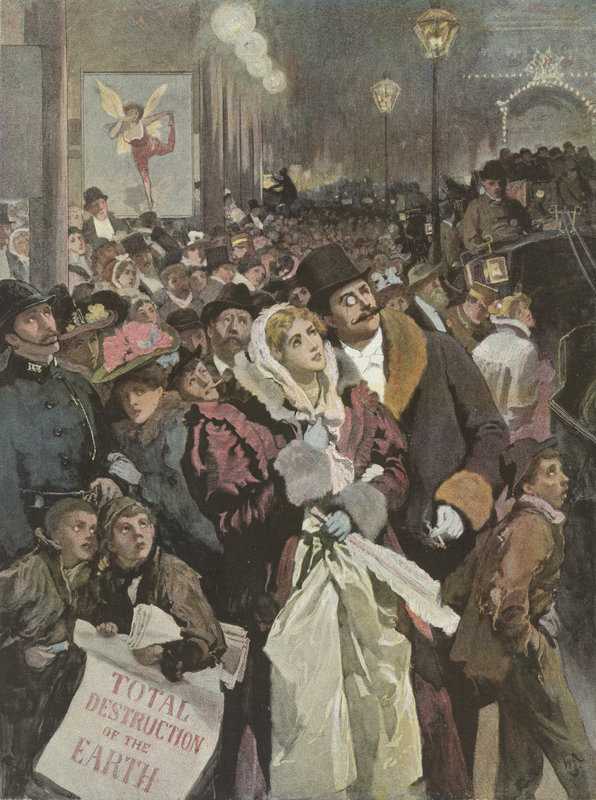
The Graphic 25/12/1897, Christmas Issue p.18
Illustration to Wells’s “The Star” by Ludek Marold

“The Star”

by

H.G. Wells


It was on the first day of the New Year that the announcement was made, almost simultaneously from three observatories, that the motion of the planet Neptune, the outermost of all the planets that wheel about the sun, had become very erratic. Ogilvy had already called attention to a suspected retardation in its velocity in December. Such a piece of news was scarcely calculated to interest a world the greater portion of whose inhabitants were unaware of the existence of the planet Neptune, nor outside the astronomical profession did the subsequent discovery of a faint remote speck of light in the region of the perturbed planet cause any very great excitement. Scientific people, however, found the intelligence remarkable enough, even before it became known that the new body was rapidly growing larger and brighter, that its motion was quite different from the orderly progress of the planets, and that the deflection of Neptune and its satellite was becoming now of an unprecedented kind.

Few people without a training in science can realise the huge isolation of the solar system. The sun with its specks of planets, its dust of planetoids, and its impalpable comets, swims in a vacant immensity that almost defeats the imagination. Beyond the orbit of Neptune there is space, vacant so far as human observation has penetrated, without warmth or light or sound, blank emptiness, for twenty million times a million miles. That is the smallest estimate of the distance to be traversed before the very nearest of the stars is attained. And, saving a few comets more unsubstantial than the thinnest flame, no matter had ever to human knowledge crossed this gulf of space, until early in the twentieth century this strange wanderer appeared. A vast mass of matter it was, bulky, heavy, rushing without warning out of the black mystery of the sky into the radiance of the sun. By the second day it was clearly visible to any decent instrument, as a speck with a barely sensible diameter, in the constellation Leo near Regulus. In a little while an opera glass could attain it.

On the third day of the new year the newspaper readers of two hemispheres were made aware for the first time of the real importance of this unusual apparition in the heavens. “A Planetary Collision,” one London paper headed the news, and proclaimed Duchaine’s opinion that this strange new planet would probably collide with Neptune. The leader writers enlarged upon the topic; so that in most of the capitals of the world, on January 3rd, there was an expectation, however vague of some imminent phenomenon in the sky; and as the night followed the sunset round the globe, thousands of men turned their eyes skyward to see–the old familiar stars just as they had always been. Continue reading ““The Star” — H.G. Wells”

“The Cone” — H.G. Wells

Plaza Italia (Great Game), Giorgio de Chirico

“The Cone”

by

H.G. Wells


The night was hot and overcast, the sky red, rimmed with the lingering sunset of mid-summer. They sat at the open window, trying to fancy the air was fresher there. The trees and shrubs of the garden stood stiff and dark; beyond in the roadway a gas-lamp burnt, bright orange against the hazy blue of the evening. Farther were the three lights of the railway signal against the lowering sky. The man and woman spoke to one another in low tones.

“He does not suspect?” said the man, a little nervously.

“Not he,” she said peevishly, as though that too irritated her. “He thinks of nothing but the works and the prices of fuel. He has no imagination, no poetry.”

“None of these men of iron have,” he said sententiously.
“They have no hearts.”

He has not,” she said. She turned her discontented face towards the window. The distant sound of a roaring and rushing drew nearer and grew in volume; the house quivered; one heard the metallic rattle of the tender. As the train passed, there was a glare of light above the cutting and a driving tumult of smoke; one, two, three, four, five, six, seven, eight black oblongs—eight trucks—passed across the dim grey of the embankment, and were suddenly extinguished one by one in the throat of the tunnel, which, with the last, seemed to swallow down train, smoke, and sound in one abrupt gulp. Continue reading ““The Cone” — H.G. Wells”

“The Loves of the Tortoises” — Italo Calvino

“The Loves of the Tortoises”

by

Italo Calvino


There are two tortoises on the patio: a male and a female. Zlack! Zlack! Their shells strike each other. It is their mating season.
The male pushes the female sideways, all around the edge of the paving. The female seems to resist his attack, or at least she opposes it with inert immobility. The male is smaller and more active; he seems younger. He tries repeatedly to mount her, from behind, but the back of her shell is steep and he slides off.
Now he must have succeeded in achieving the right position: he thrusts with rhythmic, cadenced strokes; at every thrust he emits a kind of gasp, almost a cry. The female has her foreclaws flattened against the ground, enabling her to raise her hind part. The male scratches with his foreclaws on her shell, his neck stuck out, his mouth gaping. The problem with these shells is that there’s no way To get a hold; in fact, the claws can find no purchase.
Now she escapes him; he pursues her. Not that she is faster or particularly determined to run away: to restrain her he gives her some little nips on a leg, always the same one. She does not rebel. Every time she stops, the male tries to mount her; but she takes a little step forward and he topples off, slamming his member on the ground. This member is fairly long, hooked in a way that apparently makes it possible for him to reach her even though the thickness of the shells and their awkward positioning separates them. So there is no telling how many of these attacks achieve their purpose or how many fair, or how many are theater, play-acting.
It is summer; the patio is bare, except for one green jasmine in a corner. The courtship consists of making so many turns around the little patch of grass, with pursuits and flights and skirmishing not of the claws but of the shells, which strike in a dull clicking. The female tries to find refuge among the stalks of the jasmine; she believes—or wants to make others believe—that she does this to hide; but actually this is the surest way to remain blocked by the male, held immobile with no avenue of escape. Now he has most likely managed to introduce his member properly; but this time they are both completely still, silent.
The sensations of the pair of mating tortoises are something Mr. Palomar cannot imagine. He observes them with a cold attention, as if they were two machines: two electronic tortoises programmed to mate. What does eros become if there are plates of bone or horny scales in the place of skin? But what we call eros—is it perhaps only a program of our corporeal bodies, more complicated because the memory receives messages from every cell of the skin, from every molecule of our tissues, and multiplies them and combines them with the impulses transmitted by our eyesight and with those aroused by the imagination? The difference lies only in the number of circuits involved: from our receptions billions of wires extend, linked with the computer of feelings, conditionings, the ties between one person and another. . . . Eros is a program that unfolds in the electronic clusters of the mind, but the mind is also skin: skin touched, seen, remembered. And what about the tortoises, enclosed in their insensitive casing? The poverty of their sensorial stimuli perhaps drives them to a concentrated, intense mental life, leads them to a crystalline inner awareness. . . . Perhaps the eros of tortoises obeys absolute spiritual laws, whereas we are prisoners of a machinery whose functioning remains unknown to us, prone to clogging up, stalling, exploding in uncontrolled automatisms. . . .
Do the tortoises understand themselves any better? After about ten minutes of mating, the two shells separate. She ahead, he behind, they resume their circling of the grass. Now the male remains more distanced; every now and then he scratches his claw against her shell, he climbs on her for a little, but without much conviction. They go back under the jasmine. He gives her a nip or two on a leg, always in the same place.

(Via/more).

“The Sphinx” — Edgar Allan Poe

Capture
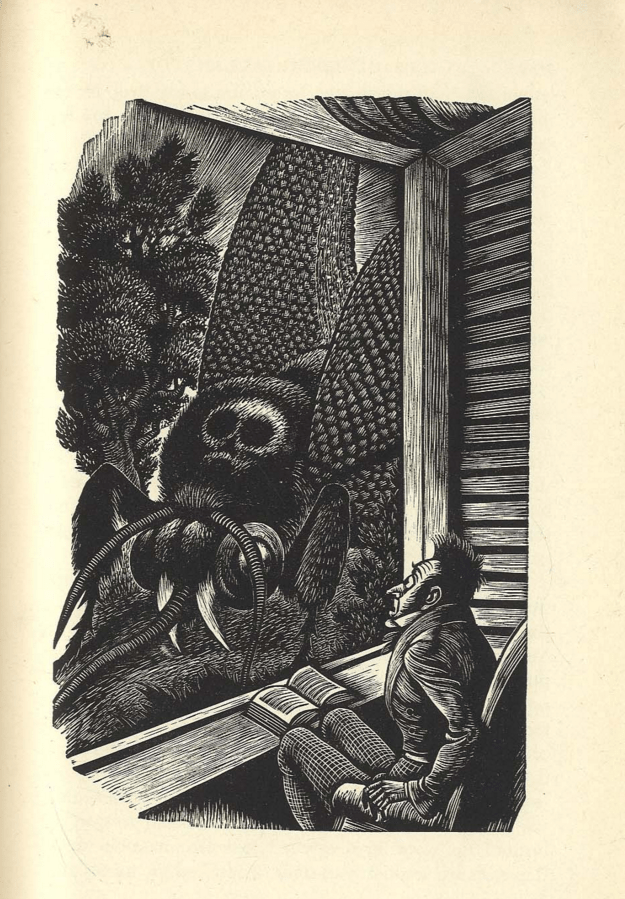
Illustration for Poe’s “The Sphinx,” Fritz Eichenberg

“The Sphinx”

by

Edgar Allan Poe


DURING the dread reign of the Cholera in New York, I had accepted the invitation of a relative to spend a fortnight with him in the retirement of his cottage ornee on the banks of the Hudson. We had here around us all the ordinary means of summer amusement; and what with rambling in the woods, sketching, boating, fishing, bathing, music, and books, we should have passed the time pleasantly enough, but for the fearful intelligence which reached us every morning from the populous city. Not a day elapsed which did not bring us news of the decease of some acquaintance. Then as the fatality increased, we learned to expect daily the loss of some friend. At length we trembled at the approach of every messenger. The very air from the South seemed to us redolent with death. That palsying thought, indeed, took entire possession of my soul. I could neither speak, think, nor dream of any thing else. My host was of a less excitable temperament, and, although greatly depressed in spirits, exerted himself to sustain my own. His richly philosophical intellect was not at any time affected by unrealities. To the substances of terror he was sufficiently alive, but of its shadows he had no apprehension.

His endeavors to arouse me from the condition of abnormal gloom into which I had fallen, were frustrated, in great measure, by certain volumes which I had found in his library. These were of a character to force into germination whatever seeds of hereditary superstition lay latent in my bosom. I had been reading these books without his knowledge, and thus he was often at a loss to account for the forcible impressions which had been made upon my fancy.

A favorite topic with me was the popular belief in omens—a belief which, at this one epoch of my life, I was almost seriously disposed to defend. On this subject we had long and animated discussions—he maintaining the utter groundlessness of faith in such matters,—I contending that a popular sentiment arising with absolute spontaneity- that is to say, without apparent traces of suggestion—had in itself the unmistakable elements of truth, and was entitled to as much respect as that intuition which is the idiosyncrasy of the individual man of genius.

The fact is, that soon after my arrival at the cottage there had occurred to myself an incident so entirely inexplicable, and which had in it so much of the portentous character, that I might well have been excused for regarding it as an omen. It appalled, and at the same time so confounded and bewildered me, that many days elapsed before I could make up my mind to communicate the circumstances to my friend. Continue reading ““The Sphinx” — Edgar Allan Poe”

“The Flowering of the Strange Orchid” — H.G. Wells

t_morino_monster_10
Illustration for “The Flowering of the Strange Orchid,” Tatsuya Morino

“The Flowering of the Strange Orchid”

by

H.G. Wells

The buying of orchids always has in it a certain speculative flavour. You have before you the brown shrivelled lump of tissue, and for the rest you must trust your judgment, or the auctioneer, or your good-luck, as your taste may incline. The plant may be moribund or dead, or it may be just a respectable purchase, fair value for your money, or perhaps – for the thing has happened again and again – there slowly unfolds before the delighted eyes of the happy purchaser, day after day, some new variety, some novel richness, a strange twist of the labellum, or some subtler coloration or unexpected mimicry.

Pride, beauty, and profit blossom together on one delicate green spike, and it may be, even immortality. For the new miracle of Nature may stand in need of a new specific name, and what so convenient as that of its discoverer? “Johnsmithia!” There have been worse names.

It was perhaps the hope of some such happy discovery that made Winter-Wedderburn such a frequent attendant at these sales – that hope, and also, maybe, the fact that he had nothing else of the slightest interest to do in the world. He was a shy, lonely, rather ineffectual man, provided with just enough income to keep off the spur of necessity, and not enough nervous energy to make him seek any exacting employments. He might have collected stamps or coins, or translated Horace, or bound books, or invented new species of diatoms. But, as it happened, he grew orchids, and had one ambitious little hothouse. Continue reading ““The Flowering of the Strange Orchid” — H.G. Wells”