
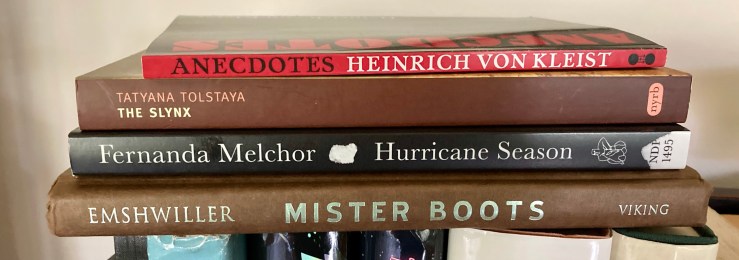
I read an excellent trio of novels to close out the summer: Carol Emshwiller’s Mister Boots, Fernanda Melchor’s Hurricane Season (translated by Sophie Hughes), and Tatyana Tolstaya’s The Slynx (translated by Jane Gambrell). In between, I read most of Anecdotes by Heinrich von Kleist (translated by Matthew Spencer), described by publisher Sublunary Editions as “short fiction and feuilletonic digressions.” (I had to look up the word “feuilletonic.”)
Mister Boots seems as good an introduction to Carol Emshwilller’s writing as I’ll get. I just sort of picked it up, started reading, and kept going. (The print was larger than the edition of her more-famous novel Carmen Dog that I got around the same time. My eyes have declined more quickly in my early forties than I would have imagined.) Mister Boots is a short, fast-paced novel. It moves along like a ever-morphing picaresque. Set somewhere near the American West proximal to the Great Depression, Emshwiller’s novel is told from the first-person perspective of Bobby. Bobby is a ten-year-old girl, but the world, apart from her sister and mother, don’t know this—-her mother raises her as a boy, dresses her as a boy, addresses her as a boy. This conceit, which even young Bobby understands cannot last forever, is a defense against her malevolent father, a stage magician and conman who wants a son to perform in his act. When Bobby’s mother dies, the father returns to take her and her sister on a wild, surreal tour of performances (and other tricks). They bring with them Mister Boots, a man who sometimes turns into a horse. I loved Mister Boots and probably read it way too quickly. It’s surreal stuff, told from the perspective of a child that really captures what young consciousness is like–slippery, trying to match causes and effect, lacking the wisdom that is experience, but also teeming with the holy powers of innocence.
I then read Tatyana Tolstoya’s post-apocalyptic satire The Slynx. The book is funny and abject, and the world Tolstoya conjures is totally gross, but also a place I was sad to leave (the general vibe reminds me of Aleksei German’s film adaptation of Hard to Be a God). The Slynx is about 300 pages but I would’ve read another 700 happily. The central hero is a lunking would-be intellectual named Benedikt; the setting is a few centuries after the Blast has reduced humanity back to the Dark Ages; most of the descendants of the pre-Blast populace endure Consequences—mutations big and small (our boy Benedikt has a cute little tail). There are also elders whose consequence is a tenuous immortality—they survive the blast and continue living (as long as they want to), an ugly curse. We first meet Benedikt as a kind of copyist, a Bartleby maybe, but one who wants more from life. He marries into a near-aristocratic family, where he has access to a huge samizdat library. More problems ensue. Ultimately, The Slynx is a postmodern fable, a book about reading itself. It’s grimy and gross and I loved it and will read it again.
I devoured Fernanda Melchor’s novel Hurricane Season and then started in again. The novel’s blurb compares it to “Roberto Bolaño’s 2666 of Faulkner’s novels,” which is high and true praise. As I stated, I immediately began rereading Hurricane Season after I started it. Like a lot of Faulkner’s work, Melchor’s narrative construction obscures, hides, and even elides important events. Crimes get lost in details. The story is set in and around a podunk Mexican town. It begins with a troop of slingshot-armed youngsters finding the body of “the Witch,” a hated and celebrated icon of the town. From there, the novel moves its camera to hover over a few key characters, letting us into their consciousness to get bits and pieces that may or may not add up to a larger picture. The village is a haunted, haunting place, a cursed world vibrating with bad mojo, drugs, rape, murder…as its publishers promised, Melchor’s world recalls Roberto Bolaño’s 2666, especially the infamous chapter “The Part about the Crimes.” (There is a fantastic moment in the fourth chapter when the third-person free indirect style slips into the language of police reports and detective inquiries.) Hurricane Season’s abjection, despair, and squalor also recalls Krasznahorkai’s Satantango, Faulkner’s A Light in August, and Bernhard’s Gargoyles. And, like Bernhard and Krasznahorkai (and his follower W.G. Sebald), Melchor crafts her novel as a brick of paragraphless text, a sometimes-flowing, sometimes-smothering miasma of words, words, words. Crimes, witches, grudges, and curses, curses, curses: Magical curses, literal curses, cursed text messages, and good old fashioned curse words. Hurricane Season is a devastating, cruel novel, but Melchor concludes it with a strange moment of grace–not for its characters, but for its readers, whom she ferries “out of this hole.” I went right back into the hole.
And—Kleist’s Anecdotes—well, I’ve kept it in my car up until this afternoon, when I finally brought it back into the house. I’ve been reading it while I wait in the carpool lane at my daughter’s school, her new school, the same high school I graduated from in fact. I read three or four as I wait for her and the other carpoolers to emerge. I’ve read a few of the anecdotes collected here before (I think I first became interested in Kleist after reading Donald Barthelme mention him as an influence). Here’s publisher Sublunary’s blurb:
Long available and celebrated in German—Kafka himself championed the 1911 Rowohlt edition of Anekdoten—Anecdotes gathers the first extensive English-language collection of Heinrich von Kleist’s short fiction and feuilletonic digressions that appeared in Berliner Abendblätter, the newspaper for which he served as editor from 1810 to 1811. Writing under increasingly unfriendly social and political conditions, this is arguably Kleist at his funniest and most irreverent, not shying away from dirty jokes while nevertheless displaying the same knack for the stylish prose that Rilke called “beautiful and so blind and skillful”.
And here’s a sample (in translation by Matthew Spencer):


 Biblioklept