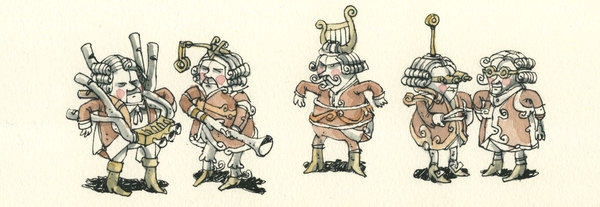
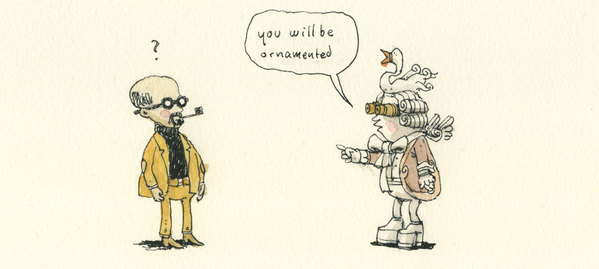
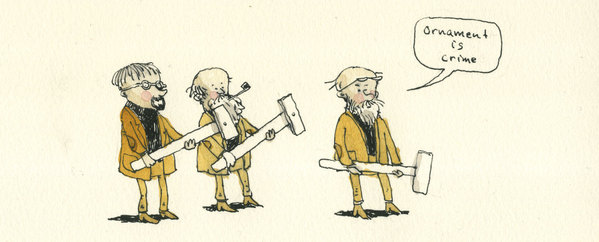
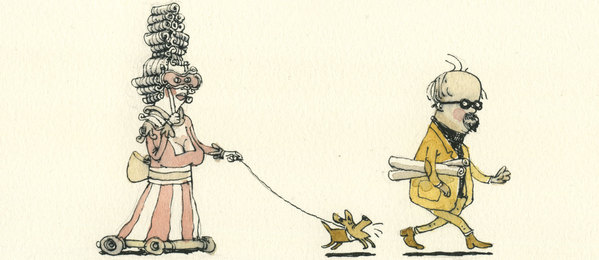
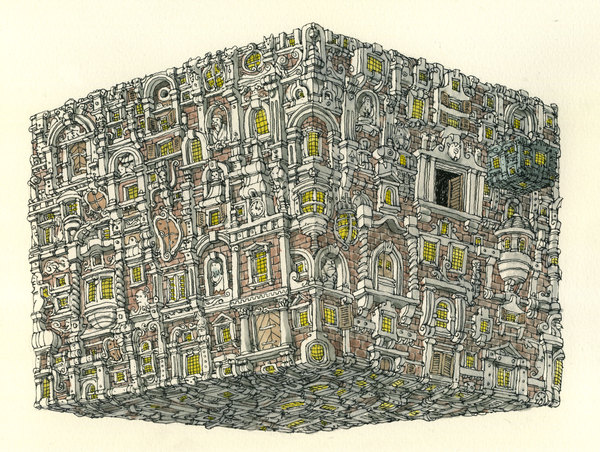
Rococo Borg vs The Association of Modernist Architects — Mattias Adolfsson

40217880c836c870cb687c970a768e25 ee3d359221e41d11679a7b9d33aed9b5 a2cd72731b785e607097b4c8b735f4d6 7688231f53421d922bac64efd0c2f60f 3784ff3670c6b426c1a9b917d7fe90b5 0d3eafe6b0376dba4bee0ba7106ea61d 2804392f9ac746cd0c020391846ae23b

(More/via).

“The Mustache” — Guy de Maupaussant

“The Mustache” by Guy de Maupassant

CHATEAU DE SOLLES, July 30, 1883.

My Dear Lucy:

I have no news. We live in the drawing-room, looking out at the rain. We cannot go out in this frightful weather, so we have theatricals. How stupid they are, my dear, these drawing entertainments in the repertory of real life! All is forced, coarse, heavy. The jokes are like cannon balls, smashing everything in their passage. No wit, nothing natural, no sprightliness, no elegance. These literary men, in truth, know nothing of society. They are perfectly ignorant of how people think and talk in our set. I do not mind if they despise our customs, our conventionalities, but I do not forgive them for not knowing them. When they want to be humorous they make puns that would do for a barrack; when they try to be jolly, they give us jokes that they must have picked up on the outer boulevard in those beer houses artists are supposed to frequent, where one has heard the same students’ jokes for fifty years.

So we have taken to Theatricals. As we are only two women, my husband takes the part of a soubrette, and, in order to do that, he has shaved off his mustache. You cannot imagine, my dear Lucy, how it changes him! I no longer recognize him-by day or at night. If he did not let it grow again I think I should no longer love him; he looks so horrid like this.

In fact, a man without a mustache is no longer a man. I do not care much for a beard; it almost always makes a man look untidy. But a mustache, oh, a mustache is indispensable to a manly face. No, you would never believe how these little hair bristles on the upper lip are a relief to the eye and good in other ways. I have thought over the matter a great deal but hardly dare to write my thoughts. Words look so different on paper and the subject is so difficult, so delicate, so dangerous that it requires infinite skill to tackle it.

Well, when my husband appeared, shaven, I understood at once that I never could fall in love with a strolling actor nor a preacher, even if it were Father Didon, the most charming of all! Later when I was alone with him (my husband) it was worse still. Oh, my dear Lucy, never let yourself be kissed by a man without a mustache; their kisses have no flavor, none whatever! They no longer have the charm, the mellowness and the snap —yes, the snap—of a real kiss. The mustache is the spice.

Imagine placing to your lips a piece of dry—or moist—parchment. That is the kiss of the man without a mustache. It is not worth while.

Whence comes this charm of the mustache, will you tell me? Do I know myself? It tickles your face, you feel it approaching your mouth and it sends a little shiver through you down to the tips of your toes.

And on your neck! Have you ever felt a mustache on your neck? It intoxicates you, makes you feel creepy, goes to the tips of your fingers. You wriggle, shake your shoulders, toss back your head. You wish to get away and at the same time to remain there; it is delightful, but irritating. But how good it is!

A lip without a mustache is like a body without clothing; and one must wear clothes, very few, if you like, but still some clothing.

I recall a sentence (uttered by a politician) which has been running in my mind for three months. My husband, who keeps up with the newspapers, read me one evening a very singular speech by our Minister of Agriculture, who was called M. Meline. He may have been superseded by this time. I do not know.

I was paying no attention, but the name Meline struck me. It recalled, I do not exactly know why, the ‘Scenes de la vie de boheme’. I thought it was about some grisette. That shows how scraps of the speech entered my mind. This M. Meline was making this statement to the people of Amiens, I believe, and I have ever since been trying to understand what he meant: “There is no patriotism without agriculture!” Well, I have just discovered his meaning, and I affirm in my turn that there is no love without a mustache. When you say it that way it sounds comical, does it not?

There is no love without a mustache!

“There is no patriotism without agriculture,” said M. Meline, and he was right, that minister; I now understand why.

From a very different point of view the mustache is essential. It gives character to the face. It makes a man look gentle, tender, violent, a monster, a rake, enterprising! The hairy man, who does not shave off his whiskers, never has a refined look, for his features are concealed; and the shape of the jaw and the chin betrays a great deal to those who understand.

The man with a mustache retains his own peculiar expression and his refinement at the same time.

And how many different varieties of mustaches there are! Sometimes they are twisted, curled, coquettish. Those seem to be chiefly devoted to women.

Sometimes they are pointed, sharp as needles, and threatening. That kind prefers wine, horses and war.

Sometimes they are enormous, overhanging, frightful. These big ones generally conceal a fine disposition, a kindliness that borders on weakness and a gentleness that savors of timidity.

But what I adore above all in the mustache is that it is French, altogether French. It came from our ancestors, the Gauls, and has remained the insignia of our national character.

It is boastful, gallant and brave. It sips wine gracefully and knows how to laugh with refinement, while the broad-bearded jaws are clumsy in everything they do.

I recall something that made me weep all my tears and also—I see it now—made me love a mustache on a man’s face.

It was during the war, when I was living with my father. I was a young girl then. One day there was a skirmish near the chateau. I had heard the firing of the cannon and of the artillery all the morning, and that evening a German colonel came and took up his abode in our house. He left the following day.

My father was informed that there were a number of dead bodies in the fields. He had them brought to our place so that they might be buried together. They were laid all along the great avenue of pines as fast as they brought them in, on both sides of the avenue, and as they began to smell unpleasant, their bodies were covered with earth until the deep trench could be dug. Thus one saw only their heads which seemed to protrude from the clayey earth and were almost as yellow, with their closed eyes.

I wanted to see them. But when I saw those two rows of frightful faces, I thought I should faint. However, I began to look at them, one by one, trying to guess what kind of men these had been.

The uniforms were concealed beneath the earth, and yet immediately, yes, immediately, my dear, I recognized the Frenchmen by their mustache!

Some of them had shaved on the very day of the battle, as though they wished to be elegant up to the last; others seemed to have a week’s growth, but all wore the French mustache, very plain, the proud mustache that seems to say: “Do not take me for my bearded friend, little one; I am a brother.”

And I cried, oh, I cried a great deal more than I should if I had not recognized them, the poor dead fellows.

It was wrong of me to tell you this. Now I am sad and cannot chatter any longer. Well, good-by, dear Lucy. I send you a hearty kiss. Long live the mustache! JEANNE.
“How to Write a Novel” — Gordon Lish

“How to Write a Novel” by Gordon Lish

First make sure you have enough time. It is crucial that you have enough time to make things up. Myself, I do not have time enough for anything like that.

But I’ll tell you what’s what. It will not be hard for you to follow me doing it.

Just listen.

Just watch.

I’m composing these instructions on an I.B.M. Selectric. I got it back in 1961. I did not buy it. I finessed it or I finagled it or I stole it.

The person who is the unexpressed direct object of one or the other of these verbs was rich. He said you can borrow this thing, use it for a while. Then he stuck his other thing in my wife’s thing. They still have their things and I have this thing and I’m not giving it up.

It’s given tip-top service. I really loved it when I first saw it, and I still love it just as much.

I never cover it over with anything. I don’t cover it over with anything like a cover or anything—because I like to look at it—the shape.  I.B.M. is good at giving a thing a nice shape. I always look at the shape of things before I snap of the light in a room.

I think 1961 was the Selectric’s first year.

I talk to engineers whenever I get a chance. I don’t mean the kind that build bridges. I mean the fellows that service things. Those are the engineers I talk to.

You know what one of those fellows once told me once? Buy the first of whatever it is! He said buy the first one of whatever it is because the maker of it is never going to knock himself out like that again—making, you know, all of the others after that. That’s why this one’s still going fine after so many wonderful, wonderful years.

The same goes for the Polaroid camera I’ve got. I’ve got the oldest one there is. You know how old that is? Here’s how old it is. It’s called, they call it, the Polaroid Land Camera.

That’s how goddamn old it is!

No shit, it was a first one—it was the very first Polaroid the Polaroid people made!

You want to see pictures? Look at these pictures! Tell me when in your life you ever saw in your life pictures as sharp as these pictures!

Because they’e this big when I start out with them. You see how big? Next to nothing, right? But then what? But then I go get them all blown up as big as life! See them? Look at them all over the walls if you don’t know what I mean!

That’s resolution for you , isn’t it?

Well, that’s my second wife, okay?

They’re framed all over the place.

People come in here and then they look at them and then they smack their heads.

My God, they say, such pictures!

I say, original issue, a maker knows his game.

“Letter of Advice and Apology to a Young Burglar” — Hilaire Belloc

“Letter of Advice and Apology to a Young Burglar” — Hilaire Belloc


My dear Ormond,

Nothing was further from my thoughts. I had imagined you knew me well enough—and, for the matter of that, all your mother’s family—to judge me better. Believe me, no conception of blaming your profession entered my mind for a moment. Whether there be such a thing as “property” in the abstract I should leave it to metaphysicians to decide: in practical affairs everything must be judged in its own surroundings.

It was not upon any musty theological whimsy that I wrote; the definition of stealing or “theft”—I care not by what name you call it—is not for practical men to discuss. Nor was I concerned with the ethical discussion of burglary (to give the matter its old legal and technical title); it was lack of judgment, sudden actions due to nothing but impulse, and what I think I may call “the speculative side” of a burglar’s life.

You have not, as yet, any great responsibilities. No one is dependent upon you—you have but yourself to provide for; but you must remember that such responsibilities will arrive in their natural course, and that if you form habits of rashness or obstinacy now they will cling to you through life. We are all looking forward to a certain event when Anne is free again; in plain English, my boy, we know your loyal heart, and we shall bless the union; but I should feel easier in my mind if I saw you settled into one definite branch of the profession before you undertook the nurture of a family.

Adventure tempts you because you are brave, and something of a poet in you leads you to unusual scenes of action. Well, Youth has a right to its dreams, but beware of letting a dangerous Quixotism spoil your splendid chances.

Take, for example, your breaking into Mr. Cowl’s house. You may say Mr. Cowl was not a journalist, but only a reviewer; the distinction is very thin, but let it pass. You know and I know that the houses of none in any way connected with the daily Press should ever be approached. It is plain common sense. The journalist comes home at all hours of the night. His servant (if he keeps one) is often up before he is abed. Do you think to enter such houses unobserved? Continue reading ““Letter of Advice and Apology to a Young Burglar” — Hilaire Belloc”

“Suicide and wife arrive in Cuba” and Other Wise Cracks from F. Scott Fitzgerald

From the “Epigrams, Wise Cracks and Jokes” section ofd  F. Scott Fitzgerald’s Noteboooks:

Suicide and wife arrive in Cuba.

Let’s all live together.

Debut—the first time a young girl is seen drunk in public.

He repeated to himself an old French proverb he had made up that morning.

A sleeping porch is a back room with no pictures on the walls. It should contain at least one window.

Kill the scrub sire is our slogan.

Why can’t you be square? Well, when I was young I used to play with old automobile tires.

Forgotten is forgiven.

If all your clothes are worn to the same state it means you go out too much.

American actresses now use European convents as a sort of female Muldoon’s.

You must stoop a little in order to jump.

For a car—Excuse my lust.

Andre Gide lifted himself by his own jockstrap so to speak—and one would like to see him hoisted on his own pedarasty.

Creditors’ jokes


“Oh My God, It’s So Juicy!”

Cranberry Sauce à la Bart Simpson

Funky Forest: The First Contact (Full Film)

Glen Baxter Comic

List of Lapsus Calami from Roberto Bolaño’s Novel 2666

A funny section from late in Roberto Bolaño’s novel 2666; lapsus calami is Latin for “slip of the pen,” indicating a mistake or miswriting (although, as the characters discuss later, some of these examples may be purposeful):

. . . . and then they started to talk about lapsus calami, many of them collected in a book published long ago in Paris and fittingly titled Le Musee des erreurs, as well as others selected by Max Sengen, hunter of errata. And one thing led to another and it wasn’t long before the copy editors got out a book (which wasn’t the French Museum of Errors or Sengen’s text), whose title Archimboldi couldn’t see, and began to read aloud a selection of cultured pearls:

“Poor Marie! Whenever she hears the sound of an approaching horse, she is certain that it is I.” Vie de Ranee, Chateaubriand.

“The crew of the ship swallowed up by the waves consisted of twenty-five men, who left hundreds of widows consigned to misery.” Les Cages flottantes, Gaston Leroux.

“With God’s help, the sun will shine again on Poland.” The Deluge, Sienkiewicz.

” ‘Let’s go!’ said Peter, looking for his hat to dry his tears.” LourdesZola.

“The duke appeared followed by his entourage, which preceded him.” Letters from My Mill, Alphonse Daudet.

“With his hands clasped behind his back, Henri strolled about the garden, reading his friend’s novel.” Le Cataclysme, Rosny.

“With one eye he read, with the other he wrote.” On the Banks of the Rhine, Auback.

“Silently the corpse awaited the autopsy.” Luck’s Favorite, Octave Feuillet.

“William couldn’t imagine the heart served for anything other than breathing.” Death, Argibachev.

“This sword of honor is the most beautiful day of my life.” Honneur d’artiste, Octave Feuillet.

“I can hardly see anymore, said the poor blind woman.” Beatrix, Balzac.

“After they cut off his head, they buried him alive.” The Death of Mongomer, Henri Zvedan.

“His hand was as cold as a snake’s.” Ponson du Terrail. And here there was no indication of the source of the lapsus calami.

The following unattributed quotes from Max Sengen’s collection were particularly notable:

“The corpse stared reproachfully at those gathered around him.”

“What can a man do who’s been killed by a lethal bullet?”

“Near the city there were roaming whole packs of solitary bears.”

“Unfortunately, the wedding was delayed fifteen days, during which time the bride fled with the captain and gave birth to eight children.”

“Three- or four-day excursions were a daily occurrence.”

And then came the commentary.

Super Golden Friends

E-Books of the Future! (Retrofuture Fun from 1959)

(Via Disonancia, which is probably my favorite thing on the internet right now).

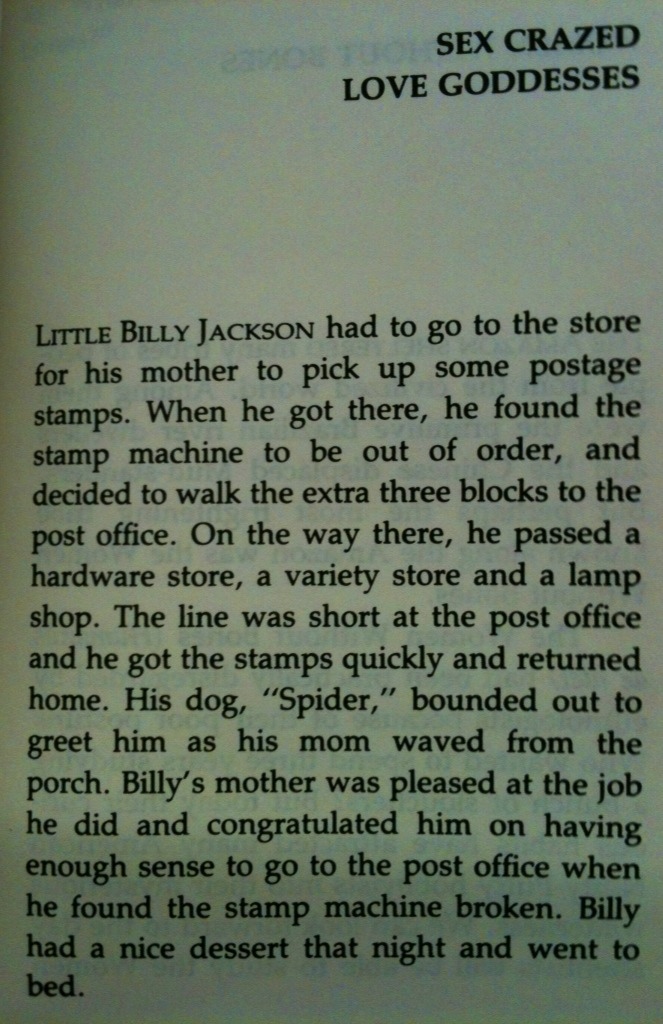
“Sex Crazed Love Goddesses” — Steve Martin

20120404-185250.jpg

(From Cruel Shoes).

“My Precious!”

“Review of Winslow Homer Show at LA County Art Museum” — Steve Martin

20120328-164325.jpg(I read my parents’ copy of Cruel Shoes at least a dozen times. At least. Let’s say it was formative stuff).

“Hold On Elmo’s Texting” Elmo — Ted McCagg

(Via The Nervous Breakdown).

Werner Herzog Explains Why His Films Are Funnier Than Eddie Murphy’s