April 11th.–I meditated accordingly, but without any very wonderful result. Then at eight o’clock bothered myself till after nine with this eternal tale of Tieck. The forenoon was spent in scribbling; but at eleven o’clock my thoughts ceased to flow,–indeed, their current has been wofully interrupted all along,–so I threw down my pen, and set out on the daily journey to the village. Horrible walking! I wasted the customary hour at the Athenæum, and returned home, if home it may now be called. Till dinner-time I labored on Tieck’s tale, and resumed that agreeable employment after the banquet.
Just when I was on the point of choking with a huge German word, Molly announced Mr. Thoreau. He wished to take a row in the boat, for the last time, perhaps, before he leaves Concord. So we emptied the water out of her, and set forth on our voyage. She leaks, but not more than she did in the autumn. We rowed to the foot of the hill which borders the North Branch, and there landed, and climbed the moist and snowy hill-side for the sake of the prospect. Looking down the river, it might well have been mistaken for an arm of the sea, so broad is now its swollen tide; and I could have fancied that, beyond one other headland, the mighty ocean would outspread itself before the eye. On our return we boarded a large cake of ice, which was floating down the river, and were borne by it directly to our own landing-place, with the boat towing behind.
Parting with Mr. Thoreau, I spent half an hour in chopping wood, when Molly informed me that Mr. Emerson wished to see me. He had brought a letter of Ellery Channing, written in a style of very pleasant humor. This being read and discussed, togetherwith a few other matters, he took his leave, since which I have been attending to my journalizing duty; and thus this record is brought down to the present moment.
Tag: Journals
Even more beautiful emotions (Kafka’s diary entry, 27 March 1912)
27. March. Monday, on the street. The boy who with several others, threw a large ball at a servant girl walking defencelessly in front of them; just as the ball was flying at the girls’ behind I grabbed him by the throat, choked him in a fury, thrust him aside, and swore. Then walked on and didn’t even look at the girl. One quite forgets one’s earthly existence because one is so entirely full of fury is permitted to believe that, given the opportunity, one would in the same way fill oneself with even more beautiful emotions.
Franz Kafka’s diary entry, 27 March 1912. Translation by Joseph Kresh.
This is Thanksgiving Day, a good old festival | Nathaniel Hawthorne’s Journal Entry for November 24, 1843
Thursday, November 24th.–This is Thanksgiving Day, a good old festival, and we have kept it with our hearts, and, besides, have made good cheer upon our turkey and pudding, and pies and custards, although none sat at our board but our two selves. There was a new and livelier sense, I think, that we have at last found a home, and that a new family has been gathered since the last Thanksgiving Day. There have been many bright, cold days latterly,–so cold that it has required a pretty rapid pace to keep one’s self warm a-walking. Day before yesterday I saw a party of boys skating on a pond of water that has overflowed a neighboring meadow. Running water has not yet frozen. Vegetation has quite come to a stand, except in a few sheltered spots. In a deep ditch we found a tall plant of the freshest and healthiest green, which looked as if it must have grown within the last few weeks. We wander among the wood-paths, which are very pleasant in the sunshine of the afternoons, the trees looking rich and warm,–such of them, I mean, as have retained their russet leaves; and where the leaves are strewn along the paths, or heaped plentifully in some hollow of the hills, the effect is not without a charm. To-day the morning rose with rain, which has since changed to snow and sleet; and now the landscape is as dreary as can well be imagined,–white, with the brownness of the soil and withered grass everywhere peeping out. The swollen river, of a leaden hue, drags itself sullenly along; and this may be termed the first winter’s day.
“Recycling one’s own life with books” |Thirteen Notes on Susan Sontag’s Notebook Collection, As Consciousness Is Harnessed to Flesh
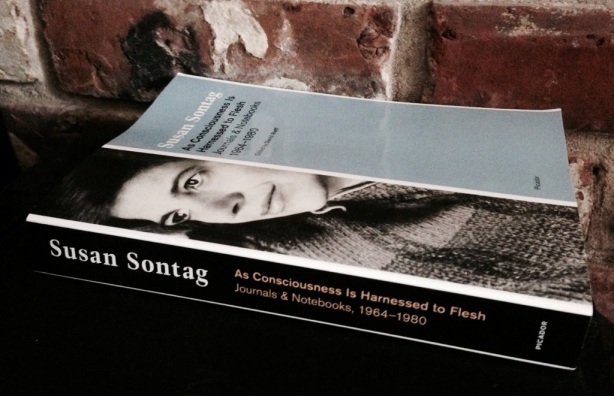
1. “In my more extravagant moments,” writes David Rieff in his introduction to Susan Sontag’s As Consciousness Is Harnessed to Flesh, “I sometimes think that my mother’s journals, of which this is the second of three volumes, are not just the autobiography she never got around to writing…but the great autobiographical novel she never cared to write.”
2. In my review of Reborn, the first of the trilogy Rieff alludes to, I wrote, “Don’t expect, of course, to get a definitive sense of who Sontag was, let alone a narrative account of her life here. Subtitled Journals & Notebooks 1947-1963, Reborn veers closer to the “notebook” side of things.”
As Consciousness Is Harnessed to Flesh is far closer to the ‘notebook’ side of things too, which I think most readers (or maybe I just mean me here) will appreciate.
3. I mean, this isn’t the autobiographical novel that Rieff suggests it might be (except of course it is).
Consciousness/Flesh offers something better: access to Sontag’s consciousness in its prime, not quite ripe, but full, heavy, bursting with intellectual energy, her mind attuned to (and attuning) the tumult of the time the journals cover, 1964 through 1980.
It’s an autobiography stripped of the pretense of presentation; it’s a novel stripped of the pretense of storytelling.
4. Sontag’s intellect and spirit course through the book’s 500 pages, eliding any distinction between lives personal and professional. “What sex is the ‘I’?” she writes, “Who has the right to say ‘I’?” The journals see her working through (if not resolving, thankfully) such issues.
5. An entry from late 1964, clearly background for Sontag’s seminal essay “Notes on Camp” (itself a series of notes), moves through a some thoughts on artists and poets, from Warhol to Breton to Duchamp (“DUCHAMP”) to simply “Style,” which, Rieff’s editorial note tells us, has a box drawn around it. The entry then moves to define
Work of Art
An experiment, a research (solving a “problem”) vs. form of a play
—before turning to a series of notes on the films of Michelangelo Antonioni.
6. A page or two later (1965) delivers the kind of gold vein we wish to discover in author’s notebooks:
PLOTS & SITUATIONS
Redemptive friendship (two women)
Novel in letters: the recluse-artist and his dealer a clairvoyant
A voyage to the underworld (Homer, Vergil [sic], Steppenwolf)
Matricide
An assassination
A collective hallucination (Story)
A theft
A work of art which is really a machine for dominating human beings
The discovery of a lost mss.
Two incestuous sisters
A space ship has landed
An ageing movie actress
A novel about the future. Machines. Each man has his own machine (memory bank, codified decision maker, etc.) You “play the machine. Instant everything.
Smuggling a huge art-work (painting? Sculpture?) out of the country in pieces—called “The Invention of Liberty”
A project: sanctity (based on SW [Simone Weil]—with honesty of Sylvia Plath—only way to solve sex “I” is talk about it
Jealousy
7. The list above—and there’s so much material like it in Consciousness/Flesh—is why I love author’s notebooks, We get to see the raw material here and imagine along with the writer (if we choose), free of the clutter and weight of execution, of prose, of damnable detail.
There’s something joyfully cryptic about Sontag’s notes, like the solitary entry “…Habits of despair” in late July of 1970—or a few months later: “A convention of mutants (Marvel comics).”
If we wish we can puzzle the notes out, treat them as clues or keys that fit to the work she was publishing at the time or to the personal circumstances of her private life. Or (and to be clear, I choose this or) we can let these notes stand as strange figures in an unconventional autobiographical novel.
8. Those looking for more direct material about Sontag’s life (and really, why do you want more and what more do you want?) will likely be disappointed—everything here is oblique (lovely, lovely oblique).
Still, there are moments of intense personal detail, like this 1964 entry where Sontag describes her body:
Body type
- Tall
- Low blood pressure
- Needs lots of sleep
- Sudden craving for pure sugar (but dislike desserts—not a high enough concentration)
- Intolerance for liquor
- Heavy smoking
- Tendency to anemia
- Heavy protein craving
- Asthma
- Migraines
- Very good stomach—no heartburn, constipation, etc.
- Negligible menstrual cramps
- Easily tired by standing
- Like heights
- Enjoy seeing deformed people (voyeuristic)
- Nailbiting
- Teeth grinding
- Nearsighted, astigmatism
- Frileuse (very sensitive to cold, like hot summers)
- Not very sensitive to noise (high degree of selective auditory focus)
There’s more autobiographical detail in that list than anyone craving a lurid expose could (should) hope for.
9. For many readers (or maybe I just mean me here) Consciousness/Flesh will be most fascinating as a curatorial project.
Sontag offers her list of best films (not in order),her ideal short story collection, and more. The collection often breaks into lists—like the ones we see above—but also into names—films, authors, books, essays, ideas, etc.
10. At times, Consciousness/Flesh resembles something close to David Markson’s so-called “notecard” novels (Reader’s Block, This Is Not a Novel, Vanishing Point, The Last Novel):
Napoleon’s wet, chubby back (Tolstoy).
and
Wordsworth’s ‘wise passiveness.’
and
Nabokov talks of minor readers. ‘There must be minor readers because there are minor writers.’
and
Camus (Notebooks, Vol. II): ‘Is there a tragic dilettante-ism?'”
and
‘To think is to exaggerate.’ — Valéry.
and so on…
11. Sometimes, the lists Sontag offers—
(offers is not the right verb at all here—these are Sontag’s personal journals and notebooks, her private ideas, material never intended for public consumption, but yes we are greedy, yes; and some of us (or maybe I just mean me here) are greedier than others, far more interested in her private ideas and notes and lists than the essays and stories and novels she generated from them—and so no, she didn’t offer this, my verb is all wrong)
—sometimes Sontag [creates/notes/generates] very personal lists, like “Movies I saw as a child, when they came out” (composed 11/25/65). There’s something tender here, imagining the child Sontag watching Fantasia or Rebecca or Citizen Kane or The Wizard of Oz in the theater; and then later, the adult Sontag, crafting her own lists, making those connections between past and present.
12. While Reborn showcased the intimate thoughts of a nascent (and at times naïve) intellect, Consciousness/Flesh shows us an assured writer at perhaps her zenith. In September of 1975, Sontag defines herself as a writer:
I am an adversary writer, a polemical writer. I write to support what is attacked, to attack what is acclaimed. But thereby I put myself in an emotionally uncomfortable position. I don’t, secretly, hope to convince, and can’t help being dismayed when my minority taste (ideas) becomes majority taste (ideas): then I want to attack again. I can’t help but be in an adversary relation to my own work.
13. Readers looking for a memoir or biography might be disappointed in Consciousness/Flesh; readers who seek to scrape its contours for “wisdom” (or worse, writing advice) should be castigated.
But As Consciousness Is Harnessed to Flesh will reward those readers who take it on its own terms as an oblique, discursive (and incomplete) record of Sontag’s brilliant mind.
I’ll close this riff with one last note from the book, a fitting encapsulation of the relationship between reader and author—and, most importantly, author-as-reader-and-rereader:
Recycling one’s own life with books.
As Consciousness Is Harnessed to Flesh is new in trade paperback from Picador; you can read excerpts from the book at their site.
Susan Sontag’s List of Novels with Cinematic Structure
Novels with cinematic structure:
Hemingway, In Our Time
Faulkner,
[Horace] McCoy, They Shoot Horses, Don’t They?
Robbe-Grillet, Les Gommes [The Erasers]
[Georges] Bernanos, M. Ouine
I[vy] Compton-Burnett,
V Woolf, Between the Acts
Philip Toynbee, Tea with Mrs. Goodman
des Forêts, Les Mendiants
his first novel—multiple pov [points of view]
[Barnes,] Nightwood
Reverzy, Le Passage
Burroughs,
[John] Dos Passos
Firbank, Caprice; Vainglory; and [Inclinations] (trilogy)
Jap[anese] writer [Yasunari Kawabata] (N.B. visual sense, suppleness of changing scenes)—Snow Country, etc.
Dickens (cf. Eisenstein)—
There are people who thought with camera eye (a unified p-o-v that displaces itself) before the camera
N[athaniel] West,
Blechman
“new novelists”: Claude Simon, Le Palace
Claude Ollier, La Mis-en-Scène
(all based on organization of a decor (N[orth] Africa)
–From an entry dated 6/26/66 Paris in Susan Sontag’s notebook, published as part of As Consciousness Is Harnessed to Flesh. (I’ve maintained the bracketed editorial intrusions of the published text, even with they did not seem necessary).
Salem, August 31, 1836 — Nathaniel Hawthorne
Salem, August 31, 1836.–A walk, yesterday, down to the shore, near the hospital. Standing on the old grassy battery, that forms a semicircle, and looking seaward. The sun not a great way above the horizon, yet so far as to give a very golden brightness, when it shone out. Clouds in the vicinity of the sun, and nearly all the rest of the sky covered with clouds in masses, not a gray uniformity of cloud. A fresh breeze blowing from land seaward. If it had been blowing from the sea, it would have raised it in heavy billows, and caused it to dash high against the rocks. But now its surface was not all commoved with billows; there was only roughness enough to take off the gleam, and give it the aspect of iron after cooling. The clouds above added to the black appearance. A few sea-birds were flitting over the water, only visible at moments, when they turned their white bosoms towards me,–as if they were then first created. The sunshine had a singular effect. The clouds would interpose in such a manner that some objects were shaded from it, while others were strongly illuminated. Some of the islands lay in the shade, dark and gloomy, while others were bright and favored spots. The white light-house was sometimes very cheerfully marked. There was a schooner about a mile from the shore, at anchor, laden apparently with lumber. The sea all about her had the black, iron aspect which I have described; but the vessel herself was alight. Hull, masts, and spars were all gilded, and the rigging was made of golden threads. A small white streak of foam breaking around the bows, which ware towards the wind. The shadowiness of the clouds overhead made the effect of the sunlight strange, where it fell.
From Nathaniel Hawthorne’s American Note-Books.
Honesty of Evil Thoughts (Kafka)
From Kafka’s Diaries.
Reborn — Susan Sontag

New in trade paperback next week from Picador, Reborn collects the early private writings of Susan Sontag, beginning in 1947 when she was just fourteen. The book begins with the following salvo from 1947: “I believe: (a) That there is no personal god or life after death.” If the phrase seems awfully definitive for such a young person to write, its terse tone is repeatedly undercut in other places in Sontag’s early journals, like when she asks “What does the expression ‘in his cups’ mean?” (he’s drunk, sweetheart). There’s also something almost cute about her entry from 12/19/48: “There are so many books and plays and stories I have to read–Here are just a few.” I feel the same way myself. She goes on to list over 20 authors and titles, including Faulkner’s Sanctuary and Dostoyevsky’s Diary of a Writer. Sontag’s immediate, visceral, and sometimes raw reactions to whatever she’s reading, hearing, and watching, make up a good bulk of Reborn, and there’s something fun, if inessential, to know that she read Huxley’s Eyeless in Gaza and James’s Portrait of a Lady in January of 1950.
Don’t expect, of course, to get a definitive sense of who Sontag was, let alone a narrative account of her life here. Subtitled Journals & Notebooks 1947-1963, Reborn veers closer to the “notebook” side of things. The book certainly doesn’t feel like its 320 pages, mostly because it’s comprised of lists, notes, half-poems, and half-ideas–with the occasional major insight or life-changing moment thrown in in an almost alarmingly casual tone. Check the following consecutive entries:
11/21/50
Excellently staged performance of Don Giovanni last night (City Center). Today, a wonderful opportunity was offered me–to do some research work for a soc[iology] instructor named Philip Rieff, who is working on, among other things, a reader in the sociology of politics + religion. At last the chance to really involve myself in one area with competent guidance.
12/2/50
Last night, or was it early this (Sat.) morning?–I am engaged to Philip Rieff.
If there’s more to this episode in Sontag’s journal, her son David Rieff, the book’s editor, has chosen to elide it (although he has included that, as early as 12/19/56, if his mother is to be believed, he knew “the difference between a sarcophagus and an esophagus”). In an introduction loaded with much hemming and hawing, Rieff acknowledges the rawness of his mother’s private diaries, noting that they were written only for Sontag herself, who had no intention of publishing them. (Rieff’s decision to publish them is an issue of control: Sontag had sold her all of her writing and papers to UCLA and Rieff felt that assuming an editorial role might protect his mother to some extent). And, as one would expect of the notes of a young college student, nothing here is even remotely polished: like the adolescent who so easily denies an afterlife, many of Sontag’s notes and thoughts come across as callow, or at least not on par with the intellectual who gave us On Photography and “Notes on ‘Camp.'” A note from 1/2/58 comes across as painfully emo: “How to make my sadness more than a lament for feeling? How to feel? How to burn? How to make anguish metaphysical?” Not that these are unserious questions, but methinks someone’s been hitting the Kierkegaard a bit too hard. When Sontag the diarist steps in–that is to say, the diarist who reflects honestly, as opposed to the academic pulling philosophical poses–we get brusque honesty full of pathos. In a note from 1960, after briefly discussing how her mother’s conflict-aversion led to “the idea that honesty equaled cruelty,” Sontag drops this shocker: “No matter what I have said, my life, my actions say that I have not loved the truth, that I have not wanted the truth.” While I don’t particularly demand self-reflection, this kind of honesty is both rare and affecting coming from an academic.
But why should we expect Sontag’s private journals to be more than they are? It’s more fun to read Reborn elliptically, picking it up and putting it down, browsing through Sontag’s lists of movies, quotes from Rilke and Blake, and various thought-experiments. From 11/4/57:
“Try whiskey. To find a voice. To speak.
Instead of talking.
[ . . . ]
Are the Jews played out? I am proud of being Jewish. Of what?
[ . . . ]
Orc–imaginary mailed beast, dragon, ogre, named after a sea-monster killed by Orlando, in Ariosto’s Orlando Furious
Whiskey, Jews, Orcs–great stuff.
We’ll conclude with one of our favorite moments in the book, which is simply a list of words. In one of the few contextual notes Rieff concedes, he notes that all her life, “SS made lists of words into which she occasionally inserted a person’s name or a brief observation.” The list is from the fall of 1949:
effete
noctambulus
perfervid
detumescence
disheveled
so alluring, so cerebral
sodden
intriguing
corrupt dignity
lotophagous
“The Jungle Is Obscene” — Werner Herzog’s Visceral Nature Writing
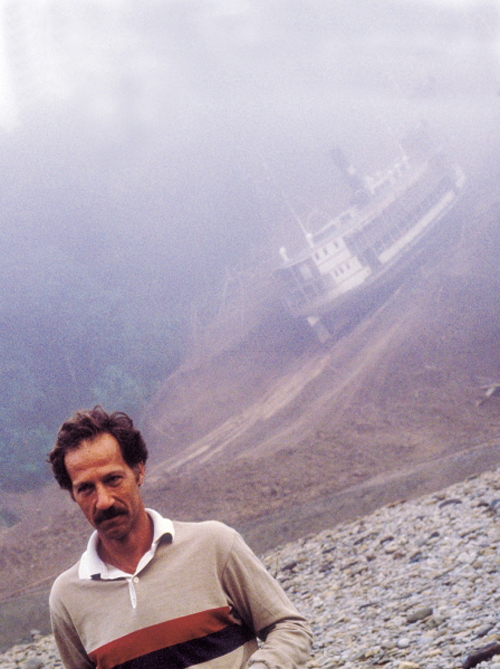
This month’s issue of Harper’s features a fantastic collection of diary entries by German film director Werner Herzog. These entries are excerpted from the forthcoming book Conquest of the Useless: Reflections from the Making of Fitzcarraldo. Released in 1982, Fitzcarraldo tells the story of a would-be rubber magnate who attempts to haul a steamship over a small mountain in Peru so that he can access an area rich in rubber trees. The infamous Klaus Kinski plays Fitzcarraldo, a European who pushes his crew to the breaking point in this mad quest; the semi-fictional plot was doubled in the real-life production disasters that plagued the movie. Fitzcarraldo dramatizes one of the oldest narrative conflicts, man vs. nature, in an earnest yet completely unromantic way. Fitzcarraldo, the opera-lover who brings ice to the natives, shatters any romantic illusions one might have about the power and majesty of nature in his mad schemes. This theme repeats throughout Herzog’s work, from the conquistador opus Aguirre, the Wrath of God to his outstanding 2005 documentary Grizzly Man. Again and again, Herzog’s films ironize, disrupt, or otherwise show the folly of romanticizing nature. His diary entries from Conquest of the Useless lay these sentiments bare in ways both bleakly poetic and terribly funny.
Take this entry from December 8, 1980: “The jungle is obscene. Everything about it is sinful, for which reason the sin does not stand out as sin.” Here, Herzog provides a succinct antithesis to Rousseau’s concept of the “noble savage.” Herzog’s view of man—de-politicized, that is—seems more Hobbesian, actually. In an entry from April 6, 1981, he writes:
“This morning I woke up to terror such as I have never experienced before: I was entirely stripped of feeling. Everything was gone; it was as if I had lost something that had been entrusted to me the previous evening, something I was supposed to take special care of overnight. I was in the position of someone who has been assigned to guard an entire sleeping army, but suddenly finds himself mysteriously blinded, deaf, and effaced. Everything was gone. I was completely empty, without pain, without longing, without love, without warmth and friendship, without anger, without hate. Nothing, nothing was there anymore, and I was left like a suit of armor with no knight inside. It took a long time before I even felt alarmed.”
Nature seems to nullify Herzog, to void any essential humanity he might have had. His repetition of “Nothing, nothing was there anymore” reminds me of King Lear’s famous lines “Never, never, never, never, never.” Although Lear is weeping over the body of his kind daughter Cordelia, the psychology of these lines surely reflect his own terrible experiences, his own nullified identity of homelessness on the wild heath.
For Herzog, nature is a war, nature will eat you. “Moss grows on lianas, and in the knobby places where the moss is thicker, a leafy plant like a slender hare’s ear grows out of the moss: a parasite on a parasite on a parasite,” he observes. If Herzog is melancholy or mordant in these grim reckonings, he’s also very, very funny. Take this hilarious June 4th entry concerning a giant albino turkey that’s been terrorizing the set:
“The camp is silent with resignation; only the turkey is making a racket. It attacked me, overestimating its own strength, and I quickly grabbed its neck, which squirmed and tried to swallow, slapped him left-right with the casual elegance of the arrogant cavaliers I had seen in French Three Musketeers films who go on to prettily cross swords, and then let the vain albino go. His feelings hurt, he trotted away, wiggling his rump but with his wings still spread in conceited display.”
And yet one senses that Herzog’s humor is a defense against the absurdity of nature, one that derives from an acute awareness that humanity is at once of and apart from nature, and at that by its own definition, its own choice. In a June 2nd entry featuring his nemesis the albino turkey, Herzog details an incident that highlights the essential ugliness of a Darwinian world:
“Our kitchen crew slaughtered our last four ducks. While they were still alive, Julian plucked their neck feathers, before chopping off their heads on the execution block. The white turkey, that vain creature, the survivor of so many roast chickens and ducks transformed into soup, came over to inspect, gobbling and displaying, and used his ugly feet to push one of the beheaded ducks, as it lay there on the ground bleeding and flapping its wings, into what he thought was a proper position and making gurgling sounds while his bluish-red wattles swelled, he mounted the dying duck and copulated with it.”
There we go. We get it all, all the order of nature. Food, sex, death, the whole deal, laid out keenly and with grim humor, neatly compacted into a single, grotesque episode. If these excerpts are any indication of the rest of the book’s trajectory, Conquest of the Useless promises to transcend standard making-of fare. Indeed, Herzog’s book seems nothing less than a profound meditation on the intersection of man, nature, terror, and mortality.
Conquest of the Useless: Reflections on the Making of Fitzcarraldo is available June 30th from HarperCollins.
 Biblioklept