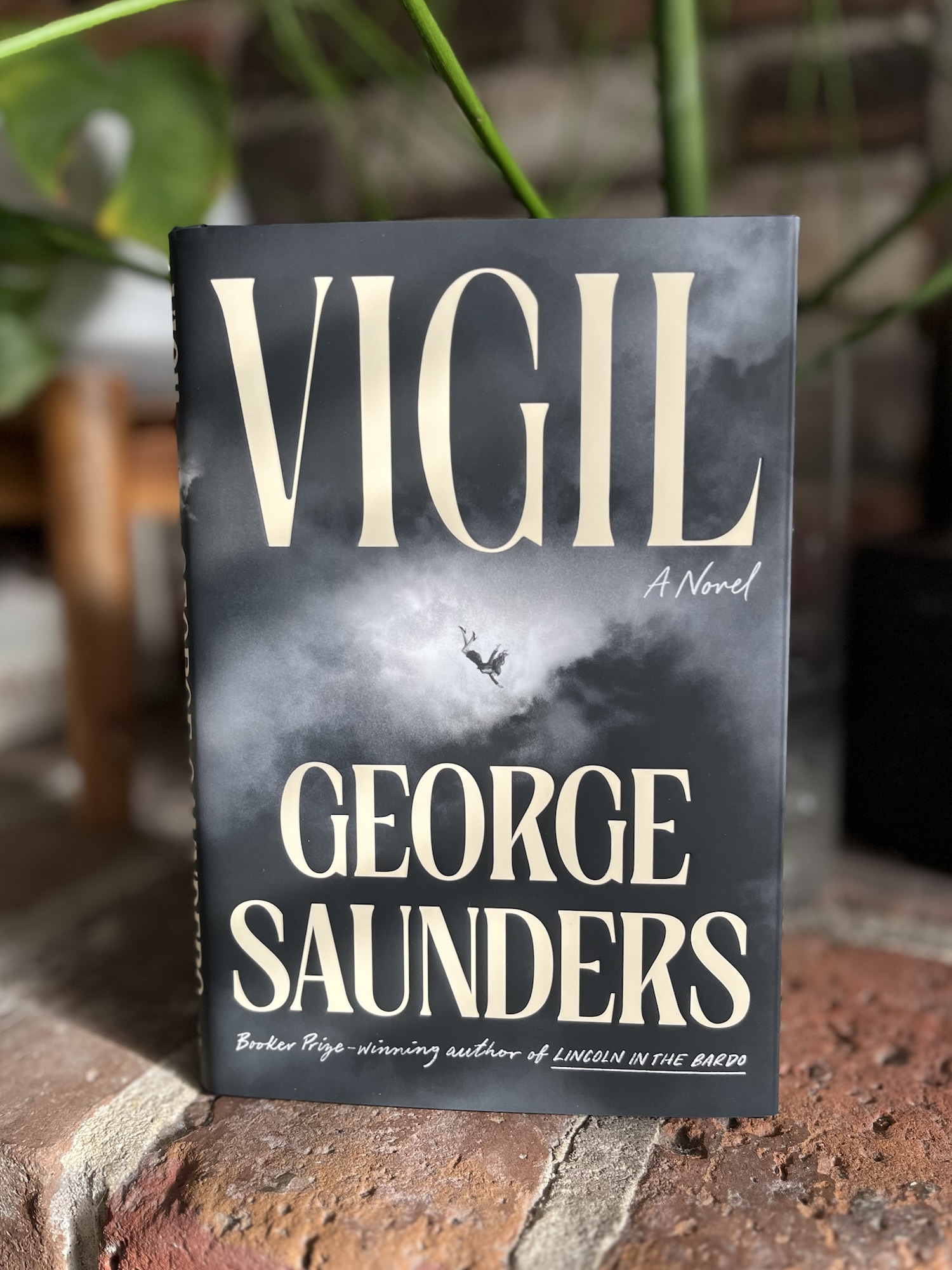
Miserable comforters are ye all | On George Saunders’ hollow new novel Vigil

George Saunders’ latest novel Vigil is told primarily from the perspective of a ghost, Jill “Doll” Blaine, a spirit who has resisted elevation to up there in order to remain on Earth, where she guides her dying “charges” into the afterlife.

Her latest (and perhaps last) charge is one K.J. Boone, an oil tycoon dying in the “slop room” of his least favorite house. Boone spent his career denying climate science, spreading misinformation and doubt, and enriching himself from fossil fuels. He’s also a flaming asshole. He remains unrepentant as he approaches death. Gentle Jill takes compassion on the dying man, trying to “comfort” him into the next step, even as he verbally abuses her.

Jill is not the only spirit interested in Boone’s afterlife. Other ghosts pop up at the deathbed, some compassionate, some confrontational; some voices urge Boone toward self-awareness while others reinforce his denial.

We meet the most adversarial of Boone’s visiting spirits very early in the novel. As Jill arrives to comfort her “charge,” she’s interrupted by “the Frenchman,” a zany phantom who urges her not to comfort Boone but rather to “lead him, as quickly as possible, to contrition, shame, and self-loathing.” We soon learn that the Frenchman — presumably Étienne Lenoir — “had a hand in the invention of the beast.”

The “beast” here is the internal combustion engine, the great evil lurking in the background of Vigil. The Frenchman wails that his invention “poisons” the earth, air, and sea, and he spends his afterlife in a purgatory that’s one-part self-flagellation, one-part punishing avenger. It is his goal to make K.J. Boone suffer.

As Vigil toots out its plot in fragments and vignettes, we come to understand just why Boone might deserve to suffer. He conspired with other oil executives to suppress research about just how damaging carbon emissions are. Furthermore, he helped fund a right-wing ecosystem designed to manufacture constant doubt and discord. He was, in short, a willing and knowing architect of a great deal of awful shit.

Most of the obscene climate disaster takes place offstage. There are brief sketches of unstoppable fires, relentless drought, beached dolphins, ravaged forests. Famine. A climate refugee is even trotted out at one point. Etc. But Saunders focuses his camera primarily on the deathbed of the Great Man, K.J. Boone. When Boone’s degrading insults become too much — or when she’s simply distracted — Jill might confer with other spirits or drift into her own tragic past (and happy past, too). But mostly, yeah, Saunders is interested in attending to the dying old asshole.

Radical empathy has always been Saunders’ calling card, but Vigil asks too much of the reader’s patience and rewards very little in return. I suppose we are to take our narrator Jill’s charming naivety as Zen, but her mantra “Comfort. Comfort, for all else is futility” is hokey pablum.

Jill’s other mantra goes something like, you are an inevitable occurrence. All persons are inevitable; their choices are inevitable; their atrocities are inevitable. This passive worldview is a wonderful Get Out of Jail Free card, I suppose, but it’s ultimately unpersuasive. Isn’t Jill’s choice for compassion just that, a choice? Saunders’ argument — and the book does read like a sentimental screed — posits evitability with one hand while using inevitability in the other hand as a kind of cloth to wipe away real, earthly sin. It’s a parlor trick, an amusement to comfort us in dismal times.

Which is all good and yes I guess sure why not? would be fine if Vigil was, like, funny, right? Is Saunders not heir apparent to Vonnegut, to Parker, to Twain? But the humor of Vigil is not humor but rather the “idea of humor,” the shadow of humor. This novel is lifeless, bloodless, hollow.

I suppose we are meant to find some black humor in Boone’s bombastic blather and his encounters with the Frenchman and other spirits. But the premise wears thin quickly. It’s clear that Saunders wants his audience to find empathy for this imp; that he believes empathy is some kind of emotional solution. But there’s not enough of a human there to empathize with. The character is too flat, more a prop than a villain.

Vigil suffers too when compared to so many stories that mine similar territory, from A Christmas Carol to Citizen Kane to There Will Be Blood. In his NYT review of Vigil, Dwight Garner wrote that “it’s as if Clarence, the angel from It’s a Wonderful Life, came down to oblige Mr. Potter instead of George.” Garner’s characterization is fair, but Lionel Barrymore’s Potter evinces more twinkling Satanic charm than dull, horrible K.J. Boone.

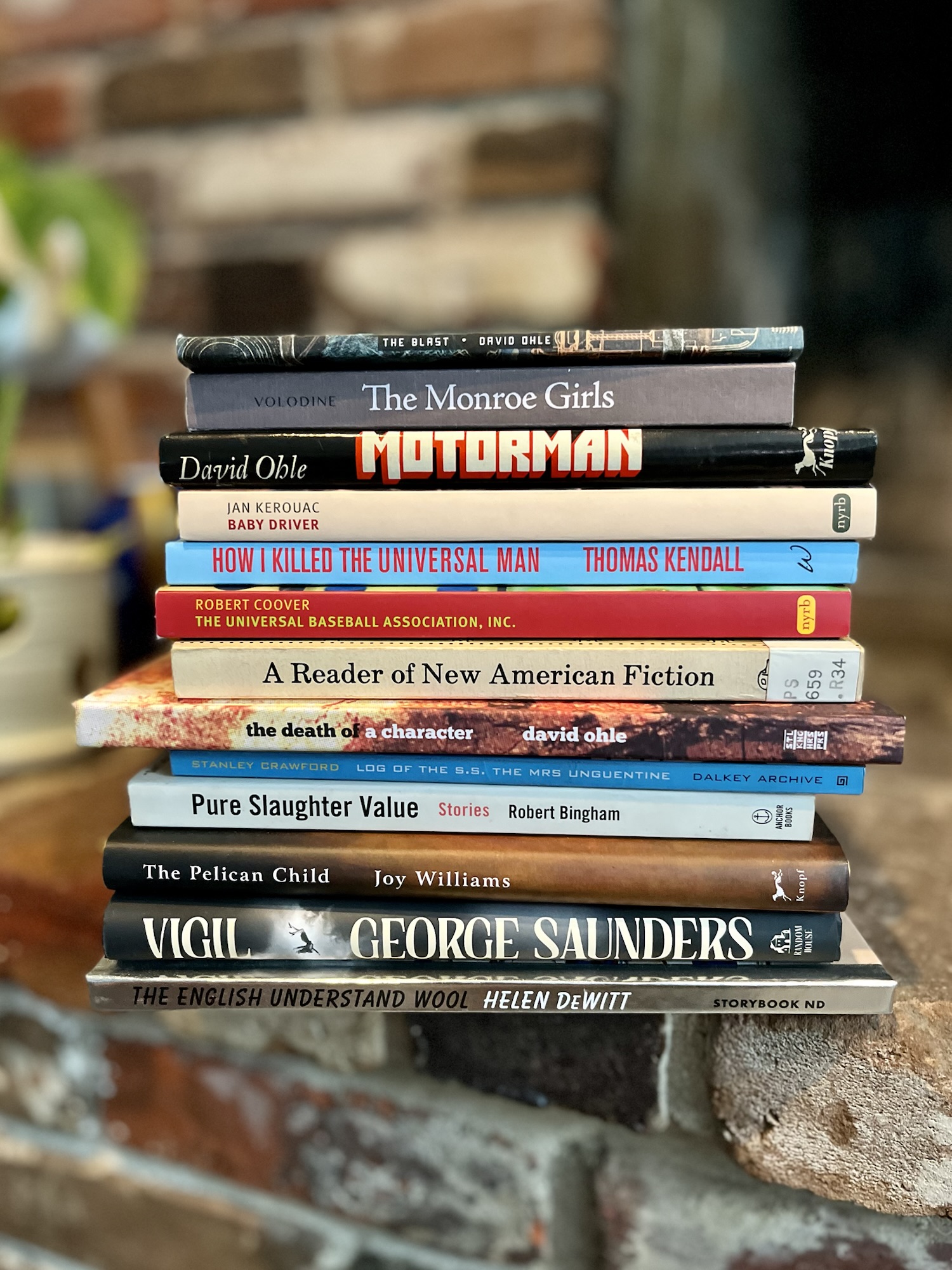
Nor will Vigil fare favorably when compared to prominent climate fiction novels like The RoadThe Parable of the Sower, or Oryx and Crake (let alone the under-read Moldenke novels of David Ohle). To be fair, Saunders is not attempting “cli-fi”; the earth’s imminent ecological collapse is not the soul of the novel. The souls of the novel are dying Boone and comforter Jill.

The rhetorical style of Vigil becomes especially tedious. While Jill’s voice sometimes gives over to a purposeful “elevated” style, much of the novel blips out in choppy fragments and stilted dialogue. There’s no fat on the novel, but there also isn’t much muscle. The quippiness in the end feels hollow, the voices undifferentiated, the “wisdom” merely platitudes.

The one real exception to the verbal doldrums happens very early in the novel, as the Frenchman perches on Boone’s deathbed, reading from “a tremendous stack of papers”:

The cardinal, he shouted, feeds on bits of plastic piping. In a ballroom filling with mud, chairs squeak in objection. A groggy hippo (What hippo, I wondered, why speak of hippos in this fearful place, this somber moment?) rolls yellow eyes up at a hunter seeking its ivory canines. A juvenile jaguar creeps forward, dismembers a poodle in a bright pink jacket.

Saunders seems to lovingly parody something sharper and stranger than what’s happening in Vigil, as if a lost text by André Breton or Antonin Artaud had infiltrated the novel. The feral energy and burst of color here are more dramatic than the weak tea that follows. I have more empathy for the cardinal eating plastic or the jaguar eating pets than I do for C. Koch Jay Tee Boone Pickens Hayward Dee Woods Chevron Valdez, Esq.

Saunders’ strongest work, like the stories in CivilWarLand in Bad Decline and The Tenth of December, skewered the deadened language of late capitalism while showcasing real and earned small-h heroism from the ordinary people doing their best in a system that they do not have the energy to resist.

There was always a touch of sentimentality to Saunders’ early stuff, a nice note to balance the bitter humor. But his work over the past decade has overindulged the sweet stuff. The prescient satire of a few decades ago has mellowed into a tepid drip of self-satisfied invocations to comfort, forgive, and absolve. Saunders loves his characters; he loves his readers more. And he wants, I think, to offer his readers comfort now in a miserable, miserable time. But now is not the time for comfort.

Wolf Hall — Hilary Mantel

Wolf Hall, Hilary Mantel’s revisionist retelling of the Tudor saga through the eyes of Thomas Cromwell, is new in trade paperback this week from Picador. When the book won the Man Booker Prize last year, chairman James Naughtie credited its success to the “bigness of the book . . . [its] boldness [and] scene setting.” In The Atlantic, Christopher Hitchens noted that the book put Mantel “in the very first rank of historical novelists.” In The New York Review of Books, Stephen Greenblatt pointed out that this “is a novel too in which nothing is wasted, and nothing completely disappears.” Here’s what Biblioklept had to say:

I’m coming to the end of Hilary Mantel’s brilliant treatment of the Tudor saga,Wolf Hall. Sign of a great book: when it’s finished, I will miss her characters, particularly her hero Thomas Cromwell, presented here as a self-made harbinger of the Renaissance, a complicated protagonist who was loyal to his benefactor Cardinal Wolsey even though he despised the abuses of the Church. Mantel’s Cromwell reminds us that the adjective “Machiavellian” need not be a pejorative, applied only to evil Iago or crooked Richard III. The Cromwell of Wolf Hall presages a more egalitarian–modern–extension of power. Cromwell here is not simply pragmatic (although he is pragmatic), he also has a purpose: he sees the coming changes of Europe, the rise of the mercantile class signaling economic power over monarchial authority. Yet he’s loyal to Henry VIII, and even the scheming Boleyns. “Arrange your face” is one of the book’s constant mantras; another is “Choose your prince.” Mantel’s Cromwell is intelligent and admirable; the sorrows of the loss of his wife and daughter tinge his life but do not dominate it; he can be cruel when the situation merits it but would rather not be. I doubt that many people wanted yet another telling of the Tudor drama–but aren’t we always looking for a great book? Wolf Hall demonstrates that it’s not the subject that matters but the quality of the writing. Highly recommended.

Presenting all these reviews is simply a way of pointing out that if you know anything about contemporary lit, you probably already know that there’s a strong critical consensus that the book is excellent. Which it is. And if you like historical fiction, particularly of the English-monarchy variety, it’s likely you’ve already read it (and if not, why not? Jeez). However, I think it’s important–particularly now, with the current brouhaha over what literary fiction is and how female writers are treated by critics–to point out that what makes Mantel’s novel so excellent–and distinctly literary–is the writing: the narrative craft, the intensity of characterization, the vitality of prose. There’s nothing gimmicky about Wolf Hall even though its hero Cromwell has been traditionally reviled. Furthermore, Mantel resists fetishizing her set pieces, unlike so many writers of historical fiction, who feel the need to bombard their readers with extraneous details, as if the author’s painstaking research were a weapon rather than a tool.

My original review of Wolf Hall overlapped with a reading of James Wood’s essay on Thomas More from his collection The Broken Estate (also, incidentally, available in paperback from Picador). More is the major villain of Wolf Hall, and Wood savages him in “Sir Thomas More: A Man for One Season.” It was strange then (not too strange, though) to see Mantel and Wood intersect again a few months later, in Wood’s New Yorker review of David Mitchell’s historical novel The Thousand Autumns of Jacob de Zoet. Here’s Wood–

Meanwhile, the historical novel, typically the province of genre gardeners and conservative populists, has become an unlikely laboratory for serious writers, some of them distinctly untraditional in emphasis and concern. (I am thinking not just of Mitchell but of Thomas Pynchon, Susan Sontag, Steven Millhauser, A. S. Byatt, Peter Carey.) What such novelists are looking for in those oldfangled laboratories is sometimes mysterious to me; and how these daring writers differ from a very gifted but frankly traditional and more commercial historical novelist like Hilary Mantel is an anxiously unanswered question.

Wood is typically dismissive of the historical novel even as he admits its attraction–one he doesn’t understand (or pretends not to understand)–to “serious writers,” a collective from which he deems to exclude Mantel. Wood’s rubric seems to be that Mantel is too “commercial” and “traditional” to warrant her inclusion in his club (even as he damns her with faint praise), but I think that his Mitchell review reveals a deep antipathy to anything that seems, y’know, approachable for most readers. That Pynchon leads Wood’s list is telling. Pynchon’s historical fictions range from fantastic and funny (V.Gravity’s Rainbow) to belabored and difficult (Mason & Dixon) to dense and inscrutable (Against the Day). But Pynchon is Pynchon and it’s not fair to exclude Mantel from the “serious writers” club for not being Pynchon (I sometimes think that poor James Wood has just been a book critic too long and hates reading). This is a roundabout way of arguing that, yes, Wolf Hall is serious writing, that it is literary writing, that it transcends its subject matter and comments on the human condition, on soul, on psyche, on spirit. That it happens to entertain at the same time is, of course, why we care. Highly recommended.

The Obligatory Jonathan Franzen Post

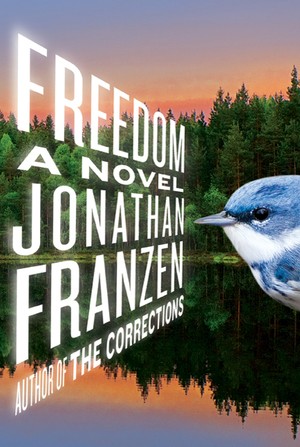
So, Jonathan Franzen’s Freedom is out today. The follow-up to 2001’s The Corrections was already in a second printing before its release today, pretty much pointing to the book being “the literary event” of 2010 (whatever that means). I haven’t read Freedom yet so I don’t have an opinion about it–but it’s hard to not have an opinion about the opinions about Freedom, at least if you follow literary-type news. The reviews have been overwhelmingly positive, even when they can find something to nitpick or quibble with. Obama picked up a copy last week on vacation. In an act of hyperbole so ridiculous as to turn comical, The Guardian’s Jonathan Jones called it “the novel of the century.” (Nevermind that the century isn’t even a decade old). But it’s probably the fact that Franzen appeared on the cover of Time magazine–the first writer in a decade to do so (the last was Stephen King)–that’s caused some professional jealousy and a backlash against Franzen. Again, this is all before the book has been released.

Yes, Franzenfreude. Authors Jodi Picoult and Jennifer Weiner felt the need to speak out against coverage of Freedom, crying foul that their books were not receiving the same critical attention as the “white male literary darling.” You can read an interview with the pair here, where their position seems to be that their work, frequently on the bestseller lists, is dismissed as genre fare. I don’t know Weiner’s stuff but Picoult’s novels strike me as the sort of maudlin crap that get turned into Lifetime movies (which they do). Picoult and Weiner don’t just play the gender card though. No, they also whip out a populist argument, the idea that literary critics ought to give more weight to “what people actually read.” In a series of recent columns on the attention Freedom has garnered, Lorin Stein pointed out that “It has become immensely hard to get a “literary” writer the attention he or she deserves.” (The comments section of Stein’s posts showcase a remarkable debate about just what “literary fiction” is).

Stein is absolutely right of course. (Weiner and Picoult will have to console themselves by sobbing into their piles of money). Franzen’s Freedom has become an opportunity for those who love literary fiction–which might be an endangered species–to call attention to the fact that novels are important, that they can somehow diagnose and analyze the spirit of an age. In his article for The Guardian, William Skidelsky strips the rhetoric away and gets to the point–

Underneath the words “Great American Novelist”, Time‘s strapline ran: “He’s not the richest or most famous. His characters don’t solve mysteries, have magical powers or live in the future. But in his new novel, Jonathan Franzen shows us all the way we live now.” It isn’t hard to unpick the subtext here: “Remember, folks, there’s such a thing as serious literature; it has little to do with Dan Brown or Harry Potter, and these days most of us tend to ignore it, but it’s actually kind of important.”

At The Faster Times, Lincoln Michel is even brassier–

There has always been a segment of the population that does not like it when intelligent artistic work gets praise. These people cry foul when an Academy Award goes to a well-crafted film with limited distribution instead of the latest Hollywood blockbuster, they moan when magazines cover innovative indie musicians instead of the most recent Nickelback CD, and you better believe they can’t stand it when that elitist literary fiction gets awards and coverage that should be reserved for books that people are “actually reading.”

Much of the critical reception of Freedom, then, is more about how the public–the reading public–is to connect with and interact with novels in an age of new media, in an age where some like to pretend the literary novel has lost its relevance, in an age where bozos go around declaring manifestos against novels. While Freedom need not be the novel to “save” the novel, it also shouldn’t be an occasion for backbiting, jealousy, and backlash. Maybe everyone should just calm down and read the damn thing.

[UPDATE: Read our obligatory review of Freedom].