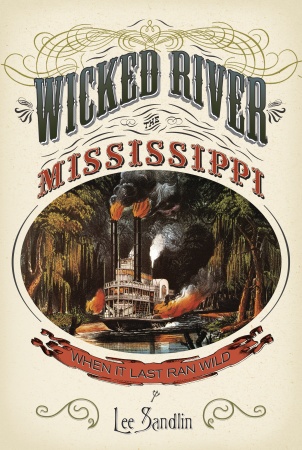
Wicked River: The Mississippi When It Last Ran Wild — Lee Sandlin

The mighty Mississippi River remains perhaps the signal geographical symbol of the United States of America. It divides our country neatly into East and West, flowing down from the industrial North to the agricultural South, and in this sense, the Mississippi is the major artery of America’s heart. We find in the Mississippi a rich mythos, one that both informs and reflects our national character. And while plenty of writers have striven to capture and express the river’s culture and character, it is Mark Twain who more or less invented our idea of the Mississippi. In his fascinating new history Wicked River, Lee Sandlin observes that, “There is a pretty much universal idea that Twain has a proprietary relationship to the Mississippi. It belongs to him, the way Victorian London belongs to Dickens or Dublin belongs to Joyce.” Sandlin’s goal in Wicked River is not to wrest the Mississippi from Twain; rather, he aims to show us the gritty turbulence swelling under Twain’s romantic myth–a myth that many Americans have come to hold as a received truth. Sandlin points out that Twain’s “Mississippi books are works of memory, even of archaeology”;  they point to a vibrant river culture in a prelapsarian past, one “with its own culture and its own language and its own unspoken rules.” Sandlin’s own book plumbs that culture, revealing strange, wild tales of river pirates and con-men, fiddlers and gamblers, road agents and robbers, politicians and drunkards, and Indians and would-be “civilizers.” Sandlin’s canny observations come from a myriad of first-hand accounts–always the sign of a legitimate history–but Wicked River is never dry or dusty, but rather brims with vigor and intensity, whether we’re learning about the earthquakes that shook up New Madrid, the tornado that smashed Natchez, the sinking of the Sultana, or the ice floe that destroyed the St. Louis Harbor. Sandlin’s writing is concise, lively, and often wry and earthy–although always grounded in fact. (One colorful passage begins, “There was one simple explanation for the wildness of river culture: everybody was drunk”). Wicked River does a marvelous job conveying the tumultuous and eclectic history of an American frontier in the nineteenth century. Recommended.

Wicked River is new in hardback this month from Pantheon.
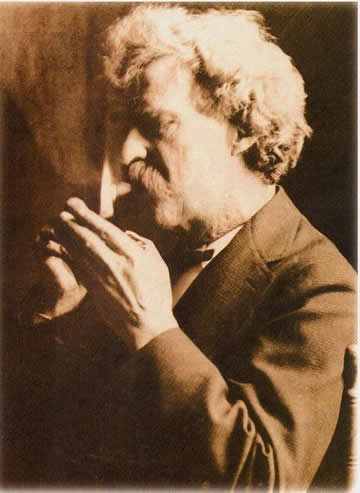
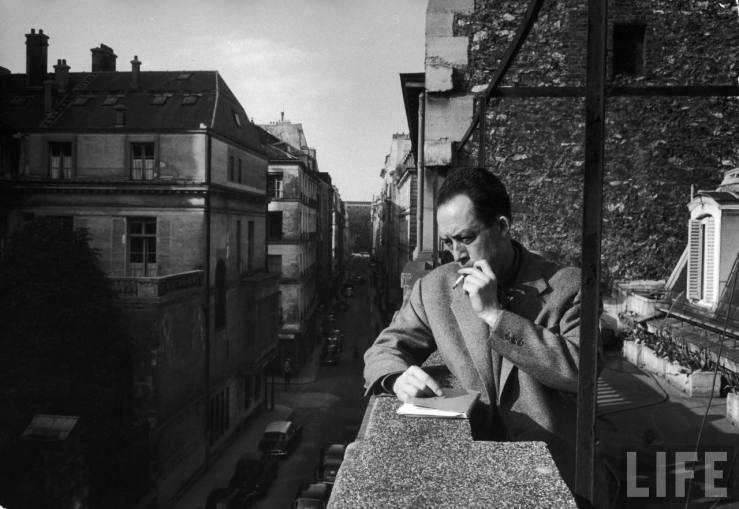
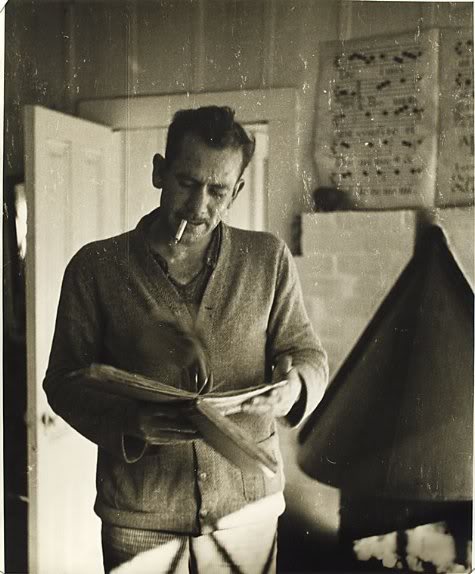
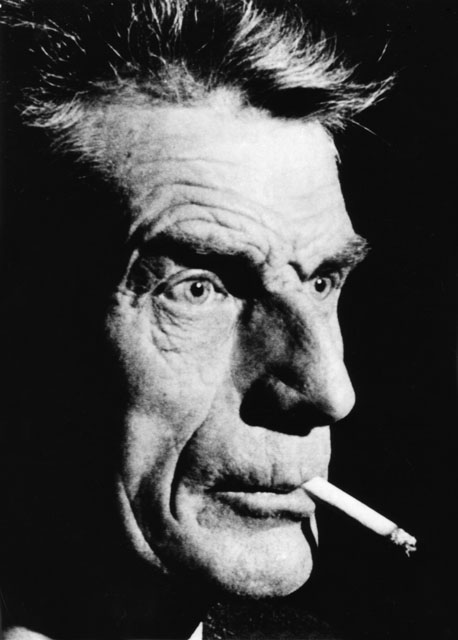
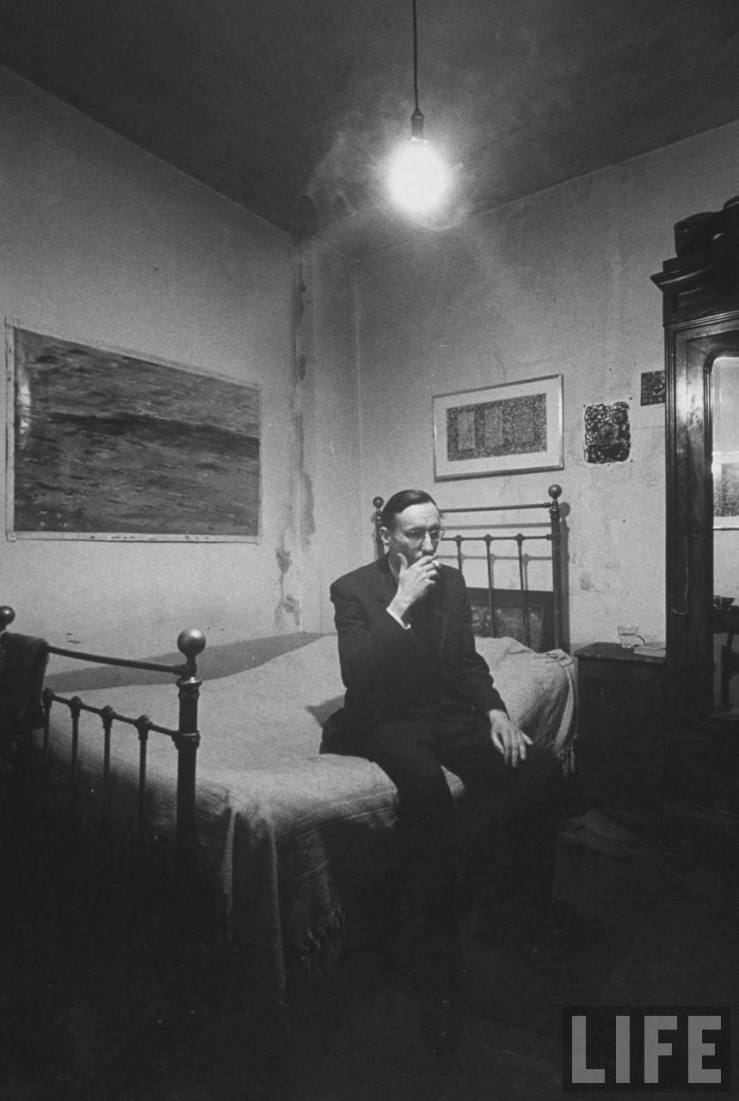
Smoking Makes You Look Cool

Mark Twain
Albert Camus
Kurt Vonnegut
Roland Barthes
John Steinbeck
Charles Bukowski
William Faulkner
Roberto Bolaño
Samuel Beckett
William Burroughs
JRR Tolkien
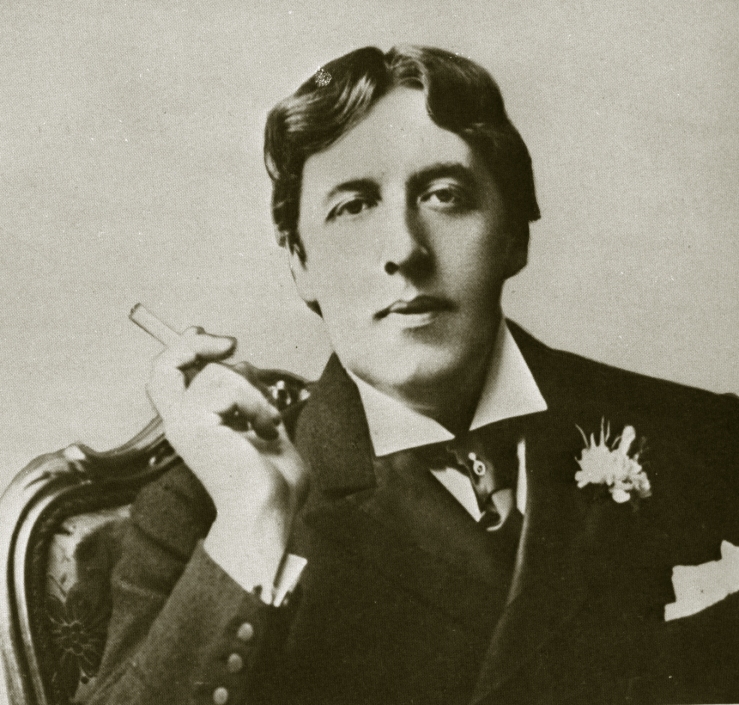
Oscar Wilde
Henry Miller
H.S.T.
Barry O'Bama

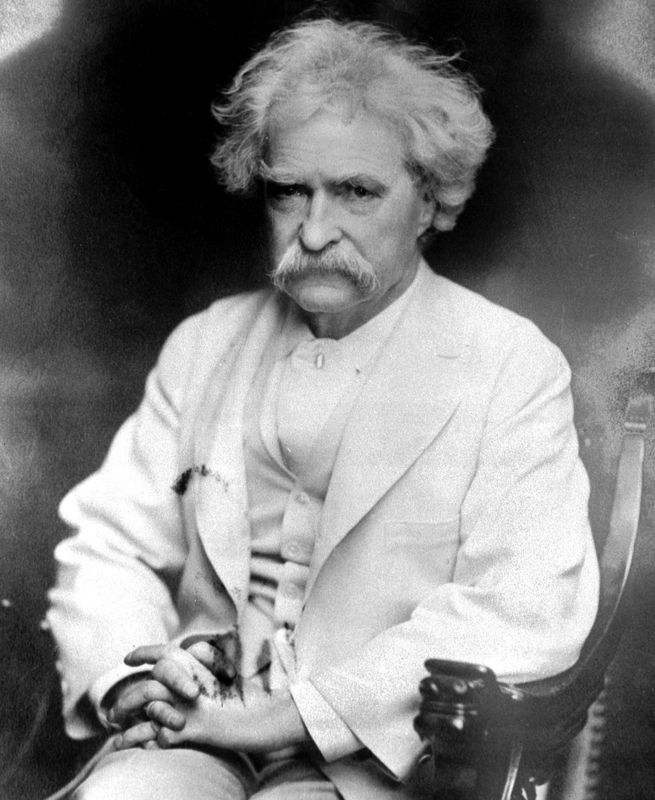
Mark Twain at Stormfield, 1909

A Scapegoat for Promiscuous Drunks, Friendly Calls, and Humbug Resolutions

mark-twain

From Mark Twain’s January 1st, 1863 column in the Territorial Enterprise:

Now is the accepted time to make your regular annual good resolutions. Next week you can begin paving hell with them as usual. Yesterday, everybody smoked his last cigar, took his last drink, and swore his last oath. To-day, we are a pious and exemplary community. Thirty days from now, we shall have cast our reformation to the winds and gone to cutting our ancient short comings considerably shorter than ever. We shall also reflect pleasantly upon how we did the same old thing last year about this time. However, go in, community. New Year’s is a harmless annual institution, of no particular use to anybody save as a scapegoat for promiscuous drunks, and friendly calls, and humbug resolutions, and we wish you to enjoy it with a looseness suited to the greatness of the occasion.

The Only Earthly Certainty Is Oblivion

Check out this odd, possibly disturbing clip from the obscure 1986 claymation masterpiece, The Adventures of Mark Twain. Bizarre, fun stuff.

The Adventures of Huckleberry Finn: One of Our Favorite Challenged Books

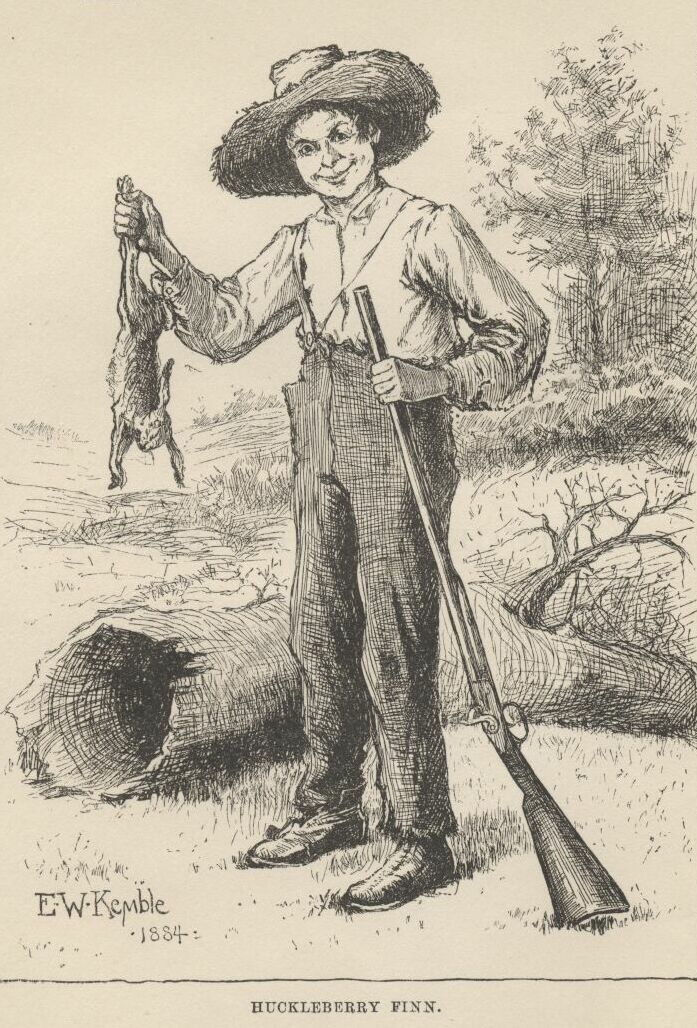
E.W. Kemble's frontispiece to the original 1884 edition
E.W. Kemble's frontispiece to the original illustrated edition

The Adventures of Huckleberry Finn by Mark Twain, undoubtedly one of the Great American Novels, ranks a healthy #5 on the ALA’s list the 100 Most Frequently Challenged Books. Young Huck’s casual colloquial use of the word “nigger” and the cruel hijinks Huck and Tom play on Jim at the novel’s end are two reasons that many have sought to suppress Twain’s masterpiece, including educator and critic John Wallace, who famously called it “the most grotesque example of racist trash ever given our children to read.” Wallace went so far as to suggest that “Any teacher caught trying to use that piece of trash with our children should be fired on the spot, for he or she is either racist, insensitive, naive, incompetent or all of the above.”

I guess I should’ve been fired on the spot, as I’ve used Huck Finn in my classroom a number of times, almost always in conjunction with excerpts from Olaudah Equiano’s Interesting Narrative, some Philis Wheatley poems, and a UN report on modern human trafficking. Context is everything.

While I can concede readily that Huck, the voice of the novel, says some pretty degrading things about Jim, often meant (on Twain’s part) to create humor for the reader, to expect Twain’s treatment of race to be what we in the 21st century want it to be is to not treat the material with any justice. And while Huck Finn may be insensitive at times, it handles the issues of race, slavery, class, and escape from the dominant social order with the complexity and thought that such weighty issues deserve. Ultimately, the novel performs a critique on the hypocrisy of a “Christian,” “democratic” society that thought it was okay to buy and sell people. This critique shows up right in the second page. Consider these lines (boldface mine):

The widow rung a bell for supper, and you had to come to time. When you got to the table you couldn’t go right to eating, but you had to wait for the widow to tuck down her head and grumble a little over the victuals, though there warn’t really anything the matter with them,—that is, nothing only everything was cooked by itself. In a barrel of odds and ends it is different; things get mixed up, and the juice kind of swaps around, and the things go better.

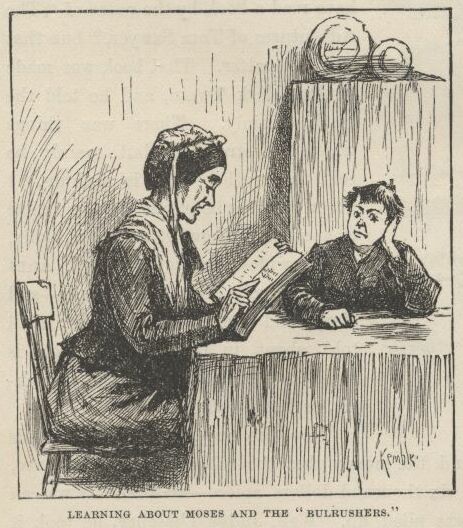
After supper she got out her book and learned me about Moses and the Bulrushers, and I was in a sweat to find out all about him; but by and by she let it out that Moses had been dead a considerable long time; so then I didn’t care no more about him, because I don’t take no stock in dead people.

Huck’s dream is of a delicious mix, a swapping of juices — integration. Additionally, his disregard for the dead Bible heroes reveals that the white Christian society’s obsession with the ancient past comes at the expense of contemporary value. Huck, an orphan, and Jim, separated from his family, will symbolically echo Moses in the bulrushes as they use the great Mississippi as a conduit for escape, for freedom. Huck (or Twain, really) here points out that it’s not enough to look at dead words on a page, on old dead lawgivers–we have to pay attention to the evils and wrongs and hypocrisies that live today.

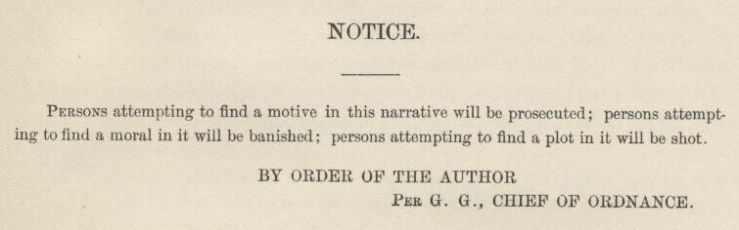
Twain even tells us how to read his book from the outset:

Now, it’s impossible to read a book–a good book–without finding its plot, searching for its moral, or caring about its characters, and Twain knows this. His “Notice” is tantamount to saying “don’t think about an elephant”–he uses irony to tell us we must find motive, moral, and plot here, and that we must do so through this lens of irony.

But of course, you have to read closely for all these things. I suppose it’s technically easier to call something trash, throw it in the garbage, and not have to devote time and energy to thinking about it. Who knows? You might learn something–and we wouldn’t want that, would we?

Word of the Day: Sillograph

From the OED:

“A writer of satires or lampoons; applied to Timon of Phlius (268 BC).

1845 LEWES Hist. Philos. I. 77 His state of mind is finely described by Timon the sillograph. 1849 GROTE Hist. Greece II. xxxvii. IV. 526 The sillograph Timon of the third century B.C.

So sillographer, sillographist.

1656 BLOUNT Glossogr., Sillographer, a writer of scoffs, taunts and revilings; such was Timon. 1775 ASH, Sillographist. 1845 Encycl. Metrop. X. 393/1 Menippus indeed, in common with the Sillographers, seems to have introduced much more parody than even the earliest Roman Satirists.”

Famous sillographers include:

Timon of Philius (as noted above)

George Bernard Shaw

Aristophanes

Jonathan Swift

Mark Twain

George Orwell

Kurt Vonnegut

MAD Magazine

Stephen Colbert

More Soup

F is for Falstaff, Shakespeare’s knavish knight. Part rascally gnoff, part philosopher, this fat rascal appears in three of the bard’s plays. In Henry IV parts 1 and 2 he advises young Prince Hal (the future king) on matters of honor and drinking. In the comedy The Merry Wives of Windsor, Falstaff tries to cuckold some country farmers and steal their cash; the scalawag’s plans go awry and he ends up wearing the horns. Falstaff is one of Shakespeare’s most verbose characters–only Hamlet has more lines. And despite his fun-loving and roguish nature, Falstaff, like Hamlet, also provides several meditations on human nature, death, and the seeming futility of the individual’s ability to change social order.

falstaff605.jpg

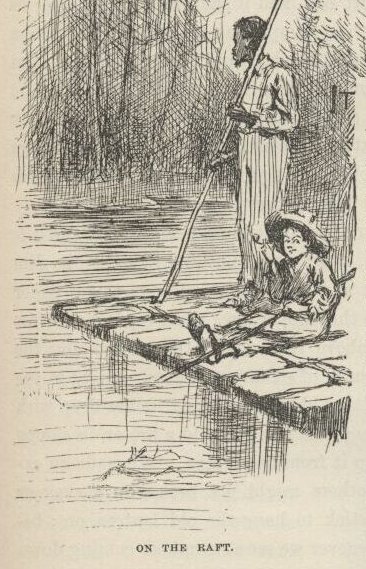
F is also for Finn, Huckleberry. Like Falstaff, Huck Finn is something of a rogue, albeit he is just a child. As the white trash double to middle class Tom Sawyer, Huck is one of Twain’s keenest tools for social satire. Huck escapes the Widow Douglas’s aspirations to give him a moral education, in turn helping her slave Jim make his own escape via the Mississippi River. While navigating the river, Huck must also navigate the perplexing and paradoxical moral codes of the strange South. Despite the happy ending of The Adventures of Huckleberry Finn, the novel remains controversial over a hundred years after its publication, still appearing frequently on lists of challenged books.

huck-and-jim-on-raft.jpg