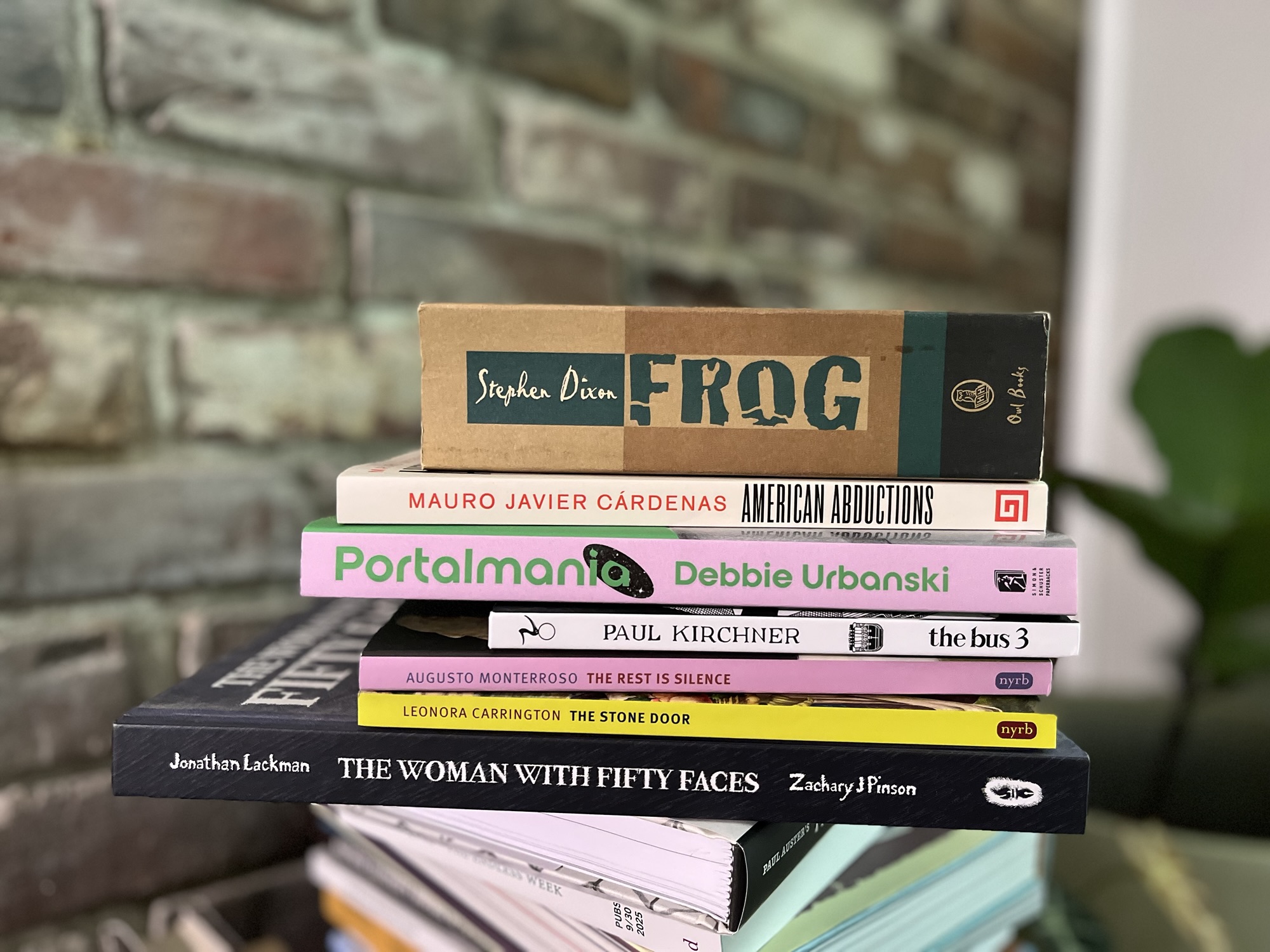
Blog about recent (non)reading

I read one novel in May 2025, the historical graphic biography The Woman with Fifty Faces: Maria Lani and the Greatest Art Heist That Never Was, by Jon Lackman and Zack Pinson. I think it was the only book I’ve read in full in the past two months. It was excellent and I owe it a full review.

I’ve read so so so many Wikipedia pages lately, tunneling down there almost every night (even all night) over the last six weeks. Last night I think I started, for some reason I can’t recall, on Julia Lennon’s page, maybe around eleven pm, and a few hours later I was reading about the visual systems of cuttlefish (this is when my wife woke up and told me to go to sleep). I didn’t start Leonora Carrington’s The Stone Door and I didn’t finish Augusto Monterroso’s The Rest Is Silence, even though they were on my cute little night stand.

I read a big chunk of The Rest Is Silence last Monday at the beach. I took my son and his friends there; despite their claims to being “goth” (or whatever, false claims) they wanted to hang out all day at Hannah Park. So we did that. I walked for a few miles and then discreetly drank a carton of sauvignon blanc and almost finished The Rest Is Silence and then promptly forgot all of the feeling of having read it, having replaced that feeling with the blazing Florida heat (a heat obscured by a heavy gray Atlantic breeze). There was a camp of young musicians wading in the water. I don’t know how I recognized them as teenage musicians, other than years of recognizing such persons in public — the same way I can recognize, say, college football coaches out for barbecue on a Saturday afternoon or late Friday. Some people just look like some people. I chatted with one of the music camp coaches. A lot of these kids hadn’t ever been to the ocean, he assured me, which he didn’t have to. Their movements against the waves showed it. I’m sure they are all graceful with their chosen instruments. Like I said, the slim novella was gone. The sand covered it over (this is a stupid metaphor; I am all rotten inside lately).

I have also not finished Paul Kirchner’s The Bus 3, mostly because I wanted to not finish it, to save it for a different shade of my disposition that is sure to arrive any day now. I love what Paul Kirchner has done, and I have never felt the strips whimsical; or, rather, their whimsy struck me as wise, a sharper whimsy. I’m having a hard time laughing lately.
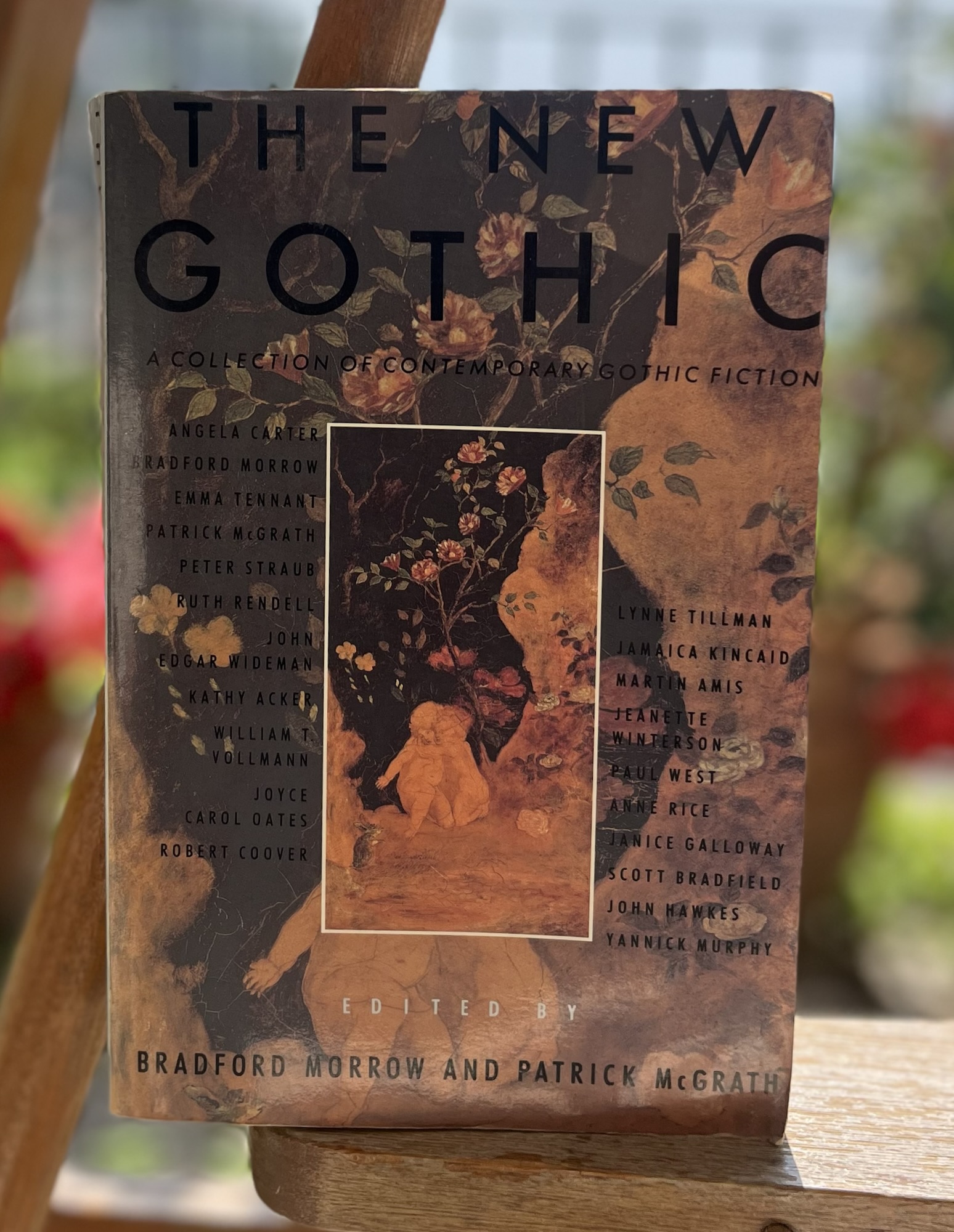
I read a big chunk of an anthology called The New Gothic about three weeks ago. It was in the house we — we my family, my wife and kids — were staying at in Minori, a smallish town in the Amalfi Coast of Italy. We spent the first fifteen days of June in Italy to celebrate my daughter’s 18th birthday and high school graduation. In a lovely little house on the side of a mountain (maybe it was a big hill, I’m a Florida boy), in a small shelf of mostly non-English language books, I picked out The New Gothic and read tales by Coover, Carter, Vollmann and others. The book is a love letter to Poe, really, with a wonderful introductory essay by editors Bradford Morrow and Patrick McGrath.

The story that really stood out though was Lynne Tillman’s “A Dead Summer.” This particular paragraph made me cry:

The Mets were doing better, but with so many new players on the team, she didn’t have the same relationship to them. Her dead friend had loved the Mets too. Sometimes she watched a game just for him, as if he could use her as a medium. She was sure his spirit was hovering near her, especially at those times. But she did not speak of this to her boyfriend who was talking about breaking up. That night she let him gag her. She didn’t have anything to say anyway, not anything worthwhile. She read that the Ku Klux Klan had marched in Palm Beach.

The story is about grief and bad dreams set against a terrifying American political backdrop. The notion of witnessing something so that one’s dead friend might use your eyes as a medium is what did me in. I’ve had such thoughts a few times in the last two months after my best friend died unexpectedly, moments where I thought I might somehow channel his spirit to, say, listen to the new Pulp record. But I don’t think he’s haunting me.

(I didn’t steal The New Gothic from the house in Minori, although I thought about it for two or three minutes.)

I have almost finished reading the stories in Debbie Urbanski’s collection Portalmania (it is a “collection” but I suspect it is a stealth novel — about escapes, transitions, aesexuality, monsters, uh, portals, etc.). Review to come. (I will absolutely get might shit together, any day now.)

I read and reviewed Mauro Javier Cárdenas’s American Abductions back in March. It’s only in this stack — this organizing picture that I use as an outline — because it is the most timely novel in America right now. It is a novel I read, loved, and highly recommend. Its narrative power surpasses the timeliness I’ve imposed upon it.

I was, what?, maybe 200, 225 pages? into Stephen Dixon’s massive novel Frog before I abandoned it. I was really loving it, its tics, repetitions, its noisy monotonous howl, its droll jabs at normal fucking people. It could have been one of my favorite novels ever, I think, but I’m not sure I’ll ever wade back in. I tried a few times, but it’s all enmeshed with some bad intense feelings I felt in early May.

Which is what? I guess? another way of saying that reading is just a series of feelings for me now. Maybe at some point I thought of reading novels as an intellectual exercise, and maybe at one point I turned that into an ideal of an aesthetics of reading — but I don’t care about any of that shit now.

I believe in reading for

pleasure

pain

other feelings, in between and otherwise.
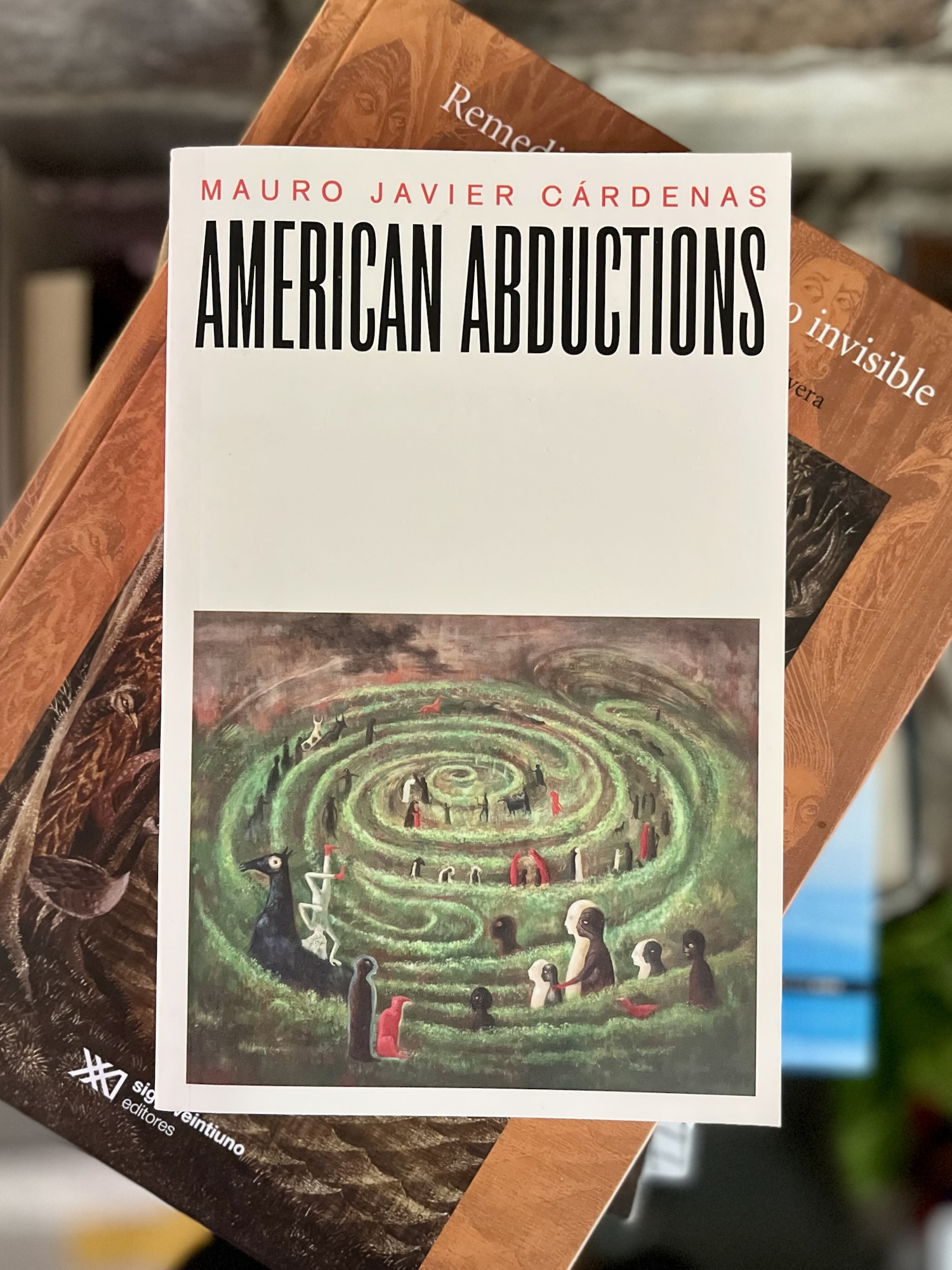
Statements of missingnessness | On Mauro Javier Cárdenas’s prescient novel American Abductions

Mauro Javier Cárdenas’s American Abductions is a novel of relentless, layered consciousness, its immersive, labyrinthine sentences pulling the reader into a fugue of voices, memories, and anxieties. American Abductions takes place in a proximal version of the United States, a digital carceral state where palefaced goons kidnap Latin Americans. Sometimes the abductees are deported; sometimes they are disappeared. Sometimes they tell stories.

The dystopia here is hardly a YA world-building exercise full of hope and heroics. Instead, the novel moves through fragmented, fevered perspectives, primarily those of sisters Ada and Eva their disappeared father, Antonio, a novelist abducted by the Pale Americans, the faceless bureaucratic enforcers of this new regime. The novel oscillates between Ada and Eva’s attempts to reconstruct what happened, Antonio’s own recursive, metafictional writing, and interjections from various other voices—family members, interrogators, digital surveillance logs—until the narrative itself becomes a reflection of the fragmented reality the characters are trapped within.

Yes, American Abductions is bleak, but it is not merely dystopian horror. Cárdenas builds his world through a dizzying interplay of language, wielding the long, unspooling sentence with the precision of Bernhard, Krasznahorkai, and Sebald. Each chapter is a single winding comma splice that careens from realism to surrealism. Cárdenas’s run-ons layer and loop back on themselves, rhetorically mirroring the characters’ attempts to make sense of their unraveling world.

The book moves forward with an absurdist energy that resists despair, its rhythms and repetitions building not just a critique of authoritarian power but something stranger, something more human—an exploration of consciousness itself, an attempt, perhaps, to make a grand “statement of missingnessness,” to borrow one of the character’s phrases.

The effect is hypnotic, dreamlike, sometimes nightmarish, but often, surprisingly, very funny. There is a dark, absurdist humor in the way bureaucratic jargon collides with intimate grief, in the way digital surveillance reports are laced with banal observations, in the way Antonio’s own metafictional writing seems to both clarify and obscure the truth of his disappearance. The novel is not just about authoritarian violence but about how language itself is manipulated under such regimes—how it obfuscates, justifies, betrays, resists. At times, American Abductions reads like a political thriller rewritten as a fever dream, at others, like a linguistic experiment that spirals into a meditation on memory, exile, and state terror.

American Abductions is not just unsettlingly prescient. Rather, it obliquely underscores the U.S. surveillance state’s direct lineage to Latin America’s Dirty Wars. Governments systematically disappeared those deemed threats to the state—intellectuals, activists, ordinary people unlucky enough to be caught in the wrong place at the wrong time. Cárdenas’s dystopia does not just critique contemporary American immigration policies; it situates them within a long history of state-sanctioned violence in the Americas.

The novel’s themes take on chilling immediacy when considered alongside the real-world abductions of those who speak truth to power, like Mahmoud Khalil and Rumeysa Ozturk. Indeed, the disturbing video footage of Ozturk’s kidnapping by masked men this week has gone viral, echoing the opening of American Abductions, wherein we learn that Ada has captured “that moment when the American abductors captured her father as he was driving her and her sister to school, which she recorded on her phone.” Ada’s video goes viral, mutates, becomes its own beast:

…and later, after her father had been captured and hundreds of thousands of people around the world were watching her video of her father asking what have I done, officer, the supervisory official probably watched it too and left an anonymous comment below it that said ice / ice baby great job ICE, illegal is illegal and wrong is wrong bye you forgot the crybaby in the backseat, for years Ada arguing in her mind with the thousands of messages berating her and her father, even after she discovered some of the comments had been manufactured by bots controlled by a Pale American in Salt Lake City — twelve million to go please continue to remove the illegal alien infestation — except the comments by Doctor Sueño, of course, which made no sense to anyone but her, just as it made no sense to anyone but her to feel, for no more than a few seconds, proud that the supervisory official of the supervisory official of the supervisory official in an agency building had taken time out of his busy schedule to focus on her father — if enough time passes, Doctor Sueño says, even the most preposterous possibilities will navigate the sea of your mind — cry like an eagle / to the sea — just as it made no sense to anyone but her to laugh at some of the videos her video had spawned for instance the video of her video but with sappy music instead of her sister politely asking the abductors where were they taking her father, as if someone figured hey no one’s going to feel sorry enough for you people let me add sad violin music to the video of your father saying I’ve done nothing wrong, officer, or how about the video from a self proclaimed irreverent news organization from China that, via computer animation as if from an obsolete video game, replicated the trajectory from her house to the sensitive location as if it were a car chase, the abductors rushing to drag her father out of the car as if it were a drug bust, the video game representation of Ada recording her father’s capture with her phone from the backseat of the car, waterfalls of tears surging from her eyes, no not waterfalls, more like someone’s comical representation of lawn sprinklers superimposed on the eyes of the video game representation of me…

Apologies if I’ve let the run-on run on too long — but you’ll have wanted a taste of Cárdenas’s style, no? His sentences, unbroken and unrelenting, mimic the inexorability of history itself—cycles of erasure, resistance, recovery, and repetition. American Abductions is not just a novel about the present; it is a novel that recognizes the past has never ended. Its characters, trapped in linguistic torrents of grief and absurdity, seem painfully aware that history is repeating itself. And yet, as despairing as that recognition might be, American Abductions refuses to be silent. It makes its “statement of missingnessness” loud, insistent, impossible to ignore, resisting erasure, demanding we listen. Very highly recommended.

Riff on some books I’m reading, have read, and should really review

Hurricane Milton passed far enough south last night to leave our city relatively untroubled. There were power outages here but not the expected flooding. Most of my anxiety was focused on my family in the Tampa Bay area, all of whom are safe; we’re just not sure about the material conditions of the things they left behind.

Milton seemed to suck the summer air out of Northeast Florida; when I got out of bed and went outside to investigate the loud THUNK that woke me up at four a.m., I was shocked at how cold the air felt. It was only about 66°, but all the humidity seemed gone, even in the cold sprinkling rain. (The THUNK was our portable basketball hoop toppling over.)

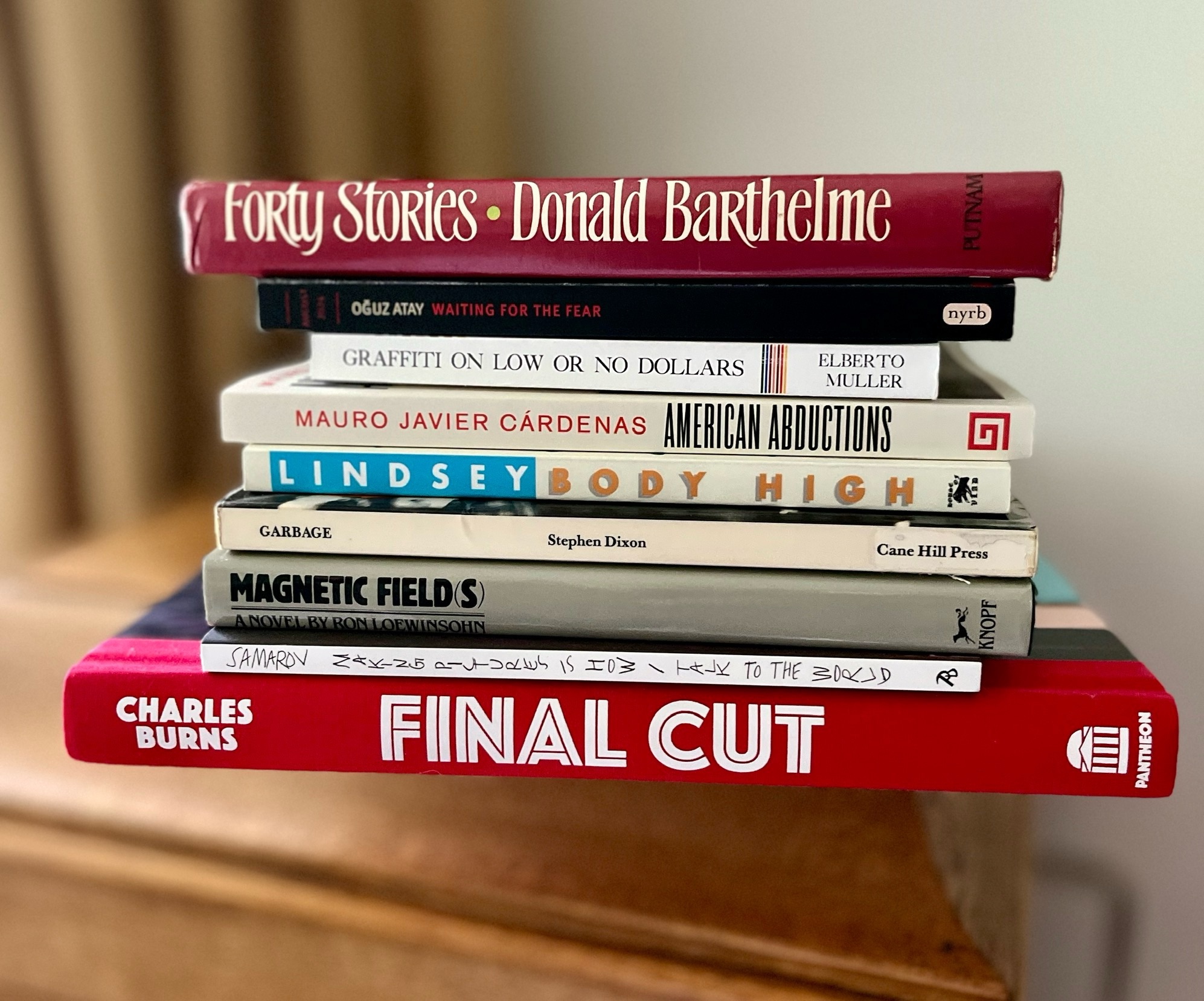
I thought I might try to knock out a review or a write-up of one of the many books I’ve finished that have stacked up as the summer has slowly transitioned to autumn. College classes have been canceled through to Tuesday. I have, ostensibly a “free” week; maybe some words, harder to cobble together for me these days, would come together, no? For the past few years I’ve focused more on reading literature with the attempt to suspend analysis in favor of, like, simply enjoying it. I realized I’d gotten into the habit of reading everything through the lens of this blog: What was I going to say about the book after reading it? I’ve been happier and read more sense freeing myself from the notion that I need to write about every fucking book I read. But the good books stack up (quite literally in a little place I have for such books); I find myself simply wanting to recommend, at some level, however facile, some of the stuff I’ve read. So forgive this lazy post, organized around a picture of a stack of books. From the top down:

Forty Stories, Donald Barthelme

A few years ago, I read Donald Barthelme’s collection Sixty Stories in reverse order. A few days ago, a commenter left me a short message on the final installment of that series of blogs: “Now do Forty Stories.” I think I have agreed–over the past week I’ve read stories forty through thirty-five in the collection. More to come.

Waiting for the Fear, Oğuz Atay; translation by Ralph Hubbell

A book of cramped, anxious stories. Atay, via Hubbell’s sticky translation, creates little worlds that seem a few reverberations off from reality. These are the kind of stories that one enjoys being allowed to leave, even if the protagonists are doomed to remain in the text (this is a compliment). Standouts include “Man in a White Overcoat,” “The Forgotten,” and “Letter to My Father.”

Graffiti on Low or No Dollars, Elberto Muller

Subtitled An Alternative Guide to Aesthetics and Grifting throughout the United States and Canada, Elberto Muller unfolds as a series of not-that-loosely connected vignettes, sketches, and fully-developed stories, each titled after the state or promise of their setting. The main character seems a loose approximation of Muller himself, a bohemian hobo hopping freights, scoring drugs, and working odd jobs—but mostly interacting with people. It kinda recalls Fuckhead at the end of Denis Johnson’s Jesus’ Son (a book Graffiti spiritually resembles) praising “All these weirdos, and me getting a little better every day right in the midst of them.” Muller’s storytelling chops are excellent—he’s economical, dry, sometimes sour, and most of all a gifted imagist.

American Abductions, Mauro Javier Cárdenas

If I were to tell you that Mauro Javier Cárdenas’s third novel is about Latin American families being separated by racist, government-mandated (and wholly fascist, really) mass deportations, you might think American Abductions is a dour, solemn read. And yes, Cárdenas conjures a horrifying dystopian surveillance in this novel, and yes, things are grim, but his labyrinthine layering of consciousnesses adds up to something more than just the novel’s horrific premise on its own. Like Bernhard, Krasznahorkao, and Sebald, Cárdenas uses the long sentence to great effect. Each chapter of American Abductions is a wieldy comma splice that terminates only when his chapter concludes—only each chapter sails into the next, or layers on it, really. It’s fugue-like, dreamlike, sometimes nightmarish. It’s also very funny. But most of all, it’s a fascinating exercise in consciousness and language—an attempt, perhaps, to borrow a phrase from one of its many characters, to make a grand “statement of missingnessness.”

Body High, Jon Lindsey

I liked Jon Lindsey’s debut Body High, a brief, even breezy drug novel that tries to do a bit too much too quickly, but is often very funny, gross, and abject. The narrator, who telegraphs his thoughts in short, clipped sentences (or fragments cobbled together) is a fuck-up whose main income derives from submitting to medical experiments. He dreams of scripting professional wrestling storylines though, perhaps one involving his almost-best friend/dealer/protector/enabler. When his underage-aunt shows up in his life, activating odd lusts, things get even more fucked up. Body High is at its best when it’s at its grimiest, and while it’s grimy, I wish it were grimier still.

Garbage, Stephen Dixon

I don’t know if Dixon’s Garbage is the best novel I’ve read so far this year, but it’s certainly the one that has most wrapped itself up in my brain pan, in my ear, throbbed a little behind my temple. The novel’s opening line sounds like an uninspired set up for a joke: “Two men come in and sit at the bar.” Everything that unfolds after is a brutal punchline, reminiscent of the Book of Job or pretty much any of Kafka’s major works. These two men come into Shaney’s bar—this is, or at least seems to be, NYC in the gritty seventies—and try to shake him down to switch up garbage collection services. A man of principle, Shaney rejects their “offer,” setting off an escalating nightmare, a world of shit, or, really, a world of garbage. I don’t think typing this description out does any justice to how engrossing and strange (and, strangely normalGarbage is. Dixon’s control of Shaney’s voice is precise and so utterly real that the effect is frankly cinematic, even though there are no spectacular pyrotechnics going on; hell, at times Dixon’s Shaney gives us only the barest visual details to a scene, and yet the book still throbs with uncanny lifeforce. I could’ve kept reading and reading and reading this short novel; it’s final line serves as the real ecstatic punchline. Fantastic stuff.

Magnetic Field(s), Ron Loewinsohn

I ate up Loewinshohn’s Magnetic Field(s) over a weekend. It’s a hypnotic triptych, a fugue, really, with phrases sliding across and through sections. We meet first a burglar breaking into a family’s home and learn that “Killing the animals was the hard”; then a composer, working with a filmmaker; then finally a novelist. Magnetic Field(s) posits crime and art as overlapping intimacies, and extends these intimacies through imagining another life as a taboo, too-intimate trespass.

Making Pictures Is How I Talk to the World, Dmitry Samarov

Making Pictures spans four decades of Samarov’s artistic career. Printed on high-quality color pages, the collection is thematically organized, showcasing Samarov’s different styles and genres. There are sketches, ink drawings, oils, charcoals, gouache, mixed media and more—but what most comes through is an intense narrativity. Samarov’s art is similar to his writing; there isn’t adornment so much as perspective. We get in Making Pictures a world of bars and coffee shops, cheap eateries and indie clubs. Samarov depicts his city Chicago with a thickness of life that is better seen than written about. Some of my favorite works include interiors of kitchens, portraits of women reading, and scribbly but energetic sketches of indie bands playing live. What I most appreciate about this collection though is that it showcases how outside of the so-called “art world” Samarov’s work is–and yet this is hardly the work of a so-called “outsider” artist. Samarov trained at the School of the Art Institute of Chicago, and yet through his career he has remained an independent, “not associated with an institution such as an art gallery, college, or museum,” as he writes in his book.

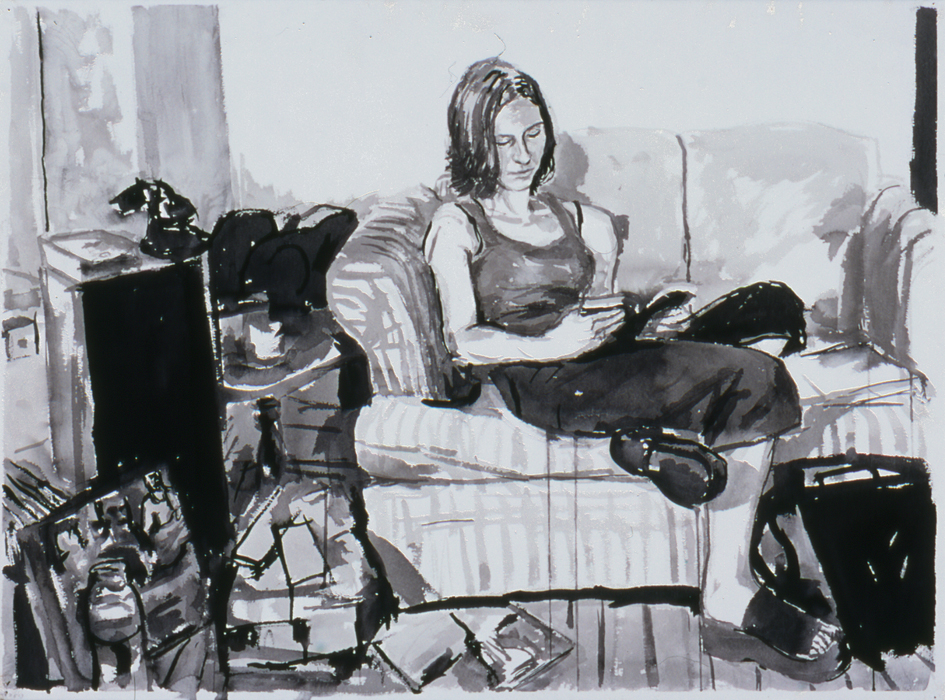
Beth, Dmitry Samarov, 2000

Final Cut, Charles Burns

I don’t know anything about Charles Burns’s upbringing, his youth, his personal life, and I don’t mean to speculate. However, it’s impossible not to approach Final Cut without pointing out that for several decades he’s been telling the same story over and over again—a sensitive, odd, artistic boy who is out of place even among others out of place. This is in no way a complaint—he tells the story with difference each time. And with more coherence. Final Cut is beautiful and sad and also weird enough to fit in neatly to Burns’s oeuvre. But it’s also more mature, a mature reflection on youth really, intense, still, but without the claustrophobia of Black Hole or the mania of his Last Look trilogy. There’s something melancholy here. It’s fitting that Burns employs the heartbreaking 1971 film The Last Picture Show as a significant motif in Final Cut.

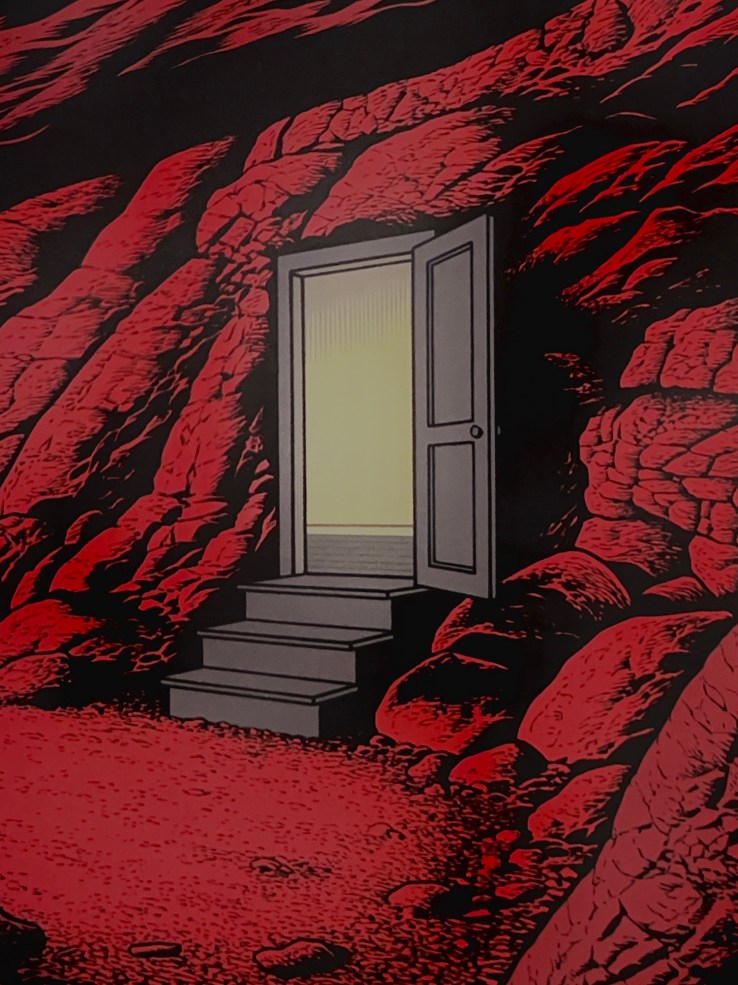
Image from Final Cut, Charles Burns, 2024

Mid-August riff; some books acquired, etc.

The last two weeks flew by. My kids went back to school this week; they are attending the same school for the first time since elementary school, high school,my own dear mother, that school, and I am relieved, if only temporarily from driving duties. We are making pizzas in an hour or two to celebrate the first Friday of their school year (we make pizzas every Friday as a nifty fridge clearing activity, but let’s not ruin the sparkle). My own semester starts the week after next and I realize that I need to do something more with my summers now that my children are so much older than they were when they were little children, when I was with them all summer, or if I wasn’t exactly right there with them I was hovering in the background.

I am on track to read fewer novels, or books, or whatever, than I read in July of this year. I finished Mauro Javier Cárdenas’s third novel American Abductions and liked it very much, or liked the experience or feeling of reading it, whatever that means, and I owe it a proper review. In July I read Katherine Dunn’s debut novel Attic and loved it. I couldn’t find her 1971 follow-up Truck in any of the used bookstores I frequent, so I ended up listening to it on audiobook. Maybe it was the narrator’s narration but I found it disappointing, but I still appreciate its grime and its abjection and its picaresque energy. I also checked out some Stephen Dixon e-books from my library; I read a handful of fucked up stories (a piece called “The Intruder” was especially weird) before digging into his 1988 novel Garbage. I read the first half of Garbage last night and I don’t even know how to describe it—it’s sort of like wandering upon some forgotten gritty 1970s American exploitation film made by an insane but focused auteur. But it’s also very normal in a way I will not explain. It’s uncanny.

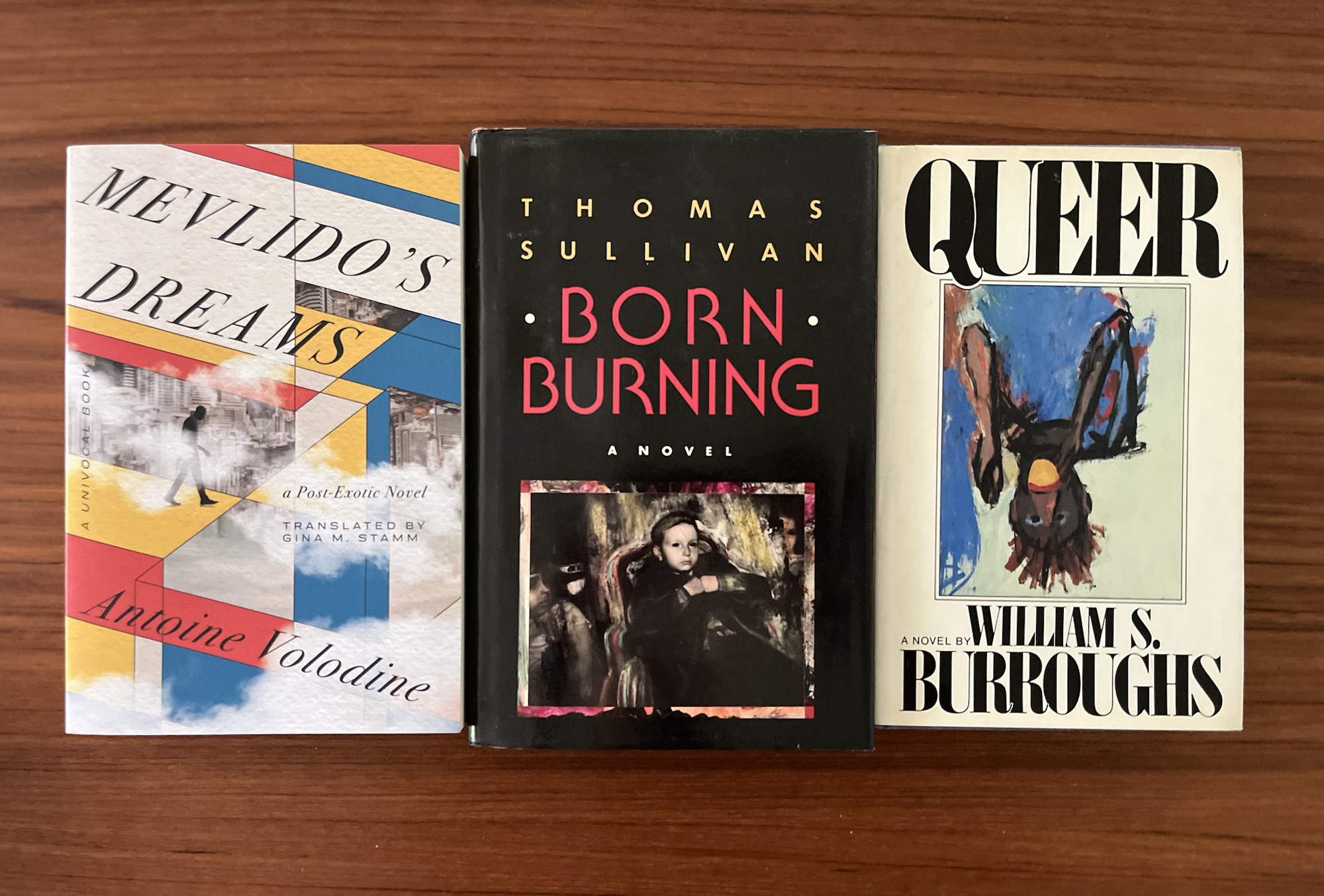
I purged about thirty paperbacks last week at my local used bookstore and ordered a copy of the latest Antoine Volodine novel, Gina M. Stamm’s translation of Mevlido’s Dreams. A recent reading of Volodine’s Radiant Terminus left me hungry for more of that sweet gross post-exotic flavor. I went to pick up the Volodine today and ended up with two hardbacks. I admit that the blurb on the back of Thomas Sullivan’s 1989 novel Born Burning sold me; it compared his previous novel to William Gaddis, John Barth, and Kurt Vonnegut. I also snapped up a first-edition hardback 1985 edition of William S. Burroughs’s novel Queer, which I fear was quite underpriced, although I don’t fear that too much. (All my sweet purged paperback credit is gone!)

I am ready for the summer to end.

Riff on July 2024 reading, etc.

I experienced the middle weeks of July 2024 as simultaneously rapid and static. Doldrums should never be so frenetic. If this decade were a novel I would’ve put it down several chapters back. I try not to obsess over things I cannot control. I try to get away from screens. I try to go outside, but the feels like heat index here in north Florida goes over a hundred and five every day. (At least it’s raining again and nothing is on fire.) So I try to read more (and actually write more).

This July I read some great stuff.

I finished Katherine Dunn’s first novel Attic a couple of days ago. The book is seriously fucked up—like William Burroughs-Kathy Acker fucked up—an abject rant from a woman in prison in the mode of Ginsberg’s Howl. The narrator seems to be an autofictional version of Dunn herself, which is perhaps why Eric Rosenblum, in his 2022 New Yorker review described it as “largely a realist work in which Dunn emphasizes the trauma of her protagonist’s childhood.” Rosenblum uses the term realism two other times to describe Attic and refers to it at one point as a work of magical realism. If Attic is realism then so is Blood and Guts in High School. I need to read her second and third novels (Truck, 1971 and the posthumous Toad) and then go back and reread Geek Love, which I remember as being Gothic and gross but also whimsical. (I don’t sniff any whimsy in Attic.)

There are eight stories in Oğuz Atay’s story collection Waiting for the Fear (in translation by Ralph Hubbell); I’ve read the first five this summer, including the long title story, which is especially good, as is the opener “Man in a White Overcoat.” Atay’s heroes (I use the term loosely) find their antecedents in Kafka’s weirdos. Or Paul Bowles. Or Jane Bowles. I should have a proper review up near the end of October when NYRB publishes Waiting for the Fear.

I had picked up Mauro Javier Cárdenas’s third novel American Abductions earlier this summer and finally started it a few nights ago after finishing Attic. Each chapter is a run-on sentence that has made me want to keep reading and reading, running on with it. The novel is, at least so far, both challenging and entertaining; it is not difficult, exactly, but rather engrossing. Sometimes I’ll find myself a bit lost in the layered consciousnesses, layers (layerings) of speech in Cárdenas’s sentences—especially when I find myself startled by an image or a joke or idea—and then I’ll wade backwards again and pick up the rhythm and keep going. The plot? I’ll steal from the Dalkey Archive’s blurb: “American Abductions opens in a near-future United States whose omnipresence of data-harvesting and algorithms has enabled the mass incarceration and deportation of Latin Americans—regardless of citizenship.” But that’s not really the plot; I mean, this isn’t a third-person dystopian world-building YA thing. The novel, at least its first half, is about a family, daughters Ada and Eva and their father Antonio, a novelist who was abducted by the titular abductors (the Pale Americans!). It’s also about writing, how we construct memory in a surveillance state, and, I suppose, love.

I reviewed Jean-Baptiste Del Amo’s latest novel The Son of Man (in translation by Frank Wynne) in the middle of July, although I think I probably read it in late June. In my review I suggested that The Son of Man “is ultimately a novel about the atavistic transmission of violence from generation to generation.” I also highly recommended it.

I went on a big Antoine Volodine binge a couple of years ago which stalled out before I got to (what I believe is) his longest novel in English translation, Radiant Terminus. I finally started into it a few weeks ago (in translation by Jeffrey Zuckerman), and I think it might be Volodine’s best work. In my longish review, I declared Radiant Terminus “an astounding novel, a work that will haunt any reader willing to tune into its strange vibrations and haunted frequencies. Very highly recommended.” I think it’s a perfect starting place for anyone interested in Volodine’s so-called post-exotic project.

Denis Johnson’s The Stars at Noon was one of two novels I revisited via audiobook this month (the other is Portis’s Gringos, which we’ll get to in a moment). I honestly didn’t remember much about The Stars at Noon other than its premise and the fact that its narrator was an alcoholic journalist-cum-prostitute in Nicaragua. It hadn’t made the same impression on me as other Johnson novels had when I went through a big Johnson jag in the late nineties and early 2000s, and I think that assessment was correct—it’s simply not as strong as AngelsFiskadoro, or Jesus’ Son. As an audiobook though I enjoyed it, especially in Will Patton’s reading. (His narration of Johnson’s perfect novella Train Dreams is the perfect audiobook.) I guess the audiobook came out in conjunction with Claire Denis’ 2022 adaptation of the film, which I still haven’t seen.

The collection of Remedios Varo’s writings On Homo rodans and Other Writings is another book I read earlier in the summer but didn’t write about until July. I was fortunate enough to get a long interview with the translator, Margaret Carson, and I think the result is one of the better things Biblioklept has published this year.

I picked up Dinah Brooke’s “lost” novel Lord Jim at Home in late June, and then read it in something of a sweat over a few days. In my review, I wrote that

Lord Jim at Home is squalid and startling and nastily horrific. It is abject, lurid, violent, and dark. It is also sad, absurd, mythic, often very funny, and somehow very, very real for all its strangeness. The novels I would most liken Lord Jim at Home to, at least in terms of the aesthetic and emotional experience of reading it, are Ann Quin’s BergAnna Kavan’s Ice, Mervyn Peake’s Gormenghast novels, Virginia Woolf’s Mrs. Dalloway, and James Joyce’s Portrait (as well as bits of Ulysses).

Gringos is the other book I “reread” via audiobook this July. Charles Portis wrote five novels and all of them are perfect—but I think Gringos might be my favorite. David Aaron Baker’s reading of the novel is excellent. He conveys the dry humor of narrator Jimmy Burns as well as the cynical sweet pathos at the core of Portis’s last novel. Highly recommended.

So well I guess July is over; the kids will be back in school again soon, and so will I. The air here will remain swamp thick, humidity that starts cooking you the minute you venture out of the desiccating AC that licensed growth on this weird peninsula. It might let up by November. Maybe because I’ve spent my entire adult career as a teacher I have always thought of August as the end of the year, not December. And some years I feel melancholy at this end, this pivot away from freer hours. But writing this on the last day of July, I think I want a return to routine, to something I can think of as a return to normalcy, the kind of normalcy that makes me appreciate the weird fucked up oddball novels that I do so love to hang out inside of.

Biblioklept Does Atlanta (Books acquired, some time last week)

Last week, the wife and I drove five hours north to Atlanta, Georgia where we stayed five days in the Cabbagetown neighborhood. Our ostensible purpose was an anniversary trip focused around a Slowdive concert last Friday, but I think we really went to just hang out and eat and drink away from our kids for a few nights. It was famous times.

The Slowdive concert itself was excellent, despite the best efforts of the awful opening band, a dubious and I must assume ironic project called Drab Majesty, and the sound system at the The Eastern. The venue seemed ill-equipped to handle the tonality of either band. I don’t want to sound like a very old man but it was Too Fucking Loud. Opener Drab Majesty, whose sound came from a single guitar, a single synth, and, I’m guessing, a few loop pedals, seemed to have plugged directly into the PA system. It was the absolute worst sound I’ve ever heard. (Earlier that day, driving in awful Atlanta traffic, we listened to a seventeen-minute Merzbow song on the alternate band of Georgia Tech’s WREK radio station; although Merzbow is “noise” music, that song had more musicality, tonality, and depth of rhythm than Drab Majesty.)

Slowdive was excellent live–much more of a rock sound than I’d expected; I’ve really enjoyed their two newer records, particularly the self-titled one from a few years back, but the songs from Souvlaki sounded particularly fierce live. The setlist was great, and they closed with a cover of Syd Barrett’s “Golden Hair” that might have gone on for 10 or 12 minutes; it was hypnotic. Here is the single picture I took during the show:

But books—

Without children about and with my wife having to work half days from the rented garage apartment, I had enough time to indulge going to pretty much any bookstore I wanted to in Atlanta. I ended up sticking mostly to East Atlanta where we were staying though.

I had been to A Capella Books a few years ago and had somehow entirely missed their used book annex, which had some really great stuff in it, including a first edition of Blood Meridian and Joseph McElroy’s Women and Men. I ended up chatting with the owner Frank for a bit; a very nice guy, he showed me his personal collection of Vintage Contemporaries and we talked in general about our shared sickness of book collecting. I left with Mauro Javier Cárdenas’s new novel American Abductions and a first-edition hardback of McCarthy’s Cities of the Plain. This second purchase seems to have initiated the trip’s theme of buying editions of books I already own—but now I have all three Knopf editions of The Border Trilogy, so everyone can sleep easier.

I stopped by Criminal Records in Little Five Points and didn’t pick anything up, although I’m happy to see that CDs have made such a comeback. (I almost certainly would have bought the new Gastr del Sol box set if it was out yet.) I then made my way to Bibliotech Books in Candler Park. The proprietor assured me that he was in the process of reorganizing, but the store was frankly a mess. One bookcase was organized by the color of the book’s spines. The inventory seemed to be someone’s childhood and adolescent books.

I headed to Virginia Highland Books, a perfectly-respectable book shop in the perfectly-respectable Virginia Highland neighborhood. The perfectly-respectable inventory was not particularly interesting, although I imagine it perfectly suits the perfectly-respectable clientele. On the way to Virginia Highland Books, at a red light, I found myself stopped next to something called Videodrome, so of course I pulled in. I got dizzy in Videodrome a DVD-rental shop stuffed with thousands and thousands of cult films, non-English language films, art films, concert films…amazing stuff. The only thing I could compare it to were some of the rental shops I’d gone to decades ago when I lived in Tokyo. I mean, this place had the Cannibal Ferox soundtrack on vinyl. I spoke to the proprietor for a while. He gave me a sticker. I saw him at the Slowdive show the next night but left him alone.

My last bookshop visit that day was to Bookish, a small indie spot specializing in books by women. I liked the store but was honestly too tired to look around much after two tallboys at a PBR-themed bar in Virginia Highland.

Over the next few days, I visited three more bookshops, all more or less by chance. We went to Decatur, simply to check it out, and parked in Decatur Square right in front of Little Shop of Stories. Framed original artwork by visiting authors adorns the walls of this children’s bookshop, and there’s a life-sized reproduction of the room from Margaret Wise Brown’s classic Good Night Moon that one can hang out in. I felt a little melancholy that our children have outgrown children’s books.

On the way back to Atlanta, we swung by Eagle Eye Books, a Decatur spot specializing in used books (with a large collection of vintage sci-fi hardbacks in a back room). They have several carts of dollar books that are supposedly accessible 24/7—there are lock boxes to slide your dollars into. I ended up picking up different editions of two books I already own: Wells Tower’s Everything Ravaged, Everything Burned in hardback and the 1985 Elisabeth Sifton Books/Penguin Books printing of William Gaddis’s J R. The J R is basically falling apart and is crammed with annotations; I love it. I gave three crumpled dollars over for these two books and then drove back to our garage apartment so we could walk to tacos and then the concert.

The mid-morning after the Slowdive concert we hung out for a while at the Virginia Highland Porchfest. We parked at the Ponce City Market to walk to Porchfest and on the way back stopped at Posman Books. I’d been there before, and while it’s basically a gift shop, its literature section is surprisingly robust, and it even offers a decent number of Spanish-language novels. The vibe at Porchfest was more frat-boys-drinking-sixers and sunburned golf dads than it was hippies and freaks. The neighborhood is Nice, with plenty of In This House signs declaring Attested Beliefs. We felt more at home in Cabbagetown, with its murals and ambivalence, even if our own presence as fucking tourists made us balk at times. But in a plant shop in Virginia Highland, we did meet an interesting clerk who let me take a photograph of their Pynchon tattoo. So that was pretty cool.

Atlanta I heart you.