Michel Houellebecq on Tocqueville, Nietzsche, and Democracy

(Click the CC button for English subtitles).

“Praise of Aphorisms” — Nietzsche

Friedrich Nietzsche. From Mixed Opinions and Maxims:

(168) Praise of aphorisms.— A good aphorism is too hard for the tooth of time and is not consumed by all millennia, although it serves every time for nourishment: this it is the great paradox of literature, the intransitory amid the changing, the food that always remains esteemed, like salt, and never loses its savor, as even that does.

“Marks of the Good Writer” — Nietzsche

Friedrich Nietzsche. From Mixed Opinions and Maxims:

(138) Marks of the good writer.— Good writers have two things in common; they prefer to be understood rather than admired; and they do not write for knowing and over-acute readers.

“The Worst Readers” — Nietzsche

Friedrich Nietzsche. From Mixed Opinions and Maxims:

(137) The worst readers.— The worst readers are those who behave like plundering troops: they take away a few things they can use, dirty and confound the remainder, and revile the whole.

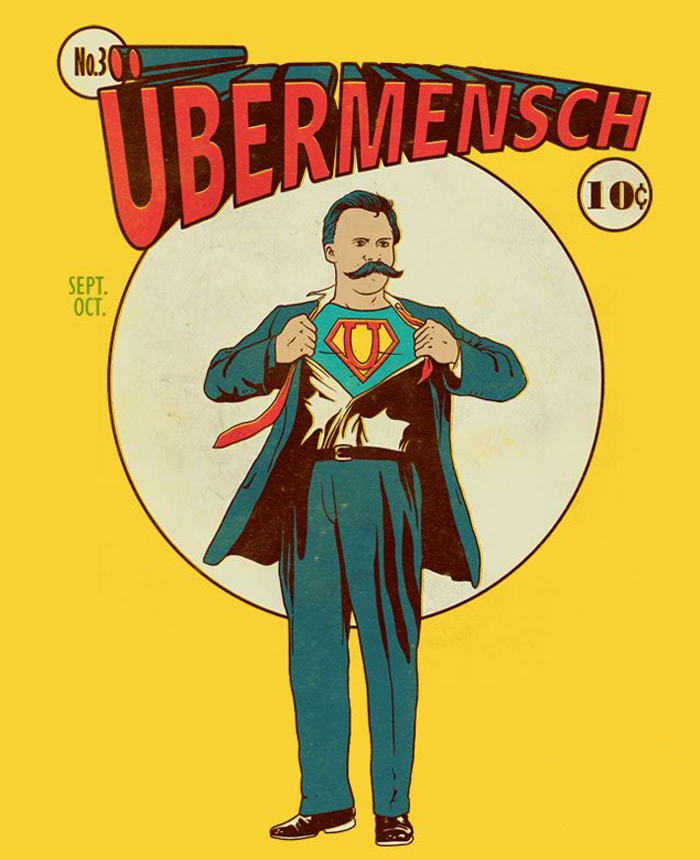
Übermensch Comics #3

Contra Mundum Press

Some of the good people at Hyperion, the journal of the Nietzsche Circle, have begun a new publishing venture: Contra Mundum Press. Their first project is a new translation of the Gilgamesh epic by Stuart Kendall; it should be ready next month. In December, CMP is planning to release the first English language translation of Nietzsche’s “Greek Music Drama.” Their list of future titles looks quite promising, and it’s always great to see a new indie publisher making a go of it in an era where print books are being eulogized (with no small level of hyperbole) on what seems to be a weekly basis.

Books I Am Always (Re-)Reading

Trudging through a very long book the other night–never mind the title, at least now anyway–it occurred to me that I’d rather be reading from 2666; that, at that particular moment, I’d rather re-read from “The Part About the Crimes.” I don’t know if it was the effete dullness of the first volume that made me want to pick up Bolaño’s epic, perhaps trying to zap some life into my waning eyeballs; perhaps it was just the sense that I was wasting my time with the merely good, which, after all, is mediocrity when set against genius (yes, these are subjective terms).

Anyway, I didn’t have to go looking for 2666 — I have a copy (yes, I have two) right there jammed into my nightstand, along with a few other books that I realize that I’m always reading. Furthermore, I’m always reading these books in the most discontinuous, stochastic fashion, often picking them up at random and thumbing through them. I think I use these books to clear my literary palate, to get a bad (or worse, boring) taste out of my brain, to inspire me, to suggest another book. Some of these books, like 2666 are big, fat volumes, volumes that I set close at hand in the hopes of rereading in full. Sometimes I’ve met this goal; in the case of Moby-Dick, I’ve read the book through at least three times now, and yet never tire of it. I’m always picking it up again and again, sometimes to find Elijah’s rant or to dip into Ahab’s mad monologue or perhaps just to hear Stubb comment on the proper preparation of shark steaks. Of a piece with those big novels is David Foster Wallace’s Infinite Jest, which I turn to repeatedly, reading over a riff or two at a time, perhaps still trying to figure out the ending, or some clue of the ending, perhaps trying to figure out why Hal can’t speak (you know, beyond like, a a metaphorical level).

There’s also Blood Meridian.

A book I always keep proximal is D.H. Lawrence’s Studies in Classic American Literature, which, if this were a dictatorship under Biblioklept might replace the Constitution (jaykay, Tea Partiers!). Tellingly, I’ve never managed to finish one of Lawrence’s novels (I even struggle through his much-anthologized piece, “The Rocking Horse Winner”), but I consider his dissertations on Hawthorne, Poe, and Melville indispensable (and creative in their own right). I guess I just like lit crit; Harold Bloom’s too-huge volume The Western Canon is a book I return to again and again. Sometimes I find myself throwing it to the ground, quite literally (if I’ve enjoyed a drink or two, that is), in disgust. Bloom’s battle with “The School of Resentment” can be maddening, especially when he’s so up front about essentially making Shakespeare God. Still, Shakespeare doesn’t seem like a bad God to have.

I should point out that I’ve made no attempt to read The Western Canon the whole way through; in fact, I’ve never made a single attempt to read it systematically. I just sort of pick it up, thumb through it, occasionally plumb the index. There are several books that I am always rereading in this category: Books That I Am Always Reading and Yet Have Never Finished. Foremost among these is Nietzsche’s Human, All Too Human, a book that I probably, at this point, have read in full, but never fully through. Its aphorisms beg to be read discontinuously; I think Nietzsche wet-dreamed about his fragmentary works being literally fragmented and then later found, read piecemeal against some newer, more garish culture. Or perhaps that’s just my metaphorical wet dream.

Other Books That I Am Always Reading and Yet Have Never Finished — The Life and Opinions of Tristram Shandy, Gentleman stands out, as does Finnegans Wake. Sterne’s book is such an oddity: I remember picking it up in a stack of books to be shelved at my college library, thumbing through it, bewildered, thinking that it must be contemporary with John Barth. A bit of research left me even more perplexed. Like Tristram, who can’t seem to finish his story, I can’t seem to actually finish it, but I’m okay with picking it up again and again. Similarly, Finnegans Wake strikes me as an unfinished-unfinishable volume (I do not mean this literally; I know that Joyce “finished” the book as an infinite strange loop, just as I know that the book can be read). I have an audio recording of Finnegans Wake that I like to listen to occasionally (especially while driving), as well as William York Tindall’s  guide (which is fun), but I’d rather just sort of grab the thing at random and read a page or two. I know, in an intellectual sense, that is, that I could easily read the book in a calendar year by committing to three pages a day (plus a few pages of Tindall), but I don’t think that I can read books in an intellectual sense. I think, at the risk of sounding unbearably corny, that books have to call to their readers in an emotional and perhaps even spiritual sense. Otherwise, what’s the point?

“Nietszche” — Lydia Davis

“Nietszche” [sic] by Lydia Davis, from Varieties of Disturbance, and reprinted in The Collected Stories of Lydia Davis

Oh, poor Dad. I’m sorry I made fun of you.

Now I’m spelling Nietszche wrong, too.

Hitler’s Private Library — Timothy W. Ryback

In Hitler’s Private Library, Timothy W. Ryback works from Walter Benjamin’s assertion that “a private library serves as a permanent and credible witness to the character of its collector.” Ryback delves into the books–the actual, physical books–that Hitler studied and pondered, paying particular attention to the dictator’s annotations and marginalia. To be sure, there are plenty of political tracts–especially anti-Semitic writings, such as Henry Ford’s The International Jew–to be found in Hitler’s library, but far more fascinating is Ryback’s analysis of Hitler’s love for Robinson Crusoe, Shakespeare, Don Quixote, and Uncle Tom’s Cabin, of all books. Hitler’s taste was varied–there’s an early infatuation with Max Osborn’s Berlin, an architectural guide to that city, an obsession with Ibsen’s Peer Gynt, and Hitler’s final day’s poring over a biography of Frederick the Great (he also comforted himself in the final days of his regime by rereading his boyhood favorite Karl May).

The Nazi party’s lurid mania for occultism is well documented, but Ryback brings a fresh perspective here, eschewing tabloid histrionics in favor of a measured approach to Hitler’s volumes of bizarre and arcane works. More troubling is the public misconception that the works of Schopenhauer and Nietchzsche some how gave philosophical weight to the Nazi’s crime spree; Ryback eliminates that notion:

For all the talk of Hitler’s exploitation of Friedrich Nietzsche’s concepts of the “master race” or Arthur Schopenhauer’s notion of the “will to power” that Hitler used to headline the 1934 party rally and Riefenstahl cribbed as a title for her cinematic chronicle of the event, we have little credible evidence of Hitler’s personal engagement with serious philosophy. Most of what we know is tenuous and at best anecdotal.

In short, Hitler was a poseur who recontextualized bit parts of great thinkers into mind-numbing sloganeering for his own ends (luckily, no politicians today would be so crude). Ryback’s even-handedness here is indicative of the project of his book: his is not a psychological study; he never seeks to explain the motivations for Hitler’s evil actions, but rather report what Hitler read closely. What we get in the end is an historicized, contextualized account of a bibliophile who initiated book burnings and mandated reading lists.

Hitler’s Private Library is really a book about books and how what we read shapes and then testifies to who we are and what we did in our life. I am not particularly interested in Hitler or the (well-documented) history of WWII, but I found in Hitler’s Private Library both a fascinating dialogic analysis as well as a new narrative take on some pretty stale material. The philosophy of Walter Benjamin permeates Ryback’s book, which is also a big plus. I’m not sure if the world needs another book about WWII, but I’m always a sucker for books about books. Recommended.

Hitler’s Private Library is available in hardback and ebook on October 21st, 2008 from Knopf.

Friday Funnies

16.gif

“The great epochs of our life come when we gain the courage to rechristen our evil as what is best in us.”

The other night, at our last birthing class, our fearless instructor pulled out the old overhead projector (she had previously come out strongly and scornfully against power point presentations), and began showing us various cartoons detailing the ups and downs of life with a new baby.

I knew that it was coming. I was clinching my jaw in preparation for it. But nothing could have readied me for just how loud the class laughed in appreciation for a Family Circus comic. I love comics of all kind, so the insipid lifeless crap-o-rama that is Family Circus is particularly offensive to me, especially when it’s somehow deemed to be true or, even worse, truly funny. Then again, the people in my birthing class are the same crew that suggested a few weeks ago that eating the placenta was distinctly un-American, so it seems about par for course that they would appreciate FC.

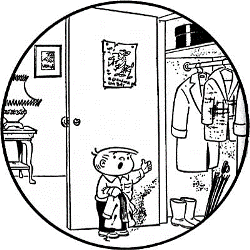
Fortunately, there’s an antidote to Bil Keane’s witless garbage. Check out The Nietzsche Family Circus, which pairs a random FC image to a random Nietzsche quote. If not always hilarious, the results are often instructive, and always constitute legitimate satire. Good stuff.

166.gif

“He who cannot give anything away cannot feel anything either.


The Sokal Hoax, Friedrich Nietzsche, Attacks on Deconstruction, and More Bad Writing

NYU physics professor Alan Sokal wrote a paper entitled “Transgressing the Boundaries: Towards a Transformative Hermeneutics of Quantum Gravity” which was published in 1996 in Duke University’s Social Text, a cultural studies journal. The same day the article was published–with no peer review, incidentally–Sokal announced in Lingua Franca that the whole thing was a hoax, a collection of nonsense, buzzwords, and jargon, making liberal use of recontextualized quotes. Sokal’s intention was to provoke the postmodern tendencies of humanities professors, whom he viewed as having a poor understanding of the science they critiqued.

Now, anyone who has spent any time in any university’s cultural studies department or English department (they tend to be the same thing nowadays) knows that postmodernism is all the rage: the dominant thinkers tend to be of the deconstructionist/post-structuralist school of thought–Derrida, Kristeva, Deleuze, Foucault, Butler, and so on. The major goal of deconstructive analysis is to disrupt the traditional, metaphysical groundings that have been accepted as “natural” to philosophy–to free up marginalized and subjugated areas of thought and break through the layers of sedimentary “givens.” In this sense, deconstruction takes a major queue from the philosophy of Friedrich Nietzsche. In many ways Nietzsche provided not only some of the major questions that initiate a deconstructive philosophy, but also a model for how those ideas would be presented in writing.

Nietzsche’s writing is poetic and often ironically self-reflexive. In his essay “On Truth and Lie in an Extra-Moral Sense,” he makes the claim that all language is an anthropomorphic jumble of metaphors, that concepts are only constructed upon other concepts, all understood through an anthropocentric viewpoint that is impossible to abandon. Nietzsche’s writing contains this awareness; he frames his argument in a series of illustrative metaphors and similes, arguing that language does not permit people to reach the true essence of “the thing in itself”; rather, concepts are the “fractured echo[es]” of the ego seeking recognition—deceptions and illusions. In Nietzsche’s view, science can only build on these empty metaphors and therefore all scientific, empirical knowledge is a house of cards waiting to collapse. Nietzsche prefers an irrational, intuitive, liquid approach to life—a “playing with seriousness”: by abandoning stoic, static reasoning, one will gain “illumination, cheer, and redemption.” This joyful disruption is one starting point for the deconstructionists who Sokal attacked in his hoax.

Sokal obviously disagrees with Nietzsche: as a physicist, Sokal clearly values empirical, rational thought. But his real disagreement is with his perception of an abusive misuse of scientific and mathematic terminology by humanities professors. Sokal views the majority of post-modern theorists as perpetrators of hogwash, arrogant elitists who obfuscate their hollow ideas in jargon.

Okay. Now. So. Is Sokal right? Is there a tendency in humanities departments toward obscurantism with elitist undertones? Absolutely. However, I see this as the academic byproduct of the writers under attack, the detritus of myriad misunderstandings and misreadings. Nobody’s perfect, obviously. I disagree that certain of the writers Sokal attacks–Julia Kristeva in particular (a hero of mine, whose writing I find to be both wonderfully lucid and poetically profound)–are purposefully difficult. Most of the deconstructionists mentioned above take their lead from Nietzsche, and thus employ a strange, elliptical, roundabout and often poetic strategy to their writing. The deconstructionist methodology itself is an affront to easy readings–simply put, it’s meant to make you think. Furthermore, philosophy, for most of us, is not beach reading.

Interestingly, and perhaps ironically, Sokal’s gesture is an essentially postmodern move, a deconstructive move–a challenge to the new establishment of academic humanities and cultural studies. Even his use of recontextualized quotes is an affirmation of Derrida’s concept of iterability. The greatest value of the hoax is that it reinforces the tenets of deconstruction: to upset the places we feel are comfortable and safe, prompting constant re-examination of our aims and goals. Sokal’s hoax initiates a dynamic rethinking of the way we write and the way we read. Who are we writing for? How are we presenting our ideas? Do we understand what we are saying? More than anything, Sokal’s hoax calls attention to the constant need for peer review, for academia to question itself, its products, its institutions.