Blog about some recent reading, books acquired, a mini-review of The Hard Quartet live, etc.

I’ve been lucky over the last decade or so that my little college’s spring break almost always coincides with my children’s spring break. We aimed again this year at Georgia, spending a few days in a cabin outside the unfortunately named Whitesburg. Spring had not yet really sprung there yet. There was very little green about, but the hikes along and around Snake Creek through 20th century ruins were pleasant enough, and the kids enjoyed ziplining and aerial obstacle courses. In one of their sessions, I sneaked away to Harvey’s House of Books.

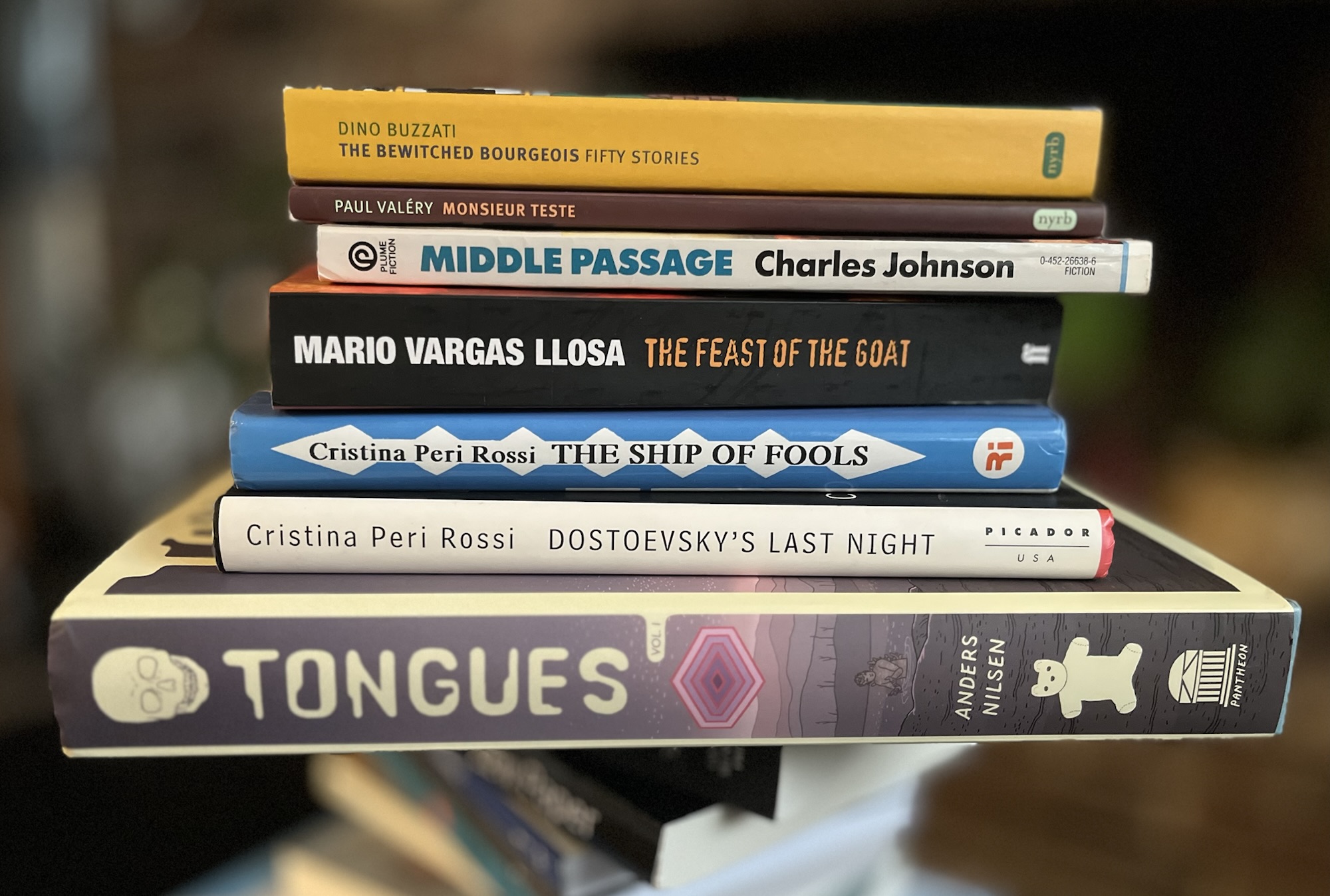
Harvey’s is, as far as I can tell, a Friends of the Library venture run by volunteers. I didn’t expect much, but the fiction section was surprisingly well populated. For around five bucks I picked up Charles Johnson’s Middle Passage, Mario Vargas Llosa’s The Feast of the Goat, and two by Cristina Peri Rossi — The Ship of Fools and Dostoevsky’s Last Night.

I was happy and surprised to find Rossi’s The Ship of Fools (in translation by Psiche Hughes); I’ve had it on a mental list for a few months now. I started it that night and it’s really odd–reminds me a bit of Ann Quin’s stuff, very odd but fun. More thoughts to come.

The Ship of Fools proved a nice antidote to the books I’d brought with me, Paul Valéry’s Monsieur Teste, (in translation by Charlotte Mandell) and a Dino Buzzati collection translated by Lawrence Venuti, called The Bewitched Bourgeois. I’ve enjoyed the Buzzati stories, but piled up there’s a sameness here that cries for interruption. I love Borgesian riffs on “Before the Law” as much as the next nerd, but too many in a row (six, in my case this week) feels, I dunno, like, I get it. But to be clear, I’ve really liked most of The Bewitched Bourgeois. I think it’s better parceled out though. Monsieur Teste on the other hand…look, I don’t know, maybe I misunderstood the book entirely, but I really kinda sorta hated it. Was I supposed to hate the central persona, Mister Teste, who aims for precision in language but comes off as a bore? At least it was short.

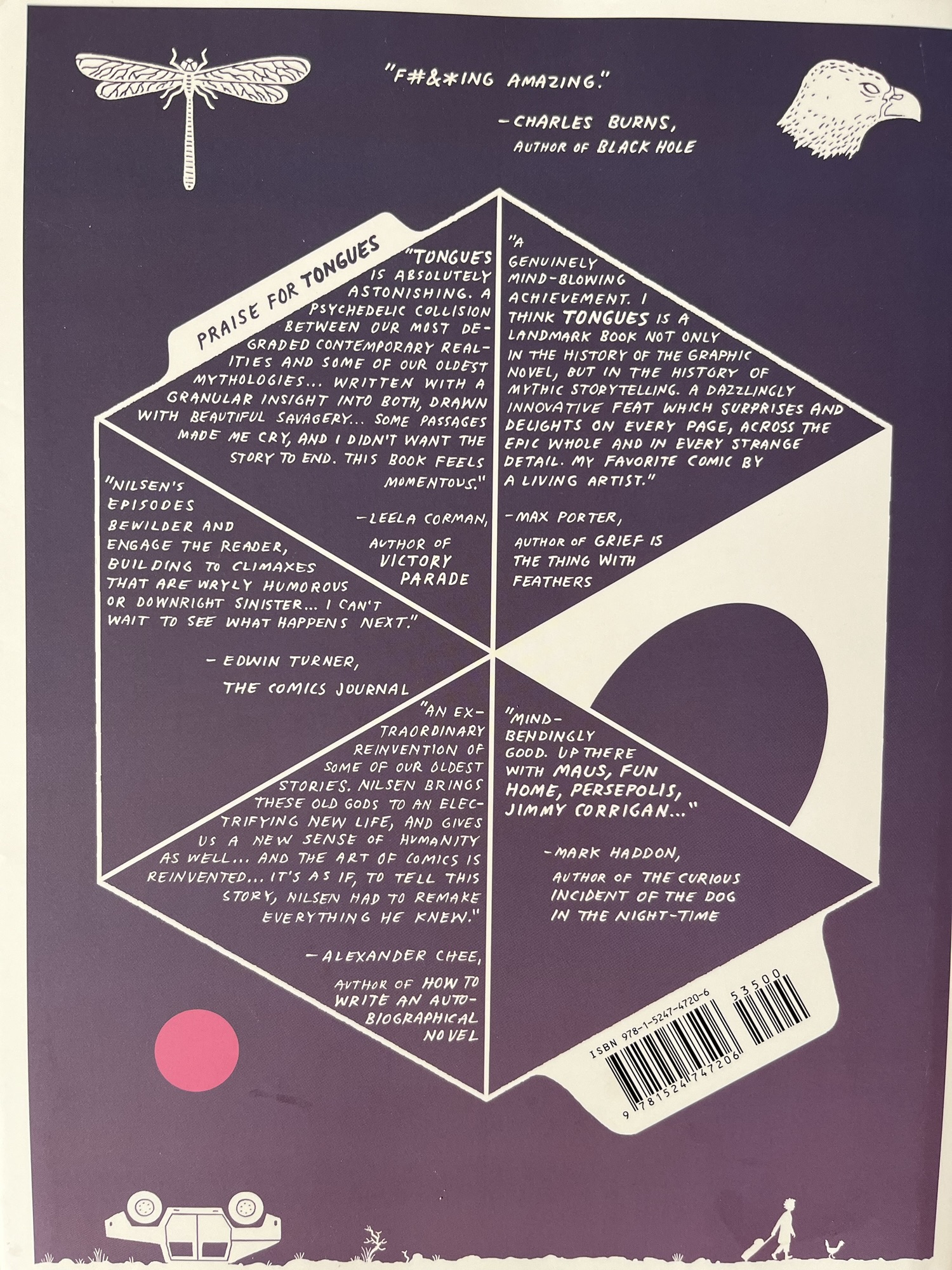
While I didn’t have the time in Atlanta to hit multiple bookstores (like in past trips), I made a point to hit up A Capella Books, a well stocked indie joint with a great used collection. I didn’t score anything there, although I was thrilled to see Anders Nilsen’s Tongues prominently featured in the graphic novel section. The book is great — I got a review copy right before we left. Some asshole named Edwin Turner landed a blurb on the back under his hero Charles Burns’s much shorter, pithier, better blurb:
Our spring break culminated Saturday night at the Variety Playhouse in Little Five Points, where we saw the so-called indie supergroup The Hard Quartet play all of their songs. I really dig The Hard Quartet’s self-titled debut, and dragged my wife and son along. (My daughter declined but played taxi driver.) Some interesting looking children were exiting the theater (really more of a club, let’s be honest) as we were entering, assuring the concerned security guard that they’d be right back, they just needed to get some Gatorade at a corner store. These were Sharp Pins, or The Sharp Pins, or Thee Sharp Pins, a Chicago power pop trio fronted by a kid named Kai Slater. They played a tight thirty minute set (including a Byrds cover); young Slater knows how to tuck away middle eight. The band’s youth invigorated the crowd of indie oldheads, and if Sharp Pins were occasionally a little out of tune or a step behind on the count, what came through was a true joy for the pop song. My son went bananas from them, saying something like, I know that they aren’t as good at playing their instruments as the Hard Quartet guys, but I liked their songs more. He bought their album and their t-shirt.

I liked The Hard Quartet’s live show very much — these are some old, or let’s just say older guys — look, pretty much everyone at the show was old, older, etc., except the Sharp Pins, my son, and some other teens there with their folks — these guys, the HQ, are veterans of disorder, coming up in club shows and theaters and big stages and big big stages and so on. They seemed very comfortable in the quasi-theater club. It was a joy to watch and listen to them.

They are, as I mentioned before, a so-called “supergroup.” Stephen Malkmus was the sideman for David Berman in The Silver Jews; Matt Sweeney, a popular YouTube influencer, was a member of another infamous supergroup — David Pajo’s short-lived side project Zwan; Emmett Kelly is a former gang member and circus performer; Jim White is the best drummer I’ve ever seen live (I have no stupid joke here; he is amazing and I listened to Ocean Songs every night for two years in a row when I was 22 and that’s not an exaggeration.)

The Hard Quartet are clearly a “real” band and not anyone’s side project. Sonics live were richer, fuller, more expansive than on disc. Emmett Kelly sang his new song, which, as far as I can tell, is the only update to their setlist in the past year — basically the record played straight through — but they seemed to never remember who was playing bass on which song when. No one used a pick, ever, as far as I could tell. Sweeney broke a string and then claimed he’d never broken a string on stage, ever. (Dubious.) Malkmus said he was thinking about “The Devil Went Down to Georgia,” but, what if it was, like, “The Devil Went Down on George.” Sweeney jokingly referred to Charlie Daniels as Chuck Daniels and at least two Atlanta audience members hissed foolish rejoinders. (Could’ve been those big beers, bald boys!) Jim White is both a gentle percussionist and a rawk gawd drummer. Malkmus’s, Kelly’s, and Sweeney’s singing in unison were some of the finest moments of the night, as in “Rio’s Song” and “Heel Highway.” The band’s weathered implementation of silence and space was also delicious and judicious in numbers like “Six Deaf Rats,” “Action for the Military Boys,” and “Hey.” Skronk and noodling were measured but never mannered. (Or the manners were there but they weren’t bad, unless they were meant to be bad.) Matt Sweeney’s left foot was the boss of the band, the bandleader, the clapper clopping down the count in a leopard print.

The Hard Quartet finished before eleven, having played all their songs. I think we all had a good time.

Jim White
Matt Sweeney
Stephen “SM” Malkmus
Emmett Kelly

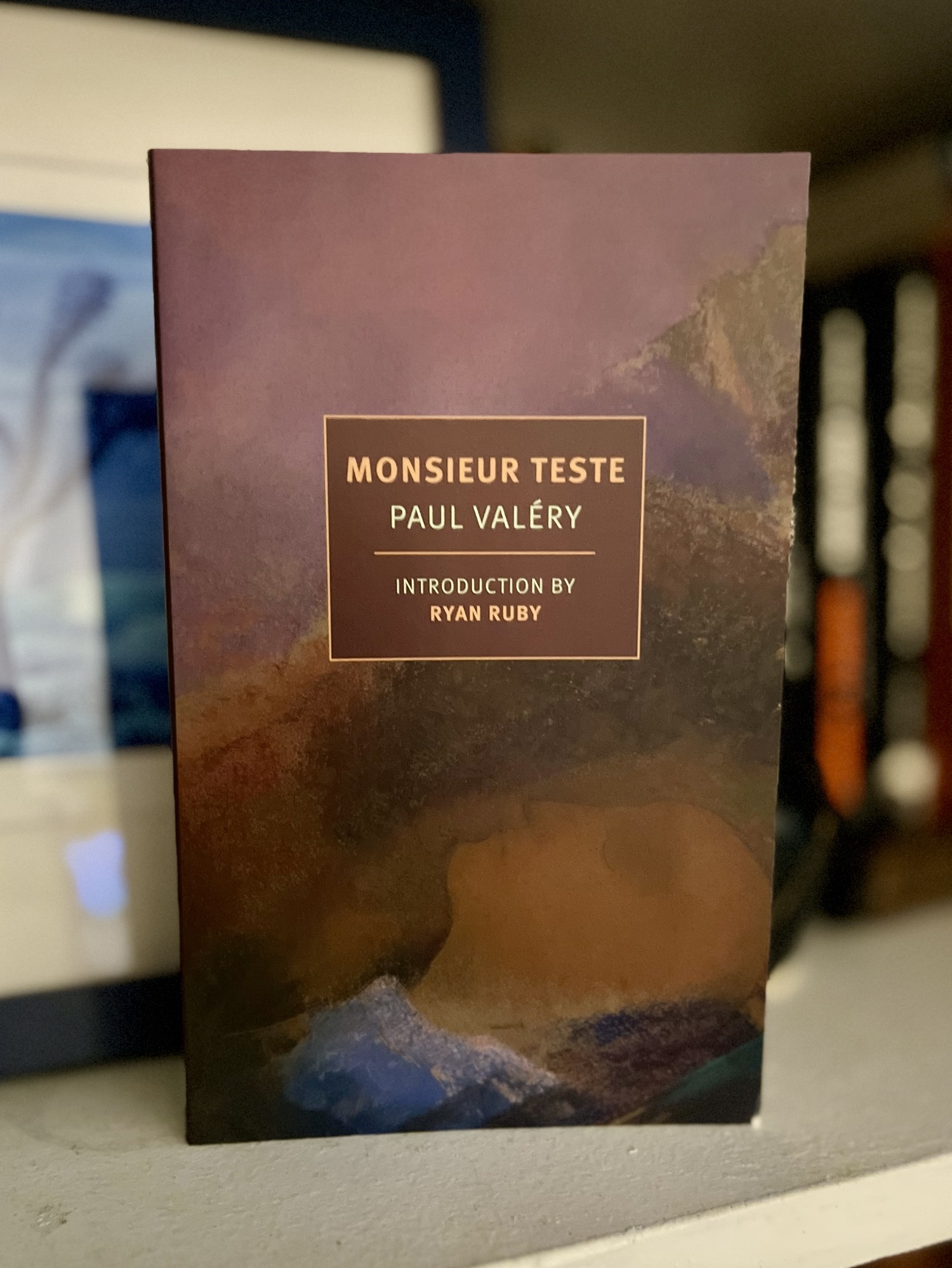
Paul Valéry’s Monsieur Teste (Book acquired, 14 Nov. 2024)

Got a review copy of Paul Valéry’s Monsieur Teste, a slim lil fellow from NYRB in translation by Charlotte Mandell. The back cover includes a blurb from William H. Gass—

Monsieur Teste is a monster, and is meant to be—an awesome, wholly individualized machine—yet in a sense he is also the sort of inhuman being Valéry aimed to become himself: a Narcissus of the best kind, a scientific observer of consciousness, a man untroubled by inroads of worldly trivia, who vacations in his head the way a Platonist finds his Florida in the realm of Forms.

What the fuck does Gass mean by “Florida” here? I really want to know.


This style of post, the book acquired post, is an established, which is to say tired, blog post format on this blog, Biblioklept, probably going back a decade now, born from a glut of review copies piling up, mostly unasked for but many asked for, books that stack up their own measures of guilt, unread, or then maybe read, months, years later—but the post style is ephemeral, yes, fluffy, sure, embarrassing even maybe. The form is stale; I apologize. I do think the Valéry book seems pretty cool.


I have a not-insubstantial stack of newly acquired new (and used books) stacked on the cherry side table by the black leather couch that I should have made book acquired posts about. These have piled up over the last few weeks. These are not interesting sentences (several of the books seem very interesting).


I am not going to find the new form I want here, am I?


When I was a freshman in high school, my then-girlfriend’s older brother gave me a mixtape that a girl had given him. He didn’t like anything on the mixtape; he liked Buddy Holly. I can’t remember why he gave me the tape—I think I saw it in his car and asked about it. But it ended up changing my life in some ways, as small giant things like songs or books or films can do when they come over you at the right time and place.

There were a few bands on the tape that I knew or had heard of, and even some I owned albums by, like the Cure and the Smiths. But for the most part, the tape opened a new aural world to me. I heard My Bloody Valentine, Big Star, Ride, the Cocteau Twins, and This Mortal Coil, among others, for the first time. There were also two songs by one band: Slowdive’s “When the Sun Hits” and “Dagger.”


(This particular blog post is no longer about acquiring a Valéry translation; it is about something else.)


Those songs are from Slowdive’s 1993 classic Souvlaki. I owned it on cassette. That cassette melted, just slightly, on the top of my 1985 Camry’s dashboard in like August of 1995. The tape was just warped enough not to fit into a cassette deck. I liked to imagine how it would sound. The next year, my lucky privileged ass found a used CD of Slowdive’s follow-up, Pygmallion on a school trip to London. Slowdive kinda sorta broke up after that.


I have always been a proponent of bands breaking up. I think a decade is long enough; get what you need done in five or six albums and move on. There are many many exceptions to this rule. But generally, I don’t think beloved bands—by which I means bands beloved by me—should keep going on too long. And if they break up, they should stay broken.


But I bought Slowdive’s 2017 reunion album Slowdive used at a St. Petersburg record store and listened to it again and again, amazed at how strong it was, how true to form. My kids liked it a lot. And then they put out a record last year, Everything Is Alive—I like that one too (not as good as the self titled one).


(There’s no point to any of this; I might’ve had some wine; I might just feel like writing.)


I guess if you’d told me back in ’95 or ’05 or even ’15 that I’d see a reunited Slowdive twice in one year I’d say that that sounded silly. (The ’15 version of me that had seen Dinosaur Jr.’s dinosaur act wouldn’t have been interested.) But we went out into the woods to see Slowdive this Sunday. They played the St. Augustine Amphitheatre to a large, strange, diverse crowd, out there in the Florida air. A band named Wisp, TikTok famous I’m told, opened, and they were pretty good. But Slowdive was perfect—better than back in May in Atlanta—echo and reverb ringing out into Anastasia State Park.


We stayed in a cheap motel off of AIA that night—another sign of my age. When I was younger, I could drive six hours, watch a band, and drive the six hours back without blinking. We are about 45 minutes from St. Augustine. It was a nice night out.


A younger version of me could’ve read the 80 pages of Paul Valéry’s Monsieur Teste in the time it took to twiddle my thumbs in this post and write a real (and likely bad) review to boot. Again, apologies. I’m getting old, a dinosaur act. But I can’t break up, not now.


Slowdive, St. Augustine Amphitheatre, 10 Nov. 2024 Slowdive, St. Augustine Amphitheatre, 10 Nov. 2024

Valéry — Gerhard Richter

valery

“Guide for New Readers of Stendhal’s Charterhouse” — Italo Calvino

“Guide for New Readers of Stendhal’s Charterhouse” by Italo Calvino (Collected in Why Read the Classics?)

How many new readers will be attracted to Stendhal’s The Charterhouse of Parma by the new film version of the novel, shortly to be broadcast on television? Perhaps very few when compared to the total number of the TV audience, or perhaps very many when compared to the statistics for the number of books Italians read. But no data can ever supply us with the most important figure, and that is how many young people will be smitten right from the opening pages, and will be instantly convinced that this has to be the best novel ever written, recognising it as the novel they had always wanted to read and which will act as the benchmark for all the other novels they will read in later life. (I’m talking particularly about the opening chapters; as you get into it, you will find that it is a different novel, or several novels each different from the other, all of which will require you to modify your involvement in the plot; whatever happens, the brilliance of the opening will continue to influence you.)

This is what happened to me and to so many others in the various generations that have read the work in the last hundred years. (The Charterhouse came out in 1839, but you have to exclude the forty years that it had to wait before Stendhal was understood, a period he himself had foreseen with extraordinary precision; even although of all his works this was the most instantly successful, and could count for its launch on a lengthy and enthusiastic essay by Balzac, a good 72 pages long!) Continue reading ““Guide for New Readers of Stendhal’s Charterhouse” — Italo Calvino”