Read “The Hanging of the Schoolmarm,” new fiction from Robert Coover

Robert Coover’s short story “The Hanging of the Schoolmarm” is new in this week’s New Yorker. It’s of a piece with the last Coover story The New Yorker published, “Invasion of the Martians.”

Here are the first few paragraphs of “The Hanging of the Schoolmarm”:

The schoolmarm is playing poker in the town saloon. The stake is the saloon itself. As she is preparing to deal the cards, one of the men demands that she cut the fuckin’ deck, and she shoots him from her lap. “Sorry, but I simply cannot allow . . .”

The others tip their crumpled hats. “No, ma’am, you just go ahead and deal.”

The men of the town find the schoolmarm difficult but are awed by her refined and lofty character, and generally do what she tells them to do. The sheriff likes to say that she’s as pure as the spotless lily of the lake, though they have no lake, and there are no lilies in it. No damn lilies. The men cuss a lot—in fact, all the time—but never around the schoolmarm. Cussing doesn’t go together with the schoolmarm. It’s like salting your coffee, to put it politely.

After winning the saloon in the poker hand, the schoolmarm has the deceased removed and turns the card tables into school desks. The bar becomes an altar on Sundays, but there’s no preacher, so the schoolmarm provides temperance lectures from it, which the men are obliged to attend. In their minds, it’s still the old bar, the old saloon, so they carry along hip flasks and beef jerky to ease themselves through the unholy tedium, belching and snorting noisily.

Robert Coover reads “The Fallguy’s Faith”

Read along here.

Falling from favor, or grace, some high artifice, down he dropped like a discredited predicate through what he called space (sometimes he called it time) and with an earsplitting crack splattered the base earth with his vital attributes. Oh, I’ve had a great fall, he thought as he lay there, numb with terror, trying desperately to pull himself together again. This time (or space) I’ve really done it! He had fallen before of course: short of expectations, into bad habits, out with his friends, upon evil days, foul of the law, in and out of love, down in the dumps—indeed, as though egged on by some malevolent metaphor generated by his own condition, he had always been falling, had he not?—but this was the most terrible fall of all. It was like the very fall of pride, of stars, of Babylon, of cradles and curtains and angels and rain, like the dread fall of silence, of sparrows, like the fall of doom.

“That morning, the city was celebrating Consumer Thanksgiving Day” | Italo Calvino

That morning, the city was celebrating Consumer Thanksgiving Day. This feast came around every year, on a day in November, and had been set up to allow shoppers to display their gratitude toward the god Production, who tirelessly satisfied their every desire. The biggest department store in town organized a parade every year: an enormous balloon in the shape of a garishly colored doll was paraded through the main streets, pulled by ribbons that sequin-clad girls held as they marched behind a musical band. That day, the procession was coming down Fifth Avenue: the majorette twirled her baton in the air, the big drums banged, and the balloon giant, representing the Satisfied Customer, flew among the skyscrapers, obediently advancing on leashes held by girls in kepis, tassels, and fringed epaulets, riding spangly motorcycles.

At the same time, another parade was crossing Manhattan. The flaky, moldy moon was also advancing, sailing between the skyscrapers, pulled by the naked girls, and behind it came a line of beat-up cars and skeletons of trucks, amid a silent crowd that was gradually increasing in size. Thousands of people joined the throng that had been following the moon since the early hours of the morning, people of all colors, whole families with children of every age, especially as the procession filed past the crowded black and Puerto Rican areas of Harlem.

Read the rest of Italo Calvino’s short story “The Daughters of the Moon” — or listen to Robert Coover read and discuss it.


“Going for a Beer” — Robert Coover

The New Yorker publishes “Going for a Beer,” a very short story by Robert Coover. From the story–

He finds himself sitting in the neighborhood bar drinking a beer at about the same time that he began to think about going there for one. In fact, he has finished it. Perhaps he’ll have a second one, he thinks, as he downs it and asks for a third. There is a young woman sitting not far from him who is not exactly good-looking but good-looking enough, and probably good in bed, as indeed she is. Did he finish his beer? Can’t remember. What really matters is: Did he enjoy his orgasm? Or even have one?


Why Robert Coover Writes

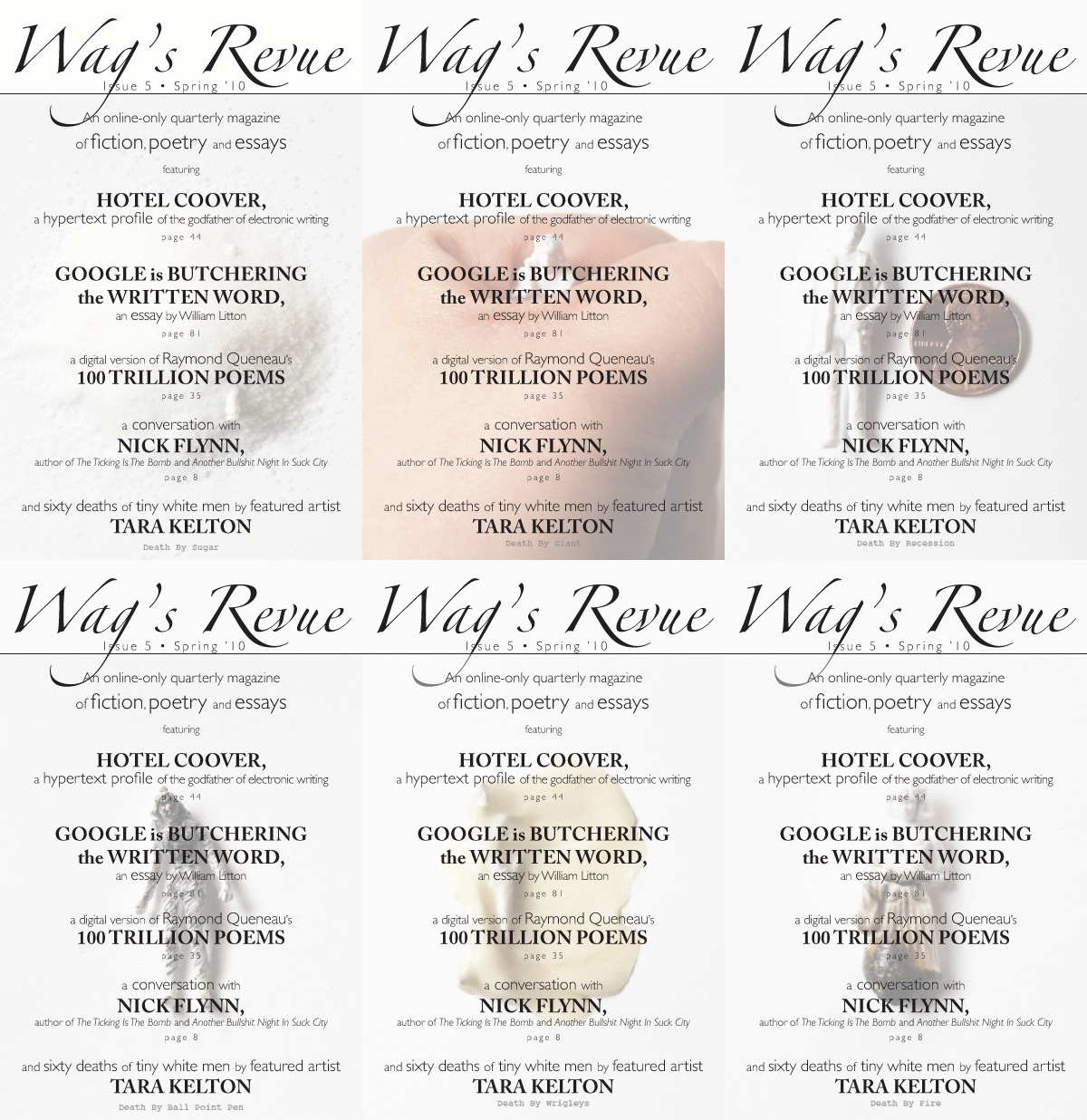
Wag’s Revue Issue 5 Out

The newest issue of the stylish and savvy online literary magazine, Wag’s Revue is out new this week. In addition to art, poetry, audio clips, and short fiction, the issue features a really cool essay by Robert Moor about Robert Coover’s groundbreaking hypertext exercise, The Hypertext Hotel. Fittingly, the essay is itself an exercise in ludic hyperlinked indeterminancy. Good stuff.