“The Werewolf” — Eugene Field

“The Werewolf” by Eugene Field

In the reign of Egbert the Saxon there dwelt in Britain a maiden named Yseult, who was beloved of all, both for her goodness and for her beauty. But, though many a youth came wooing her, she loved Harold only, and to him she plighted her troth.

Among the other youth of whom Yseult was beloved was Alfred, and he was sore angered that Yseult showed favor to Harold, so that one day Alfred said to Harold: “Is it right that old Siegfried should come from his grave and have Yseult to wife?” Then added he, “Prithee, good sir, why do you turn so white when I speak your grandsire’s name?”

Then Harold asked, “What know you of Siegfried that you taunt me? What memory of him should vex me now?”

“We know and we know,” retorted Alfred. “There are some tales told us by our grandmas we have not forgot.”

So ever after that Alfred’s words and Alfred’s bitter smile haunted Harold by day and night.

Harold’s grandsire, Siegfried the Teuton, had been a man of cruel violence. The legend said that a curse rested upon him, and that at certain times he was possessed of an evil spirit that wreaked its fury on mankind. But Siegfried had been dead full many years, and there was naught to mind the world of him save the legend and a cunning-wrought spear which he had from Brunehilde, the witch. This spear was such a weapon that it never lost its brightness, nor had its point been blunted. It hung in Harold’s chamber, and it was the marvel among weapons of that time. Continue reading ““The Werewolf” — Eugene Field”

Read “The Hanging Stranger,” A Short Story by Philip K. Dick

Five o’clock Ed Loyce washed up, tossed on his hat and coat, got his car out and headed across town toward his TV sales store. He was tired. His back and shoulders ached from digging dirt out of the basement and wheeling it into the back yard. But for a forty-year-old man he had done okay. Janet could get a new vase with the money he had saved; and he liked the idea of repairing the foundations himself!

It was getting dark. The setting sun cast long rays over the scurrying commuters, tired and grim-faced, women loaded down with bundles and packages, students swarming home from the university, mixing with clerks and businessmen and drab secretaries. He stopped his Packard for a red light and then started it up again. The store had been open without him; he’d arrive just in time to spell the help for dinner, go over the records of the day, maybe even close a couple of sales himself. He drove slowly past the small square of green in the center of the street, the town park. There were no parking places in front of LOYCE TV SALES AND SERVICE. He cursed under his breath and swung the car in a U-turn. Again he passed the little square of green with its lonely drinking fountain and bench and single lamppost.

From the lamppost something was hanging. A shapeless dark bundle, swinging a little with the wind. Like a dummy of some sort. Loyce rolled down his window and peered out. What the hell was it? A display of some kind? Sometimes the Chamber of Commerce put up displays in the square.

Again he made a U-turn and brought his car around. He passed the park and concentrated on the dark bundle. It wasn’t a dummy. And if it was a display it was a strange kind. The hackles on his neck rose and he swallowed uneasily. Sweat slid out on his face and hands.

It was a body. A human body.

Read the rest of Philip K. Dick’s early short story, “The Hanging Stranger.”


“Eleonora” — Edgar Allan Poe

“Eleonora” by Edgar Allan Poe

I AM come of a race noted for vigor of fancy and ardor of passion. Men have called me mad; but the question is not yet settled, whether madness is or is not the loftiest intelligence—whether much that is glorious—whether all that is profound—does not spring from disease of thought—from moods of mind exalted at the expense of the general intellect. They who dream by day are cognizant of many things which escape those who dream only by night. In their gray visions they obtain glimpses of eternity, and thrill, in awakening, to find that they have been upon the verge of the great secret. In snatches, they learn something of the wisdom which is of good, and more of the mere knowledge which is of evil. They penetrate, however, rudderless or compassless into the vast ocean of the “light ineffable,” and again, like the adventures of the Nubian geographer, “agressi sunt mare tenebrarum, quid in eo esset exploraturi.”

We will say, then, that I am mad. I grant, at least, that there are two distinct conditions of my mental existence—the condition of a lucid reason, not to be disputed, and belonging to the memory of events forming the first epoch of my life—and a condition of shadow and doubt, appertaining to the present, and to the recollection of what constitutes the second great era of my being. Therefore, what I shall tell of the earlier period, believe; and to what I may relate of the later time, give only such credit as may seem due, or doubt it altogether, or, if doubt it ye cannot, then play unto its riddle the Oedipus.

She whom I loved in youth, and of whom I now pen calmly and distinctly these remembrances, was the sole daughter of the only sister of my mother long departed. Eleonora was the name of my cousin. We had always dwelled together, beneath a tropical sun, in the Valley of the Many-Colored Grass. No unguided footstep ever came upon that vale; for it lay away up among a range of giant hills that hung beetling around about it, shutting out the sunlight from its sweetest recesses. No path was trodden in its vicinity; and, to reach our happy home, there was need of putting back, with force, the foliage of many thousands of forest trees, and of crushing to death the glories of many millions of fragrant flowers. Thus it was that we lived all alone, knowing nothing of the world without the valley—I, and my cousin, and her mother.

From the dim regions beyond the mountains at the upper end of our encircled domain, there crept out a narrow and deep river, brighter than all save the eyes of Eleonora; and, winding stealthily about in mazy courses, it passed away, at length, through a shadowy gorge, among hills still dimmer than those whence it had issued. We called it the “River of Silence”; for there seemed to be a hushing influence in its flow. No murmur arose from its bed, and so gently it wandered along, that the pearly pebbles upon which we loved to gaze, far down within its bosom, stirred not at all, but lay in a motionless content, each in its own old station, shining on gloriously forever.

The margin of the river, and of the many dazzling rivulets that glided through devious ways into its channel, as well as the spaces that extended from the margins away down into the depths of the streams until they reached the bed of pebbles at the bottom,—these spots, not less than the whole surface of the valley, from the river to the mountains that girdled it in, were carpeted all by a soft green grass, thick, short, perfectly even, and vanilla-perfumed, but so besprinkled throughout with the yellow buttercup, the white daisy, the purple violet, and the ruby-red asphodel, that its exceeding beauty spoke to our hearts in loud tones, of the love and of the glory of God.

And, here and there, in groves about this grass, like wildernesses of dreams, sprang up fantastic trees, whose tall slender stems stood not upright, but slanted gracefully toward the light that peered at noon-day into the centre of the valley. Their mark was speckled with the vivid alternate splendor of ebony and silver, and was smoother than all save the cheeks of Eleonora; so that, but for the brilliant green of the huge leaves that spread from their summits in long, tremulous lines, dallying with the Zephyrs, one might have fancied them giant serpents of Syria doing homage to their sovereign the Sun.

Hand in hand about this valley, for fifteen years, roamed I with Eleonora before Love entered within our hearts. It was one evening at the close of the third lustrum of her life, and of the fourth of my own, that we sat, locked in each other’s embrace, beneath the serpent-like trees, and looked down within the water of the River of Silence at our images therein. We spoke no words during the rest of that sweet day, and our words even upon the morrow were tremulous and few. We had drawn the God Eros from that wave, and now we felt that he had enkindled within us the fiery souls of our forefathers. The passions which had for centuries distinguished our race, came thronging with the fancies for which they had been equally noted, and together breathed a delirious bliss over the Valley of the Many-Colored Grass. A change fell upon all things. Strange, brilliant flowers, star-shaped, burn out upon the trees where no flowers had been known before. The tints of the green carpet deepened; and when, one by one, the white daisies shrank away, there sprang up in place of them, ten by ten of the ruby-red asphodel. And life arose in our paths; for the tall flamingo, hitherto unseen, with all gay glowing birds, flaunted his scarlet plumage before us. The golden and silver fish haunted the river, out of the bosom of which issued, little by little, a murmur that swelled, at length, into a lulling melody more divine than that of the harp of Aeolus-sweeter than all save the voice of Eleonora. And now, too, a voluminous cloud, which we had long watched in the regions of Hesper, floated out thence, all gorgeous in crimson and gold, and settling in peace above us, sank, day by day, lower and lower, until its edges rested upon the tops of the mountains, turning all their dimness into magnificence, and shutting us up, as if forever, within a magic prison-house of grandeur and of glory.

The loveliness of Eleonora was that of the Seraphim; but she was a maiden artless and innocent as the brief life she had led among the flowers. No guile disguised the fervor of love which animated her heart, and she examined with me its inmost recesses as we walked together in the Valley of the Many-Colored Grass, and discoursed of the mighty changes which had lately taken place therein.

At length, having spoken one day, in tears, of the last sad change which must befall Humanity, she thenceforward dwelt only upon this one sorrowful theme, interweaving it into all our converse, as, in the songs of the bard of Schiraz, the same images are found occurring, again and again, in every impressive variation of phrase.

She had seen that the finger of Death was upon her bosom—that, like the ephemeron, she had been made perfect in loveliness only to die; but the terrors of the grave to her lay solely in a consideration which she revealed to me, one evening at twilight, by the banks of the River of Silence. She grieved to think that, having entombed her in the Valley of the Many-Colored Grass, I would quit forever its happy recesses, transferring the love which now was so passionately her own to some maiden of the outer and everyday world. And, then and there, I threw myself hurriedly at the feet of Eleonora, and offered up a vow, to herself and to Heaven, that I would never bind myself in marriage to any daughter of Earth—that I would in no manner prove recreant to her dear memory, or to the memory of the devout affection with which she had blessed me. And I called the Mighty Ruler of the Universe to witness the pious solemnity of my vow. And the curse which I invoked of Him and of her, a saint in Helusion should I prove traitorous to that promise, involved a penalty the exceeding great horror of which will not permit me to make record of it here. And the bright eyes of Eleonora grew brighter at my words; and she sighed as if a deadly burthen had been taken from her breast; and she trembled and very bitterly wept; but she made acceptance of the vow, (for what was she but a child?) and it made easy to her the bed of her death. And she said to me, not many days afterward, tranquilly dying, that, because of what I had done for the comfort of her spirit she would watch over me in that spirit when departed, and, if so it were permitted her return to me visibly in the watches of the night; but, if this thing were, indeed, beyond the power of the souls in Paradise, that she would, at least, give me frequent indications of her presence, sighing upon me in the evening winds, or filling the air which I breathed with perfume from the censers of the angels. And, with these words upon her lips, she yielded up her innocent life, putting an end to the first epoch of my own.

Thus far I have faithfully said. But as I pass the barrier in Time’s path, formed by the death of my beloved, and proceed with the second era of my existence, I feel that a shadow gathers over my brain, and I mistrust the perfect sanity of the record. But let me on.—Years dragged themselves along heavily, and still I dwelled within the Valley of the Many-Colored Grass; but a second change had come upon all things. The star-shaped flowers shrank into the stems of the trees, and appeared no more. The tints of the green carpet faded; and, one by one, the ruby-red asphodels withered away; and there sprang up, in place of them, ten by ten, dark, eye-like violets, that writhed uneasily and were ever encumbered with dew. And Life departed from our paths; for the tall flamingo flaunted no longer his scarlet plumage before us, but flew sadly from the vale into the hills, with all the gay glowing birds that had arrived in his company. And the golden and silver fish swam down through the gorge at the lower end of our domain and bedecked the sweet river never again. And the lulling melody that had been softer than the wind-harp of Aeolus, and more divine than all save the voice of Eleonora, it died little by little away, in murmurs growing lower and lower, until the stream returned, at length, utterly, into the solemnity of its original silence. And then, lastly, the voluminous cloud uprose, and, abandoning the tops of the mountains to the dimness of old, fell back into the regions of Hesper, and took away all its manifold golden and gorgeous glories from the Valley of the Many-Colored Grass.

Yet the promises of Eleonora were not forgotten; for I heard the sounds of the swinging of the censers of the angels; and streams of a holy perfume floated ever and ever about the valley; and at lone hours, when my heart beat heavily, the winds that bathed my brow came unto me laden with soft sighs; and indistinct murmurs filled often the night air, and once—oh, but once only! I was awakened from a slumber, like the slumber of death, by the pressing of spiritual lips upon my own.

But the void within my heart refused, even thus, to be filled. I longed for the love which had before filled it to overflowing. At length the valley pained me through its memories of Eleonora, and I left it for ever for the vanities and the turbulent triumphs of the world.

I found myself within a strange city, where all things might have served to blot from recollection the sweet dreams I had dreamed so long in the Valley of the Many-Colored Grass. The pomps and pageantries of a stately court, and the mad clangor of arms, and the radiant loveliness of women, bewildered and intoxicated my brain. But as yet my soul had proved true to its vows, and the indications of the presence of Eleonora were still given me in the silent hours of the night. Suddenly these manifestations they ceased, and the world grew dark before mine eyes, and I stood aghast at the burning thoughts which possessed, at the terrible temptations which beset me; for there came from some far, far distant and unknown land, into the gay court of the king I served, a maiden to whose beauty my whole recreant heart yielded at once—at whose footstool I bowed down without a struggle, in the most ardent, in the most abject worship of love. What, indeed, was my passion for the young girl of the valley in comparison with the fervor, and the delirium, and the spirit-lifting ecstasy of adoration with which I poured out my whole soul in tears at the feet of the ethereal Ermengarde?—Oh, bright was the seraph Ermengarde! and in that knowledge I had room for none other.—Oh, divine was the angel Ermengarde! and as I looked down into the depths of her memorial eyes, I thought only of them—and of her.

I wedded;—nor dreaded the curse I had invoked; and its bitterness was not visited upon me. And once—but once again in the silence of the night; there came through my lattice the soft sighs which had forsaken me; and they modelled themselves into familiar and sweet voice, saying:

“Sleep in peace!—for the Spirit of Love reigneth and ruleth, and, in taking to thy passionate heart her who is Ermengarde, thou art absolved, for reasons which shall be made known to thee in Heaven, of thy vows unto Eleonora.”


“The Obliterated Man” — H.G. Wells

“The Obliterated Man” by H.G. Wells

I was—you shall hear immediately why I am not now—Egbert Craddock Cummins. The name remains. I am still (Heaven help me!) Dramatic Critic to the Fiery Cross. What I shall be in a little while I do not know. I write in great trouble and confusion of mind. I will do what I can to make myself clear in the face of terrible difficulties. You must bear with me a little. When a man is rapidly losing his own identity, he naturally finds a difficulty in expressing himself. I will make it perfectly plain in a minute, when once I get my grip upon the story. Let me see—where am I? I wish I knew. Ah, I have it! Dead self! Egbert Craddock Cummins!

In the past I should have disliked writing anything quite so full of “I” as this story must be. It is full of “I’s” before and behind, like the beast in Revelation—the one with a head like a calf, I am afraid. But my tastes have changed since I became a Dramatic Critic and studied the masters—G.A.S., G.B.S., G.R.S., and the others. Everything has changed since then. At least the story is about myself—so that there is some excuse for me. And it is really not egotism, because, as I say, since those days my identity has undergone an entire alteration.

That past!… I was—in those days—rather a nice fellow, rather shy— taste for grey in my clothes, weedy little moustache, face “interesting,” slight stutter which I had caught in my early life from a schoolfellow. Engaged to a very nice girl, named Delia. Fairly new, she was— cigarettes—liked me because I was human and original. Considered I was like Lamb—on the strength of the stutter, I believe. Father, an eminent authority on postage stamps. She read a great deal in the British Museum. (A perfect pairing ground for literary people, that British Museum—you should read George Egerton and Justin Huntly M’Carthy and Gissing and the rest of them.) We loved in our intellectual way, and shared the brightest hopes. (All gone now.) And her father liked me because I seemed honestly eager to hear about stamps. She had no mother. Indeed, I had the happiest prospects a young man could have. I never went to theatres in those days. My Aunt Charlotte before she died had told me not to.

Then Barnaby, the editor of the Fiery Cross, made me—in spite of my spasmodic efforts to escape—Dramatic Critic. He is a fine, healthy man, Barnaby, with an enormous head of frizzy black hair and a convincing manner, and he caught me on the staircase going to see Wembly. He had been dining, and was more than usually buoyant. “Hullo, Cummins!” he said. “The very man I want!” He caught me by the shoulder or the collar or something, ran me up the little passage, and flung me over the waste-paper basket into the arm-chair in his office. “Pray be seated,” he said, as he did so. Then he ran across the room and came back with some pink and yellow tickets and pushed them into my hand. “Opera Comique,” he said, “Thursday; Friday, the Surrey; Saturday, the Frivolity. That’s all, I think.” Continue reading ““The Obliterated Man” — H.G. Wells”

“The Huldrefish,” A Weird Tale of the Northern Seas

THE HULDREFISH

“The Huldrefish” by Jonas Lie; Translated from Norwegian by Nisbet Bain (Illustration by Laurence Housman)

It was such an odd trout that Nona hauled in at the end of his fishing-line. Large and fat, red spotted and shiny, it sprawled and squirmed, with its dirty yellow belly above the water, to wriggle off the hook. And when he got it into the boat, and took it off the hook, he saw that it had only two small slits where the eyes should have been.

It must be a huldrefish, thought one of the boatmen, for rumour had it that that lake was one of those which had a double bottom.

But Nona didn’t trouble his head very much about what sort of a fish it was, so long as it was a big one. He was ravenously hungry, and bawled to them to row as rapidly as possible ashore so as to get it cooked.

He had been sitting the whole afternoon with empty lines out in the mountain lake there; but as for the trout, it was only an hour ago since it had been steering its way through the water with its rudder of a tail, and allowed itself to be fooled by a hook, and already it lay cooked red there on the dish.

But now Nona recollected about the strange eyes, and felt for them, and pricked away at its head with his fork. There was nothing but slits outside, and yet there was a sort of hard eyeball inside. The head was strangely shaped, and looked very peculiar in many respects.

He was vexed that he had not examined it more closely before it was cooked; it was not so easy now to make out what it really was. It had tasted first-rate, however, and that was something.

But at night there was, as it were, a gleam of bright water before his eyes, and he lay half asleep, thinking of the odd fish he had pulled up.

He was in his boat again, he thought, and it seemed to him as if his hands felt the fish wriggling and sprawling for its life, and shooting its snout backwards and forwards to get off the hook.

All at once it grew so heavy and strong that it drew the boat after it by the line.

It went along at a frightful speed, while the lake gradually diminished, as it were, and dried up.

There was an irresistible sucking of the water in the direction the fish went, which was towards a hole at the bottom of the lake like a funnel, and right into this hole went the boat.

It glided for a long time in a sort of twilight along a subterranean river, which dashed and splashed about him. The air that met him was, at first, chilly and cellar-like; gradually, however, it grew milder and milder, and warmer and warmer.

The stream now flowed along calmly and quietly, and broadened out continually till it fell into a large lake.

Beyond the borders of this lake, but only half visible in the gloom, stretched swamps and morasses, where he heard sounds as of huge beasts wading and trampling. Serpent like they rose and writhed with a crashing and splashing and snorting amidst the tepid mud and mire.

By the phosphorescent gleams he saw various fishes close to his boat, but all of them lacked eyes.

And he caught glimpses of the outlines of gigantic sea-serpents stretching far away into the darkness. He now understood that it was from down here that they pop up their heads off the coast in the dog days when the sea is warm.

The lindworm, with its flat head and duck’s beak, darted after fish, and crept up to the surface of the earth through the slimy ways of mire and marsh.

Through the warm and choking gloom there came, from time to time, a cooling chilling blast from the cold curves and winds of the slimy and slippery greenish lichworm, which bores its way through the earth and eats away the coffins that are rotting in the churchyards.

Horrible shapeless monsters, with streaming manes, such as are said to sometimes appear in mountain tarns, writhed and wallowed and seized their prey in the fens and marshes.

And he caught glimpses of all sorts of humanlike creatures, such as fishermen and sailors meet and marvel at on the sea, and landsmen see outside the elfin mounds.

And, besides, that there was a soft whizzing and an endless hovering and swarming of beings, whose shapes were nevertheless invisible to the eye of man.

Then the boat glided into miry pulpy water, where her course tended downwards, and where the earth-vault above darkened as it sank lower and lower.

All at once a blinding strip of light shot down from a bright blue slit high, high, above him.

A stuffy vapour stood round about him. The water was as yellow and turbid as that which comes out of steam boilers.

And he called to mind the peculiar tepid undrinkable water which bubbles up by the side of artesian wells. It was quite hot. Up there they were boring down to a world of warm watercourses and liquid strata beneath the earth’s crust.

Heat as from an oven rose up from the huge abysses and dizzying clefts, whilst mighty steaming waterfalls roared and shook the ground.

All at once he felt as if his body were breaking loose, freeing itself, and rising in the air. He had a feeling of infinite lightness, of a wondrous capability for floating in higher atmospheres and recovering equilibrium.

And, before he knew how it was, he found himself up on the earth again.


“The Alchemist” — H.P. Lovecraft

“The Alchemist” by H.P. Lovecraft

High up, crowning the grassy summit of a swelling mound whose sides are wooded near the base with the gnarled trees of the primeval forest, stands the old chateau of my ancestors. For centuries its lofty battlements have frowned down upon the wild and rugged countryside about, serving as a home and stronghold for the proud house whose honoured line is older even than the moss-grown castle walls. These ancient turrets, stained by the storms of generations and crumbling under the slow yet mighty pressure of time, formed in the ages of feudalism one of the most dreaded and formidable fortresses in all France. From its machicolated parapets and mounted battlements Barons, Counts, and even Kings had been defied, yet never had its spacious halls resounded to the footstep of the invader.

But since those glorious years all is changed. A poverty but little above the level of dire want, together with a pride of name that forbids its alleviation by the pursuits of commercial life, have prevented the scions of our line from maintaining their estates in pristine splendour; and the falling stones of the walls, the overgrown vegetation in the parks, the dry and dusty moat, the ill-paved courtyards, and toppling towers without, as well as the sagging floors, the worm-eaten wainscots, and the faded tapestries within, all tell a gloomy tale of fallen grandeur. As the ages passed, first one, then another of the four great turrets were left to ruin, until at last but a single tower housed the sadly reduced descendants of the once mighty lords of the estate.

It was in one of the vast and gloomy chambers of this remaining tower that I, Antoine, last of the unhappy and accursed Comtes de C——, first saw the light of day, ninety long years ago. Within these walls, and amongst the dark and shadowy forests, the wild ravines and grottoes of the hillside below, were spent the first years of my troubled life. My parents I never knew. My father had been killed at the age of thirty-two, a month before I was born, by the fall of a stone somehow dislodged from one of the deserted parapets of the castle, and my mother having died at my birth, my care and education devolved solely upon one remaining servitor, an old and trusted man of considerable intelligence, whose name I remember as Pierre. I was an only child, and the lack of companionship which this fact entailed upon me was augmented by the strange care exercised by my aged guardian in excluding me from the society of the peasant children whose abodes were scattered here and there upon the plains that surround the base of the hill. At the time, Pierre said that this restriction was imposed upon me because my noble birth placed me above association with such plebeian company. Now I know that its real object was to keep from my ears the idle tales of the dread curse upon our line, that were nightly told and magnified by the simple tenantry as they conversed in hushed accents in the glow of their cottage hearths. Continue reading ““The Alchemist” — H.P. Lovecraft”

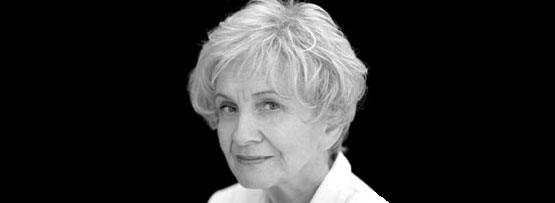
Alice Munro Wins the 2013 Nobel Prize in Literature

410519_alice_munro_555x203

Canadian writer Alice Munro has won the 2013 Nobel Prize in Literature.

Munro, 82, has written over a dozen short story collections in her career. Most of her stories–composed in a mode of psychological realism reminiscent of 19th-century modernism—focus on the lives of people in a small rural pocket of Canada. Munro’s stories appear with an almost-alarming ubiquity, popping up every year in the big anthologies and the best magazines (Jonathan Franzen’s 2004 claim that “outside of Canada, where her books are No. 1 best sellers, she has never had a large readership” strikes me as odd).

For an appreciative and comprehensive look at her work, take a look at this guide at The Millions. For a contrarian take on Munro, read Christian Lorentzen’s essay in The LRB.

Or, better yet, make your own informed opinion by reading some of her stories:

“Boys and Girls”

“Gravel”

“The Bear Came Over the Mountain”

“Fiction”

“The Great Hug” — Donald Barthelme

“The Great Hug” by Donald Barthelme

At the last breakfast after I told her, we had steak and eggs. Bloody Marys. Three pieces of toast. She couldn’t cry she tried. Balloon Man came. He photographed the event. He created the Balloon of the Last Breakfast After I Told Her — a butter- colored balloon. “This is the kind of thing I do so well,” he said. Balloon Man is not modest. No one has ever suggested that. “This balloon is going to be extra-famous and acceptable, a documentation of raw human riches, the plain canvas gravy of the thing. The Pin Lady will never be able to bust this balloon, never, not even if she hugs me for a hundred years.” We were happy to have pleased him, to have contributed to his career.

The Balloon Man won’t sell to kids. Kids will come up to the Balloon Man and say, “Give us a blue balloon, Balloon Man,” and the Balloon Man will say, “Get outa here kids, these balloons are adults-only.” And the kids will say, “C’mon, Balloon Man, give us a red balloon and a green balloon and a white balloon, we got the money.” “Don’t want any kid-money,” the Balloon Man will say, “kid-money is wet and nasty and makes your hands wet and nasty and then you wipe ’em on your pants and your pants get all wet and nasty and you sit down to eat and the chair gets all wet and nasty, let that man in the brown hat draw near, he wants a balloon.” And the kids will say, “Oh please Balloon Man, we want five yellow balloons that never pop, we want to make us a smithereen.” “Ain’t gonna make no smithereen outa my fine yellow balloons,” says the Balloon Man, “your red balloon will pop sooner and your green balloon will pop later but your yellow balloon will never pop no matter how you stomp on it or stick it and besides the Balloon Man don’t sell to kids, it’s against his principles.”

The Balloon Man won’t let you take his picture. He has something to hide. He’s a superheavy Balloon Man, doesn’t want the others to steal his moves. It’s all in the gesture — the precise, reunpremeditated right move. Continue reading ““The Great Hug” — Donald Barthelme”

Read “Fiction,” a Short Story by Carl Shuker

“Fiction” by Carl Shuker

So there was a US novelist, permanently relocated to the UK some years back for an MFA, now mid-list, mid-career and “between books”, thirty-mid-something, author of two well-received novels and a less-well-received book of short stories, product of a labor of ten years on and off, and thus at the quintessential time and place to stall, creatively, who was that kind of writer who worked from emotion thence into intellect and, if he was successful, back once again into emotion, “evoked.“

And he came to the Lebanon looking to be bitten by the dragonfly.

Emotion > intellect > emotion. From the dream to the text to the dream. In practice this meant the not-so-youngish writer knew his subject when it hurt his heart, when it obsessed him and seemed too painful and the hardest thing at which to look. Then the writer knew he would have the dark, acidic energy it took to compose, edit, destroy, recompose, re-edit, polish and eventually finish, after years, a novel something like the kind of novels he loved and aspired to create, the books that made him want to become a writer in the first place. This method, which he fell into rather than chose, in the messy process of finding one’s way as a writer in his twenties, meant that by his early thirties the writer had published first one deliberately thinly veiled book of first-person late-adolescent horror, which counted, for its relative success, on the frisson of a patchwork of à clef-ish links with his own life and on making his own weaknesses—inexperience and naiveté—part of the material, and had published second one semi-immense “follow-up” or “sophomore effort”, as critics who hadn’t read the first book always wrote, a terrific shambling thing that during the long three years of its composition veered in his imagination from being a bloated, confused, constant evasion of a real book, a shadow of the kind of book it aspired to be, to being sometimes briefly the most amazing thing he’d ever read, like, ever; structured, strong, urgent, inevitable; the writer being thrilled and dazzled it’d come out of himself, then brutally depressed and miserable at its derivativeness and the puniness of his talent and by extension his soul, his self. And so how he’d done it (coming back to the MO thing), how he’d surmounted the hugeness and endlessness of the task and this bipolar crippling self-doubt and corresponding occasional massively inflated sense of self-importance was with the choice of a subject so tough, so big and hard, so new, that he had a kind of duty to it; a duty that transcended his own comfort and his own ego. A duty to the world. A subject that humbled and steeled. The second book was published to polite notices but bigger papers and a year or so of peace for the writer, and then the award of a one-year fellowship slash residency at a red-brick university like the one he’d graduated from (in crea writ, natch; the MFA) wherein the writer was immediately expected to write again. Having drawn on his childhood and his adolescence, having spent most of his twenties writing or thinking about writing while not publishing anything, the writer was immediately wary of being seen, by imagined peers, by his remembered brutal adolescent reading self with its impossible but definitive demands, of having sold out or trying to be commercially big, not cool or hard or true or essential, so he carved out a book of singular and odd semifuturistic short stories and a novella that linked them all, in a hazy darkness of second-novel-hangover and fellowship-paid-for Scotch, a clutch of one-night-stands compared to the love affairs of the first books, and worked really hard while never really, really loving these new small strange things, never adoring them like he did the books he’d had to summon forth forces for that were old and presymbolic and frightening. He had an office and stuff, and people knew he was a writer. This hadn’t happened before.

And then he got a job teaching creative writing.

Continue reading “Read “Fiction,” a Short Story by Carl Shuker”

Read Donald Barthelme’s Story “Me and Miss Mandible”

“Me and Miss Mandible” by Donald Barthelme

13 September

Miss Mandible wants to make love to me but she hesitates because I am officially a child; I am, according to the records, according to the gradebook on her desk, according to the card index in the principal’s office, eleven years old. There is a misconception here, one that I haven’t quite managed to get cleared up yet. I am in fact thirty-five, I’ve been in the Army, I am six feet one, I have hair in the appropriate places, my voice is a baritone, I know very well what to do with Miss Mandible if she ever makes up her mind.

In the meantime we are studying common fractions. I could, of course, answer all the questions, or at least most of them (there are things I don’t remember). But I prefer to sit in this too-small seat with the desktop cramping my thighs and examine the life around me. There are thirty-two in the class, which is launched every morning with the pledge of allegiance to the flag. My own allegiance, at the moment, is divided between Miss Mandible and Sue Ann Brownly, who sits across the aisle from me all day long and is, like Miss Mandible, a fool for love. Of the two I prefer, today, Sue Ann; although between eleven and eleven and a half (she refuses to reveal her exact age) she is clearly a woman, with a woman’s disguised aggression and a woman’s peculiar contradictions. Strangely neither she nor any of the other children seem to see any incongruity in my presence here.

15 September

Happily our geography text, which contains maps of all the principal land-masses of the world, is large enough to conceal my clandestine journal-keeping, accomplished in an ordinary black composition book. Every day I must wait until Geography to put down such thoughts as I may have had during the morning about my situation and my fellows. I have tried writing at other times and it does not work. Either the teacher is walking up and down the aisles (during this period, luckily, she sticks close to the map rack in the front of the room) or Bobby Vanderbilt, who sits behind me, is punching me in the kidneys and wanting to know what I am doing. Vanderbilt, I have found out from certain desultory conversations on the playground, is hung up on sports cars, a veteran consumer of Road & Track. This explains the continual roaring sounds which seem to emanate from his desk; he is reproducing a record album called Sounds of Sebring.

19 September

Only I, at times (only at times), understand that somehow a mistake has been made, that I am in a place where I don’t belong. It may be that Miss Mandible also knows this, at some level, but for reasons not fully understood by me she is going along with the game. When I was first assigned to this room I wanted to protest, the error seemed obvious, the stupidest principal could have seen it; but I have come to believe it was deliberate, that I have been betrayed again.

Now it seems to make little difference. This life-role is as interesting as my former life- role, which was that of a claims adjuster for the Great Northern Insurance Company, a position which compelled me to spend my time amid the debris of our civilization: rumpled fenders, roofless sheds, gutted ware houses, smashed arms and legs. After ten years of this one has a tendency to see the world as a vast junkyard, looking at a man and seeing only his (potentially) mangled parts, entering a house only to trace the path of the inevitable fire. Therefore when I was installed here, although I knew an error had been made, I countenanced it, I was shrewd; I was aware that there might well be some kind of advantage to be gained from what seemed a disaster. The role of The Adjuster teaches one much.  Continue reading “Read Donald Barthelme’s Story “Me and Miss Mandible””

“Ad Astra” — William Faulkner

“Ad Astra” by William Faulkner

I DON’T KNOW what we were. With the exception of Comyn, we had started out Americans, but after three years, in our British tunics and British wings and here and there a ribbon, I don’t suppose we had even bothered in three years to wonder what we were, to think or to remember.

And on that day, that evening, we were even less than that, or more than that: either beneath or beyond the knowledge that we had not even wondered in three years. The subadar, after a while he was there, in his turban and his trick major’s pips, said that we were like men trying to move in water. “But soon it will clear away,” he said. “The effluvium of hatred and of words. We are like men trying to move in water, with held breath watching our terrific and infinitesimal limbs, watching one another’s terrific stasis without touch, without contact, robbed of all save the impotence and the need.”

We were in the car then, going to Amiens, Sartoris driving and Comyn sitting half a head above him in the front seat like a tackling dummy, the subadar, Bland and I in back, each with a bottle or two in his pockets. Except the subadar, that is. He was squat, small and thick, yet his sobriety was colossal. In that maelstrom of alcohol where the rest of us had fled our inescapable selves he was like a rock, talking quietly in a grave bass four sizes too big for him: “In my country I was prince. But all men are brothers.”

But after twelve years I think of us as bugs in the surface of the water, isolant and aimless and unflagging. Not on the surface; in it, within that line of demarcation not air and not water, sometimes submerged, sometimes not. You have watched an unbreaking groundswell in a cove, the water shallow, the cove quiet, a little sinister with satiate familiarity, while beyond the darkling horizon the dying storm has raged on. That was the water, we the flotsam. Even after twelve years it is no clearer than that. It had no beginning and no ending. Out of nothing we howled, unwitting the storm which we had escaped and the foreign strand which we could not escape; that in the interval between two surges of the swell we died who had been too young to have ever lived.

We stopped in the middle of the road to drink again. The land was dark and empty. And quiet: that was what you noticed, remarked. You could hear the earth breathe, like coming out of ether, like it did not yet know, believe, that it was awake. “But now it is peace,” the subadar said. “All men are brothers.”

(Read the rest of “Ad Astra”).

“Willie & Wade” — Donald Barthelme

“Willie & Wade” by Donald Barthelme

Well we all had our Willie & Wade records ‘cept this one guy who was called Spare Some Change? ’cause that’s all he ever said and you don’t have no Willie & Wade records if the best you can do is Spare Some Change?

So we all took our Willie & Wade records down to the Willie & Wade Park and played all the great and sad Willie & Wade songs on portable players for the beasts of the city, the jumpy black squirrels and burnt-looking dogs and filthy, sick pigeons.

And I thought probably one day Willie or Wade would show up in person at the Willie & Wade Park to check things out, see who was there and what record this person was playing and what record that person was playing.

And probably Willie (or Wade) would just ease around checking things out, saying “Howdy” to this one and that one, and he’d see the crazy black guy in Army clothes who stands in the Willie & Wade Park and every ten minutes screams like a chicken, and Willie (or Wade) would just say to that guy, “How ya doin’ good buddy?” and smile, ’cause strange things don’t bother Willie, or Wade, one bit.

And I thought I’d probably go up to Willie then, if it was Willie, and tell him ’bout my friend that died, and how I felt about it at the time, and how I feel about it now. And Willie would say, “I know.”

And I would maybe ask him did he remember Galveston, and did he ever when he was a kid play in the old concrete forts along the sea wall with the giant cannon in them that the government didn’t want any more, and he’d say, “Sure I did.” And I’d say, “You ever work the Blue lay in San Antone?” and he’d say, “Sure I have.”

And I’d say, “Willie, don’t them microphones scare you, the ones with the little fuzzy sweaters on them?” And he’d say to me, “They scare me bad, potner, but I don’t let on.”

And then he (one or the other, Willie or Wade) would say, “Take care, good buddy,” and leave the Willie & Wade Park in his black limousine that the driver of had been waiting patiently in all this time, and I would never see him again, but continue to treasure, my life long, his great contributions.

Read “The House of the Beehives” by Italo Calvino

“The House of the Beehives” by Italo Calvino

It is difficult to see from far away, and even if someone had already been here once he could not remember the way back; there was a path here at one time, but I made brambles grow over it and wiped out every trace. It’s well chosen, this home of mine, lost in this bank of broom, with a single story that can’t be seen from the valley, and covered in a chalky whitewash with windows picked out in red.

There’s some land around I could have worked and haven’t; a patch for vegetables where snails munch the lettuce is enough for me, and a bit of terraced earth to dig up with a pitchfork and grow potatoes, all purple and budding. I only need to work to feed myself, for I’ve got nothing to share with anyone.

And I don’t cut back the brambles, either the ones now clambering over the roof of the house or those already creeping like a slow avalanche over the cultivated ground; I should like them to bury everything, myself included. Lizards have made their nests in the cracks of the walls, ants have scooped out porous cities under the bricks of the floor; I look forward every day to seeing if a new crack has opened, and think of the cities of the human race being smothered and swallowed up by weeds.

Above my home are a few strips of rough meadow where I let my goats roam. At dawn, dogs sometimes pass by, on the scent of hares; I chase them off with stones. I hate dogs, with their servile fidelity to man; I hate all domestic animals, their pretense of having sympathy with human beings just so they can lick the remains off greasy plates. Goats are the only animals I can stand, for they don’t expect intimacy or give any.

I don’t need chained dogs to guard me. Or even hedges or padlocks, those horrible contraptions of humans. My field is studded with beehives, and a flight of bees is like a thorny hedge that only I can cross. At night the bees sleep in the bean husks, but no man ever comes near my house; people are afraid of me and they are right; not because certain tales they tell about me are true—lies, I say, just the sort of thing they would tell—but they are right to be afraid of me, I want them to be.

When I go over the crest in the morning, I can see the valley dropping away beneath and the sea high all around me and the world. And I see the houses of the human race perched on the edge of the sea, shipwrecked in their false neighborliness; I see the tawny, chalky city, the glittering of its windows, and the smoke of its fires. One day brambles and grass will cover its squares, and the sea will come up and mold the ruins into rocks.

Only the bees are with me now; they buzz around my hands without stinging me when I take the honey from the hives, and settle on me like a living beard; friendly bees, ancient race without a history. For years I’ve been living on this bank of broom with goats and bees; once I used to make a mark on the wall at the passing of each year; now the brambles choke everything. Why should I live with men and work for them? I loathe their sweaty hands, their savage rites, their dances and churches, their women’s acid saliva. But those stories aren’t true, believe me; they’ve always told stories about me,; the lying swine.

I don’t give anything and I don’t owe anything; if it rains at night I cook and eat the big snails slithering down the banks in the morning; the earth in the woods is scattered with soft, damp toadstools. The woods give me everything else I need: sticks and pine cones to burn, and chestnuts; and I snare hares and thrushes, too, for don’t think I love wild animals or have an idyllic adoration of nature—one of man’s absurd hypocrisies. I know that in this world we must devour one another and that the survival of the fittest holds; I kill only the animals I want to eat, with traps, not with guns, so as not to need dogs or other men to fetch them.

Sometimes I meet men in the woods, if I’m not warned in time by the dull thuds of their axes cutting down trees one by one. I pretend not to see them. On Sundays the poor come to gather fuel in the woods, which they strip like the speckled heads of aloes; the trunks are hauled away on ropes and form rough tracks, which gather the rain during storms and provoke landfalls. May everything go to similar ruin in the cities of the human race; may I, as I walk along one day, see chimney tops emerging from the earth, meet parts of streets falling off into ravines, and stumble on strips of railroad track in the middle of the forest.

But you must wonder if I don’t ever feel this solitude of mine weighing on me, if some evening, one of those long twilights, I haven’t gone down, without any definite idea in my head, toward the houses of the human race. I did go, one warm twilight, toward those walls surrounding the gardens below, and climbed down over the medlar trees; but when I heard women laughing and a distant child calling, back I came up here. That was the last time; now I’m up here alone. Well, I get frightened of making a mistake every now and again, as you do. And so, like you, I go on as I was before.

You’re afraid of me, of course, and you’re right. Not because of that affair, though. That, whether it ever happened or not, was so many years ago it doesn’t matter now, anyway.

That woman, that dark woman who came up here to scythe —I had only been up here a short time then and was still full of human emotions—well, I saw her working high on the slope and she hailed me and I didn’t reply and passed by. Yes, I was still full of human emotions then, and of an old resentment, too; and because of that old resentment—not against her, I don’t even remember her face—I went up behind her without her hearing me.

Now, the tale as people tell it is obviously false, for it was late and there wasn’t a soul in the valley and when I put my hands around her throat no one heard her. But I would have to tell you my story from the beginning for you to understand.

Ah, well, let’s not mention that evening any more. Here I live, sharing my lettuce with snails that perforate the leaves, and I know all the places where toadstools grow and can tell the good ones from the poisonous; about women and their poisons I don’t think any more. Being chaste is nothing but a habit, after all.

She was the last one, that dark woman with the scythe. The sky was full of clouds, I remember, dark clouds scudding along. It must have been under a hurrying sky like that, on slopes cropped by goats, that the first human marriage took place. In contact between human beings there can only, I know, be mutual terror and shame. That’s what I wanted, to see the terror and shame, just the terror and shame, in her eyes; that’s the only reason I did it to her, believe me.

No one has said a word about it to me, ever; there isn’t a word they can say, since the valley was deserted that evening. But every night, when the hills are lost in the dark and I can’t follow the meaning of an old book by the light of the lantern, and I sense the town with its human beings and its lights and music down below, I feel the voices of you all accusing me.

But there was no one to see me there in the valley; they say those things because the woman never returned home.

And if dogs passing by always stop to sniff at a certain spot, and bay and scratch the ground with their paws, it’s because there’s an old moles’ lair there—I swear it, just an old moles’ lair.

“Florida,” a Short Story by Mavis Gallant

Marie Carette spent eight Christmases of her life in Florida, where her son was establishing a future in the motel industry. Every time Marie went down she found Raymond starting over in a new place: his motels seemed to die on his hands. She used to come back to Montreal riddled with static electricity. Her sister Berthe couldn’t hand her a teaspoon without receiving a shock, like a small silver bullet. Berthe believed the current was generated by a chemical change that occurred as she flew out of Fort Lauderdale toward a wet, dark, snowy city.

Marie had been living with Berthe ever since 1969, the year her husband died. She still expected what Berthe thought of as husband service: flights met, cabs hailed, doors held, tips attended to. Berthe had to take the bus out to Dorval Airport, with Marie’s second-best fur coat over her arm and her high-heeled boots in a plastic bag.

‘Don’t tell me it’s still winter,’ Marie would wail, kissing Berthe as if she had been away for months rather than just a few days. Guiding Marie’s arms into the second-best-mink sleeves (paws and piecework), Berthe would get the first of the silvery shocks.


“Concerning the Bodyguard” — Donald Barthelme

“Concerning the Bodyguard” by Donald Bartheleme

Does the bodyguard scream at the woman who irons his shirts? Who has inflicted a brown burn on his yellow shirt purchased expensively from Yves St. Laurent? A great brown burn just over the heart?

Does the bodyguard’s principal make conversation with the bodyguard, as they wait for the light to change, in the dull gray Citroën? With the second bodyguard, who is driving? What is the tone? Does the bodyguard’s principal comment on the brown young women who flock along the boulevard? On the young men? On the traffic? Has the bodyguard ever enjoyed a serious political discussion with his principal?

Is the bodyguard frightened by the initials D.I.T.?

Is the bodyguard frightened by the initials C.N.D.?

Will the bodyguard be relieved, today, in time to see the film he has in mind – Emmanuelle Around the World? If the bodyguard is relieved in time to see Emmanuelle Around the World, will there be a queue for tickets? Will there be students in the queue?

Is the bodyguard frightened by the slogan Remember 17 June? Is the bodyguard frightened by black spray paint, tall letters ghostly at the edges, on this wall, on this wall? At what level of education did the bodyguard leave school?

Is the bodyguard sufficiently well-paid? Is he paid as well as a machinist? As well as a foreman? As well as an army sergeant? As well as a lieutenant? Is the Citroën armored? Is the Mercedes armored? What is the best speed of the Mercedes? Can it equal that of a BMW? A BMW motorcycle? Several BMW motorcycles?

Does the bodyguard gauge the importance of his principal in terms of the number of bodyguards he requires? Should there not be other cars leading and following his principals car, these also filled with bodyguards? Are there sometimes such additional precautions, and does the bodyguard, at these times, feel himself part of an ocean of bodyguards? Is he exalted at these times? Does he wish for even more bodyguards, possibly flanking cars to the right and left and a point car far, far ahead?

After leaving technical school, in what sort of enterprises did the bodyguard engage before accepting his present post? Has he ever been in jail? For what sort of offense? Has the bodyguard acquired a fondness for his principal? Is there mutual respect? Is there mutual contempt? When his principal takes tea, is the bodyguard offered tea? Beer? Who pays?

Can the bodyguard adduce instances of professional success?

Had he a previous client?

Is there a new bodyguard in the group of bodyguards? Why? Continue reading ““Concerning the Bodyguard” — Donald Barthelme”

The O. Henry Prize Stories 2013 (Book Acquired, Sometime Last Week)

20130914-084712.jpg

Here are the table of contents for the 2013 O. Henry Prize Stories:

Your Duck Is My Duck, by DEBORAH EISENBERG
Sugarcane, by DEREK PALACIO
The Summer People, by KELLY LINK
Leaving Maverley, by ALICE MUNRO
White Carnations, by POLLY ROSENWAIKE
Sail, by TASH AW
Anecdotes, by ANN BEATTIE
Lay My Head, by L. ANNETTE BINDER
He Knew, by DONALD ANTRIM
The Visitor, by ASAKO SERIZAWA
Where Do You Go? by SAMAR FARAH FITZGERALD
Aphrodisiac, by RUTH PRAWER JHABVALA
Two Opinions, by JOAN SILBER
They Find the Drowned, by MELINDA MOUSTAKIS
The Mexican, by GEORGE MCCORMICK
Tiger, by NALINI JONES
Pérou, by LILY TUCK
Sinkhole, by JAMIE QUATRO
The History of Girls, by AYŞE PAPATYA BUCAK
The Particles, by ANDREA BARRETT

My favorite thing about the list is that I’ve only heard of a handful of the writers here. Read the introduction here.

Read Kazuo Ishiguro’s Subtle and Unsettling Story “A Village After Dark”

There was a time when I could travel England for weeks on end and remain at my sharpest—when, if anything, the travelling gave me an edge. But now that I am older I become disoriented more easily. So it was that on arriving at the village just after dark I failed to find my bearings at all. I could hardly believe I was in the same village in which not so long ago I had lived and come to exercise such influence.

There was nothing I recognized, and I found myself walking forever around twisting, badly lit streets hemmed in on both sides by the little stone cottages characteristic of the area. The streets often became so narrow I could make no progress without my bag or my elbow scraping one rough wall or another. I persevered nevertheless, stumbling around in the darkness in the hope of coming upon the village square—where I could at least orient myself—or else of encountering one of the villagers. When after a while I had done neither, a weariness came over me, and I decided my best course was just to choose a cottage at random, knock on the door, and hope it would be opened by someone who remembered me.

I stopped by a particularly rickety-looking door, whose upper beam was so low that I could see I would have to crouch right down to enter. A dim light was leaking out around the door’s edges, and I could hear voices and laughter. I knocked loudly to insure that the occupants would hear me over their talk. But just then someone behind me said, “Hello.”

Read the rest of Kazuo Ishiguro’s story “A Village After Dark” at The New Yorker; you can also hear Ben Marcus read and discuss the story on The New Yorker’s fiction podcast.