“Ad Astra” — William Faulkner

“Ad Astra” by William Faulkner

I DON’T KNOW what we were. With the exception of Comyn, we had started out Americans, but after three years, in our British tunics and British wings and here and there a ribbon, I don’t suppose we had even bothered in three years to wonder what we were, to think or to remember.

And on that day, that evening, we were even less than that, or more than that: either beneath or beyond the knowledge that we had not even wondered in three years. The subadar, after a while he was there, in his turban and his trick major’s pips, said that we were like men trying to move in water. “But soon it will clear away,” he said. “The effluvium of hatred and of words. We are like men trying to move in water, with held breath watching our terrific and infinitesimal limbs, watching one another’s terrific stasis without touch, without contact, robbed of all save the impotence and the need.”

We were in the car then, going to Amiens, Sartoris driving and Comyn sitting half a head above him in the front seat like a tackling dummy, the subadar, Bland and I in back, each with a bottle or two in his pockets. Except the subadar, that is. He was squat, small and thick, yet his sobriety was colossal. In that maelstrom of alcohol where the rest of us had fled our inescapable selves he was like a rock, talking quietly in a grave bass four sizes too big for him: “In my country I was prince. But all men are brothers.”

But after twelve years I think of us as bugs in the surface of the water, isolant and aimless and unflagging. Not on the surface; in it, within that line of demarcation not air and not water, sometimes submerged, sometimes not. You have watched an unbreaking groundswell in a cove, the water shallow, the cove quiet, a little sinister with satiate familiarity, while beyond the darkling horizon the dying storm has raged on. That was the water, we the flotsam. Even after twelve years it is no clearer than that. It had no beginning and no ending. Out of nothing we howled, unwitting the storm which we had escaped and the foreign strand which we could not escape; that in the interval between two surges of the swell we died who had been too young to have ever lived.

We stopped in the middle of the road to drink again. The land was dark and empty. And quiet: that was what you noticed, remarked. You could hear the earth breathe, like coming out of ether, like it did not yet know, believe, that it was awake. “But now it is peace,” the subadar said. “All men are brothers.”

(Read the rest of “Ad Astra”).

“Willie & Wade” — Donald Barthelme

“Willie & Wade” by Donald Barthelme

Well we all had our Willie & Wade records ‘cept this one guy who was called Spare Some Change? ’cause that’s all he ever said and you don’t have no Willie & Wade records if the best you can do is Spare Some Change?

So we all took our Willie & Wade records down to the Willie & Wade Park and played all the great and sad Willie & Wade songs on portable players for the beasts of the city, the jumpy black squirrels and burnt-looking dogs and filthy, sick pigeons.

And I thought probably one day Willie or Wade would show up in person at the Willie & Wade Park to check things out, see who was there and what record this person was playing and what record that person was playing.

And probably Willie (or Wade) would just ease around checking things out, saying “Howdy” to this one and that one, and he’d see the crazy black guy in Army clothes who stands in the Willie & Wade Park and every ten minutes screams like a chicken, and Willie (or Wade) would just say to that guy, “How ya doin’ good buddy?” and smile, ’cause strange things don’t bother Willie, or Wade, one bit.

And I thought I’d probably go up to Willie then, if it was Willie, and tell him ’bout my friend that died, and how I felt about it at the time, and how I feel about it now. And Willie would say, “I know.”

And I would maybe ask him did he remember Galveston, and did he ever when he was a kid play in the old concrete forts along the sea wall with the giant cannon in them that the government didn’t want any more, and he’d say, “Sure I did.” And I’d say, “You ever work the Blue lay in San Antone?” and he’d say, “Sure I have.”

And I’d say, “Willie, don’t them microphones scare you, the ones with the little fuzzy sweaters on them?” And he’d say to me, “They scare me bad, potner, but I don’t let on.”

And then he (one or the other, Willie or Wade) would say, “Take care, good buddy,” and leave the Willie & Wade Park in his black limousine that the driver of had been waiting patiently in all this time, and I would never see him again, but continue to treasure, my life long, his great contributions.

Read “The House of the Beehives” by Italo Calvino

“The House of the Beehives” by Italo Calvino

It is difficult to see from far away, and even if someone had already been here once he could not remember the way back; there was a path here at one time, but I made brambles grow over it and wiped out every trace. It’s well chosen, this home of mine, lost in this bank of broom, with a single story that can’t be seen from the valley, and covered in a chalky whitewash with windows picked out in red.

There’s some land around I could have worked and haven’t; a patch for vegetables where snails munch the lettuce is enough for me, and a bit of terraced earth to dig up with a pitchfork and grow potatoes, all purple and budding. I only need to work to feed myself, for I’ve got nothing to share with anyone.

And I don’t cut back the brambles, either the ones now clambering over the roof of the house or those already creeping like a slow avalanche over the cultivated ground; I should like them to bury everything, myself included. Lizards have made their nests in the cracks of the walls, ants have scooped out porous cities under the bricks of the floor; I look forward every day to seeing if a new crack has opened, and think of the cities of the human race being smothered and swallowed up by weeds.

Above my home are a few strips of rough meadow where I let my goats roam. At dawn, dogs sometimes pass by, on the scent of hares; I chase them off with stones. I hate dogs, with their servile fidelity to man; I hate all domestic animals, their pretense of having sympathy with human beings just so they can lick the remains off greasy plates. Goats are the only animals I can stand, for they don’t expect intimacy or give any.

I don’t need chained dogs to guard me. Or even hedges or padlocks, those horrible contraptions of humans. My field is studded with beehives, and a flight of bees is like a thorny hedge that only I can cross. At night the bees sleep in the bean husks, but no man ever comes near my house; people are afraid of me and they are right; not because certain tales they tell about me are true—lies, I say, just the sort of thing they would tell—but they are right to be afraid of me, I want them to be.

When I go over the crest in the morning, I can see the valley dropping away beneath and the sea high all around me and the world. And I see the houses of the human race perched on the edge of the sea, shipwrecked in their false neighborliness; I see the tawny, chalky city, the glittering of its windows, and the smoke of its fires. One day brambles and grass will cover its squares, and the sea will come up and mold the ruins into rocks.

Only the bees are with me now; they buzz around my hands without stinging me when I take the honey from the hives, and settle on me like a living beard; friendly bees, ancient race without a history. For years I’ve been living on this bank of broom with goats and bees; once I used to make a mark on the wall at the passing of each year; now the brambles choke everything. Why should I live with men and work for them? I loathe their sweaty hands, their savage rites, their dances and churches, their women’s acid saliva. But those stories aren’t true, believe me; they’ve always told stories about me,; the lying swine.

I don’t give anything and I don’t owe anything; if it rains at night I cook and eat the big snails slithering down the banks in the morning; the earth in the woods is scattered with soft, damp toadstools. The woods give me everything else I need: sticks and pine cones to burn, and chestnuts; and I snare hares and thrushes, too, for don’t think I love wild animals or have an idyllic adoration of nature—one of man’s absurd hypocrisies. I know that in this world we must devour one another and that the survival of the fittest holds; I kill only the animals I want to eat, with traps, not with guns, so as not to need dogs or other men to fetch them.

Sometimes I meet men in the woods, if I’m not warned in time by the dull thuds of their axes cutting down trees one by one. I pretend not to see them. On Sundays the poor come to gather fuel in the woods, which they strip like the speckled heads of aloes; the trunks are hauled away on ropes and form rough tracks, which gather the rain during storms and provoke landfalls. May everything go to similar ruin in the cities of the human race; may I, as I walk along one day, see chimney tops emerging from the earth, meet parts of streets falling off into ravines, and stumble on strips of railroad track in the middle of the forest.

But you must wonder if I don’t ever feel this solitude of mine weighing on me, if some evening, one of those long twilights, I haven’t gone down, without any definite idea in my head, toward the houses of the human race. I did go, one warm twilight, toward those walls surrounding the gardens below, and climbed down over the medlar trees; but when I heard women laughing and a distant child calling, back I came up here. That was the last time; now I’m up here alone. Well, I get frightened of making a mistake every now and again, as you do. And so, like you, I go on as I was before.

You’re afraid of me, of course, and you’re right. Not because of that affair, though. That, whether it ever happened or not, was so many years ago it doesn’t matter now, anyway.

That woman, that dark woman who came up here to scythe —I had only been up here a short time then and was still full of human emotions—well, I saw her working high on the slope and she hailed me and I didn’t reply and passed by. Yes, I was still full of human emotions then, and of an old resentment, too; and because of that old resentment—not against her, I don’t even remember her face—I went up behind her without her hearing me.

Now, the tale as people tell it is obviously false, for it was late and there wasn’t a soul in the valley and when I put my hands around her throat no one heard her. But I would have to tell you my story from the beginning for you to understand.

Ah, well, let’s not mention that evening any more. Here I live, sharing my lettuce with snails that perforate the leaves, and I know all the places where toadstools grow and can tell the good ones from the poisonous; about women and their poisons I don’t think any more. Being chaste is nothing but a habit, after all.

She was the last one, that dark woman with the scythe. The sky was full of clouds, I remember, dark clouds scudding along. It must have been under a hurrying sky like that, on slopes cropped by goats, that the first human marriage took place. In contact between human beings there can only, I know, be mutual terror and shame. That’s what I wanted, to see the terror and shame, just the terror and shame, in her eyes; that’s the only reason I did it to her, believe me.

No one has said a word about it to me, ever; there isn’t a word they can say, since the valley was deserted that evening. But every night, when the hills are lost in the dark and I can’t follow the meaning of an old book by the light of the lantern, and I sense the town with its human beings and its lights and music down below, I feel the voices of you all accusing me.

But there was no one to see me there in the valley; they say those things because the woman never returned home.

And if dogs passing by always stop to sniff at a certain spot, and bay and scratch the ground with their paws, it’s because there’s an old moles’ lair there—I swear it, just an old moles’ lair.

“Florida,” a Short Story by Mavis Gallant

Marie Carette spent eight Christmases of her life in Florida, where her son was establishing a future in the motel industry. Every time Marie went down she found Raymond starting over in a new place: his motels seemed to die on his hands. She used to come back to Montreal riddled with static electricity. Her sister Berthe couldn’t hand her a teaspoon without receiving a shock, like a small silver bullet. Berthe believed the current was generated by a chemical change that occurred as she flew out of Fort Lauderdale toward a wet, dark, snowy city.

Marie had been living with Berthe ever since 1969, the year her husband died. She still expected what Berthe thought of as husband service: flights met, cabs hailed, doors held, tips attended to. Berthe had to take the bus out to Dorval Airport, with Marie’s second-best fur coat over her arm and her high-heeled boots in a plastic bag.

‘Don’t tell me it’s still winter,’ Marie would wail, kissing Berthe as if she had been away for months rather than just a few days. Guiding Marie’s arms into the second-best-mink sleeves (paws and piecework), Berthe would get the first of the silvery shocks.


“Concerning the Bodyguard” — Donald Barthelme

“Concerning the Bodyguard” by Donald Bartheleme

Does the bodyguard scream at the woman who irons his shirts? Who has inflicted a brown burn on his yellow shirt purchased expensively from Yves St. Laurent? A great brown burn just over the heart?

Does the bodyguard’s principal make conversation with the bodyguard, as they wait for the light to change, in the dull gray Citroën? With the second bodyguard, who is driving? What is the tone? Does the bodyguard’s principal comment on the brown young women who flock along the boulevard? On the young men? On the traffic? Has the bodyguard ever enjoyed a serious political discussion with his principal?

Is the bodyguard frightened by the initials D.I.T.?

Is the bodyguard frightened by the initials C.N.D.?

Will the bodyguard be relieved, today, in time to see the film he has in mind – Emmanuelle Around the World? If the bodyguard is relieved in time to see Emmanuelle Around the World, will there be a queue for tickets? Will there be students in the queue?

Is the bodyguard frightened by the slogan Remember 17 June? Is the bodyguard frightened by black spray paint, tall letters ghostly at the edges, on this wall, on this wall? At what level of education did the bodyguard leave school?

Is the bodyguard sufficiently well-paid? Is he paid as well as a machinist? As well as a foreman? As well as an army sergeant? As well as a lieutenant? Is the Citroën armored? Is the Mercedes armored? What is the best speed of the Mercedes? Can it equal that of a BMW? A BMW motorcycle? Several BMW motorcycles?

Does the bodyguard gauge the importance of his principal in terms of the number of bodyguards he requires? Should there not be other cars leading and following his principals car, these also filled with bodyguards? Are there sometimes such additional precautions, and does the bodyguard, at these times, feel himself part of an ocean of bodyguards? Is he exalted at these times? Does he wish for even more bodyguards, possibly flanking cars to the right and left and a point car far, far ahead?

After leaving technical school, in what sort of enterprises did the bodyguard engage before accepting his present post? Has he ever been in jail? For what sort of offense? Has the bodyguard acquired a fondness for his principal? Is there mutual respect? Is there mutual contempt? When his principal takes tea, is the bodyguard offered tea? Beer? Who pays?

Can the bodyguard adduce instances of professional success?

Had he a previous client?

Is there a new bodyguard in the group of bodyguards? Why? Continue reading ““Concerning the Bodyguard” — Donald Barthelme” →

The O. Henry Prize Stories 2013 (Book Acquired, Sometime Last Week)

20130914-084712.jpg

Here are the table of contents for the 2013 O. Henry Prize Stories:

Your Duck Is My Duck, by DEBORAH EISENBERG
Sugarcane, by DEREK PALACIO
The Summer People, by KELLY LINK
Leaving Maverley, by ALICE MUNRO
White Carnations, by POLLY ROSENWAIKE
Sail, by TASH AW
Anecdotes, by ANN BEATTIE
Lay My Head, by L. ANNETTE BINDER
He Knew, by DONALD ANTRIM
The Visitor, by ASAKO SERIZAWA
Where Do You Go? by SAMAR FARAH FITZGERALD
Aphrodisiac, by RUTH PRAWER JHABVALA
Two Opinions, by JOAN SILBER
They Find the Drowned, by MELINDA MOUSTAKIS
The Mexican, by GEORGE MCCORMICK
Tiger, by NALINI JONES
Pérou, by LILY TUCK
Sinkhole, by JAMIE QUATRO
The History of Girls, by AYŞE PAPATYA BUCAK
The Particles, by ANDREA BARRETT

My favorite thing about the list is that I’ve only heard of a handful of the writers here. Read the introduction here.

Read Kazuo Ishiguro’s Subtle and Unsettling Story “A Village After Dark”

There was a time when I could travel England for weeks on end and remain at my sharpest—when, if anything, the travelling gave me an edge. But now that I am older I become disoriented more easily. So it was that on arriving at the village just after dark I failed to find my bearings at all. I could hardly believe I was in the same village in which not so long ago I had lived and come to exercise such influence.

There was nothing I recognized, and I found myself walking forever around twisting, badly lit streets hemmed in on both sides by the little stone cottages characteristic of the area. The streets often became so narrow I could make no progress without my bag or my elbow scraping one rough wall or another. I persevered nevertheless, stumbling around in the darkness in the hope of coming upon the village square—where I could at least orient myself—or else of encountering one of the villagers. When after a while I had done neither, a weariness came over me, and I decided my best course was just to choose a cottage at random, knock on the door, and hope it would be opened by someone who remembered me.

I stopped by a particularly rickety-looking door, whose upper beam was so low that I could see I would have to crouch right down to enter. A dim light was leaking out around the door’s edges, and I could hear voices and laughter. I knocked loudly to insure that the occupants would hear me over their talk. But just then someone behind me said, “Hello.”

Read the rest of Kazuo Ishiguro’s story “A Village After Dark” at The New Yorker; you can also hear Ben Marcus read and discuss the story on The New Yorker’s fiction podcast.


“The only form of discourse” (Donald Barthelme)

“The only form of discourse of which I approve,” Miss R. said in her dry, tense voice, “is the litany. I believe our masters and teachers as well as plain citizens should confine themselves to what can safely be said. Thus when I hear the words pewter, snake, tea, Fad #6 sherry, serviette, fenestration, crown, blue coming from the mouth of some public official, or some raw youth, I am not disappointed. Vertical organisation is also possible,” Miss R. said, “ as in

pewter

snake

tea

fad #6 sherry

serviette

fenestration

crown

blue.

I run to liquids and colours,” she said, “but you, you may run to something else, my virgin,’ my darling, my thistle, my poppet, my own. Young people,” Miss R. said, “run to more and more unpleasant combinations as they sense the nature of our society. Some people,” Miss R. said, “run to conceits or wisdom but I hold to the hard, brown, nutlike word. I might point out that there is enough aesthetic excitement here to satisfy anyone but a damned fool.” I sat in solemn silence.

From Donald Barthelme’s short story “The Indian Uprising”; read the full story.

“The Hobo and the Fairy” — Jack London

“The Hobo and the Fairy” by Jack London

He lay on his back. So heavy was his sleep that the stamp of hoofs and cries of the drivers from the bridge that crossed the creek did not rouse him. Wagon after wagon, loaded high with grapes, passed the bridge on the way up the valley to the winery, and the coming of each wagon was like the explosion of sound and commotion in the lazy quiet of the afternoon.

But the man was undisturbed. His head had slipped from the folded newspaper, and the straggling, unkempt hair was matted with the foxtails and burrs of the dry grass on which it lay. He was not a pretty sight. His mouth was open, disclosing a gap in the upper row where several teeth at some time had been knocked out. He breathed stertorously, at times grunting and moaning with the pain of his sleep. Also, he was very restless, tossing his arms about, making jerky, half-convulsive movements, and at times rolling his head from side to side in the burrs. This restlessness seemed occasioned partly by some internal discomfort, and partly by the sun that streamed down on his face and by the flies that buzzed and lighted and crawled upon the nose and cheeks and eyelids. There was no other place for them to crawl, for the rest of the face was covered with matted beard, slightly grizzled, but greatly dirt-stained and weather-discolored.

The cheek-bones were blotched with the blood congested by the debauch that was evidently being slept off. This, too, accounted for the persistence with which the flies clustered around the mouth, lured by the alcohol-laden exhalations. He was a powerfully built man, thick-necked, broad-shouldered, with sinewy wrists and toil-distorted hands. Yet the distortion was not due to recent toil, nor were the callouses other than ancient that showed under the dirt of the one palm upturned. From time to time this hand clenched tightly and spasmodically into a fist, large, heavy-boned and wicked-looking.

The man lay in the dry grass of a tiny glade that ran down to the tree-fringed bank of the stream. On either side of the glade was a fence, of the old stake-and-rider type, though little of it was to be seen, so thickly was it overgrown by wild blackberry bushes, scrubby oaks and young madrono trees. In the rear, a gate through a low paling fence led to a snug, squat bungalow, built in the California Spanish style and seeming to have been compounded directly from the landscape of which it was so justly a part. Neat and trim and modestly sweet was the bungalow, redolent of comfort and repose, telling with quiet certitude of some one that knew, and that had sought and found. Continue reading ““The Hobo and the Fairy” — Jack London” →

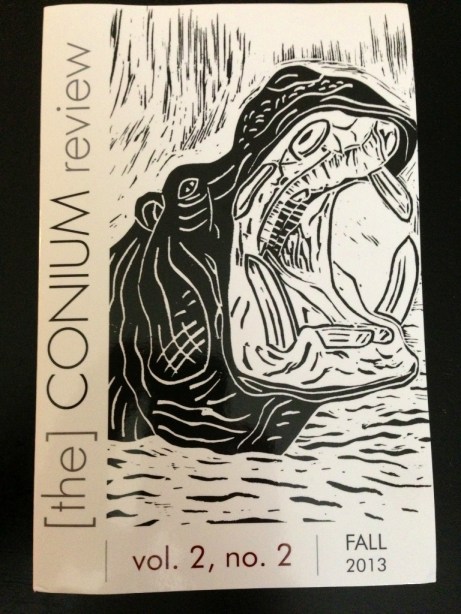
The Conium Review, Vol. 2, No. 2 (Book Acquired, 8,19.2013)

20130824-102848.jpg

This came in the mail a few weeks ago; I read a few of the poems and flash fictions, but haven’t had made time for the stories or the novella. From the The Conium Review’s website:

This issue of The Conium Review contains seventeen poems, five pieces of flash fiction, four short stories, and one novella. The contributing poets and writers are Elena Botts, Valentina Cano, Paola Capó-García, Patrick Cole, Darren C. Demaree, Thomas Dodson, Edward A. Dougherty, Ginger Graziano, Alamgir Hashmi, Kyle Hemmings, Nicholas Kriefall, Connie A. Lopez-Hood, Carlo Matos, Gretchen McGill, Robert McGuill, Thomas Mundt, Catherine Owen, Natalie Peeterse, Richard King Perkins II, Octavio Quintanilla, Charles Rafferty, Scott Ragland, Jonathan H. Roberts, M. A. Schaffner, Jacob Schepers, Claude Clayton Smith, and Emily Strauss. The cover art is courtesy of Loren Kantor.


“Von Kempelen and His Discovery ” — Edgar Allan Poe

“Von Kempelen and His Discovery ” by Edgar Allan Poe

AFTER THE very minute and elaborate paper by Arago, to say nothing of the summary in ‘Silliman’s Journal,’ with the detailed statement just published by Lieutenant Maury, it will not be supposed, of course, that in offering a few hurried remarks in reference to Von Kempelen’s discovery, I have any design to look at the subject in a scientific point of view. My object is simply, in the first place, to say a few words of Von Kempelen himself (with whom, some years ago, I had the honor of a slight personal acquaintance), since every thing which concerns him must necessarily, at this moment, be of interest; and, in the second place, to look in a general way, and speculatively, at the results of the discovery.

It may be as well, however, to premise the cursory observations which I have to offer, by denying, very decidedly, what seems to be a general impression (gleaned, as usual in a case of this kind, from the newspapers), viz.: that this discovery, astounding as it unquestionably is, is unanticipated.

By reference to the ‘Diary of Sir Humphrey Davy’ (Cottle and Munroe, London, pp. 150), it will be seen at pp. 53 and 82, that this illustrious chemist had not only conceived the idea now in question, but had actually made no inconsiderable progress, experimentally, in the very identical analysis now so triumphantly brought to an issue by Von Kempelen, who although he makes not the slightest allusion to it, is, without doubt (I say it unhesitatingly, and can prove it, if required), indebted to the ‘Diary’ for at least the first hint of his own undertaking.

The paragraph from the ‘Courier and Enquirer,’ which is now going the rounds of the press, and which purports to claim the invention for a Mr. Kissam, of Brunswick, Maine, appears to me, I confess, a little apocryphal, for several reasons; although there is nothing either impossible or very improbable in the statement made. I need not go into details. My opinion of the paragraph is founded principally upon its manner. It does not look true. Persons who are narrating facts, are seldom so particular as Mr. Kissam seems to be, about day and date and precise location. Besides, if Mr. Kissam actually did come upon the discovery he says he did, at the period designated—nearly eight years ago—how happens it that he took no steps, on the instant, to reap the immense benefits which the merest bumpkin must have known would have resulted to him individually, if not to the world at large, from the discovery? It seems to me quite incredible that any man of common understanding could have discovered what Mr. Kissam says he did, and yet have subsequently acted so like a baby—so like an owl—as Mr. Kissam admits that he did. By-the-way, who is Mr. Kissam? and is not the whole paragraph in the ‘Courier and Enquirer’ a fabrication got up to ‘make a talk’? It must be confessed that it has an amazingly moon-hoaxy-air. Very little dependence is to be placed upon it, in my humble opinion; and if I were not well aware, from experience, how very easily men of science are mystified, on points out of their usual range of inquiry, I should be profoundly astonished at finding so eminent a chemist as Professor Draper, discussing Mr. Kissam’s (or is it Mr. Quizzem’s?) pretensions to the discovery, in so serious a tone. Continue reading ““Von Kempelen and His Discovery ” — Edgar Allan Poe” →

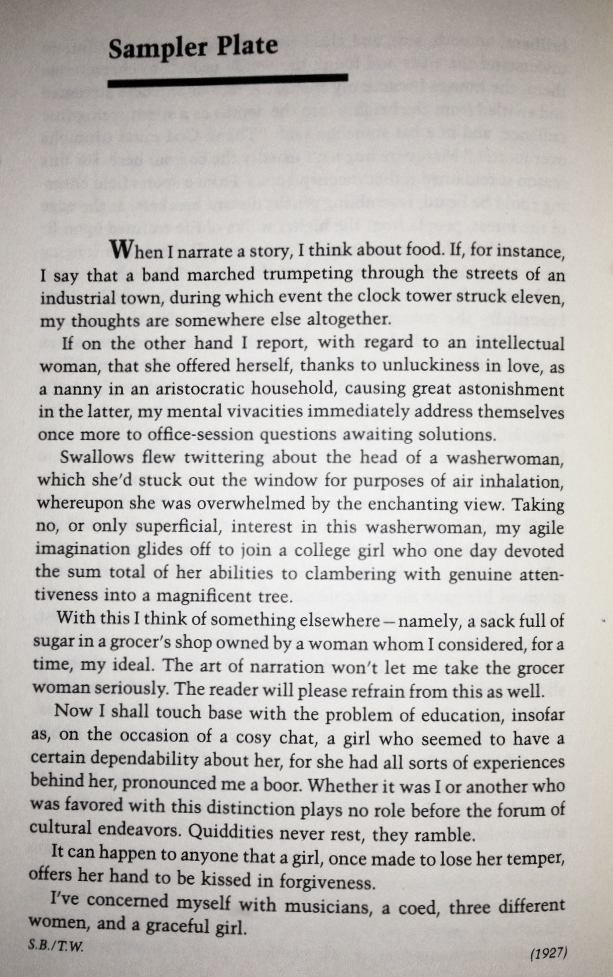
“Sampler Plate” — Robert Walser

sp

“Counterparts” — James Joyce

“Counterparts” by James Joyce

THE bell rang furiously and, when Miss Parker went to the tube, a furious voice called out in a piercing North of Ireland accent:

“Send Farrington here!”

Miss Parker returned to her machine, saying to a man who was writing at a desk:

“Mr. Alleyne wants you upstairs.”

The man muttered “Blast him!” under his breath and pushed back his chair to stand up. When he stood up he was tall and of great bulk. He had a hanging face, dark wine-coloured, with fair eyebrows and moustache: his eyes bulged forward slightly and the whites of them were dirty. He lifted up the counter and, passing by the clients, went out of the office with a heavy step.

He went heavily upstairs until he came to the second landing, where a door bore a brass plate with the inscription Mr. Alleyne. Here he halted, puffing with labour and vexation, and knocked. The shrill voice cried:

“Come in!”

The man entered Mr. Alleyne’s room. Simultaneously Mr. Alleyne, a little man wearing gold-rimmed glasses on a cleanshaven face, shot his head up over a pile of documents. The head itself was so pink and hairless it seemed like a large egg reposing on the papers. Mr. Alleyne did not lose a moment:

“Farrington? What is the meaning of this? Why have I always to complain of you? May I ask you why you haven’t made a copy of that contract between Bodley and Kirwan? I told you it must be ready by four o’clock.”

“But Mr. Shelley said, sir——”

“Mr. Shelley said, sir…. Kindly attend to what I say and not to what Mr. Shelley says, sir. You have always some excuse or another for shirking work. Let me tell you that if the contract is not copied before this evening I’ll lay the matter before Mr. Crosbie…. Do you hear me now?”

“Yes, sir.”

“Do you hear me now?… Ay and another little matter! I might as well be talking to the wall as talking to you. Understand once for all that you get a half an hour for your lunch and not an hour and a half. How many courses do you want, I’d like to know…. Do you mind me now?” Continue reading ““Counterparts” — James Joyce” →

Airships, Barry Hannah’s Cult Classic of Violent Humor

In his 1978 collection Airships, Barry Hannah sets stories in disparate milieux, from the northern front of the Civil War, to an apocalyptic future, to the Vietnam War, to strange pockets of the late-twentieth century South. Despite the shifts in time and place, Airships is one of those collections of short stories that feels somehow like an elliptical, fragmentary novel. There are the stories that correspond directly to each other — the opener “Water Liars,” for instance, features (presumably, anyway), the same group of old men as “All the Old Harkening Faces at the Rail.” The old men love to crony up, gossip, tell tall tales. An outsider spoils the fun in “Water Liars” by telling a truth more terrible than any lie; in “Harkening,” an old man shows off his new (much younger) bride. These stories are perhaps the simplest in the collection, the homiest, anyway, or at least the most “normal” (whatever that means), yet they are both girded by a strange darkness, both humorous and violent, that informs all of Airships.

We find that humor and violence in an outstanding trio of Civil War stories (or, more accurately, stories set during the Civil War). The narrator of “Dragged Fighting from His Tomb,” a Confederate infantryman relates a tale of heroic slaughter with a hypberbolic, phallic force. Observe—

I knew the blueboys thought they had me down and were about ready to come in. I was in that position at Chancelorsville. There should be about six fools, I thought. I made the repeater, I killed four, and the other two limped off. Some histrionic plumehead was raising his saber up and down on the top of a pyramid of crossties. I shot him just for fun. Then I brought up another repeater and sprayed the yard.

Later, the narrator defects, switches to the Union, and claims he kills Jeb Stuart, a figure that towers over the Civil War tales. The narrator of “Dragged Fighting” hates Stuart; the narrator of “Knowing He Was Not My Kind Yet I Followed” is literally in love with the General. In contrast to the narrator of “Dragged Fighting,” the speaker in “Knowing” — an avowed “sissy” whom the other soldiers openly detest — hates the violence and madness of war—

We’re too far from home. We are not defending our beloved Dixie anymore. We’re just bandits and maniacal. The gleam in the men’s eyes tells this. Everyone is getting crazier on the craziness of being simply too far from home for decent return. It is like Ruth in the alien corn, or a troop of men given wings over the terrain they cherished and taken by the wind to trees they do not know.

He despairs when he learns of Jeb Stuart’s death. In the final Civil War story, “Behold the Husband in His Perfect Agony,” a Union spy is given the task to communicate news of Stuart’s death through enemy lines. Rather than offering further explication, let me instead point you, dear reader, to more of Hannah’s beautiful prose, of which I have not remarked upon nearly enough. From “Behold the Husband” —

Isaacs False Corn, the Indian, the spy, saw Edison, the Negro, the contact, on the column of an inn. His coat was made of stitched newspapers. Near his bare feet, two dogs failed earnestly at mating. Pigeons snatched at the pieces of things in the rushing gutter. The rains had been hard.

The short, descriptive passage rests on my ears like a poem. Hannah, who worked with Gordon Lish, evinces in his writing again and again that great editor’s mantra that writing is putting one sentence after another.

Although set in the Vietnam War, “Midnight and I’m not Famous Yet” seems an extension of the Civil War stories. In it, an officer from a small Southern town goes slowly crazy from all the killing, yet, like the narrator of “Dragged Fighting,” he presents himself as a warrior. Above all though, he laments that the war has robbed him of some key, intermediary phase of his late youth, a phase he can’t even name—

The tears were out of my jaws then. Here we shot each other up. All we had going was the pursuit of horror. It seemed to me my life had gone straight from teen-age giggling to horror. I had never had time to be but two things, a giggler and a killer.

This ironic sense of a “pursuit of horror” pervades Airships, particularly in the collection’s most apocalyptic visions. “Eating Wife and Friends” posits an America where food shortages and material scarcity leads people to eating leaves and grass — and then each other. In “Escape to Newark,” the environment is wildly out of balance—

In August it’s a hundred fifty degrees. In December it’s minus twenty-five and three feet of snow in Mississippi. In April the big trees explode.

A plan is made to “escape” these conditions via a rocket, but of course there’s not enough fuel to get past Newark. In Airships, modes of flight are transcendent but ultimately transient. Gravity’s pull is heavy stuff.

Just as Hannah’s war stories are not really war stories, his apocalypse tales are really about human relationships, which he draws in humor, pathos, and dark cynicism. In “Green Gets It,” an old man repeatedly attempts his suicide, only to fail again and again. His suicide note, written to his daughter, is scathing and shocking and sad and hilarious and wise–

My Beloved Daughter,

Thanks to you for being one of the few who never blamed me for your petty, cheerless and malign personality. But perhaps you were too busy being awful to ever think of the cause. I hear you take self-defense classes now. Don’t you understand nobody could take anything from you without leaving you richer? If I thought rape would change you, I’d hire a randy cad myself. I leave a few dollars to your husband. Bother him about them and suffer the curse of this old pair of eyes spying blind at the minnows in the Hudson.

Your Dad,

Crabfood

Although Hannah explores the darkest gaps of the soul in Airships, he also finds there a shining kernel of love in the face of waste, depravity, violence, and indifference. This love evinces most strongly perhaps in Airships trio of long stories. These tales, which hover around 30 pages, feel positively epic set against the other stories in the collection, which tend to clock in between five and ten pages. The first long story, “Testimony of Pilot,” details the development of a boyhood friendship over a few decades. It captures the strange affections and rivalries and unnameable bonds and distances that connect and disconnect any two close friends. The second of the long tales is “Return to Return,” a tragicomic Southern drama in the Oedipal vein (with plenty of tennis and alcoholism to boot). As in “Testimony of Pilot,” Hannah finds some measure of redemption, or at least solace, for his characters in their loving friendship, yet nothing could be more unsentimental. The final long story, which closes the collection, is “Mother Rooney Unscrolls the Hurt,” a daring work of stream of consciousness that seems to both respond to — and revise — Katherine Anne Porter’s “The Jilting of Granny Weatherall.” The story concludes (and of course concludes the volume) with a vision of love that corresponds to the imagery of The Pietà, a kind of selflessness that ironically confirms the self as an entity that exists in relation to the pain of others.

I could keep writing of course — I’ve barely touched on Hannah’s surrealism, a comic weirdness that I’ve never seen elsewhere; it is Hannahesque, I suppose. Nor have I detailed Hannah’s evocations of regular working class folk, fighting and drinking and divorcing and raising children (not necessarily in that order). Airships is a world too rich and fertile to unpack in just one review, and I’ve already been blathering too long, I fear, when what I really want  to do is just outright implore you, kind reader, to find it and start reading it immediately. Very highly recommended.

[Editorial note: Biblioklept published a version of this review on March 20th, 2011]

“The Romance of an Ugly Policeman” — P.G. Wodehouse

“The Romance of an Ugly Policeman” by P.G. Wodehouse

Crossing the Thames by Chelsea Bridge, the wanderer through London finds himself in pleasant Battersea. Rounding the Park, where the female of the species wanders with its young by the ornamental water where the wild-fowl are, he comes upon a vast road. One side of this is given up to Nature, the other to Intellect. On the right, green trees stretch into the middle distance; on the left, endless blocks of residential flats. It is Battersea Park Road, the home of the cliff-dwellers.

Police-constable Plimmer’s beat embraced the first quarter of a mile of the cliffs. It was his duty to pace in the measured fashion of the London policeman along the front of them, turn to the right, turn to the left, and come back along the road which ran behind them. In this way he was enabled to keep the king’s peace over no fewer than four blocks of mansions.

It did not require a deal of keeping. Battersea may have its tough citizens, but they do not live in Battersea Park Road. Battersea Park Road’s speciality is Brain, not Crime. Authors, musicians, newspaper men, actors, and artists are the inhabitants of these mansions. A child could control them. They assault and batter nothing but pianos; they steal nothing but ideas; they murder nobody except Chopin and Beethoven. Not through these shall an ambitious young constable achieve promotion.

At this conclusion Edward Plimmer arrived within forty-eight hours of his installation. He recognized the flats for what they were—just so many layers of big-brained blamelessness. And there was not even the chance of a burglary. No burglar wastes his time burgling authors. Constable Plimmer reconciled his mind to the fact that his term in Battersea must be looked on as something in the nature of a vacation.

Continue reading ““The Romance of an Ugly Policeman” — P.G. Wodehouse” →

“The Ambitious Guest” — Nathaniel Hawthorne

“The Ambitious Guest” by Nathaniel Hawthorne

One September night a family had gathered round their hearth and piled it high with the driftwood of mountain-streams, the dry cones of the pine, and the splintered ruins of great trees that had come crashing down the precipice. Up the chimney roared the fire, and brightened the room with its broad blaze. The faces of the father and mother had a sober gladness; the children laughed. The eldest daughter was the image of Happiness at seventeen, and the aged grandmother, who sat knitting in the warmest place, was the image of Happiness grown old. They had found the “herb heart’s-ease” in the bleakest spot of all New England. This family were situated in the Notch of the White Hills, where the wind was sharp throughout the year and pitilessly cold in the winter, giving their cottage all its fresh inclemency before it descended on the valley of the Saco. They dwelt in a cold spot and a dangerous one, for a mountain towered above their heads so steep that the stones would often rumble down its sides and startle them at midnight.

The daughter had just uttered some simple jest that filled them all with mirth, when the wind came through the Notch and seemed to pause before their cottage, rattling the door with a sound of wailing and lamentation before it passed into the valley. For a moment it saddened them, though there was nothing unusual in the tones. But the family were glad again when they perceived that the latch was lifted by some traveller whose footsteps had been unheard amid the dreary blast which heralded his approach and wailed as he was entering and went moaning away from the door.

Though they dwelt in such a solitude, these people held daily converse with the world. The romantic pass of the Notch is a great artery through which the life-blood of internal commerce is continually throbbing between Maine on one side and the Green Mountains and the shores of the St. Lawrence on the other. The stage-coach always drew up before the door of the cottage. The wayfarer with no companion but his staff paused here to exchange a word, that the sense of loneliness might not utterly overcome him ere he could pass through the cleft of the mountain or reach the first house in the valley. And here the teamster on his way to Portland market would put up for the night, and, if a bachelor, might sit an hour beyond the usual bedtime and steal a kiss from the mountain-maid at parting. It was one of those primitive taverns where the traveller pays only for food and lodging, but meets with a homely kindness beyond all price. When the footsteps were heard, therefore, between the outer door and the inner one, the whole family rose up, grandmother, children and all, as if about to welcome some one who belonged to them, and whose fate was linked with theirs. Continue reading ““The Ambitious Guest” — Nathaniel Hawthorne” →

“Je t’adore” — Robert Walser

rw