“Getting Closer” — Steven Millhauser

The New Yorker publishes Steven Millhauser’s “Getting Closer.” First paragraph–

He’s nine going on ten, skinny-tall, shoulder blades pushing out like things inside a paper bag, new blue bathing suit too tight here, too loose there, but what’s all that got to do with anything? What’s important is that he’s here, standing by the picnic table, the sun shining on the river, the smell of pine needles and river water sharp in the air, somewhere a shout, laughter, music from a radio. His father’s cleaning ashes out of the grill, his mother and sister are laying down blankets on the sunny grass not far from the table, Grandma’s carrying one of the aluminum folding chairs toward the high pine near the edge of the drop to the river, and he’s doing what he likes to do best, what he’s really good at: standing around doing nothing. Everyone’s forgotten about him for a few seconds, the way it happens sometimes. You try not to remind anybody you’re there. He loves this place. On the table’s the fat thermos jug with the white spout near the bottom. After his swim he’ll push the button on the spout and fill up a paper cup with pink lemonade. It’s a good sound: fsshhpsshh. In the picnic basket he can see two packages of hot dogs, jars of relish and mustard, some bun ends showing, a box of Oreo cookies, a bag of marshmallows which are marshmellows so why the “a,” paper plates sticking up sideways, a brown folded-over paper bag of maybe cherries. All week long he’s looked forward to this day. Nothing’s better than setting off on an all-day outing, in summer, to the park by the river—the familiar houses and vacant lots no longer sitting there with nothing to do but drifting toward you through the car window, the heat of the sun-warmed seat burning you through your jeans, the bottoms of your feet already feeling the pebbly ground pushing up on them as you walk from the parking lot to the picnic grounds above the riverbank. But now he’s here, right here, his jeans tossed in the back seat of the car and his T-shirt stuffed into his mother’s straw bag, the sun on one edge of the table and the piney shade covering the rest of it, Grandma already setting up the chair. And so the day’s about to get going at last, the day he’s been looking forward to in the hot nights while watching bars of light slide across his wall from passing cars, he’s here, he’s arrived, he’s ready to begin.

“Welcome” — Deb Olin Unferth

“Welcome,” a short story by Deb Olin Unferth, published in Vice’s annual fiction issue. A sample–

I finally figured it out and I said it: You want me to leave?

I said this because I did have small evidences. The day before they had gotten a little meaner, one of them especially, the bigger one, the one who had earlier been my champion. But I didn’t understand. I had been having such a nice time. I was bewildered. Why did they suddenly not love me?

And then the next morning it happened again. The big one had a mean look on his face. The other figured she didn’t need to have an ugly look on her face because the big one was taking care of it, so she could just stand to the side and look on, bemused. But I was so stupid, I still didn’t understand. I looked at the littler one as if to say, Why is he acting this way?

“Idea for a Short Documentary Film” — Lydia Davis

“Idea for a Short Documentary Film,” a very short story by Lydia Davis, from The Collected Stories of Lydia Davis

Representatives of different food products manufacturers try to open their own packaging.

“Escape from Spiderhead” — George Saunders

The New Yorker has published a new George Saunders short story,“Escape from Spiderhead.” Read it here. A sample–

“Drip on?” Abnesti said over the P.A.

“What’s in it?” I said.

“Hilarious,” he said.

“Acknowledge,” I said.

Abnesti used his remote. My MobiPak™ whirred. Soon the Interior Garden looked really nice. Everything seemed super-clear.

I said out loud, as I was supposed to, what I was feeling.

“Garden looks nice,” I said. “Super-clear.”

Abnesti said, “Jeff, how about we pep up those language centers?”

“Sure,” I said.

“Drip on?” he said.

“Acknowledge,” I said.

He added some Verbaluce™ to the drip, and soon I was feeling the same things but saying them better. The garden still looked nice. It was like the bushes were so tight-seeming and the sun made everything stand out? It was like any moment you expected some Victorians to wander in with their cups of tea. It was as if the garden had become a sort of embodiment of the domestic dreams forever intrinsic to human consciousness. It was as if I could suddenly discern, in this contemporary vignette, the ancient corollary through which Plato and some of his contemporaries might have strolled; to wit, I was sensing the eternal in the ephemeral.

I sat, pleasantly engaged in these thoughts, until the Verbaluce™ began to wane. At which point the garden just looked nice again. It was something about the bushes and whatnot? It made you just want to lay out there and catch rays and think your happy thoughts. If you get what I mean.

Then whatever else was in the drip wore off, and I didn’t feel much about the garden one way or the other. My mouth was dry, though, and my gut had that post-Verbaluce™ feel to it.

“What’s going to be cool about that one?” Abnesti said. “Is, say a guy has to stay up late guarding a perimeter. Or is at school waiting for his kid and gets bored. But there’s some nature nearby? Or say a park ranger has to work a double shift?”

“That will be cool,” I said.

“That’s ED763,” he said. “We’re thinking of calling it NatuGlide. Or maybe ErthAdmire.”

“Those are both good,” I said.

“Thanks for your help, Jeff,” he said.

Which was what he always said.

“Only a million years to go,” I said.

Which was what I always said.

Then he said, “Exit the Interior Garden now, Jeff, head over to Small Workroom 2.”

“Honoring the Subjunctive” — Lydia Davis

“Honoring the Subjunctive,” a very short story by Lydia Davis, from The Collected Stories of Lydia Davis

It invariably precedes, even if it do not altogether supersede, the determination of what is absolutely desirable and just.

“Crash of ’69” — David Foster Wallace

“Crash of ’69” is a short story by David Foster Wallace. It was originally published in the New York-based literary quarterly Between C & D in winter of 1989. Between C & D published their journal on dot matrix paper and distributed it in plastic bags–not exactly the best way to preserve something.

CRASH OF ‘69 by David Foster Wallace

KARRIER

It’s great. I’m always wrong. It’s great.
Ask anybody except my agent if it’s great. He’ll be in checks and Weejuns, pointing binoculars at narrow horses hung with satin as they’re led toward their boxes. Mr. Diggs will say it’s great. He holds his racing form a certain way. He folds both sides together, to compare possibilities.
He’ll say So what about Rusty Hull in the Fourth, kid.
And I’ll say A winner, so sure a thing it’s almost boring, money in the account of our choice, Mr. Diggs.
He’ll put the forms side by side and feel the square of hair on his chin and say So then what about Siberian Saber-Toothed Crotch-Cricket, Karrier? Does Siberian Saber-Toothed Crotch- Cricket have a chance here in the Fourth?
I’ll say Mr. Diggs sir, no way. As in no chance. As in I feel in my chest, bowels the absence of even one slim snowball’s chance for Siberian Saber-Toothed Crotch-Cricket.
The form trembles a certain way in his hands as he trains the glasses on a certain horse, from here a tiny hull atop legs.
But are you sure Karrier.
I feel it, Mr. D. It’s that feeling, with the tight hide and velvet lips. That no-way certainty.

THE WOMAN WHO’S GOING TO BE HIS LOVER

I’ll take Father’s arm and we’ll take our constitutional together through the dawning halls of the Federal Reserve, to the sound of the click of my heels and the squeak of his chair, as the fire in the East window yellows. He says We can’t live like this, child. A whole nation has lost the cool side of the pillow. First thing every morning I taste in my mouth the human potential for evil.

His neck’s slow tic sends his head around over his shoulder. It has ceased to be great. The only brilliance he sees is over his shoulder, now.

Continue reading ““Crash of ’69” — David Foster Wallace”

The Collected Stories of Lydia Davis

The Collected Stories of Lydia Davis compiles all 198 of Davis’s short stories in one handsome volume. That’s all four of Davis’s exceptional short story collections: Break It Down, Varieties of Disturbance, Samuel Johnson Is Indignant, and Almost No Memory. FS&G debuted the hardback edition a year ago, and this month Picador offers up a lovely (and more affordable) trade paperback version; it sports deckle edge pages and French flaps, and runs over 700 pages.

I front-load my review with this data to make it obvious that, if you have any interest in Lydia Davis, this is a book to pick up. It’s a wonderful collection, a tidy brick of words that begs for immersion, the kind of book you float around in, flipping pages at random to find and enjoy yet another strange little gem. Go get it.

If you’re not sure why you should be interested in Davis, read on.

Most of Davis’s stories are very short; many are just a paragraph or two, and some a mere sentence in length. They are not stories in the traditional sense: don’t look for sweeping character development or grand plot arcs. These stories thrive rather on tone, a keen sense of inspection, perception, and mood, and an intensity of observation on matters large and small. They are tales, fables, riffs, annotations, skits, jokes, japes, anecdotes, journals, thought experiments, epigrams, half-poems, and would-be aphorisms.

“In a House Besieged,” from her first collection Break It Down (1986) reveals much about the Davis program. Here it is in full–

In a house besieged lived a man and a woman. From where they cowered in the kitchen the man and woman heard small explosions. “The wind,” said the woman. “Hunters,” said the man. “The rain,” said the woman. “The army,” said the man. The woman wanted to go home, but she was already home, there in the middle of the country in a house besieged.

“In a House Besieged” illustrates a number of the themes and motifs that run throughout Davis’s oeuvre: unnamed protagonists identified only as “the man” and “the woman” (later stories might call them “the husband” and “the wife”) who are at once allegorical placeholders and at the same time singular individuals; a domestic setting (with family members as protagonists); an unknowable and perhaps unidentifiable threat; a pervasive sense of alienation balanced by an ironic sense of humor. The story’s brevity also shows that, from the outset of her publishing career, Davis was already working toward something wholly different from the Carveresque stories that dominated MFA fiction in the 80s.

The domestic settings of Break It Down–spaces often haunted by mothers and fathers–rear up again and again throughout the collection. 1997’s Almost No Memory kicks off with “Meat, My Husband,” a story about a wife who is trying to get her husband to eat healthier–a difficult prospect considering his affection for beef. The tale should be utterly banal, but instead it is humorous and even oddly moving; the wife, who narrates the piece, concludes by realizing that her husband would really just prefer to cook for himself. The insight transcends the particular domestic scenario: it seems applicable to the reader’s own life (or to this reader’s, anyway). “How He Is Often Right,” also from the same collection, is a short paragraph where the narrator concludes that the titular “he” is often wrong, “but wrong for circumstances different from the circumstances as they actually were, while [his decision] was right for circumstances I clearly did not understand.” The story captures the way that we impart great meaning to the smallest arguments, dwelling on them, connecting them to our sense of identity. We see the same analysis at work in “The Outing” (also from Almost No Memory). In full–

An outburst of anger near the road, a refusal to speak on the path, a silence in the pine woods, a silence across the old railroad bridge, an attempt to be friendly in the water, a refusal to end the argument on the flat stones, a cry of anger on the steep bank of dirt, a weeping among the bushes.

Davis’s sentence might be telescopic, but it also, paradoxically, puts the relationship in the story under a microscope. The reader can fill in the gaps with his or her own background: we’ve all experienced this anger, this silence, this refusal. We’ve been there. The story is real. It’s true.

The truth of Davis’s stories is what unites them; it’s the reader’s recognition of their truth that makes them so pleasurable. Take “Boring Friends” from 2001’s Samuel Johnson Is Indignant (again, in full)–

We know only four boring people. The rest of our friends we find interesting. However, most of the friends we find interesting find us boring: the most interesting find us the most boring. The few who are somewhere in the middle, with whom there is reciprocal interest, we distrust: at any moment, we feel, they may become too interesting for us, or we too interesting for them.

Davis’s treatment on friendship consistently penetrates facades, exposes our competitive cores, and, at the same time, celebrates the joys we might take in others. This precarious line also evinces in Davis’s stories about taking care of young children. The short scene “Child Care” focuses on a grumpy father who’d rather watch TV than take his turn with the baby. Solution: “Together they watch The Odd Couple.” And perhaps it is because I have two young children, but I can’t recall a more accurate depiction of the simultaneous wonder and boredom of taking care of a new baby than “What You Learn About the Baby” (a lengthy treatise at six pages).

Not all of Davis’s stories focus on family and friends. There’s much here about academia: troubles with translation, grappling with tenure, the perils of teaching, and so on. There are at least three entries on grammar here. If not all readers can connect with these stories (although I certainly did), they need not worry–part of the joy of the book is its diversity. If a story doesn’t catch right away, flick to the next one, or one a hundred pages down the line. Perhaps you will alight on one of the collection’s imaginative historical biographies, like “Kafka Cooks Dinner” or “Marie Curie, So Honorable Woman,” positively epic at 18 pages. Davis’s histories fascinate; they seem utterly real and true and absurd and improbable, all at the same time.

Indeed, discursive movement is the core of Davis’s, but her digressions all point to a thematic analysis of truth, of an individual’s attempt to understand the world in terms other than the individual herself. They dwell on problems of self-consciousness, often employing literary distortion as an analytical tool. Davis’s literary distortions always point to a concrete reality, a livable, experiential reality; the fact that we should experience the real as surreal or absurd only makes her work more truthful.

It would be easy to park Davis with the postmodernist counter-tradition, but I think her work looks to something else, something post-postmodernist (I write this, I know, at the risk of falling into an abyssal loop).  Davis’s work presages contemporary “flash fiction”; her stories’ brevity reflect the simultaneous contraction of our attention spans and the expansion of our diverse interests. Her story “Samuel Johnson Is Indignant:” reads like a Facebook update. Here it is in full — “that Scotland has so few trees.” Davis transmutes an amusing annotation into a story that somehow brings the great critic back to life. The title of the story is also the title of the book; what follows then is a kind of meta-joke on reader expectations, subverting our expectations of Dr. Johnson’s (supposed) meta-commentary on the book-proper. But I fear I’m headed into a lit-crit navel-gazing snoozefest (in what has already been a long review). Far better to wrap things up, I think, by simply noting again how joyful it is to move through the book, to open at random and read. Very highly recommended.

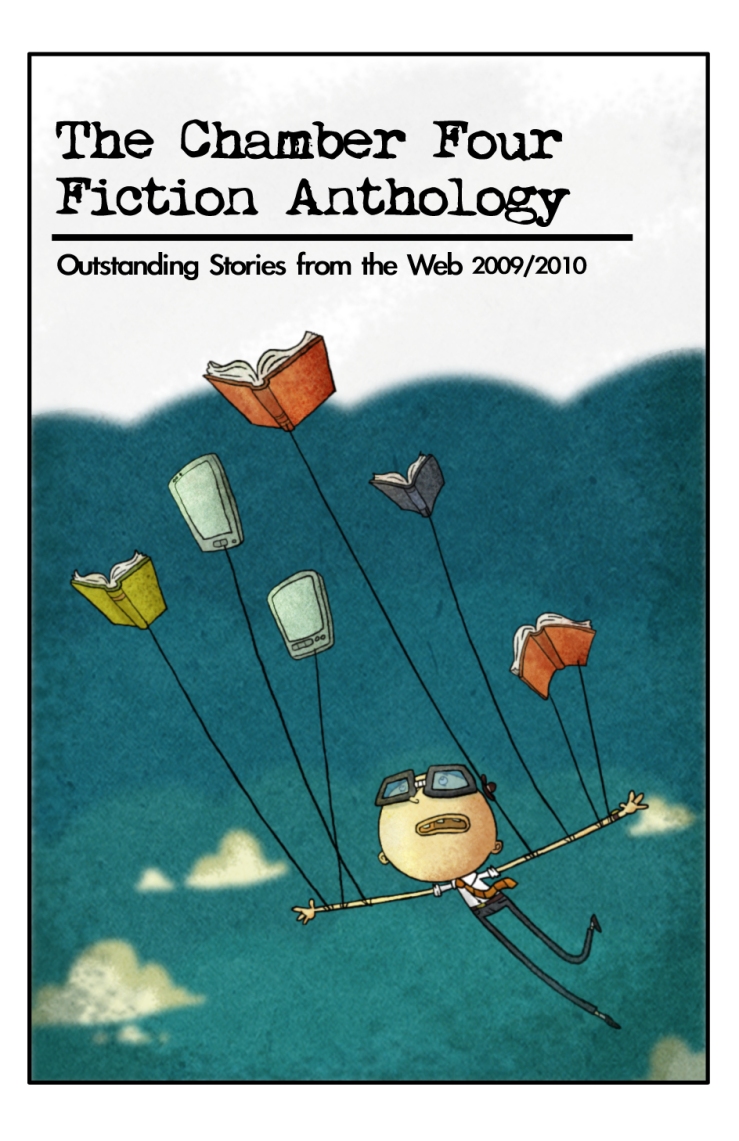
Download The Chamber Four Fiction Anthology

Download The Chamber Four Fiction Anthology. From their website–

This anthology contains 25 of the best short stories published on the web in 2009 and 2010 as chosen by the editors of ChamberFour.com, a website dedicated to making reading more enjoyable and more rewarding.

In this collection, you’ll find traditional, Carver-esque stories alongside magical realist tales of teleportation, long pieces that slowly pull you in, and single-page punches to the solar plexus. Some of these authors you’ve heard of, others you’ll be discovering for the first time, and you can be sure you’ll see them all again.

There is no factor that unifies the pieces collected here beyond their availability online and that hard-to-define but unmistakable hallmark of quality. These stories are as diverse and as wide in scope as the Internet, but each is true to their shared subject: the attempt to reconcile our world to the struggles of the human soul.

This anthology is DRM-free and free to download. Anybody charging for it is ripping you off.

“The Warm Fuzzies” — Chris Adrian

Read Biblioklept favorite Chris Adrian’s story “The Warm Fuzzies” at The New Yorker. Excerpt–

There was a time when they had been just the Carters, and not the Carter Family Band, but Molly could barely remember it. There was a time when her father had been a full-time instead of a part-time dentist, and her mother had been the dental hygienist in his office, when they had all gone to regular school instead of home school, when the family car had been a Taurus instead of a short bus, and when Melissa hadn’t even been born. Then her parents woke up one morning—without having seen a vision or having experienced a dark night of the soul—with a new understanding of their lives’ purpose. They both took up the guitar, never having played before, and started to praise Jesus in song.

There was a time, too, before they made albums or went on tours or appeared in Handycam videos produced and directed by their Aunt Jean, which aired (rather late at night ) on the community cable channel and then, eventually, on Samaritan TV, when Molly liked being in the band, and liked being in the family. She had had Melissa’s job once, and had danced as enthusiastically as Melissa did now, and had felt the most extraordinary joy during every performance, whether it was a rehearsal in the garage or a school-auditorium concert in front of three hundred kids. Then one morning two months ago, she had woken up to find that the shine had gone off everything. It was a conversion as sudden as the one her parents had suffered. She had come to breakfast feeling unwell but not sick, and was puzzling over how it was different to feel like something was not right with you and yet feel sure you were in perfect health, but she didn’t know what her problem could be until she noticed how unattractive her father was. It wasn’t his old robe or his stained T-shirt or even how he talked with his mouth full of eggs; he wore those things every morning, and he always talked with his mouth full—it was just how he was. She kept staring at him all through breakfast, and finally he asked her if there was something on his face. “No, sir,” she said, and a little voice—the sort that you hear very clearly even though it doesn’t actually speak—said somewhere inside her, He’s got ugly all over his face.

“The Landlord” — New Fiction from Wells Tower

The New Yorker has published a new short story by Biblioklept fave Wells Tower. It’ called “The Landlord” and would have fit fine in Tower’s collection Everything Ravaged, Everything Burned. An excerpt from the story–

My daughter has come from Los Angeles to live with me. Rhoda is thirty-one, and she used to work in advertising, but now she’s a painter and a maker of other art that I’m not sure how to describe. Her field is bummers. Rhoda’s past exhibitions include leukemia-cluster art, floating-yuan art, water-rights art, and mental-health-funding-cuts art, which was piles of clothes painted bronze and rigged up with speakers that yelled. She has also made a lot of hand art and hair art. Eight years ago, shortly into her new career, while getting the hang of a radial-arm saw, Rhoda severed the index, middle, and ring fingers of her left hand. The surgeons reattached them, and Rhoda recovered nearly complete range of motion, but the shock of the injury caused some of her hair to fall out. She keeps her head shaved close now, a style that improves the plainness of face she inherited from me. Bald, she looks about fifteen years older than she is, but also terrifyingly smart and owlish, Lady Malcolm McDowell.

“Extreme Solitude” — New Fiction from Jeffrey Eugenides

“Extreme Solitude” — a new story from Jeffrey Eugenides at The New Yorker. Read the whole story here. Here’s an excerpt that might ring true to many an English major:

Madeleine had met Leonard in an upper-level semiotics seminar taught by a renegade from the English department. Michael Zipperstein had arrived at Brown thirty-two years earlier filled with zeal for the New Criticism. He’d inculcated the habits of close reading and biography-free interpretation into three generations of students before taking a Road to Damascus sabbatical, in Paris, in 1975, where he’d met Roland Barthes at a dinner party and been converted, over duck cassoulet, to the new faith. Now Zipperstein taught two courses in the newly created Program in Semiotic Studies: Introduction to Semiotic Theory, in the fall, and, in the spring, Semiotics 211. Hygienically bald, with a seaman’s mustacheless white beard, Zipperstein favored French fisherman’s sweaters and wide-wale corduroys. He buried people with his reading lists: in addition to all the semiotic big hitters––Derrida, Eco, Barthes––the students in Semiotics 211 had to contend with a magpie nest of reserve reading that included everything from Balzac’s “Sarrasine” to issues of Semiotext(e) to xeroxed selections from E. M. Cioran, Robert Walser, Claude Lévi-Strauss, Peter Handke, and Carl Van Vechten. To get into the seminar, you had to submit to a one-on-one interview with Zipperstein during which he asked bland personal questions, such as what your favorite food or dog breed was, and made enigmatic Warholian remarks in response. This esoteric probing, along with Zipperstein’s guru’s dome and beard, gave his students a sense that they’d been spiritually vetted and were now—for two hours Wednesday afternoons, at least––part of a campus lit-crit élite.

Almost overnight it became laughable to read writers like Cheever or Updike, who wrote about the suburbia Madeleine and most of her friends had grown up in, in favor of reading the Marquis de Sade, who wrote about anally deflowering virgins in eighteenth-century France. Madeleine had become an English major for the purest and dullest of reasons: because she loved to read. The university’s “British and American Literature Course Catalogue” was, for Madeleine, what its Bergdorf equivalent was for her roommates. A course listing like “English 274: Lyly’s Euphues” excited Madeleine the way a pair of Fiorucci cowboy boots did Abby. “English 450A: Hawthorne and James” filled Madeleine with an expectation of sinful hours in bed that was not unlike the sensation Olivia got from wearing a Lycra skirt and leather blazer to Danceteria. Right up through her third year of college, Madeleine had kept wholesomely taking courses like “Victorian Fantasy: From ‘Phantastes’ to ‘The Water-Babies,’ ” but by senior year she could no longer ignore the contrast between the blinky people in her Beowulf seminar and the hipsters down the hall reading Maurice Blanchot. Going to college in the moneymaking eighties lacked a certain radicalism. Semiotics was the first thing that smacked of revolution. It drew a line; it created an elect; it was sophisticated and Continental; it dealt with provocative subjects, with torture, sadism, hermaphroditism––with sex and power.

“Prefiguration of Lalo Cura” — Roberto Bolaño

The New Yorker has published another short story by Roberto Bolaño. It’s called “Prefiguration of Lalo Cura” and it backgrounds a character from 2666, Olegario Cura Exposito (page 384, if you want to correlate things). The first paragraph:

It’s hard to believe, but I was born in a neighborhood called Los Empalados: The Impaled. The name glows like the moon. The name opens a way through the dream with its horn, and man follows that path. A quaking path. Invariably harsh. The path that leads into or out of Hell. That’s what it all comes down to. Getting closer to Hell or farther away. Me, for example, I’ve had people killed. I’ve given the best birthday presents. I’ve backed projects of epic proportions. I’ve opened my eyes in the dark. Once, I opened them by slow degrees in total darkness, and all I saw or imagined was that name: Los Empalados, shining like the star of destiny

The Devil and Tom Walker and the Financial Crisis

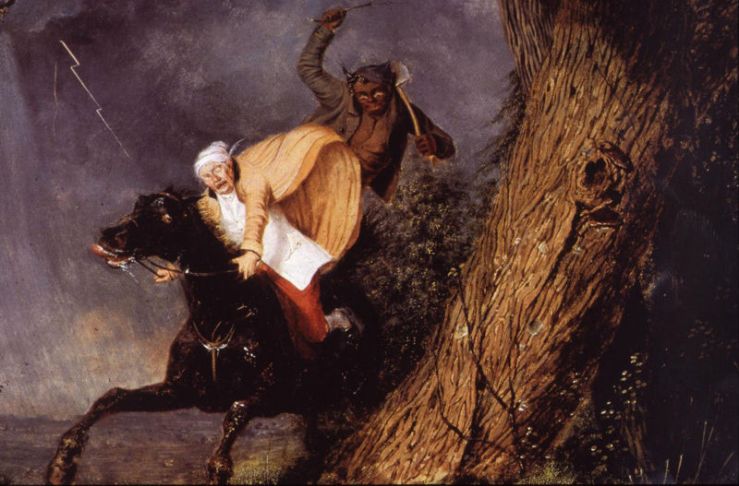
Washington Irving’s famous short story, “The Devil and Tom Walker,” seems as prescient and uncanny as ever in the lurid light of our recent financial woes:

Finding Tom so squeamish on this point, he did not insist upon it, but proposed instead that he should turn usurer; the devil being extremely anxious for the increase of usurers, looking upon them as his peculiar people.To this no objections were made, for it was just to Tom’s taste.“You shall open a broker’s shop in Boston next month,” said the black man.“I’ll do it to-morrow, if you wish,” said Tom Walker.“You shall lend money at two per cent. a month.”“Egad, I’ll charge four!” replied Tom Walker.“You shall extort bonds, foreclose mortgages, drive the merchant to bankruptcy—”“I’ll drive him to the d——l,” cried Tom Walker, eagerly.“You are the usurer for my money!” said the black legs, with delight. “When will you want the rhino?”“This very night.”“Done!” said the devil.“Done!” said Tom Walker. —So they shook hands, and struck a bargain.A few days’ time saw Tom Walker seated behind his desk in a counting house in Boston. His reputation for a ready moneyed man, who would lend money out for a good consideration, soon spread abroad. Every body remembers the days of Governor Belcher, when money was particularly scarce. It was a time of paper credit. The country had been deluged with government bills; the famous Land Bank had been established; there had been a rage for speculating; the people had run mad with schemes for new settlements; for building cities in the wilderness; land jobbers went about with maps of grants, and townships, and Eldorados, lying nobody knew where, but which every body was ready to purchase. In a word, the great speculating fever which breaks out every now and then in the country, had raged to an alarming degree, and every body was dreaming of making sudden fortunes from nothing. As usual the fever had subsided; the dream had gone off, and the imaginary fortunes with it; the patients were left in doleful plight, and the whole country resounded with the consequent cry of “hard times.”