Read a new Lydia Davis story, “How He Changed over Time”

“How He Changed over Time” is a new Lydia Davis story in the fall issue of VQR

Here are the first two paragraphs:

He used to play the violin, but then, as his fingers thickened and lost some of their agility, he became frustrated by trying to play, and then bored by it. He put the violin away in its case for good, had the case removed to a storeroom, and, instead, invited others in to play for him and his family in the evenings. In time, this playing by others, too, wearied him with its incessant sound and he no longer invited musicians into his home or willingly listened to any music, except, perhaps, at long intervals, from a distance, a patriotic march.

He used to provide what was needed in the way of food, equipment, and guides for parties of men to go off exploring. They would bring him not only reports of what they had seen but also handsome artifacts, such as feathered tribal headdresses and small handmade axes and other tools. These he would display in his roomy front hall, and visitors waiting for a private audience would pass the time studying the artifacts and learning about the indigenous tribes of the country. He had had exactly this in mind, to educate the public, when he directed that the artifacts be displayed thus on the walls and in cabinets. But then he tired of the artifacts and lost interest in what they signaled of other cultures, and no longer cared about educating the public. He had everything in the front hall taken off the walls and out of the house and sold to a museum. The bare walls, a relief to his eyes, were then to be painted gold. He no longer sent parties of men out to explore the wilderness, for he no longer had any interest in other landscapes or the wildlife or primitive peoples that inhabited them. Geography now confused him.

Read the rest of the “story” (really, it’s something closer to a poetic (and critical) essay on Thomas Jefferson). 

Donald Barthelme’s short-story contest

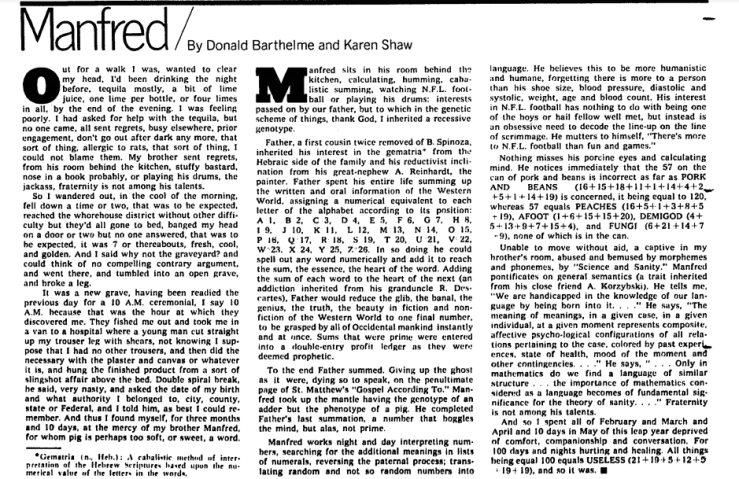
In 1976, Donald Barthelme oversaw a short-story contest in The New York Times. He wrote the first three paragraphs of an untitled story and asked readers “to provide the terrifying middle and the subtle, incomparably beautiful ending.” The winner, judged by Barthelme, was to receive a $250 prize and have their story published in the Times. That winner ended up being visual artist Karen Shaw, who applied an artistic process she termed “summantics” to the story.

The New York Times repeated the contest in 1996, this time with Nicholson Baker as the lead author.


Read “The Piano Player,” a very short story by Donald Barthelme

“The Piano Player”

by Donald Barthelme

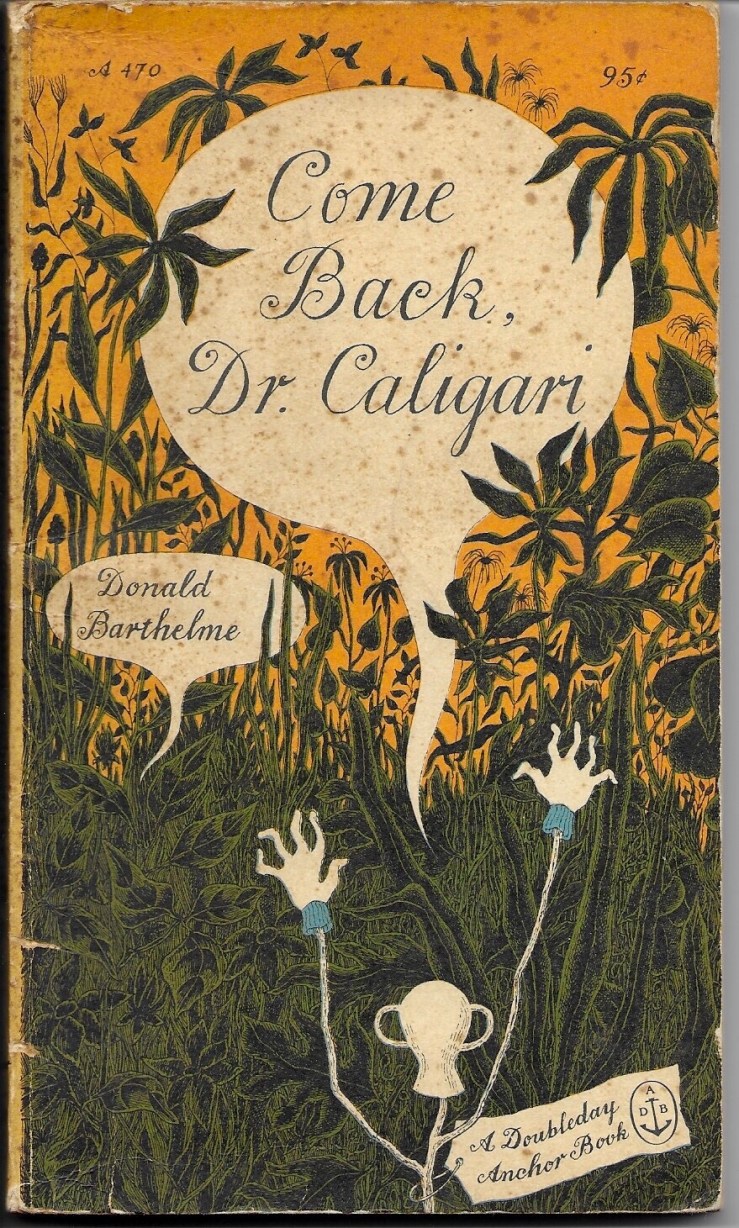
from Come Back, Dr. Caligari (1964)


Outside his window five-year-old Priscilla Hess, square and squat as a mailbox (red sweater, blue lumpy corduroy pants), looked around poignantly for someone to wipe her overflowing nose. There was a butterfly locked inside that mailbox, surely; would it ever escape? Or was the quality of mailboxes stuck to her forever, like her parents, like her name? The sky was sunny and blue. A filet of green Silly Putty disappeared into fat Priscilla Hess and he turned to greet his wife who was crawling through the door and her hands and knees.

“Yes?” he said. “What now?”

“I’m ugly,” she said, sitting back on her haunches. “Our children are ugly.”

“Nonsense,” Brian said sharply. “They’re wonderful children. Wonderful and beautiful. Other people’s children are ugly, not our children. Now get up and go back out to the smokeroom. You’re supposed to be curing a ham.”

“The ham died,” she said. “I couldn’t cure it. I tried everything. You don’t love me any more. The penicillin was stale. I’m ugly and so are the children. It said to tell you goodbye.”

“It?”

“The ham,” she said. “Is one of our children named Ambrose? Somebody named Ambrose has been sending us telegrams. How many do we have now? Four? Five? Do you think they’re heterosexual?”

She made a moue and ran a hand through her artichoke hair. “The house is rusting away. Why did you want a steel house? Why did I think I wanted to live in Connecticut? I don’t know.”

“Get up,” he said softly, “get up, dearly beloved. Stand up and sing. Sing Parsifal.”

“I want a Triumph,” she said from the floor. “A TR-4. Everyone in Stamford, every single person, has one but me. If you gave me a TR-4 I’d put our ugly children in it and drive away. To Wellfleet. I’d take all the ugliness out of your life.”

“A green one?”

“A red one,” she said menacingly. “Red with red leather seats.”

“Aren’t you supposed to be chipping paint?” he asked. “I bought us an electric data processing system. An IBM.”

“I want to go to Wellfleet,” she said. “I want to talk to

Edmund Wilson and take him for a ride in my red TR-4. The children can dig clams. We have a lot to talk about, Bunny and me.”

“Why don’t you remove those shoulder pads?” Brian said kindly. “It’s too bad about the ham.”

“I loved that ham,” she said viciously. “When you galloped into the University of Texas on your roan Volvo, I thought you were going to be somebody. I gave you my hand. You put rings on it. Rings that my mother gave me. I thought you were going to be distinguished, like Bunny.”

He showed her his broad, shouldered back. “Everything is in flitters,” he said. “Play the piano, won’t you?”

“You always were afraid of my piano, she said. “My four or five children are afraid of the piano. You taught them to be afraid of it. The giraffe is on fire, but I don’t suppose you care.”

“What can we eat,” he asked, “with the ham gone?”

“There’s some Silly Putty in the deepfreeze,” she said tonelessly.

“Rain is falling,” he observed. “Rain or something.”

“When you graduated from the Wharton School of Business,” she said, “I thought at last! I thought now we can move to Stamford and have interesting neighbors. But they’re not interesting. The giraffe is interesting but he sleeps so much of the time. The mailbox is rather interesting. The man didn’t open it at 3:31 P.M. today. He was five minutes late. The government lied again.”

With a gesture of impatience, Brian turned on the light. The great burst of electricity illuminated her upturned tiny face. Eyes like snow peas, he thought. Tamar dancing. My name in the dictionary, in the back. The Law of Bilateral Good Fortune. Piano bread perhaps. A nibble of pain running through the Western World. Coriolanus.

“Oh God,” she said, from the floor. “Look at my knees.”

Brian looked. Her knees were blushing.

“It’s senseless, senseless,” she said. “I’ve been caulking the medicine chest. What for? I don’t know. You’ve got to give me more money. Ben is bleeding. Bessie wants to be an S.S. man. She’s reading The Rise and Fall. She’s identified with Himmler. Is that her name? Bessie?”

“Yes. Bessie.”

“What’s the other one’s name? The blond one?”

“Billy. Named after your father. Your Dad.”

“You’ve got to get me an air hammer. To clean the children’s teeth. What’s the name of that disease? They’ll all have it, every single one, if you don’t get me an air hammer.”

“And a compressor,” Brian said. “And a Pinetop Smith record. I remember.”

She lay on her back. The shoulder pads clattered against the terrazzo. Her number, 17, was written large on her chest. Her eyes were screwed tight shut. “Altman’s is having a sale,” she said, “Maybe
I should go in.”

“Listen,” he said. “Get up. Go into the grape arbor. I’ll trundle the piano out there. You’ve been chipping too much paint. ”

“You wouldn’t touch that piano,” she said. “Not in a million years.”

“You really think I’m afraid of it?”

“Not in a million years,” she said, “you phoney.”

“All right,” Brian said quietly. “All right.” He strode over to the piano. He took a good grip on its black varnishedness. He began to trundle it across the room, and, after a slight hesitation, it struck him dead.

Read “Piper in the Woods,” Philip K. Dick’s early short story about men turning into plants

“Piper in the Woods”

by

Philip K. Dick

First published in Imagination: Stories of Science and Fantasy, February 1953 and made available via Project Gutenberg.


“Well, Corporal Westerburg,” Doctor Henry Harris said gently, “just why do you think you’re a plant?”

As he spoke, Harris glanced down again at the card on his desk. It was from the Base Commander himself, made out in Cox’s heavy scrawl: Doc, this is the lad I told you about. Talk to him and try to find out how he got this delusion. He’s from the new Garrison, the new check-station on Asteroid Y-3, and we don’t want anything to go wrong there. Especially a silly damn thing like this!

Harris pushed the card aside and stared back up at the youth across the desk from him. The young man seemed ill at ease and appeared to be avoiding answering the question Harris had put to him. Harris frowned. Westerburg was a good-looking chap, actually handsome in his Patrol uniform, a shock of blond hair over one eye. He was tall, almost six feet, a fine healthy lad, just two years out of Training, according to the card. Born in Detroit. Had measles when he was nine. Interested in jet engines, tennis, and girls. Twenty-six years old.

“Well, Corporal Westerburg,” Doctor Harris said again. “Why do you think you’re a plant?”

The Corporal looked up shyly. He cleared his throat. “Sir, I am a plant, I don’t just think so. I’ve been a plant for several days, now.”

“I see.” The Doctor nodded. “You mean that you weren’t always a plant?”

“No, sir. I just became a plant recently.”

“And what were you before you became a plant?”

“Well, sir, I was just like the rest of you.”

There was silence. Doctor Harris took up his pen and scratched a few lines, but nothing of importance came. A plant? And such a healthy-looking lad! Harris removed his steel-rimmed glasses and polished them with his handkerchief. He put them on again and leaned back in his chair. “Care for a cigarette, Corporal?”

“No, sir.”

The Doctor lit one himself, resting his arm on the edge of the chair. “Corporal, you must realize that there are very few men who become plants, especially on such short notice. I have to admit you are the first person who has ever told me such a thing.”

“Yes, sir, I realize it’s quite rare.”

“You can understand why I’m interested, then. When you say you’re a plant, you mean you’re not capable of mobility? Or do you mean you’re a vegetable, as opposed to an animal? Or just what?”

The Corporal looked away. “I can’t tell you any more,” he murmured. “I’m sorry, sir.”

“Well, would you mind telling me how you became a plant?”

Corporal Westerburg hesitated. He stared down at the floor, then out the window at the spaceport, then at a fly on the desk. At last he stood up, getting slowly to his feet. “I can’t even tell you that, sir,” he said.

“You can’t? Why not?”

“Because—because I promised not to.”

Continue reading “Read “Piper in the Woods,” Philip K. Dick’s early short story about men turning into plants”

Read “Details of a Sunset,” a short story by Vladimir Nabokov

“Details of a Sunset”

by

Vladimir Nabokov


The last streetcar was disappearing in the mirrorlike murk of the street and, along the wire above it, a spark of Bengal light, crackling and quivering, sped into the distance like a blue star.

“Well, might as well just plod along, even though you are pretty drunk, Mark, pretty drunk….”

The spark went out. The roofs glistened in the moonlight, silvery angles broken by oblique black cracks.

Through this mirrory darkness he staggered home: Mark Standfuss, a salesclerk, a demigod, fair-haired Mark, a lucky fellow with a high starched collar. At the back of his neck, above the white line of that collar, his hair ended in a funny, boyish little tag that had escaped the barber’s scissors. That little tag was what made Klara fall in love with him, and she swore that it was true love, that she had quite forgotten the handsome ruined foreigner who last year had rented a room from her mother, Frau Heise.

“And yet, Mark, you’re drunk….”

That evening there had been beer and songs with friends in honor of Mark and russet-haired, pale Klara, and in a week they would be married; then there would be a lifetime of bliss and peace, and of nights with her, the red blaze of her hair spreading all over the pillow, and, in the morning, again her quiet laughter, the green dress, the coolness of her bare arms. Continue reading “Read “Details of a Sunset,” a short story by Vladimir Nabokov”

Read “The Wind Bloweth Where It Listeth,” a short story by Charles Portis

“The Wind Bloweth Where It Listeth”

by

Charles Portis


The Editors are spiking most of my copy now, unread. One has described it as “hopeless crap.” My master’s degree means nothing to this pack of half-wits at the Blade. My job is hanging by a thread. But Frankie, an assistant city editor, is not such a bad boss and it was she who, out of the blue, gave me this choice assignment. I was startled. A last chance to make good?

Frankie said, “Get some bright quotes for a change, okay? Or make some up. Not so much of your dreary exposition. Not so many clauses. Get to the point at once. And keep it short for a change, okay? Now, buzz on out to the new Pecking Center on Warehouse Road, near the Loopdale Cutoff. Scoot. Take the brown Gremlin. But check the water in the radiator!” Continue reading “Read “The Wind Bloweth Where It Listeth,” a short story by Charles Portis”

The Complete Short Stories of J.G. Ballard (Fourth Riff: Stories of 1962)

jgb_complete_ss400

PREVIOUSLY:

Introductions + stories 1956-1959

Stories of 1960

Stories of 1961

IN THIS RIFF:

Nine stories published in 1962:

“The Insane Ones”

“The Garden of Time”

“The Thousand Dreams of Stellavista”

“Thirteen to Centaurus”

“Passport to Eternity”

“The Cage of Sand”

“The Watch Towers”

“The Singing Statues”

“Man on the 99th Floor”

“The Insane Ones” (1962)

Psychology, and particularly subliminal psychology, remained a major theme throughout Ballard’s writing career. “The Insane Ones” is a thought-experiment that examines what might happen if libertarianism were taken to its most extreme:

The Mental Freedom legislation enacted ten years earlier by the ultraconservative UW government had banned the profession outright and enshrined the individual’s freedom to be insane if he wanted to, provided he paid the full civil consequences for any infringements of the law. That was the catch, the hidden object of the MF laws. What had begun as a popular reaction against ‘subliminal living’ and the uncontrolled extension of techniques of mass manipulation for political and economic ends had quickly developed into a systematic attack on the psychological sciences. Overpermissive courts of law with their condoning of delinquency, pseudo–enlightened penal reformers, ‘Victims of society’, the psychologist and his patient all came under fierce attack. Discharging their self–hate and anxiety onto a convenient scapegoat, the new rulers, and the great majority electing them, outlawed all forms of psychic control, from the innocent market survey to lobotomy. The mentally ill were on their own, spared pity and consideration, made to pay to the hilt for their failings. The sacred cow of the community was the psychotic, free to wander where he wanted, drooling on the doorsteps, sleeping on sidewalks, and woe betide anyone who tried to help him.

“The Insane Ones” isn’t a particularly good story—as is the case with many of the tales in The Complete Stories, it’s mostly an excuse to tease out a speculative notion—but its conceit of a lack of adequate health care set against the backdrop of reactionary politics seems particularly germane today. 

“The Garden of Time” (1962)

“The Garden of Time” is an oddity in Ballard’s oeuvre. Most of his short stories take cues from Edgar Allan Poe, but “The Garden of Time,” a direct allegory, is pure-Hawthorne territory, a dark fairy tale with fantasy tropes unusual for Ballard. Count Axel and his darling wife live in a perfect Edenic space that they maintain by picking flowers that “freeze” time. At the periphery, a mechanized mob approaches:

At first glance, the long ranks seemed to be progressing in orderly lines, but on closer inspection, it was apparent that, like the obscured detail of a Goya landscape, the army was composed of a vast throng of people, men and women, interspersed with a few soldiers in ragged uniforms, pressing forward in a disorganized tide. Some laboured under heavy loads suspended from crude yokes around their necks, others struggled with cumbersome wooden carts, their hands wrenching at the wheel spokes, a few trudged on alone, but all moved on at the same pace, bowed backs illuminated in the fleeting sun.

I’m not sure how to read the tale—it seems that Ballard identifies the horde, the mob, as a dumb, dim force of history, a consumer society that will destroy the last vestiges of High Culture embodied by the graceful Count and his wife, the aristocrats who understand Truth and Beauty and Art &c. I think there’s a streak of conservatism here, a tendency that we might not immediately think of when we think of Ballard the futurist.

 “The Thousand Dreams of Stellavista” (1962)

Another Vermilion Sands story, “Stellavista” takes on architecture. This is basically a haunted house story; the Ballardian trick here is the psychotropic house, dwellings that echo “every shift of mood and position of the occupants.” Young couple buys house, house is haunted, etc. The conceit is interesting, but again, Ballard’s not particularly inclined to write it in anything outside of a standard pulp fiction (or doesn’t seem to know how to yet).

Ballard’s treatment of his female characters is what I find most interesting here. As always, they seem to be divided into just a few classes: The wife, an unimaginative nag; the mysterious (and impossible to understand) ingenue; the mad, abandoned old woman (shades of Miss Havisham); and the abject, consuming Villain-Woman. Ballard often combines the last three types, but they are always set in opposition to the housewife. More on this in a moment.

“Thirteen to Centaurus” (1962)

“Thirteen to Centaurus” belongs in what I’ve been calling The Essential Short Stories of J.G. Ballard, a collection of the best stuff here. Each Ballard story is essentially a trick or a thought experiment—the tale is just a delivery system, a frame. Ballard here employs a metaframe; sure, the story is still composed in the tropes and language of pulp fiction, but Ballard shows signs of breaking out. In some ways, “Thirteen to Centaurus” is a rewrite of “Manhole 69” (which I also suggested is Essential). I haven’t described the plot and won’t—I think the story is probably better read without preview or explication.

“Passport to Eternity” (1962)

“Passport to Eternity” highlights Ballard’s greatest imaginative failure. This is a guy who can conceive of every kind of fantasy trip—extraterrestrial adventures, private-war-as-vacation, space safari (the occasion for the story here is a list of surreal vacations; the story would read much, much better as just that list). Yes, Ballard can conceive of any kind of future, except one where a woman is something other than a house wife:

For several centuries now the managerial and technocratic elite had been so preoccupied with the work of government that they relied on the Templars of Aphrodite not merely to guard their wives from any marauding suitors but also to keep them amused and contented. By definition, of course, their relationship was platonic, a pleasant revival of the old chivalrous ideals…

Even if Ballard is poking ironic fun here (and I don’t think that’s the case), his framing is aggressively chauvinistic; not only does the “managerial and technocratic elite” appear to exclude women, the underlying anxiety of cuckoldry manifests in a social structure that must manage (and contain) women’s passions and sexualities. There’s something aggressively misogynistic here, a streak that finds its twin in Ballard’s abjectification of women elsewhere in the stories (I wrote above that he only conceives women as house wives—not quite true—they can also be consuming monsters in the Ballardverse).

“The Cage of Sand” (1962)

Astronauts. Ecology. Etc. Pass.

“The Watch-Towers” (1962)

“The Watch Towers” is basically an extended riff on how churches institutionalize power and regulate behavior. Ballard’s trick here is to elide or omit any language that would directly evoke religion or spirituality though. The story also gets its power comes from its bare simplicity, its lack of ornamentation—one can sense Ballard’s restraint here. The story would likely be more successful stripped even further—something closer to Shirley Jackson’s “The Lottery,” which it echoes. There are also shades here of a particularly English brand of hauntology—The Prisoner and The Wicker Man come to mind.

 “The Singing Statues” (1962)

“The Singing Statues” feels like a rewrite of several of Ballard’s Vermilion Sands stories. I suppose collected together in their own volume, the Vermilion Sands tales might read like a novel-in-stories, a work through of central themes, images, and ideas—but dispersed in The Collected Stories they get swallowed. They read like repetitions. Stale.

“Man on the 99th Floor” (1962)

Ballard handles subliminal suggestion much better in the next tale, “The Subliminal Man.” So I’ll take a pass on this one in anticipation of one of Ballard’s best.

[Ed. note: Biblioklept originally ran a series of posts on The Complete Short Stories of J.G. Ballard between October 2013 and March 2014.]

“A Guide to Virtual Death” — J.G. Ballard

“A Guide to Virtual Death”

by

J.G. Ballard


For reasons amply documented elsewhere, intelligent life on earth became extinct in the closing hours of the 20th Century. Among the clues left to us, the following schedule of a day’s television programmes transmitted to an unnamed city in the northern hemisphere on December 23, 1999, offers its own intriguing insight into the origins of the disaster.

6.00 am Porno–Disco. Wake yourself up with his–and–her hard–core sex images played to a disco beat.

7.00 Weather Report. Today’s expected micro–climates in the city’s hotel atriums, shopping malls and office complexes. Hilton International promises an afternoon snow–shower as a Christmas appetiser.

7.15 News Round–up. What our news–makers have planned for you. Maybe a small war, a synthetic earthquake or a famine–zone! charity tie–in.

7.45 Breakfast Time. Gourmet meals to watch as you eat your diet cellulose.

8.30 Commuter Special. The rush–hour game–show. How many bottoms can you pinch, how many faces can you slap?

9.30 The Travel Show. Visit the world’s greatest airports and under ground car parks.

10.30 Home–makers of Yesterday. Nostalgic scenes of old–fashioned housework. No.7 – The Vacuum Cleaner.

11.00 Office War. Long–running serial of office gang–wars.

12.00 Newsflash. The networks promise either a new serial killer or a deadly food toxin.

1.00 pm Live from Parliament. No .12 – The Alcoholic MP.

1.30 The Nose–Pickers. Hygiene programme for the kiddies.

2.00 Caress Me. Soft–porn for the siesta hour.

2.30 Your Favourite Commericials. Popular demand re–runs of golden oldie TV ads.

3.00 Housewives’ Choice. Rape, and how to psychologically prepare yourself.

4.00 Count–down. Game show in which contestants count backwards from one million.

5.00 Newsflash. Either an airliner crash or a bank collapse. Viewers express preference.

6.00 Today’s Special. Virtual Reality TV presents ‘The Kennedy Assassination.’ The Virtual Reality head–set takes you to Dallas, Texas, on November 22, 1963. First you fire the assassin’s rifle from the Book Depository window, and then you sit between Jackie and JFK in the Presidential limo as the bullet strikes. For premium subscribers only – feel the Presidential brain tissue spatter your face OR wipe Jackie’s tears onto your handkerchief.

8.00 Dinner Time. More gourmet dishes to view with your evening diet–cellulose.

9.00 Science Now. Is there life after death? Micro–electrodes pick up ultra–faint impulses from long–dead brains. Relatives question the departed.

10.00 Crime–Watch. Will it be your home that is broken into tonight by the TV Crime Gang?

11.00 Today’s Special. Tele–Orgasm. Virtual Reality TV takes you to an orgy. Have sex with the world’s greatest movie–stars. Tonight: Marilyn Monroe and Madonna OR Warren Beatty and Tom Cruise. For premium subscribers only – experience transexualism, paedophiia, terminal syphilis, gang–rape, and bestiality (choice: German Shepherd or Golden Retriever).

1.00 am Newsflash. Tonight’s surprise air–crash.

2.00 The Religious Hour. Imagine being dead. Priests and neuroscientists construct a life–like mock–up of your death.

3.00 Night–Hunter. Will the TV Rapist come through your bedroom window?

4.15 Sex for Insomniacs. Soft porn to rock you to sleep.

5.00 The Charity Hour. Game show in which Third–World contestants beg for money.


Read “Carcassonne,” a short story by William Faulkner

“Carcassonne”

by

William Faulkner

And me on a buckskin pony with eyes like blue electricity and a mane like tangled fire, galloping up the hill and right off into the high heaven of the world. His skeleton lay still. Perhaps it was thinking about this.

Anyway, after a time it groaned. But it said nothing, which is certainly not like you he thought you are not like yourself, but I can’t say that a little quiet is not pleasant. He lay beneath an unrolled strip of tarred roofing made of paper. All of him that is, save that part which suffered neither insects nor temperature and which galloped unflagging on the destinationless pony, up a piled silver hill of cumulae where no hoof echoed nor left print, toward the blue precipice never gained. This part was neither flesh nor unflesh and he tingled a little pleasantly with its lackful contemplation as he lay beneath the tarred paper bedclothing.

So were the mechanics of sleeping, of denning up for the night, simplified. Each morning the entire bed rolled back into a spool and stood erect in the corner. It was like those glasses, reading glasses which old ladies used to wear, attached to a cord that rolls onto a spindle in a neat case of unmarked gold; a spindle, a case, attached to the deep bosom of the mother of sleep.

He lay still, savoring this. Beneath him Rincon followed.

Beyond its fatal, secret, nightly pursuits, where upon the rich and inert darkness of the streets lighted windows and doors lay like oily strokes of broad and overladen brushes. From the docks a ship’s siren unsourced itself. For a moment it was sound, then it compassed silence, atmosphere, bringing upon the eardrums a vacuum in which nothing, not even silence, was. Then it ceased, ebbed; the silence breathed again with a clashing of palm fronds like sand hissing across a sheet of metal.

Still his skeleton lay motionless. Perhaps it was thinking about this and he thought of his tarred paper bed as a pair of spectacles through which he nightly perused the fabric of dreams: Across the twin transparencies of the spectacles the horse still gallops with its tangled welter of tossing flames. Forward and back against the taut roundness of its belly its legs swing, rhythmically reaching and over-reaching, each spurning over-reach punctuated by a flicking limberness of shod hooves. He can see the saddlegirth and the soles of the rider’s feet in the stirrups. The girth cuts the horse in two just back of the withers, yet it still gallops with rhythmic and unflagging fury and without progression, and he thinks of that riderless Norman steed which galloped against the Saracen Emir, who, so keen of eye, so delicate and strong the wrist which swung the blade, severed the galloping beast at a single blow, the several halves thundering on in the sacred dust where him of Bouillon and Tancred too clashed in sullen retreat; thundering on through the assembled foes of our meek Lord, wrapped still in the fury and the pride of the charge, not knowing that it was dead.

The ceiling of the garret slanted in a ruined pitch to the low eaves. It was dark, and the body consciousness, assuming the office of vision, shaped in his mind’s eye his motionless body grown phosphorescent with that steady decay which had set up within his body on the day of his birth. The flesh is dead living on itself subsisting consuming itself thriftily in its own renewal will never die for I am the
Resurrection and the Life of a man, the worm should be lusty, lean, haired-over. Of women, of delicate girls briefly like heard music in tune, it should be suavely shaped, falling feeding into prettinesses, feeding, what though to Me but as a seething of new milk Who am the Resurrection and the Life. It was dark. The agony of wood was soothed by these latitudes; empty rooms did not creak and crack. Perhaps wood was like any other skeleton though, after a time, once reflexes of old compulsions had spent themselves. Bones might lie under seas, in the caverns of the sea, knocked together by the dying echoes of waves. Like bones of horses cursing the inferior riders who bestrode them, bragging to one another about what they would have done with a first-rate rider up. But somebody always crucified the first-rate riders. And then it’s better to be bones knocking together to the spent motion of falling tides in the caverns and the grottoes of the sea. where him of Bouillon and Tancred too.

His skeleton groaned again. Across the twin transparencies of the glassy floor the horse still galloped, unflagging and without progress, its destination the barn where sleep was stabled. It was dark. Luis, who ran the cantina downstairs, allowed him to sleep in the garret. But the Standard Oil Company, who owned the garret and the roofing paper, owned the darkness too; it was Mrs Widdrington’s, the Standard Oil Company’s wife’s, darkness he was using to sleep in. She’d make a poet of you too, if you did not work anywhere. She believed that, if a reason for breathing were not acceptable to her, it was no reason. With her, if you were white and did not work, you were either a tramp or a poet. Maybe you were. Women are so wise. They have learned how to live unconfused by reality, impervious to it. It was dark. and knock my bones together and together It was dark, a darkness filled with a fairy pattering of small feet, stealthy and intent. Sometimes the cold patter of them on his face waked him in the night, and at his movement they scurried invisibly like an abrupt disintegration of dead leaves in a wind, in whispering arpeggios of minute sound, leaving a thin but definite effluvium of furtiveness and voracity. At times, lying so while daylight slanted grayly along the ruined pitch of the eaves, he watched their shadowy flickings from obscurity to obscurity, shadowy and huge as cats, leaving along the stagnant silences those whisperings gusts of fairy feet.

Mrs Widdrington owned the rats too. But wealthy people have to own so many things. Only she didn’t expect the rats to pay for using her darkness and silence by writing poetry.

Not that they could not have, and pretty fair verse probably.

Something of the rat about Byron: allocutions of stealthful voracity; a fairy pattering of little feet behind a bloody arras where fell where jell where I was King of Kings but the woman with the woman with the dogs eyes to knock my bones together and together. “I would like to perform something,” he said, shaping his lips soundlessly in the darkness, and the galloping horse filled his mind again with soundless thunder. He could see the saddlegirth and the soles of the rider’s stirruped feet, and he thought of that Norman steed, bred of many fathers to bear iron mail in the slow, damp, green valleys of England, maddened with heat and thirst and hopeless horizons filled with shimmering nothingness, thundering along in two halves and not knowing it, fused still in the rhythm of accrued momentum. Its head was mailed so that it could not see forward at all, and from the center of the plates projected a projected a “Chamfron,” his skeleton said.

“Chamfron.” He mused for a time, while the beast that did not know that it was dead thundered on as the ranks of the Lamb’s foes opened in the sacred dust and let it through.

“Chamfron,” he repeated. Living, as it did, a retired life, his skeleton could know next to nothing of the world. Yet it had an astonishing and exasperating way of supplying him with bits of trivial information that had temporarily escaped his mind. “All you know is what I tell you,” he said.

“Not always,” the skeleton said. “I know that the end of life is lying still. You haven’t learned that yet. Or you haven’t mentioned it to me, anyway.

“Oh, I’ve learned it,” he said. “I’ve had it dinned into me enough. It isn’t that. It’s that I don’t believe it’s true.”

The skeleton groaned.

“I don’t believe it, I say,” he repeated.

“All right, all right,” the skeleton said testily. “I shan’t dispute you. I never do. I only give you advice.”

“Somebody has to, I guess,” he agreed sourly. “At least, it looks like it.” He lay still beneath the tarred paper, in a silence filled with fairy patterings. Again his body slanted and slanted downward through opaline corridors groined with ribs of dying sunlight upward dissolving dimly, and came to rest at last in the windless gardens of the sea. About him the swaying caverns and the grottoes, and his body lay on the rippled floor, tumbling peacefully to the wavering echoes of the tides.

I want to perform something bold and tragical and austere he repeated, shaping the soundless words in the pattering silence me on a buckskin pony with eyes like blue electricity and a mane like tangled fire, galloping up the hill and right off into the high heaven of the world Still galloping, the horse soars outward; still galloping, it thunders up the long blue hill of heaven, its tossing mane in golden swirls like fire.

Steed and rider thunder on, thunder punily diminishing: a dying star upon the immensity of darkness and of silence within which, steadfast, fading, deepbreasted and grave of flank, muses the dark and tragic figure of the Earth, his mother.

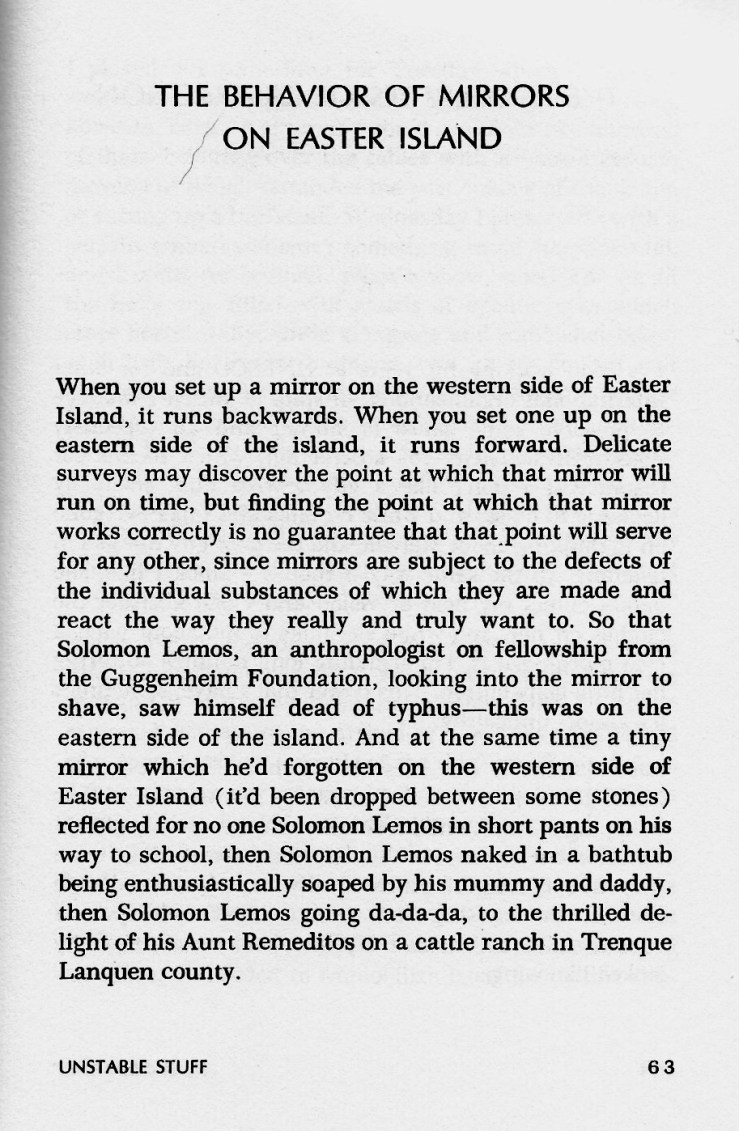
“The Behavior of Mirrors on Easter Island” — Julio Cortázar

2020-03-06_151902_3

(English translation by Paul Blackburn)

“Banal Story” — Ernest Hemingway

“Banal Story”

by

Ernest Hemingway


So he ate an orange, slowly spitting out the seeds. Outside, the snow was turning to rain. Inside, the electric stove seemed to give no heat and rising from his writing-table, he sat down upon the stove. How good it felt! Here, at last, was life.

He reached for another orange. Far away in Paris, Mascart had knocked Danny Frush cuckoo in the second round. Far off in Mesopotamia, twenty-one feet of snow had fallen. Across the world in distant Australia, the English cricketers were sharpening up their wickets. There was Romance.

Patrons of the arts and letters have discovered The Forum, he read. It is the guide, philosopher, and friend of the thinking minority. Prize short-stories—will their authors write our best-sellers of to-morrow?

You will enjoy these warm, homespun, American tales, bits of real life on the open ranch, in crowded tenement or comfortable home, and all with a healthy undercurrent of humor.

I must read them, he thought.

He read on. Our children’s children—what of them? Who of them? New means must be discovered to find room for us under the sun. Shall this be done by war or can it be done by peaceful methods?

Or will we all have to move to Canada?

Our deepest convictions—will Science upset them? Our civilization—is it inferior to older orders of things?

And meanwhile, in the far-off dripping jungles of Yucatan, sounded the chopping of the axes of the gum-choppers.

Do we want big men—or do we want them cultured? Take Joyce. Take President Coolidge. What star must our college students aim at? There is Jack Britton. There is Dr. Henry Van Dyke. Can we reconcile the two? Take the case of Young Stribling.

And what of our daughters who must make their own Soundings? Nancy Hawthorne is obliged to make her own Soundings in the sea of life. Bravely and sensibly she faces the problems which come to every girl of eighteen.

It was a splendid booklet.

Are you a girl of eighteen? Take the case of Joan of Arc. Take the case of Bernard Shaw. Take the case of Betsy Ross.

Think of these things in 1925—Was there a risqué page in Puritan history? Were there two sides to Pocahontas? Did he have a fourth dimension?

Are modern paintings—and poetry—Art? Yes and No. Take Picasso.

Have tramps codes of conduct? Send your mind adventuring.

There is Romance everywhere. Forum writers talk to the point, are possessed of humor and wit. But they do not try to be smart and are never long-winded.

Live the full life of the mind, exhilarated by new ideas, intoxicated by the Romance of the unusual. He laid down the booklet.

And meanwhile, stretched flat on a bed in a darkened room in his house in Triana, Manuel Garcia Maera lay with a tube in each lung, drowning with the pneumonia. All the papers in Andalucia devoted special supplements to his death, which had been expected for some days. Men and boys bought full-length colored pictures of him to remember him by, and lost the picture they had of him in their memories by looking at the lithographs. Bull-fighters were very relieved he was dead, because he did always in the bull-ring the things they could only do sometimes. They all marched in the rain behind his coffin and there were one hundred and forty-seven bull-fighters followed him out to the cemetery, where they buried him in the tomb next to Joselito. After the funeral every one sat in the cafés out of the rain, and many colored pictures of Maera were sold to men who rolled them up and put them away in their pockets.

Read “I Don’t Talk Service No More,” a short story by Charles Portis

“I Don’t Talk Service No More”

by

Charles Portis


Once you slip past that nurses’ station in the east wing of D-3, you can get into the library at night easy enough if you have the keys. They keep the phone locked up in a desk drawer there but if you have the keys you can get it out and make all the long-distance calls you want to for free, and smoke all the cigarettes you want to, as long as you open a window and don’t let the smoke pile up so thick inside that it sets off the smoke alarm. You don’t want to set that thing to chirping. The library is a small room. There are three walls of paperback westerns and one wall of windows and one desk.

I called up Neap down in Orange, Texas, and he said, “I live in a bog now.” I hadn’t seen him in forty-odd years and I woke him up in the middle of the night and that was the first thing out of his mouth. “My house is sinking. I live in a bog now.” I told him I had been thinking about the Fox Company Raid and thought I would give him a ring. We called it the Fox Company Raid, but it wasn’t a company raid or even a platoon raid, it was just a squad of us, with three or four extra guys carrying pump shotguns for trench work. Neap said he didn’t remember me. Then he said he did remember me, but not very well. He said, “I don’t talk service no more.”

We had been in reserve and had gone back up on the line to relieve some kind of pacifist division. Those boys had something like “Live and Let Live” on their shoulder patches. When they went out on patrol at night, they faked it. They would go out about a hundred yards and lie down in the paddies, and doze off, too, like some of the night nurses on D-3. When they came back, they would say they had been all the way over to the Chinese outposts but had failed to engage the enemy. They failed night after night. Right behind the line the mortar guys sat around in their mortar pits and played cards all day. I don’t believe they even had aiming stakes set up around their pits. They hated to fire those tubes because the Chinese would fire right back. Continue reading “Read “I Don’t Talk Service No More,” a short story by Charles Portis”

Read “The Yellow Rose” a very short story by Jorge Luis Borges

“The Yellow Rose”

by

Jorge Luis Borges

Translated by Andrew Hurley


It was neither that afternoon nor the next that Giambattista Marino died— that illustrious man proclaimed by the unanimous mouths of Fame (to use an image that was dear to him) as the new Homer or the new Dante—and yet the motionless and silent act that took place that afternoon was, in fact, the last thing that happened in his life. His brow laureled with years and glory, the man died in a vast Spanish bed with carven pillars. It costs us nothing to picture a serene balcony a few steps away, looking out toward the west, and, below, marbles and laurels and a garden whose terraced steps are mirrored in a rectangular pool. In a goblet, a woman has set a yellow rose; the man murmurs the inevitable lines of poetry that even he, to tell the truth, is a bit tired of by now:

Porpora de’giardin, pompa de’prato,
Gemmadi primavera, occhio d’aprile…

Then the revelation occurred. Marino saw the rose, as Adam had seen it in Paradise, and he realized that it lay within its own eternity, not within his words, and that we might speakabout the rose, allude to it, but never truly express it, and that the tall, haughty volumes that made a golden dimness in the corner of his room were not (as his vanity had dreamed them) a mirror of the world, but just another thing added to the world’s contents.

Marino achieved that epiphany on the eve of his death, and Homer and Dante may have achieved it as well.

“I Wrote a Letter…” — Donald Barthelme

“I Wrote a Letter…”

by

Donald Barthelme


I wrote a letter to the President of the moon, asked him if they had towaway zones up there. The cops had towed away my Honda and I didn’t like it. Cost me seventy-five dollars to get it back, plus the mental health. You ever notice how the tow trucks pick on little tiny cars? You ever seen them hauling off a Chrysler Imperial? No, you haven’t.

The President of the moon replied most courteously that the moon had no towaway zones whatsoever. Mental health on the moon, he added, cost only a dollar.

Well, I needed mental health real bad that week, so I wrote back saying I thought I could get there by the spring of ’81, if the space shuttle fulfilled its porcelain promise, and to keep some mental health warm for me who needed it, and could I interest him in a bucket of ribs in red sauce? Which I would gladly carry on up there to him if he wished?

The President of the moon wrote back that he would be delighted to have a bucket of ribs in red sauce, and that his zip code, if I needed it, was 10011000000000.

I cabled him that I’d bring some six-packs of Rolling Rock beer to drink with the ribs in red sauce, and, by the way, what was the apartment situation up there?

It was bad, he replied by platitudinum plate, apartments were running about a dollar a year, he knew that was high but what could he do? These were four-bedroom apartments, he said, with three baths, library, billiard room, root cellar, and terrace over- looking the Sea of Prosperity. Maybe he could get me a rent abatement, he said, ’cause of me being a friend of the moon.

The moon began to sound like a pretty nice place. I sent a dollar to the Space Shuttle Hurry-Up Fund.

Drumming fiercely on a hollow log with a longitudinal slit tuned to moon frequencies, I asked him about employment, medical coverage, retirement benefits, tax shelterage, convenience cards, and Christmas Club accounts.

That’s a roger, he moonbeamed back, a dollar covers it all, and if you don’t have a dollar we’ll lend you a dollar through the Greater Moon Development Mechanism.

What about war and peace? I inquired by means of curly little ALGOL circuits I had knitted myself on my Apple computer.

The President of the moon answered (by MIRV’D metaphor) that ticktacktoe was about as far as they’d got in that direction, and about as far as they would go, if he had anything to say about it.

I told him via flights of angels with special instructions that it looked to me like he had things pretty well in hand up there and would he by any chance consider being President of us? Part-time if need be?

No, he said (in a shower of used-car asteroids with blue-and-green bumper stickers), our Presidential campaigns seemed to damage the candidates, hurt them. They began hitting each other over the head with pneumatic Russians, or saying terminally silly things about the trees. He wouldn’t mind being Dizzy Gillespie, he said.

From The Teachings of Don B. (Via.)

“Ex Cathedra” — Joaquim Maria Machado de Assis

“Ex Cathedra”

by

Joaquim Maria Machado de Assis

translated by

Rhett McNeil


“Godfather, you’ll go blind from that, sir.”

“What?”

“You’re going to go blind. Reading is so sad. No sir, give me that book.”

Caetaninha took the book out of his hands. Her godfather paced around and then went into his study, where there was no lack of books. He closed the door behind him and kept reading. That was his vice. He read excessively; he read morning, noon, and night, during lunch and dinner, before going to sleep, after bathing; he read as he walked, read standing up, read in his house and in his barn; he read before reading and he read after reading; he read all sorts of books, but especially books on law (in which he’d received his degree), mathematics, and philosophy. Lately, he’d also been reading up on the natural sciences.

Worse than going blind, he went crazy. It was near the end of 1873, in Tijuca, when he started to show signs of mental disturbance; but, since the episodes were minor and few, his goddaughter only started to notice the difference in March or April of 1874. One day, over lunch, he interrupted his reading to ask her:

“What’s my name again?”

“What’s your name, godfather?” she repeated, astonished. “Your name is Fulgencio.”

“From this day forth, my name will be Fulgencius.”

And, burying his face in the book, he went on reading. Caetaninha mentioned the episode to the slave women, who admitted that they’d had their doubts about him for some time, that he hadn’t seemed well. Just imagine how fearful she was; but her fear soon passed, leaving only compassion behind, which increased her affection for him. His mania was also limited and docile, and was only related to books. Fulgencio lived for the written word, the printed word, doctrines, abstract thought, principles, and formulas. He eventually passed from mere superstition to true hallucination of the theoretical. One of his maxims was that liberty would not die, so long as there was a single piece of paper on which to declare it. So one day, waking up with the idea of improving the condition of the Turks, he wrote a constitution for them and sent it to the British diplomat in Petrópolis as a gift. On another occasion, he set about studying the eyes in anatomy books to verify whether they were really able to see, and concluded that they were.

Tell me, readers, whether, under such conditions, Caetaninha’s life could have been a happy one? It’s true that she wanted for nothing, because her godfather was rich. He had been the one who’d raised her, from the age of seven, when he lost his wife. He had taught her to read and write, French, and a little bit – so as not to say almost nothing – of history and geography, and had charged the domestic slaves with teaching her embroidery, lace-making, and sewing. There’s no denying any of that. But Caetaninha had turned fourteen and, if, in the early years, her toys and the slaves were enough to entertain her, she was now at an age when toys go out of style and slaves hold no interest, when no amount of reading or writing can transform a solitary house in Tijuca into a paradise. She went out sometimes, but rarely, and always in a rush. She never went to the theater or to dances, never made or received visits. Whenever she saw a cavalcade of men and women on horseback out in the street, her soul would ride pillion on one of the horses and ride off with them, leaving only her body behind, right next to her godfather, who kept on reading. Continue reading ““Ex Cathedra” — Joaquim Maria Machado de Assis”

“Hawk” — Joy Williams

“Hawk”

by

Joy Williams


Glenn Gould bathed his hands in wax and then they felt new. He didn’t like to eat in public. He was personally gracious. He was knowledgeable about drugs. He loved animals. In his will, he directed that half his money be given to the Toronto Humane Society. He hated daylight and bright colours. His piano chair was fourteen inches high. His music was used to score Slaughterhouse-Five, a book he did not like. After he suffered his fatal stroke, his father waited a day to turn off the respirator because he didn’t want him to die on his stepmother’s birthday. When Glenn Gould wrote cheques he signed them Glen Gould because he was afraid that by writing the second n he would make too many squiggles. He took prodigious amounts of valium and used make-up. He was once arrested in Sarasota, Florida, for sitting on a park bench in an overcoat, gloves and muffler. He was a prodigy, a genius. He had dirty hair. He had boring dreams. He probably believed in God.

My mind said You read about Glenn Gould and listen to Glenn Gould constantly but you don’t know anything about music. If he were alive you wouldn’t have anything you could say to him…

A composer acquaintance of mine dismissed Glenn as a performer.

Glenn Gould loved the idea of the Arctic but he had a great fear of the cold. He was a virtuoso. To be a virtuoso you must have an absolutely fearless attitude toward everything but Glenn was, in fact, worried, frightened and phobic. The dogs of his youth were named Nick and Banquo. As a baby, he never cried but hummed. He thought that the key of F minor expressed his personality.

You have no idea what that means my mind said. You don’t really know what it is he’s doing. You don’t know why he’s brilliant.

He could instantly play any piece of music from memory. On the whole he did not like works that progressed to a climax, and then to a reconciliation. The Goldberg Variations, which Glenn is most widely known for, were written by Bach for harpsichord. Bach was visiting one of his students, Johann Goldberg, who was employed by a Count von Keyserling, the Russian ambassador to the court of Saxony. The Count had insomnia and wanted some music that would help him through the dark hours. The first notes of the Goldberg Variations are inscribed on Glenn’s tombstone.

My dog rose from his bed and walked beneath the table, which he barely cleared. He put his chin on my knee. He stood there for a few moments, not moving. I could see nothing but his nose. I loved kissing his nose. It was my hobby. He was a big black German Shepherd with accents of silver and brown. He had a beautiful face. He looked soulful and dear and alert. He was born on 17 October 1988 and had been with us since Christmas Day of that year. He was now almost nine years old. He weighed one hundred pounds. His name was Hawk. He seemed to fear nothing. He was always looking at me, waiting for me. He just wanted to go where I was going. He could be amusing, he had a sense of humour, but mostly he seemed stoic and watchful and patient. If I was in a room, he was in that room, no other. Of course we took long walks together and many cross-country trips. He was adept at ferry crossings and checking into motels. When he could not accompany me, I would put him in a kennel, once for as long as two weeks. I felt that it was good for him to endure the kennel occasionally. Life was not all good, I told him. Though mostly life was good. He had had a series of collars over the years. His most recent one was lavender in colour. He had tags with his various addresses and phone numbers on them and a St Francis medal with the words protect us. He had a collection of toys. A softball, and squeaky toys in the shapes of a burglar, a cat, a shark, a snowman, and a hedgehog that once made a snuffling noise like a hedgehog but not for long. They were collected in a picnic basket on the floor and when he was happy he would root through the basket and select one. He preferred the snowman. His least favourite was a large green and red toy–its shape was similar to a large bone but it was an abstraction, it lacked charm. Hawk was in a hundred photographs. He was my sweetie pie, my honey, my handsome boy, my love. On the following day he would attack me as though he wanted to kill me.

Read the rest of Joy Williams’ story “Hawk” at Granta.

Read “Human Moments in World War III,” a sci-fi story by Don DeLillo

“Human Moments in World War III”

by

Don DeLillo


note about Vollmer. He no longer describes the earth as a library globe or a map that has come alive, as a cosmic eye staring into deep space. This last was his most ambitious fling at imagery. The war has changed the way he sees the earth. The earth is land and water, the dwelling place of mortal men, in elevated dictionary terms. He doesn’t see it any more (storm-spiralled, sea-bright, breathing heat and haze and colour) as an occasion for picturesque language, for easeful play or speculation.

At two hundred and twenty kilometres we see ship wakes and the larger airports. Icebergs, lightning bolts, sand-dunes. I point out lava flows and cold-core eddies. That silver ribbon off the Irish coast, I tell him, is an oil slick.

This is my third orbital mission, Vollmer’s first. He is an engineering genius, a communications and weapons genius, and maybe other kinds of genius as well. As mission specialist, I’m content to be in charge. (The word specialist, in the standard usage of Colorado Command, refers here to someone who does not specialize.) Our spacecraft is designed primarily to gather intelligence. The refinement of the quantum-burn technique enables us to make frequent adjustments of orbit without firing rockets every time. We swing out into high, wide trajectories, the whole earth as our psychic light, to inspect unmanned and possibly hostile satellites. We orbit tightly, snugly, take intimate looks at surface activities in untravelled places. The banning of nuclear weapons has made the world safe for war.

I try not to think big thoughts or submit to rambling abstractions. But the urge sometimes comes over me. Earth orbit puts men into philosophical temper. How can we help it? We see the planet complete, we have a privileged vista. In our attempts to be equal to the experience, we tend to meditate importantly on subjects like the human condition. It makes a man feel universal, floating over the continents, seeing the rim of the world, a line as clear as a compass arc, knowing it is just a turning of the bend to Atlantic twilight, to sediment plumes and kelp beds, an island chain glowing in the dusky sea.

I tell myself it is only scenery. I want to think of our life here as ordinary, as a housekeeping arrangement, an unlikely but workable setup caused by a housing shortage or spring floods in the valley.

Continue reading “Read “Human Moments in World War III,” a sci-fi story by Don DeLillo”