“Up in the Gallery” — Franz Kafka

If some frail tubercular lady circus rider were to be driven in circles around and around the arena for months and months without interruption in front of a tireless public on a swaying horse by a merciless whip-wielding master of ceremonies, spinning on the horse, throwing kisses and swaying at the waist, and if this performance, amid the incessant roar of the orchestra and the ventilators, were to continue into the ever-expanding, gray future, accompanied by applause, which died down and then swelled up again, from hands which were really steam hammers, perhaps then a young visitor to the gallery might rush down the long stair case through all the levels, burst into the ring, and cry “Stop!” through the fanfares of the constantly adjusting orchestra.

But since things are not like that—since a beautiful woman, in white and red, flies in through curtains which proud men in livery open in front of her, since the director, devotedly seeking her eyes, breathes in her direction, behaving like an animal, and, as a precaution, lifts her up on the dapple-gray horse, as if she were his grand daughter, the one he loved more than anything else, as she starts a dangerous journey, but he cannot decide to give the signal with his whip and finally, controlling himself, gives it a crack, runs right beside the horse with his mouth open, follows the rider’s leaps with a sharp gaze, hardly capable of comprehending her skill, tries to warn her by calling out in English, furiously castigating the grooms holding hoops, telling them to pay the most scrupulous attention, and begs the orchestra, with upraised arms, to be quiet before the great jump, finally lifts the small woman down from the trembling horse, kisses her on both cheeks, considers no public tribute adequate, while she herself, leaning on him, high on the tips of her toes, with dust swirling around her, arms outstretched and head thrown back, wants to share her luck with the entire circus—since this is how things are, the visitor to the gallery puts his face on the railing and, sinking into the final march as if into a difficult dream, weeps, without realizing it.

“Up in the Gallery” by Franz Kafka

“Mutations” — Jorge Luis Borges

JLB

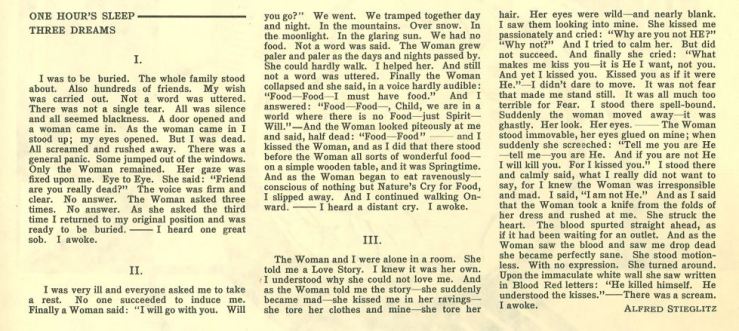
“One Hour’s Sleep—–Three Dreams” — Alfred Stieglitz

From the first issue of 291; via the mighty Ubuweb.

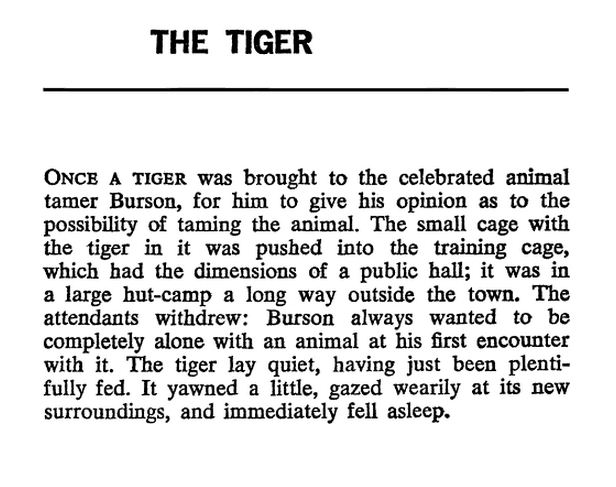
“The Tiger” — Kafka

“Parable of Cervantes and Don Quixote” — Jorge Luis Borges

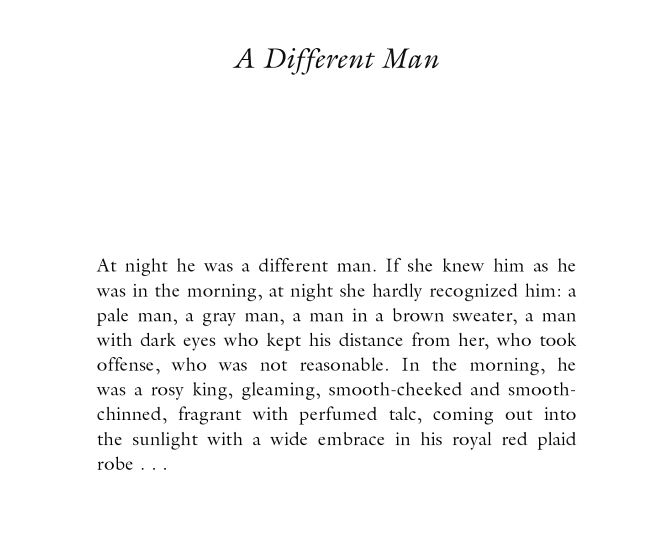
“A Different Man” — Lydia Davis

“Montparnasse” — Ernest Hemingway

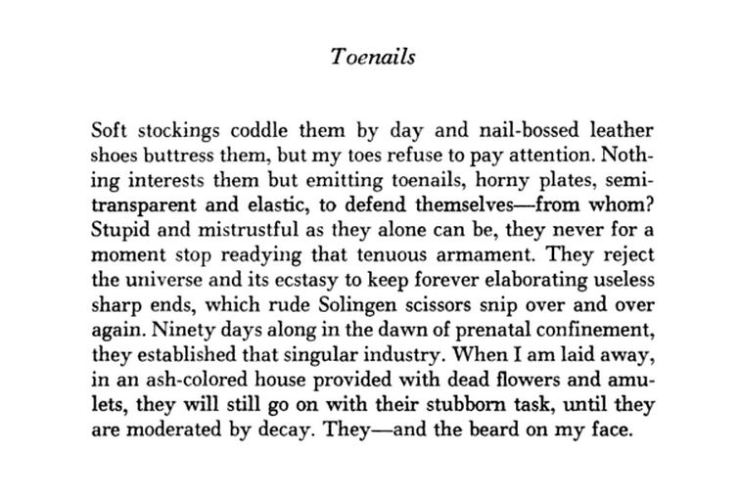
“Toenails” — Jorge Luis Borges

“The Emperor” — Kafka

“Memory” — H.P. Lovecraft

“An Uncomfortable Bed” — Guy de Maupassant

“An Uncomfortable Bed” by Guy de Maupassant:

One autumn I went to stay for the hunting season with some friends in a chateau in Picardy.

My friends were fond of practical joking, as all my friends are. I do not care to know any other sort of people.

When I arrived, they gave me a princely reception, which at once aroused distrust in my breast. We had some capital shooting. They embraced me, they cajoled me, as if they expected to have great fun at my expense.

I said to myself:

“Look out, old ferret! They have something in preparation for you.”

During the dinner, the mirth was excessive, far too great, in fact. I thought: “Here are people who take a double share of amusement, and apparently without reason. They must be looking out in their own minds for some good bit of fun. Assuredly I am to be the victim of the joke. Attention!”

During the entire evening, everyone laughed in an exaggerated fashion. I smelled a practical joke in the air, as a dog smells game. But what was it? I was watchful, restless. I did not let a word or a meaning or a gesture escape me. Everyone seemed to me an object of suspicion, and I even looked distrustfully at the faces of the servants.

The hour rang for going to bed, and the whole household came to escort me to my room. Why? They called to me: “Good night.” I entered the apartment, shut the door, and remained standing, without moving a single step, holding the wax candle in my hand.

I heard laughter and whispering in the corridor. Without doubt they were spying on me. I cast a glance around the walls, the furniture, the ceiling, the hangings, the floor. I saw nothing to justify suspicion. I heard persons moving about outside my door. I had no doubt they were looking through the keyhole.

An idea came into my head: “My candle may suddenly go out, and leave me in darkness.”

Then I went across to the mantelpiece, and lighted all the wax candles that were on it. After that, I cast another glance around me without discovering anything. I advanced with short steps, carefully examining the apartment. Nothing. I inspected every article one after the other. Still nothing. I went over to the window. The shutters, large wooden shutters, were open. I shut them with great care, and then drew the curtains, enormous velvet curtains, and I placed a chair in front of them, so as to have nothing to fear from without.

Then I cautiously sat down. The armchair was solid. I did not venture to get into the bed. However, time was flying; and I ended by coming to the conclusion that I was ridiculous. If they were spying on me, as I supposed, they must, while waiting for the success of the joke they had been preparing for me, have been laughing enormously at my terror. So I made up my mind to go to bed. But the bed was particularly suspicious-looking. I pulled at the curtains. They seemed to be secure. All the same, there was danger. I was going perhaps to receive a cold shower-bath from overhead, or perhaps, the moment I stretched myself out, to find myself sinking under the floor with my mattress. I searched in my memory for all the practical jokes of which I ever had experience. And I did not want to be caught. Ah! certainly not! certainly not! Then I suddenly bethought myself of a precaution which I consider one of extreme efficacy: I caught hold of the side of the mattress gingerly, and very slowly drew it toward me. It came away, followed by the sheet and the rest of the bedclothes. I dragged all these objects into the very middle of the room, facing the entrance door. I made my bed over again as best I could at some distance from the suspected bedstead and the corner which had filled me with such anxiety. Then, I extinguished all the candles, and, groping my way, I slipped under the bedclothes.

For at least another hour, I remained awake, starting at the slightest sound. Everything seemed quiet in the chateau. I fell asleep.

I must have been in a deep sleep for a long time, but all of a sudden, I was awakened with a start by the fall of a heavy body tumbling right on top of my own body, and, at the same time, I received on my face, on my neck, and on my chest a burning liquid which made me utter a howl of pain. And a dreadful noise, as if a sideboard laden with plates and dishes had fallen down, penetrated my ears.

I felt myself suffocating under the weight that was crushing me and preventing me from moving. I stretched out my hand to find out what was the nature of this object. I felt a face, a nose, and whiskers. Then with all my strength I launched out a blow over this face. But I immediately received a hail of cuffings which made me jump straight out of the soaked sheets, and rush in my nightshirt into the corridor, the door of which I found open.

O stupor! it was broad daylight. The noise brought my friends hurrying into the apartment, and we found, sprawling over my improvised bed, the dismayed valet, who, while bringing me my morning cup of tea, had tripped over this obstacle in the middle of the floor, and fallen on his stomach, spilling, in spite of himself, my breakfast over my face.

The precautions I had taken in closing the shutters and going to sleep in the middle of the room had only brought about the interlude I had been striving to avoid.

Ah! how they all laughed that day!


“Mother Mouth” — Barry Hannah

“Prometheus” — Kafka

“In Lima” — Thomas Bernhard

“The Image of the Lost Soul” — Saki


“The Image of the Lost Soul” by Saki—

There were a number of carved stone figures placed at intervals along the parapets of the old Cathedral; some of them represented angels, others kings and bishops, and nearly all were in attitudes of pious exaltation and composure. But one figure, low down on the cold north side of the building, had neither crown, mitre, not nimbus, and its face was hard and bitter and downcast; it must be a demon, declared the fat blue pigeons that roosted and sunned themselves all day on the ledges of the parapet; but the old belfry jackdaw, who was an authority on ecclesiastical architecture, said it was a lost soul. And there the matter rested.

One autumn day there fluttered on to the Cathedral roof a slender, sweet-voiced bird that had wandered away from the bare fields and thinning hedgerows in search of a winter roosting-place. It tried to rest its tired feet under the shade of a great angel-wing or to nestle in the sculptured folds of a kingly robe, but the fat pigeons hustled it away from wherever it settled, and the noisy sparrow-folk drove it off the ledges. No respectable bird sang with so much feeling, they cheeped one to another, and the wanderer had to move on.

Only the effigy of the Lost Soul offered a place of refuge. The pigeons did not consider it safe to perch on a projection that leaned so much out of the perpendicular, and was, besides, too much in the shadow. The figure did not cross its hands in the pious attitude of the other graven dignitaries, but its arms were folded as in defiance and their angle made a snug resting-place for the little bird. Every evening it crept trustfully into its corner against the stone breast of the image, and the darkling eyes seemed to keep watch over its slumbers. The lonely bird grew to love its lonely protector, and during the day it would sit from time to time on some rainshoot or other abutment and trill forth its sweetest music in grateful thanks for its nightly shelter. And, it may have been the work of wind and weather, or some other influence, but the wild drawn face seemed gradually to lose some of its hardness and unhappiness. Every day, through the long monotonous hours, the song of his little guest would come up in snatches to the lonely watcher, and at evening, when the vesper-bell was ringing and the great grey bats slid out of their hiding-places in the belfry roof, the brighteyed bird would return, twitter a few sleepy notes, and nestle into the arms that were waiting for him. Those were happy days for the Dark Image. Only the great bell of the Cathedral rang out daily its mocking message, “After joy . . . sorrow.”

The folk in the verger’s lodge noticed a little brown bird flitting about the Cathedral precincts, and admired its beautiful singing. “But it is a pity,” said they, “that all that warbling should be lost and wasted far out of hearing up on the parapet.” They were poor, but they understood the principles of political economy. So they caught the bird and put it in a little wicker cage outside the lodge door.

     That night the little songster was missing from its accustomed haunt, and the Dark Image knew more than ever the bitterness of loneliness. Perhaps his little friend had been killed by a prowling cat or hurt by a stone. Perhaps . . . perhaps he had flown elsewhere. But when morning came there floated up to him, through the noise and bustle of the Cathedral world, a faint heart-aching message from the prisoner in the wicker cage far below. And every day, at high noon, when the fat pigeons were stupefied into silence after their midday meal and the sparrows were washing themselves in the street-puddles, the song of the little bird came up to the parapets — a song of hunger and longing and hopelessness, a cry that could never be answered. The pigeons remarked, between mealtimes, that the figure leaned forward more than ever out of the perpendicular.

One day no song came up from the little wicker cage. It was the coldest day of the winter, and the pigeons and sparrows on the Cathedral roof looked anxiously on all sides for the scraps of food which they were dependent on in hard weather.

“Have the lodge-folk thrown out anything on to the dust-heap?” inquired one pigeon of another which was peering over the edge of the north parapet.

“Only a little dead bird,” was the answer.

There was a crackling sound in the night on the Cathedral roof and a noise as of falling masonry. The belfry jackdaw said the frost was affecting the fabric, and as he had experienced many frosts it must have been so. In the morning it was seen that the Figure of the Lost Soul had toppled from its cornice and lay now in a broken mass on the dustheap outside the verger’s lodge.

     “It is just as well,” cooed the fat pigeons, after they had peered at the matter for some minutes; “now we shall have a nice angel put up there. Certainly they will put an angel there.”

“After joy . . . sorrow,” rang out the great bell.


“The Kiss” — Kate Chopin


“The Kiss,” a short story by Kate Chopin—

It was still quite light out of doors, but inside with the curtains drawn and the smouldering fire sending out a dim, uncertain glow, the room was full of deep shadows.

Brantain sat in one of these shadows; it had overtaken him and he did not mind. The obscurity lent him courage to keep his eyes fastened as ardently as he liked upon the girl who sat in the firelight.

She was very handsome, with a certain fine, rich coloring that belongs to the healthy brune type. She was quite composed, as she idly stroked the satiny coat of the cat that lay curled in her lap, and she occasionally sent a slow glance into the shadow where her companion sat. They were talking low, of indifferent things which plainly were not the things that occupied their thoughts. She knew that he loved her—a frank, blustering fellow without guile enough to conceal his feelings, and no desire to do so. For two weeks past he had sought her society eagerly and persistently. She was confidently waiting for him to declare himself and she meant to accept him. The rather insignificant and unattractive Brantain was enormously rich; and she liked and required the entourage which wealth could give her.

During one of the pauses between their talk of the last tea and the next reception the door opened and a young man entered whom Brantain knew quite well. The girl turned her face toward him. A stride or two brought him to her side, and bending over her chair—before she could suspect his intention, for she did not realize that he had not seen her visitor—he pressed an ardent, lingering kiss upon her lips.

Brantain slowly arose; so did the girl arise, but quickly, and the newcomer stood between them, a little amusement and some defiance struggling with the confusion in his face.

“I believe,” stammered Brantain, “I see that I have stayed too long. I—I had no idea—that is, I must wish you good-by.” He was clutching his hat with both hands, and probably did not perceive that she was extending her hand to him, her presence of mind had not completely deserted her; but she could not have trusted herself to speak.

“Hang me if I saw him sitting there, Nattie! I know it’s deuced awkward for you. But I hope you’ll forgive me this once—this very first break. Why, what’s the matter?”

“Don’t touch me; don’t come near me,” she returned angrily. “What do you mean by entering the house without ringing?”

“I came in with your brother, as I often do,” he answered coldly, in self-justification. “We came in the side way. He went upstairs and I came in here hoping to find you. The explanation is simple enough and ought to satisfy you that the misadventure was unavoidable. But do say that you forgive me, Nathalie,” he entreated, softening.

“Forgive you! You don’t know what you are talking about. Let me pass. It depends upon—a good deal whether I ever forgive you.”

At that next reception which she and Brantain had been talking about she approached the young man with a delicious frankness of manner when she saw him there.

“Will you let me speak to you a moment or two, Mr. Brantain?” she asked with an engaging but perturbed smile. He seemed extremely unhappy; but when she took his arm and walked away with him, seeking a retired corner, a ray of hope mingled with the almost comical misery of his expression. She was apparently very outspoken.

“Perhaps I should not have sought this interview, Mr. Brantain; but—but, oh, I have been very uncomfortable, almost miserable since that little encounter the other afternoon. When I thought how you might have misinterpreted it, and believed things”—hope was plainly gaining the ascendancy over misery in Brantain’s round, guileless face—”Of course, I know it is nothing to you, but for my own sake I do want you to understand that Mr. Harvy is an intimate friend of long standing. Why, we have always been like cousins—like brother and sister, I may say. He is my brother’s most intimate associate and often fancies that he is entitled to the same privileges as the family. Oh, I know it is absurd, uncalled for, to tell you this; undignified even,” she was almost weeping, “but it makes so much difference to me what you think of—of me.” Her voice had grown very low and agitated. The misery had all disappeared from Brantain’s face.

“Then you do really care what I think, Miss Nathalie? May I call you Miss Nathalie?” They turned into a long, dim corridor that was lined on either side with tall, graceful plants. They walked slowly to the very end of it. When they turned to retrace their steps Brantain’s face was radiant and hers was triumphant.

Harvy was among the guests at the wedding; and he sought her out in a rare moment when she stood alone.

“Your husband,” he said, smiling, “has sent me over to kiss you.”

A quick blush suffused her face and round polished throat. “I suppose it’s natural for a man to feel and act generously on an occasion of this kind. He tells me he doesn’t want his marriage to interrupt wholly that pleasant intimacy which has existed between you and me. I don’t know what you’ve been telling him,” with an insolent smile, “but he has sent me here to kiss you.”

She felt like a chess player who, by the clever handling of his pieces, sees the game taking the course intended. Her eyes were bright and tender with a smile as they glanced up into his; and her lips looked hungry for the kiss which they invited.

“But, you know,” he went on quietly, “I didn’t tell him so, it would have seemed ungrateful, but I can tell you. I’ve stopped kissing women; it’s dangerous.”

Well, she had Brantain and his million left. A person can’t have everything in this world; and it was a little unreasonable of her to expect it.
 

“Cowshed” — Robert Walser

“Cowshed,” a short story by Robert Walser—

I went to see Bonn. I beheld him in his famous checked Sherlock Holmes suit. The sight of his tawny leather spats devastated me. But it is far from my intention to make so bold as to speak of Bonn, whom I also learned to admire as Edmund Kean in the play by Dumas. Today, with the kind reader’s permission, I wish to speak of the Cowshed, an artistic singsong and jinglejangle establishment that lies in the northern reaches of our beloved city, Berlin. At the Cowshed, among other things, I met and learned to revere beyond all measure a Swiss girl who figured as a waitress there. There are figures galore at the Cowshed. I myself am a not unpopular, at times even celebrated regular. When I set foot on the premises, which are redolent of an aging, half-dead elegance, the publican gets up from his seat where he is keeping watch and greets me with great amicability by making a thoroughly courteous, suave bow, the significance of which is that I should buy a round of cognac. Oh, the conduct I display here at the Cowshed. It resembles the conduct of a Prince Dolgoroucki, a Count Osten-Sacken, a Prince Poniatowski. I always treat the artistes assembled upon the small triangular stage, which is stuck in a corner as if lost in indeterminacy and incertitude, to a boot. The significance of the term boot in localities such as the Cowshed is no doubt unfamiliar to most ladies and gentlemen of a literary bent. A boot of this sort is quite simply a tankard of beer shaped like a lady’s boot, made of glass and holding nearly two liters. The music made at the Cowshed is often ear-rending; nonetheless I do adore it and dream of divinely beautiful things whenever it creeps into my ear to ensnare me with melodies. Invariably I have some refreshment placed upon the fortepiano of the bushy-haired, gasconading lout of a band leader. This amenity, which he loses no time in appreciating and, as for the rest, most artfully guzzling, ah pardon, I mean drinking, consists in nothing other than various glasses of beer. Yes, I do have to say that quite a lot of money exits my pockets at the Cowshed. Excellent interest accrues on the capital thus invested, and this interest takes the form of merriments that give me no end of pleasure. For the most part I am a most cleverly respectable fellow, but at times, at times when the mood happens to strike.