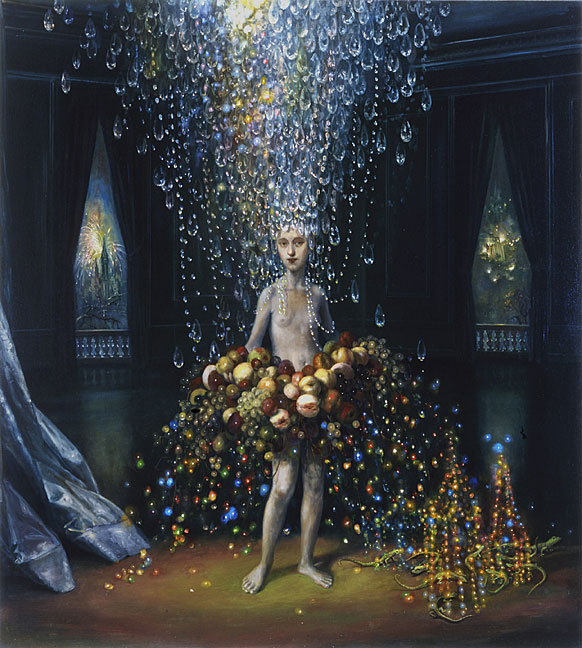
Diorama with Gasoline, Dopamine and Adrenaline — Laurie Hogin

Pages from Joseph Cornell’s Imaginary Journal

Check out the Peabody Essex Museum’s marvelous interactive exhibit Navigating the Imagination, which lets you view (and play with) the works of artist Joseph Cornell The images here come from a 1911 textbook that Cornell transformed into a magical book object, full of illustrations, collages, quotes, and cut outs (you can peruse the entire book).

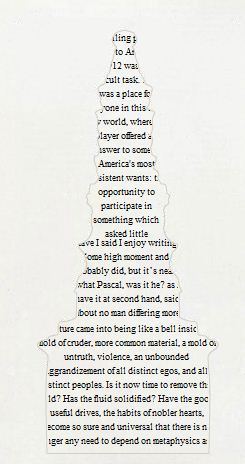
Bonus: Make your own Word Tower in the “Crystal Cage” machine. Here’s mine; I used snips from open tabs on my browser (two pieces from Gaddis and a Nietzsche):

Carousel-Animal Opera — Joseph Cornell

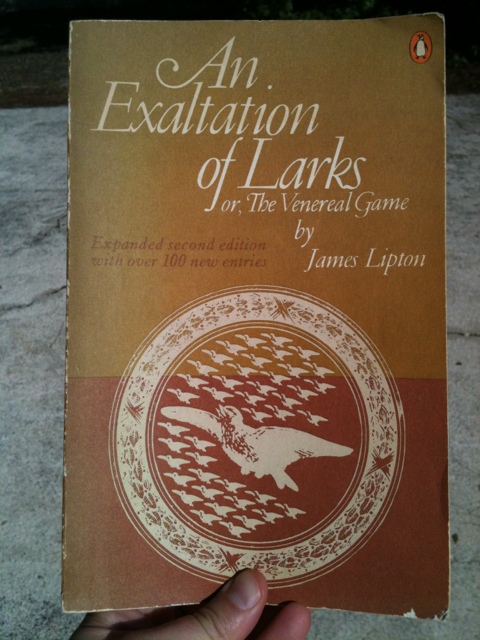
Book Acquired, Some Time Last Week: An Exaltation of Larks (The Venereal Game)

20111219-131203.jpg

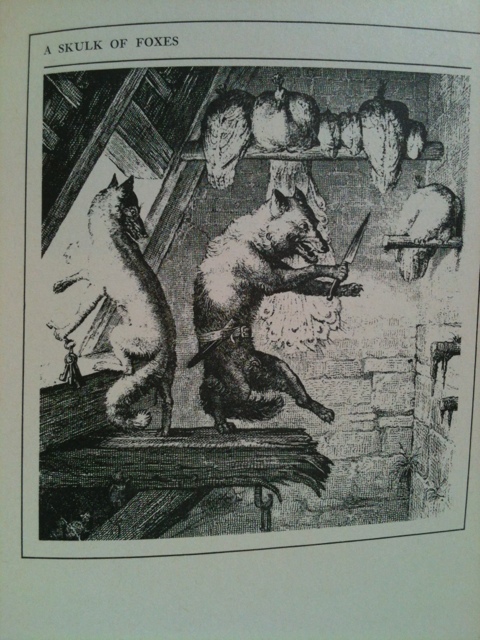
I had never heard of James Lipton’s dictionary of terms of venery, An Exaltation of Larks, or The Venereal Game before I found it wedged between some old etymological dictionaries I was browsing in my favorite book store, but when I picked it up I knew I was going to buy it almost immediately. Part dictionary, part etymology, and part linguistic game, An Exaltation explores those strange collective noncount nouns of English that anglophiles (like me) find so charming and weird. The first part of the book deals with some of the more common terms of venery, like “pride of lions,” or “skulk of foxes”:

20111219-131213.jpg

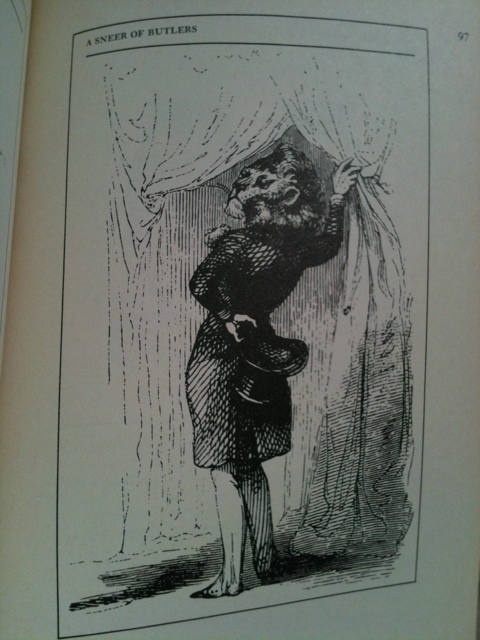
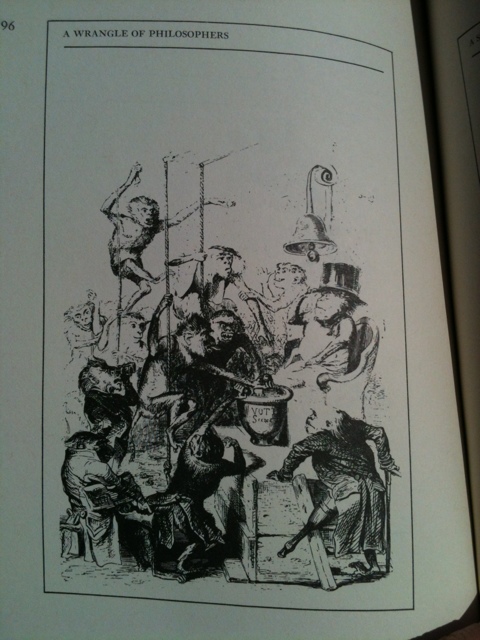
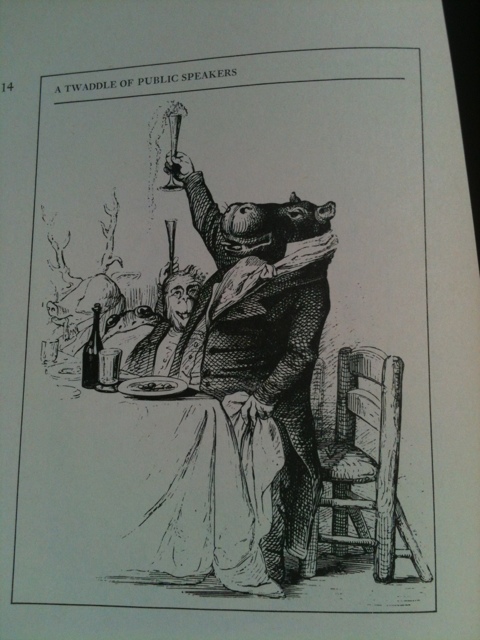
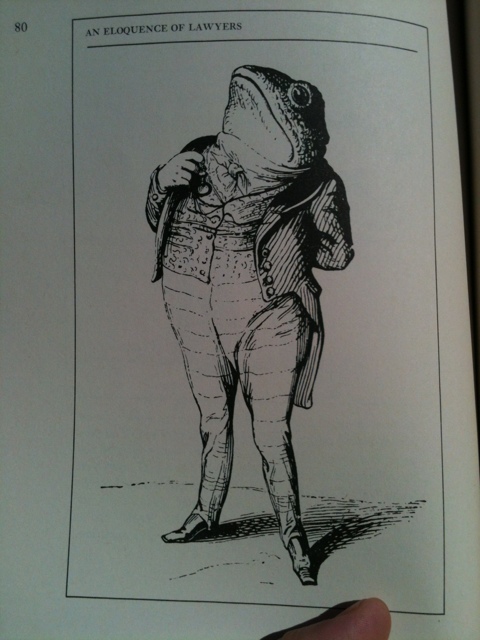
But Lipton soon gives over to more esoteric terms, and then eventually plays with outright invention. The book’s illustrations recall Max Ernst’s surrealist graphic novel Une Semaine de Bonté; they also remind me of the recapitations of recent Biblioklept interviewee Click Mort. Anyway, a very cool book, likely a cult favorite, and lots and lots of fun.

20111219-131224.jpg

20111219-131243.jpg

20111219-131301.jpg

20111219-131308.jpg

“It Might Be a Week or a Year for the Right Head to Show Up” — Biblioklept Talks to Click Mort About His Wonderful, Surreal Sculptures


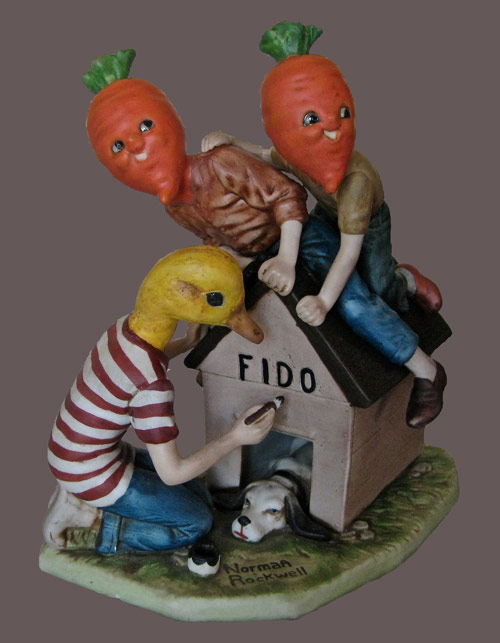
Duck and Carrots Putting the Final Touches on a Doghouse -- Click Mort

Click Mort makes surreal, charming, disarming sculptures that synthesize pre-existing figures into strange new forms. Largely self-taught, Click works out of his home in his native L.A., where he lovingly decapitates and recapitates antique statuettes.  Click’s sculptures were featured in a solo exhibit earlier this year in L.A.’s La Luz de Jesus gallery and are currently on display at the Webb Gallery in Waxahachie, Texas. Click was kind enough to talk to me in detail about his work over a series of emails around Thanksgiving. Check out Click’s website to see more of his fantastical stuff.

Biblioklept: I love your sculptures. They’re disconcerting and surreal but also charming. They’re bizarre and clever, but not whimsical. Can you tell us about how you make them?

Click Mort: Thanks. I’m especially happy to hear them described as “not whimsical.”  As for how they’re made, I should probably backtrack a bit since the porcelain pieces I’m doing now weren’t the actual starting point. The first things I tried recapitating were resin figurines from the 99 Cent Store: cute kid couples strolling hand-in-hand, adorable angel-tots, etc.. They were pleasantly awful on their own merits, but when I saw some particularly crappy plastic barnyard animals in the toy section that were roughly the same scale, the gears started turning. Those first head-swaps were pretty crude: I’d just hack off both heads mid-neck with a jeweler’s saw, attach the non-native head with some sculpting resin, and paint over the seam. Voila … Angel-tot with a pig’s head (or angel-pig with a tot’s body, depending on how you look at things).

After a few years of working with cheap resin figures, I kind of burnt out on them. My technique had developed to the point where the swaps were reasonably undetectable, but the available subject matter  —  tots, tots, and … tots  —  had gotten monotonous. Also, the figures gave off a really horrible smell when sawed; I strongly suspected they were made of something creepy like melamine. At that point, I decided to try doing the same thing with porcelain figures.

Right … so now I can answer your actual question. Once a suitable head and body match have been found (and describing that process would add a few more paragraphs to an already inhumanely long and dull answer) the first job is to remove all the unwanted material. A jeweler’s saw  — or any cutting implement whose description doesn’t include the words “diamond-edged”  —   won’t even mar the finish on porcelain. I use a high-speed Dremel with some sort of diamond-dust edged cutting tool attachment. Assuming we’re talking about a human body getting an animal head, everything from the collar up has to go on the body figure. This includes hair, headgear, ribbons, or whatever connecting the head and body. If any of these drape over a collar or lapel, those parts have to go too. For the heads, the amount that gets hacked off depends on the animal. On a quadruped, because of the different angle the spine intersects the skull relative to a biped, almost everything behind the ears and under the jawline has to be removed and then re-sculpted after the head has been attached to the body.

This slideshow requires JavaScript.

In order to get a really good bond between the head and body, I fill the upper torso with sculpting resin and sink an aluminum rod into it. A length of rod is left protruding up, and the head—which also gets stuffed with resin—is then positioned on it. After that, all the missing areas have to be sculpted back on. Finally, whatever painting is needed to cover the recreated areas and blend them into the original parts gets done.

And however tedious that was to read, the actual process is several thousand times more so.

Biblioklept: I liked reading about the process, but I suppose when we do something all the time, it seems tedious to us. Your process fascinates me, because the images of your figures don’t show any “seams” — your figures look like little mass produced statues from an alternate dimension. There’s a surreal synthesis at play in your work, not just in the actual combination of, say, a dog’s head on human body, but also in the tone of the work. Your pieces strike me as both creepy and tender at the same time. I’m curious how you know if a piece “works” — when are you satisfied with your figures?

CM: That mass-produced quality is something I really try not to lose when putting together the figures. There’s something inherently familiar and low-key about mass-produced objects, and I like the idea of art that doesn’t scream for attention but just sort of sits there mumbling to itself. The down side to this is it sometimes works against the figures getting noticed at all. In the few gallery shows they’ve been in, it seemed a lot of people never looked at them from closer than a few feet away. Maybe they thought someone had just lined up a bunch of old lady tschotske crap as some sort of conceptual piece.

As for the figures working as much on a tonal as objective level, yeah, that’s becoming more and more the case. Or at least my intention. On the early pieces, I was getting figures that I thought were awful to begin with and simply trying to change the nature of their awfulness. Over the course of hundreds of hours on eBay looking for working materials, I started noticing how great some of these cheap figurines were in their own right, particularly the stuff made in Japan in the fifties and sixties. At that point, I really started paying less attention to what kind of head would seem funniest on a piece and focusing more on how the shape and expression of the new head would fit into what was already a wonderful figure. It became more about trying to maintain the geometry of the whole thing while shifting the mood.

“Creepy and tender” is as good a description as I’ve heard. I guess the tenderness is a product of my real affection for the original figures showing through. And while I don’t consider the finished pieces particularly creepy, a lot of people have described them that way. As near as I can figure, it’s because the heads I like to use almost always have sort of neutral expressions, and that lack of expression is unsettling to us on some fundamental level.

And to a great degree, when a piece “works” is determined almost as soon as I have the original figure in hand. The only finished pieces I’ve been unhappy with are ones where as soon as I unpackaged a figure bought online, I hated it but followed through with a head-swap anyway rather than just eat the cost of the figure. Usually though, if I like the original piece, I’m going to be happy with the finished figure. It might be a week or a year for the right head to show up, but I’ll know when it does. And from there, it’s only a matter of taking the time (and typically, this is something like ten to twenty hours) to bring the two together.

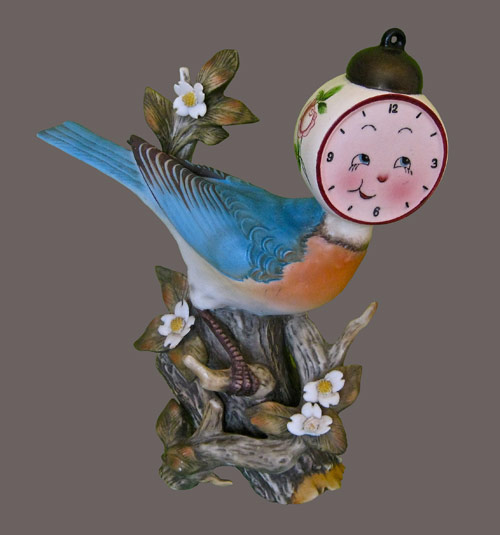
Clock Headed Harpy -- Click Mort

Biblioklept: There’s a clear appreciation or even adoration of kitsch in your work, but there’s also this level to it where you’re literally grafting two tchotchkes to each other in a way that transcends kitsch (I don’t know if that description is clear or valid). What I like about your work is that it doesn’t rely solely on an ironic aesthetic shared by both artist and audience, but that’s nevertheless part of the experience. What is it about the awful that attracts us?

CM: I wouldn’t describe my composite pieces as transcending their components, but that’s probably an extension of my regard for the original, unaltered figures. I mean, obviously I don’t think they’re sacrosanct or whatever or I wouldn’t be doing what I’m doing. Still, if there were only one  —  rather than thousands  — of a given figure, I’d absolutely leave it alone. The same holds true for figures I think are already so wonderfully bizarre that anything I could possibly do to them would only diminish their oddity.

I guess I consider what I do as just condensing what I like about these things: taking the most expressive elements of each and putting that all in one figure in a way that enhances (but doesn’t necessarily transcend) what was already going on to some degree in the original.

It’s really hard to say what perceptions I share with whatever audience my work has. Originally, the only place that would carry them was a little boutique retail store, and now the figures have gotten into a couple of gallery group shows. In both instances, I almost never know who’s bought them, so there’s no opportunity for any sort of dialogue. For me, there’s no irony whatsoever at work in these things, but I’m pretty much literal to the point of dullness and don’t really see them as operating on any level other than the apparent. All I’m trying to do is get objectively incongruent elements and make them visually and aesthetically congruent.

But that’s just my take on them. I can be a didactic goon about a lot of stuff, but it would really be pointless to try and dictate what anyone else is or isn’t seeing in these pieces. And while there’s a definite attraction to awfulness, I don’t perceive these figures as awful. Alien, yeah. Absolutely. Which is pretty funny, given that they were originally produced as innocuous home garni and now something like a Norman Rockwell figurine is about as familiar as one of those lumpy Paleolithic Venus figures.

Biblioklept: A few of your pieces reference authors (DidionHemingway), but it’s not necessarily a recurring theme. How did these authors find their way into your titles? What do you enjoy reading?

CM: Titling the pieces is probably my least favorite part of the process. Usually, I just slap on whatever gibberish pops into my head and that’s that. The two figures you’ve posted are the only ones with literary references and, oddly enough, refer to one author who knocks me out and one I think is flat-out terrible (and I don’t think Didion is terrible).

As for what I read, it’s sort of a weird grab bag of stuff. Rather than trying to categorize my likes, I just grabbed the pile currently on the nightstand. Here’s what was there:

Wicked Bugs: The Louse That Conquered Napoleon’s Army & Other Diabolical Insects

Dada and Surrealism: A Very Short Introduction

Zippy Goes to School (The titular Zippy is a chimp, not the better-known pinhead.)

Guns, Germs, and Steel: The Fates of Human Societies (Keep trying to read this but invariably drop it in favor of something like Zippy Goes to School)

Tank Warfare: A History of Tanks in Battle

Monsters Are Attacking Tokyo: The Incredible World of Japanese Fantasy Films

And there’s other stuff I like and have been reading and rereading for decades: Saki and Flannery O’Connor are two particular faves.

Portrait of the Artist with the Easter Bunny, 2011

Biblioklept: You’ve mentioned that you don’t have an art school background. I’ll concede up front that this is one of those questions that interviewers aren’t supposed to ask, but I’d really like to know—what artists move you?

CM: Not to flip the interview, but why aren’t you supposed to ask stuff like that? It seems like a reasonable question.

Besides lacking an art school background, I’ve got a pretty skimpy art foreground. I’ve just never paid all that much attention to visual art. There are a few artists who for whatever reason caught my attention like Mark Ryden, Basil Wolverton, and Norman Saunders, but that’s about it. Oh, and Norman Rockwell, whose paintings are as wonderful as the figures inspired by them aren’t.  And oddly enough, I seem much more moved by sounds than sights. It’s probably just a matter of how my neuro-wiring is laid out.

Biblioklept: I don’t know where I got the idea that you weren’t supposed to ask the interviewee questions like “What artists do you like?” or “What books do you read?” — maybe my high school journalism teacher? Not sure. I guess it just seems lazy on my part. But the questions are asked in good faith, I think.

You bring up music—I know you played guitar for The Cramps in the early eighties—do you have any musical projects underway now?

CM: Nope. While I still spend a fair amount of time banging on guitars, the interest and/or enthusiasm for any sort of group effort just isn’t there. I mean, I guess I could go the digital recording route, but rock and roll  —  and that’s all I really care about  —  has always been a real immediate, physical kind of thing to me. Anything other than playing with a clutch of similarly-minded goofballs just seems kinda clinical.

Biblioklept: What are you working on now? What projects do you have on the horizon?

CM: I’ve attached pictures of the figures currently in progress. This seemed kinder than subjecting your readers to the equivalent two thousand words.

As for events outside the “studio” (which is my apartment’s kitchen and breakfast nook), about a dozen pieces will be in a show opening December 4 at the Webb Gallery in Waxahachie, Texas. Also, La Luz de Jesus here in L.A. will have a clutch of them on hand through December. And my website will have an ongoing influx  —  and hopefully, outflux  —  of new figures.

Biblioklept: Have you ever stolen a book?

CM: Not recently, but yeah, I’ve lifted a volume or two. For a big stretch of my adult life I was a junky, and like most junkies had a terrifically flexible  —  and convenient  —  sense of morality. I used to steal books from used bookstores under the theory they were already used, so if I read them and then took them back, no one was really out anything.

And I usually did return them, but as often as not it was to sell the store their own book.

When I finally cleaned up, I felt like a crumb for having done this. All the same, I wasn’t about to risk some hothead filing charges if I told them I was sorry about what I’d done and wanted to settle up. Instead, I just went back to the various stores involved and, over time, bought all the books I’d sold them and those just read and returned. To me that seemed to square things, but this could be just more convenient moral reckoning. Beats me.

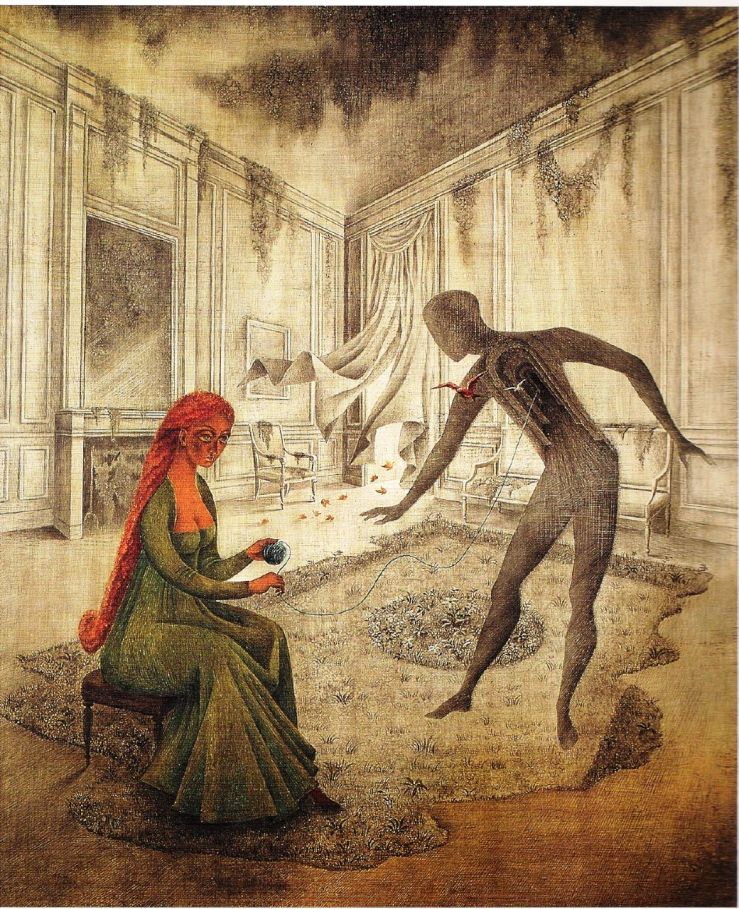
Les Feuilles Mortes — Remedios Varo

Sometimes I Spit with Pleasure on the Portrait of My Mother (Sacred Heart) — Salvador Dali

Agnostic Symbol — Salvador Dali

Cannibalism in Autumn — Salvador Dali

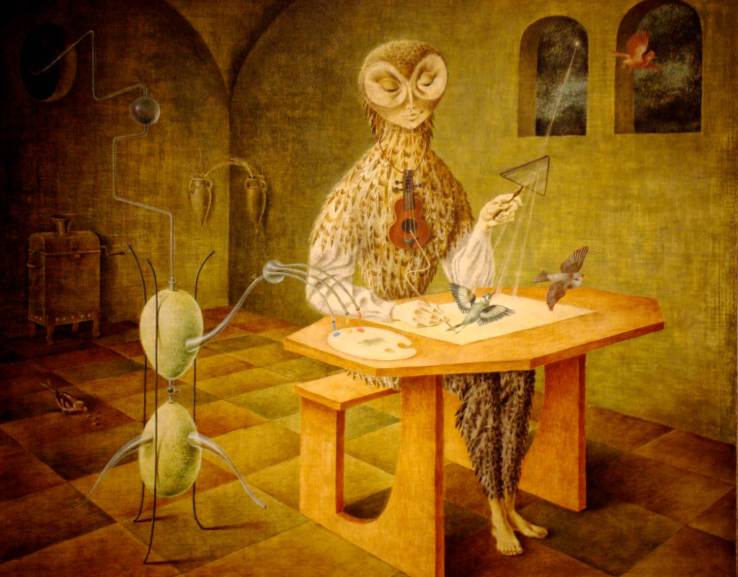
Creation of the Birds — Remedios Varo

Biblioklept Interviews Mahendra Singh About Fitting Lewis Carroll into a Protosurrealist Straitjacket with Matching Dada Cufflinks

Mahendra Singh’s new book is a graphic-novelization of Lewis Carroll’s epic poem The Hunting of the Snark (read our review). Singh was kind enough to talk to us about his project over a series of emails. The Hunting of the Snark is available now in hardback from Melville House. You can read more about Singh’s work at his website.

Biblioklept: Where did your interest in Carroll originate?

Singh: I read the Alice books as a child and only read the Snark when I was a teenager. The Alice’s were fun, as was the Snark, but it also puzzled me at first. It was hard-core Nonsense and it took me a while to digest it, and half-way understand it. It was a great mental stretching exercise, still is. Kids need that sort of thing if they want their brains to grow up to be something besides consumer units.

Alice’s game of Nonsense is really a warm-up to the Snark’s. When Carroll got to the Snark, he’d had a bit of practice and was in top form. The Snark is really Alice 2.0, the more expensive professional upgrade to Nonsense Making.

When I was young, I had odd reading tastes. From 70s SF to Aristophanes to the Ramayana; I was a little piggy. What I usually liked was a complex, completely furnished fictional world, along with a nice musicality with words. What really turned me on was when that fictional world would be logically intertwined with the real world, past or present. In short, one world would be a sort of code for the other.

I think a lot of kids still like that, it’s really the basic premise of most storytelling, although nowadays it is often so deeply monetized and predigested that it’s hard to really enjoy or even benefit from.

In any case, everything Carroll wrote fit my tastes, but the Snark was extra-special, the difference being that this epic poem (the only genuine Victorian epic poem and I’ll defend that claim against all comers), this epic took the Alice premise of mismatching appearances and meaning and took it to its logical conclusion, which itself is another Nonsense paradox doubled upon itself — beware these Carrollian infinite regressions!

In the Snark, the story-telling code of Nonsense is perfected. Most of the elements are still drawn from the familiar, real world but they are so recombined that their appearances and meaning are impossible to decipher anymore. And yet the persistent, nagging feeling of a genuine logic behind it all still remains.

I think for most young people who are thinking things over, the above Snarkian description is a pretty accurate of their budding world view. And anyway, breaking world-codes was pure catnip for me, it’s the essence of reading, good reading anyway.

And I have to mention the poetry. I’ve always loved poetry and Carroll’s verse skills in the Snark are the perfect vehicle for what he’s doing. Their anapestic bounce, their goofy mouth feel (the mouthfeel of Old English poetry charms and chants) make a perfect vehicle for the code. It’s a bit of a music hall, Gilbert & Sullivan feel to what is technically a tragic verse epic.

I wouldn’t say I’m a full-bore Carrollian Obsessive, I’ve met plenty of them and they’re dangerous … quiet, nattily dressed librarians with bow ties and a deadpan penchant for puns and parody. Book editors concealing rural silos crammed full of  highly addictive Carrollian Nonsense. Carrollian Illuminatis cleverly disguised as entomologists hanging out at obscure Snarkian forestry associations.

I’m just a Carrollian Nutter, I’m harmless as long as I have access to drawing materials. And pictures of Snarks.

Biblioklept: You’ve described your work on Snark as “fitting Lewis Carroll into a protosurrealist straitjacket with matching Dada cufflinks.” Why do the techniques of surrealism and Dada lend themselves to Carroll?

Singh: Surrealism is one of those things that everyone can point at but few can define. It’s the idea of awakening the sleeper within us and letting them speak to us in their own dream language of pictures and words. Since dreams are a universal form of memory that draw upon every possible human experience, Surrealism is sort of the simultaneous dream-memory of everything.

Protosurrealism is what I call the comfy, cozy Carrollian straitjacket I’ve trapped my Snark in. Carroll was himself hailed as a protosurrealist by the founding fathers of this odd cult, Breton, Aragon, etc. His work, with its dreamlike logic and free associations entranced them and they regarded him as a unique trail-blazer in their explorations. And his verse, to me, is the epitome of the dream world; all poetry (Nonsense or otherwise) must surely be the natural, Adamic language of dreams!

The Surrealist Max Ernst was an enormous inspiration to me — his technique of using 19th-century engravings to illustrate dream stories is brilliant; the old-fashioned, realistic visual style gives them a jarring sense of authority. Realism is the optimal style of the determined dreamer! The urban dreamscapes and dream-eroded objects of Giorgio de Chirico and his brother, the unjustly neglected Alberto Savinio, were also part of my bag of tricks. And of course, references to Rene Magritte are scattered everywhere in this Snark. Magritte’s various techniques for undermining systems of linguistic and visual meaning are ideally suited to navigating the Carrollian Multiverse.
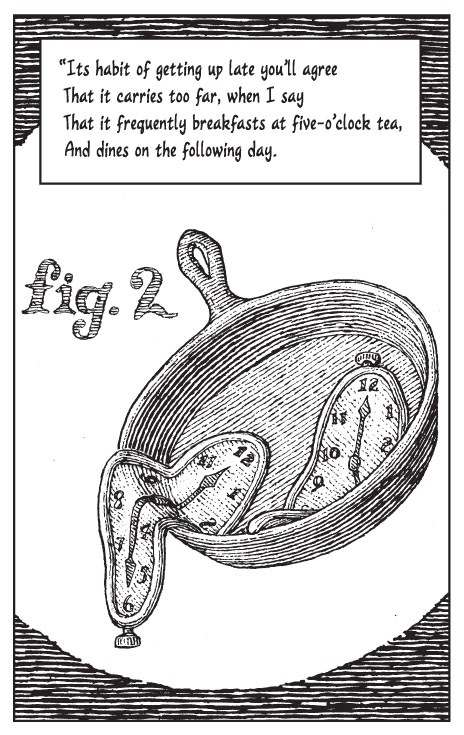
It’s hard to illustrate an idea and oddly enough, the Snark is really a poem of ideas, couched in the form of a tragic epic and then declaimed by a master comedian. One thing I wanted to avoid was doing literal drawings of the scenes in it; I wanted the Snark to constantly bring up a stream of associations, references, insinuations, all of them triggering more and faster allusions, what I call a gateway Surrealism that leaves readers hopelessly addicted and desperate for more! Don’t say no, kids!

I’ll add that protosurrealism is the 21st-century application of 19th-century answers to 20th-century problems. The application is this 21st century Snark, the answers are the Victorian rendering style I used and also Carroll’s entire invention of Victorian Nonsense, and the questions are the existential questions that 20th-century artists couched in the language of Surrealism.

Plus, let’s face it, Surrealism just looks cooler! Who wants a postmodernist or abstract expressionist Snark? And the smart kids love it, they’re still young enough to dare to question the sordid, official version of reality. Which is where Dada comes in — there’s a bit of it in my Snark and it’s there because Dada was the ultimate poke in Western Civ’s eye. If the idea of using a blank map isn’t pure Dada, what is it then?

It’s odd having to discuss this in words, proof positive that the Surrealist project remains unfinished. In a perfect Surrealist world, the meaning of my Snark would bleed out of the book and contaminate the reader’s world until they could not distinguish where the Snark began or reality left off. And that’s the essence of Carrollian Nonsense, fiddling with the logical doors of perception.

Biblioklept: Much of surrealist and Dadaist art seems to be an immediate response to mechanical reproduction. In Snark, you seem to at times be reconfiguring, recombining, recontextualizing otherwise familiar images. How do you work? How do you go about creating your art? Can you describe your process?

Singh: Mechanical reproduction can be a loaded phrase. Walter Benjamin gave it quite the kick in the pants, pointing out that it is a degradation of the cult object, a commodification, etc. But the problem is us, the public. A work of art has absolutely no meaning or value except what the viewer puts into it. This is a very important point. If art is degraded or degrades others, it is our choice.
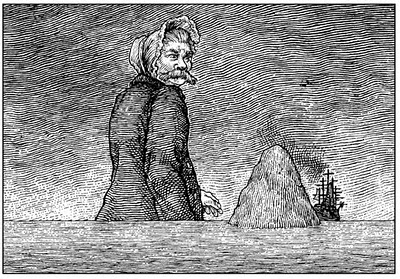
Poor Benjamin, a smart guy but always wriggling back into a Marxist strait-jacket just as useless as medieval Scholasticism or modern neoconservatism. At least Carrollian Nonsense makes the kiddies giggle! He never grasped that all philosophy is individual psychology (and wish-fulfilment) in essence. That’s why the Banker in my Snark is Karl Marx — revenge was sweet! I also included Nietzsche as the Bonnet-maker and Heidegger as the Barrister to round things off. I can assure you, several philosophers were injured in the course of this production. A broken ontology can be quite painful.

Nothing has meaning or value unless we decide it does. For years, readers have puzzled over the meaning behind the Snark. It’s another Carrolian Zen koan : the meaning is the meaning. It’s always been staring us in the face, the meaning of the Snark is a verb, it is to search for meaning and when doing so, one automatically generates a meaniningful purpose just as naturally as a spider ejects its web. Inside this silky web is the comfort of whatever logic you feel up to (and that is the secret pleasure of Carrollian Nonsense) and outside the web is just chaos, a Boojum!

In my Snark I’ve mashed up artists including Hieronymous Bosch, Grünewald, Titian, Théodore Géricault, David, Ingres, even George Herriman and also many Surrealists such as Man Ray, Dali, Magritte, etc. There are musicians and authors, the Beatles and Gilbert and Sullivan, Edgar Allan Poe, the Comte de Lautremont, even Victorian parlor games and optical illusions. The idea was to create a web, a labyrinth of allusions in which to hunt the Snark. Some of the references will be familiar but some will not and the reader, if so inclined, can hunt them down on their own. It’s a hunt within a hunt, another Carrollian regression.

The educational aspect is important to me. I really do hope some of the kids who read this will get curious and start off on their own, pillaging a library, ransacking a museum, sneaking into the opera, whatever turns them on. The smart kids are hungry for culture. We must get them thinking, to get them to manufacture and own their own meanings before a mass-marketing goon does it for them.
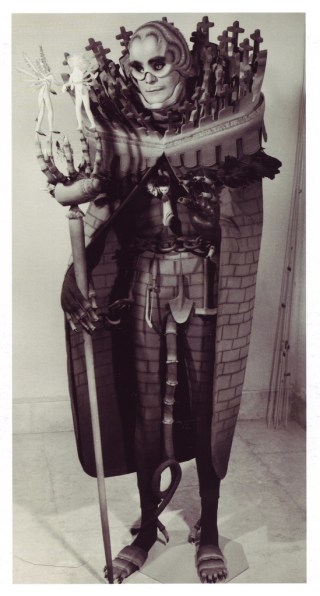
The actual process of creating the imagery was simple, it’s basically me lying on a sofa, maybe a quick snooze and then free-associating while pondering the text. The cover image is a good example, it’s also the illustration for the whiskered Snarks who scratch and the feathered Snarks who bite. This made me think of Old Scratch, the devil, AKA Lucifer, who was once an angel with feathered wings who also showed a nasty tendency to bite the hand that feeds. I had a vague visual memory of seeing a photo of a surrealist devil; I rummaged through some books until I found it — Denise Bellon’s photo of the Québécois Surrealist, Jean Benoit, at a costume party.

The slippers are what caught my eye, it made me think of Old Scratch lounging at home in Pandemonium, his day off, not bothering to shave, hence the whiskers that scratch. I made the toes unequal on a lark, it just seemed right to have Satan misshapen but afterwards I came up with a cabalistic explanation which I won’t bore you with for now.

I then did a pencil drawing on tissue paper, constantly refining and adding or deleting, this was the slowest part of the entire Snark, the pencils. Afterwards I did the pen and ink drawing atop the tissue, on Denril, a synthetic vellum. This is an old technical illustrator’s work habit, which is how I started out actually, in the 80s.

This business of free associating while simultaneously referring to one’s internal visual memory is only possible if one has spent many years romping though books and museums. You cannot be a serious illustrator if you don’t read and look voraciously, all the time. And above all, don’t look at too much rubbish or you will start drawing rubbish. Art students reading this, take heed! You are what you see.

Recombining Surrealism and other –isms, along with the free associations triggered by Carroll’s Nonsense verse, creates a matrix which allows the reader to move seamlessly back and forth between the worlds of dreams, culture, memory and emotion. Those readers who catch the references will enjoy the historical and even non-verbal logic binding them, the rest is up to you.

You are really bringing the meaning with you, and when confronted by my Snark I hope it triggers a cascade of free associations, a mental phenomenon which is the precursor to dreaming, the royal road of Surrealism and Carrollian Nonsense.

Biblioklept: How does your work respond to the nine illustrations by Henry Holiday that originally accompanied Carroll’s text?

Singh: Holiday’s illustrations are odd things, I’ve never been very keen on them. He was a graceful artist usually, very talented and yet these drawings are a bit grotesque, ugly perhaps. They just don’t look so appealing to me. The technique is flawless though, a very classic British style of line work that lasted well into the 1940s.

Some Snarkologists believe that Holiday worked with Carroll to hide a secret meaning in the art. Angles and distances have been measured, objects analysed,  hidden shapes discovered and reconfigured. Who knows? It’s unlikely but in any case, you can’t avoid Holiday if you’re doing the Snark.

I used some of his symbols, the bare-breasted woman and her anchor representing Hope, a very british motif which suits the nautical nature of much of the quest. His picture of the Beaver doing its math problem inspired me to treat that entire Fit the Fifth as a long variation upon the Temptation of St. Anthony, especially the version by Bosch. Holiday really nailed that one. I have to confess that Flaubert’s version is a favorite book of mine and I tried to give this part of the Snark the same baroque, over the top feeling of deranged pagan vs. Christian imagery.

Holiday also crammed a considerable number of small details in the Beaver illustration. It’s quite a contrast to the style of the other big Carroll illustrator, Sir John Tenniel, who favored a cleaner look. Nowadays this technique is called “chicken fat” and I used a lot of chicken fat in my Snark, more than Holiday. Of course, with only 9 drawings, he had to keep to a slower visual tempo. That was another reason I did it as a graphic novel — I could vary the tempo quite a bit and really overwhelm the reader with chicken fat when the verses demanded it.

On the other hand, doing it as a graphic novel required creating a narrative visual thread through the whole thing, something which Holiday really didn’t need. In this case, my idea was to make it a theatrical presentation, each Fit a new set change until the end, when Carroll is revealed as the spectator in the empty hall. Carroll was fond of theatricals and the Snark does have a stagey feel to it anyway.

Biblioklept: Have you ever stolen a book?

Singh: Yes, Aces High, a lavishly illustrated book about British fighter pilot aces of WWI. It once graced the shelves of the high school I once attended in a desultory manner (myself, not the book). I was, and still am, fascinated by all things aviation and I could not bear the sight of that wonderful book languishing there, unremarked, unappreciated. I still know the difference between a Sopwith Pup and a Sopwith Camel and I love a well-executed Immelman at the crack of dawn. It was wrong to do and I can only plead callow youth in my defence. Don’t do it, kids! It isn’t worth it! Gosh, I hope Mrs. Merrill isn’t reading this . .  .

Henry Miller on Surrealism, Lewis Carroll, and Dada

Henry Miller, in a 1962 Paris Review interview, speaks about surrealism, dada, and his love for Lewis Carroll

INTERVIEWER

In “An Open Letter to Surrealists Everywhere” you say, “I was writing surrealistically in America before I ever heard the word.” Now, what do you mean by surrealism?

MILLER

When I was living in Paris, we had an expression, a very American one, which in a way explains it better than anything else. We used to say, “Let’s take the lead.” That meant going off the deep end, diving into the unconscious, just obeying your instincts, following your impulses, of the heart, or the guts, or whatever you want to call it. But that’s my way of putting it, that isn’t really surrealist doctrine; that wouldn’t hold water, I’m afraid, with an André Breton. However, the French standpoint, the doctrinaire standpoint, didn’t mean too much to me. All I cared about was that I found in it another means of expression, an added one, a heightened one, but one to be used very judiciously. When the well-known surrealists employed this technique, they did it too deliberately, it seemed to me. It became unintelligible, it served no purpose. Once one loses all intelligibility, one is lost, I think.

INTERVIEWER

Is surrealism what you mean by the phrase “into the night life”?

MILLER

Yes, there it was primarily the dream. The surrealists make use of the dream, and of course that’s always a marvelous fecund aspect of experience. Consciously or unconsciously, all writers employ the dream, even when they’re not surrealists. The waking mind, you see, is the least serviceable in the arts. In the process of writing one is struggling to bring out what is unknown to himself. To put down merely what one is conscious of means nothing, really, gets one nowhere. Anybody can do that with a little practice, anybody can become that kind of writer.

INTERVIEWER

You have called Lewis Carroll a surrealist, and his name suggests the kind of jabberwocky which you use occasionally . . .

MILLER

Yes, yes, of course Lewis Carroll is a writer I love. I would give my right arm to have written his books, or to be able to come anywhere near doing what he did. When I finish my project, if I continue writing, I would love to write sheer nonsense.

INTERVIEWER

What about Dadaism? Did you ever get into that?

MILLER

Yes, Dadaism was even more important to me than surrealism. The Dadaist movement was something truly revolutionary. It was a deliberate conscious effort to turn the tables upside down, to show the absolute insanity of our present-day life, the worthlessness of all our values. There were wonderful men in the Dadaist movement, and they all had a sense of humor. It was something to make you laugh, but also to make you think.

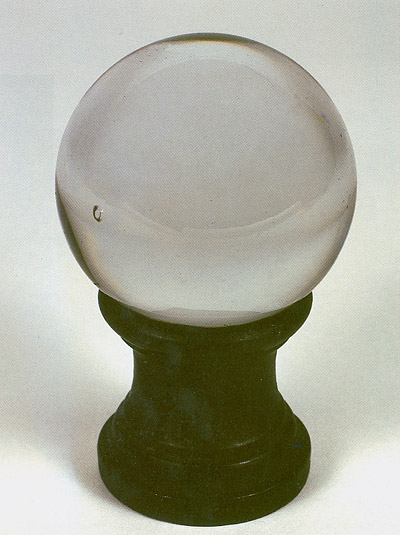
André Breton’s Crystal Ball

More info here.

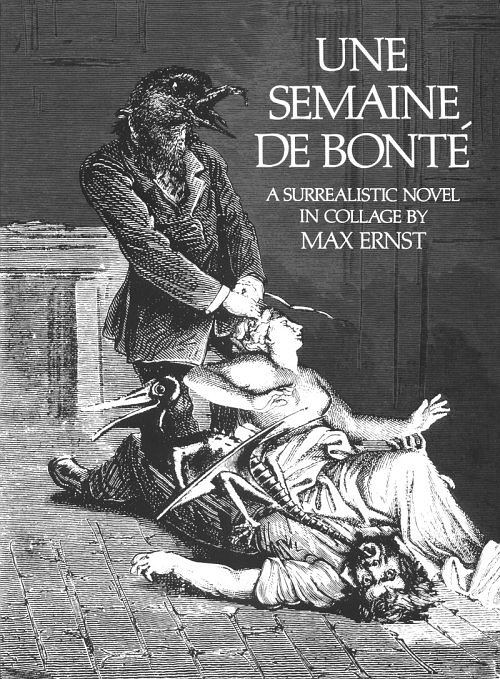
Une Semaine de Bonté — Max Ernst

semaine

Max Ernst’s graphic novel, Une Semaine de Bonté, is one of the coolest books I own. Comprised of concise collages utilizing black and white images from periodicals and catalogs, Ernst’s narrative is both engrossing and disturbing. Full of birds and breasts and beasts, Semaine plays out like a weird, violent, funny mindfuck, its repeated scenes of submission and domination ironizing its title (A Week of Kindness). Great stuff. There’s a decent enough chunk of the book available for preview at Google Books.