There is a theory going around that the U.S.A. was and still is a gigantic Masonic plot under the ultimate control of the group known as the Illuminati (Gravity’s Rainbow)

There is a theory going around that the U.S.A. was and still is a gigantic Masonic plot under the ultimate control of the group known as the Illuminati. It is difficult to look for long at the strange single eye crowning the pyramid which is found on every dollar bill and not begin to believe the story, a little. Too many anarchists in 19th-century Europe—Bakunin, Proudhon, Salverio Friscia—were Masons for it to be pure chance. Lovers of global conspiracy, not all of them Catholic, can count on the Masons for a few good shivers and voids when all else fails. One of the best of the classic Weird Mason Stories has Doctor Livingstone (living stone? oh, yes) come wandering into a native village in, not even the heart, but the subconscious of Darkest Africa, a place, a tribe he’s never seen before: fires in the silence, unfathomable stares, Livingstone ambles up to the village chief and flashes him a Masonic high sign—the chief recognizes it, returns it, all smiles, and orders every fraternal hospitality laid on for the white stranger. But recall that Dr. Livingstone, like Wernher von Braun, was born close to the Spring Equinox, and so had to confront the world from that most singular of the Zodiac’s singular points… . Well, and keep in mind where those Masonic Mysteries came from in the first place. (Check out Ishmael Reed. He knows more about it than you’ll ever find here.)

We must also never forget famous Missouri Mason Harry Truman: sitting by virtue of death in office, this very August 1945, with his control-finger poised right on Miss Enola Gay’s atomic clit, making ready to tickle 100,000 little yellow folks into what will come down as a fine vapor-deposit of fat-cracklings wrinkled into the fused rubble of their city on the Inland Sea… .


From Thomas Pynchon’s Gravity’s Rainbow.

One Possible Sequence for Reading Thomas Pynchon’s Novels, Presented Without Remarks

Mason & Dixon

Against the Day

Gravity’s Rainbow

V.

The Crying of Lot 49

Inherent Vice

Vineland

Bleeding Edge

Brief internal feminist critique (perhaps) of Gravity’s Rainbow

tnagr

From page 507 of Thomas Pynchon’s novel Gravity’s Rainbow.

The Mother Conspiracy (Gravity’s Rainbow)

Otto is earnestly explaining his views on the Mother Conspiracy. It’s not often a sympathetic girl will listen. The Mothers get together once a year, in secret, at these giant conventions, and exchange information. Recipes, games, key phrases to use on their children. “What did yours use to say when she wanted to make you feel guilty?”

“‘I’ve worked my fingers to the bone!’” sez the girl.

“Right! And she used to cook those horrible casseroles, w-with the potatoes, and onions—”

“And ham! Little pieces of ham—”

“You see, you see? That can’t be accidental! They have a contest, for Mother of the Year, breast-feeding, diaper-changing, they time them, casserole competitions, ja—then, toward the end, they actually begin to use the children. The State Prosecutor comes out on stage. ‘In a moment, Albrecht, we are going to bring your mother on. Here is a Luger, fully loaded. The State will guarantee you absolute immunity from prosecution. Do whatever you wish to do—anything at all. Good luck, my boy.’ The pistols are loaded with blanks, natürlich, but the unfortunate child does not know this. Only the mothers who get shot at qualify for the finals.

Here they bring in psychiatrists, and judges sit with stopwatches to see how quickly the children will crack. ‘Now then, Olga, wasn’t it nice of Mutti to break up your affair with that long-haired poet?’ ‘We understand your mother and you are, ah, quite close, Hermann. Remember the time she caught you masturbating into her glove? Eh?’ Hospital attendants stand by to drag the children off, drooling, screaming, having clonic convulsions. Finally there is only one Mother left on stage. They put the traditional flowered hat on her head, and hand her the orb and scepter, which in this case are a gilded pot roast and a whip, and the orchestra plays Tristan und Isolde.

From Thomas Pynchon’s novel Gravity’s Rainbow.

Anti-paranoia (Gravity’s Rainbow)

Rain drips, soaking into the floor, and Slothrop perceives that he is losing his mind. If there is something comforting—religious, if you want—about paranoia, there is still also anti-paranoia, where nothing is connected to anything, a condition not many of us can bear for long. Well right now Slothrop feels himself sliding onto the anti-paranoid part of his cycle, feels the whole city around him going back roofless, vulnerable, uncentered as he is, and only pasteboard images now of the Listening Enemy left between him and the wet sky.

Either They have put him here for a reason, or he’s just here. He isn’t sure that he wouldn’t, actually, rather have that reason…

From Thomas Pynchon’s novel Gravity’s Rainbow. The “pasteboard images” line recalls a favorite passage of Moby-Dick.

Reading/Have Read/Should Write About

All of this is basically reading around/between/over Gravity’s Rainbow:

Rereading Roberto Bolaño’s Nazi Literature in the Americas again. (I reviewed it here on this blog over five goddamn years ago). I want to read 2666 (yet) again, so this is…I don’t know…a staving off against that urge?

Yuri Herrera’s excellent novella Signs Preceding the End of the World also makes me want to read 2666. You should read this book (Signs, but also 2666). I will write a Full Goddamn Review—but excellent. Get it from And Other Stories.

Reading GR interspersed with short (often very short) stories from the collection Africa 39—two hits, a miss, and a shrug so far. More thoughts to come.

Can’t and Won’t by Lydia Davis. Like a palate cleanser. Wait. Not the right term. I mean, like, a sorbet—tasteful, tasty, snappy, bright. There are some longer pieces at the end, I see, that I will not get to for awhile. More to come—but let’s get real, you either like what Davis does or you don’t and your indifference, like all indifference, is uninteresting, but not boring or damning, let alone an indictment of your beautiful character. Chill.

David Winters’s collection Infinite Fictions. Damn him! Not really. This book is great—the book I wish that I had written.

I have tried and failed to write about Jason Schwartz’s first book A German Picturesque four goddamn times now.

I don’t think I will even try to write about Gravity’s Rainbow. (Unless I do try).

Look at Borges (Pynchon’s Gravity’s Rainbow)

In the days of the gauchos, my country was a blank piece of paper. The pampas stretched as far as men could imagine, inexhaustible, fenceless. Wherever the gaucho could ride, that place belonged to him. But Buenos Aires sought hegemony over the provinces. All the neuroses about property gathered strength, and began to infect the countryside. Fences went up, and the gaucho became less free. It is our national tragedy. We are obsessed with building labyrinths, where before there was open plain and sky. To draw ever more complex patterns on the blank sheet. We cannot abide that openness: it is terror to us. Look at Borges. Look at the suburbs of Buenos Aires. The tyrant Rosas has been dead a century, but his cult flourishes. Beneath the city streets, the warrens of rooms and corridors, the fences and the networks of steel track, the Argentine heart, in its perversity and guilt, longs for a return to that first unscribbled serenity… that anarchic oneness of pampas and sky…

From Thomas Pynchon’s novel Gravity’s Rainbow.

The official lie (Gravity’s Rainbow)

What did Caesar really whisper to his protégé as he fell? Et tu, Brute, the official lie, is about what you’d expect to get from them—it says exactly nothing. The moment of assassination is the moment when power and the ignorance of power come together, with Death as validator. When one speaks to the other then it is not to pass the time of day with et-tu-Brutes. What passes is a truth so terrible that history—at best a conspiracy, not always among gentlemen, to defraud—will never admit it. The truth will be repressed or in ages of particular elegance be disguised as something else. What will Rathenau, past the moment, years into a new otherside existence, have to say about the old dispensation? Probably nothing as incredible as what he might have said just as the shock flashed his mortal nerves, as the Angel swooped in…

From Thomas Pynchon’s novel Gravity’s Rainbow.

The extinction of the dodo (Pynchon’s Gravity’s Rainbow)

He left the dodoes to rot, he couldn’t endure to eat their flesh. Usually, he hunted alone. But often, after months of it, the isolation would begin to change him, change his very perceptions—the jagged mountains in full daylight flaring as he watched into freak saffrons, streaming indigos, the sky his glass house, all the island his tulipomania. The voices—he insomniac, southern stars too thick for constellations teeming in faces and creatures of fable less likely than the dodo—spoke the words of sleepers, singly, coupled, in chorus. The rhythms and timbres were Dutch, but made no waking sense. Except that he thought they were warning him… scolding, angry that he couldn’t understand. Once he sat all day staring at a single white dodo’s egg in a grass hummock. The place was too remote for any foraging pig to’ve found. He waited for scratching, a first crack reaching to net the chalk surface: an emergence. Hemp gripped in the teeth of the steel snake, ready to be lit, ready to descend, sun to black-powder sea, and destroy the infant, egg of light into egg of darkness, within its first minute of amazed vision, of wet downstirred cool by these south-east trades… . Each hour he sighted down the barrel. It was then, if ever, he might have seen how the weapon made an axis potent as Earth’s own between himself and this victim, still one, inside the egg, with the ancestral chain, not to be broken out for more than its blink of world’s light. There they were, the silent egg and the crazy Dutchman, and the hookgun that linked them forever, framed, brilliantly motionless as any Vermeer. Only the sun moved: from zenith down at last behind the snaggleteeth of mountains to Indian ocean, to tarry night. The egg, without a quiver, still unhatched. He should have blasted it then where it lay: he understood that the bird would hatch before dawn. But a cycle was finished. He got to his feet, knee and hip joints in agony, head gonging with instructions from his sleeptalkers droning by, overlapping, urgent, and only limped away, piece at right shoulder arms.

Continue reading “The extinction of the dodo (Pynchon’s Gravity’s Rainbow)”

Control (Gravity’s Rainbow)

It’s control. All these things arise from one difficulty: control. For the first time it was inside, do you see. The control is put inside. No more need to suffer passively under ‘outside forces’—to veer into any wind. As if…A market needed no longer be run by the Invisible Hand, but now could create itself—its own logic, momentum, style, from inside. Putting the control inside was ratifying what de facto had happened—that you had dispensed with God. But you had taken on a greater, and more harmful, illusion. The illusion of control. That A could do B. But that was false. Completely. No one can do. Things only happen, A and B are unreal, are names for parts that ought to be inseparable…

From Thomas Pynchon’s novel Gravity’s Rainbow.

A rambling and possibly incoherent riff on Inherent Vice (film and novel) and The Crying of Lot 49

IMG_0200

A. The first time I saw Paul Thomas Anderson’s film Inherent Vice, I was in the middle of rereading Pynchon’s novel The Crying of Lot 49, which I hadn’t read in fifteen years. I remembered the novel’s vibe, its milieu, but not really its details.

B. I read The Crying of Lot 49 and then immediately reread it. It seemed much stronger the second time—not nearly as silly. Darker. Oedipa Maas, precursor to Doc Sportello, trying not to lose the thread as she leaves the tower for the labyrinth, rushing dizzy into the sixties.

C. Another way of saying this: Inherent Vice is sequel to The Crying of Lot 49. Any number of details substantiate this claim (and alternately unravel it, if you wish, but let’s not travel there)—we could focus on the settings, sure, or maybe the cabals lurking in the metaphorical shadows of each narrative—is The Golden Fang another iteration of The Tristero?—but let me focus on the conclusions of both novels and then discuss the conclusion of PTA’s film.

D. A favorite line from a favorite passage from The Crying of Lot 49: “the true paranoid for whom all is organized in spheres joyful or threatening about the central pulse of himself.” Paranoia as a kind of sustained hope, a way to find meaning, order, a center.

E. The final pages of The Crying of Lot 49 find Oedipa trying to make sense of the labyrinth (my emphases in bold):

For it was now like walking among matrices of a great digital computer, the zeroes and ones twinned above, hanging like balanced mobiles right and left, ahead, thick, maybe endless. Behind the hieroglyphic streets there would either be a transcendent meaning, or only the earth. In the songs Miles, Dean, Serge and Leonard sang was either some fraction of the truth’s numinous beauty (as Mucho now believed) or only a power spectrum. Tremaine the Swastika Salesman’s reprieve from holocaust was either an injustice, or the absence of a wind; the bones of the GI’s at the bottom of Lake Inverarity were there either for a reason that mattered to the world, or for skin divers and cigarette smokers. Ones and zeroes. So did the couples arrange themselves. At Vesperhaven House either an accommodation reached, in some kind of dignity, with the Angel of Death, or only death and the daily, tedious preparations for it. Another mode of meaning behind the obvious, or none. Either Oedipa in the orbiting ecstasy of a true paranoia, or a real Tristero. For there either was some Tristero beyond the appearance of the legacy America, or there was just America and if there was just America then it seemed the only way she could continue, and manage to be at all relevant to it, was as an alien, unfurrowed, assumed full circle into some paranoia.

There is either meaning, or there is not meaning. Continue reading “A rambling and possibly incoherent riff on Inherent Vice (film and novel) and The Crying of Lot 49”

Live long and prosper (Pynchon’s Mason & Dixon)

One day, the Meridian having been closely enough establish’d, and with an hour or two of free time available to them, one heads north, one south, and ’tis Dixon’s luck to discover The Rabbi of Prague, headquarters of a Kabbalistick Faith, in Correspondence with the Elect Cohens of Paris, whose private Salute they now greet Dixon with, the Fingers spread two and two, and the Thumb held away from them likewise, said to represent the Hebrew letter Shin and to signify, “Live long and prosper.” The area just beyond the next Ridge is believ’d to harbor a giant Golem, or Jewish Automaton, taller than the most ancient of the Trees. As explain’d to Dixon, ’twas created by an Indian tribe widely suppos’d to be one of the famous Lost Tribes of Israel, who had somehow given up control of the Creature, sending it headlong into the Forest, where it would learn of its own gift of Mobile Invisibility.

“And . . . do you folk wear Special Hats, anything like that?” inquires Dixon.

From Thomas Pynchon’s novel Mason & Dixon. (More/some context).

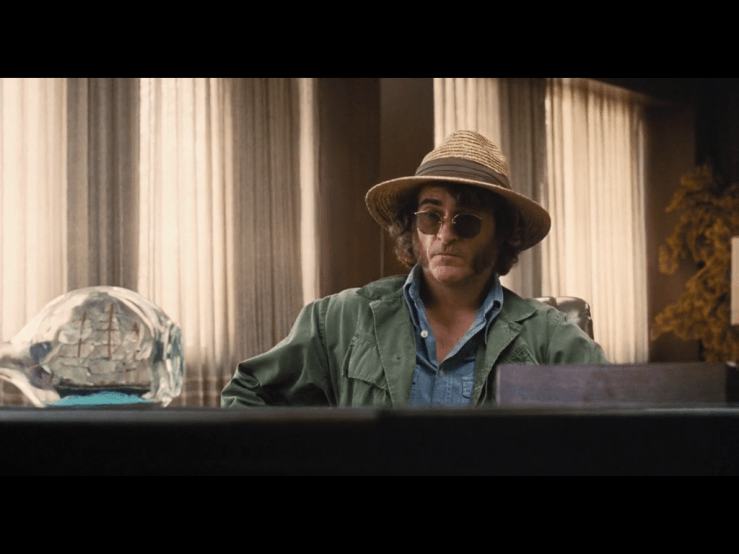
Ship in a bottle (Inherent Vice)

Ship in a bottle (Inherent Vice)

Paul Thomas Anderson’s Inherent Vice Screenplay

Capture


You can (legally) download Paul Thomas Anderson’s screenplay for his adaptation of Thomas Pynchon’s Inherent Vice(Via, via, via).

There is no avoiding time (Pynchon’s Inherent Vice)

Sauncho was giving a kind of courtroom summary, as if he’d just been handling a case. “. . . yet there is no avoiding time, the sea of time, the sea of memory and forgetfulness, the years of promise, gone and unrecoverable, of the land almost allowed to claim its better destiny, only to have the claim jumped by evildoers known all too well, and taken instead and held hostage to the future we must live in now forever. May we trust that this blessed ship is bound for some better shore, some undrowned Lemuria, risen and redeemed, where the American fate, mercifully, failed to transpire . . .”

From Thomas Pynchon’s Inherent Vice. The passage, near the end of the novel, acts as a summary—or rather one of several summaries—to Inherent Vice’s shaggy plot. The blessed ship is The Golden Fang, aka Preserved. I’ve been sketching out a riff on Inherent Vice the novel, Inherent Vice the film, and The Crying of Lot 49. (This passage also kinda sorta summarizes The Crying of Lot 49. And Mason & Dixon).

Because It’s So Damn Cold, Donald Barthelme’s Recipes for Fine Homemade Oxtail Soup and Fine Homemade Leek Soup

In his introduction to The Teachings of Don B, Thomas Pynchon praises Donald Barthelme’s soups:

Those recipes. That oxtail soup mix. That “burgoo,” with the frozen ducks in it? A notable moment in chef psychopathology, to be sure — yet such is Barthelme’s genius that even the most porkophobic or duck-intolerant among us is drooling, unashamed, by recipe’s end.

I don’t own The Teachings of Don B, but Pynchon’s description (which I found while looking for something entirely different) piqued my interest (first and foremost: was the recipe even a real thing?). Anyway: Via Maude Newton, via Overnight to Many Distant Cities, and then an additional Google search to The Purest of Treats:

FINE HOMEMADE OXTAIL SOUP

Take Knorr Oxtail Soupmix, decant into same any leftover meat (sliced or diced) from the old refrigerator. Follow above strategies to the letter. The result will make you happy. Knorr’s Oxtail is also good as a basic gravy maker and constituent of a fine fake cassoulet about which we can talk at another time. Knorr is a very good Swiss outfit whose products can be found in both major and minor cities. The point here is not to be afraid of the potential soup but to approach it with the attitude that you know what’s best for it. And you do. The rawness of the vegetables refreshes the civilization of the Soupmixes. And there are opportunities for mercy–if your ox does not wish to part with his tail, for example, to dress up your fine Oxtail Soup, you can use commercial products from our great American supermarkets, which will be almost as good.

And if you’re into Lenten observation:

FINE HOMEMADE LEEK SOUP

Take one package Knorr Leek Soupmix. Prepare as directed. Take two live leeks. Chop leeks into quarter-inch rounds. Throw into Soupmix. Throw in ½ cup Tribuno Dry Vermouth. Throw in chopped parsley. Throw in some amount of salt and a heavy bit of freshly ground pepper. Eat with good-quality French bread, dipped repeatedly in soup.

(See also: Gordon Lish’s recipe for chicken soup).