“Edgar Poe’s Significance” — Walt Whitman

“Edgar Poe’s Significance” by Walt Whitman. From Specimen Days.

Jan. 1, ’80.—In diagnosing this disease called humanity—to assume for the nonce what seems a chief mood of the personality and writings of my subject—I have thought that poets, somewhere or other on the list, present the most mark’d indications. Comprehending artists in a mass, musicians, painters, actors, and so on, and considering each and all of them as radiations or flanges of that furious whirling wheel, poetry, the centre and axis of the whole, where else indeed may we so well investigate the causes, growths, tally-marks of the time—the age’s matter and malady?

By common consent there is nothing better for man or woman than a perfect and noble life, morally without flaw, happily balanced in activity, physically sound and pure, giving its due proportion, and no more, to the sympathetic, the human emotional element—a life, in all these, unhasting, unresting, untiring to the end. And yet there is another shape of personality dearer far to the artist-sense, (which likes the play of strongest lights and shades,) where the perfect character, the good, the heroic, although never attain’d, is never lost sight of, but through failures, sorrows, temporary downfalls, is return’d to again and again, and while often violated, is passionately adhered to as long as mind, muscles, voice, obey the power we call volition. This sort of personality we see more or less in Burns, Byron, Schiller, and George Sand. But we do not see it in Edgar Poe. (All this is the result of reading at intervals the last three days a new volume of his poems—I took it on my rambles down by the pond, and by degrees read it all through there.) While to the character first outlined the service Poe renders is certainly that entire contrast and contradiction which is next best to fully exemplifying it.

Almost without the first sign of moral principle, or of the concrete or its heroisms, or the simpler affections of the heart, Poe’s verses illustrate an intense faculty for technical and abstract beauty, with the rhyming art to excess, an incorrigible propensity toward nocturnal themes, a demoniac undertone behind every page—and, by final judgment, probably belong among the electric lights of imaginative literature, brilliant and dazzling, but with no heat. There is an indescribable magnetism about the poet’s life and reminiscences, as well as the poems. To one who could work out their subtle retracing and retrospect, the latter would make a close tally no doubt between the author’s birth and antecedents, his childhood and youth, his physique, his so-call’d education, his studies and associates, the literary and social Baltimore, Richmond, Philadelphia and New York, of those times—not only the places and circumstances in themselves, but often, very often, in a strange spurning of, and reaction from them all.

The following from a report in the Washington “Star” of November 16, 1875, may afford those who care for it something further of my point of view toward this interesting figure and influence of our era. There occurr’d about that date in Baltimore a public reburial of Poe’s remains, and dedication of a monument over the grave:

“Being in Washington on a visit at the time, ‘the old gray’ went over to Baltimore, and though ill from paralysis, consented to hobble up and silently take a seat on the platform, but refused to make any speech, saying, ‘I have felt a strong impulse to come over and be here to-day myself in memory of Poe, which I have obey’d, but not the slightest impulse to make a speech, which, my dear friends, must also be obeyed.’ In an informal circle, however, in conversation after the ceremonies, Whitman said: ‘For a long while, and until lately, I had a distaste for Poe’s writings. I wanted, and still want for poetry, the clear sun shining, and fresh air blowing—the strength and power of health, not of delirium, even amid the stormiest passions—with always the background of the eternal moralities. Non-complying with these requirements, Poe’s genius has yet conquer’d a special recognition for itself, and I too have come to fully admit it, and appreciate it and him.

“‘In a dream I once had, I saw a vessel on the sea, at midnight, in a storm. It was no great full-rigg’d ship, nor majestic steamer, steering firmly through the gale, but seem’d one of those superb little schooner yachts I had often seen lying anchor’d, rocking so jauntily, in the waters around New York, or up Long Island sound—now flying uncontroll’d with torn sails and broken spars through the wild sleet and winds and waves of the night. On the deck was a slender, slight, beautiful figure, a dim man, apparently enjoying all the terror, the murk, and the dislocation of which he was the centre and the victim. That figure of my lurid dream might stand for Edgar Poe, his spirit, his fortunes, and his poems—themselves all lurid dreams.'”

Much more may be said, but I most desired to exploit the idea put at the beginning. By its popular poets the calibres of an age, the weak spots of its embankments, its sub-currents, (often more significant than the biggest surface ones,) are unerringly indicated. The lush and the weird that have taken such extraordinary possession of Nineteenth century verse-lovers—what mean they? The inevitable tendency of poetic culture to morbidity, abnormal beauty—the sickliness of all technical thought or refinement in itself—the abnegation of the perennial and democratic concretes at first hand, the body, the earth and sea, sex and the like—and the substitution of something for them at second or third hand—what bearings have they on current pathological study?

“Birds and Birds and Birds” — Walt Whitman

A little later—bright weather.—An unusual melodiousness, these days, (last of April and first of May) from the blackbirds; indeed all sorts of birds, darting, whistling, hopping or perch’d on trees. Never before have I seen, heard, or been in the midst of, and got so flooded and saturated with them and their performances, as this current month. Such oceans, such successions of them. Let me make a list of those I find here:

Black birds (plenty,) Meadow-larks (plenty,)
Ring doves, Cat-birds (plenty,)
Owls, Cuckoos,
Woodpeckers, Pond snipes (plenty,)
King-birds, Cheewinks,
Crows (plenty,) Quawks,
Wrens, Ground robins,
Kingfishers, Ravens,
Quails, Gray snipes,
Turkey-buzzards, Eagles,
Hen-hawks, High-holes,
Yellow birds, Herons,
Thrushes, Tits,
Reed birds, Woodpigeons.

Early came the

Blue birds, Meadow-lark,
Killdeer, White-bellied swallow,
Plover, Sandpiper,
Robin, Wilson’s thrush,
Woodcock, Flicker.

From Walt Whitman’s Specimen Days.


“Literary Indecencies” — H.L. Mencken

The low, graceless humor of names! On my shelf of poetry, arranged by the alphabet, Coleridge and J. Gordon Cooglar are next-door neighbors! Mrs. Hemans is beside Laurence Hope! Walt Whitman rubs elbows with Ella Wheeler Wilcox; Robert Browning with Richard Burton; Rossetti with Cale Young Rice; Shelly with Clinton Scollard; Wordsworth with George E. Woodberry; John Keats with Herbert Kaufman!

Ibsen, on the shelf of dramatists, is between Victor Hugo and Jerome K. Jerome. Sudermann follows Harriet Beecher Stowe. Maeterlinck shoulders Percy Mackaye. Shakespeare is between Sardou and Shaw. Euripides and Clyde Fitch! Upton Sinclair and Sophocles! Aeschylus and F. Anstey! D’Annunzio and Richard Harding Davis! Augustus Thomas and Tolstoi!

More alphabetical humor. Gerhart Hauptmann and Robert Hichens; Voltaire and Henry Van Dyke; Flaubert and John Fox, Jr.; Balzac and John Kendrick Bangs; Ostrovsky and E. Phillips Oppenheim; Elinor Glyn and Théophile Gautier; Joseph Conrad and Robert W. Chambers; Zola and Zangwill!…

Midway on my scant shelf of novels, between George Moore and Frank Norris, there is just room enough for the two volumes of “Derringforth,” by Frank A. Munsey.

“Literary Indecencies,” a chapter from H.L. Mencken’s collection Damn!


Walt Whitman: American Experience (Full Documentary)

Portrait of Walt Whitman — Thomas Eakins

Ticket of Admission to a Lecture by Walt Whitman on Abraham Lincoln

Ticket of admission to a lecture by Walt Whitman on Abraham Lincoln,"  initialed by Whitman at lower right. Lecture "to be delivered on Thursday, April 14th [1887], at 4 o'clock P. M., in the Madison Square Theatre, New-York."

(Via/about).

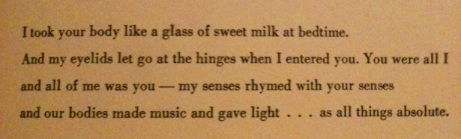
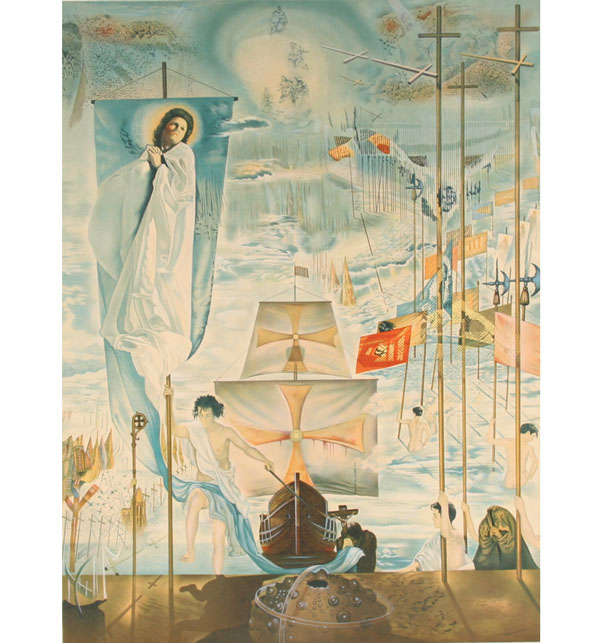
Anthems in New Tongues I Hear Saluting Me (Whitman/Dali)


Salvador Dali Museum.
Salvador Dalí, The Discovery of America by Christopher Columbus

“Prayer of Columbus” by Walt Whitman

A batter’d, wreck’d old man,
Thrown on this savage shore, far, far from home,
Pent by the sea and dark rebellious brows, twelve dreary months,
Sore, stiff with many toils, sicken’d and nigh to death,
I take my way along the island’s edge,
Venting a heavy heart.
I am too full of woe!
Haply I may not live another day;
I cannot rest O God, I cannot eat or drink or sleep,
Till I put forth myself, my prayer, once more to Thee,
Breathe, bathe myself once more in Thee, commune with Thee,
Report myself once more to Thee.
Thou knowest my years entire, my life,
My long and crowded life of active work, not adoration merely;
Thou knowest the prayers and vigils of my youth,
Thou knowest my manhood’s solemn and visionary meditations,
Thou knowest how before I commenced I devoted all to come to Thee,
Thou knowest I have in age ratified all those vows and strictly kept them,
Thou knowest I have not once lost nor faith nor ecstasy in Thee,
In shackles, prison’d, in disgrace, repining not,
Accepting all from Thee, as duly come from Thee.
All my emprises have been fill’d with Thee,
My speculations, plans, begun and carried on in thoughts of Thee,
Sailing the deep or journeying the land for Thee;
Intentions, purports, aspirations mine, leaving results to Thee.
O I am sure they really came from Thee,
The urge, the ardor, the unconquerable will,

The potent, felt, interior command, stronger than words,

A message from the Heavens whispering to me even in sleep,
These sped me on.
By me and these the work so far accomplish’d,
By me earth’s elder cloy’d and stifled lands uncloy’d, unloos’d,
By me the hemispheres rounded and tied, the unknown to the known.
The end I know not, it is all in Thee,
Or small or great I know not–haply what broad fields, what lands,
Haply the brutish measureless human undergrowth I know,
Transplanted there may rise to stature, knowledge worthy Thee,
Haply the swords I know may there indeed be turn’d to reaping-tools,
Haply the lifeless cross I know, Europe’s dead cross, may bud and
blossom there.
One effort more, my altar this bleak sand;
That Thou O God my life hast lighted,
With ray of light, steady, ineffable, vouchsafed of Thee,
Light rare untellable, lighting the very light,
Beyond all signs, descriptions, languages;
For that O God, be it my latest word, here on my knees,
Old, poor, and paralyzed, I thank Thee.
My terminus near,
The clouds already closing in upon me,
The voyage balk’d, the course disputed, lost,
I yield my ships to Thee.
My hands, my limbs grow nerveless,
My brain feels rack’d, bewilder’d,
Let the old timbers part, I will not part,
I will cling fast to Thee, O God, though the waves buffet me,
Thee, Thee at least I know.
Is it the prophet’s thought I speak, or am I raving?
What do I know of life? what of myself?
I know not even my own work past or present,
Dim ever-shifting guesses of it spread before me,
Of newer better worlds, their mighty parturition,
Mocking, perplexing me.
And these things I see suddenly, what mean they?
As if some miracle, some hand divine unseal’d my eyes,
Shadowy vast shapes smile through the air and sky,
And on the distant waves sail countless ships,
And anthems in new tongues I hear saluting me.


“Blind, loving, wrestling touch! sheath’d, hooded, sharp-tooth’d touch!” — Walt Whitman

Blind, loving, wrestling touch! sheath’d, hooded, sharp-tooth’d touch!
Did it make you ache so, leaving me?

Parting, track’d by arriving—perpetual payment of perpetual loan;
Rich, showering rain, and recompense richer afterward.

Sprouts take and accumulate—stand by the curb prolific and vital:
Landscapes, projected, masculine, full-sized and golden

Section 29 of Walt Whitman’s Song of Myself.

Walt Whitman’s Cardboard Butterfly

(More/background/controversy)

“Walter, Leave Off” — D.H. Lawrence on Walt Whitman

From Lawrence’s chapter on Whitman in Studies in Classic American Literature (more):

POST-MORTEM effects?

But what of Walt Whitman?

The ‘good grey poet’.

Was he a ghost, with all his physicality?

The good grey poet.

Post-mortem effects. Ghosts.

A certain ghoulish insistency. A certain horrible pottage of human parts. A certain stridency and portentousness. A luridness about his beatitudes.

DEMOCRACY! THESE STATES! EIDOLONS! LOVERS, ENDLESS LOVERS!

ONE IDENTITY!

ONE IDENTITY!

I AM HE THAT ACHES WITH AMOROUS LOVE.

Do you believe me, when I say post-mortem effects ?

When the Pequod went down, she left many a rank and dirty steamboat still fussing in the seas. The Pequod sinks with all her souls, but their bodies rise again to man innumerable tramp steamers, and ocean-crossing liners. Corpses.

What we mean is that people may go on, keep on, and rush on, without souls. They have their ego and their will, that is enough to keep them going.

So that you see, the sinking of the Pequod was only a metaphysical tragedy after all. The world goes on just the same. The ship of the soul is sunk. But the machine-manipulating body works just the same: digests, chews gum, admires Botticelli and aches with amorous love.

I AM HE THAT ACHES WITH AMOROUS LOVE.

What do you make of that? I AM HE THAT ACHES. First generalization. First uncomfortable universalization. WITH AMOROUS LOVE! Oh, God! Better a bellyache. A bellyache is at least specific. But the ACHE OF AMOROUS LOVE!

Think of having that under your skin. All that!

I AM HE THAT ACHES WITH AMOROUS LOVE.

Walter, leave off. You are not HE. You are just a limited Walter. And your ache doesn’t include all Amorous Love, by any means. If you ache you only ache with a small bit of amorous love, and there’s so much more stays outside the cover of your ache, that you might be a bit milder about it.

I AM HE THAT ACHES WITH AMOROUS LOVE.

CHUFF! CHUFF! CHUFF!

CHU-CHU-CHU-CHU-CHUFF!

Reminds one of a steam-engine. A locomotive. They’re the only things that seem to me to ache with amorous love. All that steam inside them. Forty million foot-pounds pressure. The ache of AMOROUS LOVE. Steam-pressure. CHUFF!

An ordinary man aches with love for Belinda, or his Native Land, or the Ocean, or the Stars, or the Oversoul: if he feels that an ache is in the fashion.

It takes a steam-engine to ache with AMOROUS LOVE. All of it.

Walt was really too superhuman. The danger of the superman is that he is mechanical.

Oscar Wilde’s Letter to Walt Whitman

Partial transcript from The Library of Congress:

Before I leave America I must see you again–there is no one in this wide great world of America whom I love and honour so much. With warm affection, and honourable admiration, Oscar Wilde.

The Walt Whitman Archive fleshes out the story:

On 18 January 1882 Wilde visited Walt Whitman in Camden, where the poet was then living with his brother and sister-in-law. Wilde told Whitman that his mother had purchased a copy of Leaves of Grass when it was first published, that Lady Wilde had read the poems to her son, and that later, at Oxford, he and his friends carried Leaves to read on their walks. Flattered, Whitman offered Wilde, whom he later described as “a fine large handsome youngster,” some of his sister-in-law’s homemade elderberry wine, and they conversed for two hours. Asked later by a friend how he managed to get the elderberry wine down, Wilde replied: “If it had been vinegar I would have drunk it all the same, for I have an admiration for that man which I can hardly express”

Trapper’s Wedding — Walt Whitman

I saw the marriage of the trapper in the open air in the far west,
the bride was a red girl,
Her father and his friends sat near cross-legged and dumbly smoking,
they had moccasins to their feet and large thick blankets
hanging from their shoulders,
On a bank lounged the trapper, he was drest mostly in skins, his luxuriant
beard and curls protected his neck, he held his bride by the hand,
She had long eyelashes, her head was bare, her coarse straight locks
descended upon her voluptuous limbs and reach’d to her feet.

—Walt Whitman, Song of Myself, section 10.

William James on Walt Whitman: “He Is Aware Enough of Sin for a Swagger to Be Present in His Indifference Towards It”

William James on Walt Whitman; from The Varieties of Religious Experience (1902):

Walt Whitman owes his importance in literature to the systematic expulsion from his writings of all contractile elements. The only sentiments he allowed himself to express were of the expansive order; and he expressed these in the first person, not as your mere monstrously conceited individual might so express them, but vicariously for all men, so that a passionate and mystic ontological emotion suffuses his words, and ends by persuading the reader that men and women, life and death, and all things are divinely good Whitman is often spoken of as a “pagan.” The word nowadays means sometimes the mere natural animal man without a sense of sin; sometimes it means a Greek or Roman with his own peculiar religious consciousness. In neither of these senses does it fitly define this poet. He is more than your mere animal man who has not tasted of the tree of good and evil. He is aware enough of sin for a swagger to be present in his indifference towards it, a conscious pride in his freedom from flexions and contractions, which your genuine pagan in the first sense of the word would never show

Robert Louis Stevenson on Walt Whitman’s Leaves of Grass: “It Is Only a Book for Those Who Have the Gift of Reading”

From Robert Louis Stevenson’s essay “The Books Which Have Influenced Me”:

I come next to Whitman’s Leaves of Grass, a book of singular service, a book which tumbled the world upside down for me, blew into space a thousand cobwebs of genteel and ethical illusion, and, having thus shaken my tabernacle of lies, set me back again upon a strong foundation of all the original and manly virtues. But it is, once more, only a book for those who have the gift of reading. I will be very frank–I believe it is so with all good books except, perhaps, fiction. The average man lives, and must live, so wholly in convention, that gun-powder charges of the truth are more apt to discompose than to invigorate his creed. Either he cries out upon blasphemy and indecency, and crouches the closer round that little idol of part-truths and part-conveniences which is the contemporary deity, or he is convinced by what is new, forgets what is old, and becomes truly blasphemous and indecent himself. New truth is only useful to supplement the old; rough truth is only wanted to expand, not to destroy, our civil and often elegant conventions. He who cannot judge had better stick to fiction and the daily papers. There he will get little harm, and, in the first at least, some good.

All of David Markson’s References in The Last Novel to Walt Whitman

All of David Markson’s references in The Last Novel to Walt Whiman:

I am he that aches with amorous love.            Wrote Whitman.

Walter, leave off.

Wrote D. H. Lawrence.

Walt Whitman’s claim — never in any way verified — that he had fathered at least six illegitimate children.

Gerard Manley Hopkins, on realizing that he feels a certain kinship with Whitman:

As he is a very great scoundrel this is not a very pleasant confession.

A writer of something occasionally like English — and a man of something occasionally like genius.

Swinburne called Whitman.

Future generations will regard Bob Dylan with the awe reserved for Blake, Whitman, Picasso and the like.

Said an otherwise seemingly rational writer named Jonathan Lethem.

Before the Euro, the portrait of Yeats on Ireland’s twenty-pound note.

America’s Whitman twenty-dollar bill, when?

The Melville ten?

Twenty-five years after his death, Poe’s remains were disinterred from what had been little better than a pauper’s grave and reburied more formally.

Walt Whitman, who made the journey from Camden to Baltimore in spite of being disabled from a recent stroke, was the only literary figure to appear at the ceremonies.

Walt Whitman, Unsurprisingly, Was Not a Prescriptive Grammarian

More from Walt Whitman’s essay “Slang in America”:

Language, be it remember’d, is not an abstract construction of the learn’d, or of dictionary-makers, but is something arising out of the work, needs, ties, joys, affections, tastes, of long generations of humanity, and has its bases broad and low, close to the ground. Its final decisions are made by the masses, people nearest the concrete, having most to do with actual land and sea. It impermeates all, the Past as well as the Present, and is the grandest triumph of the human intellect.

“The Wholesome Fermentation or Eructation of Those Processes Eternally Active in Language” — Walt Whitman on Slang

From Walt Whitman’s essay “Slang in America,” :

Slang, profoundly consider’d, is the lawless germinal element, below all words and sentences, and behind all poetry, and proves a certain perennial rankness and protestantism in speech. As the United States inherit by far their most precious possession–the language they talk and write–from the Old World, under and out of its feudal institutes, I will allow myself to borrow a simile even of those forms farthest removed from American Democracy. Considering Language then as some mighty potentate, into the majestic audience-hall of the monarch ever enters a personage like one of Shakspere’s clowns, and takes position there, and plays a part even in the stateliest ceremonies. Such is Slang, or indirection, an attempt of common humanity to escape from bald literalism, and express itself illimitably, which in highest walks produces poets and poems, and doubtless in pre-historic times gave the start to, and perfected, the whole immense tangle of the old mythologies. For, curious as it may appear, it is strictly the same impulse-source, the same thing. Slang, too, is the wholesome fermentation or eructation of those processes eternally active in language, by which froth and specks are thrown up, mostly to pass away; though occasionally to settle and permanently chrystallize.