A strange and sensual riff from Walt Whitman’s Song of Myself —
Twenty-eight young men bathe by the shore,
Twenty-eight young men and all so friendly;
Twenty-eight years of womanly life and all so lonesome.
She owns the fine house by the rise of the bank,
She hides handsome and richly drest aft the blinds of the window.
Which of the young men does she like the best?
Ah the homeliest of them is beautiful to her.
Where are you off to, lady? for I see you,
You splash in the water there, yet stay stock still in your room.
Dancing and laughing along the beach came the twenty-ninth
bather,
The rest did not see her, but she saw them and loved them.
The beards of the young men glisten’d with wet, it ran from their
long hair,
Little streams pass’d all over their bodies.
An unseen hand also pass’d over their bodies,
It descended tremblingly from their temples and ribs.
The young men float on their backs, their white bellies bulge to the
sun, they do not ask who seizes fast to them,
They do not know who puffs and declines with pendant and bending
arch,
They do not think whom they souse with spray.
“Defending Walt Whitman,” a poem by Sherman Alexie—
Basketball is like this for young Indian boys, all arms and legs
and serious stomach muscles. Every body is brown!
These are the twentieth-century warriors who will never kill,
although a few sat quietly in the deserts of Kuwait,
waiting for orders to do something, to do something.
God, there is nothing as beautiful as a jumpshot
on a reservation summer basketball court
where the ball is moist with sweat,
and makes a sound when it swishes through the net
that causes Walt Whitman to weep because it is so perfect.
Welcome, Brazilian brother–thy ample place is ready;
A loving hand–a smile from the north–a sunny instant hall!
(Let the future care for itself, where it reveals its troubles,
impedimentas,
Ours, ours the present throe, the democratic aim, the acceptance and
the faith;)
To thee to-day our reaching arm, our turning neck–to thee from us
the expectant eye,
Thou cluster free! thou brilliant lustrous one! thou, learning well,
The true lesson of a nation’s light in the sky,
(More shining than the Cross, more than the Crown,)
The height to be superb humanity.
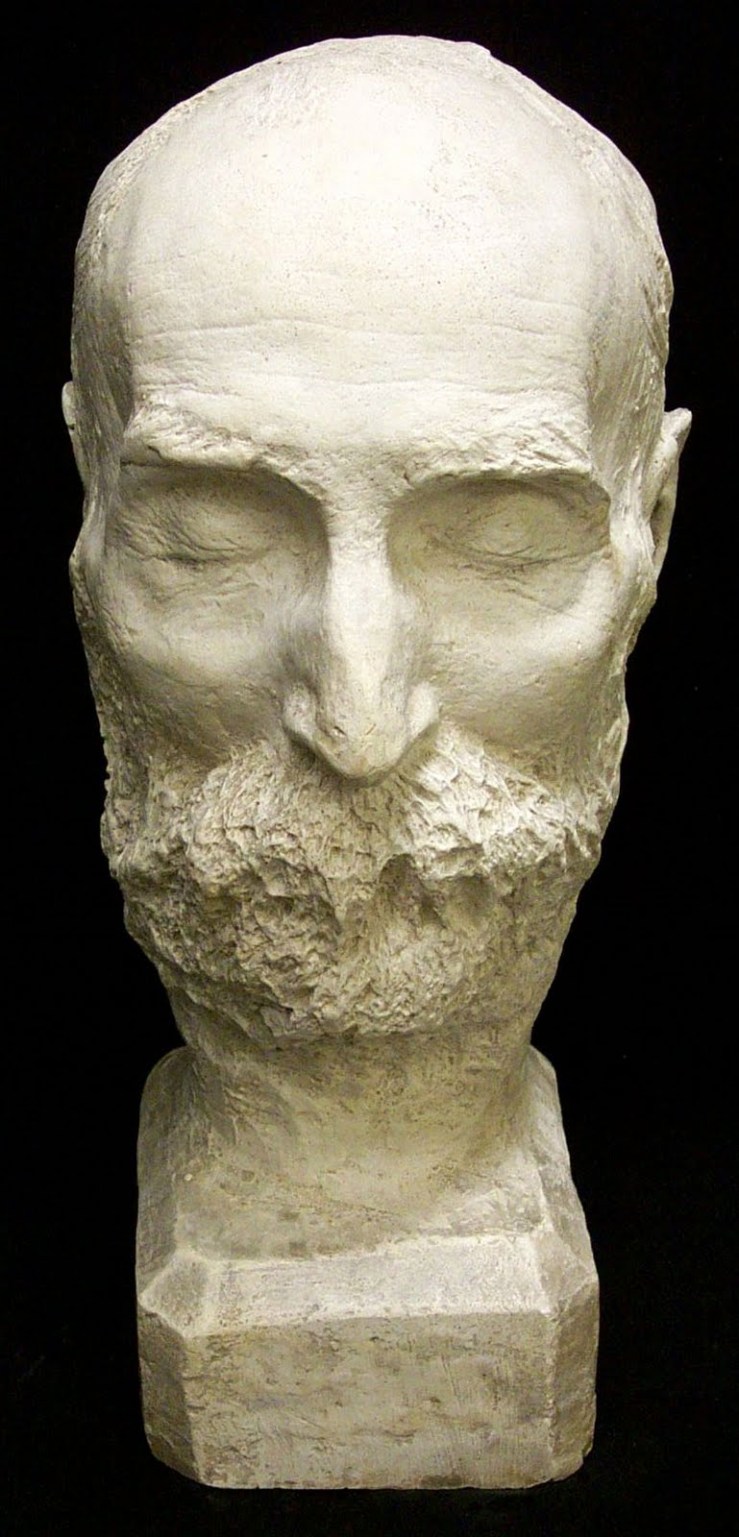
Read more about Walt Whitman’s death mask here. Read Whitman’s poem “Starting from Paumonak,”where he claims “I will show that nothing can happen more beautiful than death.”
FAST-ANCHOR’D eternal O love! O woman I love!
O bride! O wife! more resistless than I can tell, the thought of
you!
Then separate, as disembodied or another born,
Ethereal, the last athletic reality, my consolation,
I ascend, I float in the regions of your love O man,
O sharer of my roving life.
If I should need to name, O Western World, your powerfulest scene and
show,
‘Twould not be you, Niagara–nor you, ye limitless prairies–nor
your huge rifts of canyons, Colorado,
Nor you, Yosemite–nor Yellowstone, with all its spasmic
geyser-loops ascending to the skies, appearing and disappearing,
Nor Oregon’s white cones–nor Huron’s belt of mighty lakes–nor
Mississippi’s stream:
–This seething hemisphere’s humanity, as now, I’d name–the still
small voice vibrating–America’s choosing day,
(The heart of it not in the chosen–the act itself the main, the
quadriennial choosing,)
The stretch of North and South arous’d–sea-board and inland–
Texas to Maine–the Prairie States–Vermont, Virginia, California,
The final ballot-shower from East to West–the paradox and conflict,
The countless snow-flakes falling–(a swordless conflict,
Yet more than all Rome’s wars of old, or modern Napoleon’s:) the
peaceful choice of all,
Or good or ill humanity–welcoming the darker odds, the dross:
–Foams and ferments the wine? it serves to purify–while the heart
pants, life glows:
These stormy gusts and winds waft precious ships,
Swell’d Washington’s, Jefferson’s, Lincoln’s sails.
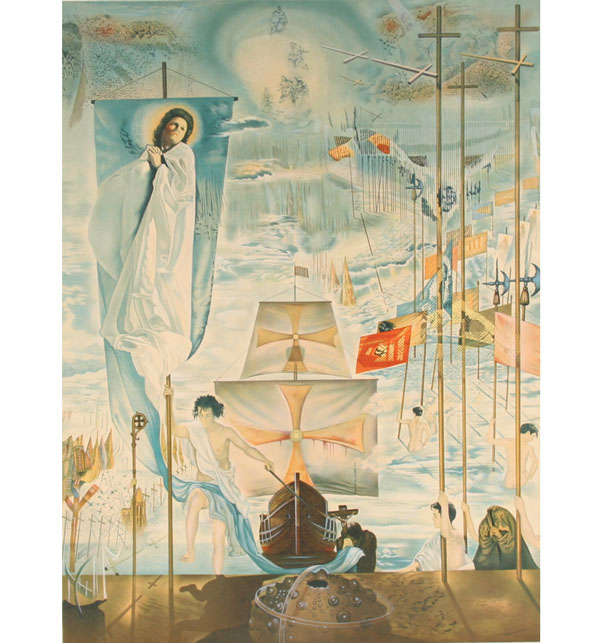
Salvador Dalí, The Discovery of America by Christopher Columbus, 1959, oil on canvas, 410 x 284 cm, St. Petersburg, Florida: Salvador Dalí Museum.
“Prayer of Columbus” by Walt Whitman
A batter’d, wreck’d old man,
Thrown on this savage shore, far, far from home,
Pent by the sea and dark rebellious brows, twelve dreary months,
Sore, stiff with many toils, sicken’d and nigh to death,
I take my way along the island’s edge,
Venting a heavy heart.
I am too full of woe!
Haply I may not live another day;
I cannot rest O God, I cannot eat or drink or sleep,
Till I put forth myself, my prayer, once more to Thee,
Breathe, bathe myself once more in Thee, commune with Thee,
Report myself once more to Thee.
Thou knowest my years entire, my life,
My long and crowded life of active work, not adoration merely;
Thou knowest the prayers and vigils of my youth,
Thou knowest my manhood’s solemn and visionary meditations,
Thou knowest how before I commenced I devoted all to come to Thee,
Thou knowest I have in age ratified all those vows and strictly kept them,
Thou knowest I have not once lost nor faith nor ecstasy in Thee,
In shackles, prison’d, in disgrace, repining not,
Accepting all from Thee, as duly come from Thee.
All my emprises have been fill’d with Thee,
My speculations, plans, begun and carried on in thoughts of Thee,
Sailing the deep or journeying the land for Thee;
Intentions, purports, aspirations mine, leaving results to Thee.
O I am sure they really came from Thee,
The urge, the ardor, the unconquerable will,
The potent, felt, interior command, stronger than words,
A message from the Heavens whispering to me even in sleep,
These sped me on.
By me and these the work so far accomplish’d,
By me earth’s elder cloy’d and stifled lands uncloy’d, unloos’d,
By me the hemispheres rounded and tied, the unknown to the known.
The end I know not, it is all in Thee,
Or small or great I know not–haply what broad fields, what lands,
Haply the brutish measureless human undergrowth I know,
Transplanted there may rise to stature, knowledge worthy Thee,
Haply the swords I know may there indeed be turn’d to reaping-tools,
Haply the lifeless cross I know, Europe’s dead cross, may bud and
blossom there.
One effort more, my altar this bleak sand;
That Thou O God my life hast lighted,
With ray of light, steady, ineffable, vouchsafed of Thee,
Light rare untellable, lighting the very light,
Beyond all signs, descriptions, languages;
For that O God, be it my latest word, here on my knees,
Old, poor, and paralyzed, I thank Thee.
My terminus near,
The clouds already closing in upon me,
The voyage balk’d, the course disputed, lost,
I yield my ships to Thee.
My hands, my limbs grow nerveless,
My brain feels rack’d, bewilder’d,
Let the old timbers part, I will not part,
I will cling fast to Thee, O God, though the waves buffet me,
Thee, Thee at least I know.
Is it the prophet’s thought I speak, or am I raving?
What do I know of life? what of myself?
I know not even my own work past or present,
Dim ever-shifting guesses of it spread before me,
Of newer better worlds, their mighty parturition,
Mocking, perplexing me.
And these things I see suddenly, what mean they?
As if some miracle, some hand divine unseal’d my eyes,
Shadowy vast shapes smile through the air and sky,
And on the distant waves sail countless ships,
And anthems in new tongues I hear saluting me.
1. Friends of the ‘klept have embarked on a new culinary adventure. Read all about it at brand new blog Confined Nomad. Their mission:
The goal of this journey is to find cuisines from every United Nations member state, within New York City limits, in alphabetical order. We realize that there are a few flaws to this logic, and will make every attempt to handle these wisely when we reach a questionable issue. For instance, cuisines are not defined by the UN. There are regional specialties, there are countries not internationally recognized, there are border disputes, and new countries are being formed all the time . . . This blog will serve as documentation of the adventure, in which we will do our best to describe not only the food we eat, but also things we learn about its nation of origin, culture, and the immigrant communities here in New York City. We hope this will be much more than a food blog.
The virgin entries on Afghanistan and Albania are tasty fare (sorry!) and we’re looking forward to plenty more delectable treats (yikes! sorry again!).
2. We finally saw Frank Marshall’s 1993 film Alive this weekend. Alive, based on Piers Paul Read’s book of the same name, tells the true story of the Uruguayan Air Force Flight 571 crash of October 13, 1972, in which a Uruguayan rugby team’s chartered flight crashes in the Andes. The survivors eventually resort to cannibalizing the dead to survive (let’s see what happens when Confined Nomad gets to ‘U’ on their list). Despite plenty of strange flaws, including egregious over-acting, the film is oddly great. An intense, chest-tightening narrative that offers few moments of relief, Alive is a real-life horror movie masquerading as an adventure tale. Recommended.
3. With distinguished Englishman Max Tundra’s new album Parallax Error Beheads You ready to drop any day now (glowing review forthcoming), we thought we’d bring up the greatness of his last CD, Mastered by Guy at the Exchange. Max’s MBGATE was easily one of our favorite albums of the early aughties. Weird and tuneful and splendid and frenetic, MBGATE is a neglected classic, perhaps due to its unclassifiable sound. Max programs old Amigas, plays dozens of instruments, and sings along with his sister on a strange group of songs about Michel Gondry, delivery jobs, amino acids, the break up of Don Caballero (with Storm & Stress as consolation prize), and, uh, girls. We love it and so should you. His website is awesome, by the way.
4. Today marks the one-year anniversary of gazillionaire adventurer Steve Fossett disappearing along with his single-engine Bellanca Super Decathlon airplane. We don’t think Fossett is dead, and neither, apparently, does Chris Irvine, who speculated in the Telegraph that Fossett faked his own death. We now invite our readers, again, to speculate on the whereabouts of Mr. Fossett. Check out our Steve Fossett Fan Fiction Contest blog for all the details!
5. Down here in The Florida, we continue to have hurricane concerns. And, because this blog likes to masquerade as a a literary affair, we offer a few lines from books on the subject:
In Shakespeare’s King Lear, Act 3 scene 2, we find one of the earliest usages of the word hurricane in the English language:
Blow, winds, and crack your cheeks! rage! blow!
You cataracts and hurricanoes, spout
Till you have drenched our steeples, drowned the cocks!
You sulphurous and thought-executing fires,
Vaunt-couriers to oak-cleaving thunderbolts,
Singe my white head! And thou, all-shaking thunder,
Strike flat the thick rotundity o’ the world!
Crack nature’s molds, all germens spill at once
That make ingrateful man!
Bit of a drama queen, Lear, what with all these apocalyptic fantasies. Speaking of drama queens, how about the opening lines of Walt Whitman’s “With Husky-haughty Lips, O Sea!”:
With husky-haughty lips, O sea!
Where day and night I wend thy surf-beat shore,
Imaging to my sense thy varied strange suggestions,
(I see and plainly list thy talk and conference here,)
Thy troops of white-maned racers racing to the goal,
Thy ample, smiling face, dash’d with the sparkling dimples of the sun,
Thy brooding scowl and murk–thy unloos’d hurricanes,
Thy unsubduedness, caprices, wilfulness
Fanciful stuff. For a less romanticized description, might we suggest the end of Zora Neale Hurston’s Their Eyes Were Watching God, where a massive hurricane turns Lake Okeechobee into a “monstropolous beast,” a monster that floods the streets and destroys homes. Stay away, Hannah.
It’s the greatest open secret, that death will take everyone, that every person is as transient as a shadow. Embracing this knowledge…was how sane people managed their grief.
In his debut novel Gob’s Grief, Chris Adrian explores the turbulent political, cultural, and social reforms of the immediate post-Civil War era through the lens of personal loss–specifically, the loss of dead brothers. Gob Woodhull, fictional son of agitating feminist Victoria Woodhull, suffers from intense grief and guilt after not running away to war with his twin brother Tomo, who dies at Chickamauga. Deciding that he must perform the impossible, Gob sacrifices his pinkie finger (and much more!) to a sinister, cave-dwelling magical being called the Urfeist, who takes young Gob on as an apprentice. Under the Urfeist’s tutelage, Gob begins designing and building a Frankenstein machine that will bring both his brother and all of the dead back to earth. Gob describes his machine and its purpose:
Don’t you understand? What’s grief if not a profound complaint? It’s what the engine will do; it will complain. It will grieve with mechanical efficiency and mechanical strength. It will grieve for my brother and for your brother and for all the six hundred thousand dead of the war. It will grieve for all the dead of history, and all the dead of the future. Man’s grief does nothing to bring them back, but just as man’s hands cannot move mountains, but man’s machines can, our machine will grieve away the boundaries between this world and the next.
The Urfeist agrees with Gob’s strange logic, explaining just what’s in it for the dead:
Unhappiness is the lot of the spirits. They are denied bodily delight, but they are creatures of desire. Desire is all that’s left to them. They want to live again! They want to be with you, all you desolate millions. How will you live without them? How will they continue without you? What sort of heaven can there be when brothers are apart?
Aiding Gob, often against their better judgment, are Walt Whitman (yes, that Walt Whitman), Will Fie, and Maci Truffant; both Will and Maci have also lost brothers in the Civil War, and these fraternal ghosts literally haunt them. Whitman too has lost a brother, but the poet more keenly misses Hank, a young man who Whitman becomes very attached to while volunteering at a hospital. Although Hank dies, his voice remains in Whitman’s head. Walt, Will, and Maci all make unique contributions to Gob’s bizarre machine. Maci serves as an engineer, Will as a visionary builder, and Walt, “the Kosmos,” serves as the battery that powers the strange, mansion-sized contraption. Added to the mix is Pickie Beecher, an unearthly little kid birthed during an early trial run of the machine.
The novel is divided into three distinct sections, each focusing on the different perspectives of Walt, Will, and Maci, and the most interesting moments of the narrative are when the events overlap, revealing the differences between these characters (the first section, focusing on Walt Whitman, is easily my favorite; it even made me go back and reread portions of Leaves of Grass). Adrian also employs interchapters focusing on young Tomo running away to the war and the Urfeist’s education of Gob. At times, this structure is fascinating, but it often gets in the way of characterization and detail: at nearly 400 pages, Gob’s Grief is a fairly long book, but it feels like it should be much longer. Adrian is fascinated with the cultural, economic, and social upheavals that preceded the Gilded Age, but much of the fine tuning seems edited away in favor of repeated descriptions of, uh, grief (at a certain point, I wanted to yell, “Okay–I get it! He’s mourning! He’s sad! Move on”). I also found the elements of magical realism, particularly the backstory of the Urfeist, to be underdeveloped, often overshadowed by a concern for the tropes of historical fiction.
Still, in Gob’s Grief, Adrianconveys a marvelous aplomb rare in debut novels, a promise he lives up to in his fantastic follow-up The Children’s Hospital (Pickie Beecher shows up again in that novel, and its main protagonist, Jemma Claflin, is a descendant of Woodhull). In all likelihood, Adrian will continue to perfect his craft. And while we’re waiting for his next great novel, we can read A Better Angel, a collection of short stories set to drop this August.








 Biblioklept