Ray Bradbury Offers Writing Advice; Wears Short Shorts

“Style and Content Must Match” — William Gaddis on Voice and Risk in His Novels

From a brief  1982 interview with William Gaddis

Q: The pervasive and distinctive authorial voice of The Recognitions gives way in J R to a self-effacing voice that seems to serve only functional purposes. Also in J R there is an increased dependence on dialogue. For verisimilitude in Lolita, Nabokov “travelled in school buses to listen to the talk of schoolgirls.” Did you take any special measures to hear and note the speech patterns of any of the wide variety of people who speak in “J R”?

William Gaddis: Style and content must match, must be complementary, accounting in part for a difference between the two books, though the lack of a conventional narrative style had already jarred a good many readers of The Recognitions when it appeared, as its hapless reviews show. J R was started as a story which quickly proved unsatisfactory, inspired- here’s the legitimate gossip—-by the postwar desecration of the Long Island village of Massapequa where my family had had property since around 1910, take a look at it now and you’ll see all the book’s worst hopes realized. In approaching J R as a novel, I was at pains to remove the author’s presence from the start as must be obvious. This was partly by way of what I mentioned earlier, obliging the thing to stand on own, take its own chances. But it was also by way of setting up a problem, a risk, in order to sustain my own interest, especially since the largely uninterrupted dialogue raised the further risk of presenting a convincing sense of real time without the conventional chapter breaks, white spaces, such narrative intrusions as “A week later . . .” How some of the writers I come across get through their books without dying of boredom is beyond me. As for what you call speech patterns, one is always listening and has got an ear or hasn’t, and without one, unless perhaps in dealing with an unfamiliar language and culture, no amount of your special measures like riding around on school buses will get you out of the swamp.

“The Ego Is the Enemy of Imagination” — David Milch on Writing

The Coen Brothers (Try to) Describe Their Writing Process

Biblioklept Interviews Camelia Elias, Editor-in-Chief of EyeCorner Press

Camelia Elias is the founder and editor-in-chief of EyeCorner Press, an independent publisher devoted to printing a host of difficult-to-classify writings, including creative academic writing, and poetic fragments and aphorisms. EyeCorner publishes works in English, Danish, and Romanian, as well as bilingual editions. This multilingual approach gels with the publishing house’s fragmentary philosophy, as well as its origins as a collaborative venture between universities in three nations. In addition to her editorial duties, Elias is also one of EyeCorner’s authors; her latest work Pulverizing Portraits is a monograph on the poetry of Lynn Emanuel. Elias is Associate Professor of American Studies at Roskilde University in Denmark and she blogs at FRAG/MENTS. Elias was kind enough to talk with me over a series of emails; in our discussion she defines creative criticism, discusses the value in being open to error, accounts for hostility against deconstruction and post-structuralism in academia, and explains why it doesn’t hurt to throw the word “fuck” into a textbook now and then.

Camelia Elias

Biblioklept: EyeCorner Press is somewhat unusual, even for an indie publisher — a joint venture between universities in Denmark, Finland, and the US that focuses on creative criticism. How did the press come into being?

Camelia Elias: The press came into being as an act of anarchism, if you like, a form of resistance against the idea that academic work must be measured not only against its own standard, but also against the standard that idiotic governments sets for measuring, and hence controlling, intelligence, creativity, and freedom. In 2007 I was editing new research papers written by colleagues and associates of the Institute of Language and Culture at Aalborg University with view to publication by the Faculty of Humanities at AU. A new change in leadership also brought about a new set of ideas. These were rigidly formulated along the newly established injunction passed down by the Danish government, which dictated that all Danish academics must now prioritize publishing with Oxford and Harvard. Without getting into the silly and imbecilic arguments produced for the sustainability of such a demand in reality, the fact remains that many heads of department throughout our Danish universities tried to implement the new regulations literally. The good publishing folks at Aalborg were told that Research News (the publishing venue) was going to close, and no, as the justification for it ran, this was not because the papers were not good enough, but 1) because publishing new research under the aegis of the department was likely to have the undesirable effect of preventing the researchers from expanding their range of publishing possibilities – and hence not consider Oxford and Harvard – and 2) there will be no money for it anymore. Few of us tried to make obvious the stupidity pertaining to the first argument – bad idea, as bosses generally don’t want to be told that they have limited visions – and as to the second argument, pertaining to the precarious, or rather by then non-existent financial support, a few of us also tried to suggest that we could go ‘on demand’ and even work ‘con amore’ for it, which would involve no expenses. The answer was still no. So, there we were, with a few manuscripts in the pipeline and no possibility of getting them out. As the editor of these papers, I felt a responsibility not only towards the writers but also towards the readers who had bothered to peer-review the works. I decided to start EyeCorner Press in my own name, but retain the ties we had in terms of publishing jointly with a few other partner universities. With Brenau University in Gainesville, Georgia, we had just finalized a volume on transatlantic relations (aesthetics and politics) within Cultural Text Studies Series published by Aalborg University Press. We are happy to call them our close allies. University of Georgia, Gwinnett, and Oulu University in Finland followed suit and so did Roskilde University, which became my new working place not long after the Aalborg ‘situation’.

Continue reading “Biblioklept Interviews Camelia Elias, Editor-in-Chief of EyeCorner Press”

Read Gordon Lish’s Edit of Raymond Carver’s “What We Talk About When We Talk About Love”

Boy oh boy this is great (yes, I am that kind of nerd). A few years ago The New Yorker published an early draft of Raymond Carver’s short story “What We Talk About When We Talk About Love,” which was originally titled “Beginners.” The New Yorker simultaneously published a version of the story showing Gordon Lish’s edits. It’s a fascinating look at the Carver-Lish writing experience. In the sample that follows, strike-throughs are deletions and boldfaced words are Lish’s additions—

My friend Mel Herb McGinnis, a cardiologist, was talking. Mel McGinnis is a cardiologist, and sometimes that gives him the right. The four of us were sitting around his kitchen table drinking gin. It was Saturday afternoon. Sunlight filled the kitchen from the big window behind the sink. There were Mel Herb and me I and his second wife, Teresa—Terri, we called her—and my wife, Laura. We lived in Albuquerque, then. But but we were all from somewhere else. There was an ice bucket on the table. The gin and the tonic water kept going around, and we somehow got on the subject of love. Mel Herb thought real love was nothing less than spiritual love. He said When he was young he’d spent five years in a seminary before quitting to go to medical school. He He’d left the Church at the same time, but he said he still looked back on to those years in the seminary as the most important in his life.

Terri said the man she lived with before she lived with Mel Herb loved her so much he tried to kill her. Herb laughed after she said this. He made a face. Terri looked at him. Then Terri she said, “He beat me up one night, the last night we lived together. He dragged me around the living room by my ankles. He kept saying, , all the while saying, ‘I love you, don’t you see? I love you, you bitch.’ He went on dragging me around the living room. My , my head kept knocking on things.” TerriShe looked around the table at us and then looked at her hands on her glass. “What do you do with love like that?” she said. She was a bone-thin woman with a pretty face, dark eyes, and brown hair that hung down her back. She liked necklaces made of turquoise, and long pendant earrings. She was fifteen years younger than Herb, had suffered periods of anorexia, and during the late sixties, before she’d gone to nursing school, had been a dropout, a “street person” as she put it. Herb sometimes called her, affectionately, his hippie.

“My God, don’t be silly. That’s not love, and you know it,” Mel Herb said. “I don’t know what you’d call it, —madness is what I’d call it—but I sure know you wouldn’t call it it’s sure as hell not love.”

The Collected Fictions of Gordon Lish (as Read by Gordon Lish)

Listening to Gordon Lish read selections from Iambik Audio’s compendium of his Collected Fictions for the fourth time today, it occurred to me that I should just go ahead and review the damn thing. Quit stalling. Get to it. I hope that pointing out that I’ve listened to Lish narrate ten of his odd, funny, gut-wrenching tales four times now (and will surely listen again) is enough to motivate thee, gentle reader, to follow my example—but that’s lazy, wishful thinking, right? There needs to be a proper review. Here goes—

Lish is perhaps more famous as an editor than a writer of short fiction. He worked for years at Vanity Fair and later for Knopf, and the list of writers that he championed reads like a who’s-who of contemporary greats: Don DeLillo, Cynthia Ozick, Amy Hempel, Barry Hannah, David Leavitt, and Harold Brodkey, just to name a few. The writer he is perhaps most associated with though is Raymond Carver. By paring down sentence after sentence, Lish helped Carver develop his spare, minimalist style.

It’s that attention to sentences, to the truth of each sentence, to their individual force, that shines through in the collection. Consider this beauty, from “The Death of Me,” a story about a boy (surely Gordon Lish, hero of all Gordon Lish stories) who peaks too early, winning first place in all five field events at his summer camp one fine day in 1944, and then succumbing to the realization that this apex is, frankly, the end of it all–

I felt like going to sleep and staying asleep until someone came and told me that my parents were dead and that I was all grown up and that there was a new God in heaven and that he liked me better even than the old God had.

This sentence seems to me to be the expression of an emotion that I’ve felt for which I have no name. Lish’s sentences can move through tragedy and pathos to devastating comedy, a kind of comedy that collapses the auditor. Check out a line from “Mr. Goldbaum”–

What if your father was the kind of father who was dying and he called you to him and you were his son and he said for you to come lie down on the bed with him so that he could hold you and so that you could hold him so that you both could be like that hugging with each other like that to say goodbye before you had to actually go leave each other and did it, you did it, you god down on the bed with your father and you got up close to your father and you got your arms around your father and your father was hugging you and you were hugging your father and there was one of you who could not stop it, who could not help it, but who just got a hard-on?

Lish advised, “Don’t have stories — have sentences,” but “The Death of Me” and “Mr. Goldbaum” are more than the sum of their parts, more than just a collection of sculpted, scalpeled syntax. From the 1988 collection Mourner at the Door (the only Lish book I’d read before Collected Fictions), both stories announce Lish’s major theme of death, the absurdity of death, or the absurdity of life against the inevitability of death—but also the heavy truth of death, the ugly truth of death, the powerlessness of language against the finality of death. “Spell Bereavement,” also from Mourner, is essentially a prequel to “Mr. Goldbaum”: Gordon gets the news of his father’s death from his sister and mother. The story takes place over the phone as a sort of switch-hit interrogation, as mom and sis caustically berate the speechless man, who tells us, at the end, “There are not people in my heart of hears. There are just sentences in my heart of hearts.” Why does Gordon the narrator of “Spell Bereavement” fail to respond to the news of his father’s death? He is “too disabled to talk . . . going crazy with pencil and paper so as not to miss one word.”

Lish means to capture the ecstatic truth in death, and truth is at the core of all these stories, even when they are fables of a sort, like “After the Beanstalk,” which features a bewitched princess who has been transmogrified into a dog. The tale is hilarious and cutting and sad. There’s also “Squeak in the Sycamore,” which begins as a child’s list of fears and enumerations of death and longing and nature and ends in a joke and then an insult to the reader for laughing at the joke. (Best line: “Six is: the gardener died from digging up a basilisk”). “How to Write a Poem” is a caustic rant that argues that literary theft is really a matter of stern guts, of facing truth, and “Everything I Know” problematizes the very act of storytelling — it’s a story about how we tell stories, or our versions of stories. By far the most affecting piece that Lish reads though is “Eats with Ozick and Lentricchia,” about which he tells us, before reading it, “there is not a word of it that is not true.” It is a story that hovers around the death, or the dying of, more accurately, Lish’s wife Barbara; its details are almost too cruel, too true to bear.

Lish reads his tales in a bold voice that seems to challenge the auditor at all angles, as if his sentences were prodding you, poking you, pinching you even. He claims, in one of the many asides that precede these tales, to have never really read his work aloud before, and not to have really read the work in years, but his confidence seems to belie this notion; maybe, more accurately, it conveys the intense concentration of his intellect. His tone fascinates, and then he cracks out something like: “It always astonishes me I could have written such a thing” in such a dry honest voice that, while his quip hangs ambiguous, it remains utterly sincere. There’s a wonderful moment in the recording when he moves from reading “Mr. Goldbaum” to “Spell Bereavement” and seems to notice, as if for the first time, their close connection. He then remarks–

It shames me in one kind of way to see that my writing gathers itself into such a rut, but on the other hand it does please me to have spoken again and again and again about that which occurred to me at the time to be of consequence. I haven’t written fiction or anything else really for a great number of years and this occasion, reading these pieces, is an education for me and alien, foreign, in one kind of way, because the sentences are complex, but in another kind of way, I’m reminded of who I am.

Lish’s influence cannot be underestimated, from writers like David Foster Wallace to Denis Johnson to Sam Lipsyte, and all of those who will follow in turn. Readers have a fantastic (and incredibly inexpensive, I must add) starting place in Iambik’s wonderful collection. Do yourself a favor and check this out. Very highly recommended.


“The Opinions That Are Important to Me Are Entertained Almost Exclusively by Dead People” — David Milch on Writing

“The Reader Is a Person You Need to Charm” — Writing Advice from George Saunders

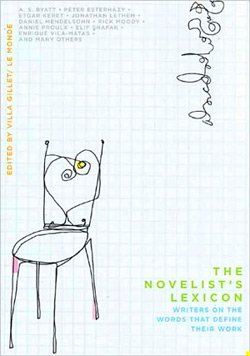
The Novelist’s Lexicon

The Novelist’s Lexicon, new in hardback from Columbia University Press, is an auspicious and at times bewildering project originating from an international literary conference hosted by Le Monde a few years ago. Over seventy authors from more than a dozen countries were asked to write about a “key word that opens the door to his work.” A list of just a few of the authors here is probably more than enough to pique interest: Rick Moody, Helene Cixous, Colum McCann, Jonathan Lethem, Adam Thirlwell, A.S. Byatt, David Peace, Dennis Cooper, and Annie Proulx all contribute pieces, mostly short, somewhere between 100 and 500 words. By nature, The Novelist’s Lexicon is a fragmentary affair, discontinuous, open to multiplicity, and unified only by its authors’ sense of craft, as well as an abiding intelligence.

Some authors take the project in earnest, like Lethem, whose piece “Furniture,” (which we excerpted late last year) pinpoints a fundamental yet largely unremarked upon element of novel-writing. French author Nicholas Fargues taps into etymology, offering a bit of advice in his piece “Novice”–

Don’t ‘make’ literature. Don’t write because that’s what people expect of you now that you’re a ‘writer.’ Don’t write for the beauty of the gesture or the love of art. Beware of fine phrases and well-turned maxims; that’s not your thing. Watch out for words that strike a pose. But do let your memory and your instincts flow; let the aptest words, the words that resemble you most closely, come of their own accord.

Anne Weber’s piece “Waiting/Attention” suggests that a key word — or any key, really — is an impossible dream–

It would be a word that encapsulated my aspirations and expectations, my sadness and my joy, my amazement at the quince’s hairy skin, the wash of the sky, and the delicate pattern of the cyclamen’s leaves. And since everything would be contained in this single, essential word, since it would express everything, I wouldn’t need to write anymore. And good riddance, too!

Swedish author Jonas Hassen Khemiri, who goes with “Un-” also points to language’s simultaneous limitations and possibilities–

Un- as in never being satisfied with the language we have. Un- as in the realization of how difficult it is to communicate with people in a language you have invented yourself. Un- as in doubting whether you will ever succeed. Un- as in continuing to try even so. Un- as in suddenly launching yourself over a coffee table and transforming a dictionary into confetti.

Khemiri’s frustration with language (and paradoxical love) is thematic throughout Lexicon; we see it, for instance in David Peace’s “Plague.” Peace comes off like the crotchety old man in the group–

To be honest or stupid or both, but not churlish or contrary (I hope), I am uncertain I understand the premise of this lexicon. However, I am against the presumption of all premises and, equally, I am against all definitions and dictionaries, lexicons and lists, which, in their commodification and exclusivity, are the preserve and the territory of fascists and shoppers.

After this radical caveat, including the claim that he is under “duress” (did the folks at Le Monde put guns to these authors’ heads?), Peace goes on to discuss the word “plague,” tracing it through Western lit and showing how it evinces in his novel Occupied City (which we reviewed here, by the way).

Perhaps Peace should’ve just ignored the assignment, like Dennis Cooper, whose piece is “Signed D.C.” is simply a work of microfiction, imagining what would happen if Olive Oyl and Popeye who “peel like decals from the TV and live in the world.” The story is a clever, short five paragraphs, and ends with at least a trace of insight into Cooper’s writing process: “I am heavier than my constructions understand.” Maybe he didn’t ignore the assignment.

Cooper is not the only writer to let fiction reign — there are poems and meditations and strange riffs here, largely divorced of discussion from technique or craft. In any case, those interested in getting into the heads of some of the 21st century’s most prominent (and skillful) writers will wish to take notice of The Novelist’s Lexicon, a fun and repeatedly rewarding book. Recommended.

Why Robert Coover Writes

“The Thirty-Six Dramatic Situations” — Georges Polti

“The Thirty-Six Dramatic Situations” is a list compiled by nineteenth-century French writer George Polti intended as a literary criticism device; in 2011 it reads almost like some kind of story or prose poem in itself–
  1. Supplication (in which the Supplicant must beg something from Power in authority)
  2. Deliverance
  3. Crime Pursued by Vengeance
  4. Vengeance taken for kindred upon kindred
  5. Pursuit
  6. Disaster
  7. Falling Prey to Cruelty of Misfortune
  8. Revolt
  9. Daring Enterprise
  10. Abduction
  11. The Enigma (temptation or a riddle)
  12. Obtaining
  13. Enmity of Kinsmen
  14. Rivalry of Kinsmen
  15. Murderous Adultery
  16. Madness
  17. Fatal Imprudence
  18. Involuntary Crimes of Love (example: discovery that one has married one’s mother, sister, etc.)
  19. Slaying of a Kinsman Unrecognized
  20. Self-Sacrificing for an Ideal
  21. Self-Sacrifice for Kindred
  22. All Sacrificed for Passion
  23. Necessity of Sacrificing Loved Ones
  24. Rivalry of Superior and Inferior
  25. Adultery
  26. Crimes of Love
  27. Discovery of the Dishonor of a Loved One
  28. Obstacles to Love
  29. An Enemy Loved
  30. Ambition
  31. Conflict with a God
  32. Mistaken Jealousy
  33. Erroneous Judgment
  34. Remorse
  35. Recovery of a Lost One
  36. Loss of Loved Ones.

“Every Story Is a Showing Up” — David Milch on Writing

Gordon Lish on Beckett’s Boils and Other Matters of Literary Import

Hey. Do yourself a favor and listen to Iambik’s first podcast, a raucous, rambling conversation with legendary editor/short story author Gordon Lish. I finally got around to listening to the discussion between Lish and his publisher John Oakes. (Why the delay? I’ve been listening to and very much enjoying another Iambik recording, an audiobook of Lydia Millet’s Oh Pure and Radiant Heart, and I needed to get to a decent stopping place before the Lish (review of the Millet forthcoming)) . I had already listened to Lish reading a selection of his own stories which was nine kinds of awesome (thanks again to the good folks at Iambik, whose hooking me up with the sweet mp3age has in no way affected my fondness for their operation (review of the Lish selections forthcoming)).

Hearing Lish in this conversational, easy manner is revelatory. Wise and funny, erudite and crafty, you’ll learn something and be entertained:

Iambikcast #1a (mp3)
Iambikcast #1b (mp3)

What does he talk about? I’ll crib from Iambikist Miette’s write-up, which hardly sums it up but does a nice job of surveying the discussion–

In the first part of the conversation, Lish covers Beckett’s boils and other afflictions of our literary heroes, remembrances of Neal Cassady, and the writer as witch doctor.

The second part focuses on Lish’s (as always, uncensored) assertions on the state of contemporary American letters, in which we’re imparted with opinions on Allen Ginsberg and Philip Roth, achieving religious experience through DeLillo, the finer points of book blurbing, and encouraging the further crimes of Tao Lin.

Jon Lovitz’s Writing Tips

Jon Lovitz does AV Club’s Random Rules today. Here, he gives some pretty good writing advice. Context: he’s describing coming back as the host of the show in 1997, and going to the writer’s meeting on Monday. The “They” is the SNL writers–

They’d say, “We have an idea for a sketch. You’re a teacher, and the student brings you an apple.” I go, “Right.” “And then another comes in and another brings you an apple, and then another brings you an apple.” I go, “Then what happens?” They go, “No, that’s the sketch. They’re just all bringing you apples.” I said, “That’s not a sketch. That’s just a premise.” They didn’t know what I was talking about. I said, “A sketch is supposed to have a beginning, middle, and end. It’s like a movie. It’s supposed to have a story. You have a who, what, where—the beginning, and the conflict, and it builds and builds. That’s how you do improv. You’re filling in all those spots to make the scene work. It builds to a climax. Then there’s a resolution, which is the ending. It takes hours to write the ending. It’s hard to come up with them.” They just looked at me blankly.

I think the writers thought I was a jerk, because I was like, “Then what happens?” to all of it. They’d go, “That’s it.” Maybe they didn’t like that. They wrote a first draft, and, “Who are you to touch our brilliant first draft?” Writing is rewriting.


“There Are Anthropological Limits on Reading” — David Mitchell Talks About Writing

James Franco and Michael Cunningham on Writing and MFA Programs