
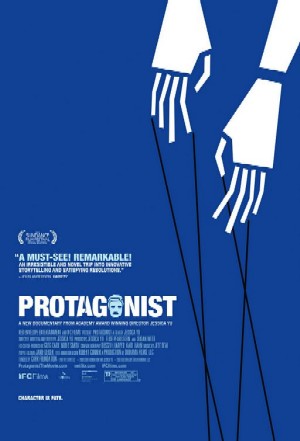
Jessica Yu’s 2007 documentary Protagonist chronicles the lives of four men to reveal how absolute certainty is a form of psychological blindness that can entail devastating consequences. In a spare, Errol Morriseque approach, Yu sticks mostly to upper-body shots of the men, who tell their stories directly to the camera, beginning with childhood and extending into their formative traumas and the consequent fallout of these traumas. Yu uses film or video of the men from outside sources at times (news reports, surveillance video, home video, cable access shows, etc.), but the major conceit for dramatizing or reenacting the men’s stories comes from her use of wooden puppets. These wooden puppets are dressed in ancient Greek theater garb, including two-faced masks; the puppet segments are set in a miniature Greek theater. In addition to the puppets who play act parts of the interviewee’s stories, there is a Greek chorus which introduces each chapter of the film by reciting lines from Greek tragedies that correlate directly to the men’s lives. While these lives never directly intersect, Yu deftly crafts her film to show how each person, as the protagonist of his own life, must course a trajectory against the curse/blessing of family, history, and social conditioning. While the men share certain phenomena in their pasts—abusive parents, strict religious upbringings, early childhood traumas—it’s their search for ultimate, authoritative certainty that most unites them. Each man quests for identity, and along the way is challenged, experiences epiphany, dreams of apotheosis, and achieves eventual catharsis. The search for certitude eventually blinds each man; as the film concludes, each subject recounts how absolute certainty—the absence of doubt—is precisely what leads to unthinking, inhumane actions. The film ends with one interviewee paraphrasing Socrates’ famous dictum: I only know that I know nothing.
I’ve omitted so far exactly what specific details make these men’s lives so hideous, so odious, so fascinating, so redemptive—so worth watching. Namely: What did these four dudes actually, like, do in their lives that is worth 90 minutes of your time? I was lucky enough not to know such details going in to the film, and I think that there couldn’t be a better way to see it. Each man tells his life story, beginning in youth; the stories become increasingly shocking as they progress. With this in mind, I strongly recommend you see Protagonist and skip the rest of the review, which contains SPOILERS.
Continue reading “Interviews with Hideous Men — Jessica Yu’s Documentary Protagonist”

 Thanks to Biblioklept reader Jescie for sending in

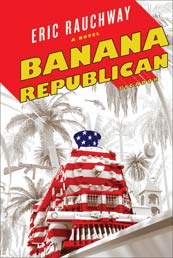 Banana Republican is the first novel by historian Eric Rauchway. The book is a send up of American Imperialism in the 1920s, satirizing the naked greed, corrupt capitalism, and ugly jingoism that infused the rise of the global economy. Fortunately, all of these ills have left American foreign policy forever, right? Satire! Seriously though, Banana Republican looks to the past to reveal that our current foreign debacles are merely an extension of policies that have been around for decades. The protagonist is Tom Buchanan (yes, that Tom Buchanan, the racist football-playing, mistress-slapping lout of The Great Gatsby). Rauchway sends Buchanan into the fiasco of American intervention in Nicaragua in the early 20th century. In an interview with
 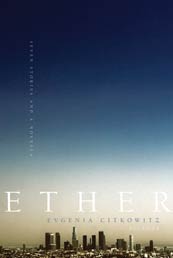 Evgenia Citkowitz’s Ether collects seven short stories and a novella, all united by psychological and emotional complexity. Citkowitz’s characters explore moral dilemmas as they quest for identity, and if that sounds like the stock of contemporary fiction (which it is), the prose, terse, often chilly, and darkly funny, is what set these apart. Here’s Ligaya Mishan, reviewing the hardback edition last year in
  In his promo vid (below) for The Oregon Experiment, author Keith Scribner suggests that, “It’s a novel that explores the ways in which the political, the social, the personal, the domestic are inseparable.” Those are some pretty grand claims, so here are the details: The Oregon Experiment recounts the story of Scanlon and Naomi Pratt, a couple who move from the East Coast to Oregon, where Scanlon begins his first tenure-track job as a professor who studies radical action mass movements. Naomi was once a “genius nose” who worked for perfume companies, but she’s lost her sense of smell; she’s also pregnant with the couple’s first child. Scanlon quickly becomes enamored of Oregon, and becomes particularly intrigued by local separatists and anarchists; Naomi’s nose returns, but she isn’t quite as thrilled as Scanlon about the new scene (particularly Scanlon’s enchantment with Sequoia, leader of the secessionists), although she does connect with Scanlon’s young subject Clay, an anarchist. Scribner propels his novel with ideas rendered in crisp, realistic dialogue. The Oregon Experiment is new from
 Biblioklept