Nyarlathotep … the crawling chaos … I am the last … I will tell the audient void….
I do not recall distinctly when it began, but it was months ago. The general tension was horrible. To a season of political and social upheaval was added a strange and brooding apprehension of hideous physical danger; a danger widespread and all-embracing, such a danger as may be imagined only in the most terrible phantasms of the night. I recall that the people went about with pale and worried faces, and whispered warnings and prophecies which no one dared consciously repeat or acknowledge to himself that he had heard. A sense of monstrous guilt was upon the land, and out of the abysses between the stars swept chill currents that made men shiver in dark and lonely places. There was a demoniac alteration in the sequence of the seasons—the autumn heat lingered fearsomely, and everyone felt that the world and perhaps the universe had passed from the control of known gods or forces to that of gods or forces which were unknown.
And it was then that Nyarlathotep came out of Egypt. Who he was, none could tell, but he was of the old native blood and looked like a Pharaoh. The fellahin knelt when they saw him, yet could not say why. He said he had risen up out of the blackness of twenty-seven centuries, and that he had heard messages from places not on this planet. Into the lands of civilisation came Nyarlathotep, swarthy, slender, and sinister, always buying strange instruments of glass and metal and combining them into instruments yet stranger. He spoke much of the sciences—of electricity and psychology—and gave exhibitions of power which sent his spectators away speechless, yet which swelled his fame to exceeding magnitude. Men advised one another to see Nyarlathotep, and shuddered. And where Nyarlathotep went, rest vanished; for the small hours were rent with the screams of nightmare. Never before had the screams of nightmare been such a public problem; now the wise men almost wished they could forbid sleep in the small hours, that the shrieks of cities might less horribly disturb the pale, pitying moon as it glimmered on green waters gliding under bridges, and old steeples crumbling against a sickly sky. Continue reading ““Nyarlathotep” — H.P. Lovecraft”→
When a novelist has “something to say,” they mean a message. It has political connotations, or a religious message, or a moral prescription. It means “commitment,” as used by Sartre and other fellow-travelers. They are saying that the writer has a world view, a sort of truth that he wishes to communicate, and that his writing has an ulterior significance. I am against this. Flaubert described a whole world, but he had nothing to say, in the sense that he had no message to transmit, no remedy to offer for the human condition.
INTERVIEWER
But did Dostoyevsky have nothing to say? Tolstoy?
ROBBE-GRILLET
Tolstoy yes. That is why on the whole he doesn’t interest me.
INTERVIEWER
Not even Anna Karenina?
ROBBE-GRILLET
Especially not Anna Karenina! Among Tolstoy’s books the one that interests me is The Death of Ivan Ilych. Ivan is someone who hurts himself while unhooking a curtain, and one sees his death in that gesture. As for Dostoyevsky, perhaps there is a message in his work but for me it is a kind of parasite. In Crime And Punishment, I am much more interested in the first part which is the preparation for the murder. You remember the scene where Raskolnikov is getting the axe ready? And he is fascinated by the act he has to accomplish? The last part of the book, about guilt and moral responsibility and so on, bores me profoundly.
INTERVIEWER
Because you, or your characters, never feel moral responsibility or guilt?
ROBBE-GRILLET
Never!
INTERVIEWER
Aren’t you lucky!
ROBBE-GRILLET
Perhaps. The book of Dostoyevsky’s that interests me most is The Possessed. It is an enigmatic novel; the main protagonist is an enigma. I read it over and over again and find it tremendous—it has a concept of reality that escapes “significance.” That may be my reading of it; someone else might apprehend it differently. I am sure Camus would have said something quite different about it.
INTERVIEWER
Another writer who has had a great influence on you is Kafka. He is someone who has been interpreted in more than one way. What is his fascination for you?
ROBBE-GRILLET
He has been read as having a metaphysical and religious message—the relationship between the Jew and his God. This is the influence of Max Brod, his friend and first biographer. It doesn’t interest me in the least. I read Kafka as the revelation of a world, which is much more important than yet another meditation on the Talmud. Brod’s reading of Kafka is reductive and restrictive, as if his work could be reduced to metaphysical relations. What I find extraordinary is the actual presence of this opaque world.
“A Lodging for the Night” — Robert Louis Stevenson
It was late in November 1456. The snow fell over Paris with rigorous, relentless persistence; sometimes the wind made a sally and scattered it in flying vortices; sometimes there was a lull, and flake after flake descended out of the black night air, silent, circuitous, interminable. To poor people, looking up under moist eyebrows, it seemed a wonder where it all came from. Master Francis Villon had propounded an alternative that afternoon, at a tavern window: was it only Pagan Jupiter plucking geese upon Olympus, or were the holy angels moulting? He was only a poor Master of Arts, he went on; and as the question somewhat touched upon divinity, he durst not venture to conclude. A silly old priest from Montargis, who was among the company, treated the young rascal to a bottle of wine in honor of the jest and the grimaces with which it was accompanied, and swore on his own white beard that he had been just such another irreverent dog when he was Villon’s age.
The air was raw and pointed, but not far below freezing; and the flakes were large, damp, and adhesive. The whole city was sheeted up. An army might have marched from end to end and not a footfall given the alarm. If there were any belated birds in heaven, they saw the island like a large white patch, and the bridges like slim white spars, on the black ground of the river. High up overhead the snow settled among the tracery of the cathedral towers. Many a niche was drifted full; many a statue wore a long white bonnet on its grotesque or sainted head. The gargoyles had been transformed into great false noses, drooping toward the point. The crockets were like upright pillows swollen on one side. In the intervals of the wind there was a dull sound of dripping about the precincts of the church.
The cemetery of St. John had taken its own share of the snow. All the graves were decently covered; tall, white housetops stood around in grave array; worthy burghers were long ago in bed, benightcapped like their domiciles; there was no light in all the neighborhood but a little peep from a lamp that hung swinging in the church choir, and tossed the shadows to and fro in time to its oscillations. The clock was hard on ten when the patrol went by with halberds and a lantern, beating their hands; and they saw nothing suspicious about the cemetery of St. John. Continue reading ““A Lodging for the Night” — Robert Louis Stevenson”→
It was while gliding through these latter waters that one serene and moonlight night, when all the waves rolled by like scrolls of silver; and, by their soft, suffusing seethings, made what seemed a silvery silence, not a solitude; on such a silent night a silvery jet was seen far in advance of the white bubbles at the bow. Lit up by the moon, it looked celestial; seemed some plumed and glittering god uprising from the sea. Fedallah first descried this jet. For of these moonlight nights, it was his wont to mount to the main-mast head, and stand a look-out there, with the same precision as if it had been day. And yet, though herds of whales were seen by night, not one whaleman in a hundred would venture a lowering for them. You may think with what emotions, then, the seamen beheld this old Oriental perched aloft at such unusual hours; his turban and the moon, companions in one sky. But when, after spending his uniform interval there for several successive nights without uttering a single sound; when, after all this silence, his unearthly voice was heard announcing that silvery, moon-lit jet, every reclining mariner started to his feet as if some winged spirit had lighted in the rigging, and hailed the mortal crew. “There she blows!” Had the trump of judgment blown, they could not have quivered more; yet still they felt no terror; rather pleasure. For though it was a most unwonted hour, yet so impressive was the cry, and so deliriously exciting, that almost every soul on board instinctively desired a lowering.
From “The Spirit Spout,” Chapter 51 of Melville’s Moby-Dick
Nathaniel Hawthorne’s tale “The Birth-Mark” — or is it “The Birthmark”? — has been a favorite story of mine for years despite (or maybe because of) its being so damn symbolically overdetermined.
Or perhaps you want a quick summary—a refresher—okay:
Aylmer, “a man of science,” has this totally hot wife Georgiana—only she’s got a birthmark on her cheek, a small red mark that resembles a tiny hand—and it drives our scientist mad—so mad that he determines to make her perfect by removing the mark. Tragic ending ensues.
One of the reasons I like “The Birth-Mark” so much is that it so clearly limns the futility of idealism.
Aylmer’s driving desire for mastery over Nature (echoing Shelley’s Frankenstein): the desire to “lay his hand on the secret creative force and perhaps make new worlds.”
The word “God” does not appear in “The Birth-Mark.”
But of course gods and creators are repeatedly invoked.
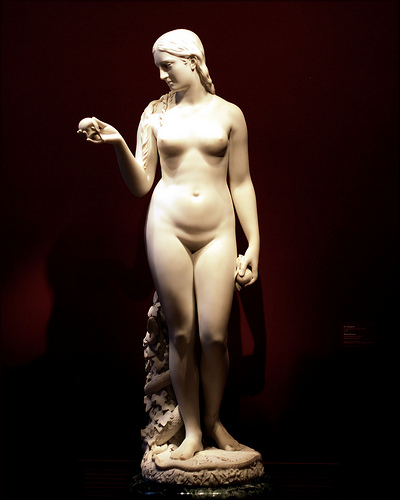
One such creator is Hawthorne’s friend Hiram Powers, whose sculpture Eve Tempted is invoked (invoking that other creator, the one who made a garden . . . )
Eve Tempted, Hiram Powers
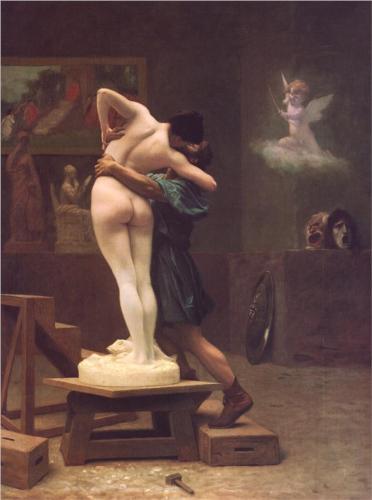
And Pygmalion—
Pygmalion and Galate, Jean-Leon Gerome
Aylmer, having convinced his wife that he’ll erase her mark: “Even Pygmalion, when his sculptured woman assumed life, felt not greater ecstasy than mine will be!”
Aylmer’s plan is shameful. It’s based on an obsessive misreading of the symbolism of his wife’s birthmark. We’re told that Aylmer “select[s] it as the symbol of his wife’s liability to sin, sorrow, decay, and death, Aylmer’s sombre imagination was not long in rendering the birthmark a frightful object, causing him more trouble and horror than ever Georgiana’s beauty, whether of soul or sense, had given him delight.”
He’s a very poor reader. His judgments are overawed by idealism.
Georgiana asks him: “Cannot you remove this little, little mark, which I cover with the tips of two small fingers?”
On one level, Georgiana is offering her husband the opportunity to play doctor with her, to get rid of the mark that’s driving him mad—but I think there’s an ironic second meaning at work here as well. I think she’s suggesting that he remove his perception of the mark, his reading of the mark. That he change his attitude.
Hawthorne’s homeboy Herman Melville, in his big book Moby-Dick, has Ishmael point out—in a simple, charming, homey way—that there is no simply no ideal purity available to us:
We felt very nice and snug, the more so since it was so chilly out of doors; indeed out of bed-clothes too, seeing that there was no fire in the room. The more so, I say, because truly to enjoy bodily warmth, some small part of you must be cold, for there is no quality in this world that is not what it is merely by contrast. Nothing exists in itself. If you flatter yourself that you are all over comfortable, and have been so a long time, then you cannot be said to be comfortable any more.
13. Actually, even though we’re told he’s brilliant, it turns out that Aylmer is not the transcendent scientist he’d like to be. In a scene that almost edges into comedy (just a dab to give this tragedy dimension), Georgiana reads
a large folio from her husband’s own hand, in which he had recorded every experiment of his scientific career, its original aim, the methods adopted for its development, and its final success or failure, with the circumstances to which either event was attributable. The book, in truth, was both the history and emblem of his ardent, ambitious, imaginative, yet practical and laborious life. He handled physical details as if there were nothing beyond them; yet spiritualized them all, and redeemed himself from materialism by his strong and eager aspiration towards the infinite. In his grasp the veriest clod of earth assumed a soul. Georgiana, as she read, reverenced Aylmer and loved him more profoundly than ever, but with a less entire dependence on his judgment than heretofore. Much as he had accomplished, she could not but observe that his most splendid successes were almost invariably failures, if compared with the ideal at which he aimed. His brightest diamonds were the merest pebbles, and felt to be so by himself, in comparison with the inestimable gems which lay hidden beyond his reach. The volume, rich with achievements that had won renown for its author, was yet as melancholy a record as ever mortal hand had penned. It was the sad confession and continual exemplification of the shortcomings of the composite man, the spirit burdened with clay and working in matter, and of the despair that assails the higher nature at finding itself so miserably thwarted by the earthly part. Perhaps every man of genius in whatever sphere might recognize the image of his own experience in Aylmer’s journal.
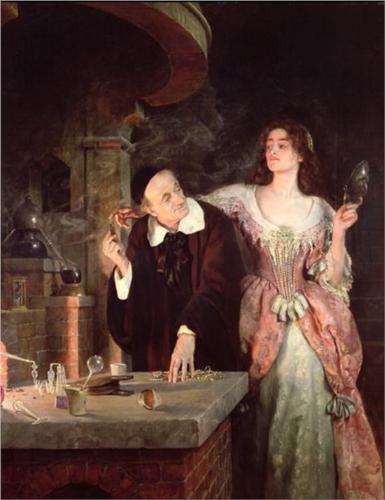
I should clarify, perhaps, that Georgiana reads the journal as she waits out Aylmer’s experiments in his laboratory.
The Laboratory, John Collier
Oh, gosh, I almost forgot—there’s a third player in this piece, Aminadab, Aylmer’s manservant/lab assistant, who’s described throughout the text (usually by Aylmer) as “clod,” “man of clay,” “human machine,” “earthly mass,” “thing of the senses” — he’s the pure-material to contrast Aylmer’s (would-be) pure-spirit. Although he’s not described as hunchbacked I can’t help but see him that way, this Igor to a Hollywood Frankenstein. And he laughs.
Aminadab laughs at Aylmer’s folly. Here is the conclusion of this story:
Alas! it was too true! The fatal hand had grappled with the mystery of life, and was the bond by which an angelic spirit kept itself in union with a mortal frame. As the last crimson tint of the birthmark—that sole token of human imperfection—faded from her cheek, the parting breath of the now perfect woman passed into the atmosphere, and her soul, lingering a moment near her husband, took its heavenward flight. Then a hoarse, chuckling laugh was heard again! Thus ever does the gross fatality of earth exult in its invariable triumph over the immortal essence which, in this dim sphere of half development, demands the completeness of a higher state. Yet, had Alymer reached a profounder wisdom, he need not thus have flung away the happiness which would have woven his mortal life of the selfsame texture with the celestial. The momentary circumstance was too strong for him; he failed to look beyond the shadowy scope of time, and, living once for all in eternity, to find the perfect future in the present.
17. I won’t comment any further on the story, other than to suggest that the final two lines—in bold above—seem perfectly sensible and wonderfully wise to me. I think Wittgenstein may have been approaching a similar idea some eighty years later in his Tractatus Logico-Philosophicus:
Death is not an event in life: we do not live to experience death. If we take eternity to mean not infinite temporal duration but timelessness, then eternal life belongs to those who live in the present. Our life has no end in the way in which our visual field has no limits.
This thing is so rare in all its circumstances, and on so good authority, that my reading and conversation have not given me anything like it. It is fit to gratify the most ingenious and serious inquirer. Mrs. Bargrave is the person to whom Mrs. Veal appeared after her death; she is my intimate friend, and I can avouch for her reputation for these fifteen or sixteen years, on my own knowledge; and I can confirm the good character she had from her youth to the time of my acquaintance. Though, since this relation, she is calumniated by some people that are friends to the brother of Mrs. Veal who appeared, who think the relation of this appearance to be a reflection, and endeavor what they can to blast Mrs. Bargrave’s reputation and to laugh the story out of countenance. But by the circumstances thereof, and the cheerful disposition of Mrs. Bargrave, notwithstanding the ill usage of a very wicked husband, there is not yet the least sign of dejection in her face; nor did I ever hear her let fall a desponding or murmuring expression; nay, not when actually under her husband’s barbarity, which I have been a witness to, and several other persons of undoubted reputation.
Now you must know Mrs. Veal was a maiden gentlewoman of about thirty years of age, and for some years past had been troubled with fits, which were perceived coming on her by her going off from her discourse very abruptly to some impertinence. She was maintained by an only brother, and kept his house in Dover. She was a very pious woman, and her brother a very sober man to all appearance; but now he does all he can to null and quash the story. Mrs. Veal was intimately acquainted with Mrs. Bargrave from her childhood. Mrs. Veal’s circumstances were then mean; her father did not take care of his children as he ought, so that they were exposed to hardships. And Mrs. Bargrave in those days had as unkind a father, though she wanted neither for food nor clothing; while Mrs. Veal wanted for both, insomuch that she would often say, “Mrs. Bargrave, you are not only the best, but the only friend I have in the world; and no circumstance of life shall ever dissolve my friendship.” They would often condole each other’s adverse fortunes, and read together Drelincourt upon Death, and other good books; and so, like two Christian friends, they comforted each other under their sorrow. Continue reading ““The Apparition of Mrs. Veal” — Daniel Defoe”→







 Biblioklept