Werner Herzog Eats His Shoe

How to Look Younger (Peanuts)

younger

An Interview with Evan Lavender-Smith

Evan Lavender-Smith is an American writer who has published two books, Avatar and From Old Notebooks.

I really really really like his anti-novel (or whatever you want to call it) From Old Notebooks, which has recently been reissued by the good people at Dzanc Books.

(Here is my review of FON). I still haven’t read Avatar.

Evan talked with me about his writing, his reading, and other stuff over a series of emails. He was generous in his answers and I very much enjoyed talking with him.

Evan lives in New Mexico with his wife, son, and daughter. He has a website. Read his books.

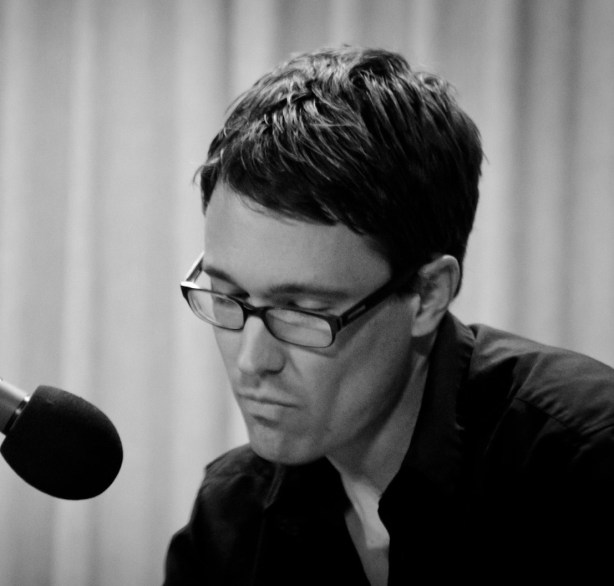
author-photo2

Biblioklept: Do you know that first editions of From Old Notebooks are going for like three hundred dollars on Amazon right now?

ELS: Here at the house I have a whole drawer full of them. That’s how I’m planning to pay for the kids’ college.

Biblioklept: I read that Cormac McCarthy won’t sign his books anymore because he has this reserve of signed editions that are for his son to sell and corner the market on. Or I think I read that.

Speaking of your kids: the parts in From Old Notebooks about them are some of my favorites, perhaps because the moments you describe seem so real to me, or that I relate so strongly to the feelings that you express. (My own kids, a daughter and son, are about the same age as your kids are in the book). Is it weird if I ask how your kids are?

ELS: Glad to hear some of that stuff resonates with you. No, I don’t think it’s weird. I believe the book even sort of self-consciously anticipates a certain reader’s empathetic engagement with it. There’s that passage somewhere, for example, in which we get something like an interview answer, something like “The real Evan Lavender-Smith has never made it past the first section of Ulysses, the real Evan Lavender-Smith has no children,” which I think maybe winks at the possibility of that type of readerly engagement. So no, it’s encouraging to hear that parts of the book seemed to work for you. My kids are great, by the way. Sofia’s at her violin lesson, Jackson’s doing an art project with his mom.

Biblioklept: The faux-interview answers crack me up. I think we’ve all done that in some way—that we go through these little experiments of interviewing ourselves, performing ourselves, imagining how others perceive us. You write your own obituary; at one point we get: ” ‘With my first book I hope to get all the cult of personality stuff out of the way’.” You remark that you don’t put dates on anything as “an act of defiance” against your “literary executors.” Moments like these seem simultaneously ironic and sincere.

I’m curious as to how closely you attended to these disjunctions—From Old Notebooks seems incredibly, I don’t know, organic.

ELS: At a certain point I became very aware that I was performing some version or versions of myself in the book, and I think the book tries to find ways of grappling with problems I perceived as bound up with that performance. One way was to insist on a narrative tone or mode somewhere in between irony and sincerity, or to regularly oscillate between or conflate these competing modes. Something like “I am the greatest writer in the history of the world!” might later be countered by “Gosh, my writing really blows, doesn’t it?”; or “My kids are so beautiful, I love them so much,” might be followed by “I wish those little fuckers were never born.” While the function of this variability is, in From Old Notebooks, probably mostly an apology or a mask for a kind of subjectivity I worry might come off as cliche and naive, that particular representation of the thinking subject — cleaved, inconsistent, heterogeneous — does strike me as truer of human experience and perception than the more streamlined consistency of expression and behavior we tend to associate with the conventional narratological device called “character.” When I try to look deep down inside myself, to really get a handle on my thinking, for example, or on my understanding of truth, I end up facing a real mess of disjunctive, contradictory forces competing for my attention. For me — and likely for the book, as well — the most immediate figure for this condition might be the confluence of sincerity and irony, the compossibility of taking a genuine life-affirming pleasure in, and exhibiting a kind of cynical hostility toward, the fact of my own existence.

Biblioklept: That contest between sincerity and irony seems present in many works of post-postmodern fiction. It’s clearly a conflict that marks a lot of David Foster Wallace’s stuff. You invoke Wallace a number of times in From Old Notebooks, but the style of the book seems in no way beholden to his books. Can you talk about his influence on you as a reader? A writer?

ELS: Wallace hugely influenced the way I think about any number of things. I think his most immediate influence on my writing is this blending of hieratic and demotic modes of language when I’m dealing with pretty much anything that requires the serious application of my writing mind; the hip nerdiness of his language was and still is very empowering to me. He made it seem super cool to geek out on books — “The library, and step on it,” says Hal in Infinite Jest — and back in high school and college that example was so vital for me, as someone entirely too obsessed with being both cool and well read. He served to guide my reading of other writers in a way that only John Barth and Brian Evenson have come close to matching; I poured over his essays for names, then went to the library and checked out and read all the books he mentioned, then reread his essays. His fiction’s most common subject matter — addiction, depression, the yearning for transcendence, the incommensurability of language and lived experience, problems of logic vis-a-vis emotion, metafiction’s values and inadequacies — all of this stuff hit very close to home. To my mind there’s little doubt that Infinite Jest is the best English-language novel published in the last 25 years. His advocacy for David Markson has got to be up there among the greatest literary rescue missions of the 20th century. In “Good Old Neon” he wrote what may be the most haunting long short story since “The Death of Ivan Ilych.” He galvanized young writers everywhere right when the internet was taking off and unwittingly served as a touchstone for emerging online literary communities that thrive today. I think for a lot of young writers, myself included, he was, maybe next to the emergence of the internet, the most important force in the language’s recent history. The list goes on and on. And also he helped me out personally, providing encouragement and advice that was so generous and inspiring. I was extremely troubled by his suicide and wasn’t able to write much or think about much else for quite a while.

With all that said, there are some things he says that bother me a bit. The synthesis of art and entertainment he espouses as it pertains to the role of the writer in the age of television — which I think in many ways corresponds to his striving for a new aesthetic in which the cerebral effects associated with 60s and 70s postmodernist fiction are complemented by or synthesized with the more visceral effects associated with 70s and 80s realist fiction — strikes me now as existing very much in opposition to what I believe in most passionately about writing: that it can and in the most important cases should exist in a state of absolute opposition to our entertainments. I’ve come to better appreciate, years after reading Wallace, the writing of people like Woolf and Beckett and Gaddis, those writers who are uncompromising in their vision of narrative art’s most radical and affecting possibilities and who necessarily, I believe, pay very little attention to any sort of entertainment imperative. The books I love most make me feel things strongly, and think things strongly, but rarely do they entertain me. If I want to be entertained, I know exactly where to go: a room without books. I’ve come to think of certain books as my life’s only source of intellectual solace; when I’m not despairing over the futility of everything under the sun, that unflagging commitment to a truly rigorous and uncompromising art that I perceive in a writer like Beckett seems to me a matter of life and death, just as serious as life can ever get. When Wallace talks that shit about art and entertainment, or about the need to add more heart or greater complexity of character to Pynchon or whatever, it makes me feel like I want to throw up. I heard him say once in an interview that he felt he couldn’t write the unfiltered stuff in his head, that it would be too radical or something, and the admission really upset me; it felt like in some serious way he had allowed his projection of an imaginary target audience’s desire to determine the form of his writing. I often feel something similar in the essays; I find many of them to be merely entertaining. I suppose I often judge the essays in relation to the fictions, which I find far superior in their attempt to overcome the strictures and conventions of language and form. Wallace was always at his best, to my reading, when he was really bearing down — when he was at his most difficult.

But no doubt he’s been monumentally important to me, more so than any other recent fiction writer, and in more ways than I can name. There’s something in From Old Notebooks where the methodical awkwardness and wordiness of so many of his sentences is likened to the affectation of bumping up against the limits of language. That’s probably what I take away from him more than anything: when I sit down at the laptop to face the language, I often feel myself struggling with the words as well as struggling to demonstrate that I’m struggling with the words. That’s pure Wallace: word-by-word, letter-by-letter self-consciousness. (There’s another thing in From Old Notebooks about how I’m always talking shit because I care for him so deeply … which is why the paragraph before this one). Continue reading “An Interview with Evan Lavender-Smith”

Rabbits under Moon — Hiroshige

“On Eating and Drinking” — Jerome K. Jerome

I always was fond of eating and drinking, even as a child—especially eating, in those early days. I had an appetite then, also a digestion. I remember a dull-eyed, livid-complexioned gentleman coming to dine at our house once. He watched me eating for about five minutes, quite fascinated seemingly, and then he turned to my father with—

“Does your boy ever suffer from dyspepsia?”

“I never heard him complain of anything of that kind,” replied my father. “Do you ever suffer from dyspepsia, Colly wobbles?” (They called me Colly wobbles, but it was not my real name.)

“No, pa,” I answered. After which I added:

“What is dyspepsia, pa?”

My livid-complexioned friend regarded me with a look of mingled amazement and envy. Then in a tone of infinite pity he slowly said:

“You will know—some day.”

My poor, dear mother used to say she liked to see me eat, and it has always been a pleasant reflection to me since that I must have given her much gratification in that direction. A growing, healthy lad, taking plenty of exercise and careful to restrain himself from indulging in too much study, can generally satisfy the most exacting expectations as regards his feeding powers.

It is amusing to see boys eat when you have not got to pay for it. Their idea of a square meal is a pound and a half of roast beef with five or six good-sized potatoes (soapy ones preferred as being more substantial), plenty of greens, and four thick slices of Yorkshire pudding, followed by a couple of currant dumplings, a few green apples, a pen’orth of nuts, half a dozen jumbles, and a bottle of ginger-beer. After that they play at horses.

How they must despise us men, who require to sit quiet for a couple of hours after dining off a spoonful of clear soup and the wing of a chicken!

But the boys have not all the advantages on their side. A boy never enjoys the luxury of being satisfied. A boy never feels full. He can never stretch out his legs, put his hands behind his head, and, closing his eyes, sink into the ethereal blissfulness that encompasses the well-dined man. A dinner makes no difference whatever to a boy. To a man it is as a good fairy’s potion, and after it the world appears a brighter and a better place. A man who has dined satisfactorily experiences a yearning love toward all his fellow-creatures. He strokes the cat quite gently and calls it “poor pussy,” in tones full of the tenderest emotion. He sympathizes with the members of the German band outside and wonders if they are cold; and for the moment he does not even hate his wife’s relations.

A good dinner brings out all the softer side of a man. Under its genial influence the gloomy and morose become jovial and chatty. Sour, starchy individuals, who all the rest of the day go about looking as if they lived on vinegar and Epsom salts, break out into wreathed smiles after dinner, and exhibit a tendency to pat small children on the head and to talk to them—vaguely—about sixpences. Serious men thaw and become mildly cheerful, and snobbish young men of the heavy-mustache type forget to make themselves objectionable.

I always feel sentimental myself after dinner. It is the only time when I can properly appreciate love-stories. Then, when the hero clasps “her” to his heart in one last wild embrace and stifles a sob, I feel as sad as though I had dealt at whist and turned up only a deuce; and when the heroine dies in the end I weep. If I read the same tale early in the morning I should sneer at it. Digestion, or rather indigestion, has a marvelous effect upon the heart. If I want to write any thing very pathetic—I mean, if I want to try to write anything very pathetic—I eat a large plateful of hot buttered muffins about an hour beforehand, and then by the time I sit down to my work a feeling of unutterable melancholy has come over me. I picture heartbroken lovers parting forever at lonely wayside stiles, while the sad twilight deepens around them, and only the tinkling of a distant sheep-bell breaks the sorrow-laden silence. Old men sit and gaze at withered flowers till their sight is dimmed by the mist of tears. Little dainty maidens wait and watch at open casements; but “he cometh not,” and the heavy years roll by and the sunny gold tresses wear white and thin. The babies that they dandled have become grown men and women with podgy torments of their own, and the playmates that they laughed with are lying very silent under the waving grass. But still they wait and watch, till the dark shadows of the unknown night steal up and gather round them and the world with its childish troubles fades from their aching eyes.

I see pale corpses tossed on white-foamed waves, and death-beds stained with bitter tears, and graves in trackless deserts. I hear the wild wailing of women, the low moaning of little children, the dry sobbing of strong men. It’s all the muffins. I could not conjure up one melancholy fancy upon a mutton chop and a glass of champagne.

A full stomach is a great aid to poetry, and indeed no sentiment of any kind can stand upon an empty one. We have not time or inclination to indulge in fanciful troubles until we have got rid of our real misfortunes. We do not sigh over dead dicky-birds with the bailiff in the house, and when we do not know where on earth to get our next shilling from, we do not worry as to whether our mistress’ smiles are cold, or hot, or lukewarm, or anything else about them.

Foolish people—when I say “foolish people” in this contemptuous way I mean people who entertain different opinions to mine. If there is one person I do despise more than another, it is the man who does not think exactly the same on all topics as I do—foolish people, I say, then, who have never experienced much of either, will tell you that mental distress is far more agonizing than bodily. Romantic and touching theory! so comforting to the love-sick young sprig who looks down patronizingly at some poor devil with a white starved face and thinks to himself, “Ah, how happy you are compared with me!”—so soothing to fat old gentlemen who cackle about the superiority of poverty over riches. But it is all nonsense—all cant. An aching head soon makes one forget an aching heart. A broken finger will drive away all recollections of an empty chair. And when a man feels really hungry he does not feel anything else.

We sleek, well-fed folk can hardly realize what feeling hungry is like. We know what it is to have no appetite and not to care for the dainty victuals placed before us, but we do not understand what it means to sicken for food—to die for bread while others waste it—to gaze with famished eyes upon coarse fare steaming behind dingy windows, longing for a pen’orth of pea pudding and not having the penny to buy it—to feel that a crust would be delicious and that a bone would be a banquet.

Hunger is a luxury to us, a piquant, flavor-giving sauce. It is well worth while to get hungry and thirsty merely to discover how much gratification can be obtained from eating and drinking. If you wish to thoroughly enjoy your dinner, take a thirty-mile country walk after breakfast and don’t touch anything till you get back. How your eyes will glisten at sight of the white table-cloth and steaming dishes then! With what a sigh of content you will put down the empty beer tankard and take up your knife and fork! And how comfortable you feel afterward as you push back your chair, light a cigar, and beam round upon everybody.

Make sure, however, when adopting this plan, that the good dinner is really to be had at the end, or the disappointment is trying. I remember once a friend and I—dear old Joe, it was. Ah! how we lose one another in life’s mist. It must be eight years since I last saw Joseph Taboys. How pleasant it would be to meet his jovial face again, to clasp his strong hand, and to hear his cheery laugh once more! He owes me 14 shillings, too. Well, we were on a holiday together, and one morning we had breakfast early and started for a tremendous long walk. We had ordered a duck for dinner over night. We said, “Get a big one, because we shall come home awfully hungry;” and as we were going out our landlady came up in great spirits. She said, “I have got you gentlemen a duck, if you like. If you get through that you’ll do well;” and she held up a bird about the size of a door-mat. We chuckled at the sight and said we would try. We said it with self-conscious pride, like men who know their own power. Then we started.

We lost our way, of course. I always do in the country, and it does make me so wild, because it is no use asking direction of any of the people you meet. One might as well inquire of a lodging-house slavey the way to make beds as expect a country bumpkin to know the road to the next village. You have to shout the question about three times before the sound of your voice penetrates his skull. At the third time he slowly raises his head and stares blankly at you. You yell it at him then for a fourth time, and he repeats it after you. He ponders while you count a couple of hundred, after which, speaking at the rate of three words a minute, he fancies you “couldn’t do better than—” Here he catches sight of another idiot coming down the road and bawls out to him the particulars, requesting his advice. The two then argue the case for a quarter of an hour or so, and finally agree that you had better go straight down the lane, round to the right and cross by the third stile, and keep to the left by old Jimmy Milcher’s cow-shed, and across the seven-acre field, and through the gate by Squire Grubbin’s hay-stack, keeping the bridle-path for awhile till you come opposite the hill where the windmill used to be—but it’s gone now—and round to the right, leaving Stiggin’s plantation behind you; and you say “Thank you” and go away with a splitting headache, but without the faintest notion of your way, the only clear idea you have on the subject being that somewhere or other there is a stile which has to be got over; and at the next turn you come upon four stiles, all leading in different directions! Continue reading ““On Eating and Drinking” — Jerome K. Jerome”

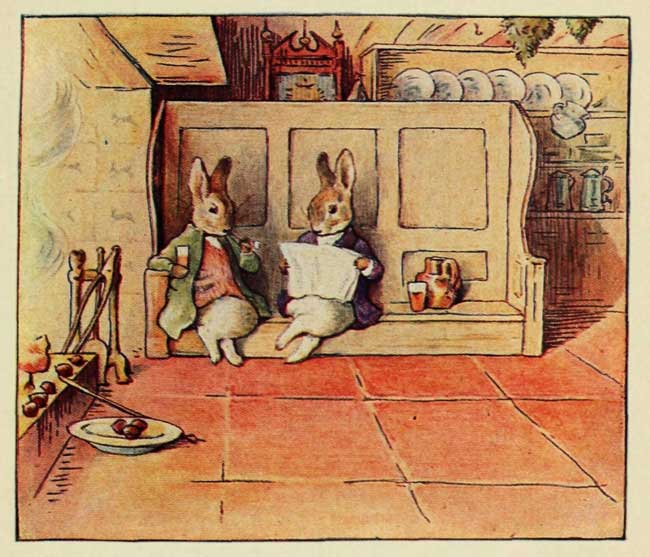
Two Rabbits, One Reading, One Smoking and Drinking — Beatrix Potter

illus-0007-1