Shakespeare at Dusk — Edward Hopper

“Just mix up a mixture of theolologicophilolological” — Stephen Dedalus on Shakespeare

From Stephen Dedalus’s strange thesis on Shakespeare in episode 9 of James Joyce’s Ulysses–

— And the sense of property, Stephen said. He drew Shylock out of his own long pocket. The son of a maltjobber and moneylender he was himself a cornjobber and moneylender, with ten tods of corn hoarded in the famine riots. His borrowers are no doubt those divers of worship mentioned by Chettle Falstaff who reported his uprightness of dealing. He sued a fellowplayer for the price of a few bags of malt and exacted his pound of flesh in interest for every money lent. How else could Aubrey’s ostler and callboy get rich quick? All events brought grist to his mill. Shylock chimes with the jewbaiting that followed the hanging and quartering of the queen’s leech Lopez, his jew’s heart being plucked forth while the sheeny was yet alive: Hamlet and Macbeth with the coming to the throne of a Scotch philosophaster with a turn for witchroasting. The lost armada is his jeer in Love’s Labour Lost. His pageants, the histories, sail fullbellied on a tide of Mafeking enthusiasm. Warwickshire jesuits are tried and we have a porter’s theory of equivocation. The Sea Venture comes home from Bermudas and the play Renan admired is written with Patsy Caliban, our American cousin. The sugared sonnets follow Sidney’s. As for fay Elizabeth, otherwise carrotty Bess, the gross virgin who inspired The Merry Wives of Windsor, let some meinherr from Almany grope his life long for deephid meanings in the depths of the buckbasket.

I think you’re getting on very nicely. Just mix up a mixture of theolologicophilolological. Mingo, minxi, mictum, mingere.

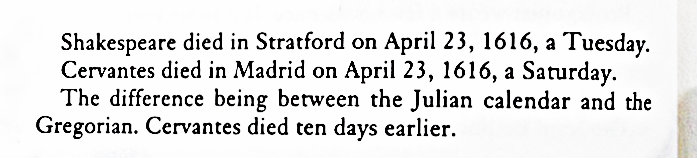
April 23, 1616 (David Markson)

dm


Spectrum Appearance of Banquo — Gustave Doré

Cordelia’s Portion — Ford Madox Brown

Novels That Will Be Considered the Most Important Literary Works of the Twentieth Century in the Year 2100 (According to Dalkey Archive)

Novels That Will Be Considered the Most Important Literary Works of the Twentieth Century in the Year 2100

Nightwood, Djuna Barnes
Malone Dies, Samuel Beckett
Molloy, Samuel Beckett
The Unnamable, Samuel Beckett
The Lime Works, Thomas Bernhard
Nostromo, Joseph Conrad
JR, William Gaddis
The Recognitions, William Gaddis
Ulysses, James Joyce
One Hundred Years of Solitude, Gabriel Garcia Marquez
At Swim-Two-Birds, Flann O’Brien
The Inquisitory, Robert Pinget
Remembrance of Things Past, Marcel Proust
Gravity’s Rainbow, Thomas Pynchon
Mulligan Stew, Gilbert Sorrentino

Speculative list from the Dalkey Archive (from an issue of their journal Context; compiled from responses  of “advisors at universities and bookstores”). I’m sure the fact that they publish several of these titles has nothing to do with these books’ inclusion. I’ve read all of seven of these, some of five of these, and none of three of these.

Ideal Portrait of Shakespeare — Angelica Kauffman

“The Bottle Imp” — Robert Louis Stevenson

“The Bottle Imp” by Robert Louis Stevenson

There was a man of the Island of Hawaii, whom I shall call Keawe; for the truth is, he still lives, and his name must be kept secret; but the place of his birth was not far from Honaunau, where the bones of Keawe the Great lie hidden in a cave.  This man was poor, brave, and active; he could read and write like a schoolmaster; he was a first-rate mariner besides, sailed for some time in the island steamers, and steered a whaleboat on the Hamakua coast.  At length it came in Keawe’s mind to have a sight of the great world and foreign cities, and he shipped on a vessel bound to San Francisco.

This is a fine town, with a fine harbour, and rich people uncountable; and, in particular, there is one hill which is covered with palaces.  Upon this hill Keawe was one day taking a walk with his pocket full of money, viewing the great houses upon either hand with pleasure, “What fine houses these are!” he was thinking, “and how happy must those people be who dwell in them, and take no care for the morrow!”  The thought was in his mind when he came abreast of a house that was smaller than some others, but all finished and beautified like a toy; the steps of that house shone like silver, and the borders of the garden bloomed like garlands, and the windows were bright like diamond; and Keawe stopped and wondered at the excellence of all he saw.  So stopping, he was aware of a man that looked forth upon him through a window so clear that Keawe could see him as you see a fish in a pool upon the reef.  The man was elderly, with a bald head and a black beard; and his face was heavy with sorrow, and he bitterly sighed.  And the truth of it is, that as Keawe looked in upon the man, and the man looked out upon Keawe, each envied the other.

All of a sudden, the man smiled and nodded, and beckoned Keawe to enter, and met him at the door of the house.

“This is a fine house of mine,” said the man, and bitterly sighed.  “Would you not care to view the chambers?”

So he led Keawe all over it, from the cellar to the roof, and there was nothing there that was not perfect of its kind, and Keawe was astonished.

“Truly,” said Keawe, “this is a beautiful house; if I lived in the like of it, I should be laughing all day long.  How comes it, then, that you should be sighing?”

“There is no reason,” said the man, “why you should not have a house in all points similar to this, and finer, if you wish.  You have some money, I suppose?”

“I have fifty dollars,” said Keawe; “but a house like this will cost more than fifty dollars.”

The man made a computation.  “I am sorry you have no more,” said he, “for it may raise you trouble in the future; but it shall be yours at fifty dollars.”

“The house?” asked Keawe. Continue reading ““The Bottle Imp” — Robert Louis Stevenson”

A Week of Kindness Illustration (Woman with Book and Dragon) — Max Ernst